
Zhang K., Li D. Electromagnetic Theory for Microwaves and Optoelectronics
Подождите немного. Документ загружается.

6.6 Circular Dielectric Waveguides and Optical Fibers 371
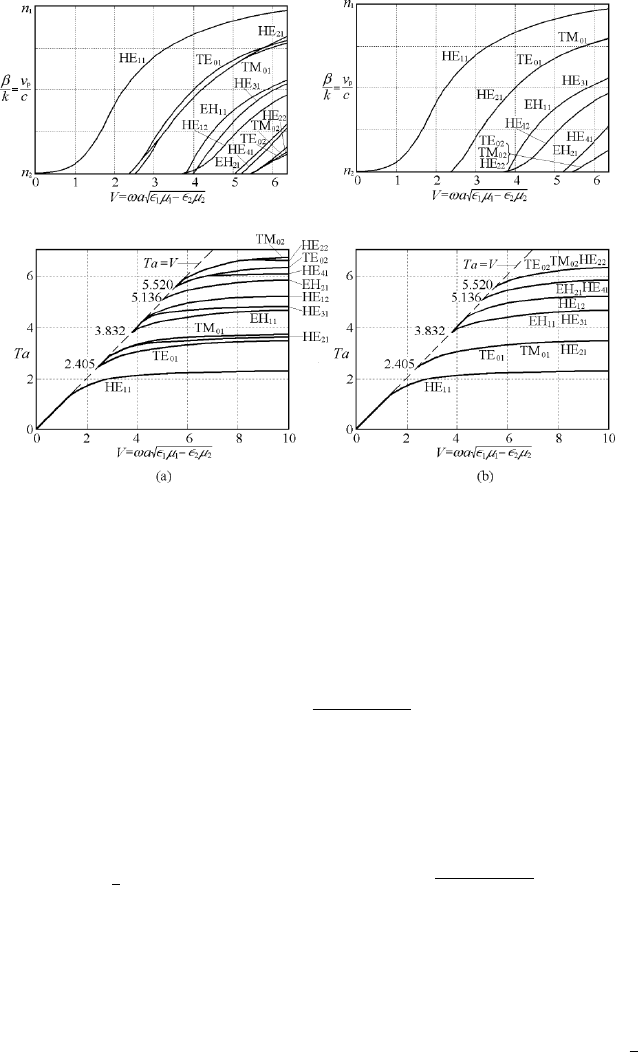
Figure 6.22: Dispersion curves for some lower modes in a circular dielectric
waveguide (a) and weakly guiding fiber (b).
(b) n > 1: For n > 1, the curves are similar to those for n = 1. As an
example, the curves for n = 2 are shown in Fig. 6.21(b).
The right-hand side of (6.259) for EH
nm
modes is a monotonically de-
creasing function of T a which has value zero at T a = 0 and approaches
−∞ as T a gets near V and τa =
p
V
2
− (T a)
2
goes to zero. The left-
hand side of (6.259) is a multi-branched function of T a which behaves like
tan(T a −π/4) for n even or −cot(T a −π/4) for n odd when the value of T a
is large enough. A representative plot of (6.259) for n = 2 is shown in the
lower half of Fig. 6.21(b).
The right-hand side of (6.260) for HE
nm
modes is a monotonically in-
creasing function of T a which has value zero at T a = 0 and takes the value
(V ²
2
)/[2(n − 1)²] as T a approaches V and τa =
p
V
2
− (T a)
2
approaches
zero. The left-hand side of (6.260) is a multi-branched function of T a, which
behaves like −tan(T a −π/4) for n even or cot(T a −π/4) for n odd when the
value of T a is large enough. The function has no root when T a is less than
the value for the function equals (T a)/[2(n − 1)]. A representative plot of
(6.260) for n = 2 is shown in the upper half of Fig. 6.21(b). The dotted line
with slope 1/2(n − 1) represents the lower possible value of T a for the left-
hand side of (6.260) having root, and the dotted line with slope ²
2
/2(n −1)²
372 6. Dielectric Waveguides and Resonators
represents the value of the right-hand side of (6.260) with T a = V .
In Fig. 6.21(a), (b) and the similar figures for n > 2, the intersections
of the lines plotted by functions on left-hand and right-hand sides of the
equations (6.259) or (6.260) represent the guided modes in the waveguide.
The values of T , τ, and β versus ω are then calculated and the dispersion
relations are obtained. The dispersion curves for some lower modes in circular
dielectric waveguide are shown in Figure 6.22a.
(3) Cutoff Conditions for Circularly Asymmetric Modes
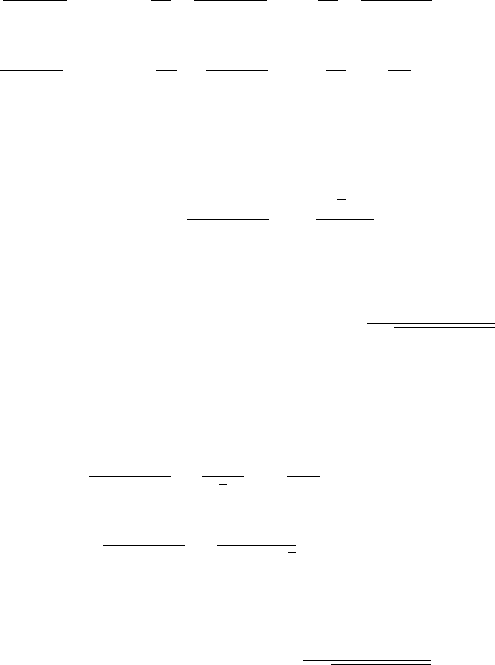
The solutions of the eigenvalue equations (6.259) and (6.260) under the con-
dition of T a = V and τ = 0 give the cutoff conditions of the waveguide. To
do this, we have to examine equations (6.259) and (6.260) for small values of
τa, using the following asymptotic expressions of modified Bessel functions
for small arguments derived from (C.9),
lim
x→0
K
0
n
(x)
xK
n
(x)
= lim
x→0
·
−
n
x
2
−
K
n−1
(x)
xK
n
(x)
¸
=−
n
x
2
−
1
2(n − 1)
, for n > 1, (6.262)
lim
x→0
K
0
1
(x)
xK
1
(x)
= lim
x→0
·
−
1
x
2
−
K
0
(x)
xK
1
(x)
¸
= −
1
x
2
−ln
2
γx
, for n = 1, (6.263)
where γ is Euler’s constant, γ = 1.781.
With these small-value approximations, the eigenvalue equation of EH
modes (6.259) for small τa reduces to
J
n+1
(T a)
J
n
(T a)
= −
2n² T a
²
1
τa
. (6.264)
Hence the cutoff conditions for EH
nm
modes (τa = 0, T a = V ) are given by
J
n
(T a) = 0, T
c
a = x
nm
= V, ω
c
=
x
nm
a
√
µ
1
²
1
− µ
2
²
2
, (6.265)
where x
nm
denotes the mth root of J
n
(x) = 0.
In the same approximation, the eigenvalue equation for HE modes (6.260)
for small τ a reduces to
J
n−1
(T a)
J
n
(T a)
=
²
2
T a
²
ln
µ
2
γτa

, for n = 1, (6.266)
J
n−1
(T a)
J
n
(T a)
=
²
2
T a
2(n − 1)²
, for n > 1. (6.267)
The cutoff conditions for HE
1m
(n = 1) modes (τa = 0, T a = V ) (6.266)
are therefore
J
1
(T a) = 0, T
c
a = x
1m
= V, ω
c
=
x
1m
a
√
µ
1
²
1
− µ
2
²
2
, for n = 1. (6.268)
6.6 Circular Dielectric Waveguides and Optical Fibers 373
Note that, T a = 0 is the first root of equation (6.268), denoted by HE
1m
mode.
For HE
nm
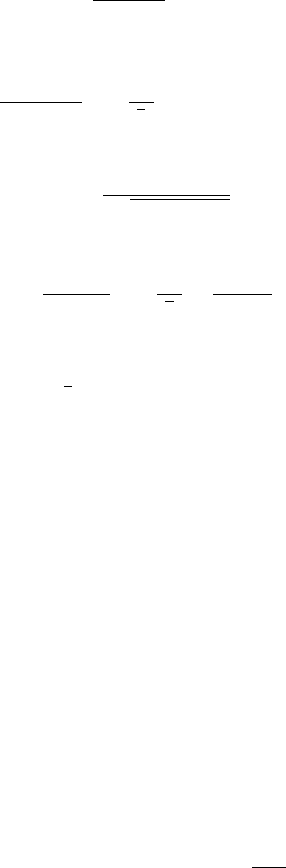
(n > 1) modes, by substitution of the recursion relation
J
n−1
(x) =
x
2(n − 1)
[J
n−2
(x) + J
n
(x)],
the above equation for n > 1 (6.267) is equivalent to
J
n−2
(T a)
J
n
(T a)
= −
∆²
²
, for n > 1, (6.269)
which gives
T
c
a = z
nm
= V, ω
c
=
z
nm
a
√
µ
1
²
1
− µ
2
²
2
, for n > 1, (6.270)
where z
nm
is the mth root of
J
n−2
(z)
J
n
(z)
= −
∆²
²
=
²
2
− ²
1
²
2
+ ²
1
.
The vertical asymptotes of the dashed lines in Fig. 6.21(a) and the lower
half of Fig. 6.21(b) represent the solutions of (6.265) and (6.266). The dotted
line with slope ²
2
/2(n − 1)² in the upper half of Fig. 6.21(b) represents the
right-hand side of (6.267). Its intersections with the multi-branched curves
representing the function J
n−1
(T a)/J
n
(T a) identify the minimum values of
T a for which the corresponding fields can be completely confined in the
waveguide without transverse radiation. These are just the cutoff conditions
for those modes (6.270).
We showed in Section 6.6.1 that, T a = 0 is not the cutoff condition for
TE and TM modes. Similarly, we can see that, the eigenvalue equation of
EH
nm
modes and that of HE
nm
(n > 1) modes for small τa, (6.264) and
(6.267), can not be satisfied by τ a → 0 and T a → 0. So T a = 0 is not the
cutoff condition for all EH
nm
modes and the HE
nm
modes with n > 1. Only
the eigenvalue equation of HE
1m
(n = 1) modes for small τa (6.266) can be
satisfied by τa → 0 and T a → 0. So T a = 0, i.e., T
C
= 0 is the first cutoff
condition of HE
1m
modes, labeled by m = 1, i.e., HE
11
mode. This is just
the lowest mode, i.e., dominant mode for circular dielectric waveguide with
zero cutoff frequency.
In summary, we have the cutoff conditions of circular dielectric waveguide
for all the following eigenmodes.
(1) If n = 0, the cutoff conditions for both EH
0m
and HE
0m
modes are
J
0
(T
c
a) = 0, T
c
=
x
0m
a
, (6.271)
where x
0m
is the mth root of the zeroth order Bessel function. The EH
0m
modes are labeled TE
0m
modes and the HE
0m
modes are labeled TM
0m
modes.
374 6. Dielectric Waveguides and Resonators
(2) The cutoff conditions for EH
nm
modes are
J
n
(T
c
a) = 0, T
c
=
x
n,m
a
, (6.272)
(3) If n = 1, the cutoff conditions for HE
1m
modes are
T
c1
a = 0, T
c1
= 0, (6.273)
and
J
1
(T
cm
a) = 0, T
cm
=
x
1,m−1
a
, (6.274)
where T
c
= 0 is recognized as the first root, m=1, and x
1,m−1
is the (m−1)th
root of the first order Bessel function, m = 2, 3, 4, ···.
(4) If n > 1, the cutoff conditions for HE
nm
modes are
J
n−2
(T a)
J
n
(T a)
=
²
2
− ²
1
²
2
+ ²
1
, T
c
=
z
n,m
a
, (6.275)
where z
nm
are the roots of the above equation, and m is the number labeling
of the roots.
(4) Behavior of EH and HE Modes
Let us now examine the behavior of the EH, HE, TE and TM modes.
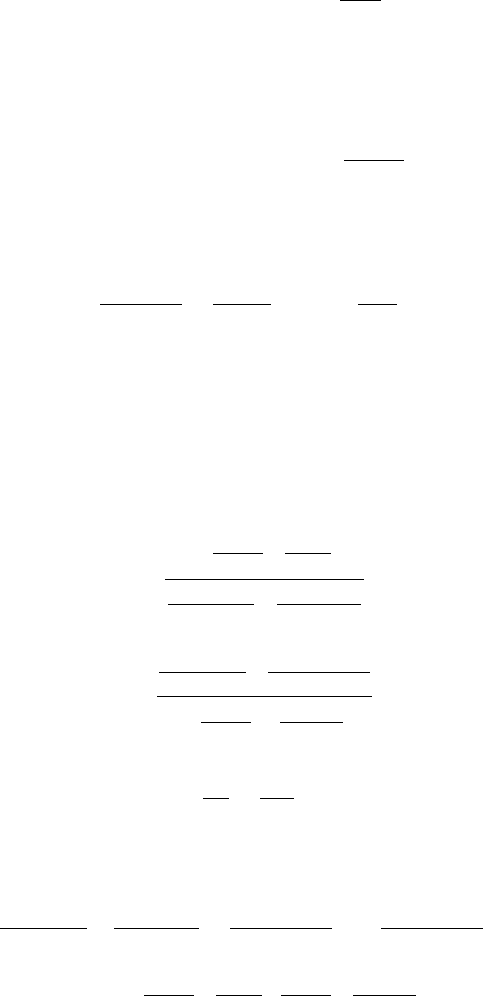
Rewrite the definition of parameter χ (6.214) for nonmagnetic dielectric
waveguide
χ=
n
·
1
(T a)
2
+
1
(τa)
2
¸
J
0
n
(T a)
T aJ
n
(T a)
+
K
0
n
(τa)
τaK
n
(τa)
, (6.276)
or
χ=
J
0
n
(T a)
T aJ
n
(T a)
+
²
2
K
0
n
(τa)
²
1
τaK
n
(τa)
n
·
1
(T a)
2
+
²
2
²
1
(τa)
2
¸
, (6.277)
and
H
z
E
z
=
jβχ
ωµ
0
. (6.278)
From (6.232) and (6.233), for µ
1
= µ
2
= µ
0
, we have the eigenvalue
equations in the following two equivalent forms
J
0
n
(T a)
T aJ
n
(T a)
+
K
0
n
(τa)
τaK
n
(τa)
=
∆²K
0
n
(τa)
²
1
τaK
n
(τa)
±
(
·
∆²K
0
n
(τa)
²
1
τaK
n
(τa)
¸
2
+ n
2
·
1
(T a)
2
+
1
(τa)
2
¸·
1
(T a)
2
+
²
2
²
1
(τa)
2
¸¾
1/2
, (6.279)

6.6 Circular Dielectric Waveguides and Optical Fibers 375
J
0
n
(T a)
T aJ
n
(T a)
+
²
2
K
0
n
(τa)
²
1
τaK
n
(τa)
= −
∆²K
0
n
(τa)
²
1
τaK
n
(τa)
±
(
·
∆²K
0
n
(τa)
²
1
τaK
n
(τa)
¸
2
+ n
2
·
1
(T a)
2
+
1
(τa)
2
¸·
1
(T a)
2
+
²
2
²
1
(τa)
2
¸¾
1/2
, (6.280)
where ∆² = (²
1
− ²
2
)/2. It is to be noted that, although (6.279) and (6.280)
are invariant when n is replaced by −n, but according to (6.276) and (6.277),
χ changes sign under this substitution, and the fields are therefore different
for n and −n.
By the convention adopted in the literature, we label the modes belonging
to (6.232) or (6.259) or with the plus sign on the radical in (6.279) and (6.280)
as EH modes, and the modes belonging to (6.233) or (6.260) or with the minus
sign on the radical in (6.279) and (6.280) as HE modes.
Substituting (6.280) into (6.277), we find that, for EH mo des with a plus
sign on the radical in (6.279) or (6.280), |χ| > 1, i.e.,
χ ≥ 1, for EH
nm
modes, n > 0,
χ ≤ −1, for EH
nm
modes, n < 0,
χ → ∞, for EH
0m
or TE
0m
modes, n = 0.
Substituting (6.279) into (6.276), we find that, for HE modes with a minus
sign on the radical in (6.279) or (6.280), |χ| < 1, i.e.,
−1 < χ < 0, for HE
nm
modes, n > 0,
0 < χ < 1, for HE
nm
modes, n < 0,
χ = 0, for HE
0m
or TM
0m
modes, n = 0.
These inequalities may be proven by estimation with the realization that τa
is a pure real quantity and K
0
n
(τa)/τaK
n
(τa) is accordingly an intrinsically
negative, real quantity.
From (6.278), we find that, the phase of H
z
leads that of E
z
by π/2 for
the wave with χ > 0, and the phase of H
z
lags that of E
z
by π/2 for the wave
with χ < 0. From the above description of χ and n for different modes, we
see that, when n > 0, i.e. for counterclockwise skew waves, for EH modes,
χ ≥ 1 > 0, the phase of H
z
leads that of E
z
by π/2 and for HE modes, χ < 0,
the phase of H
z
lags that of E
z
by π/2; and when n < 0, i.e., for clockwise
skew waves, for EH modes, χ ≤ −1 < 0, the phase of H
z
lags that of E
z
by
π/2 and for HE modes, χ > 0, the phase of H
z
leads that of E
z
by π/2.
From the field-component expressions (6.218)–(6.229), we notice that the
transverse field component is an elliptically polarized field composed of two
circularly polarized fields in opposite senses. First we consider a clockwise
skew wave, n < 0. For EH modes, χ is negative and the sense of the domi-
nant circularly polarized wave components of E and H are counterclockwise
376 6. Dielectric Waveguides and Resonators
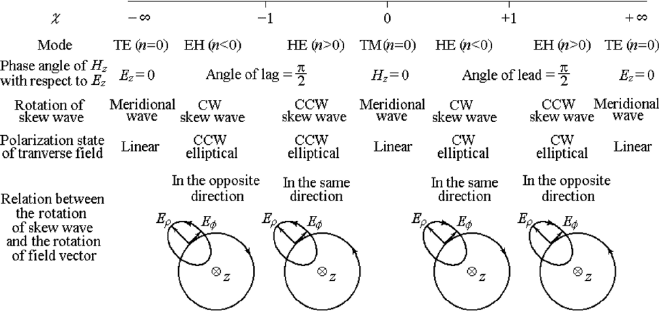
Figure 6.23: Behavior of EH and HE Modes.
circularly polarized, so that the composed E and H are counterclockwise
elliptically polarized. This describes the elliptically polarized wave has trans-
verse field vectors that rotate in a sense opposite to that of the advancing
skew wave. For HE modes, on the other hand, χ is positive and the dominant
circularly polarized transverse components of E and H are clockwise, so that
the elliptically polarized wave whose transverse field vectors have the same
sense of rotation as the advancing skew wave. Second we consider a counter-
clockwise skew wave, n > 0. For EH modes, χ is positive and the transverse
fields are clockwise elliptically p olarized whereas for HE modes, χ is negative
and the transverse fields are counterclockwise elliptically polarized.
Finally we conclude that the transverse field vectors in the elliptically
polarized skew wave of EH modes rotate in an opp osite sense as the skew
wave, refer to Fig. 6.18, whereas the transverse field vectors of HE modes
rotate in the same sense to the skew wave. The above relationship is shown
in Fig. 6.23.
Recall that, as we have mentioned before, in this book, the direction
of the rotation of field vectors is determined by an observer who transmits
the wave, i.e., looks in the direction of propagation. In some literature, the
direction of the rotation of field vectors is determined by an observer who
receives the wave, i.e., looks in the opposite direction, and the clockwise and
counterclockwise of the rotation of polarized field vectors are exchanged.
As we mentioned before, for waveguides made by isotropic material and
isotropic boundaries, the longitudinal phase coefficients for clockwise skew
wave, n < 0, and for counterclockwise skew wave, n > 0, are the same.
Under this condition, the result of superposition of two opposite skew waves
6.6 Circular Dielectric Waveguides and Optical Fibers 377
is a wave of fields with sin nφ or cos nφ dependence, i.e., even symmetric or
odd symmetric modes. These are two orthogonal degenerate mo des.
For n = 0, the EH
0m
and HE
0m
modes become TE
0m
and TM
0m
modes.
They become circularly symmetric modes, i.e., meridional waves.
The field patterns of some lower modes in a circular dielectric waveguide
are shown in Fig. 6.20.
6.6.3 Weakly Guiding Optical Fibers
In typical optical fibers, the refractive index of the core is only slightly larger
than that of the cladding. The difference between the refractive indices of
the core and the cladding is in the range of 1%–5%. So that (n
1
−n
2
)/n
1
¿ 1
and ²
1
≈ ²
2
. This kind of optical fiber is known as the weakly guiding optical
fiber.
For weakly guiding optical fiber, the critical angle on the boundary is
rather large. For guided modes, the angle of incidence must be larger than
the critical angle and close to π/2, i.e. the wave vector of the incident wave
is almost parallel to the z axis. In this case, the longitudinal components of
the fields are much less than the transverse components, and the longitudinal
wave number is approximately equal to the wave number of a plane wave in
the core material, T ¿ β, β =
p
k
2
1
− T
2
≈ k
1
; that is to say, the wave is
close to the TEM mode.
(1) Eigenvalue Equations for Weakly Guiding Fibers
For weakly guiding optical fibers, ²
1
≈ ²
2
and µ
1
= µ
2
= µ
0
. The eigenvalue
equation (6.258) becomes
·
J
n+1
(T a)
T aJ
n
(T a)
+
K
n+1
(τa)
τaK
n
(τa)
¸·
J
n−1
(T a)
T aJ
n
(T a)
−
K
n−1
(τa)
τaK
n
(τa)
¸
= 0. (6.281)
It can be separated into two equations:
T aJ
n
(T a)
J
n+1
(T a)
= −
τaK
n
(τa)
K
n+1
(τa)
, for EH modes, (6.282)
T aJ
n
(T a)
J
n−1
(T a)
=
τaK
n
(τa)
K
n−1
(τa)
, for HE modes. (6.283)
These two eigenvalue equations can also be obtained by applying the weakly
guiding approximation ²
1
≈ ²
2
to equations (6.259) and (6.260) .
From the recurrence formulas for Bessel functions (C.13) and (C.15), we
have
J
n
(x) =
2(n − 1)
x
J
n−1
(x)−J
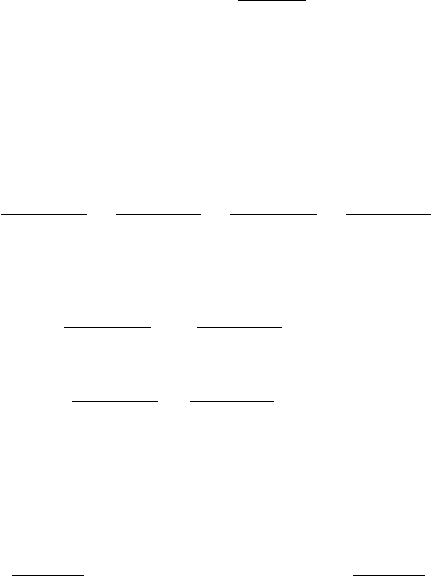
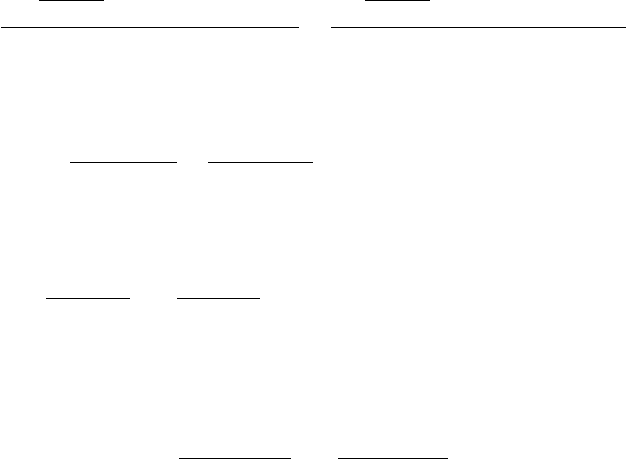
n−2
(x), K
n
(x) =
2(n − 1)
x
K
n−1
(x)+K
n−2
(x).
378 6. Dielectric Waveguides and Resonators
Applying them in (6.283), yields,
T a
·
2(n−1)
T a
J
n−1
(T a) − J
n−2
(T a)
¸
J
n−1
(T a)
=
τa
·
2(n−1)
τa
K
n−1
(τa) −K
n−2
(τa)
¸
K
n−1
(τa)
.
After rearrangement, the eigenvalue equation of HE modes for a weakly guid-
ing fiber becomes
T aJ
n−2
(T a)
J
n−1
(T a)
=
τaK
n−2
(τa)
K
n−1
(τa)
, for HE modes. (6.284)
Under the weakly guiding condition, the eigenvalue equations for TE and TM
modes, (6.235) and (6.236), reduce to the same equation:
T aJ
0
(T a)
J
1
(T a)
= −
τaK
0
(τa)
K
1
(τa)
, for TE and TM modes. (6.285)
From the above discussions we see that, for weakly guiding fibers, the eigen-
value equations for all of EH, HE, TE, and TM modes, (6.282), (6.284) and
(6.285) can be expressed by the universal eigenvalue equation
T aJ
n
0
−1
(T a)
J
n
0
(T a)
= −
τaK
n
0
−1
(τa)
K
n
0
(τa)
, (6.286)
where
n
0
=
1, for TE and TM modes,
n + 1, for EH modes,
n − 1, for HE modes.
(6.287)
(2) Cutoff Conditions for Weakly Guiding Fibers
For weakly guiding fibers, ∆² ≈ 0, the cutoff conditions for HE modes (6.275)
becomes
J
n−2
(T
c
a) = 0. (6.288)
The cutoff conditions of the other modes remain valid. It can be easily seen
that, for weakly guiding fibers, the cutoff conditions for all EH, HE, TE, and
TM modes (6.272), (6.288) and (6.271) can be expressed by the universal
equation
J
n
0
−1
(T
c
a) = 0, (6.289)
where n
0
is identical to that in (6.287).
In the special case of n = 1 for HE modes, there is a zero cutoff HE
11
mode with the cutoff condition
T
c
a = 0.

6.6 Circular Dielectric Waveguides and Optical Fibers 379
(3) Modes and Degeneracy for Weakly Guiding Fibers
The modes and degeneration for weakly guiding fibers are as follows. See
Fig. 6.22b.
(1) The dominant (lowest) mode, HE
11
mode with zero cutoff frequency is
not a circularly symmetric mode, hence it is regarded as two orthogonal po-
larized modes with the same dispersion characteristics that constitute double
degenerate modes.
(2) The cutoff conditions for TE
0m
and TM
0m
modes are the same, and
for a weakly guiding waveguide, the eigenvalue equations are also approx-
imately the same. In this case, they are nearly degenerate modes in the
weakly guiding approximation. Furthermore, the cutoff conditions and the
eigenvalue equations for the two orthogonally polarized HE
2m
modes are the
same as those for TE
0m
and TM
0m
modes, so those modes possess four-mode
degeneracy in the weakly guiding approximation.
(3) When n > 1, it may be easily seen from the universal eigenvalue
equation (6.286) and the universal cutoff equation (6.289) that in the weakly
guiding approximation, the EH
n−1,m
mode and HE
n+1,m
mode are degen-
erate modes, so these modes also possess four-mode degeneracy including
polarization degeneracy.
(4) When n = 1, the cutoff condition for HE
1,m+1
modes are the same
as those for EH
1m
or HE
3m
modes. However, the eigenvalue equations are
different for different modes, none of these modes can be degenerate modes.
The cutoff conditions for some modes in a circular dielectric waveguide
are listed in Table 6.1.
Table 6.1 Modes in a circular dielectric waveguide
number total
modes
cutoff T
c
a of numb er
condition modes of modes
HE
11
T a = 0 0 2 2
TE
01
,TM
01
,HE
21
J
0
(T a)
1
= 0 2.405 4 6
HE
12
,EH
11
,HE
31
J
1
(T a)
1
= 0 3.832 6 12
EH
21
,HE
41
J
2
(T a)
1
= 0 5.136 4 16
TE
02
,TM
02
,HE
22
J
0
(T a)
2
= 0 5.520 4 20
EH
31
,HE
51
J
3
(T a)
1
= 0 6.38 4 24
HE
13
,EH
12
,HE
32
J
1
(T a)
2
= 0 7.01 6 30
EH
41
,HE
61
J
4
(T a)
1
= 0 7.58 4 34
EH
22
,HE
42
J
2
(T a)
2
= 0 8.41 4 38
TE
03
,TM
03
,HE
23
J
0
(T a)
3
= 0 8.65 4 42
EH
51
,HE
71
J
5
(T a)
1
= 0 8.71 4 46
EH
32
,HE
52
J
3
(T a)
2
= 0 9.76 4 50
EH
61
,HE
81
J
6
(T a)
1
= 0 9.93 4 54
The number of modes includes the number of polarization degeneracy
In a multi-mode fiber, there are usually dozens, even hundreds, of guided
modes, but in a single-mode fiber there is only one guided mode, i.e., the
HE
11
mode.
380 6. Dielectric Waveguides and Resonators
6.6.4 Linearly Polarized Modes in Weakly Guiding
Fibers
In weakly guiding optical fibers, the EH
n−1,m
mode and the HE
n+1,m
mode
are nearly degenerate mo des. The two waves are elliptically polarized in
opposite senses with almost equal phase coefficients. This property ensures
that the two modes with the same amplitude will add up to represent a
linearly polarized mode denoted by LP
nm
. The state of linear polarization
will remain during the propagation because the phase coefficients of the two
elliptically polarized waves in opposite senses are approximately equal.
As we have mentioned before, in the weakly guiding approximation, the
longitudinal components of the field are negligible compared with the trans-
verse components and the longitudinal wave number is close to the space
wave number in the core material, β ≈ k
1
.
For a linearly polarized mode in an arbitrary direction on the transverse
section. We choose our coordinate system such that one of the coordinate
axis is along the electric field vector, for an example, one defines the mode
with its transverse electric field in the y direction as y linear polarized mode
or TE
(x)
mode. For TE
(x)
modes, U
(x)
= 0, V
(x)
6= 0, and function V can be
written as the product of a function in ρ, a function in φ, and a function in
z. To satisfy the boundary conditions on the circular cylindrical boundary,
the function must be expressed in terms of cylindrical harmonics.
In region 1, the core, to avoid singularity on the axis ρ = 0, the functions
in ρ must be Bessel functions of the first kind. The functions in φ can either
be even functions or odd functions. So the function V
(x)
1
is given by
V
(x)
1
=AJ
n
(T ρ)
½
cos nφ
sin nφ
¾
e
−jβz
. (6.290)
The transformation from polar coordinates to the cartesian coordinates
in two dimensions is given by
∂
∂x
= cos φ
∂
∂ρ
−
1
ρ
sin φ
∂
∂φ
,
∂
∂y
= sin φ
∂
∂ρ
+
1
ρ
cos φ
∂
∂φ
.
Substituting (6.290) into the field-component expressions in terms of U
(x)
and V
(x)
, (4.153)–(4.158), and using the recurrence formula (C.13) and differ-
ential formula (C.16), we obtain the field components of the linearly polarized
modes in the core:
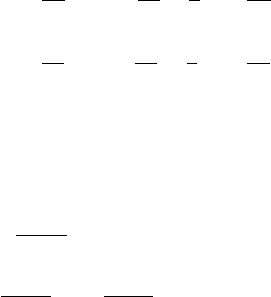
E
y 1
= −jωµ
0
∂V
(x)
1
∂z
= −ωµ
0
βAJ
n
(T ρ)
½
cos nφ
sin nφ
¾
e
−jβz
, (6.291)
E
z1
= jωµ
0
∂V
(x)
1
∂y
= −j
ωµ
0
T
2
A
·
J
n+1
(T ρ)
½
sin (n + 1)φ
−cos (n + 1)φ
¾