
Zhang K., Li D. Electromagnetic Theory for Microwaves and Optoelectronics
Подождите немного. Документ загружается.

6.8 Dielectric Resonators 391
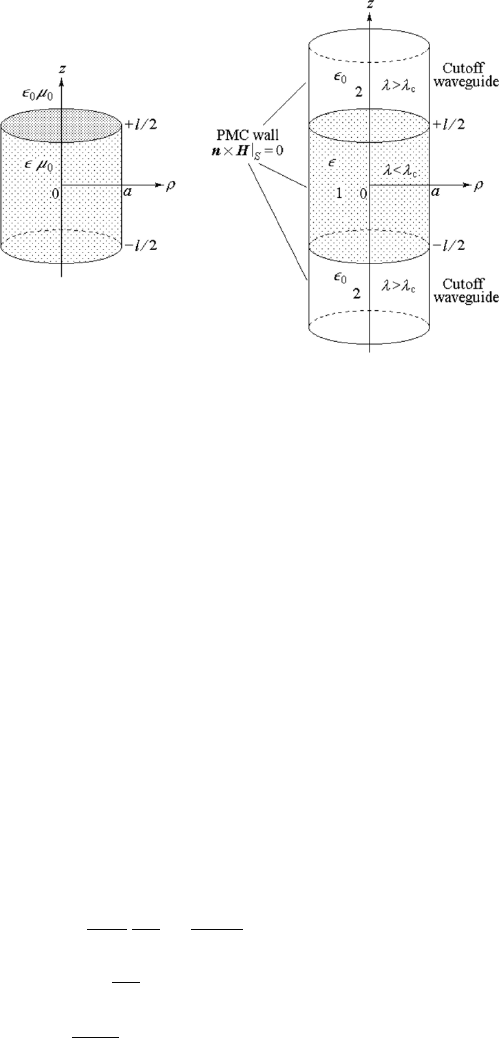
Figure 6.28: Cutoff-waveguide approach for a dielectric resonator.
6.8.2 Cutoff-Waveguide Approach
In the PMC wall model, all the fields outside the dielectric object are ne-
glected. In the improved model, the dielectric resonator is seen as a circular
waveguide with an open-circuit wall at ρ = a. In the waveguide, a segment of
length l is filled with a dielectric, with ², which is the resonator, and beyond
the ends of the resonator, the waveguide either has vacuum inside or is filled
with air. See Fig. 6.28. The fields outside the cylinder of radius a are again
neglected, and the fields inside the cylinder of radius a are taken into account.
In region 1, |z| ≤ l/2, i.e., inside the resonator, the waveguide is in a guiding
state and the fields are standing waves along z. In region 2, |z| ≥ l/2, and
ρ ≤ a, i.e., outside the resonator but inside the waveguide, the waveguide is
in a cutoff state and the fields are decaying fields along +z and −z.
For TE modes, the V function and the field expressions in region 1 are
the same as those in the PMC wall model,
V
1
= AJ
n
(T ρ) cos nφ cos(βz + θ), (6.347)
E
ρ1
= −
jωµ
0
ρ
∂V
∂φ
=
jωµ
0
n
ρ
AJ
n
(T ρ) sin nφ cos(βz + θ), (6.348)
E
φ1
= jωµ
0
∂V
∂ρ
= jωµ
0
T AJ
0
n
(T ρ) cos nφ cos(βz + θ), (6.349)
H
ρ1
=
∂
2
V
∂ρ ∂z
= −βT AJ
0
n
(T ρ) cos nφ sin(βz + θ), (6.350)

392 6. Dielectric Waveguides and Resonators
H
φ1
=
1
ρ
∂
2
V
∂φ ∂z
=
βn
ρ
AJ
n
(T ρ) sin nφ sin(βz + θ), (6.351)
H
z1
= T
2
V = T
2
AJ
n
(T ρ) cos nφ cos(βz + θ)., (6.352)
In region 2, the V function and the fields of cutoff modes are given by
V
2
= BJ
n
(T ρ) cos nφ e
−α(|z|−l/2)
, (6.353)
E
ρ2
=
jωµ
0
n
ρ
BJ
n
(T ρ) sin nφ e
−α(|z|−l/2)
, (6.354)
E
φ2
= jωµ
0
T BJ
0
n
(T ρ) e
−α(|z|−l/2)
, (6.355)
H
ρ2
= −αT BJ
0
n
(T ρ) cos nφ e
−α(|z|−l/2)
, (6.356)
H
φ2
=
αn
ρ
BJ
n
(T ρ) sin nφ e
−α(|z|−l/2)
, (6.357)
H
z2
= T
2
BJ
n
(T ρ) cos nφ e
−α(|z|−l/2)
. (6.358)
The relations between β, α, and T are given by
β
2
+ T
2
= k
2
= ω
2
µ
0
², −α
2
+ T
2
= k
2
0
= ω
2
µ
0
²
0
. (6.359)
The boundary conditions on the side of the waveguide, ρ = a, are again
H
z
(a) = 0 and H
φ
(a) = 0, which give
J
n
(T a) = 0, T
c
=
x
nm
a
. (6.360)
At the end surfaces, |z| = ±l/2, the tangential component of the fields must
be continuous, which gives
E
φ1
(±l/2) = E
φ2
(±l/2)
E
ρ1
(±l/2) = E
ρ2
(±l/2)
¾
→ A cos(βl/2 + θ) = B,
H
φ1
(±l/2) = H
φ2
(±l/2)
H
ρ1
(±l/2) = H
ρ2
(±l/2)
¾
→ βA sin(βl/2 + θ) = αB.
Subtracting the above two equations and canceling A and B, we have
β tan(βl/2 + θ) = α. (6.361)
Considering the symmetry property of the resonator, we know that the fields
must be either even symmetrical or odd symmetrical, i.e.,
θ = 0, for even modes, or θ = π/2, for odd modes,
and (6.361) becomes
β tan(βl/2) = α, β tan(βl/2 + π/2) = α.

6.8 Dielectric Resonators 393
Then we have
βl = 2 arctan(α/β)+pπ =(p+δ)π,
½
p=0, 2, 4, ···, for even modes,
p=1, 3, 5, ···, for odd modes,
(6.362)
where
δ =
2 arctan(α/β)
π
. (6.363)
The modes of the resonator is denoted by TE
n,m,p+δ
and the natural
angular frequency is given by
ω
TE
n,m,p+δ
=
s
β
2
+ T
2
c
µ
0
²
=
s
[(p + δ)π/l]
2
+ (x
nm
/a)
2
µ
0
²
. (6.364)
For the dominant TE mode, the TE
01δ
mode, with n = 0, m = 1, p =
0, β = δπ/l, we have
T =
x
01
a
=
2.405
a
, βl =2 arctan
α
β
, β =
p
ω
2
µ
0
²−T
2
, α =
p
T
2
−ω
2
µ
0
²
0
.
(6.365)
The solution of TM modes can also be obtained by means of the cutoff-
waveguide terminal approach, which we leave as a problem for the reader.
6.8.3 Cutoff-Waveguide, Cutoff-Radial-Line Approach
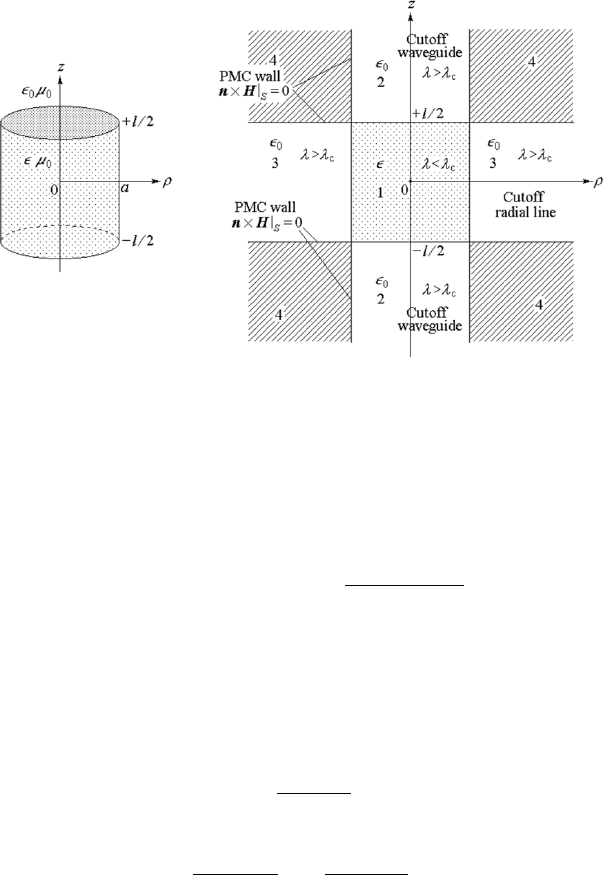
To obtain the exact solution, the whole space needs to be separated into four
regions, shown in Fig. 6.29. In region 1, ρ ≤ a, |z| ≤ ±l/2, i.e., inside the
resonator, the fields are standing waves in both the ρ and the z direction. In
regions 2, ρ ≤ a, |z| ≥ ±l/2, i.e., beyond the end surfaces of the resonator, the
fields are standing waves in the ρ direction and are decaying fields in the ±z
direction. In region 3, ρ ≥ a, |z| ≤ ±l/2, i.e., outside the side surfaces of the
resonator, the fields are standing waves in the z direction and are decaying
fields in the ρ direction. Finally, in regions 4, ρ ≥ a, |z| ≥ ±l/2, the fields
that are decaying in both the ρ and the z direction can be neglected. The
physical model used by the approach is such that beyond the end surfaces
of the resonator lay the cutoff waveguides with perfect magnetic walls and
outside the side surface there should be a cutoff radial line. Therefore, this
approach is known as the cutoff-waveguide, cutoff-radial-line approach. We
are devoted to the circumferential uniform modes for which n = 0.
For TE modes, the V functions in the three regions are given by
V
1
= AJ
0
(T ρ) cos βz, (6.366)
V
2
= BJ
0
(T ρ)e
−α(|z|−l/2)
, (6.367)
V
3
= CK
0
(τρ) cos βz, (6.368)
where
β
2
+ T
2
= k
2
1
= ω
2
µ
0
², −α
2
+ T
2
= k
2
0
= ω
2
µ
0
²
0
, β
2
−τ
2
= k
2
0
= ω
2
µ
0
²
0
.
394 6. Dielectric Waveguides and Resonators
Figure 6.29: Cutoff-waveguide, cutoff-radial-line approach for a dielectric
resonator.
The boundary conditions on the end surfaces are the same as those for
the cutoff-waveguide approach in the last subsection, and we have
βl = (p + δ)π, δ =
2 arctan(α/β)
π
.
From the boundary conditions on the side surface of the cylinder, ρ = a,
E
φ1
(a) = E
φ3
(a) → T AJ
1
(T a) = τ CK
1
(τa),
H
z1
(a) = H
z3
(a) → T
2
AJ
0
(T a) = −τ
2
CK
0
(τa),
we get
C =
T J
1
(T a)
τK
1
(τa)
A, (6.369)
and
T aJ
0
(T a)
J
1
(T a)
= −
τaK
0
(τa)
K
1
(τa)
. (6.370)
This is the eigenvalue equation for the TE
0,m,p+δ
modes for circular cylindri-
cal dielectric resonator. It is similar to that of the circular dielectric waveg-
uide.
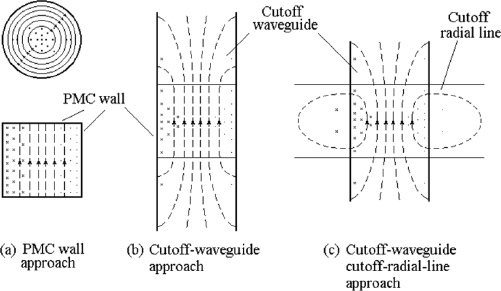
The sketch drawings of the electric and magnetic fields obtained from
the above three approaches on a circular cylindrical dielectric resonator are
shown in Fig. 6.30.
6.8 Dielectric Resonators 395
Figure 6.30: Sketch maps of the electric and magnetic fields for the TE
0,1,δ
mode in a circular cylindrical dielectric resonator.
6.8.4 Dielectric Resonators in Microwave Circuits
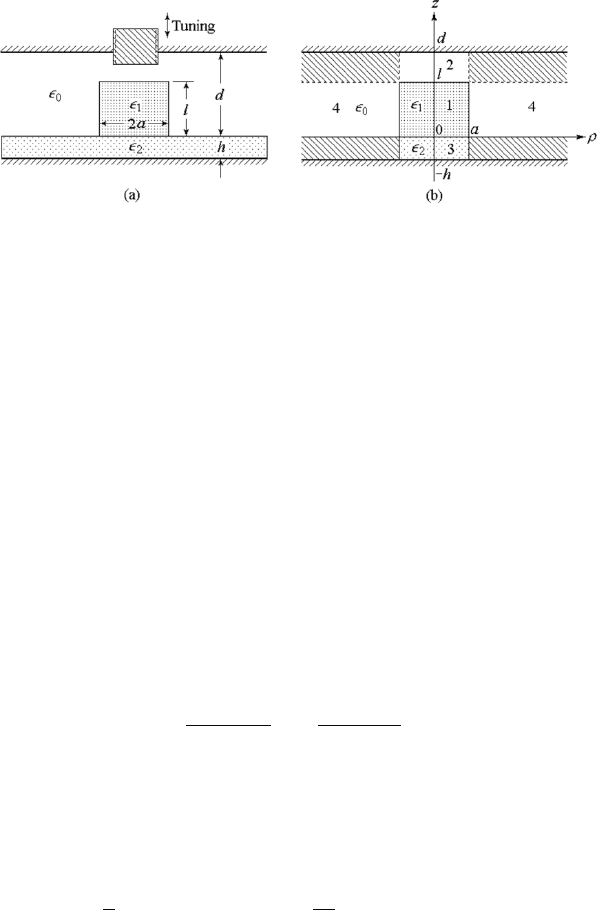
In microwave integrated circuits or strip-line circuits, the dielectric resonator
is practically mounted on a dielectric substrate with much lower permittivity
than that of the resonator. Below the substrate and on top of the resonator,
metallic plates are placed for use as the casing. See Fig. 6.31a. The p ermit-
tivity of the resonator, region 1, is ²
1
, the permittivities of regions 2 and 4
are ²
0
, and the permittivity of region 3 is ²
3
, ²
0
< ²
3
¿ ²
1
. See Figure 6.31b.
For TE modes, the V functions and the field components in the four
regions are given by
V
1
= AJ
0
(T ρ) sin(βz + θ), (6.371)
E
φ1
= −jωµ
0
T AJ
1
(T ρ) sin(βz + θ), (6.372)
H
ρ1
= −βT AJ
1
(T ρ) cos(βz + θ), (6.373)
H
z1
= T
2
AJ
0
(T ρ) sin(βz + θ), (6.374)
V
2
= BJ
0
(T ρ) sinh[α
2
(d − z)], (6.375)
E
φ2
= −jωµ
0
T BJ
1
(T ρ) sinh[α
2
(d − z)], (6.376)
H
ρ2
= α
2
T BJ
1
(T ρ) cosh[α
2
(d − z)], (6.377)
H
z2
= T
2
BJ
0
(T ρ) sinh[α
2
(d − z)], (6.378)
V
3
= CJ
0
(T ρ) sinh[α
3
(z + h)], (6.379)
E
φ3
= −jωµ
0
T CJ
1
(T ρ) sinh[α
3
(z + h)], (6.380)
H
ρ3
= −α
3
T CJ
1
(T ρ) cosh[α
3
(z + h)], (6.381)
H
z3
= T
2
CJ
0
(T ρ) sinh[α
3
(z + h)], (6.382)
396 6. Dielectric Waveguides and Resonators
Figure 6.31: Practical dielectric resonator in microwave integrated circuits.
V
4
= DK
0
(τρ) sin(βz + θ), (6.383)
E
φ4
= −jωµ
0
τDK
1
(τρ) sin(βz + θ), (6.384)
H
ρ4
= −βτ DK
1
(τρ) cos(βz + θ), (6.385)
H
z4
= τ
2
DK
0
(τρ) sin(βz + θ), (6.386)
where
β
2
+ T
2
= k
2
1
= ω
2
µ
0
², (6.387)
β
2
− τ
2
= k
2
0
= ω
2
µ
0
²
0
, (6.388)
−α
2
2
+ T
2
= k
2
0
= ω
2
µ
0
²
0
, (6.389)
−α
2
3
+ T
2
= k
2
3
= ω
2
µ
0
²
3
. (6.390)
Applying the argument that the boundary condition on the side surface,
ρ = a is such that tangential components of both electric and magnetic fields
are continuous, we have the same eigenvalue equation as that in the last
subsection:
T aJ
0
(T a)
J
1
(T a)
= −
τaK
0
(τa)
K
1
(τa)
. (6.391)
Applying the argument that the boundary condition on the top-end surface,
z = l, we write E
φ1
(l) = E
φ2
(l) and H
ρ1
(l) = H
ρ2
(l), which immediately
gives
β cot(βl + θ) = α
2
coth[α
2
(d − l)],
and then
π
2
− (βl + θ) = arctan
½
α
2
β
coth[α
2
(d − l)]
¾
. (6.392)
Applying the same argument about the boundary condition on the bottom-
end surface, z = 0 as on the top-end surface, we write E
φ1
(0) = E
φ2
(0) and
H
ρ1
(0) = H
ρ2
(0), which gives
β cot θ = −α
2
coth(α
4
h), (6.393)

Problems 397
π
2
− θ = −arctan
·
α
3
β
coth(α
4
h)
¸
. (6.394)
From (6.392), (6.393) and (6.394), it follows that
βl = arctan
½
α
2
β
coth[α
2
(d − l)]
¾
+ arctan
·
α
3
β
coth(α
4
h)
¸
+ pπ. (6.395)
The natural angular frequency of the resonator is then found from equa-
tions (6.387), (6.389), (6.391), and (6.395). It can be seen that the natural
frequency of the resonator is determined not only by the size of the resonator
but also by the spacing d −l. Hence the resonator can be tuned by adjusting
a bolt on the top cover of the casing.
Problems
6.1 Show that the boundary conditions of the waveguide shown in Fig. 6.1b
can be satisfied by the fields of LSE
(y )
or LSM
(y )
modes.
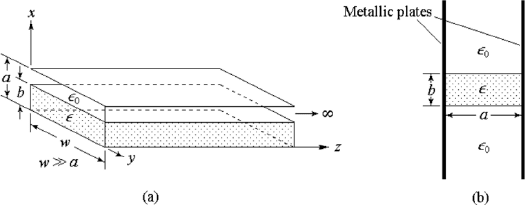
6.2 Find the fields and the propagation characteristics of the parallel-plate
transmission line, partially filled with dielectric material, shown in
Fig. 6.32(a). Suppose that the widths of the plates are much larger
than the spacing between the plates.
6.3 Find the change in the cutoff frequency due to filling of dielectric in the
metallic waveguide shown in Fig. 6.1a by using the method of perturba-
tion. Compare the result with that of the field analysis in Section 6.1.
6.4 A dielectric waveguide made of high permittivity material (for example
²
r
> 30) can be analyzed approximately by means of the open-circuit
boundary model. Find the field components, eigenvalue equation, and
the propagation characteristics of a rectangular waveguide enclosed by
open-circuit boundaries. Show that this is the dual problem of the
metallic waveguide.
6.5 Find the field components, eigenvalue equation, and the propagation
characteristics of a circular waveguide enclosed by open-circuit bound-
aries. Show that it is the dual problem of the metallic waveguide.
6.6 Find the field components, eigenvalue equation, and the propagation
characteristics of the rectangular waveguide, in which the wide walls
are approximately open-circuit planes and the narrow walls are approx-
imately short-circuit planes. It is the large permittivity approximation
of the dielectric H-type waveguide given in the next problem.
398 6. Dielectric Waveguides and Resonators
Figure 6.32: (a) Problem 6.2. Parallel-plate line, partially filled with dielec-
tric material, (b) Problem 6.7. H-type waveguide.
6.7 Find the field components, eigenvalue equation, and the propagation
characteristics of the H-type waveguide shown in Fig. 6.32(b). Suppose
the permittivity of the dielectric is not very large.
6.8 Find the field components, eigenvalue equation, and the propagation
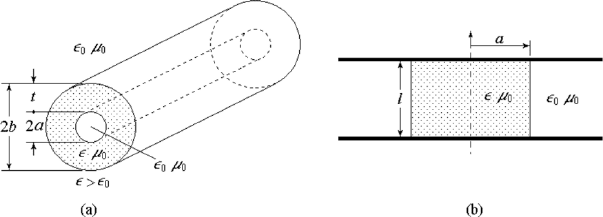
characteristics of the circularly symmetric TE and TM modes in the
circular dielectric tube shown in Figure 6.33(a).
6.9 Find the field components, eigenvalue equation, and the propagation
characteristics of the circularly symmetric TM modes in the circular
metallic waveguide coated with a dielectric layer on the inner wall. The
inner radius of the waveguide is a, the inner radius of the dielectric layer
is b and the permittivity of the dielectric material is ².
6.10 Show that for axial asymmetrical, i.e., angular nonuniform fields, the
TE or TM modes alone cannot satisfy the dielectric boundary condi-
tions of waveguides given in Problems 6.8, 6.9 and Section 6.7.
6.11 For the case when the permittivity of the dielectric is very large
(²
r
> 30), repeat problem 6.8 by using the model of a perfect mag-
netic conducting wall and compare the results with those found for the
coaxial line.
6.12 Find the fields and the natural frequencies of the TM modes of a circular
cylindrical dielectric resonator by using the cutoff-waveguide approach.
6.13 Find the fields and the natural frequencies of a circular cylindrical di-
electric resonator between two metallic plate at the two ends. Suppose
the permittivity of the dielectric is very large. Refer to Fig. 6.33(b).
6.14 Repeat the last problem for the case when the permittivity of the di-
electric is not very large.
Problems 399
Figure 6.33: (a) Problem 6.8. Circular dielectric tube, (b) Problem 6.13.
Cylindrical dielectric resonator between two metallic plate.
6.15 A dielectric cylinder of radius b and permittivity ² is inserted in a
cylindrical cavity with radius a and length l along the axis. Find the
natural frequency of the TM
010
mode and compare the result to that
of problem 5.17.
6.16 (1) Derive the eigenvalue equation and the field components of the TE
modes for an asymmetrical planar dielectric waveguide by using the
field-matching method.
(2) Derive the eigenvalue equation and the field components of the TM
modes for an asymmetrical planar dielectric waveguide by using the
impedance-matching method.
6.17 An asymmetrical dielectric slab waveguide is constructed by growing
a GaAs layer on the AlGaAs substrate. The index of the AlGaAs
substrate is n
2
= 3.5, that of the GaAs guiding layer is n
1
= 1.03n
2
and the cladding is air, n
3
= 1. Find the maximum thickness of the
guiding layer so that the waveguide operating in single-mode state for
the wavelength larger than λ = 1 µm.
6.18 A single-mode optical fiber is made of fused silica, the refraction indices
of the cladding and the core are n
2
= 1.518 and n
1
= 1.015n
2
= 1.541,
respectively, and the diameter of the core is 2a = 4 µm. Find the cutoff
wavelength of the mo de next to the dominant mode.
6.19 (1) Find the maximum radius of a single-mode optical fiber operating
at wavelength 1.3µm. The fiber is made of the same material as that
of the last problem.
(2) Repeat the last question for a multi-mode optical fiber with 50
modes propagating in the fiber.
400 6. Dielectric Waveguides and Resonators
6.20 Find the field components and eigenvalue equations for the x linear
polarized modes in a weekly guiding optical fiber.
6.21 Prove that the fields with single space harmonic cannot satisfy the exact
boundary conditions for a circular cylindrical dielectric resonator, as it
doesn’t for rectangular dielectric waveguide.
6.22 Show that, if the operating frequency is much higher than the cutoff
frequency, ω À ω
c
, τa → ∞, then the parameter χ of circular dielectric
waveguide is equal to +1 for EH modes and −1 for HE modes, and
the transverse fields in weakly guiding circular dielectric waveguide are
circularly polarized.
EH (χ = +1) HE (χ = −1)
E
ρ1
= jk
1
T AJ
n+1
(T ρ)e
jnφ
e
−jβz
−jk
1
T AJ
n−1
(T ρ)e
jnφ
e
−jβz
E
φ1
= k
1
T AJ
n+1
(T ρ)e
jnφ
e
−jβz
k
1
T AJ
n−1
(T ρ)e
jnφ
e
−jβz
E
z1
= T
2
AJ
n
(T ρ)e
jnφ
e
−jβz
T
2
AJ
n
(T ρ)e
jnφ
e
−jβz
H
ρ1
= −(k
1
/η
1
)T AJ
n+1
(T ρ)e
jnφ
e
−jβz
−(k
1
/η
1
)T AJ
n−1
(T ρ)e
jnφ
e
−jβz
H
φ1
= j(k
1
/η
1
)T AJ
n+1
(T ρ)e
jnφ
e
−jβz
−j(k
1
/η
1
)T AJ
n−1
(T ρ)e
jnφ
e
−jβz
H
z1
= j(1/η
1
)T
2
AJ
n
(T ρ)e
jnφ
e
−jβz
−j(1/η
1
)T
2
AJ
n
(T ρ)e
jnφ
e
−jβz