
Zhang K., Li D. Electromagnetic Theory for Microwaves and Optoelectronics
Подождите немного. Документ загружается.

Chapter 7
Periodic Structures and
the Coupling of Modes
In microwave band, there are two types of charged-particle-field interaction
devices, amplifiers and particle accelerators. In the amplifier, kinetic energy
or potential energy of charged-particles is converted into the energy of the
field, and the wave is strengthened. On the contrary, in the accelerator, the
energy of the field is converted into the kinetic energy of charged-particles,
and the particle is accelerated.
During the operations of traveling wave interaction devices, such as
traveling-wave amplifiers or linear accelerators, the electron or ion beam is
to interact with an electromagnetic wave effectively. For this purpose, the
charged particles (electrons or ions) need to be kept in phase with a retarding
field in the amplifiers’ case or an accelerating field in the accelerators’ case
over a long distance. This means that the phase velocity of the wave need
to be roughly equal to the average velocity of the charged particles, for the
phase velocity is the velocity with which an observer would have to move so
as to always be able to remain in the same phase of the wave. Since electrons
and ions can be accelerated only to velocities less than the velocity of light,
we need to look for electromagnetic structures capable of sustaining waves
propagating with phase velocities less than that of a plane wave in free space,
i.e., the speed of light. Such waves are called slow waves and the structures
capable of having slow waves propagating along them are called slow-wave
structures or slow-wave systems.
The slow waves are also used in many devices in which the electromagnetic
wave is to interact with a surface acoustic wave (SAW), a magnetostatic wave
(MSW), and those waves with phase velocities less than the speed of light.
In dielectric waveguides, the longitudinal phase velocity for the guided
mode is larger than the plane-wave phase velocity in the dielectric material
the core is made of, so one has fast waves in the core. For fast waves, the fields
402 7. Periodic Structures and the Coupling of Modes
are standing waves in the transverse direction. Although the longitudinal
phase velocity in the cladding is equal to that in the core, the permittivity
of the medium of which the cladding is made is less than that of the core,
so that the plane-wave phase velocity in the cladding is larger than that in
the core; consequently, the guided mode in the cladding for which the fields
are decaying fields in the transverse direction is a slow wave. Therefore, all
the dielectric waveguides, dielectric coated metallic planes, dielectric coated
metallic rods, and metallic waveguides with dielectric coating on the inner
walls can properly be viewed as slow-wave structures.
In this chapter, we will discuss the slow-wave structures with metallic
boundaries, which suit application in many devices, especially high-power
devices, for which small attenuation and high-power capacity are demanded.
In Chapter 4, we have seen that a system bounded by short-circuit or
open-circuit boundaries, for example uniform smooth conductors can sup-
port only TEM-wave and fast-wave modes, because the fields confined by ho-
mogeneous boundary conditions must be Laplacian fields or standing waves.
Therefore, the boundaries of a system in which the slow waves can be sup-
ported must be impedance boundaries. Consequently, the metallic slow-wave
structures needs to be constructed with nonuniform or periodic boundaries
and is known as a periodic structure or periodic system. The structure can
be analyzed approximately as a uniform system when the spatial period is
much less than the guided wavelength, which means that the phase shift in
a period is infinitesimally small. On the contrary, if the spatial period is
comparable to or larger than the guided wavelength, field theory must be
developed for periodic systems.
Much of the mathematics and arguments employed in studying periodic
transmission structures is the same as used in studying the phenomena of
light (including x-rays) or electrons passing through a crystal lattice and the
artificial photonic crystals.
In the remainder of this chapter, a coupled-mode formalism in space is
given and, as examples, waveguide couplers and distributed feedback struc-
tures (DFB) are discussed. The coupled-mode theory is used not only for
treating electromagnetic wave modes, but also for studying all the phenom-
ena involving interaction of waves.
7.1 Characteristics of Slow Waves
7.1.1 Dispersion Characteristics
The relation between phase velocity v
p
and frequency f is known as dispersion
Characteristics or dispersion relations of the transmission system.
Alternative expressions for the dispersion characteristics are the ω–β di-
agram and the k–β diagram.
We know that the slope of the straight line connecting the origin and a
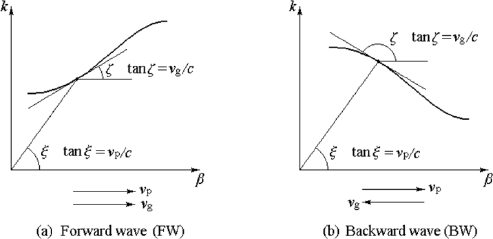
7.1 Characteristics of Slow Waves 403
Figure 7.1: Dispersion curves, phase velocity, and group velocity for FW (a)
and BW (b) of guided wave structures.
certain point on the ω–β curve represents the phase velocity v
p
, and that the
slope of the line tangential to the curve at that point represents the group
velocity v
g
. The corresponding slopes defined on the k–β diagram represent
the slow-wave ratios v
p
/c and v
g
/c, respectively.
Two typical k–β diagrams describing the characteristics of slow-wave
structures are shown in Fig. 7.1. It is easily seen that for the wave shown in
Figure 7.1(a), the phase velocity points in the same direction as the group
velocity. This kind of wave is known as a forward wave, denoted by FW.
All guided modes in common transmission lines, metallic waveguides, and
dielectric waveguides discussed in the previous chapters are forward waves.
On the contrary, in Problem 3.7, we found that for the transmission line
of high-pass filter type, which consists of distributed series capacitance and
shunt inductance, the phase coefficient β decreases with frequency. That is
to say, the slope of the line tangential to the ω–β curve is negative, so that
the group velocity and the phase velocity are in opposite directions. This
kind of wave is known as a backward wave, denoted by BW; see Fig. 7.1(b).
Generally speaking, in a guided wave system, some of the modes are forward
waves and some are backward waves.
The k–β curve in the upper half of the plane above 45
◦
line, i.e., k = β
line, or area covered by k > β, represents a fast wave, and that in the lower
half of the plane below 45
◦
line, or area covered by k < β, represents a slow
wave.
7.1.2 Interaction Impedance
In traveling-wave amplifiers, particle accelerators and other active devices,
the charged particle (electron or ion) beam is to interact with the longitu-
dinal component of the electric field. The effectiveness of the interaction
404 7. Periodic Structures and the Coupling of Modes
is described by a parameter called the coupling impedance or interaction
impedance, which is a measure of the strength of the electric field, usually
the z component, of a given mode referred to the total power flow carried by
the mode.
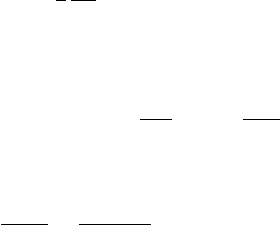
K =
1
2
U
2
P
,
where U denotes the amplitude of the effective voltage across two points
separated by a quarter wavelength along the longitudinal direction:
U =
Z
λ
z
/4
0
E
z
dz =
Z
λ
z
/4
0
E
zm
sin
µ
2πz
λ
z

dz =
E
zm
β
.
By substituting the expression for U into the expression for K, we have
K =
E
2
zm
2β
2
P
=
E
2
zm
2β
2
v
g
W
, (7.1)
where E
zm
is the amplitude of the longitudinal electric field, P is the total
power flow carried by the given mode and W is the energy of the mode stored
in the system of unit length.
7.2 A Corrugated Conducting Surface
as a Uniform System
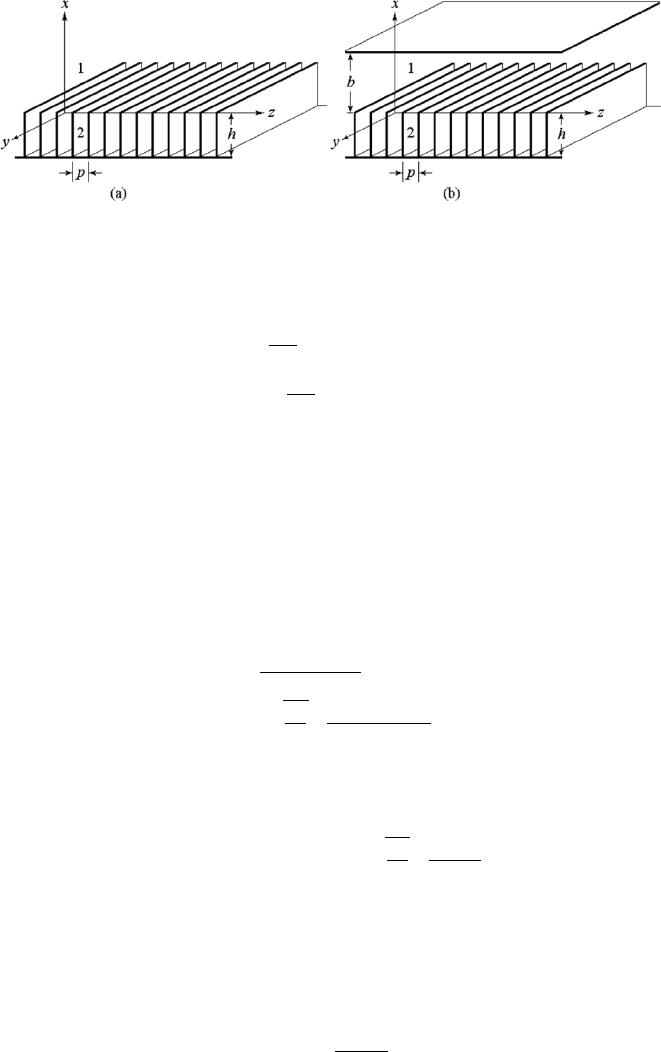
The dielectric coated conducting plane introduced in Section 6.3 and Fig. 6.2b
is a typical uniform planar slow-wave structure. In the case of the metallic
structure, a corrugated conducting surface is used instead of the dielectric
coating; see Fig. 7.2. If the spatial period of the structure is much less than
the longitudinal wavelength, p ¿ λ
z
, so that the phase shift in one period
is infinitesimally small, βp ¿ 2π, the system can be analyzed approximately
by means of the uniform system model.
7.2.1 Unbounded Structure
In the unbounded structure or open structure shown in Fig. 7.2(a), the field
extends to infinity in the +x direction. We are interested in the TM modes
with fields uniform in the y direction; V = 0 and U(x, z) 6= 0.
In region 1, the upper half-space, 0 ≤ x ≤ ∞, For a slow wave, U function
is required to be an exponentially decaying function with respect to x, e
−τx
and have a traveling wave form in z, e
−jβz
. Consequently
U = Ae
−τx
e
−jβz
, (7.2)
and
E
z1
= −τ
2
U = −τ
2
Ae
−τx
e
−jβz
, (7.3)
7.2 A Corrugated Conducting Surface as a Uniform System 405
Figure 7.2: Corrugated conducting surface, (a) unbounded structure, (b)
bounded structure.
E
x1
= −jβ
∂U
∂x
= jβτ Ae
−τx
e
−jβz
, (7.4)
H
y 1
= −jω²
0
∂U
∂x
= jω²
0
τAe
−τx
e
−τx
, (7.5)
where
β
2
− τ
2
= k
2
= ω
2
µ
0
²
0
. (7.6)
In region 2, the corrugated region, −h ≤ x ≤ 0, the space between each
pair of plates can be viewed as a parallel-plate transmission line with a short-
circuit plane at x = −h. Since p ¿ λ
z
, βp ¿ 2π, the only mode that has
to be considered is the TEM mode propagating in the ±x directions, and
the phase shift along z can be considered as an approximately continuous
function, e
−jβz
. Hence we have
E
z2
= B
sin k(x + h)
sin kh
e
−jβz
, (7.7)
H
y 2
= −j
r
²
0
µ
0
B
cos k(x + h)
sin kh
e
−jβz
. (7.8)
The boundary conditions on the surface, x = 0, are
E
z1
(0) = E
z2
(0) → B = −τ
2
A, (7.9)
H
y 1
(0) = H
y 2
(0) → −j
r
²
0
µ
0
B
cos kh
sin kh
= jω²
0
τA. (7.10)
From (7.9) and (7.10) we get the eigenvalue equation
τh = kh tan kh. (7.11)
Substituting (7.6) into the above equation, we have
βh = ±
kh
cos kh
. (7.12)
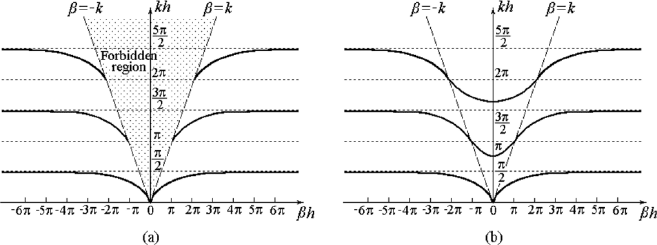
406 7. Periodic Structures and the Coupling of Modes
Figure 7.3: The k–β diagram of the open corrugated conducting surface
structure (a) and the closed structure (b) as uniform systems.
The k–β curves resulting from this dispersion equation are plotted in
Fig. 7.3(a).
It is evident from the dispersion curves in Fig. 7.3(a) that there are pass
bands of TM modes in the range nπ ≤ kh ≤ (n + 1/2)π, n = 0, 1, 2, ···,
and that in between the pass bands there are stop bands. In the pass band,
the length of the shorted parallel-plate line is longer than zero or a certain
even multiple of quarter wavelengths and is shorter than the next-nearest odd
multiple of quarter wavelengths. In this case, the input impedance at x = 0
is an inductance. This is just the requirement that the surface impedance
should support a TM slow wave.
From the eigenvalue equation (7.11), we may argue that if τ is imaginary
and β ≤ k, the root of the equation does not exist in the real frequency
domain. Hence all the dispersion curves of an unbounded corrugated con-
ducting plane are located in the region of β ≥ k and τ must be real. In
the region β ≤ k, τ becomes imaginary; then there are radiation fields in
x direction. In this case, the modes become radiation modes. As a result
of this fact, the region β ≥ k in the k–β diagram is a forbidden region, see
Fig. 7.3(a), and no fast wave can exist in unbounded systems.
The characteristics of the corrugated conducting surface under the condi-
tion p ¿ λ
z
are the same as those of the dielectric coated conducting plane
given in Section 6.3. Thus this kind of metallic structure is known as an
artificial dielectric.
7.2.2 Bounded Structure
If we put a conducting plate over the corrugated conducting surface, it must
become the bounded or closed structure shown in Fig. 7.2(b). We again
consider the TM modes with fields uniform in the y direction.
In region 1, 0 ≤ x ≤ b. For U to be zero at x = b, it must b e a hyperbolic

7.3 A Disk-Loaded Waveguide as a Uniform System 407
sine function, sinh τ (x−b), rather than an exponential function as in an open
system. From this argument we have
U = A sinh τ (x − b)e
−jβz
, (7.13)
E
z1
= −τ
2
A sinh τ (x − b)e
−jβz
, (7.14)
E
x1
= −jβτ A cosh τ(x − b)e
−jβz
, (7.15)
H
y 1
= −jω²
0
τA cosh τ (x − b)e
−τx
. (7.16)
In region 2, the field components here are the same as those in the corre-
sponding region in an open system, (7.7) and (7.8).
By virtue of the same boundary conditions at x = 0 as in an open system,
E
z1
(0) = E
z2
(0) and H
y 1
(0) = H
y 2
(0), we have the following eigenvalue
equation
τb tanh τ b =
b
h
kh tan kh. (7.17)
The solution of this equation along with (7.6) gives the dispersion curves
shown in Fig. 7.3(b). According to this equation, if τ is imaginary then
tanh τ b is also imaginary so as to allow the roots to still exist in the real
frequency domain. Hence, there is no forbidden region in the k–β diagram,
and fast waves do exist in bounded systems.
7.3 A Disk-Loaded Waveguide as a
Uniform System
The disk-loaded waveguide is a circular metallic waveguide loaded with
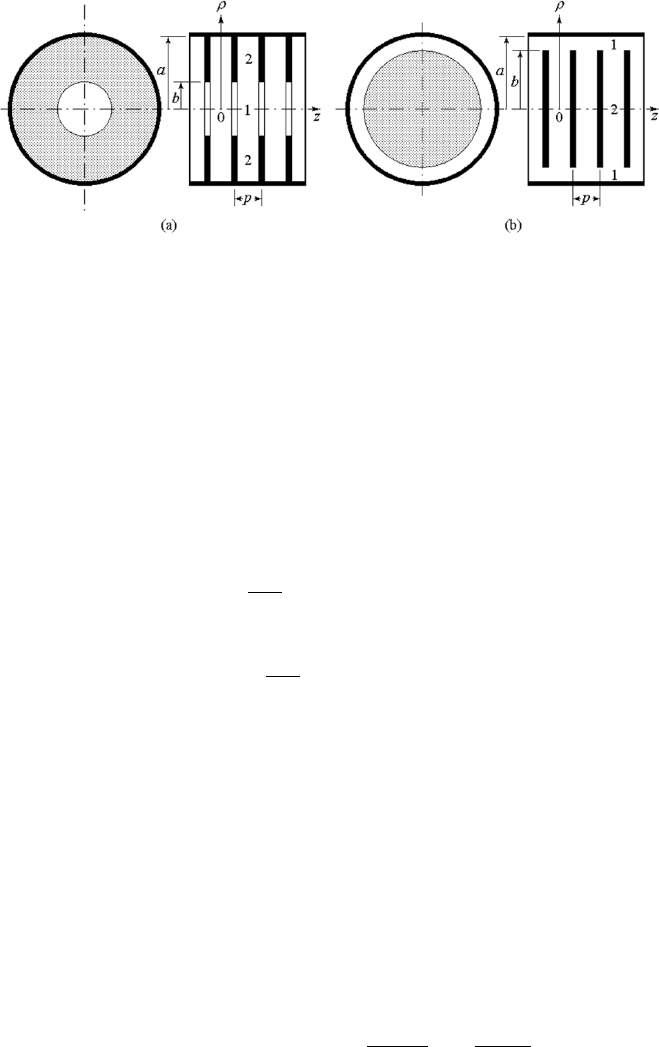
equally spaced metallic disks as shown in Fig. 7.4(a) for center coupling
hole structure, and Fig. 7.4(b) for edge coupling hole structure. The disk-
loaded waveguide is also known as a coupled-cavity-chain structure. Various
slow-wave systems used in traveling wave amplifiers are modified disk-loaded
waveguides or coupled-cavity structures.
7.3.1 Disk-Loaded Waveguide with Center Coupling
Hole
The disk-loaded waveguide with center coupling holes shown in Fig. 7.4(a)
is the guided-wave system used in linear accelerators. At SLAC (Stanford
Linear Accelerator Center), the length of the accelerator extends for 2 miles
(≈ 3 km). The modified disk-loaded waveguides are used in high-power
traveling-wave amplifiers.
We are interested in the azimuthal invariant TM modes, in which the
longitudinal electric field component at the center is suitable for the purpose
of field–electron interaction. The coupling region or slow-wave region ρ ≤ b
is called region 1 and the disk region or cavity region b ≤ ρ ≤ a is called
408 7. Periodic Structures and the Coupling of Modes
Figure 7.4: Disk-loaded waveguide with coupling holes at the center (a) and
at the edge (b).
region 2. Suppose that the spatial period is much less than the longitudinal
wavelength, p ¿ λ
z
, and that the structure can be analyzed as a uniform
system.
In region 1, ρ ≤ b, the azimuthal invariant slow-wave solution in cylin-
drical coordinates is a modified Bessel function of the first kind, I
0
(τρ), with
the coefficient of K
0
(τρ) being zero to avoid singularity on the axis ρ = 0.
Then the U
1
function and field components are given by
U
1
= AI
0
(τρ)e
−jβz
, (7.18)
E
ρ1
= −jβ
∂U
1
∂ρ
= −jβτ AI
1
(τρ)e
−jβz
, (7.19)
E
z1
= −τ
2
U
1
= −τ
2
AI
0
(τρ)e
−jβz
, (7.20)
H
φ1
= −jω²
0
∂U
1
∂ρ
= −jω²
0
τAI
1
(τρ)e
−jβz
, (7.21)
where
β
2
− τ
2
= k
2
= ω
2
µ
0
²
0
. (7.22)
In region 2, b ≤ ρ ≤ a, the space between the disks can be viewed as
a radial line with a short-circuit surface at ρ = a or a cylindrical cavity of
radius a. Under the condition that p ¿ λ
z
, i.e., βp ¿ 2π, only TEM
(ρ)
modes, in other words TM
(z)
0m0
modes, exist in the shorted radial line or
cylindrical cavity. For the same reason as given in the last section, the phase
shift along z can still be considered as an approximately continuous function,
e
−jβz
. Hence we have the solution with the standing wave in ρ as follows
U
2
= [B
1
J
0
(kρ) + B
2
N
0
(kρ)]e
−jβz
.
In satisfying the short-circuit boundary condition at ρ = a, we have
B
1
J
0
(ka) + B
2
N
0
(ka) = 0,
B
1
N
0
(ka)
= −
B
2
J
0
(ka)
= B.
7.3 A Disk-Loaded Waveguide as a Uniform System 409
Figure 7.5: The dispersion curves of disk-loaded waveguide with coupling
holes at the center (a) and at the edge (b).
Then U
2
and the field components become
U
2
= B[N
0
(ka)J
0
(kρ) − J
0
(ka)N
0
(kρ)]e
−jβz
, (7.23)
E
z2
= k
2
U
2
= k
2
B[N
0
(ka)J
0
(kρ) − J
0
(ka)N
0
(kρ)]e
−jβz
, (7.24)
H
φ2
= −jω²
0
∂U
2
∂ρ
= jω²
0
kB[N
0
(ka)J
1
(kρ) − J
0
(ka)N
1
(kρ)]e
−jβz
, (7.25)
In order to satisfy the continuous conditions of tangential field components
on the cylindrical boundary ρ = b, E
z1
(b) = E
z2
(b), and H
φ1
(b) = H
φ2
(b),
we must have
−τ
2
AI
0
(τb) = k
2
B[N
0
(ka)J
0
(kb) − J
0
(ka)N
0
(kb)], (7.26)
−jω²
0
τAI
1
(τb) = jω²
0
kB[N
0
(ka)J
1
(kb) − J
0
(ka)N
1
(kb)]. (7.27)
Dividing the second of the two expressions by the first one, we obtain the
eigenvalue equation
I
1
(τb)
τbI
0
(τb)
=
1
kb
N
0
(ka)J
1
(kb) − J
0
(ka)N
1
(kb)
N
0
(ka)J
0
(kb) − J
0
(ka)N
0
(kb)
. (7.28)
The dispersion relation is determined by this equation and the equation
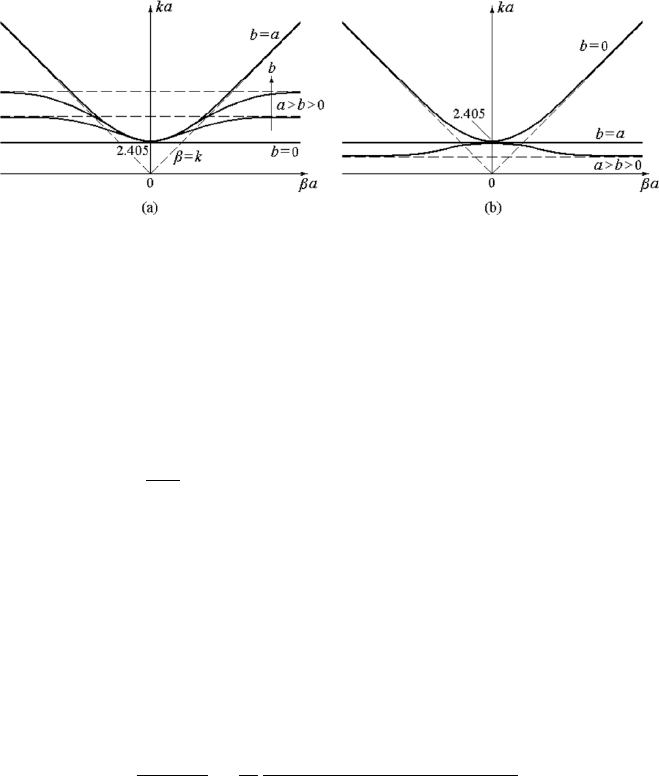
of β and τ , (7.22). The k–β diagram of the dominant TM mode in a disk-
loaded waveguide with coupling holes at the center is given in Fig. 7.5(a).
We see that for a disk-loaded waveguide, there is no forbidden region in the
k–β diagram because it is a b ounded structure.
The lower cutoff frequency of a center-holed disk-loaded waveguide is
equal to the cutoff frequency of the TM
01
mode in the circular waveguide
with radius a, which is the transverse resonant frequency and the longitudinal
phase coefficient becomes zero. This cutoff frequency is independent of the
radius b of the hole, and ka = x
01
= 2.405.

410 7. Periodic Structures and the Coupling of Modes
The higher cutoff frequency of the system is determined by the radius b
of the hole. If b = 0, the system becomes a chain of isolated cavities and the
pass-band width becomes zero, i.e., the upper cutoff frequency is equal to
the lower one. If b = a, the system becomes a hollow circular waveguide, the
upper cutoff frequency becomes infinity, and the system becomes a high-pass
filter. When the radius of the hole b is smaller than the radius of the cavity a
and larger than zero, the system becomes a band-pass filter. The larger the
radius b of the hole, the higher the upper cutoff frequency.
The dominant TM mode in a center-hole disk-loaded waveguide is a for-
ward wave, for which the phase velocity is in the same direction as the group
velocity.
The disk-loaded waveguide can also be considered as a chain of resonant
cavities mutually coupled by the coupling hole. The larger the coupling
coefficient the broader the bandwidth.
7.3.2 Disk-Loaded Waveguide with Edge Coupling Hole
The disk-loaded waveguide with edge coupling holes is shown in Fig. 7.4(b).
In practice, for the passing through of a electron beam, there are also center
holes. The diameter of the center hole is rather small so that the coupling
effect of the center hole can be neglected. We are also interested in the
azimuthal invariant TM modes.
In region 1, b ≤ ρ ≤ a, the azimuthal invariant slow-wave solution are
both the modified Bessel function of the first and the second kinds, I
0
(τρ)
and K
0
(τρ), for the axis ρ = 0 is outside the region. The U
1
function and
field components are given by
U
1
= [A
1
I
0
(τρ) + A
2
K
0
(τρ)]e
−jβz
.
For satisfying the boundary condition on the wall of the waveguide r = a, we
must have
U
1
(a) = 0, A
1
I
0
(τa) + A
2
K
0
(τa) = 0
i.e.,
A
1
K
0
(τa)
= −
A
2
I
0
(τa)
= A.
Function U
1
and field components become
U
1
= A[K
0
(τa)I
0
(τρ) − I
0
(τa)K
0
(τρ)]e
−jβz
, (7.29)
E
ρ1
= −jβτ A[K
0
(τa)I
1
(τρ) + I
0
(τa)K
1
(τρ)]e
−jβz
, (7.30)
E
z1
= −τ
2
A[K
0
(τa)I
0
(τρ) − I
0
(τa)K
0
(τρ)]e
−jβz
, (7.31)
H
φ1
= −jω²
0
τA[K
0
(τa)I
1
(τρ) + I
0
(τa)K
1
(τρ)]e
−jβz
, (7.32)
where
β
2
− τ
2
= k
2
= ω
2
µ
0
²
0
. (7.33)