
Zhang K., Li D. Electromagnetic Theory for Microwaves and Optoelectronics
Подождите немного. Документ загружается.


8.9 Nonreciprocal Media 541
These equations may be solved to give
M
x
=
ω
0
ω
M
ω
2
0
− ω
2
H
x
+ j
ωω
M
ω
2
0
− ω
2
H
y
, (8.289)
M
y
= −j
ωω
M
ω
2
0
− ω
2
H
x
+
ω
0
ω
M
ω
2
0
− ω
2
H
y
, (8.290)
M
z
= 0, (8.291)
where
ω
0
= γB
0
= γµ
0
H
0
(8.292)
is the Larmor frequency, and
ω
M
= γµ
0
M
0
(8.293)
is a characteristic frequency that depends on the saturation magnetization of
the material.
The resultant susceptibility tensor that relates the a-c magnetization vec-
tor to the magnetic field vector is
M
1
= χ
m
· H
1
, (8.294)
χ
m
=
χ
1
jχ
2
0
−jχ
2
χ
1
0
0 0 0
, (8.295)
where
χ
1
=
ω
0
ω
M
ω
2
0
− ω
2
, χ
2
=
ωω
M
ω
2
0
− ω
2
. (8.296)
The general macroscopic constitutional relationship in a magnetic mate-
rial is
B
1
= µ
0
(H
1
+ M
1
) = µ · H
1
. (8.297)
Substituting (8.289)–(8.291) into this equation yields
B
1
= µ · H
1
, µ =
µ
1
jµ
2
0
−jµ
2
µ
1
0
0 0 µ
3
, (8.298)
where
µ
1
= µ
0
(1 + χ
1
) = µ
0
³
1 +
ω
0
ω
M
ω
2
0
− ω
2
´
, µ
2
= µ
0
χ
2
= µ
0
ωω
M
ω
2
0
− ω
2
, µ
3
= µ
0
.
(8.299)
We conclude that the permeability tensor for the ferrite with saturated
magnetization in a d-c magnetic field is an asymmetric tensor, and the ferrite
is a magnetic-gyrotropic medium or gyromagnetic medium.
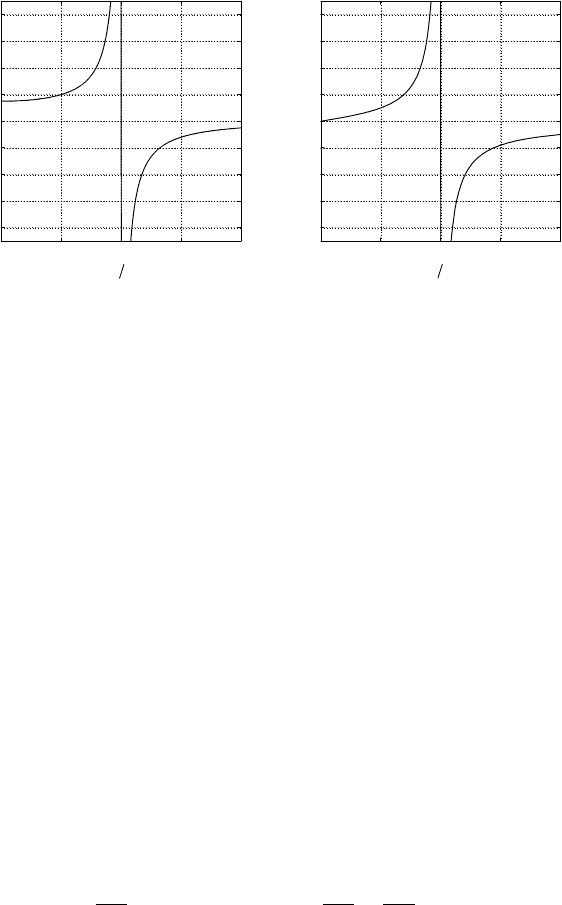
The plots of the elements of susceptibility tensors χ
1
and χ
2
with respect
to frequency are given in Fig. 8.25. When ω = ω
0
, both χ
1
and χ
2
for lossless
ferrites approach infinity. This is the magnetic resonance or ferrimagnetic
resonance. Hence the Larmor frequency ω
0
is also known as the magnetic
resonant frequency.
542 8. Electromagnetic Waves in Dispersive Media and Anisotropic Media
0.0 .5 1.0 1.5 2.0
-8
-6
-4
-2
0
2
4
6
8
0.0 .5 1.0 1.5 2.0
-8
-6
-4
-2
0
2
4
6
8
Z
M
Z
0
F
1
F
2
0
ZZ
0
ZZ
Figure 8.25: Plots of χ
1
and χ
2
with respect to frequency for lossless ferrites.
(2) Lossy Ferrites, Damping
In practice, there are losses associated with the motion of the dipoles in an
actual gyromagnetic medium. The exact details of the mechanisms contribut-
ing to the magnetic losses or the damping of the precessional motion are just
beginning to be understood; refer to [57]. It is, however, more convenient
to represent the loss phenomenologically in the equation of motion. That
is, a term that has the proper dimension and appropriately represents the
experimentally observed result can be added. Historically, there have been
two basic forms of the loss term, the Landau–Lifshitz (L-L) form and the
Bloch–Bloembergen (B-B) form. The L-L form can be intro duced into the
expressions of the constitutional parameters by a simple mathematical pro-
cedure and, since it represents the overall losses adequately in a simple form,
is suitable for describing the wave propagation phenomena. The B-B form,
however, is more useful in describing the individual types of relaxation pro-
cesses and can serve as the basis of the discussion of the physical principles
of relaxation. In this book, only the L-L form will be introduced.
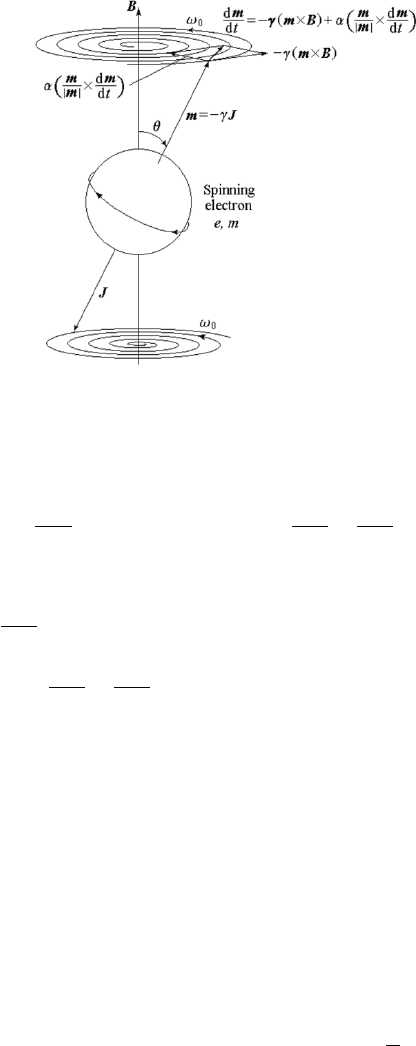
In the Landau–Lifshitz equation, losses present in a ferrite may be ac-
counted for by introducing into the equation of motion (8.277) a damping
term that will produce a torque tending to reduce the precession angle θ, i.e.,
dm
dt
= −γ (m × B) + α
µ
m
|m|
×
dm
dt

, (8.300)
where α is a dimensionless damping factor. The additional damping term
on the right-hand side of (8.300) is a vector perpendicular to m. Thus the
amplitude of the precession angle can be influenced, but the magnitude of
the magnetization vector is not affected by the damping term. See Fig. 8.26.
8.9 Nonreciprocal Media 543
Figure 8.26: Damping of the precession of a spinning electron in lossy ferrite.
Then the equation for the magnetization vector becomes
dM
dt
= −γµ
0
(M × H) + α
µ
M
|M|
×
dM
dt

. (8.301)
Suppose that the material is saturate-magnetized in z direction. Under
the small-amplitude assumption, in the damping term of the above equation,
M ≈
ˆ
zM
0
,
M
|M|
≈
ˆ
z, we obtain
α
µ
M
|M|
×
dM
dt

= (−
ˆ
xjωαM
y
+
ˆ
yjωα M
x
)e
jωt
,
and (8.301) becomes
jωM
1
= −γµ
0
(
ˆ
zM
0
× H
1
+ M
1
×
ˆ
zH
0
) −
ˆ
xjωαM
y
+
ˆ
yjωα M
x
. (8.302)
The components of the equation become
jωM
x
= −(γµ
0
H
0
+ jωα)M
y
+ γµ
0
M
0
H
y
, (8.303)
jωM
y
= −γµ
0
M
0
H
x
+ (γµ
0
H
0
+ jωα)M
x
, (8.304)
jωM
z
= 0. (8.305)
Comparing these equations with those for lossless ferrite, we find that the
only difference between them is that γµ
0
H
0
in (8.286) to (8.288) is replaced
by γµ
0
H
0
+ jωα, so that the Larmor frequency becomes complex:
˙ω
0
= γµ
0
H
0
+ jωα = ω
0
+ jωα = ω
0
+
j
T
, (8.306)

544 8. Electromagnetic Waves in Dispersive Media and Anisotropic Media
where T = 1/ωα denotes the relaxation time of the material.
The solutions of (8.303) to (8.305) are given by
M
x
=
˙ω
0
ω
M
˙ω
2
0
− ω
2
H
x
+ j
ωω
M
˙ω
2
0
− ω
2
H
y
, (8.307)
M
y
= −j
ωω
M
˙ω
2
0
− ω
2
H
x
+
˙ω
0
ω
M
˙ω
2
0
− ω
2
H
y
, (8.308)
M
z
= 0. (8.309)
The resultant susceptibility tensor becomes
χ
m
=
˙χ
1
j ˙χ
2
0
−j ˙χ
2
˙χ
1
0
0 0 0
, (8.310)
where
˙χ
1
= χ
1
0
− jχ
1
00
=
˙ω
0
ω
M
˙ω
2
0
− ω
2
=
(ω
0
+ j/T )ω
M
(ω
0
+ j/T )
2
− ω
2
, (8.311)
˙χ
2
= χ
2
0
− jχ
2
00
=
ωω
M
˙ω
2
0
− ω
2
=
ωω
M
(ω
0
+ j/T )
2
− ω
2
. (8.312)
The permeability tensor becomes
µ =
˙µ
1
j ˙µ
2
0
−j ˙µ
2
˙µ
1
0
0 0 µ
3
, (8.313)
where
˙µ
1
=µ
1
0
− jµ
1
00
=µ
0
(1+ ˙χ
1
)=µ
0
³
1+
˙ω
0
ω
M
˙ω
2
0
− ω
2
´
=µ
0
h
1+
(ω
0
+ j/T )ω
M
(ω
0
+ j/T )
2
− ω
2
i
,
(8.314)
˙µ
2
= µ
2
0
− jµ
2
00
= µ
0
˙χ
2
= µ
0
ωω
M
˙ω
2
0
− ω
2
= µ
0
ωω
M
(ω
0
+ j/T )
2
− ω
2
, (8.315)
µ
3
= µ
0
. (8.316)
The conclusion is that the elements of the permeability tensor for the
lossy ferrite with saturated magnetization become complex values with dis-
persive and dissipative components, and the permeability tensor is no longer
a Hermitian tensor.
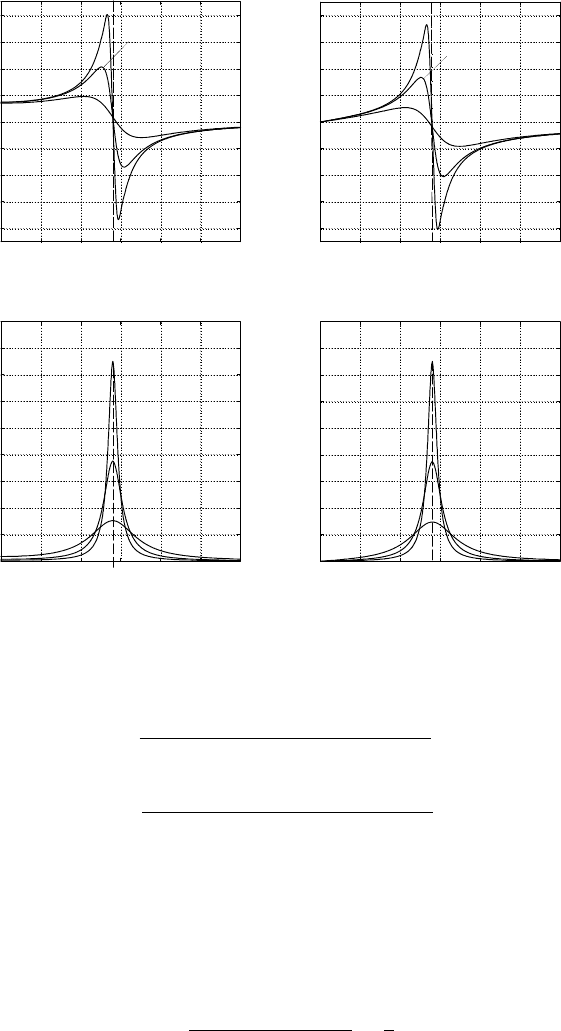
The real and the imaginary parts, i.e., the dispersive and dissipative com-
ponents of susceptibilities are
χ
1
0
=
(ω
M
T )(ω
0
T )
£
(ω
0
T )
2
− (ωT )
2
+ 1
¤
£
(ω
0
T )
2
− (ωT )
2
− 1
¤
2
+ 4(ω
0
T )
2
, (8.317)
χ
1
00
=
(ω
M
T )
£
(ω
0
T )
2
+ (ωT )
2
+ 1
¤
£
(ω
0
T )
2
− (ωT )
2
− 1
¤
2
+ 4(ω
0
T )
2
, (8.318)
8.9 Nonreciprocal Media 545
0 1 2 3 4 5 6
0
2
4
6
8
10
12
14
16
18
F
2
"
0 1 2 3 4 5 6
-8
-6
-4
-2
0
2
4
6
8
F
2
'
f (GHz)
0 1 2 3 4 5 6
0
2
4
6
8
10
12
14
16
18
F
1
"
0 1 2 3 4 5 6
-8
-6
-4
-2
0
2
4
6
8
P
0
M
0
= 0.15 T
'B = 0.01 T
B
0
= 0.1 T
F
1
'
f (GHz)
f
0
f (GHz)
f (GHz)
'B = 0.02 T
'B = 0.05 T
f
0
f
0
f
0
'B = 0.01 T
'B = 0.02 T
'B = 0.05 T
'B = 0.01 T
'B = 0.01 T
'B = 0.02 T
'B = 0.02 T
'B = 0.05 T
'B = 0.05 T
Figure 8.27: Plots of χ
1
0
, χ
1
00
, χ
2
0
and χ
2
00
with respect to frequency for lossy
ferrites.
χ
2
0
=
(ω
M
T )(ωT )
£
(ω
0
T )
2
− (ωT )
2
− 1
¤
£
(ω
0
T )
2
− (ωT )
2
− 1
¤
2
+ 4(ω
0
T )
2
, (8.319)
χ
2
00
=
2(ω
M
T )(ω
0
T )(ωT )
£
(ω
0
T )
2
− (ωT )
2
− 1
¤
2
+ 4(ω
0
T )
2
. (8.320)
The plots of χ
1
0
, χ
1
00
, χ
2
0
, and χ
2
00
with respect to frequency for a fixed B
0
are given in Fig. 8.27. These curves are called magnetic resonance curves.
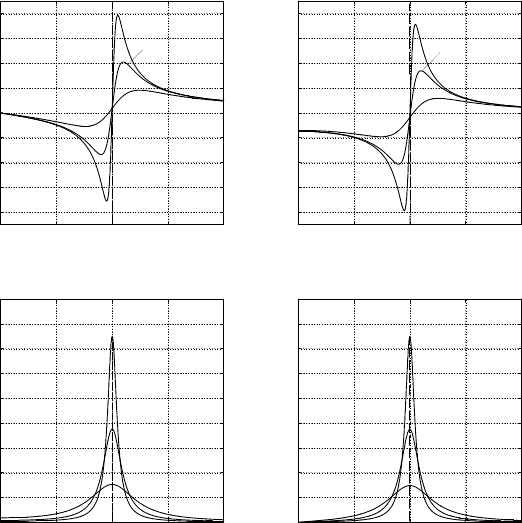
The magnetic resonance curves are also plotted with respect to B
0
or H
0
for
a fixed frequency, as shown in Figure 8.28.
It follows from (8.318) that the peak value of χ
1
00
occurs at ω = ω
0
and
is given by
(χ
1
00
)
peak
=
ω
M
T
£
2(ω
0
T )
2
+ 1
¤
1 + 4(ω
0
T )
2
≈
1
2
ω
M
T, (8.321)
546 8. Electromagnetic Waves in Dispersive Media and Anisotropic Media
0.00 .05 .10 .15 .20
0
2
4
6
8
10
12
14
16
18
0.00 .05 .10 .15 .20
-8
-6
-4
-2
0
2
4
6
8
0.00 .05 .10 .15 .20
0
2
4
6
8
10
12
14
16
18
0.00 .05 .10 .15 .20
-8
-6
-4
-2
0
2
4
6
8
f = 2.8 GHz
B
0
(T)
P
0
M
0
= 0.15 T
'B = 0.02 T
'B = 0.05 T
F
1
'
F
2
'
F
1
"
F
2
"
B
0
(T)
B
0
(T)
B
0
(T)
'B = 0.01 T
'B = 0.01 T
'B = 0.01 T
'B = 0.01 T
'B
= 0.02 T
'B = 0.02 T
'B = 0.02 T
'B
= 0.05 T
'B = 0.05 T
'B = 0.05 T
Figure 8.28: Plots of χ
1
0
, χ
1
00
, χ
2
0
and χ
2
00
with respect to B for lossy ferrites.
8.10 Electromagnetic Waves in Nonreciprocal Media 547
where 1 ¿ (ω
0
T )
2
is considered. Half of the peak value of χ
1
00
is given
approximately by
(ω
M
T )
£
(ω
0
T )
2
+ (ωT )
2
¤
£
(ω
0
T )
2
− (ωT )
2
¤
2
+ 4(ω
0
T )
2
=
1
2
µ
1
2
ω
M
T

. (8.322)
The approximate solution to this equation is seen to be
ω ≈ ω
0
±
1
T
. (8.323)
The resonance linewidth is obtained as
∆ω =
2
T
. (8.324)
Equivalently,
∆B =
2
|γ|T
, (8.325)
which is known as the ferrimagnetic resonance linewidth. The relaxation time
or damping factor can be obtained experimentally from the resonance absorp-
tion curve. Hence the linewidth is a convenient parameter for characterizing
the lossy ferrimagnetic material.
The peak value and the resonance linewidth for χ
2
00
are similar to those
for χ
1
00
.
We have to mention that in the literature on magnetics and magnetic
materials as well as on theoretical physics, the commonly used measuring
units are the Gaussian system of units. In this book we use the SI system of
units throughout. In the Gaussian system the unit of H is the oersted (Oe)
and the unit of B is the gauss (G) instead of ampere/meter (A/m) and tesla
(T) in the SI system, respectively. The relations between them are
1 A/m = 4π × 10
−3
Oe, 1 T = 10
4
G.
The differences among different systems of units are not only the value of
the physical quantities but also the forms of equations; refer to Appendix
A.2. For details on electromagnetic units and dimensions, please refer to the
appendix in [43].
8.10 Electromagnetic Waves in Nonreciprocal
Media
The study of electromagnetic waves propagating in nonreciprocal or gy-
rotropic media reveals many interesting wave types [53, 84]. The most impor-
tant result is that the eigenwaves in gyrotropic media are elliptic or circularly
polarized waves instead of linearly polarized eigenwaves in reciprocal media.

548 8. Electromagnetic Waves in Dispersive Media and Anisotropic Media
8.10.1 Plane Waves in a Stationary Plasma
Stationary plasma in a finite magnetic field is an electric-gyrotropic or ²-
anisotropic medium The wave equation of E is given by (8.90):
∇
2
E − ∇(∇ · E) + ω
2
µ² · E = 0.
Suppose that the gyrotropic axis, i.e., the direction of the d-c magnetic
field, is z. We consider the eigenwaves propagating along the directions par-
allel to and perpendicular to z.
(1) Plane Wave Along the Gyrotropic Axis
Rewrite the wave equation for plane waves in ²-anisotropic media (8.92):
k
2
E − k(k · E) − ω
2
µ² · E = 0,
For a plane wave propagating along z, i.e., k = β, k =
ˆ
zβ and the spatial
dependence of the field is e
−jβz
, so that
∂
∂x
= 0,
∂
∂y
= 0,
∂
∂z
= −jβ.
The wave equation (8.92) becomes
−β
2
E
x
E
y
E
z
+
0
0
β
2
E
z
+ ω
2
µ
0
²
1
j²
2
0
−j²
2
²
1
0
0 0 ²
3
·
E
x
E
y
E
z
= 0. (8.326)
The component equations are
−β
2
E
x
+ ω
2
µ
0
(²
1
E
x
+ j²
2
E
y
) = 0, (8.327)
−β
2
E
y
+ ω
2
µ
0
(−j²
2
E
x
+ ²
1
E
y
) = 0, (8.328)
ω
2
µ
0
²
3
E
z
= 0. (8.329)
The conditions for having nontrivial solutions of the above equations are
E
z
= 0, and E
y
= ∓jE
x
. (8.330)
The corresponding eigenvalue equations are
β
2
− ω
2
µ
0
(²
1
± ²
2
) = 0. (8.331)
Such waves correspond to the following two circularly p olarized eigenwaves
E
y
= −jE
x
, β
I
= ω
p
µ
0
(²
1
+ ²
2
) = ω
√
µ
0
²
0
s
1 −
ω
2
p
/ω
ω − ω
c
, (8.332)

8.10 Electromagnetic Waves in Nonreciprocal Media 549
E
y
= jE
x
, β
II
= ω
p
µ
0
(²
1
− ²
2
) = ω
√
µ
0
²
0
s
1 −
ω
2
p
/ω
ω + ω
c
. (8.333)
(1) The eigenwave of type I, E
y
= −jE
x
, represents the clockwise circu-
larly polarized wave (CW) or right-handed wave along +z denoted by E
CW
+
,
E
CW
+
= E
CW
+
(
ˆ
x − j
ˆ
y), (8.334)
and the counterclockwise wave (CCW) or left-handed wave along −z denoted
by E
CCW
−
,
E
CCW
−
= E
CCW
−
(
ˆ
x − j
ˆ
y), (8.335)
respectively. They have the same angular wave number β
I
:
β
CW
+
= β
CCW
−
= β
I
= ω
√
µ
0
²
I
, ²
I
= ²
1
+²
2
= ²
0
Ã
1 −
ω
2
p
/ω
ω − ω
c
!
, (8.336)
where ²
I
is the effective permittivity of the circularly polarized eigenwave of
type I.
(2) The eigenwave of type II, E
y
= jE
x
, represents CCW along +z and
CW along −z, denoted by
E
CCW
+
= E
CCW
+
(
ˆ
x + j
ˆ
y), (8.337)
and
E
CW
−
= E
CW
−
(
ˆ
x + j
ˆ
y), (8.338)
respectively. They have the same angular wave number β
II
:
β
CCW
+
= β
CW
−
= β
II
= ω
√
µ
0
²
II
, ²
II
= ²
1
− ²
2
= ²
0
Ã
1 −
ω
2
p
/ω
ω + ω
c
!
.
(8.339)
where ²
II
is the effective permittivity of the circularly polarized eigenwave of
type II.
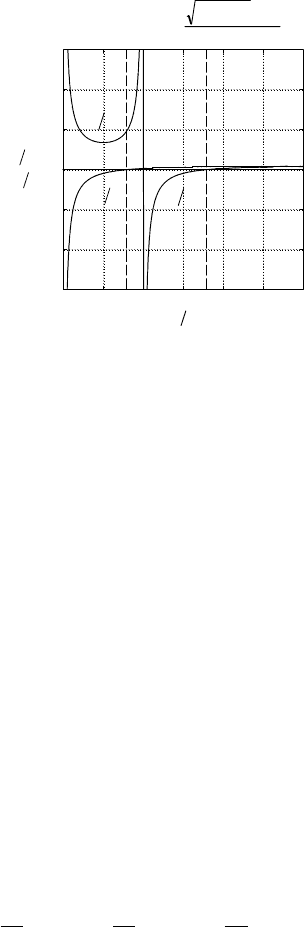
The plots of ²
I
/²
0
= β
2
I
/ω
2
µ
0
²
0
and ²
II
/²
0
= β
2
II
/ω
2
µ
0
²
0
with respect to
angular frequency ω are illustrated in Figure 8.29.
Now the conclusion is that the eigenwaves or normal modes in nonre-
ciprocal gyrotropic media are no longer linearly polarized waves. These are
two circularly polarized waves rotating in opposite senses with different wave
numbers, i.e., with different effective permittivities. The positive permit-
tivity ²
I
has the singularity at ω = ω
c
and corresponds to the circularly
polarized wave that rotates in the same sense as the rotation of electrons in
the d-c magnetic field. The negative permittivity ²
II
does not have singular-
ity and describes the response of the medium to a circularly polarized wave
rotating in the opposite sense. The cyclotron resonance condition can only
be achieved when the electric field vector rotates in the same sense as the
rotation of electrons.
550 8. Electromagnetic Waves in Dispersive Media and Anisotropic Media
0.0 .5 1.0 1.5 2.0 2.5 3.0
-30
-20
-10
0
10
20
30
1
Z
p
= 1.2
Z
c
c
ZZ
0II
0I
HH
HH
2
4
c
2
p
2
c
2,1
ZZZ
Z
r
Z
=
Z
c
Z
=
Z
Z
=
Z
2
0I
HH
0I
HH
0II
HH
Figure 8.29: Plots of effective permittivity of circularly polarized eigenwaves
²
I
/²
0
and ²
II
/²
0
with respect to frequency.
We mentioned in the last section that the cyclotron resonance frequency
of the ionosphere around the Earth is f
c
≈ 6 MHz. In the adjacent band
of this frequency, the circularly polarized wave rotating in the same sense as
the precessional motion is strongly absorbed in the ionosphere.
When a linearly polarized wave passes through a gyrotropic medium,
the field is decomposed into two circularly polarized eigenmodes in opposite
senses with different wave numbers. As a consequence, the field vector of the
linearly polarized wave rotates during the propagation. This effect is known
as the Faraday rotation.
The Faraday rotation angle in ionosphere is as large as 60
◦
at about 1
GHz and is not stable. Hence for satellite communication at and below the
1 GHz band, the circularly polarized wave is used. When the frequency is
higher than 3 GHz, β
I
≈ β
II
, the Faraday rotation angle is small and hence
the linearly polarized wave is used.
(2) Plane Wave Perpendicular to the Gyrotropic Axis
For a plane wave propagating along x, i.e., k = β, k =
ˆ
xβ and the spatial
dependence of the field is e
−jβx
, so that
∂
∂y
= 0,
∂
∂z
= 0,
∂
∂x
= −jβ.
The wave equation (8.92) becomes
−β
2
E
x
E
y
E
z
+
β
2
E
x
0
0
+ ω
2
µ
0
²
1
j²
2
0
−j²
2
²
1
0
0 0 ²
3
·
E
x
E
y
E
z
= 0. (8.340)