
Zhang K., Li D. Electromagnetic Theory for Microwaves and Optoelectronics
Подождите немного. Документ загружается.

8.11 Magnetostatic Waves 561
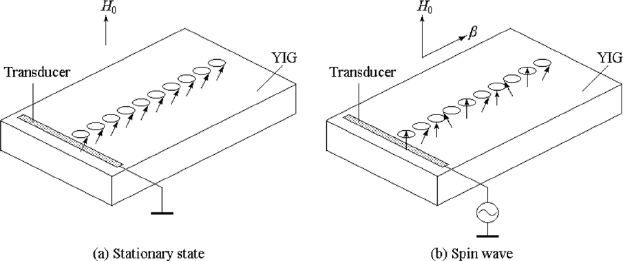
Figure 8.32: Spin wave in ferrimagnetic material.
km/s and exhibit wavelengths from 1 µm to 1 mm. In addition to the space-
charge wave, MSW is another example of non-Maxwell waves.
The magnetostatic modes in ferrimagnetic material were observed and
analyzed in the 1950s and 1960s [104, 27, 28]. Early experiments in bulk yt-
trium iron garnet (YIG) were begun in the late 1950s to demonstrate tunable
microwave delay lines for use in pulse compression, frequency translation, and
parametric amplifier circuits. However, none of these devices reached product
engineering status because of basic material problems which are the results of
the nonuniform internal fields inherent in the non-ellipsoidal YIG geometry
employed. The bulk MSW delay line demonstrated at that time had more
than 30 dB of insertion loss and exhibited very limited dynamic range.
With the advent of liquid-phase epitaxy (LPE) techniques for growing
single-crystal YIG films, grown on nonmagnetic gadolinium gallium garnet
(GGG), a renewed interest in MSW devices started in the mid-1970s. Since
thin YIG films with thicknesses in the range of 1–100 µm can be grown
with less than one defect per 10 cm
2
and because these films exhibit an
approximately uniform internal d-c magnetic field throughout most of their
cross sections, which reduces losses, MSW delay lines are being built with less
than 5 dB of insertion loss at 10 GHz. Furthermore, the thin-film geometry
makes itself compatible with the integrated circuit techniques, resulting in
high device yield and excellent repeatability of performance [3, 19].
Magnetostatic waves provide an attractive means for signal processing in
the microwave band, i.e. approximately 0.5 to 30 GHz. The MSW devices
are complementary to the surface acoustic wave (SAW) devices which can
successfully operate only in the frequency bands lower than 3 GHz.
A comparison of magnetostatic waves (MSW), surface acoustic waves
(SAW), electromagnetic waves in coaxial lines (EMW), and guided optical
waves (GOW) are given in Table 8.1.

562 8. Electromagnetic Waves in Dispersive Media and Anisotropic Media
Table 8.1 Comparison of MSW, SAW, EMW, and GOW.
MSW SAW EMW GOW
Medium Single-crystal LiNbO
3
, Coaxial LiNbO
3
,
YIG film sapphire cable SiO
2
, GaAs
Velocity 3 to 1 000 km/s 1 to 6 km/s 100 000 to 300 000 km/s
Freq. range 0.5 to 26.5 GHz 1 kHz to 3 GHz 0.3 to 50 GHz 300 THz
Wavelength 30 µm 3 µm 1–3 cm 0.5–1 µm
at 10 GHz at 1 GHz at 10 GHz at 300 THz
1 dB/µs 1 dB/µs 100 dB/µs 0.2 dB/km
Attenuation
at 1 GHz at 1 GHz at 1 GHz for fiber
12 dB/µs 100 dB/µs 1 dB/cm for
at 10 GHz at 10 GHz channel WG
8.11.1 Magnetostatic Wave Equations
Suppose that in the ferrimagnetic material the magnetic field vector, the
magnetization vector, and the magnetic induction vector consist of d-c and a-c
components. We will study the situation in which all the magnetic domains
are aligned in the z direction, i.e., the direction of the gyrotropic axis, by
a strong applied d-c magnetic bias field H
0
=
ˆ
zH
0
, i.e., the material is
saturated in the z direction. Then we write
H =
ˆ
zH
0
+ H
1
e
jωt
, H
1
=
ˆ
xH
x
+
ˆ
yH
y
+
ˆ
zH
z
, (8.397)
M =
ˆ
zM
0
+ M
1
e
jωt
, M
1
=
ˆ
xM
x
+
ˆ
yM
y
+
ˆ
zM
z
, (8.398)
B =
ˆ
zB
0
+ B
1
e
jωt
, B
1
=
ˆ
xB
x
+
ˆ
yB
y
+
ˆ
zB
z
. (8.399)
The expressions of the magnetization vector components are given in (8.289)
to (8.291) as
M
x
= χ
1
H
x
+ jχ
2
H
y
, (8.400)
M
y
= −jχ
2
H
x
+ χ
1
H
y
, (8.401)
M
z
= 0, (8.402)
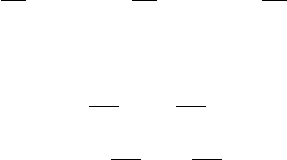
where
χ
1
=
Ω
H
Ω
2
H
− Ω
2
, χ
2
=
Ω
Ω
2
H
− Ω
2
, (8.403)
where
Ω =
ω
ω
M
=
ω
γµ
0
M
0
, Ω
H
=
ω
0
ω
M
=
H
0
M
0
. (8.404)
8.11 Magnetostatic Waves 563
In the above equations,
ˆ
zM
z
= 0 because the ferrimagnetic material is satu-
rated in the z direction so that any change in the magnetization strength in
this direction is impossible.
The macroscopic constitutional relationship for the a-c magnetic field is
B
1
= µ
0
(H
1
+ M
1
). (8.405)
Substituting (8.400) to (8.402) into this equation yields
B
x
= µ
0
(1 + χ
1
)H
x
+ jµ
0
χ
2
H
y
, (8.406)
B
y
= −jµ
0
χ
2
H
x
+ µ
0
(1 + χ
1
)H
y
, (8.407)
B
z
= µ
0
H
z
. (8.408)
Suppose that in the ferrimagnetic material the coupling between the a-
c electric field and magnetic field is much less than the coupling between
the magnetic field and the dipole moments of the spin electrons, so that the
effect of electric field can be neglected. The Maxwell equations for the a-c
components of the magnetic field are then written as
∇ × H
1
= 0, (8.409)
∇ · B
1
= 0. (8.410)
These equations are the same as the equations for magnetostatic field, but
the fields are not static.
The a-c magnetic field H
1
is an irrotational vector field, and we can write
H
1
= ∇ϕ, (8.411)
where ϕ is the a-c scalar magnetic potential and
H
x
=
∂ϕ
∂x
, H
y
=
∂ϕ
∂y
, H
z
=
∂ϕ
∂z
. (8.412)
Inside the ferrimagnetic material, ϕ = ϕ
i
, then (8.400)–(8.402) become
M
x
= χ
1
∂ϕ
i
∂x
+ jχ
2
∂ϕ
i
∂y
, (8.413)
M
y
= −jχ
2
∂ϕ
i
∂x
+ χ
1
∂ϕ
i
∂y
, (8.414)
M
z
= 0. (8.415)
Substituting (8.405) and (8.411) into the divergence equation (8.410), yields
∇ · (µ
0
H
1
+ µ
0
M
1
) = µ
0
∇
2
ϕ
i
+ µ
0
∇ · M
1
= 0.
i.e.,
∇
2
ϕ
i
+ ∇ · M
1
= 0. (8.416)
564 8. Electromagnetic Waves in Dispersive Media and Anisotropic Media
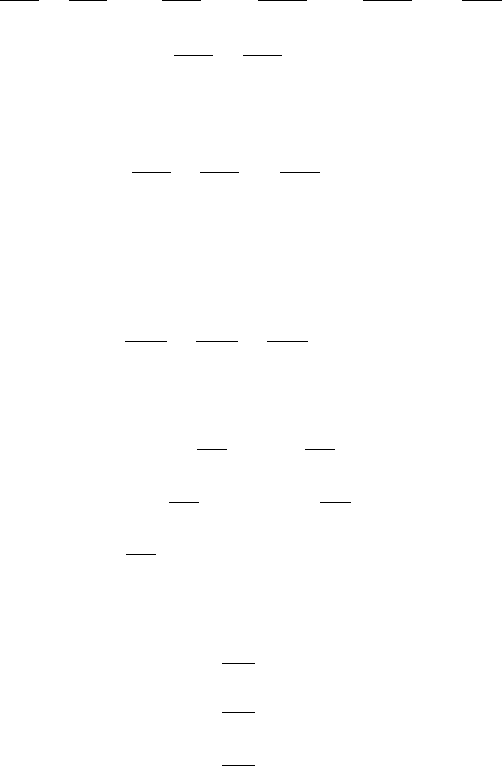
Following (8.413)–(8.415), we obtain
∇ · M
1
=
∂m
x
∂x
+
∂m
y
∂y
= χ
1
∂
2
ϕ
i
∂x
2
+ jχ
2
∂
2
ϕ
i
∂x ∂y
− jχ
2
∂
2
ϕ
i
∂x ∂y
+ χ
1
∂
2
ϕ
i
∂y
2
= χ
1
³
∂
2
ϕ
i
∂x
2
+
∂
2
ϕ
i
∂y
2
´
. (8.417)
Substituting this equation into (8.416) yields
(1 + χ
1
)
³
∂
2
ϕ
i
∂x
2
+
∂
2
ϕ
i
∂y
2
´
+
∂
2
ϕ
i
∂z
2
= 0. (8.418)
This is the MSW equation for the magnetic potential ϕ
i
inside the ferrimag-
netic medium.
The equation for ϕ = ϕ
e
outside the ferrimagnetic medium is the Laplace
equation:
∇
2
ϕ =
∂
2
ϕ
e
∂x
2
+
∂
2
ϕ
e
∂y
2
+
∂
2
ϕ
e
∂z
2
= 0. (8.419)
The constitutional equations inside the ferrimagnetic medium are
B
x
= µ
0
(1 + χ
1
)
∂ϕ
i
∂x
+ jµ
0
χ
2
∂ϕ
i
∂y
, (8.420)
B
y
= −jµ
0
χ
2
∂ϕ
i
∂x
+ µ
0
(1 + χ
1
)
∂ϕ
i
∂y
, (8.421)
B
z
= µ
0
∂ϕ
i
∂z
, (8.422)
and the constitutional equations outside the ferrimagnetic medium are
B
x
= µ
0
∂ϕ
e
∂x
, (8.423)
B
y
= µ
0
∂ϕ
e
∂y
, (8.424)
B
z
= µ
0
∂ϕ
e
∂z
. (8.425)
8.11.2 Magnetostatic Wave Modes
Solving (8.418) and (8.419) for given boundary conditions, we can obtain
the fields and the propagation characteristics of MSW normal modes. There
are three kinds of eigenwaves: forward volume waves (MSFVW), surface
waves (MSSW), and backward volume waves (MSBVW), depending upon
the directions of the d-c magnetic field and the wave vector with respect to
the orientation of the ferrimagnetic material.
8.11 Magnetostatic Waves 565
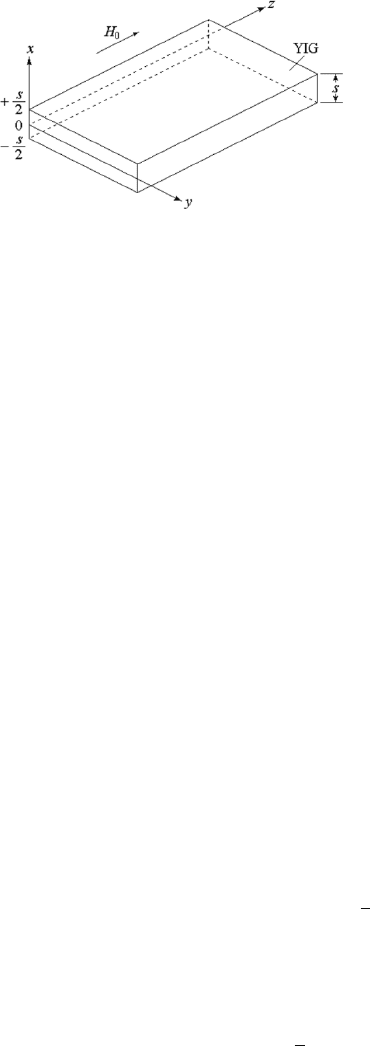
Figure 8.33: MSW in ferrimagnetic film with the d-c magnetic field parallel
to the film.
(1) D-C Magnetic Field Parallel to the Film Surface
Suppose that a thin film or slab of ferrimagnetic material of thickness s lies
on the y-z plane, the two surfaces of the film are at x = ±s/2, and the film is
unbounded in the y and z directions. The d-c magnetic bias field is in the z
direction and is sufficiently strong for the ferrimagnetic film to be saturated.
See Fig. 8.33.
The magnetic potential inside the ferrimagnetic film, |x| ≤ s/2, is
ϕ
i
(x, y, z) = X
i
(x)Y
i
(y)Z
i
(z). (8.426)
The magnetic potential outside the ferrimagnetic film, |x| ≥ s/2, is
ϕ
e
(x, y, z) = X
e
(x)Y
e
(y)Z
e
(z). (8.427)
These functions must be rectangular harmonics in order for equations (8.418)
and (8.419) to be satisfied. For the boundary conditions at x = ±s/2 to be
satisfied, one needs to have Y
i
(y) = Y
e
(y) = Y (y) and Z
i
(z) = Z
e
(z) =
Z(z). Functions Y (y) and Z(z) for an unbounded region in y and z must be
traveling waves. Consider the waves along +y and +z only. These functions
are
Y (y) = e
−jk
y
y
, Z(z) = e
−jk
z
z
. (8.428)
Inside the ferrimagnetic film, function X
i
(x) must be of the form of a standing
wave, so that
X
i
(x) = A sin k
xi
x + B cos k
xi
x, |x| ≤
s
2
. (8.429)
Outside the ferrimagnetic film, as the natural boundary conditions are to be
taken into account at x → ±∞, function X
e
(x) must be in the form of a
decaying field, i.e.,
X
e
(x) = Ce
−τ
xe
x
, x ≥
s
2
, (8.430)

566 8. Electromagnetic Waves in Dispersive Media and Anisotropic Media
X
e
(x) = De
τ
xe
x
, x ≤ −
s
2
. (8.431)
The magnetic potentials inside and outside the ferrimagnetic film become
ϕ
i
(x, y, z)=X
i
(x)Y (y)Z(z) = (A sin k
xi
x +B cos k
xi
x) e
−jk
y
y
e
−jk
z
z
, |x| ≤
s
2
,
(8.432)
ϕ
e
(x, y, z) = X
e
(x)Y (y)Z(z) = Ce
−τ
xe
x
e
−jk
y
y
e
−jk
z
z
, x ≥
s
2
, (8.433)
ϕ
e
(x, y, z) = X
e
(x)Y (y)Z(z) = De
τ
xe
x
e
−jk
y
y
e
−jk
z
z
, x ≤ −
s
2
. (8.434)
Substituting them into (8.418) and (8.419), respectively, one finds
(1 + χ
1
)
¡
k
2
xi
+ k
2
y
¢
+ k
2
z
= 0. (8.435)
−τ
2
xe
+ k
2
y
+ k
2
z
= 0. (8.436)
The boundary conditions at x = ±s/2 are
H
ti
|
x=±s/2
= H
te
|
x=±s/2
→ ϕ
i
|
x=±s/2
= ϕ
e
|
x=±s/2
, (8.437)
B
ni
|
x=±s/2
= B
ne
|
x=±s/2
→
·
(1 + χ
1
)
∂ϕ
i
∂x
− jχ
2
∂ϕ
i
∂y
¸
x=±s/2
=
∂ϕ
e
∂x
¯
¯
¯
¯
x=±s/2
,
(8.438)
where the constitutional equations (8.420)–(8.425) are used. Using (8.432)–
(8.434) in the boundary equation (8.437) at +s/2 and −s/2 gives
C =
A sin(k
xi
s/2) +B cos(k
xi
s/2)
e
−τ
xe
s/2
, (8.439)
D =
−A sin(k
xi
s/2) +B cos(k
xi
s/2)
e
−τ
xe
s/2
. (8.440)
Using (8.432)–(8.434) and (8.439) and (8.440) in the boundary equation
(8.438) at +s/2 and −s/2, we obtain after a lot of algebra
τ
2
xe
+ 2τ
xe
k
xi
(1 + χ
1
) cot(k
xi
s) − k
2
xi
(1 + χ
1
)
2
− χ
2
2
k
2
y
= 0. (8.441)
Substituting (8.435) and (8.436) into this equation yields
k
2
y
+k
2
z
± 2
q
k
2
y
+k
2
z
q
−(1+χ
1
)
2
k
2
y
−(1+χ
1
)k
2
z
cot
s
−
(1+χ
1
) k
2
y
+k
2
z
1 + χ
1
s
+ (1+χ
1
)
2
k
2
y
+(1+χ
1
)k
2
z
− χ
2
2
k
2
y
= 0. (8.442)
This is the eigenvalue equation of MSW in a ferrimagnetic film with a d-
c magnetic field parallel to the film surface, which explains the relations
between the components of angular vectors k
y
and k
z
with respect to ω,
where ω is involved in χ
1
and χ
2
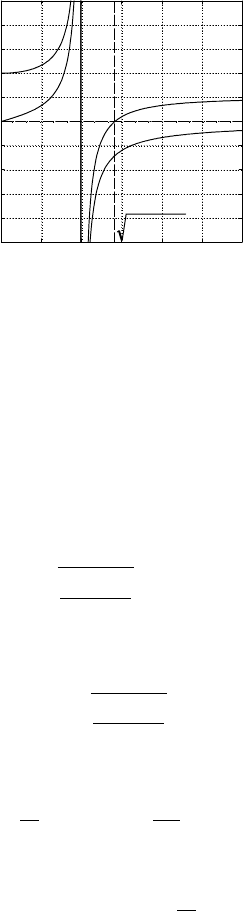
, refer to Figure 8.34.
Now we discuss the special cases of k
y
= 0 or k
z
= 0 and the general case
of k
y
6= 0 and k
z
6= 0.
8.11 Magnetostatic Waves 567
0.0 .5 1.0 1.5 2.0 2.5 3.0
-5
-4
-3
-2
-1
0
1
2
3
4
5
F
2
1+
F
1
1+
F
1
1+
F
1
F
2
F
2
H
2
H
¡¡
H
¡
)(1
0MH
ZZ
¡
¡
Figure 8.34: The frequency response of 1 + χ
1
and χ
2
.
(a) MSW in the Direction of the d-c Magnetic Field (MSBVW).
In this case, k
y
= 0, β = k
z
, then (8.435), (8.436) and (8.441) become
(1 + χ
1
)k
2
xi
+ β
2
= 0, (8.443)
τ
2
xe
− β
2
= 0, (8.444)
τ
2
xe
+ 2τ
xe
k
xi
(1 + χ
1
) cot(k
xi
s) − k
2
xi
(1 + χ
1
)
2
= 0. (8.445)
From (8.443) and (8.444), we obtain
k
xi
= ±
s
−1
(1 + χ
1
)
β = ±Kβ, (8.446)
τ
xe
= ±β, (8.447)
where
K =
s
−1
(1 + χ
1
)
. (8.448)
Then, (8.445) become
1 ± 2
1
K
cot(Kβs) −
1
K
2
= 0, (8.449)
and finally we obtain
2 cot(Kβs) = ±
³
K −
1
K
´
. (8.450)
This is the eigenvalue equation for the MSW which propagates in the direction
of the d-c magnetic field. The condition of the solution of β for this equation
existing in the real domain is K
2
> 0, i.e.,
1 + χ
1
≤ 0. (8.451)
568 8. Electromagnetic Waves in Dispersive Media and Anisotropic Media
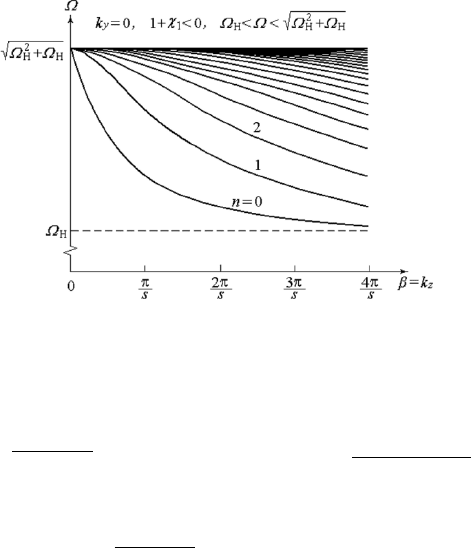
Figure 8.35: The dispersion curves of MSBVW.
From (8.403), refer to Fig. 8.34, the frequency range for 1 + χ
1
≤ 0 is
Ω
H
≤ Ω ≤
q
Ω
2
H
+ Ω
H
, i.e., γµ
0
H
0
≤ ω ≤ γµ
0
p
H
0
(H
0
+ M
0
), (8.452)
and we have
β = 0 when Ω =
q
Ω
2
H
+ Ω
H
, and β → ∞ when Ω = Ω
H
.
When the operating frequency is within the range given in (8.452), there
is an infinite number of roots, which corresponds to an infinite number of
modes to satisfying the eigenvalue equation (8.450). The number of modes
is n = 1, 2, 3, ···. The Ω-β diagram is plotted according to (8.450), as shown
in Figure 8.35. We find from Fig. 8.35 that the slopes of the Ω-β curves
are negative. Hence these waves are backward waves, for which the group
velocity and the phase velocity are in opp osite directions.
Within the frequency range of 1 + χ
1
≤ 0, a magnetostatic wave propa-
gates in the z direction, i.e., β and K are real. Then from (8.446) and (8.447)
we know that k
xi
and τ
xe
are also real. The field distributions in x direction
inside the ferrimagnetic film are standing waves and those outside the film
are decaying fields. This means that the fields are distributed in the volume
of the film. Hence this kind of wave is known as a volume wave or bulk wave.
The conclusion is that in a ferrimagnetic film with a d-c magnetic field
parallel to the film surface, the magnetostatic wave along the direction of
the d-c magnetic field is a magnetostatic backward volume wave denoted by
MSBVW.
The magnetic potentials ϕ
i
and ϕ
e
with respect to x, i.e., the functions
X
i
(x) and X
e
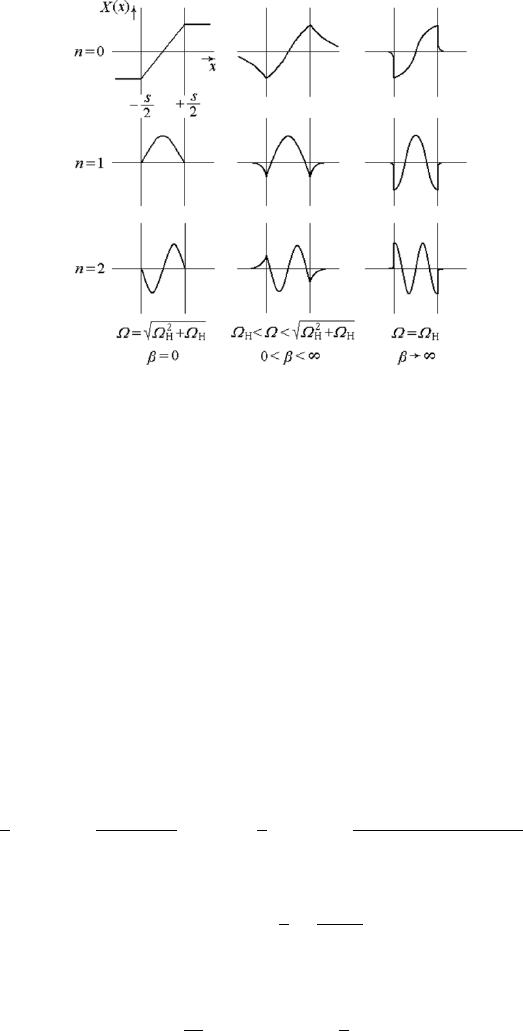
(x) for some lower modes of MSBVW, are plotted in Figure 8.36.
8.11 Magnetostatic Waves 569
Figure 8.36: Functions X
i
(x) and X
e
(x) for MSBVW.
(b) MSW in the Direction Perpendicular to the d-c Magnetic Field
(MSSW). In this case, k
z
= 0, β = k
y
. Then (8.435) and (8.436) become
(1 + χ
1
)
¡
k
2
xi
+ β
2
¢
= 0, τ
2
xe
− β
2
= 0. (8.453)
For 1 + χ
1
6= 0, we obtain
k
xi
= jβ, τ
xe
= β. (8.454)
Substituting them into (8.441), yields
2(1 + χ
1
) coth(βs) + 2(1 + χ
1
) + (χ
2
1
− χ
2
2
) = 0, (8.455)
which gives
β =
1
s
coth
−1
½
χ
2
2
− χ
2
1
2(1 + χ
1
)
− 1
¾
=
1
s
coth
−1
½
1
2 [Ω
2
− (Ω
2
H
+ Ω
H
)]
− 1
¾
.
(8.456)
Using the formula
coth
−1
x =
1
2
ln
x + 1
x − 1
for hyperbolic functions, we obtain
β = k
y
= −
1
2s
ln
(
4
"
µ
Ω
H
+
1
2

2
− Ω
2
#)
. (8.457)
570 8. Electromagnetic Waves in Dispersive Media and Anisotropic Media
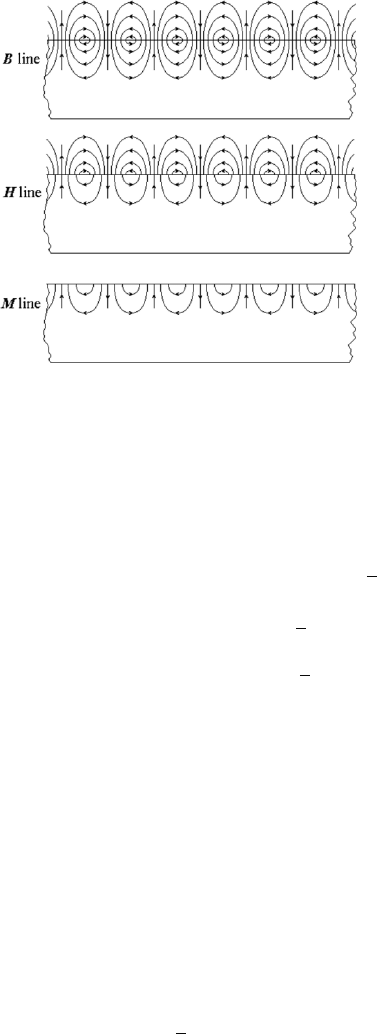
Figure 8.37: The patterns of field lines for MSSW.
For a traveling wave to exist along y, β = k
y
has got to be real. It is
clear from (8.454) that k
xi
= jβ must be imaginary and τ
xe
= β must be real.
Then the distribution of the magnetic potential (8.429)–(8.431) becomes
X
i
(x) = A sinh βx + B cosh βx, |x| ≤
s
2
. (8.458)
X
e
(x) = Ce
−βx
, x ≥
s
2
, (8.459)
X
e
(x) = De
βx
, x ≤ −
s
2
. (8.460)
We find that, in this case, the field inside the ferrimagnetic film and the field
outside the film are both decaying functions along the transverse direction
x. Hence in a ferrimagnetic film with a d-c magnetic field parallel to the film
surface, the magnetostatic wave propagates in the direction perpendicular to
the d-c magnetic field is a magnetostatic surface wave denoted by MSSW,
and the fields concentrate at the surface of the film. [88]
The patterns of field lines for MSSW are shown in Fig. 8.37.
If β is negative, then function X
e
(x) becomes a divergent function in
±x in violation of the radiation condition, i.e., the potential as well as the
field cannot become infinity if finite sources are distributed in a finite region.
Hence β can only be positive, viz., β > 0. According to (8.457) we know that
the condition for β > 0 is
0 ≤ 4
"
µ
Ω
H
+
1
2

2
− Ω
2
#
≤ 1,