
Zhang K., Li D. Electromagnetic Theory for Microwaves and Optoelectronics
Подождите немного. Документ загружается.

8.10 Electromagnetic Waves in Nonreciprocal Media 551
The component equations are
ω
2
µ
0
(²
1
E
x
+ j²
2
E
y
) = 0, (8.341)
−β
2
E
y
+ ω
2
µ
0
(−j²
2
E
x
+ ²
1
E
y
) = 0, (8.342)
−β
2
E
z
+ ω
2
µ
0
²
3
E
z
= 0. (8.343)
There are two independent solutions:
(1) The linearly polarized solution,
E
x
= 0, E
y
= 0, E
z
6= 0, (8.344)
and
β
2
I
= ω
2
µ
0
²
3
. (8.345)
(2) The elliptically polarized solution,
E
x
= −j
²
2
²
1
E
y
, E
z
= 0, (8.346)
and
β
2
II
= ω
2
µ
0
µ
²
2
1
− ²
2
2
²
1

. (8.347)
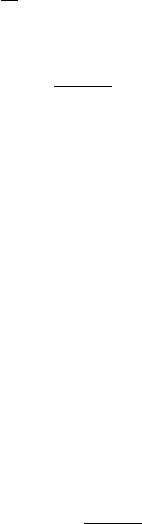
The first solution corresponds to a linearly polarized eigenwave. The
electric field vector is perpendicular to the direction of wave propagation and
is parallel to the direction of the d-c magnetic field. So that the electron
motion due to the action of the r-f electric field is in the direction of the
magnetic field and is not influenced by the magnetic field. This eigenwave is
an ordinary wave.
The second solution is an elliptically polarized eigenwave. The electric
field vector lies in the x-y plane and is perpendicular to the direction of
the d.c. magnetic field. There is an electric field component parallel to the
direction of propagation. This eigenwave is an extraordinary wave.
From the constitutional equation (8.268) and (8.269), the electric induc-
tion vector in the second solution becomes
D
x
= ²
1
E
x
+ j²
2
E
y
, D
y
= −j²
2
E
x
+ ²
1
E
y
,
which gives
D
x
= 0, D
y
=
²
2
1
− ²
2
2
²
1
E
y
.
Therefore, in the extraordinary wave, although the electric field vector E is
elliptically polarized, the electric induction vector D is y-linearly polarized.
If the plane wave propagates in an arbitrary direction, both eigenwaves
become elliptically polarized, which is similar to the case in magnetized fer-
rites, refer to the next subsection.

552 8. Electromagnetic Waves in Dispersive Media and Anisotropic Media
8.10.2 Plane Waves in Saturated-Magnetized Ferrites
The analysis of plane waves in magnetized ferrites are similar to those in
magnetized plasmas. In this subsection, first, as an example, we use the kDB
system to derive the general equations and solutions of plan waves along an
arbitrary direction in saturated-magnetized ferrites. Then, the propagation
characteristics of waves along and normal to the gyrotropic axis are given.
Finally, two important effects, the Faraday effect and the Cotton–Mouton
effect, are introduced. The methods and results of this subsection are also
valid for magnetized plasma and any other gyrotropic medium.
(1) Plan Waves Along an Arbitrary Direction
The constitutional equations (8.70) for gyromagnetic media are
E = κD, H = ν · B, (8.348)
where
κ =
1
²
, ν = µ
−1
. (8.349)
For gyromagnetic media, the impermeability tensor ν in xyz coordinates is
given by
ν
(xyz)
=
ν
1
jν
2
0
−jν
2
ν
1
0
0 0 ν
3
=
µ
1
jµ
2
0
−jµ
2
µ
1
0
0 0 µ
3
−1
, (8.350)
where
ν
1
=
µ
1
µ
2
1
− µ
2
2
, ν
2
=
µ
2
µ
2
2
− µ
2
1
, ν
3
=
1
µ
3
. (8.351)
From the transformation relation (8.120), the impermeability tensor in
the kDB coordinates becomes
ν
(kDB)
= T ·ν
(xyz)
· T
−1
=
ν
1
jν
2
cos γ jν
2
sin γ
−jν
2
cos γ ν
1
cos
2
γ + ν
3
sin
2
γ (ν
1
− ν
3
) sin γ cos γ
−jν
2
sin γ (ν
1
− ν
3
) sin γ cos γ ν
1
sin
2
γ + ν
3
cos
2
γ
. (8.352)
Substituting it into Maxwell equations (8.129) and (8.130), we obtain
κ
·
D
η
D
ξ
¸
=
·
0 ω/k
−ω/k 0
¸·
B
η
B
ξ
¸
, (8.353)
·
ν
1
jν
2
cos γ
−jν
2
cos γ ν
1
cos
2
γ+ν
3
sin
2
γ
¸·
B
η
B
ξ
¸
=
·
0 −ω/k
ω/k 0
¸·
D
η
D
ξ
¸
. (8.354)

8.10 Electromagnetic Waves in Nonreciprocal Media 553
These are the Maxwell equations for plane waves propagating in gyromagnetic
media in the kDB coordinate system. Eliminating D
η
and D
ξ
from the above
two equations yields
"
ω
2
k
2
− κν
1
−jκν
2
cos γ
jκν
2
cos γ −κ(ν
1
cos
2
γ + ν
3
sin
2
γ)
#
·
B
η
B
ξ
¸
= 0. (8.355)
This is the wave equation for gyromagnetic media in kDB coordinates, which
is a set of homogeneous linear equations. The homogeneous equations are
satisfied by nontrivial solutions only when the determinant of the coefficients
vanishes:
¯
¯
¯
¯
¯
¯
ω
2
k
2
− κν
1
−jκν
2
cos γ
jκν
2
cos γ
ω
2
k
2
− κ(ν
1
cos
2
γ + ν
3
sin
2
γ)
¯
¯
¯
¯
¯
¯
= 0. (8.356)
After going through a lot of algebra we obtain
k
2
=
2ω
2
κ
·
ν
1
(1+ cos
2
γ)+ ν
3
sin
2
γ ±
q
(ν
1
− ν
3
)
2
sin
4
γ + 4ν
2
2
cos
2
γ
¸
, (8.357)
where γ is the angle between the axes ζ and z, i.e., between the vectors k
and
ˆ
z, so that
k
z
= k cos γ, k
T
= k sin γ,
where k
z
is the z component of k and k
T
is the projection of vector k on the
plane perpendicular to axis z. The expression (8.357) can thus be written as
ω
2
=
κ
2
·
ν
1
¡
k
2
+ k
2
z
¢
+ ν
3
k
2
T
±
q
(ν
1
− ν
3
)
2
k
4
T
+ 4ν
2
2
k
2
k
2
z
¸
. (8.358)
The ratio of B
ξ
to B
η
can be found from (8.355),
B
ξ
B
η
=
−2jν
2
cos γ
(ν
1
− ν
3
) sin
2
γ ±
q
(ν
1
− ν
3
)
2
sin
4
γ + 4ν
2
2
cos
2
γ
. (8.359)
Let
tan 2ψ =
2ν
2
cos γ
(ν
1
− ν
3
) sin
2
γ
. (8.360)
Then
B
ξ
B
η
=
−j tan 2ψ
1 ±
p
1 + tan
2
2ψ
. (8.361)
The two eigenwaves are as follows.
(1) Type I: For the eigenwave with the angular wave number k having
the plus sign in (8.357), then (8.357) and (8.361) become
k
2
I
=
2ω
2
κ
·
ν
1
(1+ cos
2
γ)+ ν
3
sin
2
γ +
q
(ν
1
− ν
3
)
2
sin
4
γ + 4ν
2
2
cos
2
γ
¸
, (8.362)

554 8. Electromagnetic Waves in Dispersive Media and Anisotropic Media
B
ξ
B
η
= −j tan ψ. (8.363)
(2) Type II: For the eigenwave with the angular wave number k having
the minus sign in (8.357), then (8.357) and (8.361) become
k
2
II
=
2ω
2
κ
·
ν
1
(1+ cos
2
γ)+ ν
3
sin
2
γ −
q
(ν
1
− ν
3
)
2
sin
4
γ + 4ν
2
2
cos
2
γ
¸
,
(8.364)
B
ξ
B
η
= j cot ψ. (8.365)
The two eigenwaves are elliptically polarized waves in opposite senses.
Assume that ν
1
> ν
3
and ν
2
is positive, if 0 < γ < π/2, i.e., the wave vector
has +z component, the wave of type I is a clockwise wave (CW) or right-
handed wave and the wave of type II is a counterclockwise wave (CCW) or
left-handed wave. If π/2 < γ < π, i.e., the wave vector has −z component,
the wave of type I is a counterclockwise wave (CCW) or left-handed wave
and the wave of type II is a clockwise wave (CW) or right-handed wave.
The two eigenwaves have different wave numbers, i.e., birefringence. When
γ
2
= π −γ
1
, i.e., the angle between +z and k
1
is equal to the angle between
−z and k
2
, then the wave number of the CW wave in one direction is equal
to that of the CCW wave in the another direction, and vice versa.
When ν
2
is zero, the medium becomes uniaxial and the eigenwaves become
linearly polarized.
Now, let us consider some special cases.
(2) Plane Waves Along the Gyrotropic Axis
When the direction of wave propagation is parallel to the gyrotropic axis,
k k
ˆ
z, then ζ = z, η = x, and ξ = y. We have γ = 0 and (8.355) reduces to
£
(ω/k)
2
− κν
1
¤
B
η
− jκν
2
B
ξ
= 0, (8.366)
jκν
2
B
η
+
£
(ω/k)
2
− κν
1
¤
B
ξ
= 0. (8.367)
The expression for the angular wave number (8.357) reduces to
k
2
=
ω
2
κ(ν
1
± ν
2
)
= ω
2
²(µ
1
± µ
2
), (8.368)
and the ratio of field components (8.359) becomes
B
ξ
B
η
=
B
y
B
x
= ∓j. (8.369)
The two eigenwaves are circularly polarized waves in opposite senses. They
have different wave numbers. The two types of eigenwaves are as follows.
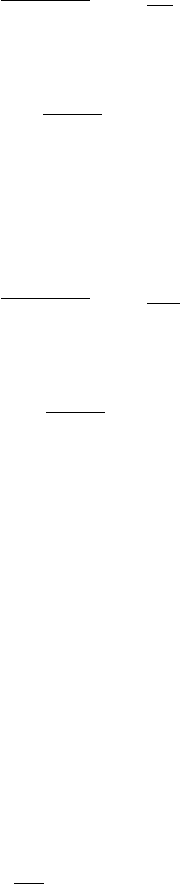
8.10 Electromagnetic Waves in Nonreciprocal Media 555
(1) The eigenwave of type I, B
y
= −jB
x
, represents the clockwise circu-
larly polarized wave (CW) or right-handed wave along +z and the counter-
clockwise wave (CCW) or left-handed wave along −z, denoted by
B
CW
+
= B
CW
+
(
ˆ
x − j
ˆ
y), and B
CCW
−
= B
CCW
−
(
ˆ
x − j
ˆ
y), (8.370)
respectively. They have the same angular wave number k
I
,
β
CW
+
= β
CCW
−
= k
I
= ω
p
²(µ
1
+ µ
2
) = ω
√
²µ
I
, (8.371)
where µ
I
is the effective permeability of the circularly polarized eigenwave of
type I,
µ
I
= µ
1
+ µ
2
= µ
0
µ
1 +
ω
M
ω
0
− ω

. (8.372)
(2) The eigenwave of type II, B
y
= jB
x
, represents CCW along +z and
CW along −z, denoted by
B
CCW
+
= B
CCW
+
(
ˆ
x + j
ˆ
y), and B
CW
−
= B
CW
−
(
ˆ
x + j
ˆ
y), (8.373)
respectively. They have the same angular wave number k
II
,
β
CCW
+
= β
CW
−
= k
II
= ω
p
²(µ
1
− µ
2
) = ω
√
²µ
II
, (8.374)
where µ
II
is the effective permeability of the circularly polarized eigenwave
of type II,
µ
II
= µ
1
− µ
2
= µ
0
µ
1 +
ω
M
ω
0
+ ω

. (8.375)
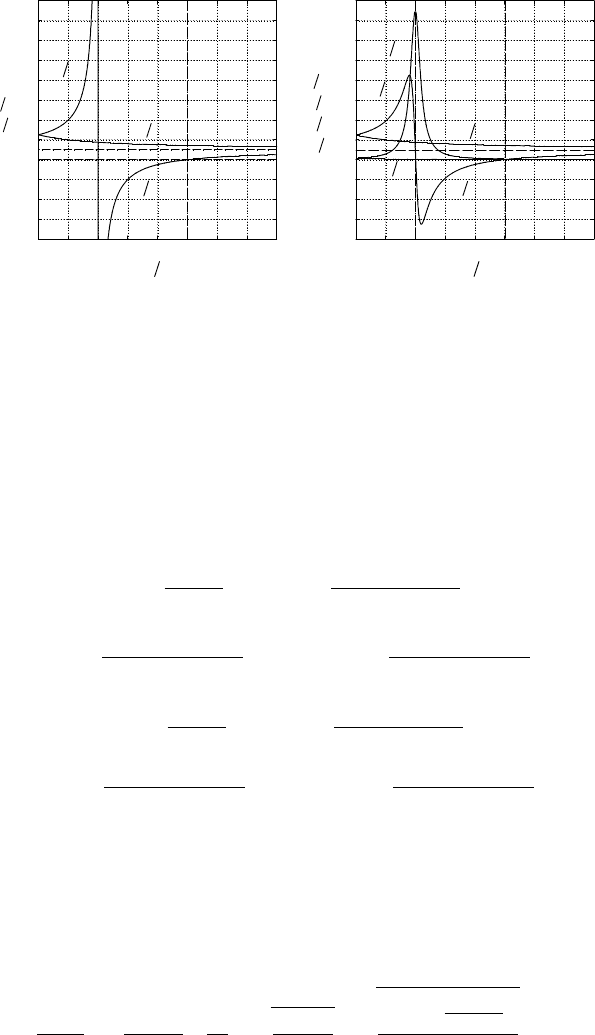
The plots of µ
I
/µ
0
= k
2
I
/ω
2
µ
0
² and µ
II
/µ
0
= k
2
II
/ω
2
µ
0
² with respect to
angular frequency ω are illustrated in Fig. 8.30(a).
We find that the propagation characteristics of circularly polarized eigen-
waves in ferrite are similar to those in the plasma. The wave number of the
type-I wave has a singularity at ω = ω
0
and corresponds to the circularly
polarized wave rotating in the same sense as the precessional motion. The
wave number of the type-II wave does not have singularity and describes the
response of the medium to a circularly polarized wave rotating in the oppo-
site sense. The magnetic resonance condition can only be achieved when the
magnetic field vector rotates in the same sense as the precessional motion.
When ω < ω
0
, both k
I
and k
II
are real, so both eigenwaves are persistent
waves and k
I
> k
II
, v
pII
> v
pI
. When ω
0
< ω < ω
0
+ ω
M
, k
II
is still real and
k
I
becomes imaginary, so the type-II wave is still a persistent wave and the
type-I wave becomes decaying or evanescent fields. In this frequency range,
a wave with an arbitrary polarization state will transform to a circularly
polarized wave in the sense opposite to the precessional motion if the distance
of propagation in the gyromagnetic medium is sufficiently long. When ω >
ω
0
+ ω
M
, both k
I
and k
II
are real again, but k
II
> k
I
, v
pI
> v
pII
. When
ω → ∞, both wave numbers approach ω
√
²µ
0
.
556 8. Electromagnetic Waves in Dispersive Media and Anisotropic Media
0.0 .5 1.0 1.5 2.0 2.5 3.0 3.5 4.0
-8
-6
-4
-2
0
2
4
6
8
10
12
14
16
'B = 0
B
0
= 0.1 T
f
0
= 2.8 GHz
Z
M
1.5
Z
0
Z
=
Z
0
Z
=
Z
0
Z
M
0
ZZ
0I
PP
0I
PP
0II
0I
PP
PP
0II
PP
0.0 .5 1.0 1.5 2.0 2.5 3.0 3.5 4.0
-8
-6
-4
-2
0
2
4
6
8
10
12
14
16
'B = 0.02 T
Z
=
Z
0
Z
=
Z
0
Z
M
0
ZZ
0I
"
PP
0I
'
PP
0II
0II
0I
01
"
'
"
'
PP
PP
PP
PP
0II
"
PP
0II
'
PP
0I
'
PP
B
0
= 0.1 T
f
0
= 2.8 GHz
Z
M
1.5
Z
0
(b)
(a)
Figure 8.30: Plots of the effective permeability of circularly polarized eigen-
waves µ
I
/µ
0
and µ
II
/µ
0
with respect to frequency.
If the loss in the ferrite is not negligible, the effective permeability of
circularly polarized eigenwaves become complex:
˙µ
I
= µ
0
I
− jµ
00
I
= ˙µ
1
+ ˙µ
2
. ˙µ
II
= µ
0
II
− jµ
00
II
= ˙µ
1
− ˙µ
2
. (8.376)
Substituting (8.314) and (8.315) into (8.376), yields
˙µ
I
= µ
0
³
1 +
ω
M
˙ω
0
− ω
´
= µ
0
h
1 +
ω
M
(ω
0
+ j/T ) − ω
i
, (8.377)
µ
0
I
= µ
0
h
1 +
ω
M
T (ω
0
− ω)T
(ω
0
− ω)
2
T
2
+ 1
i
, µ
00
I
= µ
0
ω
M
T
(ω
0
− ω)
2
T
2
+ 1
, (8.378)
and
˙µ
II
= µ
0
³
1 +
ω
M
˙ω
0
+ ω
´
= µ
0
h
1 +
ω
M
(ω
0
+ j/T ) + ω
i
, (8.379)
µ
0
II
= µ
0
h
1 +
ω
M
T (ω
0
+ ω)T
(ω
0
+ ω)
2
T
2
+ 1
i
, µ
00
II
= µ
0
ω
M
T
(ω
0
+ ω)
2
T
2
+ 1
. (8.380)
The plots of µ
0
I
/µ
0
, µ
00
I
/µ
0
, µ
0
II
/µ
0
, and µ
00
II
/µ
0
with respect to ω are shown
in Fig. 8.30(b). It is clear that the frequency responses of µ
0
I
/µ
0
and µ
00
I
/µ
0
around ω
0
become typical responses of a resonant system, but the responses
of µ
0
II
/µ
0
and µ
00
II
/µ
0
do not have resonant characteristics.
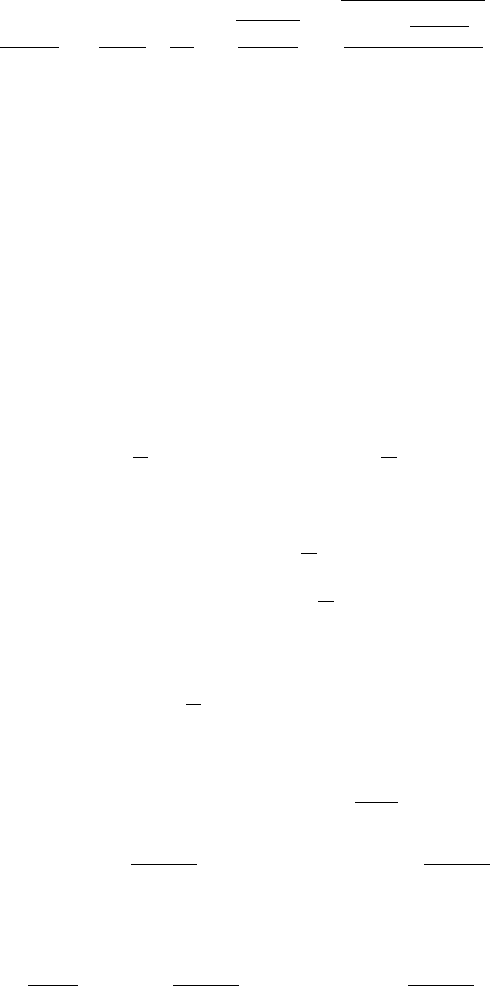
The wave impedances of the clockwise circularly polarized wave (CW)
along +z and the counterclockwise wave (CCW) along −z are
η
I
=
E
CW
+
H
CW
+
=−
E
CCW
−
H
CCW
−
=
k
I
ω²
=
r
˙µ
1
+ ˙µ
2
²
=
v
u
u
t
µ
0
³
1+
ω
M
˙ω
0
− ω
´
²
, (8.381)
8.10 Electromagnetic Waves in Nonreciprocal Media 557
and the wave impedances of the counterclockwise circularly polarized wave
(CCW) along +z and the clockwise wave (CW) along −z are
η
II
=
E
CCW
+
H
CCW
+
=−
E
CW
−
H
CW
−
=
k
II
ω²
=
r
˙µ
1
− ˙µ
2
²
=
v
u
u
t
µ
0
³
1+
ω
M
˙ω
0
+ ω
´
²
. (8.382)
(3) The Faraday Effect
We have mentioned before that a linearly polarized wave is rotated when it
passes through a gyrotropic medium, because of the difference of wave num-
bers between the clockwise polarized wave and the counterclockwise polarized
wave. This effect is known as the Faraday effect or Faraday rotation.
Consider a linearly polarized wave propagating in the +z direction with
E in the x direction at the plane z = 0 in the gyrotropic medium:
E(0) =
ˆ
xE.
This field may be decomposed into two circular polarized eigenwaves with
opposite senses:
E(0) = E
CW
+
(0) + E
CCW
+
(0), (8.383)
E
CW
+
(0) =
E
2
(
ˆ
x − j
ˆ
y), E
CCW
+
(0) =
E
2
(
ˆ
x + j
ˆ
y).
The fields of these two eigenwaves propagating to plane z are
E
CW
+
(z) = E
CW
+
(0)e
−jβ
I
z
=
E
2
(
ˆ
x − j
ˆ
y)e
−jβ
I
z
, (8.384)
E
CCW
+
(z) = E
CCW
+
(0)e
−jβ
II
z
=
E
2
(
ˆ
x + j
ˆ
y)e
−jβ
II
z
. (8.385)
The composed field at z is given by adding them,
E(z) = E
CW
+
(z)+E
CCW
+
(z) =
E
2
£
ˆ
x
¡
e
−jβ
II
z
+ e
−jβ
I
z
¢
+j
ˆ
y
¡
e
−jβ
II
z
− e
−jβ
I
z
¢¤
,
(8.386)
which can be rearranged as the form
E(z) = [
ˆ
xE
x
(z) +
ˆ
yE
y
(z)]e
−j
β
I
+β
II
2
z
, (8.387)
E
x
(z) = E cos
³
β
I
− β
II
2
z
´
, E
y
(z) = −E sin
³
β
I
− β
II
2
z
´
.
The composed field vector is still linearly polarized but rotates by an angle
θ relative to the field vector at z = 0,
tan θ =
E
y
(z)
E
x
(z)
= −tan
³
β
I
− β
II
2
z
´
, i.e., θ(z) =
β
II
− β
I
2
z. (8.388)
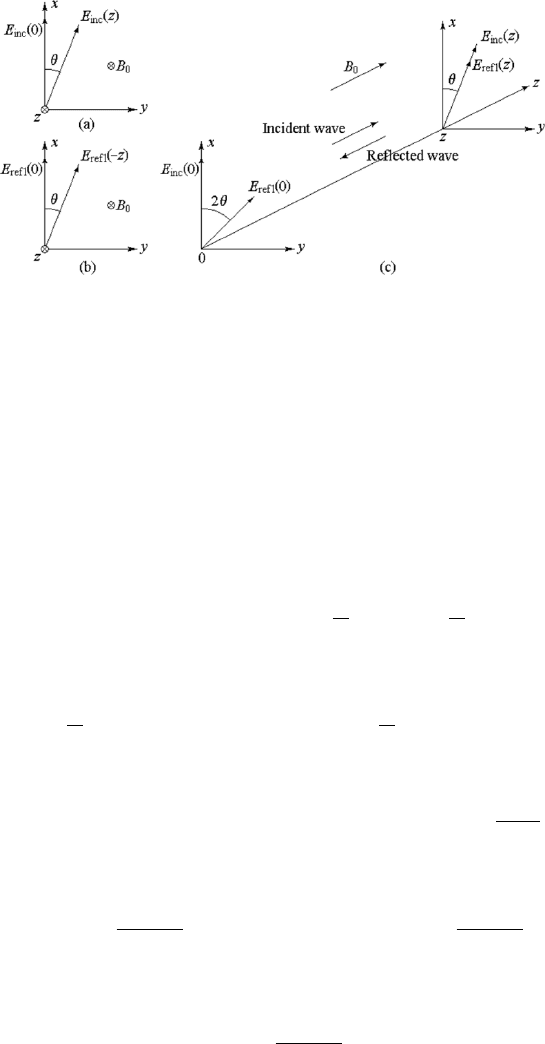
558 8. Electromagnetic Waves in Dispersive Media and Anisotropic Media
Figure 8.31: Faraday rotation.
It is clear that the linearly polarized wave rotates as it passes along the
gyrotropic axis z and has a wave number that is the average of those of the
clockwise and counterclockwise eigenwaves. For the case of β
II
> β
I
, the
relation between E(z) and E(0) is shown in Fig. 8.31(a). We can see that
the rotation of the field vector is clockwise.
If the linearly polarized wave propagates in the −z direction with the
same E vector as that for the wave propagating in the +z direction at the
plane z = 0, then
E(0) =
ˆ
xE = E
CW
−
(0) + E
CCW
−
(0) =
E
2
(
ˆ
x + j
ˆ
y) +
E
2
(
ˆ
x − j
ˆ
y).
The fields of the two circularly polarized eigenwaves at plane −z become
E
CW
−
(−z) =
E
2
(
ˆ
x+j
ˆ
y)e
jβ
II
(−z)
, E
CCW
−
(−z) =
E
2
(
ˆ
x−j
ˆ
y)e
jβ
I
(−z)
. (8.389)
The composed field at −z is given by adding them:
E(−z) = E
CW
−
(−z) + E
CCW
−
(−z) = [
ˆ
xE
x
(−z) +
ˆ
yE
y
(−z)]e
j
β
I
+β
II
2
(−z)
,
(8.390)
where
E
x
(−z) = E cos
·
β
II
− β
I
2
(−z)
¸
, E
y
(−z) = −E sin
·
β
II
− β
I
2
(−z)
¸
.
The composed field vector rotates by an angle,
tan θ = −tan
·
β
II
− β
I
2
(−z)
¸
,

8.10 Electromagnetic Waves in Nonreciprocal Media 559
i.e.,
θ(−z) =
β
I
− β
II
2
(−z) =
β
II
− β
I
2
(z), (8.391)
In the above expressions, the value of z is positive, we notice that the direction
of rotation about the positive gyrotropic axis is the same for waves traveling
in the positive and the negative z direction. In other words, the direction
of rotation about the direction of propagation is in the opposite sense, see
Fig. 8.31(b). Thus, if we consider the propagation of the wave described
by (8.387) back to the plane z = 0, the original direction of polarization is
not restored; instead, the field vector will rotate by an angle 2θ relative to
the original direction, see Fig. 8.31(c). The Faraday rotation is a typical
nonreciprocal effect.
(4) Plane Waves Perpendicular to the Gyrotropic Axis, Cotton–
Mouton Effect
When the wave vector k is perpendicular to the gyrotropic axis, k ⊥
ˆ
z, i.e.,
ˆ
ζ ⊥
ˆ
z. Let
ˆ
ζ k
ˆ
x,
ˆ
η k
ˆ
y and
ˆ
ξ k
ˆ
z, we have γ = π/2 and B
ζ
= B
x
= 0. Then
the wave equation (8.355) reduces to
µ
ω
2
k
2
− κν
1

B
η
= 0,
µ
ω
2
k
2
− κν
3

B
ξ
= 0. (8.392)
Following (8.360), for γ = π/2, we get
tan 2ψ = 0, ψ = 0. (8.393)
According to the classification of eigenwaves (8.362) to (8.365) and applying
(8.351), the two types of eigenwaves and their wave numbers are
(1) The eigenwave of type I,
B
ξ
B
η
=
B
z
B
y
= −j tan ψ = 0, B
z
= 0, B
I
=
ˆ
yB
y
,
k
I
=
ω
√
κν
1
= ω
s
²
µ
2
1
− µ
2
2
µ
1
, v
pI
=
1
r
²
µ
2
1
− µ
2
2
µ
1
, (8.394)
(2) The eigenwave of type II,
B
η
B
ξ
=
B
y
B
z
= −j tan ψ = 0, B
y
= 0, B
II
=
ˆ
zB
z
,
k
II
=
ω
√
κν
3
= ω
√
²µ
3
= k
3
, v
pII
=
1
√
²µ
3
. (8.395)
560 8. Electromagnetic Waves in Dispersive Media and Anisotropic Media
These are two plane waves with different wave numbers, i.e., birefringence.
The magnetic induction vectors for the two waves are linearly polarized and
are perpendicular to each other.
The magnetic field vectors of the two waves are given by
H
x
H
y
H
z
=
ν
1
jν
2
0
−jν
2
ν
1
0
0 0 ν
3
0
B
y
B
z
. (8.396)
For the eigenwave type I, B
x
= 0, B
z
= 0, and B
y
6= 0, i.e., the magnetic
induction vector is perpendicular to the direction of the d-c magnetic field.
Then H
x
= jν
2
B
y
, H
y
= ν
1
B
y
, and H
z
= 0. The magnetic field vector
H becomes elliptically polarized on the x-y plane, although the magnetic
induction vector B is linearly polarized.
For the eigenwave type II, B
x
= 0, B
y
= 0, and B
z
6= 0, i.e., the magnetic
induction vector is parallel to the direction of the d-c magnetic field. Then
H
z
= ν
3
B
z
, H
x
= 0, and H
y
= 0. The magnetic field vector H as well as
the magnetic induction vector B are linearly polarized.
This special type of birefringence in gyrotropic media is known as the
Cotton–Mouton effect.
The Faraday effect and the Cotton–Mouton effect in optical wave band
are known as magneto-optic effect. Note that, for magneto-optic effect, most
anisotropic materials can be considered as ²-anisotropic media [7, 55].
8.11 Magnetostatic Waves
In ferrimagnetic material, under the influence of an external d-c bias field
H
0
, the magnetic dipole moments created by the spin of the bound electrons
in the material precess around the direction of the bias field at the same rate
and same phase. Any perturbation of the magnetic field or any a-c magnetic
field H
1
will change the state of precession of the spinning electrons. If, as
a result of a localized change in H
1
, the state of precession of a spinning
electron is arbitrarily changed, the nearest-neighbor spinning electron will
try to change its precession also, by the influence of the perturbation of
the magnetic field caused by the changing of the magnetic dipolar field of
the former spinning electron and by the electromagnetic exchange following
the Maxwell equations. This process then continues to other neighboring
spinning electrons, resulting in a spin wave as shown in Fig. 8.32.
When the interaction between the a-c magnetic field and the magnetic
dipole spin system is strong, the prevailing coupling mechanism among the
spins is the magnetic dipolar field and the Maxwell electromagnetic ex-
change effects are negligible, the spin waves are known as magnetostatic
waves (MSW) [93].
The magnetostatic waves travel with velocities in the range of 3 to 1000