
Zhang K., Li D. Electromagnetic Theory for Microwaves and Optoelectronics
Подождите немного. Документ загружается.

8.8 Waves in Electron Beams 531
(2) Plane Space-Charge Waves
If the field has no transverse variation, ∇
2
T
E
z
= 0, then (8.230) becomes
¡
ω
2
µ
0
²
0
− k
2
z
¢
"
1 −
ω
2
p
(ω − k
z
v
0
)
2
#
E
z
= 0. (8.231)
The two roots of the equation (8.231) are
(1) k
2
z
= ω
2
µ
0
²
0
. This is the wave in vacuum in the absence of the beam.
(2) 1 −
ω
2
p
(ω − k
z
v
0
)
2
= 0, This leads to two waves with wave numbers
k
z
=
ω ± ω
p
v
0
= k
e
± k
p
. (8.232)
where k
e
= ω/v
0
and k
p
= ω
p
/v
0
, denote the wave numbers of plane waves of
ω and ω
p
, respectively, propagating with the beam velocity v
0
. These waves
are known as space-charge waves. Their phase velocities are just greater and
less than the beam velocity or the average velocity of electrons.
v
p
=
ω
k
z
= v
0
1
1 ± ω
p
/ω
. (8.233)
The group velocities for both space-charge waves are equal to the velocity of
plane wave in vacuum,
v
g
=
∂ω
∂k
z
= v
0
. (8.234)
In a space-charge wave, interactions take place between a-c electric fields
and a-c charge densities. The uniform plane space-charge wave is a pure
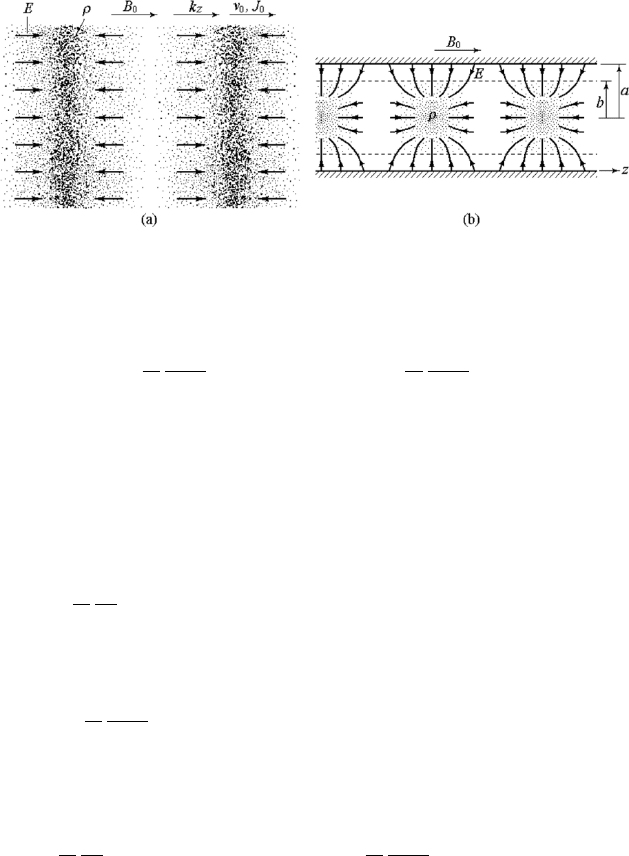
longitudinal wave without an a-c magnetic field, refer to Fig. 8.22(a).
If an electron beam is confined in a metallic tunnel, the presence of the
finite b oundaries reduces the effect of space charge in the electron beam
because some of the a-c electric flux leaks out of the beam and couples to the
metallic boundaries as shown in Fig. 8.22(b). The result is that the effective
plasma frequency reduces to ω
q
= F ω
p
, where ω
q
denotes the reduced plasma
frequency and F is the reduction factor [10].
(3) Velocity Modulation and Density Modulation of Electron Beam
The angular wave numbers of the two space-charge waves are
k
z1
= k
e
+ k
p
, k
z2
= k
e
− k
p
, (8.235)
k
z1
v
0
= ω + ω
p
, k
z2
v
0
= ω − ω
p
. (8.236)
According to (8.217) and (8.222), the velocity modulation and the density
modulation of the electron beam for the two waves are
v
(1)
1
= −j
e
m
1
ω
p
E
(1)
zm
, v
(2)
1
= j
e
m
1
ω
p
E
(2)
zm
, (8.237)
532 8. Electromagnetic Waves in Dispersive Media and Anisotropic Media
Figure 8.22: (a) Uniform plane space-charge wave and (b) space-charge wave
in a cylindrical tunnel.
J
(1)
1
= −j
e
m
ωJ
0
v
0
ω
2
p
E
(1)
zm
, J
(2)
1
= −j
e
m
ωJ
0
v
0
ω
2
p
E
(2)
zm
. (8.238)
The composed space-charge waves are
E
z
(z) = E
(1)
z
+ E
(2)
z
= E
(1)
zm
e
j[ωt−(k
e
+k
p
)z]
+ E
(2)
zm
e
j[ωt−(k
e
−k
p
)z]
=
h³
E
(1)
zm
+ E
(2)
zm
´
cos k
p
z + j
³
−E
(1)
zm
+ E
(2)
zm
´
sin k
p
z
i
e
j(ωt−k
e
z)
,
(8.239)
˜v (z) = ˜v
(1)
+ ˜v
(2)
= v
(1)
1
e
j[ωt−(k
e
+k
p
)z]
+ v
(2)
1
e
j[ωt−(k
e
−k
p
)z]
= j
e
m
1
ω
p
h³
−E
(1)
zm
+ E
(2)
zm
´
cos k
p
z + j
³
E
(1)
zm
+ E
(2)
zm
´
sin k
p
z
i
e
j(ωt−k
e
z)
,
(8.240)
˜
J (z) =
˜
J
(1)
+
˜
J
(2)
= J
(1)
1
e
j[ωt−(k
e
+k
p
)z]
+ J
(2)
1
e
j[ωt−(k
e
−k
p
)z]
= −j
e
m
ωJ
0
v
0
ω
2
p
h³
E
(1)
zm
+E
(2)
zm
´
cos k
p
z + j
³
−E
(1)
zm
+E
(2)
zm
´
sin k
p
z
i
e
j(ωt−k
e
z)
.
(8.241)
The initial values of the velocity modulation and the density modulation are
˜v(0) = j
e
m
1
ω
p
³
−E
(1)
zm
+E
(2)
zm
´
e
jωt
,
˜
J(0)=−j
e
m
ωJ
0
v
0
ω
2
p
³
E
(1)
zm
+E
(2)
zm
´
e
jωt
. (8.242)
The velocity modulation and the density modulation can be obtained from
(8.240) and (8.241) with the given initial values ˜v(0) and
˜
J(0).
Consider the case of a velocity-modulation device named klystron, where
a velocity-modulated electron beam enters the input end of the drift region.
The initial values are
˜v(0) = v
m
e
jωt
,
˜
J(0) = 0. (8.243)
8.8 Waves in Electron Beams 533
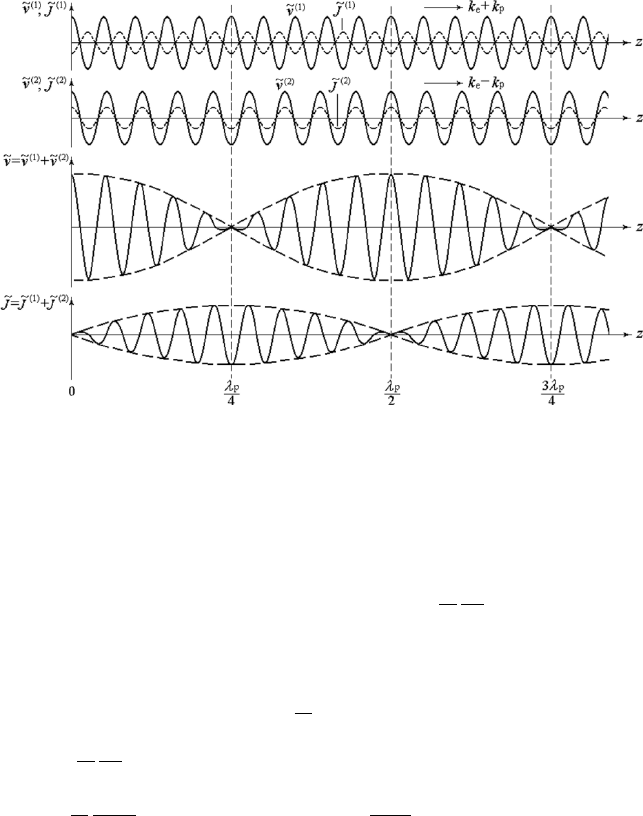
Figure 8.23: The space-charge wave formulation of the velocity modulation
and the current density modulation of an electron beam.
Then from (8.242) we have
E
(2)
zm
= −E
(1)
zm
= E
zm
, v
m
= j
e
m
2
ω
p
E
zm
.
Substituting them into (8.239), (8.240), and (8.241) yields, refer to Fig. 8.23,
E
z
(z) = j2E
zm
sin k
p
ze
j(ωt−k
e
z)
=
m
e
ω
p
v
m
sin k
p
ze
j(ωt−k
e
z)
, (8.244)
˜v (z) = j
e
m
2
ω
p
E
zm
cos k
p
ze
j(ωt−k
e
z)
= v
m
cos k
p
ze
j(ωt−k
e
z)
, (8.245)
˜
J (z) =
e
m
2ωJ
0
v
0
ω
2
p
E
zm
sin k
p
ze
j(ωt−k
e
z)
= −j
ωJ
0
v
0
ω
p
v
m
sin k
p
ze
j(ωt−k
e
z)
. (8.246)
It is obvious that the superposition of two space-charge waves becomes a
modulated traveling wave, the envelope of which is a standing wave. The
wavelength of the modulated wave is λ
e
= 2π/k
e
and the wavelength of the
envelope is λ
p
= 2π/k
p
. Generally, ω
p
¿ ω, k
p
¿ k
e
and λ
p
À λ
e
. This is
the space-charge-wave approach to the electron bunching in klystron.
The space-charge wave is a purely electrical process, independent of
Maxwell’s electro-magnetic interaction and is an example of non-Maxwell
wave.
534 8. Electromagnetic Waves in Dispersive Media and Anisotropic Media
8.9 Nonreciprocal Media
As we mentioned in Section 8.3.2, for the nonreciprocal media the non-
diagonal elements of the constitutional tensors can never become zero, and
²
ij
= −²
ji
, or µ
ij
= −µ
ji
. (8.247)
In nonreciprocal media, the eigenwaves are circularly polarized waves, and
the medium is known as gyrotropic medium. Gyrotropic behavior results
from the application of a finite magnetic field to a plasma, to a ferrite, and
to some dielectric crystals named gyro-optic crystals.
In this section, we choose the plasma in a finite magnetic field or magne-
tized plasma as an example of a ²-gyrotropic medium and a ferrite in a finite
magnetic field or magnetized ferrite as an example of a µ-gyrotropic medium.
8.9.1 Stationary Plasma in a Finite Magnetic Field
We now consider the stationary magnetized plasma for which the average
velocity of electrons is zero, v
0
= 0, and consequently, the d-c current density
is zero, J
0
= 0. The plasma is immersed in a finite and uniform d-c magnetic
field, B
z
= B
0
. In this case, all the x, y, and z components of the time-
dependent fields, electron velocity, current density, and wave vector exist.
The assumptions given in the last section that the d-c electric field of the
electrons is compensated by the field of an equal density of positive ions and
the positive ions are considered not to move under the action of time-varying
field are still valid. The sketch for the stationary magnetized plasma is similar
to that for the electron beam given in Fig. 8.21b, except that v
0
= 0 and B
z
is finite.
The analysis is again under the small-amplitude assumption that the cross
products of the a-c quantities can be neglected.
Suppose that the t dependence and z dependence of the a-c quantities are
e
jωt
and e
jk·x
, respectively, where
k =
ˆ
xk
x
+
ˆ
yk
y
+
ˆ
zk
z
, x =
ˆ
xx +
ˆ
yy +
ˆ
zz.
The charge density, electron velocity, current density, and electric field are
given as
% = −%
0
+ ˜% = −%
0
+ %
1
e
j(ωt−k·x)
, %
1
¿ %
0
, (8.248)
v =
ˆ
xv
x
+
ˆ
yv
y
+
ˆ
zv
z
, v
0
= 0, (8.249)
J =
ˆ
xJ
x
+
ˆ
yJ
y
+
ˆ
zJ
z
, J
0
= 0, (8.250)
E =
ˆ
xE
x
+
ˆ
yE
y
+
ˆ
zE
z
. (8.251)
In the small-amplitude approach the convection current density is given by
J = %v = (−%
0
+ ˜%)v ≈ −%
0
v. (8.252)
8.9 Nonreciprocal Media 535
The governing equations are again the Newton equation, the Lorentz force
equation, the continuity equation and the Maxwell equations.
For finite electric and magnetic fields, the Newton–Lorentz equation is
given by
dv
dt
= −
e
m
(E + v × B), (8.253)
where only the magnetic force due to the d-c magnetic field is to be considered
and the effect of the a-c magnetic field is neglected because the a-c magnetic
field is not as strong as the d-c one and the velocity of the electron is much
smaller than c.
The total time derivative is
dv
dt
=
∂v
∂t
+
∂v
∂x
dx
dt
+
∂v
∂y
dy
dt
+
∂v
∂z
dz
dt
= j(ω −k
x
v
x
−k
y
v
y
−k
z
v
z
)v. (8.254)
The a-c velocity of an electron is assumed to be small compared with any
phase-velocity components,
k
x
v
x
=
ω
v
px
v
x
¿ ω, k
y
v
y
=
ω
v
py
v
y
¿ ω, k
z
v
z
=
ω
v
pz
v
z
¿ ω,
hence (8.254) reduces to
dv
dt
≈ jωv. (8.255)
Then the Newton–Lorentz equation (8.253) becomes
jωv = −
e
m
(E + v × B), (8.256)
and the equations for the components are given by
jωv
x
= −
e
m
E
x
−
e
m
B
0
v
y
, (8.257)
jωv
y
= −
e
m
E
y
+
e
m
B
0
v
x
, (8.258)
jωv
z
= −
e
m
E
z
. (8.259)
These equations are solved for velocity components in terms of fields with
the result
v
x
=
−jω(e/m)E
x
+ (e/m)ω
c
E
y
ω
2
c
− ω
2
, (8.260)
v
y
=
−(e/m)ω
c
E
x
− jω(e/m)E
y
ω
2
c
− ω
2
, (8.261)
v
z
= j
(e/m)
ω
E
z
, (8.262)
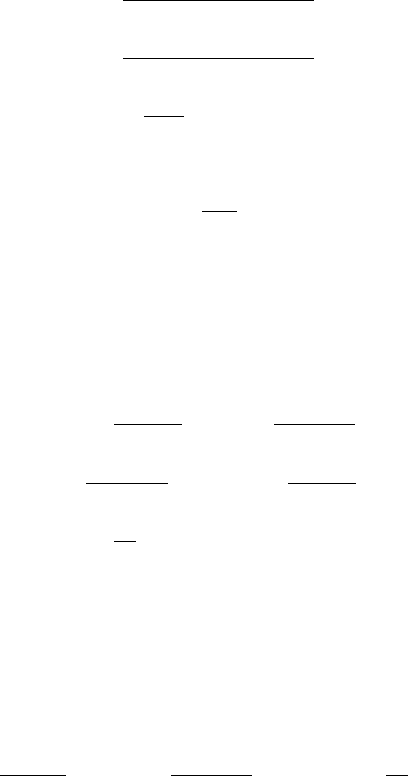
where
ω
c
=
e
m
B
0
(8.263)
536 8. Electromagnetic Waves in Dispersive Media and Anisotropic Media
is called the angular cyclotron frequency.
Substituting (8.260)–(8.262) into (8.252), we obtain
J
x
=
jω²
0
ω
2
p
E
x
− ²
0
ω
2
p
ω
c
E
y
ω
2
c
− ω
2
, (8.264)
J
y
=
²
0
ω
2
p
ω
c
E
x
+ jω²
0
ω
2
p
E
y
ω
2
c
− ω
2
, (8.265)
J
z
= −j
²
0
ω
2
p
ω
E
z
, (8.266)
where ω
p
is the angular plasma frequency defined before:
ω
2
p
=
%
0
e
²
0
m
.
Rewrite Maxwell’s equation for the curl of H:
∇ × H = jω²
0
E + J = jω² · E = jωD. (8.267)
Substituting (8.264)–(8.266) into this equation, and decomposing it into three
component equations, yields
D
x
= ²
0
µ
1 +
ω
2
p
ω
2
c
− ω
2

E
x
+ j²
0
ω
2
p
(ω
c
/ω)
ω
2
c
− ω
2
E
y
, (8.268)
D
y
= −j²
0
ω
2
p
(ω
c
/ω)
ω
2
c
− ω
2
E
x
+ ²
0
µ
1 +
ω
2
p
ω
2
c
− ω
2

E
y
, (8.269)
D
z
= ²
0
µ
1 −
ω
2
p
ω
2

E
z
. (8.270)
Finally, we find the permittivity tensor for the stationary magnetized plasma,
² =
²
1
j²
2
0
−j²
2
²
1
0
0 0 ²
3
, (8.271)
where
²
1
=²
0
µ
1+
ω
2
p
ω
2
c
− ω
2

, ²
2
=²
0
ω
2
p
(ω
c
/ω)
ω
2
c
− ω
2
, ²
3
=²
0
µ
1−
ω
2
p
ω
2

. (8.272)
This is just a permittivity tensor for nonreciprocal anisotropic media.
We conclude that the stationary magnetized plasma is an electric-
gyrotropic medium or ²-gyrotropic medium with an asymmetric permittivity
tensor. The z axis, which is the direction of the d-c magnetic field, is called
the gyrotropic axis of the medium.
When the frequency of the wave approaches the cyclotron frequency, ω ≈
ω
c
, ²
1
→ ∞, ²
2
→ ∞, cyclotron resonance occurs. A moving electron in a

8.9 Nonreciprocal Media 537
magnetic field without an electric field rotates at an angular frequency ω
c
,
so an applied alternating electric field oscillates at ω
c
continually pumps the
electron to higher and higher velocities and leads to the infinite response.
The collisions of electrons with ions and molecules limit the amplitude of the
oscillation and give rise to an absorption of the wave.
The cyclotron frequency of a plasma in a strong d-c magnetic field is in the
range of GHz, i.e., in the microwave to millimeter wave band. Hence cyclotron
resonance can be an effective technique for producing high-temperature
plasma by means of microwave energy. This is an important technique in
the experimental facilities to realize controlled nuclear fusion.
The ionosphere around the Earth is another example of a magnetized
plasma. The geomagnetic field strength is about 3 × 10
−5
T (0.3 Gauss), so
f
c
≈ 6 MHz, which is beyond the high end of the medium-wave broadcasting
band. The waves in the adjacent band of this frequency are strongly absorbed
in the ionosphere and are scarcely used in communication and broadcasting
purposes, but they are suitable for ionosphere explorations.
If the d-c magnetic field approaches infinity, then ω
c
= (e/m)B
0
→ ∞,
and
²
1
= ²
0
, ²
2
= 0, ²
3
= ²
0
µ
1 −
ω
2
p
ω
2

.
This is the same as (8.228) given in the last section, and the medium becomes
reciprocal.
If the d-c magnetic field approaches zero, ω
c
→ 0, or the frequency of the
applied alternating field is much larger than the cyclotron frequency of the
plasma, ω À ω
c
, the medium becomes isotropic:
²
2
= 0, ²
1
= ²
3
= ²
0
µ
1 −
ω
2
p
ω
2

.
This is the same as the result given in Section 8.1.7.
8.9.2 Saturated-Magnetized Ferrite, Gyromagnetic
Media
Ferrites or ferrimagnetic materials are a group of materials that have strong
magnetic effects and low loss up to microwave frequencies. Ferrites are
ceramic-like materials with a high resistivity that may be as much as 10
14
greater than that of metals, with relative permittivities around 8 to 15 or
greater, and with relative permeability as high as several thousand. Ferrites
are made by sintering a mixture of metallic oxides and have the general com-
position MO·Fe
2
O
3
, where M is a divalent metal such as Mn, Mg, Fe, Zn, Ni,
Cd, etc., or a mixture of them. The details of the structure and performance
of ferrites are described in reference [57]. The most recent development in
the area of ferrimagnetic material is the single-crystal ferrite, mainly yttrium
iron garnet (YIG), which has much lower loss in the microwave band.
538 8. Electromagnetic Waves in Dispersive Media and Anisotropic Media
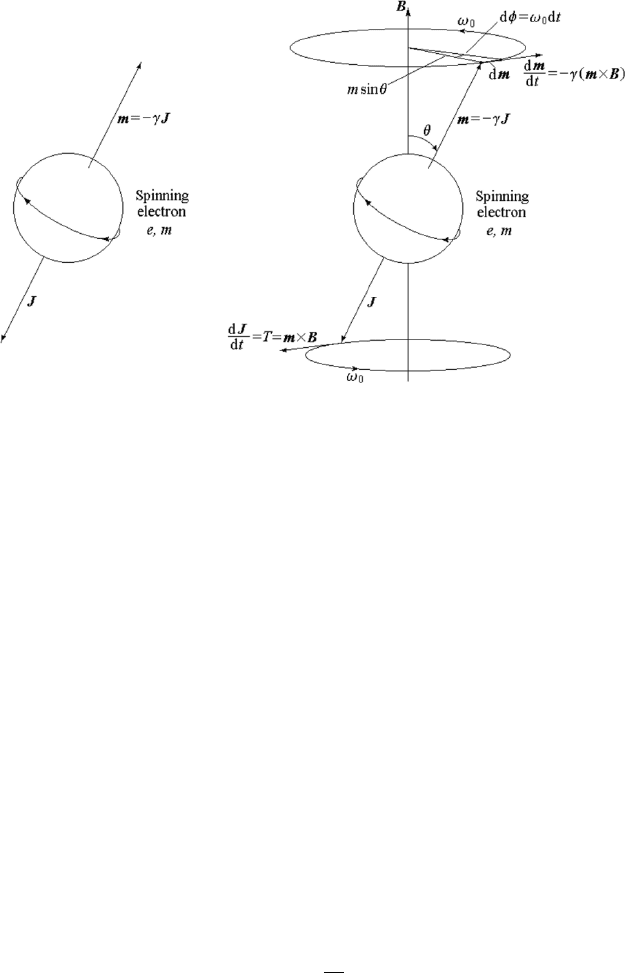
Figure 8.24: (a) Spinning electron in a ferrite. (b) Precession of a spinning
electron in lossless ferrite.
Ferrite in a d-c magnetic field, or so-called bias field, is a magnetic gy-
rotropic medium or gyromagnetic medium. The magnetic properties of ferrite
arises mainly from the magnetic dipole moment associated with the electron
spin. This is an atomic-scale phenomenon and must be studied by means of
microscopic theory based on quantum mechanics. But a classical picture of
the magnetization and the anisotropic magnetic properties may be obtained
by treating spinning electrons as gyroscopic tops.
(1) Permeability Tensors for Lossless Ferrites
A ferrite is considered to be made up of spinning bound electrons having
the behavior of magnetic tops, as shown in Fig. 8.24(a). For the spinning
electron, the magnetic dipole moment m and the angular momentum J are
parallel vectors in opposite directions because the charge of the electron is
negative. In this subsection, any losses associated with the motion of the
dipoles in an actual ferrite are neglected.
The ratio of the magnetic moment to the angular momentum of the spin-
ning electron is called the gyromagnetic ratio and is denoted by γ, i.e.,
−γ =
m
J
. (8.273)
The ratio m/J is a negative scalar because m and J are always in opposite
directions for an electron. The correct value of γ must be found from quantum
8.9 Nonreciprocal Media 539
mechanics and turns out to be equal to the value of the charge-to-mass ratio
of the electron, i.e.,
γ = 1.758796 × 10
11
rad s
−1
T
−1
. (8.274)
If the electron is considered to be a uniform mass and uniform charge dis-
tribution in a spherical volume, m and J are found by classical theory, the
resultant value of γ is in error by a factor of 2.
If a spinning electron is located in a magnetic field, a torque T will be
exerted on the dipole moment:
T = m × B. (8.275)
According to Newton’s equation for a rotating body, the rate of change of
the angular momentum J is equal to the applied torque T , i.e.,
dJ
dt
= T . (8.276)
Combining the above three equations, we obtain
dJ
dt
= (m × B),
dm
dt
= −γ (m × B), (8.277)
which are the equations of motion of the angular-momentum vector and the
magnetic-moment vector, respectively. The spinning electron will be regarded
as a magnetic top and torque T = m × B will cause the axis of the top
to rotate slowly about an axis parallel to the magnetic field, as shown in
Fig. 8.24(b). This rotation is called precession and the precession of a spin-
ning electron is known as Larmor precession. From Fig. 8.24(b) we can see
that
|dm| = |m|sin θdφ,
and
¯
¯
¯
¯
dm
dt
¯
¯
¯
¯
= |m|sin θ
dφ
dt
= ω
0
|m|sin θ, (8.278)
where θ is the angle between m and B. From (8.277), we have
¯
¯
¯
¯
dm
dt
¯
¯
¯
¯
= | − γ (m × B)| = γB|m|sin θ. (8.279)
Combining the above two equations (8.277) and (8.278), we obtain
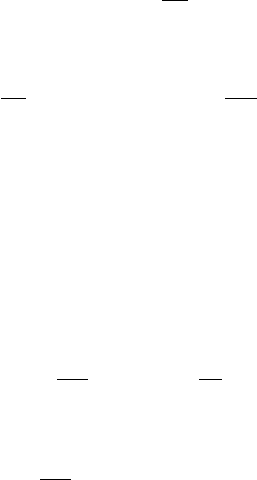
ω
0
= γB,
which is the angular frequency of the electron precession, usually called the
Larmor frequency. The value of the Larmor frequency ω
0
is equal to that
of the electron cyclotron frequency ω
c
because the gyromagnetic ratio of a
spinning electron is equal to the charge-to-mass ratio of the electron.

540 8. Electromagnetic Waves in Dispersive Media and Anisotropic Media
In (8.277), B is the total magnetic field acting on a particular molecule
or a magnetic top. It is made up of an external magnetic field B and the
magnetic field due to the other magnetic dipoles, which is proportional to the
magnetization vector of the medium surrounding the top under consideration:
B = µ
0
H + κµ
0
M, (8.280)
where κ is a constant that depends on the nature of the microscopic inter-
action of nearby dipole moments. The magnetization vector is the volume
density of the magnetic dipole moment:
M = lim
∆V →0
P
m
∆V
= N
0
m,
where N
0
is the effective number density of the spinning electrons.
Substituting (8.278) into (8.277) and considering that M ×M = 0, yield
dM
dt
= −γµ
0
[M × (H + κM)], i.e.,
dM
dt
= −γµ
0
(M × H). (8.281)
Assume that both the magnetic field vector and the magnetization vector
consist of d-c and sinusoidal a-c components. We will study the situation in
which all the magnetic domains are aligned in the direction of the gyrotropic
axis z, by a strong applied d-c magnetic bias field H
0
=
ˆ
zH
0
, i.e., the
material is saturated. Then we write
H = H
0
+
˜
H =
ˆ
zH
0
+ H
1
e
jωt
, (8.282)
M = M
0
+
˜
M =
ˆ
zM
0
+ M
1
e
jωt
, (8.283)
in which
H
1
=
ˆ
xH
x
+
ˆ
yH
y
+
ˆ
zH
z
, M
1
=
ˆ
xM
x
+
ˆ
yM
y
,
and
ˆ
zM
z
= 0 because the ferrite is saturated in the z direction so that any
change in the magnetization strength in this direction is impossible.
Equation (8.281) then becomes
jωM
1
= −γµ
0
(
ˆ
zM
0
+ M
1
) × (
ˆ
zH
0
+ H
1
). (8.284)
We treat the problem with the small-amplitude assumption that the cross
products of the a-c quantities M
1
× H
1
can be neglected and mention that
ˆ
zM
0
×
ˆ
zH
0
= 0. Equation (8.284) becomes
jωM
1
= −γµ
0
(
ˆ
zM
0
× H
1
+ M
1
×
ˆ
zH
0
). (8.285)
The component equations are
jωM
x
= −γµ
0
H
0
M
y
+ γµ
0
M
0
H
y
, (8.286)
jωM
y
= −γµ
0
M
0
H
x
+ γµ
0
H
0
M
x
, (8.287)
jωM
z
= 0. (8.288)