
Zhang K., Li D. Electromagnetic Theory for Microwaves and Optoelectronics
Подождите немного. Документ загружается.

8.6 Electromagnetic Waves in Uniaxial Crystals 511
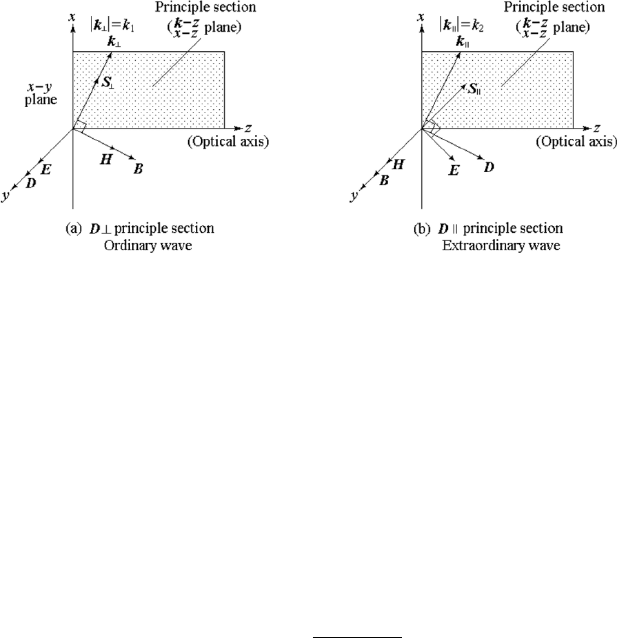
Figure 8.10: Plane waves in uniaxial crystals propagating in an arbitrary
direction.
Both linearly polarized components are o-waves and the composite wave is
an o-wave too. See Fig. 8.9(c).
The two linearly polarized wave components have different wave numbers
k
⊥
= k
1
and k
k
= k
3
, i.e., different phase velocities. As a consequence,
the state of polarization of the composite wave must continue to alternate
between linear and elliptic during the propagation through the medium.
If D
⊥
= D
k
and they are in phase at ζ = 0, the wave is linearly polarized
in a direction making a 45
◦
angle with respect to the optical axis. After
propagating a distance l such that
k
3
l −k
1
l =
(2m + 1)π
2
,
where m is an integer, the wave becomes circularly polarized. A slab of
crystal of such thickness is known as a quarter-wave plate and can be used
as a circular polarizer.
If a uniaxial crystal where ²
3
has a very large imaginary part such that
the parallel polarized wave is attenuated after a distance, whereas the per-
pendicularly polarized wave is transmitted with only a little attenuation. A
slab of such a crystal can be used as a linear polarizer.
8.6.4 Plane Waves Propagating in an Arbitrary
Direction
For a plane wave propagating in an arbitrary direction other than those par-
allel to and normal to the optical axis, there are two mutually perpendicular
linearly p olarized eigenwaves with different phase velocities. The perpen-
dicularly polarized eigenwave is an ordinary wave and the parallel polarized
eigenwave is an extraordinary wave. See Fig. 8.10. The angular wave num-
512 8. Electromagnetic Waves in Dispersive Media and Anisotropic Media
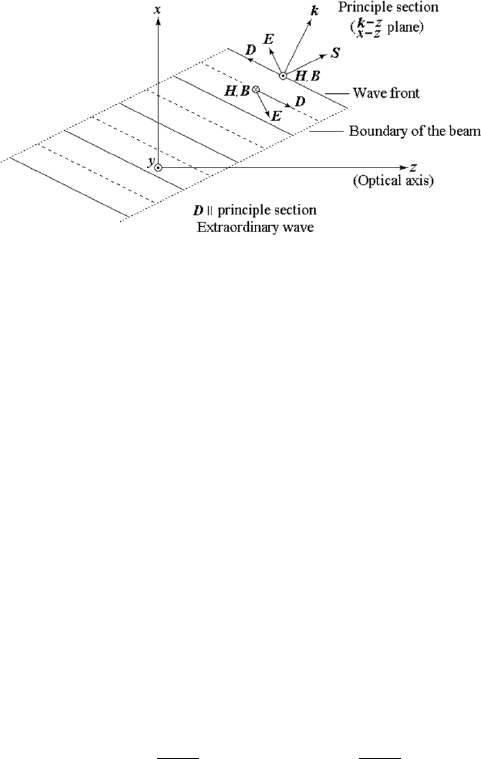
Figure 8.11: Fields, wave fronts, wave vector and Poynting vector in e-wave.
bers, phase velocities and effective index of the two eigenwaves are shown in
(8.146), (8.151), (8.147), (8.152), (8.148), and (8.153).
For the o-wave, the power flow and the wave vector are in the same
direction, i.e., the group velocity and the phase velocity are in the same
direction. For the e-wave, the power flow and the wave vector are in different
directions, i.e., the group velocity and the phase velocity are in different
directions. The fields, wave fronts, wave vector, and power flow for the e-
wave are shown in Fig. 8.11. The magnetic field vector for the e-wave is
perpendicular to the principle section, so it is convenient to write the wave
equation for the magnetic field.
In the case of D being in an arbitrary direction, it can be decomposed into
two linearly polarized components, D
⊥
and D
k
. The wave component with
D
⊥
is an ordinary wave and the wave component with D
k
is an extraordinary
wave. When a light ray with an arbitrary oriented D is incident on a surface
of a uniaxial crystal at an angle of incidence θ
i
, the angle of refraction of the
two eigenwaves θ
t⊥
and θ
tk
are different,
sin θ
t⊥
=
sin θ
i
n
⊥
, sin θ
tk
=
sin θ
i
n
k
. (8.157)
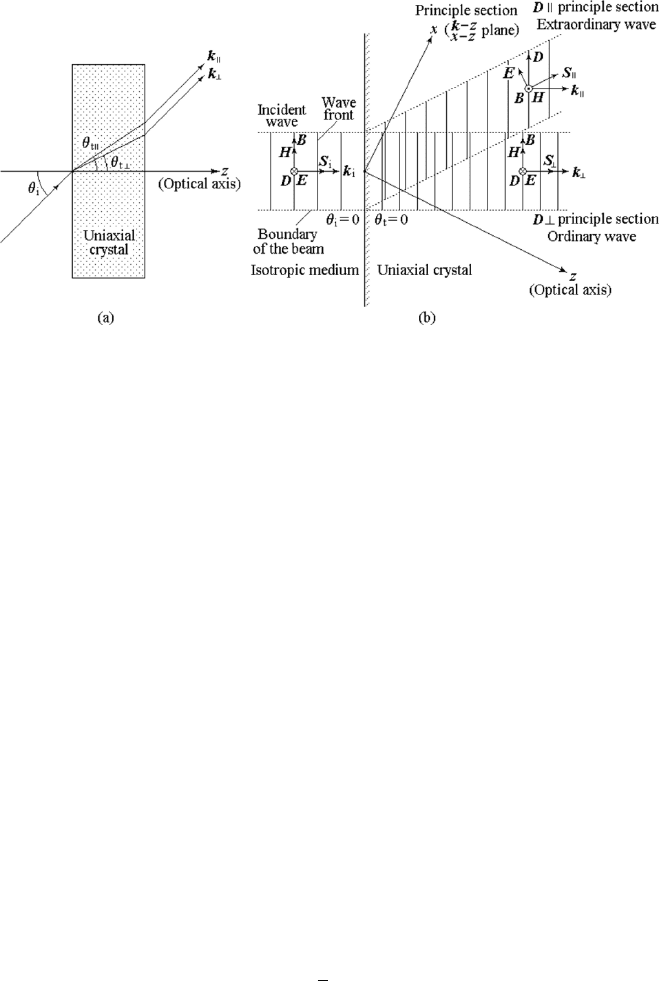
The ray will split in two rays with different angles of refraction, an ordinary
ray and an extraordinary ray, refer to Fig. 8.12(a). This splitting of the
refracted waves is an important phenomena of double refraction or birefrin-
gence. Note that the rays are again parallel when they pass through a planar
crystal slab.
If a crystal surface is cut at an angle oblique to the optical axis and a
ray with an arbitrary oriented D is normally incident on the surface, both
ordinary and extraordinary waves are excited in the crystal. The directions of
wave vectors of the two waves remain unchanged because of normal incidence,
but the directions of the power flows are different. The power flow of the o-
wave is still in the direction normal to the surface, whereas the power flow
8.7 General Formalisms of EM Waves in Reciprocal Media 513
Figure 8.12: Birefringence in uniaxial crystals.
of the e-wave is in a direction oblique to the surface. Hence the ray is split
into two. For the o-wave, the group velocity and the phase velocity are in the
same direction, but for the e-wave, the group velocity and the phase velocity
are in different directions, see Fig. 8.12(b).
8.7 General Formalisms of Electromagnetic
Waves in Reciprocal Media
In the previous section, electromagnetic waves in uniaxial media were stud-
ied. Now we turn to the general mathematical and graphical formalisms of
electromagnetic waves in reciprocal anisotropic media including uniaxial and
biaxial crystals [55].
8.7.1 Index Ellipsoid
A geometrical formalism for describing crystal permittivity and helping us to
understand the wave propagation in crystals is a quadratic surface defined in
terms of the κ-tensor components. It is called the index ellipsoid.
The original formula for the electric energy density stored in the medium,
which is suitable for isotropic as well as anisotropic media, is given by
w =
1
2
D · E. (8.158)
Substituting the constitutional equation (8.69) and the expression of the im-
permittivity of reciprocal crystals in the principle axes (8.132) into (8.158)
514 8. Electromagnetic Waves in Dispersive Media and Anisotropic Media
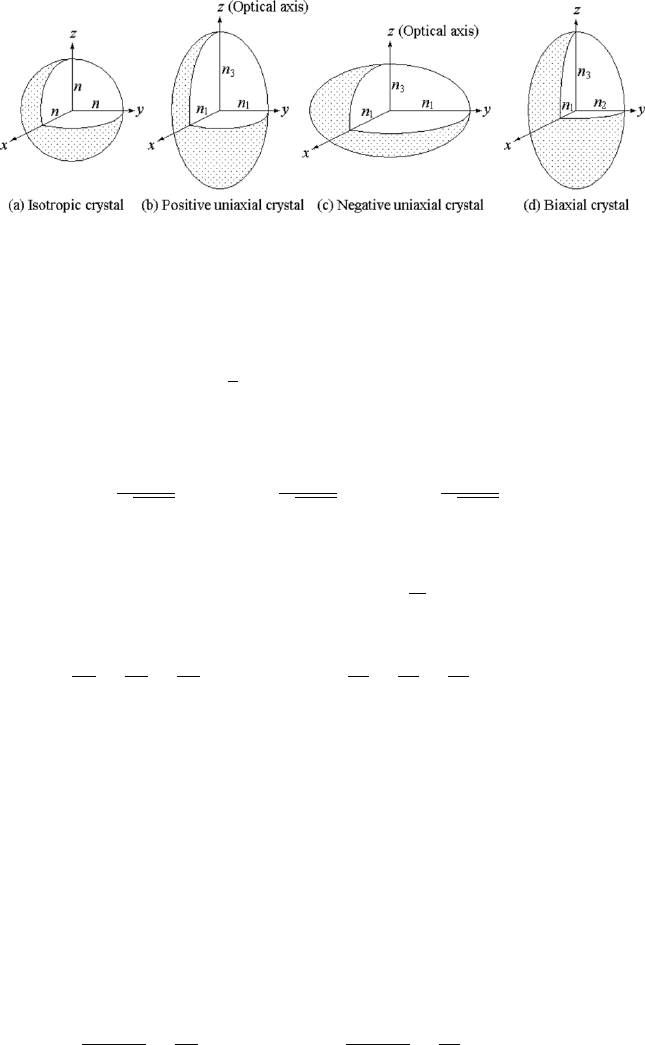
Figure 8.13: Index ellipsoid for isotropic (a), uniaxial (b), (c), and biaxial
(d) media.
gives
w =
1
2
¡
κ
1
D
2
x
+ κ
2
D
2
y
+ κ
3
D
2
z
¢
. (8.159)
Define three quantities x, y, and z measured along the three principle spatial
axes by
x =
D
x
√
2²
0
w
, y =
D
y
√
2²
0
w
, z =
D
z
√
2²
0
w
. (8.160)
Then (8.159) becomes
κ
1
x
2
+ κ
2
y
2
+ κ
3
z
2
=
1
²
0
, (8.161)
i.e.,
x
2
²
r1
+
y
2
²
r2
+
z
2
²
r3
= 1, or
x
2
n
2
1
+
y
2
n
2
2
+
z
2
n
2
3
= 1. (8.162)
Since κ
i
and ²
i
are all p ositive, this is the equation of an ellipsoid called the
index ellipsoid. The semi-axes of the ellipsoid are equal to the indices or
the square roots of the relative permittivities in the three principle axes as
shown in Fig. 8.13. The indices in the three principle axes are called principle
indices. In general, the three semi-axes are not equal to each other.
The above geometrical formalism is suitable for all reciprocal media. The
three special cases are as follows.
(1) Isotropic media, n
1
= n
2
= n
3
= n. Equation (8.162) becomes
x
2
+ y
2
+ z
2
= ²
r
, or x
2
+ y
2
+ z
2
= n
2
, (8.163)
The index ellipsoid reduces to a sphere as shown in Fig. 8.13(a).
(2) Uniaxial media, n
1
= n
2
, n
3
6= n
1
. Equation (8.162) becomes
x
2
+ y
2
²
r1
+
z
2
²
r3
= 1, or
x
2
+ y
2
n
2
1
+
z
2
n
2
3
= 1, (8.164)

8.7 General Formalisms of EM Waves in Reciprocal Media 515
This is an ellipsoid of revolution with the axis of circular symmetry parallel
to z. For a positive uniaxial medium, ²
3
> ²
1
, the index ellipsoid becomes a
prolate spheroid and for a negative uniaxial medium, ²
3
< ²
1
, this becomes
a oblate spheroid. See Fig. 8.13(b) and (c).
When k k
ˆ
z, the intersection of a plane through the origin and normal to
k with the index ellipsoid is a circle so that n
x
= n
y
, and the propagation
characteristics of arbitrarily polarized plane waves are the same as those in
isotropic media. Hence a uniaxial medium has one optical axis, i.e., the z
axis, with an index different to those in the other two axis.
When k ⊥
ˆ
z, the section consists k and
ˆ
z is the principle section, and the
intersection of a plane through the origin and normal to k with the index
ellipsoid is a ellipse. The two semi axes represent the direction perpendicular
to and parallel to the principle section. The effective indices are n
⊥
= n
1
,
n
k
= n
3
and the corresponding eigenwaves are both o-waves.
When k 6k
ˆ
z, k 6⊥
ˆ
z, the intersection of a plane through the origin and
normal to k with the index ellipsoid is also a ellipse. As we discussed in the
last section, n
⊥
= n
1
, the corresponding eigenwave is an o-wave, and n
k
is
given by (8.153) lies between n
1
and n
3
, the corresponding eigenwave is an
e-wave.
(3) Biaxial media n
1
6= n
2
6= n
3
: Equation (8.162) remains in its gen-
eral form. This is a general ellipsoid with three different semi-axes. See
Fig. 8.13(d).
The equation of the ellipse on the x-z section is
x
2
n
2
1
+
z
2
n
2
3
= 1.
An arbitrary point on the ellipse can be expressed in polar coordinates as
r = re
jψ
, and the above equation of ellipse become
cos
2
ψ
n
2
1
+
sin
2
ψ
n
2
3
=
1
r
2
, (8.165)
where r is the length of the vector r and ψ is the angle between r and ˆx, so
that
x = r cos ψ, z = r sin ψ, r
2
= x
2
+ z
2
, tan ψ =
z
x
,
and
r = n
1
, when ψ = 0; r = n
3
, when ψ =
π
2
.
Suppose n
3
> n
2
> n
1
, we can find two special points on the ellipse with
ψ = ψ
0
so that r = n
2
, and (8.165) becomes:
cos
2
ψ
0
n
2
1
+
sin
2
ψ
0
n
2
3
=
1
n
2
2
. (8.166)
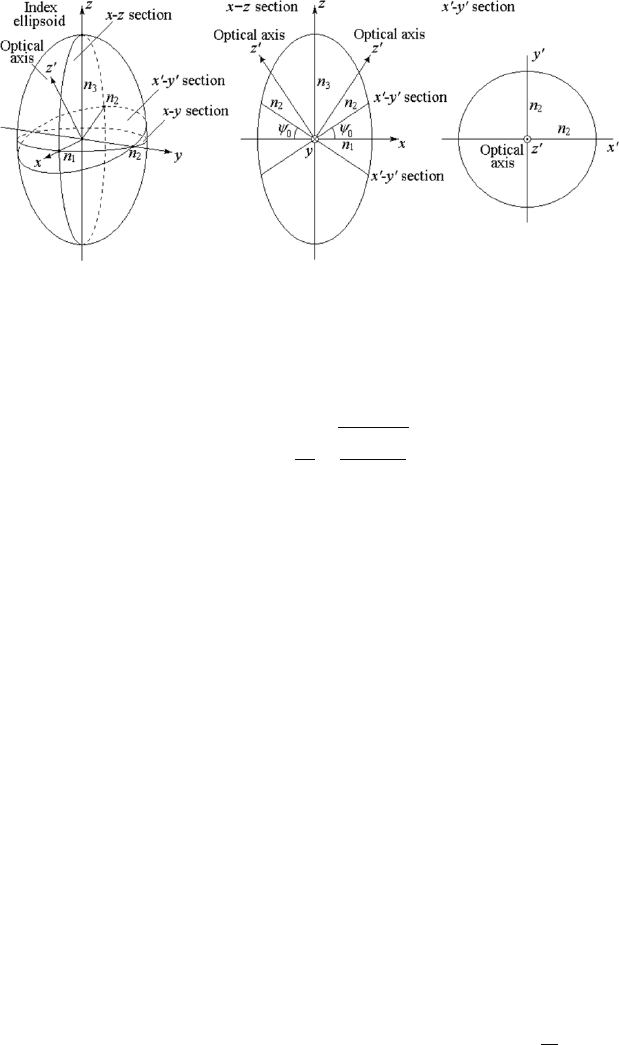
516 8. Electromagnetic Waves in Dispersive Media and Anisotropic Media
Figure 8.14: Optical axes for biaxial medium.
From this equation, we find that
tan ψ
0
= ±
n
3
n
1
s
n
2
2
− n
2
1
n
2
3
− n
2
2
. (8.167)
The intersections of the index ellipsoid with the planes through y axis and
these two special points are two circles with radius n
2
. See Fig. 8.14. Let
the axis normal to one of the two planes is z
0
and the coordinate axes on
the plane are x
0
and y
0
. We see that n
x
0
= n
y
0
= n
2
. When a plane wave
propagates along any one of these two axes, the vector D must lie in the x
0
-y
0
plane and the effective index is independent of the orientation of D. Hence
arbitrary polarized plane waves with arbitrary orientation of D propagate
along these axes with the same phase velocities as those in isotropic media
with index n
2
, and keep the state of polarization unchanged. These two
special axes are known as the optical axes for the medium and the medium
is, as a consequence, called a biaxial medium.
In bi-anisotropic medium, if the direction of propagation is not along an
optical axis, the two eigenwaves will propagate with different phase velocities
and birefringence will occur.
8.7.2 The Effective Indices of Eigenwaves
For an arbitrarily oriented coordinate system x
0
, y
0
, z
0
, the equation of the
ellipsoid is
κ
x
0
x
0
x
02
+κ
y
0
y
0
y
02
+κ
z
0
z
0
z
02
+2κ
y
0
z
0
y
0
z
0
+2κ
z
0
x
0
z
0
x
0
+2κ
x
0
y
0
x
0
y
0
=
1
²
0
. (8.168)
8.7 General Formalisms of EM Waves in Reciprocal Media 517
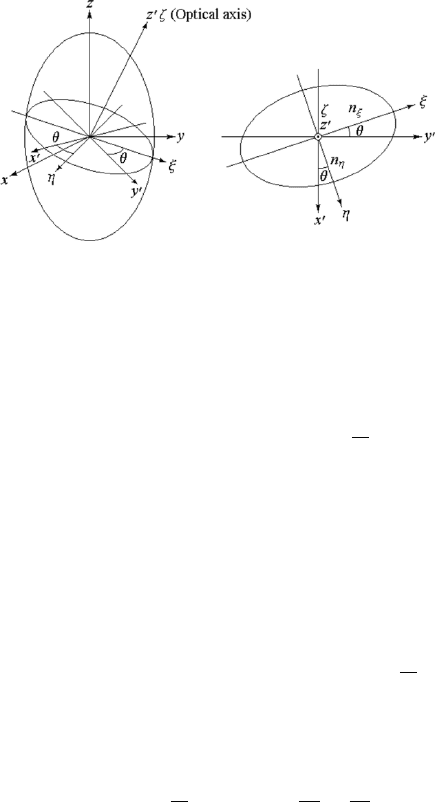
Figure 8.15: Index ellipsoid and its cross-section.
The plane perpendicular to the z
0
axis through the origin, i.e., the plane
z
0
= 0, cuts the ellipsoid in the ellipse
κ
x
0
x
0
x
02
+ κ
y
0
y
0
y
02
+ 2κ
x
0
y
0
x
0
y
0
=
1
²
0
. (8.169)
If we choose the orientation of x
0
and y
0
in a manner such that
κ
x
0
y
0
= 0,
the new coordinate system is just the kDB system with ζ = z
0
parallel to
the director of the wave vector k and x
0
, y
0
become η, ξ, respectively; refer
to Figure 8.15. Then the equation of the ellipsoid becomes
κ
ηη
η
2
+ κ
ξξ
ξ
2
+ κ
ζζ
ζ
2
+ 2κ
ξζ
ξζ + 2κ
ζη
ζη =
1
²
0
. (8.170)
The plane perpendicular to the ζ axis through the origin, ζ = 0, cuts the
ellipsoid in the ellipse
κ
ηη
η
2
+ κ
ξξ
ξ
2
=
1
²
0
, or
η
2
n
2
η
+
ξ
2
n
2
ξ
= 1. (8.171)
The directions of semi-axes of this ellipse are just the coordinates η and
ξ, see Fig. 8.15, i.e., the orientations of D for the two linearly polarized
eigenwaves propagation along the direction of ζ. For a given direction of
propagation, we can find the orientations of D and the corresponding phase
velocities of the two linearly polarized eigenwaves by means of the index
ellipsoid as follows. Determine the ellipse formed by the intersection of a
plane through the origin and normal to the direction of propagation, i.e., k
or
ˆ
ζ, and the index ellipsoid. The direction of the major and minor semi-
axes of the ellipse, i.e.,
ˆ
η and
ˆ
ξ, are those of the two allowed polarizations

518 8. Electromagnetic Waves in Dispersive Media and Anisotropic Media
of eigenwaves and the lengths of these semi-axes are the effective indices of
the two eigenwaves, n
η
and n
ξ
. The phase coefficients and phase velocities
of the two eigenwaves are then
k
I
= k
η
= ω
n
η
c
, k
II
= k
ξ
= ω
n
ξ
c
, v
pI
=
c
n
η
, v
pII
=
c
n
ξ
.
8.7.3 Dispersion Equations for the Plane Waves
in Reciprocal Media
We are now going to find the dispersion equation for a plane wave propagating
in a general reciprocal medium along an arbitrary direction. The wave vector
of the plane wave is k,
k =
ˆ
xk
x
+
ˆ
yk
y
+
ˆ
zk
z
, k
2
= k
2
x
+ k
2
y
+ k
2
z
, (8.172)
k
x
= k cos α, k
y
= k cos β, k
z
= k cos γ, (8.173)
where k
x
, k
y
, and k
z
are the three components of the wave vector k, α, β
and γ are the angles between k and
ˆ
x,
ˆ
y, and
ˆ
z, respectively, and
cos
2
α + cos
2
β + cos
2
γ = 1. (8.174)
The electric field vector of the plane wave is
E =
ˆ
xE
x
+
ˆ
yE
y
+
ˆ
zE
z
. (8.175)
Substituting (8.172) and (8.175) into the wave equation for plane waves in
anisotropic media (8.92),
k
2
E − k(k · E) − ω
2
µ
0
² · E = 0,
yields
ˆ
xk
2
E
x
+
ˆ
yk
2
E
y
+
ˆ
zk
2
E
z
−
ˆ
xk
x
(k
x
E
x
+ k
y
E
y
+ k
z
E
z
)
−
ˆ
yk
y
(k
x
E
x
+ k
y
E
y
+ k
z
E
z
) −
ˆ
zk
z
(k
x
E
x
+ k
y
E
y
+ k
z
E
z
)
−
ˆ
xk
2
1
E
x
−
ˆ
yk
2
2
E
y
−
ˆ
zk
2
3
E
z
= 0, (8.176)
where
k
2
1
= ω
2
µ
0
²
1
, k
2
2
= ω
2
µ
0
²
2
, k
2
3
= ω
2
µ
0
²
3
are the principle wave numbers in the three principle axes x, y, and z, re-
spectively. The three components in the left-hand side of the above equation
must be equal to zero individually, i.e.,
¡
k
2
y
+ k
2
z
− k
2
1
¢
E
x
− k
x
k
y
E
y
− k
x
k
z
E
z
= 0, (8.177)
−k
y
k
x
E
x
+
¡
k
2
z
+ k
2
x
− k
2
2
¢
E
y
− k
y
k
z
E
z
= 0, (8.178)
−k
z
k
x
E
x
− k
z
k
y
E
y
+
¡
k
2
x
+ k
2
y
− k
2
3
¢
E
z
= 0. (8.179)

8.7 General Formalisms of EM Waves in Reciprocal Media 519
This is a set of homogeneous linear equations with variables E
x
, E
y
, and
E
z
. The homogeneous simultaneous equations have nontrivial solutions only
when the determinant of the coefficients equals zero, i.e.,
¯
¯
¯
¯
¯
¯
k
2
y
+ k
2
z
− k
2
1
−k
x
k
y
−k
x
k
z
−k
y
k
x
k
2
z
+ k
2
x
− k
2
2
−k
y
k
z
−k
z
k
x
−k
z
k
y
k
2
x
+ k
2
y
− k
2
3
¯
¯
¯
¯
¯
¯
= 0. (8.180)
Going through a lot of algebra yields
¡
k
2
1
k
2
x
+ k
2
2
k
2
y
+ k
2
3
k
2
z
¢¡
k
2
x
+ k
2
y
+ k
2
z
¢
−
£
k
2
1
¡
k
2
2
+ k
2
3
¢
k
2
x
+ k
2
2
¡
k
2
3
+ k
2
1
¢
k
2
y
+ k
2
3
¡
k
2
1
+ k
2
2
¢
k
2
z
¤
+ k
2
1
k
2
2
k
2
3
= 0, (8.181)
or
k
4
¡
k
2
1
cos
2
α + k
2
2
cos
2
β + k
2
3
cos
2
γ
¢
− k
2
£
k
2
1
k
2
2
¡
cos
2
α + cos
2
β
¢
+ k
2
2
k
2
3
¡
cos
2
β + cos
2
γ
¢
+ k
2
3
k
2
1
¡
cos
2
γ + cos
2
α
¢¤
+ k
2
1
k
2
2
k
2
3
= 0. (8.182)
Equation (8.181) or (8.182) is the eigenvalue equation or dispersion equation
for the plane wave propagating in a general reciprocal medium along an
arbitrary direction.
One alternative form of the eigenvalue equation is given by
cos
2
α
v
2
1
− v
2
p
+
cos
2
β
v
2
2
− v
2
p
+
cos
2
γ
v
2
3
− v
2
p
= 0, (8.183)
where v
p
= ω/k is the phase velocity of the plane wave along k; v
1
=
1/
√
µ
0
²
1
, v
2
= 1/
√
µ
0
²
2
, and v
3
= 1/
√
µ
0
²
3
are the principle phase veloci-
ties along the three principle axes x, y, and z, respectively. This equation is
known as the Fresnel normal equation in crystal optics. Equations (8.181),
(8.182), and (8.183) are identical with each other. The eigenvalue equation
(8.182) is a quadratic equation of k
2
, and hence there are two roots denoted
by k
2
I
and k
2
II
. The corresponding phase velocities are v
2
pI
and v
2
pII
.
(1) Plane Waves in Biaxial Crystals
Rewrite Maxwell’s equations for plane waves in ²-anisotropic media:
k × E = ωµ
0
H, k × H = −ωD.
It gives
k × (k × E) = k(k · E) − k
2
E = −ω
2
µ
0
D,
and then we get
D = −
1
ω
2
µ
0
k × (k × E) =
1
ω
2
µ
0
[k
2
E − k(k · E)]. (8.184)

520 8. Electromagnetic Waves in Dispersive Media and Anisotropic Media
Considering the constitutional relation
D =
ˆ
xD
x
+
ˆ
yD
y
+
ˆ
zD
z
=
ˆ
x²
1
E
x
+
ˆ
y²
2
E
y
+
ˆ
z²
3
E
z
,
we obtain
ˆ
xD
x
+
ˆ
yD
y
+
ˆ
zD
z
=
1
ω
2
µ
0
[k
2
ˆ
x
D
x
²
1
+
ˆ
y
D
y
²
2
+
ˆ
z
D
z
²
3
−(
ˆ
xk
x
+
ˆ
yk
y
+
ˆ
zk
z
)(k ·E)].
Solving for D
x
, D
y
, and D
z
gives
D
x
=
k
x
(1/µ
0
²
1
− ω
2
/k
2
)
k · E
µ
0
k
2
=
cos α
v
2
1
− v
2
p
1
µ
0
µ
k
k
· E

, (8.185)
D
y
=
k
y
(1/µ
0
²
2
− ω
2
/k
2
)
k · E
µ
0
k
2
=
cos β
v
2
2
− v
2
p
1
µ
0
µ
k
k
· E

, (8.186)
D
z
=
k
z
(1/µ
0
²
3
− ω
2
/k
2
)
k · E
µ
0
k
2
=
cos γ
v
2
3
− v
2
p
1
µ
0
µ
k
k
· E

, (8.187)
Then the expression of vector D becomes
D =
1
µ
0
µ
ˆ
x
cos α
v
2
1
− v
2
p
+
ˆ
y
cos β
v
2
2
− v
2
p
+
ˆ
z
cos γ
v
2
3
− v
2
p
¶µ
k
k
· E

. (8.188)
Corresponding to the two solutions k
I
and k
II
, we have two sets of fields D
I
,
E
I
and D
II
, E
II
with phase velocities v
pI
and v
pII
, respectively. The scalar
product of D
I
and D
II
is given by
D
I
· D
II
=
1
µ
2
0
µ
k
I
k
I
· E
I
¶µ
k
II
k
II
· E
II

1
v
2
pI
− v
2
pII
"
cos α
v
2
1
− v
2
pI
−
cos α
v
2
1
− v
2
pII
+
cos β
v
2
2
− v
2
pI
−
cos β
v
2
2
− v
2
pII
+
cos γ
v
2
3
− v
2
pI
−
cos γ
v
2
3
− v
2
pII
#
. (8.189)
Both v
pI
and v
pII
are solutions of the Fresnel wave normal equation (8.183),
hence the factors in the square brackets have to be zero, and we have
D
I
· D
II
= 0. (8.190)
The electric inductions of the two solutions D
I
and D
II
are perpendicular to
each other.
We conclude that in a reciprocal biaxial crystal, in an arbitrary direction
of propagation, there are two linearly polarized eigenwaves with different
phase velocities. The orientations of the two eigenwaves are normal to each
other. Following the discussion in Section 8.4.2, vectors D
I
, E
I
, k
I
, and
S
I
are coplanar and D
I
, E
I
, k
I
, and S
I
are coplanar too. In general, both
eigenwaves are extraordinary waves. See Fig. 8.16(a).