
Zhang K., Li D. Electromagnetic Theory for Microwaves and Optoelectronics
Подождите немного. Документ загружается.

9.2 Characteristics of Gaussian Beams 581
0 1 2 3 4
0
1
2
3
4
0
ww
szz )(
0
0 1 2 3 4 5
0
1
2
3
4
5
szz )(
0
sR
(a)
(b)
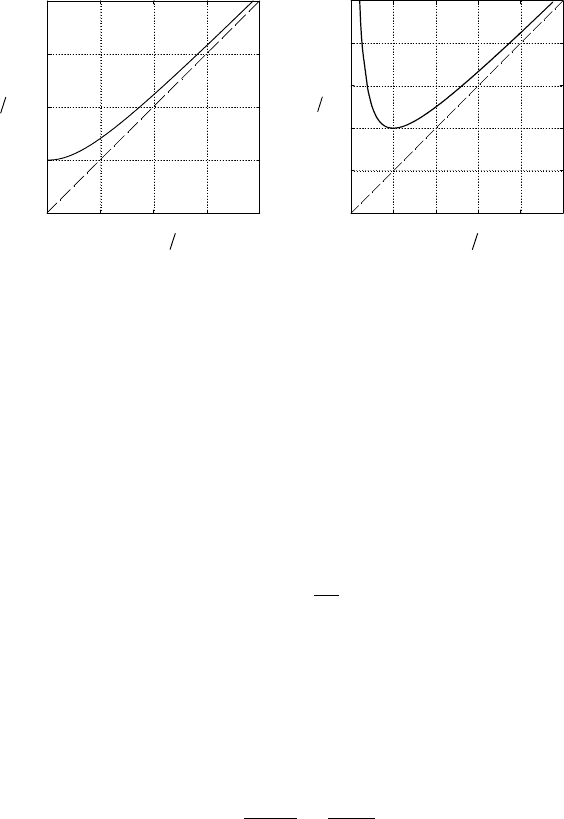
Figure 9.1: (a) The normalized beam radius and (b) the normalized radius
of the phase front for Gaussian beam.
9.2.2 Beam Radius, Curvature Radius of Phase Front,
and Half Far-Field Divergence Angle
When z − z
0
is small, the beam radius is nearly the same as w
0
. if z − z
0
is
large, the radius increases linearly with z − z
0
. From (9.20), the normalized
beam radius, w/w
0
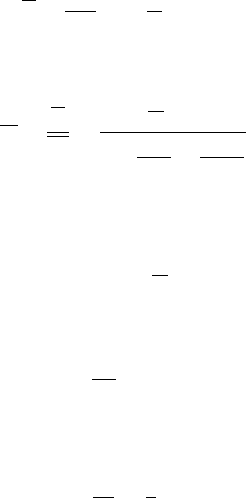
, is a function of (z − z
0
)/s, as shown in Fig. 9.1(a).
From (9.17), the equation of the phase front is
φ − k
·
(z − z
0
) +
ρ
2
2R
¸
= C, (9.25)
where C is a constant. It is easy to prove that the phase front is approxi-
mately a spherical surface whose curvature radius is R. If z − z
0
À s, R is
approximately z − z
0
, and the center of the spherical surface is at z = z
0
.
From (9.21), the normalized radius of the phase front, R/s, is a function of
(z − z
0
)/s, as shown in Fig. 9.1(b).
From (9.20), as z − z
0
À s,
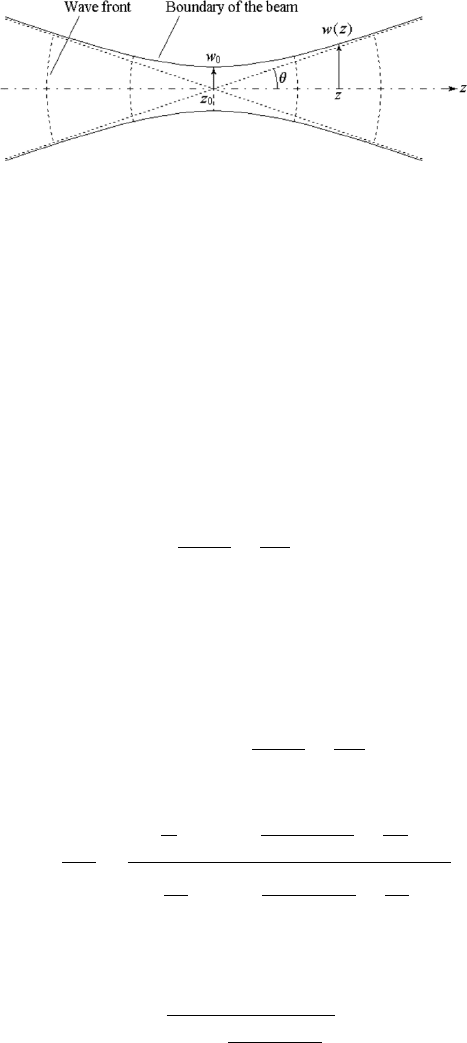
tan θ =
w
z − z
0
=
λ
nπw
0
, (9.26)
where θ is the half far-field divergence angle of the beam, which is shown in
Fig. 9.2. The larger the radius of the beam waist, the smaller the half far-field
divergence angle is, and the collimation of the beam is better. Contrarily, the
smaller the radius of beam waist, the larger the half far-field divergence angle
is, and the focus characteristics is better. As w
0
is one thousand times larger
than the wavelength, the half far-field divergence angle is about 10
−3
π rad,
and the beam is nearly a plane wave. For the beam from a semiconductor
laser, the radius of the beam waist is less than a wavelength, the half far-field
divergence angle is about 0.5 rad, and the paraxial condition is not valid.
582 9. Gaussian Beams
Figure 9.2: The half far-field divergence angle of Gaussian beam.
From (9.26), we know that the shorter the wavelength, the smaller the half
far-field divergence angle is. In free-space optical communication, a Gaussian
beam with a short wavelength is preferable.
9.2.3 Phase Velocity
The phase velocity is the propagating velocity of the phase fronts. The phase
fronts in a Gaussian beam are not planar, so the phase velocity is not a
constant vector. From (9.15) and (9.17), the phase factor of the Gaussian
beam is expressed as
kz − arctan
z − z
0
s
+
kρ
2
2R
=
Z
β · dr, (9.27)
where β is the vector propagation constant, r is the position vector, and the
integrating path is a curve from the central point of the beam waist to the
relevant position. From (9.27) we obtain
β = ∇M, (9.28)
where
M = kz − arctan
z − z
0
s
+
kρ
2
2R
. (9.29)
The phase velocity can be expressed as
v
p
=
ωβ
|β|
2
=
ω
½
ρ
R
ˆρ +
·
1 −
w
2
0
− ρ
2
2R(z − z
0
)
−
ρ
2
R
2
¸
ˆ
z
¾
k
(
ρ
2
R
2
+
·
1 −
w
2
0
− ρ
2
2R(z − z
0
)
−
ρ
2
R
2
¸
2
)
, (9.30)
where ˆρ is the radial unit vector and
ˆ
z is the axial unit vector. The phase
velocity on the beam axis is
v
p
=
ω
k
·
1 −
w
2
0
2R(z − z
0
)
¸
ˆ
z. (9.31)
9.2 Characteristics of Gaussian Beams 583
From (9.31) it is confirmed that the phase velocity of a Gaussian beam
is greater than that of a plane wave. This result is natural because the wave
vectors of the elementary plane waves of a Gaussian beam have inclining
angles with respect to the beam axis. At z = z
0
, the radius of the beam is a
minimum, and the phase velocity is a maximum, which is expressed as
v
p
=
ω
k −
λ
nπw
2
0
. (9.32)
The paraxial approximation requires that the phase velocity is close to
the velocity of a plane wave, and this leads to
k À
λ
nπw
2
0
. (9.33)
The above formula is exactly the same as (9.24).
In some problems we need to use light rays to express Gaussian beams, and
the geometrical optics is applied to some special transformations of Gaussian
beams. The rays are the curves that are perpendicular to the phase fronts,
and their tangents represent the directions of the phase velocity. Supposing
the angle between the direction of the phase velocity and the beam axis to
be α. From (9.30) we obtain
tan α =
ρ
R
1 −
w
2
0
− ρ
2
2R(z − z
0
)
−
ρ
2
R
2
. (9.34)
Within the paraxial approximation, (9.34) is expressed as
tan α =
ρ
R
. (9.35)
9.2.4 Electric and Magnetic Fields in Gaussian Beams
In order to obtain the electric and magnetic field distributions in a Gaussian
beam, it is necessary to specify the scalar quantity as a component of the
vector potential. The magnetic field can be derived from this component, and
then the electric field can be derived from the magnetic field. We assume the
vector potential to be
A = ψ
ˆ
x = u(x, y, z)e
−jkz
ˆ
x. (9.36)
The magnetic field is then given by
H =
∇ × A
µ
0
= −
jk
µ
0
e
−jkz
µ
u
ˆ
y − j
∂u
k∂y
ˆ
z

. (9.37)
Since ∇ · ∇ × A = 0, the magnetic field lines are closed.
584 9. Gaussian Beams
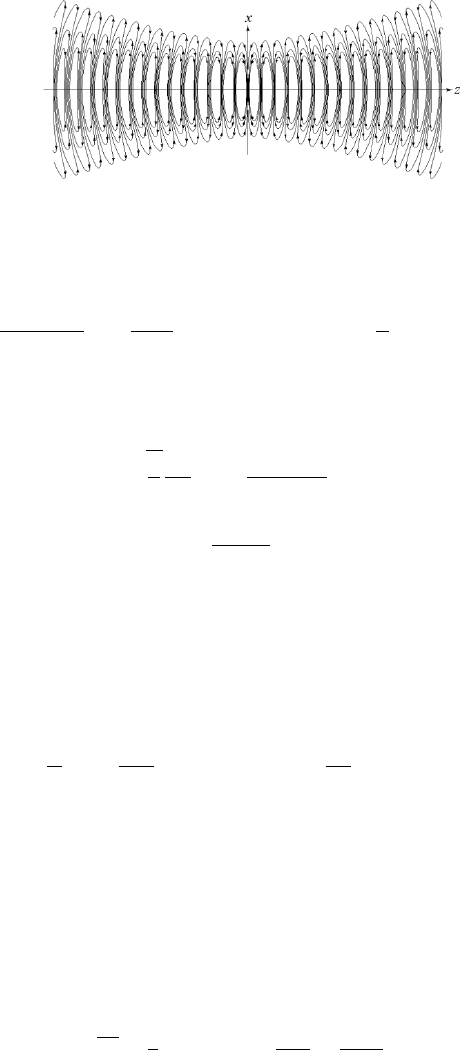
Figure 9.3: The electric field lines of a Gaussian beam.
The electric field is
E =
−j∇ × H
ω²
≈ −
k
ω²µ
0
∇ × (ue
−jkz
ˆ
y) = ∇
³
−
ω
k
ue
−jkz
´
×
ˆ
y. (9.38)
Since the amplitude of the longitudinal field component is much less than
that of the transverse components, in (9.38) the longitudinal component of
H is neglected. The electric field distribution including the time factor is
E(r, t ) = ∇
(
−
r
2
π
ω
kw
exp
µ
−x
2
− y
2
w
2

×cos
·
ωt−k
µ
z+
x
2
+y
2
2R

+φ
¸
)
×
ˆ
y =∇M(r, t)×
ˆ
y. (9.39)
The expression in the curly brackets is represented by M (r, t), so E(r, t) ⊥
ˆ
y
and E(r, t) ⊥ ∇M(r, t). The direction of the electric field is perpendicular to
the y axis and ∇M(r, t). In the xz plane the direction of the electric field is
consistent with the equivalue curve of M(r, t), so the equation of the electric
field lines is the same as that for the equivalue curve of M(r, t). In the plane
of y = 0 the equation is
1
w
exp
µ
−x
2
w
2

cos
·
ωt − k
µ
z +
x
2
2R

+ φ
¸
= C, (9.40)
where C is a constant, w, R, and φ are determined by (9.13)–(9.15). In
Fig. 9.3, the electric field lines of a Gaussian beam with w
0
= λ at a moment
in the y = 0 plane are shown.
9.2.5 Energy Density and Power Flow
The energy density and the p ower flow in a Gaussian beam can be derived
from the electric and magnetic fields. From (9.37) and (9.38) the averaged
energy density is
W =
1
2
ω
2
²|u|
2
µ
1 +
ρ
2
2R
2
+
2ρ
2
k
2
w
4

. (9.41)
9.3 Transformation of Gaussian Beams 585
The Poynting vector is
S =
kω
2µ
0
|u|
2
³
ρ
R
ˆρ +
ˆ
z
´
. (9.42)
The velocity of the energy is then
v
e
=
S
W
=
c
³
ρ
R
ˆρ +
ˆ
z
´
1 +
ρ
2
2R
2
+
2ρ
2
k
2
w
4
, (9.43)
where c is the velocity of plane waves. If β is the angle b etween the direction
of energy flow and the z axis, we have the relation
tan β =
ρ
R
. (9.44)
The equation of the contour at which the energy density is a fraction of
that on the beam axis is
ρ
2
w
2
= A, (9.45)
where A is a constant. From (9.13), (9.14), and (9.45) it is proved that the
tangential direction of the contour is determined by
dρ
dz
=
ρ
z
. (9.46)
Comparing (9.44) with (9.46), we see that the tangential direction of the
contour is the direction of energy flow.
9.3 Transformation of Gaussian Beams
In the propagation of Gaussian beams, if reflection, refraction, focusing, and
collimating through or from optical elements take place, the beam parameters
will be changed, and these processes are known as transformation of Gaussian
beams [38, 65, 116]. The prerequisite of dealing with the transformation is
that the beams are quasi-plane waves. Only when the paraxial condition is
satisfied, can the transformation law be discussed.
9.3.1 The q Parameter and Its Transformation
The fundamental parameters in a Gaussian beam are the radius w
0
and
the position z
0
of its waist. For a fixed wavelength, all beam parameters
are determined by w
0
and z
0
. The confocal parameter s contains w
0
and
the wavelength, so the parameter relating to the spacial distribution of the
Gaussian b eam is specified to be q = (z −z
0
) + js, and the transformation of
the Gaussian beam is referred to as the transformation of q parameter.
586 9. Gaussian Beams
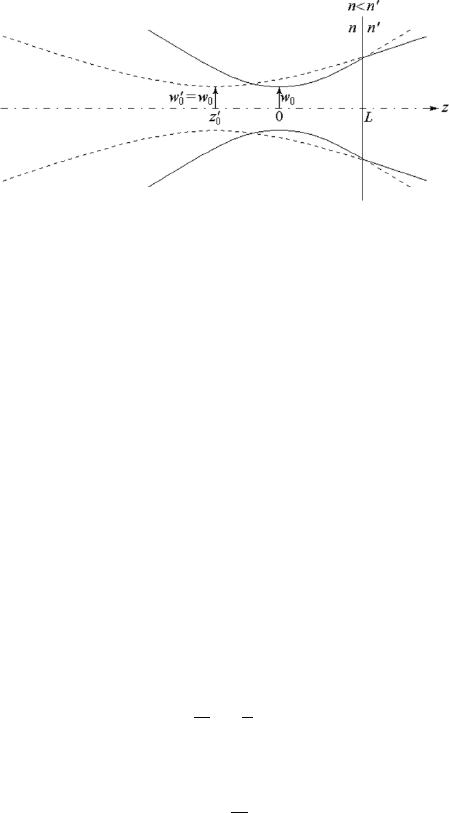
Figure 9.4: Transmission of a Gaussian beam through a boundary between
two media.
The transformations of a Gaussian beam include propagation along a
distance, transmission from a medium into another, reflection from a spherical
mirror, and transmission through a thin lens or a self-focusing lens. These
transformations are often encountered in optics and optoelectronics, and they
are discussed separately in the following text.
(1) The transformation for propagating through a distance d is
q
0
= q + d. (9.47)
(2) A Gaussian beam transmits normally from a medium into another, as
shown in Fig. 9.4. If the variation of reflectance at the whole boundary is
neglected, according to the continuous condition, the coefficients of ρ
2
in
the beam distribution formula (9.5) must be identified on both sides of the
boundary, and this leads to
k
0
q
0
=
k
q
. (9.48)
From the above formula we obtain
q
0
=
n
0
n
q, (9.49)
where n and n
0
are the refractive indices of the two media.
Example A Gaussian beam whose waist is at z
0
= 0 is incident from free
space normally into a medium whose refractive index is n
0
, the boundary is
at z = L. Derive the radius of the transmitting beam waist and its location.
As q
0
= n
0
q, where q
0
= (z − z
0
0
) + js
0
, q = z + js, we have
L − z
0
0
+ js
0
= n
0
(L + js).
9.3 Transformation of Gaussian Beams 587
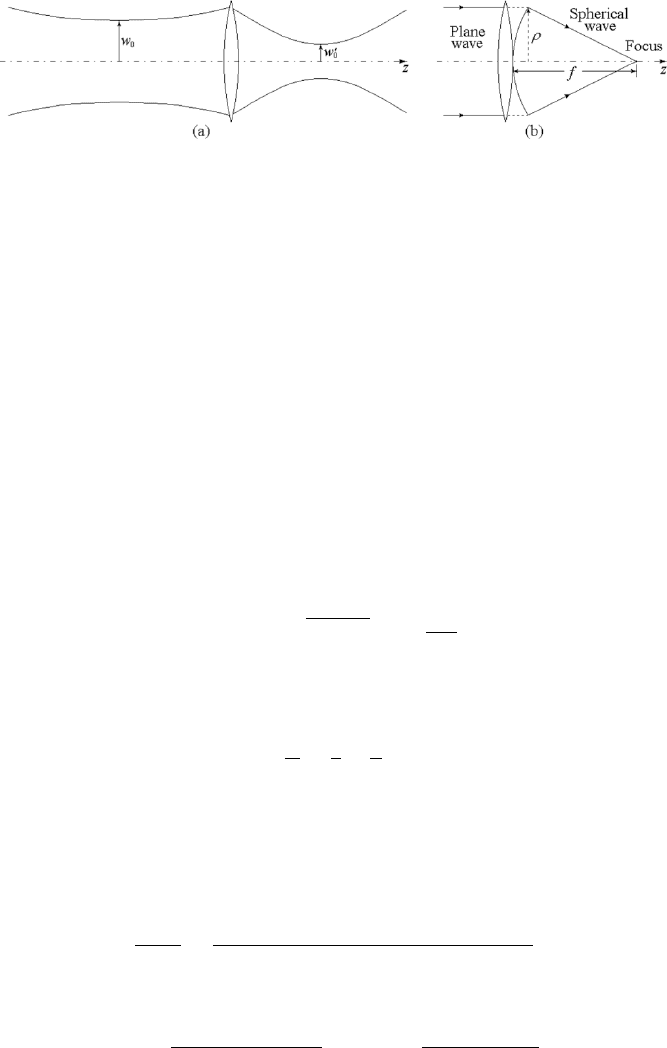
Figure 9.5: (a) Transformation of Gaussian b eam through a thin lens. (b)
Focusing of plane wave through a thin lens.
Comparing the real part and the imaginary part, we obtain
z
0
0
= (1 − n
0
)L, w
0
0
= w
0
.
The radius of the transmitting beam waist is identical to that of the
incident beam. The waist of the transmitting beam is located in the first
medium, and we call it the virtual beam waist because it does not really
exist.
(3) The transformation for a beam passing through a thin lens, as shown
in Fig. 9.5(a), is to add an additional phase delay to the beam.
As shown in Fig. 9.5(b), when a plane wave is incident on an ideal thin
lens, it is converged to the focus of the lens, and the phase delay is
−k
³
f −
p
f
2
− ρ
2
´
≈ −
kρ
2
2f
, (9.50)
where f is the focal length. Introducing this additional phase delay into the
amplitude of the incident beam expressed by (9.5), we obtain
1
q
0
=
1
q
−
1
f
. (9.51)
Example A Gaussian beam whose waist is located at z
0
= 0 is incident
on a thin lens at z = L. The focal length of the lens is f. Derive the
transformation.
At z = L, q = L + js, q
0
= (L − z
0
0
) + js
0
. From (9.51) we have
q
0
=
qf
f − q
=
Lf(f − L) + fs
2
+ jf[(f − L)s + Ls]
(f − L)
2
+ s
2
.
So
z
0
0
= L −
Lf
2
− f(L
2
+ s
2
)
(f − L)
2
+ s
2
, s
0
=
f
2
s
(f − L)
2
+ s
2
.
588 9. Gaussian Beams
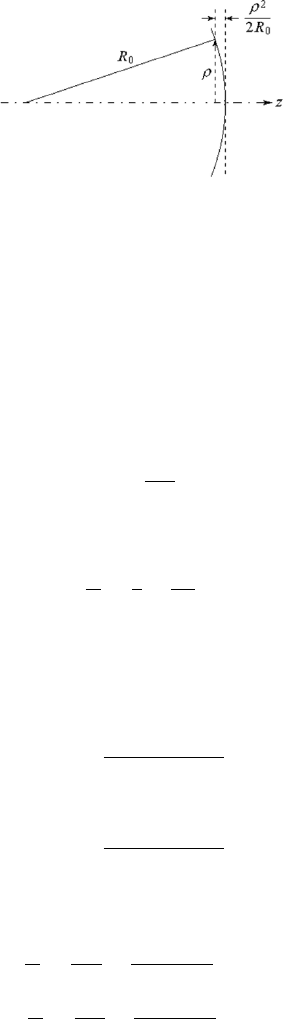
Figure 9.6: Spherical reflecting mirror.
If L = f, then z
0
0
= 2f, ss
0
= f
2
; that is, w
2
0
w
02
0
= λ
2
f
2
/π
2
. If w
0
= 0, then
w
0
0
→ ∞; the transformed beam is a plane wave. This result is the same as
that in geometric optics.
(4) The transformation at a spherical mirror is shown in Fig. 9.6. If the
radius of the spherical mirror is much larger than the beam radius, the phase
precedence is
σ =
kρ
2
R
0
, (9.52)
where R
0
is the radius of the spherical mirror. From (9.5) and the matching
condition, the transformation relation is
1
q
0
=
1
q
−
2
R
0
. (9.53)
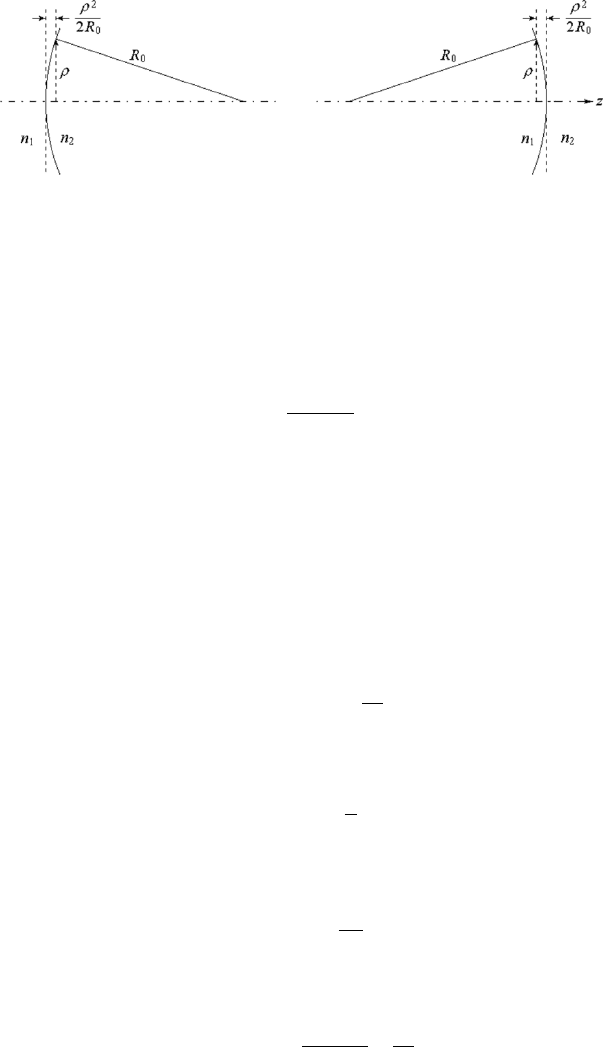
(5) The transformation through spherical dielectric boundaries is shown
in Fig. 9.7. There are the left spherical boundary and the right spherical
boundary. The additional phase delay for the left spherical boundary is
σ
1
=
(n
1
− n
2
)k
0
ρ
2
2R
0
, (9.54)
and that for the right spherical boundary is
σ
2
=
(n
2
− n
1
)k
0
ρ
2
2R
0
. (9.55)
where k
0
is the propagation constant in free space. According to (9.5) and
the matching condition, we derive
1
q
0
=
n
1
n
2
q
+
(n
1
− n
2
)
n
2
R
0
, (9.56)
1
q
0
=
n
1
n
2
q
+
(n
2
− n
1
)
n
2
R
0
. (9.57)
9.3 Transformation of Gaussian Beams 589
Figure 9.7: Spherical dielectric boundaries.
9.3.2 ABCD Law and Its Applications
Summarizing the transformations of q in the last subsection, we find that all
of them may be expressed as
q
0
=
Aq + B
Cq + D
. (9.58)
where A, B, C, and D can be expressed as a transformation matrix. From
(9.47), (9.49), (9.51), (9.53), (9.56), and (9.57) various transformation matri-
ces can be derived.
For a distance d in free space
·
A B
C D
¸
=
·
1 d
0 1
¸
. (9.59)
For a dielectric plane boundary
·
A B
C D
¸
=
·
1 0
0
n
1
n
2
¸
. (9.60)
For a thin lens with focal length f
·
A B
C D
¸
=
"
1 0
−
1
f
1
#
. (9.61)
For a spherical mirror with radius R
0
·
A B
C D
¸
=
"
1 0
−
2
R
0
1
#
. (9.62)
For the left spherical dielectric boundary
·
A B
C D
¸
=
"
1 0
n
1
− n
2
n
2
R
0
n
1
n
2
#
. (9.63)
590 9. Gaussian Beams
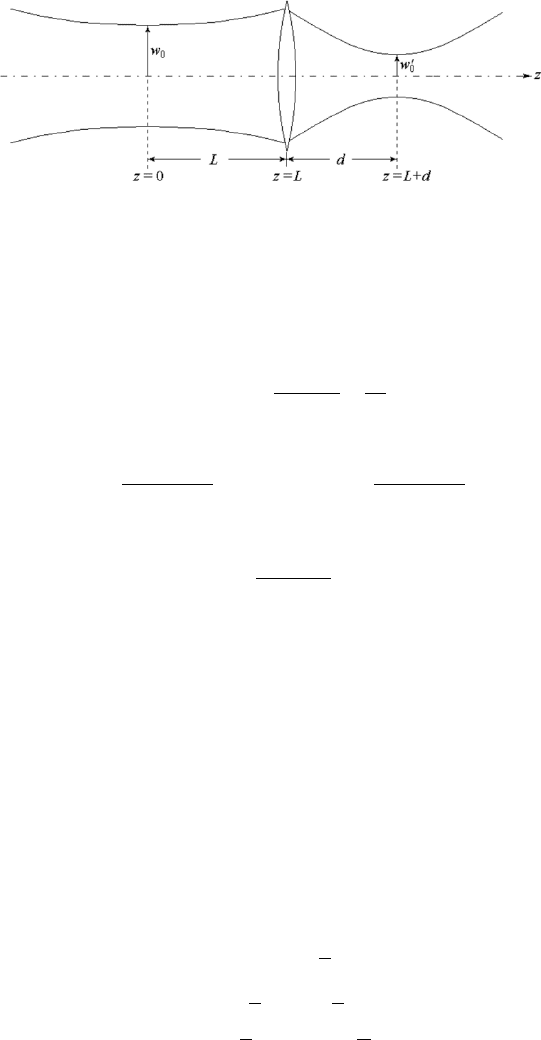
Figure 9.8: Application of the ABCD law in the focusing of a Gaussian beam
by a thin lens.
For the right spherical dielectric boundary
·
A B
C D
¸
=
"
1 0
n
2
− n
1
n
2
R
0
n
1
n
2
#
. (9.64)
If two optical systems are cascaded, their transformation formulas are
q
2
=
A
2
q
1
+ B
2
C
2
q
1
+ D
2
and q
1
=
A
1
q
0
+ B
1
C
1
q
0
+ D
1
. (9.65)
Substitution of q
1
into the expression of q
2
yields
q
2
=
Aq
0
+ B
Cq
0
+ D
, (9.66)
where
·
A B
C D
¸
=
·
A
2
B
2
C
2
D
2
¸ ·
A
1
B
1
C
1
D
1
¸
. (9.67)
The ABCD law makes the transformation of Gaussian beam very clear, so
it has wide applications.
Example
Illustrate the application of the ABCD law in the focusing of a
Gaussian beam by a thin lens.
The waist of a Gaussian beam is located at z
0
= 0, at this point the
parameter q is js. A lens is at z = L. After transformation the beam waist
is at z = L + d, as shown in Figure 9.8. From z = 0 to z = L + d, the beam
undergoes three transformations, and the transformation matrix is
·
A B
C D
¸
=
·
1 d
1 0
¸
"
1 0
−
1
f
1
#
·
1 L
0 1
¸
=
1 −
d
f
³
1 −
d
f
´
L + d
−
1
f
1 −
L
f
.