
Zhang K., Li D. Electromagnetic Theory for Microwaves and Optoelectronics
Подождите немного. Документ загружается.

9.3 Transformation of Gaussian Beams 591
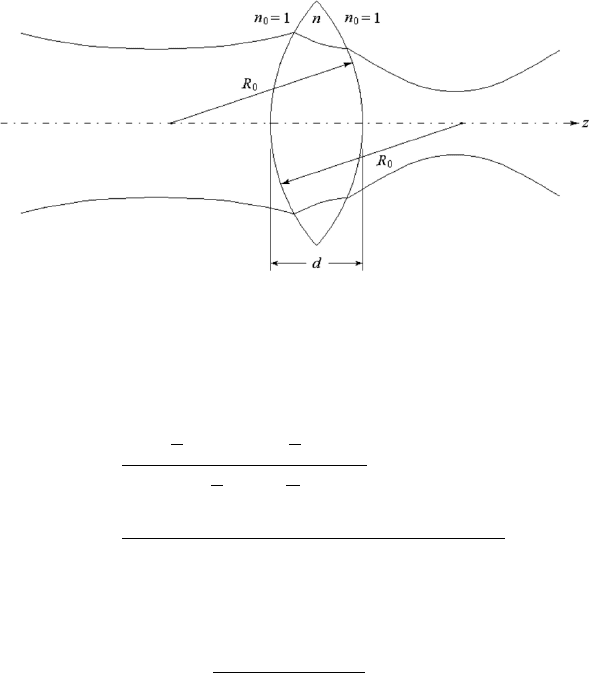
Figure 9.9: Non-thin lens considered as a cascade of three optical elements.
From this matrix we derive
q
2
=
³
1 −
d
f
´
js +
³
1 −
d
f
´
L + d
−j
s
f
+ 1 −
L
f
=
d
£
(f − L)
2
+ s
2
¤
+ Lf
2
− f
¡
L
2
+ s
2
¢
+ jsf
2
(f − L)
2
+ s
2
.
At the waist of the transformed beam, the real part of q
2
is zero, and we
obtain
d =
f(L
2
+ s
2
) − Lf
2
(f − L)
2
+ s
2
.
9.3.3 Transformation Through a Non-thin Lens
Lenses are widely used in focusing and collimating Gaussian beams. If the
beam radius is large enough, it does not introduce too much error to treat
the transformation by a thin lens with matrix (9.61). As a matter of fact in
many applications the conditions are not so. For example, the output light
spots from optical fibers and waveguides are only several wavelength wide,
and for such small beam radii, the concept of a thin lens cannot be accepted.
As shown in Fig. 9.9, when the beam radius is small, the lens can be
considered as a cascade of three optical elements, they are two spherical
dielectric boundaries and a dielectric slab. Because the beam radius is small,
the thickness of the dielectric plate is taken as the distance between the
tops of the two spherical boundaries. According to (9.63) and (9.64) the
transformation matrices of the left and right spherical dielectric boundaries
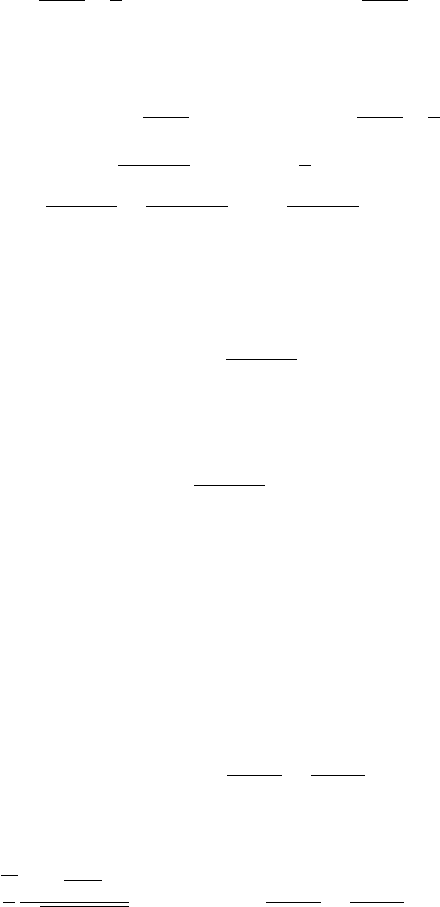
592 9. Gaussian Beams
are
·
A
1
B
1
C
1
D
1
¸
=
"
1 0
1 − n
nR
0
1
n
#
and
·
A
3
B
3
C
3
D
3
¸
=
"
1 0
1 − n
R
0
n
#
. (9.68)
The final transformation matrix is
·
A B
C D
¸
=
"
1 0
1 − n
R
0
n
#
·
1 d
0 1
¸
"
1 0
1 − n
nR
0
1
n
#
=
1 +
(1 − n)d
nR
0
d
n
2(1 − n)
R
0
+
(1 − n)
2
d
nR
2
0
1 +
(1 − n)d
nR
0
. (9.69)
In the case of a thin lens the space b etween the spherical surfaces is
neglected, and the matrix is
·
A B
C D
¸
=
"
1 0
−
2(n − 1)
R
0
1
#
. (9.70)
Comparison with (9.61) shows that the fo cal length of a thin lens composed
of two spherical surface with the same radii is
f =
R
0
2(n − 1)
. (9.71)
9.4 Elliptic Gaussian Beams
In optoelectronics, beams with non-axially symmetric distributions of
Gaussian-functional patterns are often applied. These beams are called
elliptic Gaussian beams [116]. The output beams of semiconductor lasers
and some optical waveguides and fibers are approximately elliptic Gaussian
beams.
The solution of the paraxial wave equation for elliptic Gaussian beams is
taken as
u = A exp
½
−j
·
p(z) +
kx
2
2q
x
(z)
+
ky
2
2q
y
(z)
¸¾
. (9.72)
With a similar procedure as in (9.6)–(9.17), the derived field distribution
becomes
ψ = j
r
k
π
4
√
s
x
s
y
p
q
x
(z)q
y
(z)
exp
½
−j
·
kz +
kx
2
2q
x
(z)
+
ky
2
2q
y
(z)
¸¾
, (9.73)
where
q
x
(z) = (z − z
0x
) + js
x
, q
y
(z) = (z − z
0y
) + js
y
. (9.74)
9.4 Elliptical Gaussian Beams 593
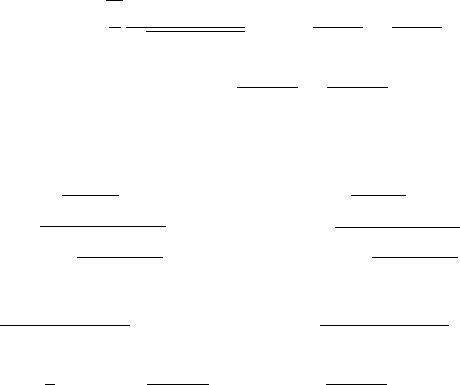
(9.73) can be further expressed as
ψ(x, y, z) =
r
2
π
1
p
w
x
(z)w
y
(z)
exp
·
−
x
2
w
2
x
(z)
−
y
2
w
2
y
(z)
¸
×exp
½
−j
·
kz +
kx
2
2R
x
(z)
+
ky
2
2R
y
(z)
− φ
¸¾
, (9.75)
where
s
x
=
nπw
2
0x
λ
, s
y
=
nπw
2
0y
λ
, (9.76)
w
x
(z) = w
0x
s
1 +
(z − z
0x
)
2
s
2
x
, w
y
(z) = w
0y
s
1 +
(z − z
0y
)
2
s
2
y
, (9.77)
R
x
(z) =
(z − z
0x
)
2
+ s
2
x
z − z
0x
, R
y
(z) =
(z − z
0y
)
2
+ s
2
y
z − z
0y
, (9.78)
φ =
1
2
·
arctan
µ
z − z
0x
s
x

+ arctan
µ
z − z
0y
s
y
¶¸
. (9.79)
Equations (9.73)–(9.79) represent an elliptic Gaussian beam. The beam waist
in the x direction is lo cated at z
0x
, and the semi-width is w
0x
. The beam
waist in the y direction is at z
0y
, and the semi-width is w
0y
. If z
0x
= z
0y
,
the beam waists in the two directions are at the same position. The output
beams of semiconductor lasers are considered to be elliptic Gaussian beams
whose waists are located at the output faces.
In the transformation of elliptic Gaussian beams, the ABCD law is ap-
plied in two directions separately. An axially symmetric Gaussian beam
becomes an elliptic Gaussian beam after passing through a cylindrical lens.
If the beam waists in two directions are required to be in the same loca-
tion, a specially designed lens is needed. In the transformation of the axially
symmetric Gaussian beams, it is necessary to know the beam radii and their
locations of the original and the transformed beams in advance, then the
location and the focal length of the lens is determined. In transformation
of a symmetric Gaussian beam to an elliptic Gaussian beam with the beam
waists in two directions to be at the same location, the location of the trans-
formation plane is determined by the parameters of the transformed b eam.
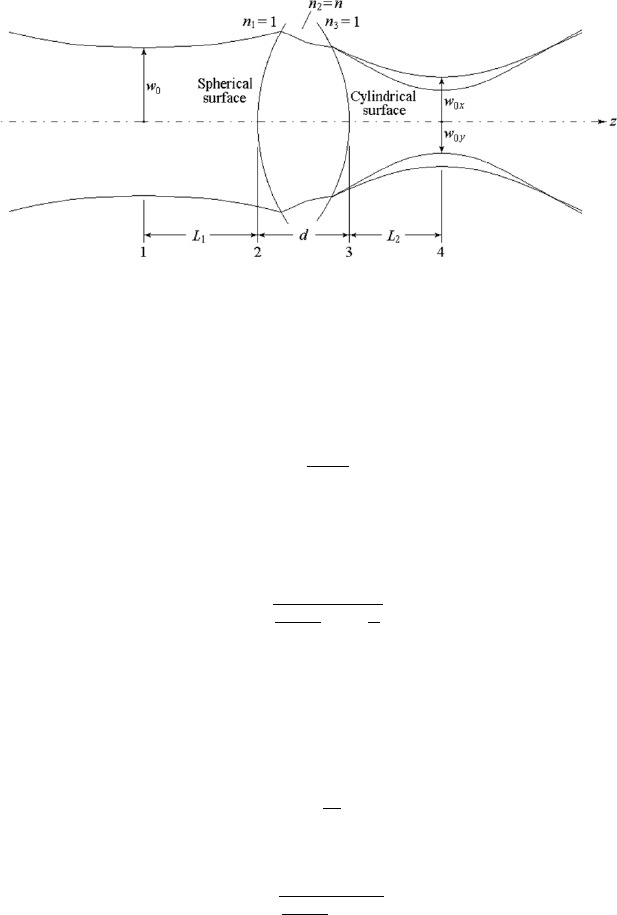
In practical applications, a unique spherical-cylindrical lens can be de-
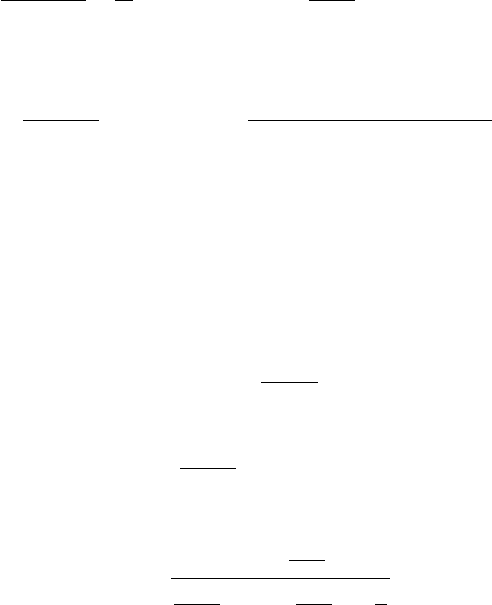
signed to make the above transformation come true. In Fig. 9.10, the trans-
formation system from an axially symmetric beam to an elliptic beam is
shown, where the refractive index of the lens is n, and its front and rear sur-
faces are a spherical surface and a cylindrical surface, respectively. The waist
radius of the incident b eam is w
0
. After transformation the beam waists in
two directions are at the same location, and their semi-widths are w
0x
and
w
0y
.
594 9. Gaussian Beams
Figure 9.10: The transformation from an axially symmetric beam to an el-
liptic beam.
At plane 1,
q
1
=
jπw
2
0
λ
. (9.80)
At plane 2,
q
2
= q
1
+ L
1
. (9.81)
After the transformation expressed by (9.63), the q parameter becomes
q
0
2
=
q
2
1 − n
nR
01
q
2
+
1
n
, (9.82)
where R
01
is the radius of the spherical surface. At plane 3,
q
3
= q
0
2
+ d. (9.83)
In the following, the transformation is carried out in the x and y directions
separately. In the x direction, the q parameter, from (9.60), is
q
0
3x
=
q
3
n
. (9.84)
In the y direction, the q parameter, from (9.64), is
q
0
3y
=
q
3
1 − n
R
02
q
3
+ n
, (9.85)
where R
02
is the radius of the cylindrical surface. The transformation for-
mula for the cylindrical dielectric surface is the same as that for a spherical
dielectric surface. At plane 4,
q
4x
= q
0
3x
+ L
2
, q
4y
= q
0
3y
+ L
2
. (9.86)
9.5 Higher-Order Modes of Gaussian Beams 595
Substituting q
4x
= jπw
2
0x
/λ and q
4y
= jπw
2
0y
/λ into (9.86), then substituting
the obtained q
0
3x
and q
0
3y
into (9.84) and (9.85), and eliminating q
3
, we obtain
the following equation:
L
2
2
−
π
2
w
2
0x
w
2
0y
λ
2
−
jπ
λ
·
L
2
¡
w
2
0x
+ w
2
0y
¢
+
R
02
1 − n
¡
w
2
0x
− w
2
0y
¢
¸
= 0. (9.87)
The real part and the imaginary part must be zero in (9.87), and this leads
to
L
2
=
πw
0x
w
0y
λ
and R
02
=
(n − 1)πw
0x
w
0y
¡
w
2
0x
+ w
2
0y
¢
λ
¡
w
2
0x
− w
2
0y
¢
. (9.88)
Expression (9.88) shows that both the position and the radius of the cylindri-
cal surface are determined by the parameters of the elliptic Gaussian beam.
If w
0x
À w
0y
, the cylindrical radius is close to (n − 1)L
2
. If w
0y
is less than
the wavelength, the cylindrical radius is close to w
0x
, and this is contradic-
tory to the paraxial condition. For the above situation it is not possible to
transform a circular Gaussian beam into an elliptic one whose beam waists
in the x and y directions are at the same position.
From (9.84), (9.86), and (9.88) we obtain
q
3
= n(q
4x
− L
2
) =
nπw
0x
λ
(jw
0x
− w
0y
). (9.89)
Substitution of (9.89) into (9.83) yields
q
0
2
=
nπw
0x
λ
(jw
0x
− w
0y
) − d. (9.90)
From (9.80)–(9.82), q
0
2
can also be expressed as
q
0
2
=
L
1
+ j
πw
2
0
λ
1 − n
nR
01
µ
L
1
+ j
πw
2
0
λ

+
1
n
. (9.91)
Combining (9.90) and (9.91), we derive two equations by making the real
part and the imaginary part be zero. The equations include three variables:
L
1
, d, and R
01
. If one of them is fixed, the other two can be solved.
9.5 Higher-Order Modes of Gaussian Beams
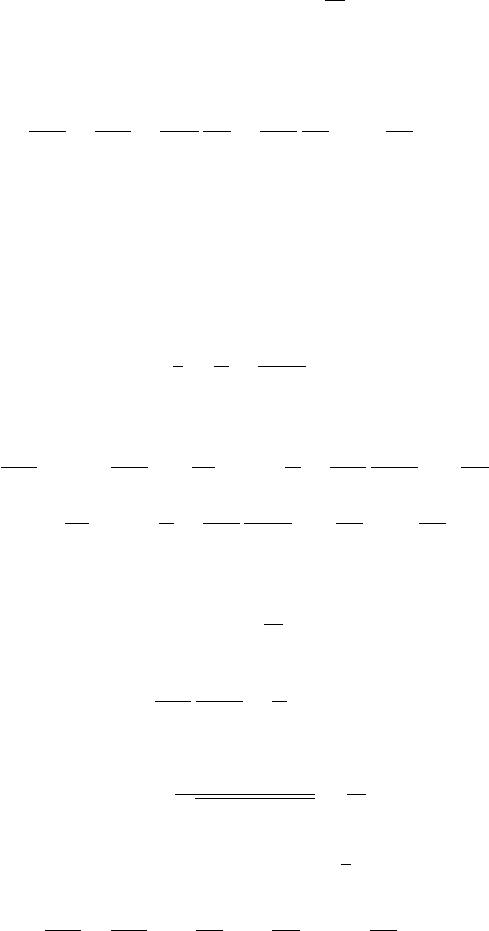
It is well known from wave theory that in order to express an arbitrary
amplitude distribution at the input plane an orthogonal mode set is necessary.
Similarly, an orthogonal mode set with the fundamental Gaussian beam being
its lowest order is needed to expand the paraxial distribution [108].
From the requirement for orthogonality and completeness we predict that
a high-order mode is the product of the Gaussian function and a special
function. The form of the special function depends on the coordinate system.
596 9. Gaussian Beams
9.5.1 Hermite-Gaussian Beams
In a rectangular coordinate system the solution of the paraxial wave equation
may be taken as the following form
u(x, y, z) = F (x, y, z) exp
½
−j
·
p +
k
2q
¡
x
2
+ y
2
¢
¸¾
, (9.92)
where the exponential part is the fundamental mode of the Gaussian beam
and F (x, y, z) is a special function. Substitution of (9.92) into (9.4) yields
∂
2
F
∂x
2
+
∂
2
F
∂y
2
−
2jkx
q
∂F
∂x
−
2jky
q
∂F
∂y
− 2jk
∂F
∂z
= 0. (9.93)
To derive (9.93), the two equations in (9.7) are used. As q is a function of z,
(9.93) cannot be solved by separation of variables. In order to use such an
approach, we make the following substitution:
ξ = a(z)x, η = a(z)y, ζ = z. (9.94)
Substituting (9.94) into (9.93), and introducing the relation
1
q
=
1
R
−
jλ
nπw
2
, (9.95)
we derive
a
2
(z)
∂
2
F
∂ξ
2
+ a
2
(z)
∂
2
F
∂η
2
−
½
4
w
2
+ 2jk
·
1
R
+
1
a(z)
da(z)
dz
¸¾
ξ
∂F
∂ξ
−
½
4
w
2
+ 2jk
·
1
R
+
1
a(z)
da(z)
dz
¸¾
η
∂F
∂η
− 2jk
∂F
∂ζ
= 0. (9.96)
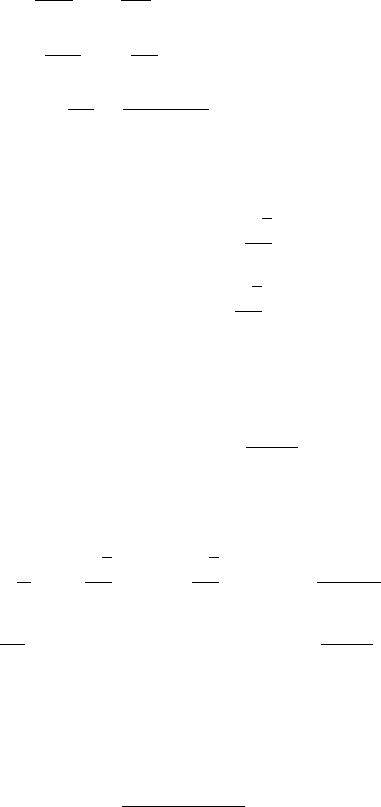
The conditions that (9.96) can be solved by separation of variables are
a(z) =
a
0
w
(9.97)
and
1
a(z)
da(z)
dz
+
1
R
= 0, (9.98)
where a
0
is a constant. Substitution of (9.14) into (9.98) yields
a(z) =
m
0
p
(z − z
0
)
2
+ s
2
=
a
0
w
, (9.99)
where m
0
is a constant. (9.99) is identical to (9.97), so (9.96) can be solved
by separation of variables. Substituting a(z) =
√
2/w into (9.96), we obtain
∂
2
F
∂ξ
2
+
∂
2
F
∂η
2
− 2ξ
∂F
∂ξ
− 2η
∂F
∂η
− jkw
2
∂F
∂ζ
= 0. (9.100)
9.5 Higher-Order Modes of Gaussian Beams 597
Substituting F = X(ξ)Y (η)Z(ζ) into (9.100), we derive the following equa-
tions
d
2
X
dξ
2
− 2ξ
dX
dξ
+ 2mX = 0, (9.101)
d
2
Y
dη
2
− 2η
dY
dη
+ 2nY = 0, (9.102)
dZ
dζ
−
2j(m + n)
kw
2
Z = 0. (9.103)
In (9.101)–(9.103) m and n are integers. The solutions of (9.101) and (9.102)
can be expressed as
X = H
m
(ξ) = H
m
Ã
√
2
w
x
!
, (9.104)
Y = H
n
(η) = H
n
Ã
√
2
w
y
!
, (9.105)
where H
m
and H
n
are Hermite polynomials of order m and order n, respec-
tively. The solution of (9.103) is
Z = exp
·
j(m + n) arctan
µ
z − z
0
s
¶¸
. (9.106)
In the derivation of (9.106), expressions (9.19) and (9.20) are used. The final
expression for a Hermite-Gaussian beam is
ψ(x, y, z) = c
mn
1
w
H
m
Ã
√
2
w
x
!
H
n
Ã
√
2
w
y
!
exp
µ
−
x
2
+ y
2
w
2

×exp
½
−j
·
kz +
k
2R
¡
x
2
+ y
2
¢
− (m + n + 1) arctan
µ
z − z
0
s
¶¸¾
, (9.107)
where R, w, and s were defined previously in (9.19)–(9.21), and c
mn
is
a constant. c
mn
can be determined by the normalization condition that
R
∞
∞
R
∞
∞
dxdy|u
mn
|
2
= 1, and we have
c
mn
=
µ
2
m!n!2
m+n
w
2
0
π

1/2
. (9.108)
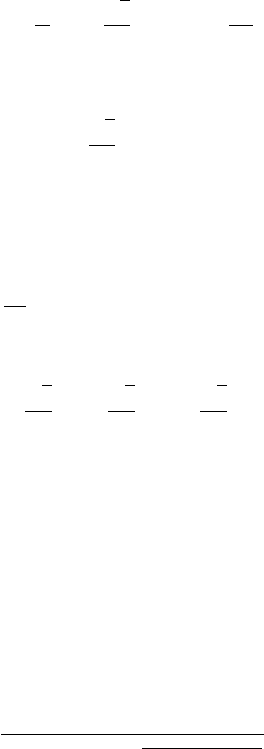
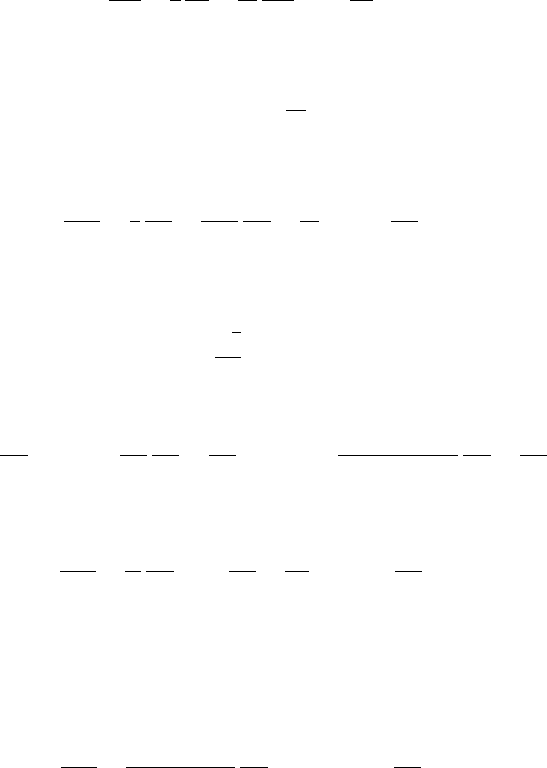
The transverse distribution expressed in (9.107) is called as the trans-
verse mode and is represented as TEM
mn
. All TEM
mn
modes constitute a
complete orthogonal mode set. The fundamental Gaussian beam is only the
special mode with m = 0 and n = 0. Under the paraxial condition an arbi-
trary distribution at a cross section can be expressed as the superposition of
TEM
mn
modes.
598 9. Gaussian Beams
The distributing forms along x and y in a Hermite-Gaussian beam are
identical, and we need to analyze only the distribution in one dimension. For
y = 0, the distribution along x is
A(x, z) =
1
w
H
m
Ã
√
2
w
x
!
exp
µ
−
x
2
w
2

. (9.109)
The beam amplitude has m nulls in the x direction, which are determined by
H
m
Ã
√
2
w
x
!
= 0. (9.110)
There must be an extremum between two nulls. Since A is zero as x is
infinite, there are m + 1 extrema, and their coordinates are determined by
∂A/∂x = 0. With the recurrence formula
d
dx
H
m
(x) = 2mH
m−1
(x), (9.111)
the coordinates of these extrema are determined from
2mH
m−1
Ã
√
2
w
x
!
−
√
2
w
xH
m
Ã
√
2
w
x
!
= 0. (9.112)
Equation (9.112) is an equation of (m + 1)th power of x, so there are m + 1
roots, and there are m + 1 extrema in the x direction. The amplitude and
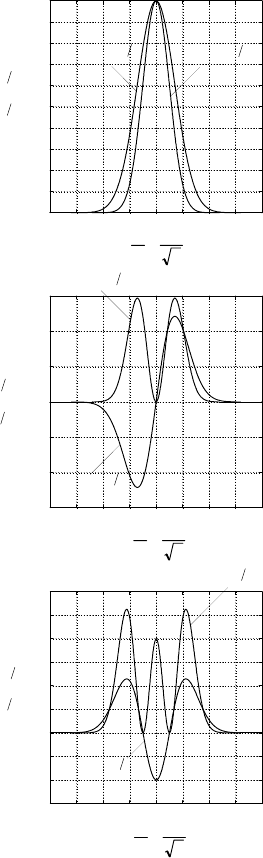
the intensity distributions of several lowest-order Hermite-Gaussian beams
are shown in Fig. 9.11.
From (9.107), it is known that the equiphase surface of the Hermite-
Gaussian beam is dependent on its order. Within the paraxial condition the
influence of the order on the curvature radius is negligible, and we consider
that all modes of the Hermite-Gaussian beam have approximately the same
curvature radii.
The phase velocity on the beam axis is
v
p
=
ω
k − (m + n + 1)
s
(z − z
0
)
2
+ s
2
. (9.113)
The higher the order, the larger the phase velocity is.
In the previous formulas w is the radius of the fundamental Gaussian
beam, but it cannot represent the half-width of the Hermite-Gaussian beam.
From Fig. 9.11 we see that there are several wave petals in the distribution
of a high-order mode, and we may define the half-width as the distance from
the axis to a point located outside the most extreme petal and at which the
intensity is down to 1/e
2
of the peak value of this petal. Of course, this
definition fits any order modes including the fundamental mode.
9.5 Higher-Order Modes of Gaussian Beams 599
-4 -3 -2 -1 0 1 2 3 4
-3
-2
-1
0
1
2
3
4
5
6
-4 -3 -2 -1 0 1 2 3 4
-1.5
-1.0
-.5
0.0
.5
1.0
1.5
-4 -3 -2 -1 0 1 2 3 4
0.0
.1
.2
.3
.4
.5
.6
.7
.8
.9
1.0
2
[
w
x
2
[
w
x
2-
0
2
e)(H
[
[
2-
0
2
e)(H
[
[
22-
0
]e)(H[
2
[
[
2
1
2
e)(H
[
[
22-
1
]e)(H[
2
[
[
2-
1
2
e)(H
[
[
22-
1
]e)(H[
2
[
[
2
[
w
x
2-
2
2
e)(H
[
[
2-
2
2
e)(H
[
[
22-
2
]e)(H[
2
[
[
22-
2
]e)(H[
2
[
[
22-
0
]e)(H[
2
[
[
Figure 9.11: The amplitude and the intensity distributions of several lowest-
order Hermite-Gaussian beams.
600 9. Gaussian Beams
9.5.2 Laguerre-Gaussian Beams
In the cylindrical coordinate system the solution of the paraxial wave equation
can be expressed as the product of a Laguerre polynomial and the Gaussian
function, and it is called the laguerre-Gaussian beam.
The paraxial wave equation in a cylindrical coordinate system is
∂
2
u
∂ρ
2
+
1
ρ
∂u
∂ρ
+
1
ρ
2
∂
2
u
∂θ
2
− 2jk
∂u
∂z
= 0. (9.114)
The solution of (9.114) is taken as
u = F (ρ, z) exp
·
−j
µ
p +
k
2q
ρ
2
¶¸½
cos lθ
sin lθ
¾
, (9.115)
where l is an integer. Substituting (9.115) into (9.114) leads to
∂
2
F
∂ρ
2
+
1
ρ
∂F
∂ρ
−
2jkρ
q
∂F
∂ρ
−
l
2
ρ
2
F − 2jk
∂F
∂z
= 0. (9.116)
To do this, (9.7) is introduced. According to the similar method used in
dealing with Hermite-Gaussian beams, we make the variable substitution
that
ρ
0
=
√
2
w
ρ, z
0
= z. (9.117)
The fifth term in (9.116) is then
−2jk
∂F
∂z
= −2jk
µ
∂F
∂ρ
0
∂ρ
0
∂z
0
+
∂F
∂z
0

= −2jk
·
−(z − z
0
)ρ
0
(z − z
0
)
2
+ s
2
∂F
∂ρ
0
+
∂F
∂z
0
¸
.
(9.118)
After some manipulation, (9.116) becomes
∂
2
F
∂ρ
02
+
1
ρ
0
∂F
∂ρ
0
− 2ρ
0
∂F
∂ρ
0
−
l
2
ρ
02
F − jkw
2
∂F
∂z
0
= 0. (9.119)
If l 6= 0 the value of F on the axis must be zero, so it is taken as
F = ρ
0l
G(ρ
0
, z
0
). (9.120)
Substituting (9.120) into (9.119), we obtain
∂
2
G
∂ρ
02
+
2l + 1 − 2ρ
02
ρ
0
∂G
∂ρ
0
− 2lG − jkw
2
∂G
∂z
0
= 0. (9.121)
The above equation is not a nonlinear equation for some kind of special
functions, and we need to make the further substitution that
ζ = ρ
02
. (9.122)