
Zhang K., Li D. Electromagnetic Theory for Microwaves and Optoelectronics
Подождите немного. Документ загружается.

9.7 Optical Resonators with Curved Mirrors 611
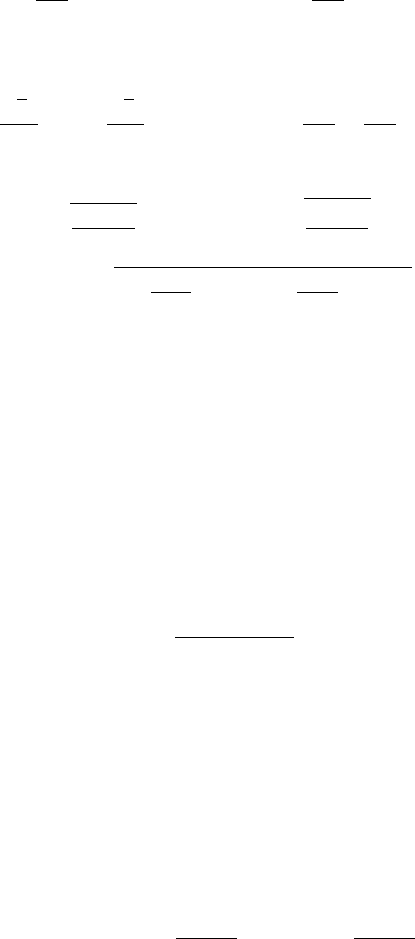
where
˙n
0
= n
0
0
− jn
00
0
, (9.198)
Γ
2
x
= 2g
x
− j
2n
00
0
n
0
0
(h
x
− g
x
), Γ
2
y
= 2g
y
− j
2n
00
0
n
0
0
(h
y
− g
y
). (9.199)
According to the method used previously, we derive the steady-state so-
lution of the elliptic Hermite-Gaussian beams:
ψ = A
0
H
m
Ã
√
2x
w
0x
!
H
n
Ã
√
2y
w
0y
!
e
−jβ
mn
z
exp
Ã
−
x
2
w
2
0x
−
y
2
w
2
0y
!
, (9.200)
where
w
0x
=
r
2
k
0
˙n
0
Γ
x
, w
0y
=
s
2
k
0
˙n
0
Γ
y
, (9.201)
β
mn
= k
0
˙n
0
r
1 −
Γ
x
k
0
˙n
0
(2m + 1) −
Γ
y
k
0
˙n
0
(2n + 1). (9.202)
As ˙n
0
is a real number, w
0x
and w
0y
are the half-widths of the elliptic fun-
damental mode.
9.7 Optical Resonators with Curved Mirrors
In this section we will study the optical resonators formed by a couple of
curved mirrors. We suppose that the dimensions of the optical resonator are
much larger than the wavelength and, within the paraxial condition, the field
distribution inside the resonator is some kind of Gaussian beams.
In a Gaussian beam the loci of the points at which the amplitude is a
fraction of its value on the axis are hyperboloids
x
2
+ y
2
= C
(z − z
0
)
2
+ s
2
s
2
, (9.203)
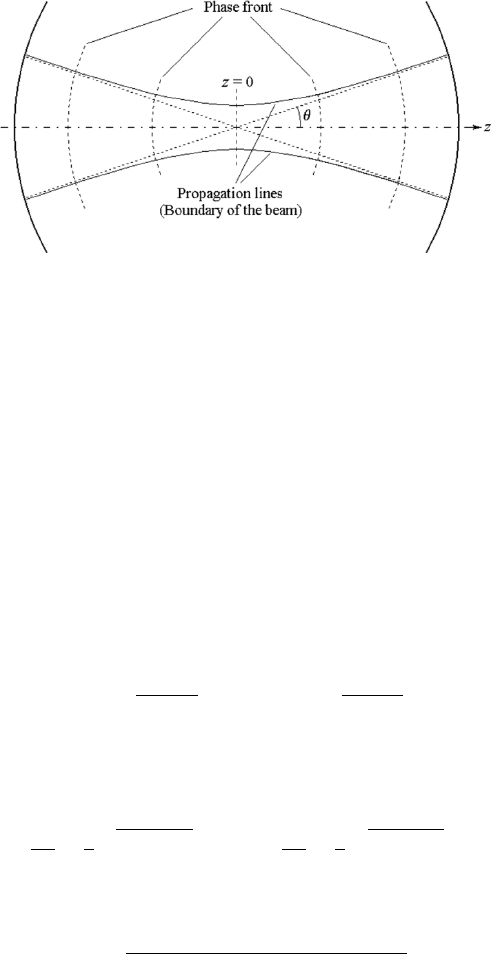
where C is a constant. Fig. 9.13 shows the hyperbolas generated by inter-
section of the hyperboloid with a plane that includes the beam axis. These
hyperbolas approximately represent the direction of energy flow and phase
velocity. The phase fronts are normal to these curves, and as long as the
far-field divergence angle of the beam is small enough, and z − z
0
is much
larger than the beam radius, the phase fronts are spherical surfaces. We can
place two separated spherical mirrors to form a resonator. The surfaces of
the mirrors coincide with the phase fronts and are normal to the direction of
energy flow, so the reflected beam will retrace itself. If the spacing between
the mirrors satisfies
k(z
1
− z
2
) − (m + n + 1)
·
arctan
µ
z
1
− z
0
s

− arctan
µ
z
2
− z
0
s
¶¸
= gπ,
(9.204)
612 9. Gaussian Beams
Figure 9.13: Optical resonator formed by a couple of curved mirrors.
where z
1
and z
2
are locations of the mirrors, g is an integer, and other
parameters are as defined in (9.107), stable standing waves are formed in
the resonator. Generally, the transverse dimensions of the mirrors are much
larger than the beam diameter, so the field at the mirror rims is negligible.
In practice, the procedure is often reversed. Not determining the configu-
ration of the resonator from the beam parameters, we instead fix the resonator
first, then calculate the beam parameters. Two mirrors with spherical radii
R
1
and R
2
and spacing l are given. The resonant mode fitting this configura-
tion is then determined. Under certain conditions, the width and location of
the beam waist will be adjusted to make the mirrors coincide with the phase
fronts.
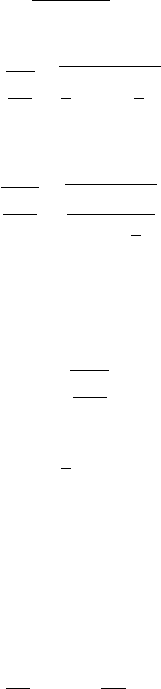
The radii of the mirrors are
R
1
=
z
2
1
+ s
2
z
1
, R
2
=
z
2
2
+ s
2
z
2
. (9.205)
where z
1
and z
2
are locations of the mirrors, s is the confocal parameter of
the beam. Here we have supposed that the beam waist is at z = 0. From
(9.205) we get
z
1
=
R
1
2
±
1
2
q
R
2
1
− 4s
2
, z
2
=
R
2
2
±
1
2
q
R
2
2
− 4s
2
. (9.206)
Since the spacing between the mirrors is l, that is l = z
2
− z
1
, from (9.206)
we obtain
s
2
=
l(−R
1
− l)(R
2
− l)(R
2
− R
1
− l)
(R
2
− R
1
− 2l )
2
. (9.207)
Here z
2
is to the right of z
1
, and the mirror curvature is taken as positive
if the center of curvature is to the left of the mirror. For a fixed resonator
configuration the confocal parameter s is determined by (9.207). The radius
9.7 Optical Resonators with Curved Mirrors 613
of the beam waist is determined from s according to (9.18), and then its
relative position is determined from (9.206).
A special case is the symmetrical mirror resonator. In this case two iden-
tical mirrors are symmetrically placed. Taking R = −R
1
= R
2
, and substi-
tuting into (9.207), we get
s
2
=
(2R − l)l
4
. (9.208)
The radius of the beam waist is then
w
0
=
r
λ
nπ
4
s
l
2
µ
R −
l
2

. (9.209)
Substitution of (9.209) and z = l/2 into (9.13) yields the beam radius at the
mirrors
w =
r
λl
2nπ
4
v
u
u
t
2R
2
l
³
R −
l
2
´
. (9.210)
It is easily proved that if R = l, the spot size at the mirrors will take a
minimum value. We call such a resonator the symmetrical confocal resonator,
since the fo cal lengths of two mirrors are both l/2, and two foci coincide. The
radius of the beam waist is
w
0cf
=
r
λl
2nπ
. (9.211)
The beam radii at the mirrors are
w
cf
=
√
2w
0cf
. (9.212)
For some combinations of R
1
, R
2
, and l there will be a stable Gaussian
beam in the resonator, yielding a stable mo de, and for some combinations the
beam will spread outside the mirror edges, yielding high loss or an unstable
mode.
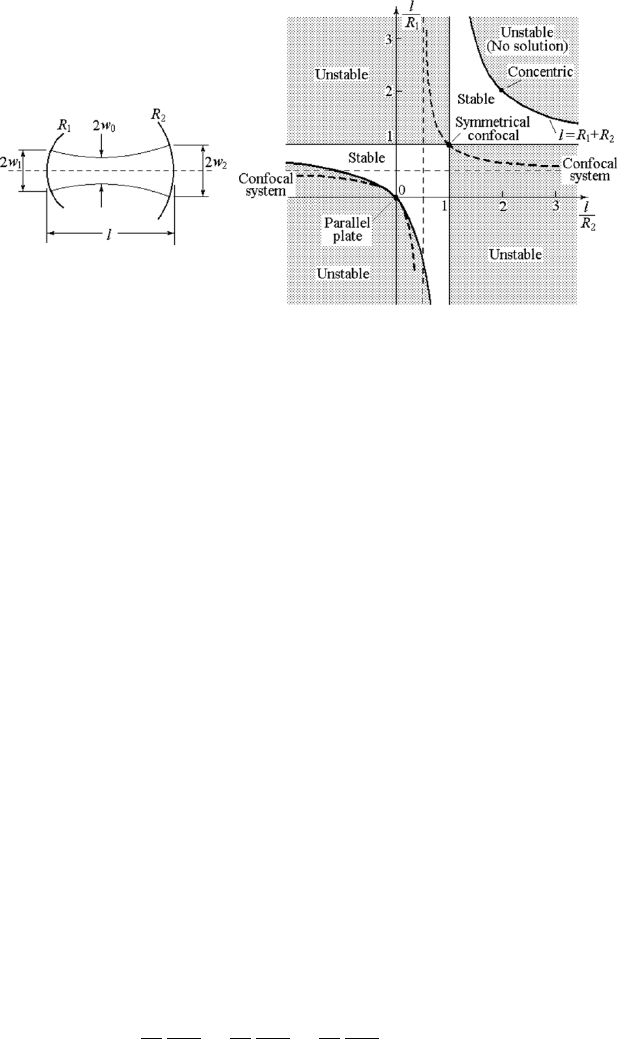
For a stable resonator mode, the right-hand side of (9.207) must be posi-
tive, and this leads to
0 ≤
µ
1 −
l
R
1
¶µ
1 −
l
R
2

≤ 1. (9.213)
Figure 9.14 gives the diagram showing the range of l /R
1
and l/R
2
for which
steady solutions can be found.
Resonators for which no stable Gaussian modes exist are unstable res-
onators. In these resonators the Gaussian beam modes cannot reproduce
themselves, instead the beam radii become large and large, and finally the
energy loses a fraction by overflowing the mirror rims. Because of this, they
have been found useful in some lasers with media of high gain. The large
diffraction loss helps to suppress the unwanted higher-order modes.
614 9. Gaussian Beams
Figure 9.14: The range of l/R
1
and l/R
2
for which steady solutions can be
found.
9.8 Gaussian Beams in Anisotropic Media
Crystals, most of which are anisotropic, are widely used in optical devices,
so it is of practical importance to study the propagation of Gaussian beams
in them [38]. In this section we discuss only the Gaussian beams of extraor-
dinary waves in uniaxial crystals b ecause the propagation of ordinary waves
is the same as in isotropic media.
In Chapter 8, we pointed out that in the principal coordinate system,
all off-diagonal elements of the dielectric tensor are zero. Fig. 9.15 shows a
principal coordinate system in which the z axis is taken as the optical axis
of the crystal; p is defined as the direction of the beam axis. The angle
between the beam axis and the optical axis is θ. The electric field component
of the extraordinary plane wave is in the xz plane, and the magnetic field
component is along the y axis.
For a uniaxial crystal the tensor dielectric constant of matrix form in the
principal coordinate system is
² = ²
0
n
2
o
0 0
0 n
2
o
0
0 0 n
2
e
, (9.214)
where n
o
and n
e
are the effective refractive indices for ordinary and extraor-
dinary waves, respectively. From the Maxwell equations, we derive the wave
equation for extraordinary plane waves,
1
n
2
e
∂
2
ψ
∂x
2
+
1
n
2
e
∂
2
ψ
∂y
2
+
1
n
2
o
∂
2
ψ
∂z
2
+ k
2
0
ψ = 0, (9.215)
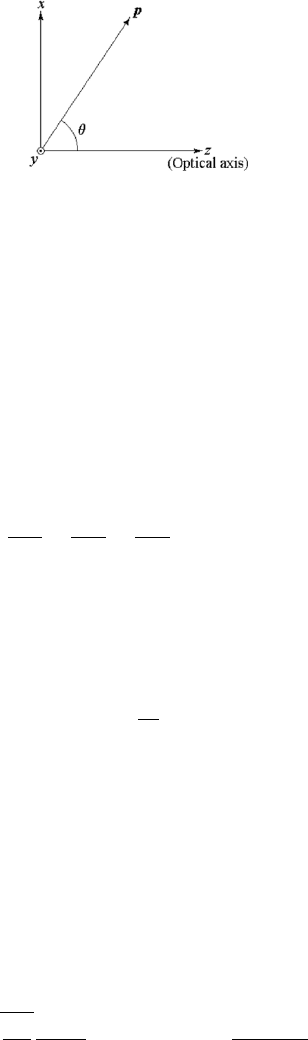
9.8 Gaussian Beam in Anisotropic Media 615
Figure 9.15: Principal coordinate system and the direction of the beam axis.
where ψ is an arbitrarily component of the electric field, magnetic field or
vector potential, k
2
0
= ω
2
²
0
µ
0
, and ω is the angular frequency. The wave
equation for the ordinary waves is the same as that in isotropic media, and
we will not discuss it here.
In order to derive a standard equation from (9.215), we need to make the
coordinate transformation
u = n
e
x, v = n
e
y, w = n
o
z. (9.216)
Substituting (9.216) into (9.215), we obtain the standard wave equation
∂
2
ψ
∂u
2
+
∂
2
ψ
∂v
2
+
∂
2
ψ
∂w
2
+ k
2
0
ψ = 0. (9.217)
This equation is the scalar Helmholtz equation, which is the same as that
in isotropic media, and the results obtained in the previous sections can be
directly cited. The axes of the uvw coordinate system coincide with those
of the xyz system but their scales are different, so the direction of p has
changed, and the angle γ between p and the w axis is determined by
tan γ =
n
e
n
o
tan θ, (9.218)
as shown in Fig. 9.16.
In order to directly cite the well-known results, the direction of p should
coincide with a coordinate axis, and further coordinate rotation is necessary.
The transformation relation is
ξ = u cos γ − w sin γ, η = v, ζ = u sin γ + w cos γ. (9.219)
In the ξηζ coordinate system the beam axis coincides with the ζ axis. The
ξηζ coordinate system is also shown in Fig. 9.16.
A Gaussian beam whose beam waist is located at the origin in the ξηζ
coordinate system is expressed as
ψ = j
r
k
0
s
π
1
ζ + js
exp
½
−jk
0
·
ζ +
ξ
2
+ η
2
2(ζ + js)
¸¾
, (9.220)
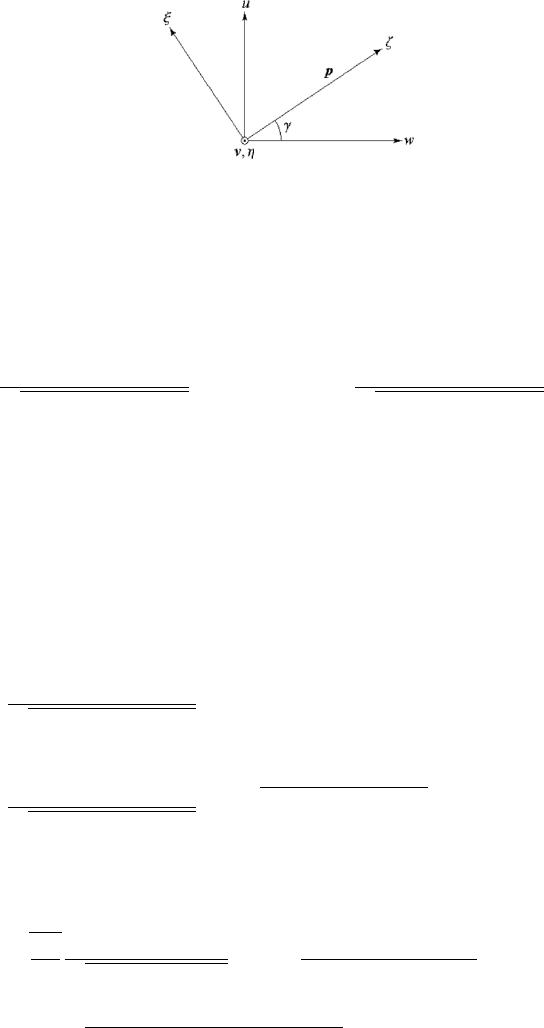
616 9. Gaussian Beams
Figure 9.16: The direction of the beam axis in different coordinate systems.
where s = πw
2
0
/λ. To obtain the distribution of this Gaussian beam in the
xyz coordinate system we need an argument substitution. From (9.216),
(9.218), and (9.219) we obtain
ξ =
n
o
n
e
(x cos θ − z sin θ)
q
n
2
o
cos
2
θ + n
2
e
sin
2
θ
, η = n
e
y, ζ =
n
2
e
x sin θ + n
2
o
z cos θ
q
n
2
o
cos
2
θ + n
2
e
sin
2
θ
. (9.221)
Substitution of (9.221) into (9.220) yields the amplitude distribution of the
Gaussian beam in the xyz coordinate system.
In the xyz coordinate system the beam axis is no longer along a coordi-
nate axis, and we need to transform the xyz coordinate system to the z
0
y
0
z
0
coordinate system in which the z
0
axis is coincident with the beam axis. The
transformation relations are
x = x
0
cos θ + z
0
sin θ, y = y
0
, z = −x
0
sin θ + z
0
cos θ. (9.222)
Substitution of (9.222) into (9.221) yields
ξ =
n
o
n
e
q
n
2
o
cos
2
θ + n
2
e
sin
2
θ
x
0
= mx
0
,
η = n
e
y
0
= ly
0
, (9.223)
ζ =
sin θ cos θ
¡
n
2
e
− n
2
o
¢
q
n
2
o
cos
2
θ + n
2
e
sin
2
θ
x
0
+
q
n
2
o
cos
2
θ + n
2
e
sin
2
θz
0
= ax
0
+ bz
0
.
The amplitude distribution is then derived by substituting (9.223) into
(9.220), and after some manipulation it is expressed as
ψ =
r
k
0
s
π
1
p
(ax
0
+ bz
0
)
2
+ s
2
exp
(
−
k
0
s
£
(mx
0
)
2
+ (ly
0
)
2
¤
2
£
(ax
0
+ bz
0
)
2
+ s
2
¤
)
×exp
(
−j
k
0
(ax
0
+ bz
0
)
£
(mx
0
)
2
+ (ly
0
)
2
¤
2
£
(ax
0
+ bz
0
)
2
+ s
2
¤
− jk
0
(ax
0
+ bz
0
) + jφ
)
, (9.224)
9.8 Gaussian Beam in Anisotropic Media 617
where
φ = arctan
µ
az
0
+ bz
0
s

. (9.225)
In order to get deep insight into the characteristics of this distribution,
we discuss it separately for x
0
= 0 and y
0
= 0. In the plane of x
0
= 0 the
distribution is
ψ =
r
2
π
1
n
e
w
y
0
exp
Ã
−
y
02
w
2
y
0
!
exp
½
−j
·
k
µ
z
0
+
y
02
2R
y
0

− arctan
µ
z
0
y
0
s
y
0
¶¸¾
,
(9.226)
where
z
0
y
0
=
n
2
o
cos
2
θ + n
2
e
sin
2
θ
n
2
e
z
0
, (9.227)
k = k
0
q
n
2
o
cos
2
θ + n
2
e
sin
2
θ, (9.228)
w
y
0
=
s
1 +
µ
z
0
y
0
s
y
0

2
w
0y
0
, (9.229)
w
0y
0
=
1
n
e
r
2s
k
0
=
w
0
n
e
, (9.230)
s
y
0
=
s
q
n
2
o
cos
2
θ + n
2
e
sin
2
θ
n
2
e
=
kw
2
0y
0
2
, (9.231)
R
y
0
=
z
02
y
0
+ s
2
y
0
z
0
y
0
. (9.232)
In (9.226)–(9.232), w
y
0
is the half-width of the beam, w
0y
0
is the half-width
of the beam waist, and R
y
0
is the curvature radius of the phase front.
In the plane of y
0
= 0, the distribution is no longer symmetric with respect
to the beam axis. Within the paraxial approximation a
2
x
02
+ 2abx
0
z
0
¿
b
2
z
02
+ s
2
, arctan[(ax
0
+ bz
0
)/s] ≈ arctan(bz
0
/s), and it can be expressed as
ψ =
r
2
π
q
n
2
o
cos
2
θ + n
2
e
sin
2
θ
n
o
n
e
w
x
0
exp
µ
−x
02
w
2
x
0

×exp
(
−j
"
k
Ã
z
0
+
sin θ cos θ
¡
n
2
e
− n
2
o
¢
n
2
o
cos
2
θ + n
2
e
sin
2
θ
x
0
+
x
02
2R
x
0
!
− arctan
µ
z
0
x
0
s
x
0

#)
,
(9.233)
where
z
0
x
0
=
¡
n
2
o
cos
2
θ + n
2
e
sin
2
θ
¢
2
n
2
o
n
2
e
z
0
, (9.234)

618 9. Gaussian Beams
w
x
0
=
s
1 +
µ
z
0
x
0
s
x
0

2
w
0x
0
, (9.235)
w
0x
0
=
w
0
q
n
2
o
cos
2
θ + n
2
e
sin
2
θ
n
o
n
e
, (9.236)
s
x
0
=
s
¡
n
2
o
cos
2
θ + n
2
e
sin
2
θ
¢
3/2
n
2
o
n
2
e
=
kw
2
0x
0
2
, (9.237)
R
x
0
=
z
02
x
0
+ s
2
x
0
z
0
x
0
, (9.238)
In (9.233)–(9.238), w
x
0
is the semi-width of the beam, w
0x
0
is the semi-width
of the beam waist, and R
x
0
is the curvature radius of the wave front.
In anisotropic media, the direction of the energy flow is along the beam
axis, but the phase velocity is not in the same direction unless the beam
axis is along a principal axis of the crystal. From (9.224) the magnitude and
direction of the wave vector can be derived. The phase factor is
θ(x
0
, y
0
, z
0
) =
k
0
(ax
0
+ bz
0
)
£
(mx
0
)
2
+ (ly
0
)
2
¤
2
£
(ax
0
+ bz
0
)
2
+ s
2
¤
+k
0
(ax
0
+ bz
0
) − arctan
µ
ax
0
+ bz
0
s

. (9.239)
The gradient of θ is the local wave vector
β = ∇
0
θ(x
0
, y
0
, z
0
). (9.240)
On the beam axis,
β =
µ
k
0
a −
sa
s
2
+ b
2
z
02

ˆx
0
+
µ
k
0
b −
sb
s
2
+ b
2
z
02

ˆz
0
. (9.241)
The angle between the phase velocity and the beam axis is
δ = arctan
³
a
b
´
= arctan
"
sin θ cos θ
¡
n
2
e
− n
2
o
¢
n
2
o
cos
2
θ + n
2
e
sin
2
θ
#
. (9.242)
The angle expressed by (9.242) is identical to that between the wave vector
and the energy flow for a plane wave. A Gaussian beam in the uniaxial crystal
for the case of n
e
> n
o
is shown in Fig. 9.17.
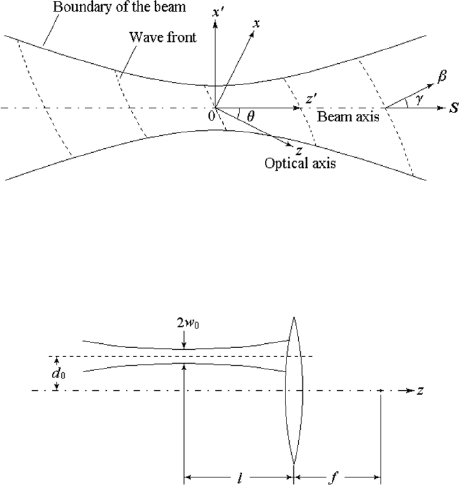
Problems 619
Figure 9.17: A Gaussian beam in the uniaxial crystal and the relation between
the directions of the wave vector and the energy flow.
Figure 9.18: Problem 9.4.
Problems
9.1 Within the paraxial approximation, prove that the contours of a Gaus-
sian beam are coincident with the normal lines of the phase fronts.
9.2 Draw the electric and magnetic field lines of a Gaussian beam with w
0
=
λ, 2λ, 3λ.
9.3 Transform a Gaussian beam whose waist radius is w
01
and is located at
d
1
to a Gaussian beam whose waist radius is w
02
and located at d
2
.
Determine the focal length and the position of the lens.
9.4 Determine the parameters of the transformed b eam shown in Fig. 9.18.
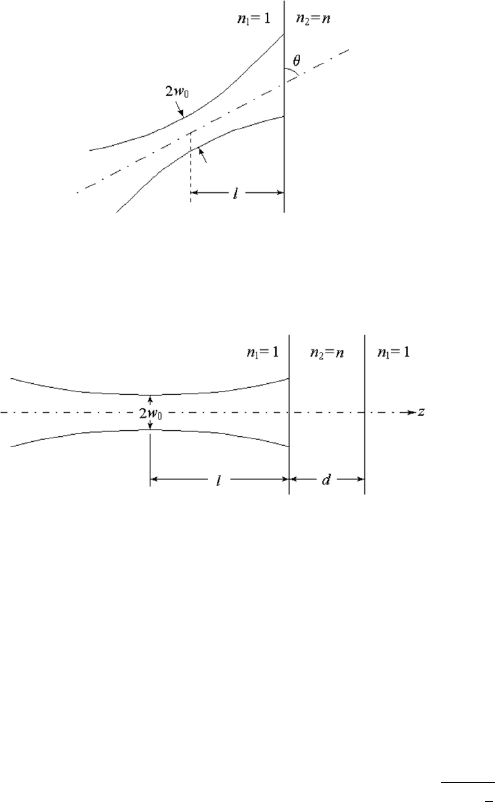
9.5 A Gaussian beam is incident obliquely onto a medium, as shown in
Fig. 9.19. Determine the radius of the transmitted beam waist and its
position.
9.6
A Gaussian beam is normally incident onto a dielectric slab with index
n and thickness d, as shown in Fig. 9.20. Determine the position of the
transmitted beam waist and the far-field divergence angle.
620 9. Gaussian Beams
Figure 9.19: Problem 9.5.
Figure 9.20: Problem 9.6.
9.7 A Gaussian beam has it waist at z = 0, and a detector is located at
z = L. If the beam is focused onto the detector with a lens of focal
length f , what is the position of the lens?
9.8 Derive the field distribution of an elliptic Gaussian beam.
9.9 If the half-width of a Gaussian-Hermite beam is defined as the distance
from the beam axis to a point outside the most external wave petal,
where d
2
u/dx
2
= 0, prove that the half-width is x
m
=
q
m +
1
2
w(z),
where H
m+1
(ξ) −2ξH
m
(ξ) + 2mH
m−1
(ξ) = 0 is used.