
Foster L.V. A Brief History of Mexico
Подождите немного. Документ загружается.

A BRIEF HISTORY OF MEXICO
148
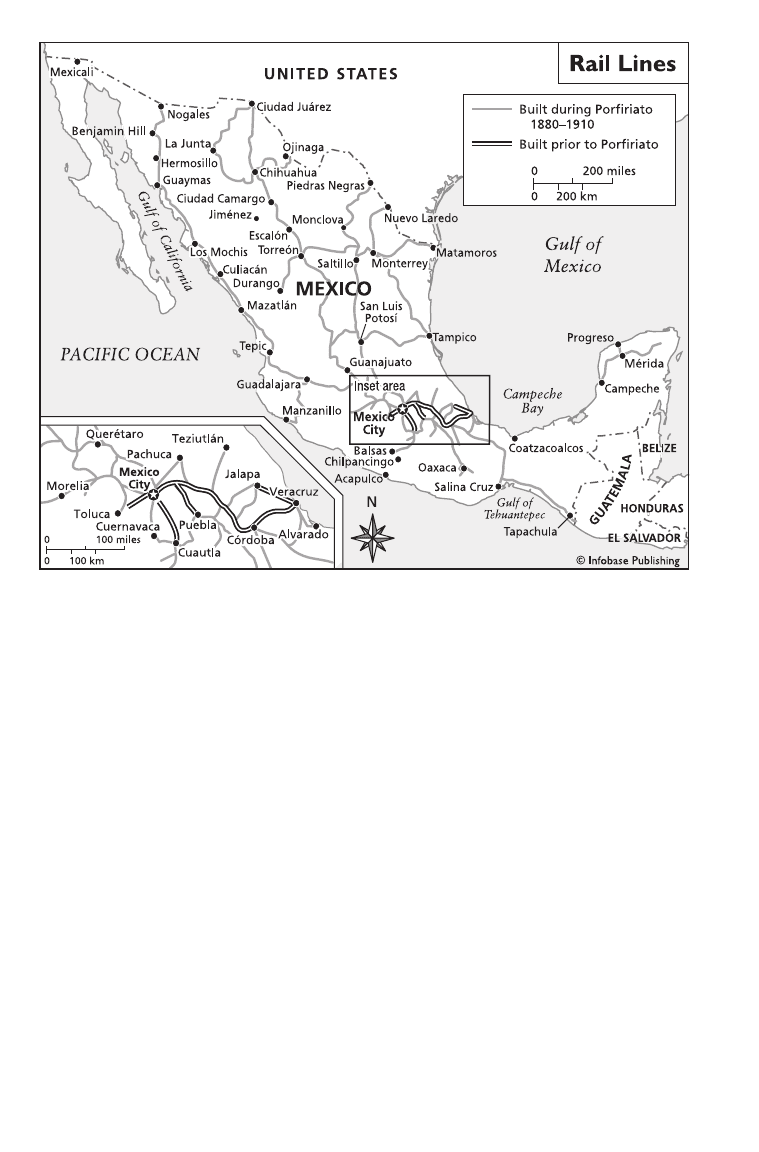
interest in most of them to form the National Railways of Mexico—
many claimed it overpaid to appease foreign interests. The tracks
radiated from the capital to major cities such as Guadalajara, Puebla,
Monterrey, and Oaxaca; they connected the coasts from the Pacific
to the Gulf and linked the major ports with production centers and
Mexico City with its Guatemalan frontier. Initially, the lines extending
to the Texan border at El Paso and Laredo and from Guaymas on the
Pacific to Nogales, Arizona created considerable concern. Mexicans
feared, after the losses in the Texas wars, that the railways would simply
facilitate a U.S. takeover of the rest of Mexico.
The railroad network had its gaps—for example Yucatán was not
connected at all. Yet it unified much of Mexico and helped Díaz control
the various regions with a stronger arm: troops could arrive quickly
to any problem area. But above all, the railroads enabled the Mexican
economy to develop more rapidly than ever before. For the first time,
cotton arrived expeditiously and affordably to the textile mills and
silver to the smelters and ports. Shipping costs were lowered so much
by rail transit that what had cost $67 to ship in 1877 cost only $3 in

149
1910. The trains created a profitable domestic and export market for
agricultural surpluses: farm exports, sisal, and goat hides, for example,
generated more than 100 million pesos, up from 7 million.
The Gilded Age
The impact of a strengthened economy and a modernized infrastruc-
ture on Mexico cannot be underestimated. Those who benefited from
the economy—most of the middle and upper classes—gained a new
sense of pride in their country. European governments gave honors to
Díaz. Visitors from abroad extolled the nation’s progress. With peace,
the population grew to more than 15 million, and the population of
Mexico City finally exceeded the population of Aztec Tenochtitlán at
470,000.
Most of the population growth was in the cities, especially Monterrey,
Chihuahua, and Durango in the more industrialized north. But smaller
towns such as Salina Cruz, now reachable by train, also blossomed.
The commerce brought a construction boom and an expanding middle
class that resided mostly in the cities. Government workers and school
teachers, skilled artisans and professionals, clergy and petty army offi-
cers increased in number and income; initially from the lower classes,
they now could afford indoor plumbing, some fashionable clothes, and
meat a few times a week.
Mexico was more confident, but not so much so that it didn’t bor-
row European culture and fashion. The literati studied the classics.
Cities such as Guanajuato and Mérida built magnificent Belle Epoque
opera houses, importing Italian marble and artisans to create them even
though Mexico had marble and skilled artisans of its own. The upper
classes sent their children to French universities, joined French cultural
societies, and assumed the latest French fashions (
see page 152). The
bishop of Mérida was transported in a jewel-encrusted carriage pur-
chased in Paris. An opera by Gustavo Campo on Nahuatl poet and king
Nezahuacóyotl was entitled in French, not Spanish.
For all its pretense at progress, the Porfiriato did little to improve
educational opportunities. The middle classes in the cities and women
found schooling more accessible, but higher education remained
almost exclusively the preserve of the elite. Rural areas, predominated
by poor peons and Indians, were even less well served. The number of
schools did double; the number of teachers almost did too, although
they were paid no more than a housemaid. Yet the population doubled
as well. The national illiteracy rate was 80 percent.
THE PORFIRIATO DICTATORSHIP
A BRIEF HISTORY OF MEXICO
150
In the mid-19th century, Fanny Calderón de la Barca despaired that
“the women of the landed class were condemned to a life, the vapid-
ity of which makes us yawn at the very thought.” Their education
was neglected; most were as illiterate as they were gracious and kind.
During the Porfiriato an increasing number of women were educated
for the professions. The first woman graduated from the medical school
in Mexico City in 1887 and a commercial school for women was
opened to great demand in 1903. A feminist group, the Admiradoras de
Juárez, was founded in 1904.
Intellectuals and artists were able to pursue their interests as long as
they did not criticize the dictatorship. Some journalists and newspaper
publishers found this difficult: Filomena Mata was jailed 34 times for
the independence of his publication. The period did produce sophis-
ticated literature in the modernist tradition, which eschewed politics
for a purer art-for-art’s-sake aesthetic. Amado Nervo (1870–1919) was
the most talented and prolific writer, best known for his first novel, El
bachiller (1895). Typical of the age, he resided in Paris. Historians pro-
duced scholarly studies of the long-past (hence politically safe) colonial
period, such as Joaquín García Icazbalceta’s (1824–94) biography of
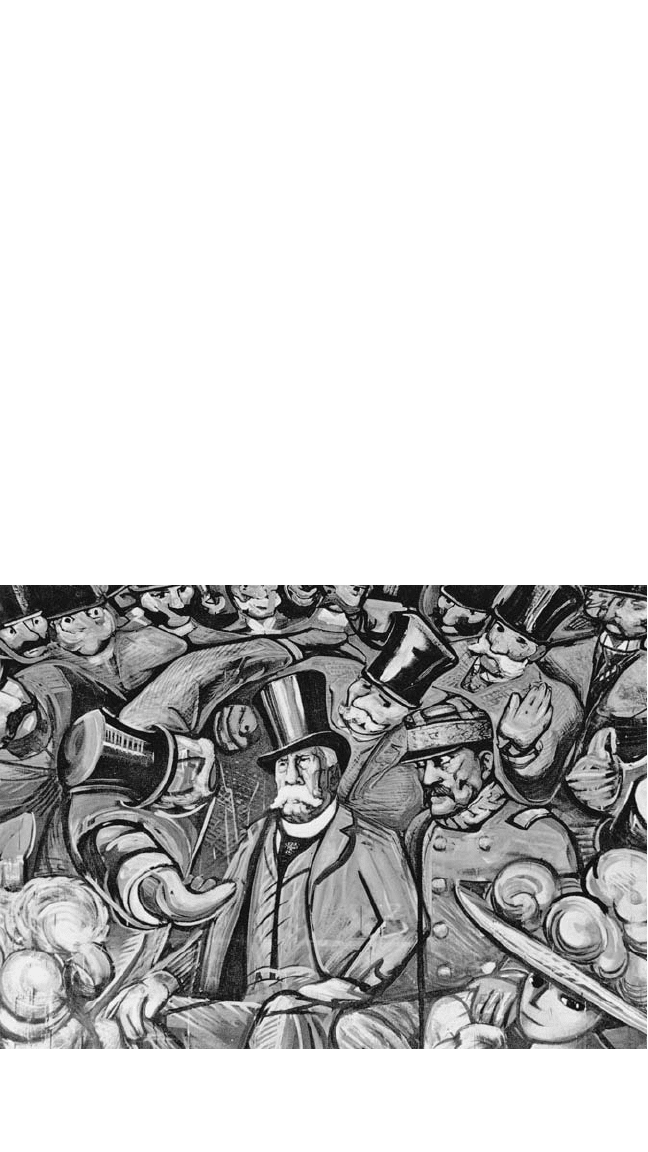
Porfirio Díaz and the Científicos (1957–60), a mural by David Alfaro Siqueiros in the
National Museum of History, Mexico City

151
Bishop Zumárraga. Justo Sierra (1848–1912), Díaz’s minister of educa-
tion, wrote México: su evolución social, an interpretive history of the
nation.
Positivism was the dominant intellectual movement and the one
that rationalized Díaz’s dictatorship. This philosophy, also borrowed
from France, originated with the emphasis on scientific thinking in the
philosophy of Auguste Comte. Positivists, called científicos in Mexico,
controlled the highest governmental positions. They argued that the
country’s problems could be solved by the application of statistics and
sound thinking. Rational policies and social order would bring the
nation to the level of Europe and the United States. This thinking was
never more effective than in Minister Limantour’s handling of national
finances. However, the policies were less “scientific” when a dash of
Social Darwinism was added to preserve the privileges of Creoles and
the ruling class, who argued that only they were fit to govern. Mexico
wasn’t ready for democracy, Justo Sierra said from the Ministry of
Education. And the indigenous masses, inferior according to these
científicos, would never be ready.
European tastes predominated in art, setting back the national
themes that had prevailed after independence, especially during
Maximilian’s reign. The capital’s most elegant avenue, the Paseo de la
Reforma, had been designed by Maximilian but was not sufficiently
European for aristocrats of the Porfiriato. It was redesigned to look
more like Paris’s Champs-Élysées and lined with statues, many com-
missioned from abroad. Don Porfirio also found little in national art
appealing. The Mexican entry at the Paris World Fair of 1889 was
neo-Greek in style and flanked by sphinxes. The dictator appointed
a director of the Academy of San Carlos who agreed with his prefer-
ences and who brought in many other European instructors to “civi-
lize” local tastes.
Fortunately, fashion didn’t dictate all art of the period. Many artists
continued to seek a Mexican style. José María Velasco (1840–1912)
and José Guadalupe Posada (1852–1913) created works that are among
the finest examples of art. The soft grandeur of Velasco’s Mexican
landscapes (see page 146) derive from the academic tradition. In fact,
Velasco was an instructor at the academy and one of Diego Rivera’s
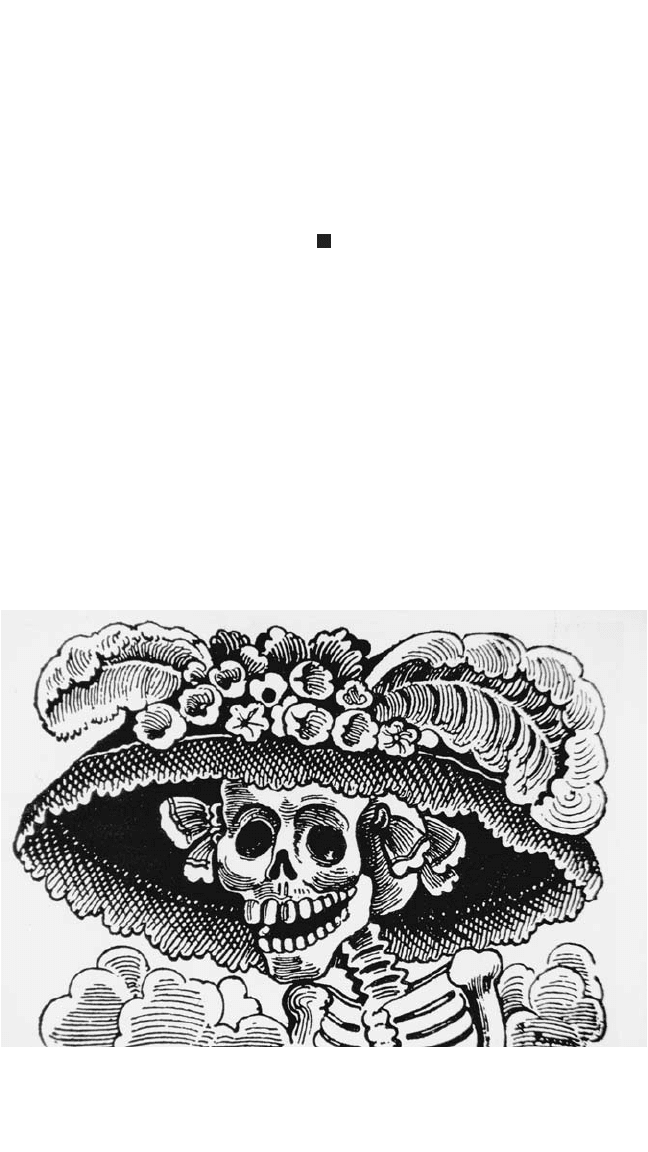
early teachers. By contrast, Posada was trained as a printer’s appren-
tice. He created his expressive and often fantastic engravings for street
gazettes; his illustrations of folk ballads and his political satires and
amusing calaveras (skulls) for Day of the Dead editions were meant
for popular audiences. The Daumier of Mexico, Posada created what is
THE PORFIRIATO DICTATORSHIP
A BRIEF HISTORY OF MEXICO
152
considered the earliest example of the modern Mexican art style that
predominated after the Revolution.
Foreign Dependency
The North American, the foreigner, had prospered in Mexico, but
not its native sons.
Regis Planchet, 1906 (quoted by Charles C. Cumberland)
Just about everything in Mexico was foreign owned. There were more
than 1,000 mining companies: 85 percent were North American and
a few of them, such as Daniel Guggenheim’s American Smelting and
Refining Company and Anaconda Copper Company, operated many
different mines in most of the states in northern Mexico with a total
value of some $12 million. Petroleum was first drilled successfully
in 1901 by Edward Doheny, a Californian who owned 600,000 acres
along the oil-rich Gulf coast; when he sold his wells to Standard Oil
Company, they were producing $1 million worth of oil a week. A second
La catrina (1913), metal cut by José Guadalupe Posada in the National Museum of Prints,
Mexico City, satirizes the French fashions of the Porfiriato.

153
dominant producer of Mexican oil was the Briton Sir Weetman Pearson,
later Lord Cowdray. Many banks were in foreign hands, too, as well as
most industries.
The foreign firms gave job preference to their own nationals and
even in Mexican-owned firms, the manager was often a foreigner. So
prevalent was this practice that Mexicans rarely made their income
from management, but rather as intermediaries for foreign inves-
tors with the government. Although European companies included
Mexicans on their boards and in other capacities, U.S. firms rarely did.
And in a practice that would lead to conflict, foreign workers doing the
same job as a Mexican usually earned much more.
The economy was fueled by foreign trade. Although Mexico was
becoming somewhat industrialized, especially in the north, it exported
primarily raw, not manufactured materials—just as it had in colonial
times. The economy depended on the strength of European and U.S.
demands for these products. For most of the Porfiriato, Mexico ben-
efited from an expanding U.S. economy. The potential profits from
foreign trade had transformed the agricultural sector into producing
cash crops. Yucatecan hacendados found that sisal alone brought such
incredible profits on the world market that they planted nothing else.
The Antiquarians—
a Different Kind
of Investment
N
ot all foreigners came to Mexico for aristocratic balls or to
make a fortune. Many Europeans and Americans wished to know
more about the ancient ruined cities. Edward Thompson, U.S. consul
in Mérida, used his spare time to investigate the Maya ruins of Yucatán
state for the Peabody Museum of Harvard University. In 1894, permis-
sive Mexican land policies enabled Thompson to buy the Hacienda
Chichén, 100 square miles of land that happened to include the ruins
of Chichén Itzá, a pre-Columbian city of 50,000 inhabitants in a.d. 880.
Thompson devoted himself to the study of the ruins and befriended his
Maya workers, who permitted him to observe rituals and dances that
they said were preserved from ancient times and could be seen carved
in the walls of Chichén.
THE PORFIRIATO DICTATORSHIP

A BRIEF HISTORY OF MEXICO
154
The states of Chiapas and Tabasco, too, had little diversification, gam-
bling on the world market for their coffee and rubber exports to keep
the wealthy wealthier. In the north, where the economy was more
diversified with mining and industry, cash crops such as chickpeas and
profitable animal grazing dominated agriculture.
The Land Grab
[One of Mexican agriculture’s] greatest drawbacks is that the
whole country is divided into immense haciendas or landed
estates, small farms being rarely known . . . Some of these
estates comprise square leagues instead of square acres in
extent and are said to have irrigating ditches from 40 to 50
miles in length.
D. A. Wells, 1887
By 1910 only 2 percent of the population held title to land and 3 per-
cent of the properties covered 58 percent of Mexico. Nearly 70 percent
of those titles had been acquired since the reforms of Ley Lerdo in
1867. Yet seven out of 10 Mexicans were farmers; most were forced into
debt peonage in order to survive.
Under Díaz, two policies concentrated land in the hands of the privi-
leged. The first, the Ley Lerdo, had not been extensively implemented
in regard to Indian community lands under Juárez. Now it was ruth-
lessly implemented. The second was the vacant lands survey in which
allegedly untitled or “public” lands were surveyed and put up for sale;
in total, surveyed land constituted the size of California and was sold
to Díaz favorites and the surveyors themselves for a pittance. Worse, it
was often confiscated from the legitimate owners.
Under either policy, when an Indian had been deprived of land,
there was little hope of rectifying the injustice. Yet some did try. If
Indians could find the money and wherewithal to file a complaint in
court, they not only rarely won but sometimes were fined by judges
for daring to besmirch the name of the hacendado or gentlemanly
surveyor. When land wasn’t taken under the guise of the Ley Lerdo or
survey, it could be taken by cutting off the water supply. Or by force.
The Yaqui Indians of Sonora, for example, after holding off the army
in bloody battles for years, finally were routed and sold as laborers to
henequén plantation owners in the Yucatán where they were forced to

155
work in chains. Their fertile lands went to the American Richardson
Company.
Hunger
In 1910 only 10 percent of Indian communities held land. The land-own-
ers held vast territories. When the arable lands weren’t devoted to cash
crops for export, they often lay fallow. When hungry Indians asked to
rent such land in order to grow their subsistence corn and beans, they too
often were refused. Despite a 50 percent increase in population, Mexico
produced less maize in 1910 than in 1877. Mexico failed to be self-sus-
taining in wheat, too, even though this grain was favored by the upper
classes. Economists estimate that there were on average two pounds of
maize available daily to each Mexican at independence; a century later, in
1910, there was less than a pound—including imported grains. The price
Cash Crops in Two Regions
C
alled “green gold,” the Yucatán’s henequén crop represented the
most extreme consequences of commercial agriculture. It was so
lucrative to grow the fibrous sisal for international cordage that cattle
were killed in order to use the pasture to grow more henequén. In fact,
so many animals were killed that serious meat shortages were created,
even for the wealthy. And hacendados encroached on traditional Mayan
milpas, too, with near impunity, so they could plant yet more sisal.
Finding themselves dispossessed, the Maya repeatedly rebelled against
the hacendados, creating serious labor shortages. When the military
arrived, they fled toward the less developed Caribbean where other
rebel Maya congregated in what is now the state of Quintana Roo. Those
who did not escape were forced to work the sisal fields, slaves in all but
name. When synthetic cordage was developed after World War I, the
henequén market collapsed along with the Yucatán’s economy.
In contrast to the Yucatán and the rest of Mexico, the Sierra
Mixteca—and indeed all of Oaxaca—managed to retain most of its
communal lands not just during the Reform Period but throughout the
Porfiriato. Historians are uncertain of the reason, but some believe
the continued absence of a large wealthy hacendado class meant few
were in a position to buy up the lands. Also, with the loss of cochineal
and with erosion caused by overgrazing, there was no cash crop that
especially attracted foreign monies to the area.
THE PORFIRIATO DICTATORSHIP

A BRIEF HISTORY OF MEXICO
156
of the little maize that was available cost twice as much, and beans, now
an export crop, cost six times more. Wages, however, remained the same
throughout the 19th century. Mexicans were starving.
Survival of the Fittest
The white is proprietor; the Indian, proletariat. The white is
rich; the Indian, poor, wretched . . . The white lives in a mag-
nificent town house; the Indian is isolated in the countryside
and lives in a miserable shack . . . two different people in one
land; what is worse, two people to a certain degree enemies.
Francisco Pimental, 1865 (translated by Stein & Stein)
The circumstances of the poor masses were dreadful during the
Porfiriato. The shameful state in which most Mexicans were forced
to live is reflected in equally dismaying statistics. Sixteen percent of
Mexicans were homeless. Of those with shelter, half lived in hovels that
the government census deemed unfit for human habitation. Sanitation
was nonexistent: public baths were rare, and a bar of soap cost 25 per-
cent of the basic wage. Hungry, the poor were beaten to work under
onerous conditions—regardless of the provisos against forced labor in
the 1857 constitution. In both factory and hacienda the masses labored
seven days a week, 11 to 12 hours a day. Not surprisingly, the national
life expectancy in 1910 was 30—in contrast to 50 in the United States.
In some rural, predominantly Indian areas 800 out of every 1,000
people died before reaching their first year; the national average was
bad enough, at nearly 450 per 1,000.
Peasant uprisings became common. All were put down mercilessly
with the support of those profiting from the Porfiriato. When confronted
with the embarrassing reality of the mortality statistics, the privileged had
a ready answer: the Indians were to blame. It was their innate laziness,
not the lack of food and wages (most were paid in chits at the company
store, not cash), that made them poor workers. It was their stupidity, not
their lack of education, that made them illiterate. Alcoholism, they said,
not hunger and poor sanitation, caused their early deaths.
Indians, the científicos claimed, held back the progress of Mexico. In
the age of social Darwinism, pseudoscience glossed over blatant racism:
the Indians were inferior, and there was no way to improve their lot;
no education or training would enable them to farm better; no wage

157
increases would improve their work; and no improved housing, nutri-
tion, or sanitation would improve their health. So said the científicos.
European Immigration
Most of the population increases were in cities. In many regions there
were severe labor shortages. But European laborers and small farmers
were preferred, not Indians. Díaz embarked on a program to encourage
immigration. The científicos believed increasing the number of Europeans
would add intelligence and energy to the labor force. Citizenship was
made easy, and “vacant” lands were available at low prices so that the
Indian presence could be “diluted.” Although Europeans were preferred
(to diffuse the influence of the North Americans as well), Mexico failed
to attract them. Mexican wages and working conditions could not com-
pete with the appeal of the United States, where an average of 3,500
Europeans arrived daily in 1907. Most who did take advantage of the
welcome were from the United States, half of whom were illiterate drift-
ers looking for a handout. In perhaps the worst racist policy since the
colonial caste system, Díaz and his científicos managed to insult most
Mexicans in order to attract just over 100,000 foreigners.
Growing Nationalism
After 1900, the results of Porfiriato policies culminated in increas-
ing dissatisfaction and rising opposition. In a surge of nationalism
Mexicans, from northern hacendados to factory workers, were resentful
of privileges granted to foreigners but not to them. The wealthy Madero
family of Coahuila opposed a U.S. company’s attempt to monopolize
water rights. Young professionals saw only foreigners in the manage-
ment positions they wanted and only 60-year-olds in the government of
the aging Díaz. Small businesses couldn’t get bank loans. Workers saw
North Americans gain the best jobs in factories.
In this atmosphere of growing resentment, an increasing number of
liberal publications found their voice. One, Regeneración, published
by the Flores Magón brothers attracted enough attention to land the
brothers in prison and eventually to self-exile in the United States. But
from there they continued to publish—despite an assassination attempt
ordered by Díaz—and received support from young Mexican intellectu-
als in their call for freedom of the press and better conditions for the
poor. They wanted an end to child labor, an eight-hour work day, and
the redistribution of uncultivated land.
THE PORFIRIATO DICTATORSHIP