
Foster L.V. A Brief History of Mexico
Подождите немного. Документ загружается.


A BRIEF HISTORY OF MEXICO
118
Emperor Iturbide
A significant misfortune for the new nation of Mexico was to have the
disreputable Iturbide as its first leader. Joel Poinsett, a minister from
the United States, described him as “distinguished for his immorality”
in a society riddled with corruption. After staging an unruly demon-
stration in support of himself in the streets of the capital, Iturbide
was able to bully the Creole-dominated congress into making him the
emperor of Mexico.
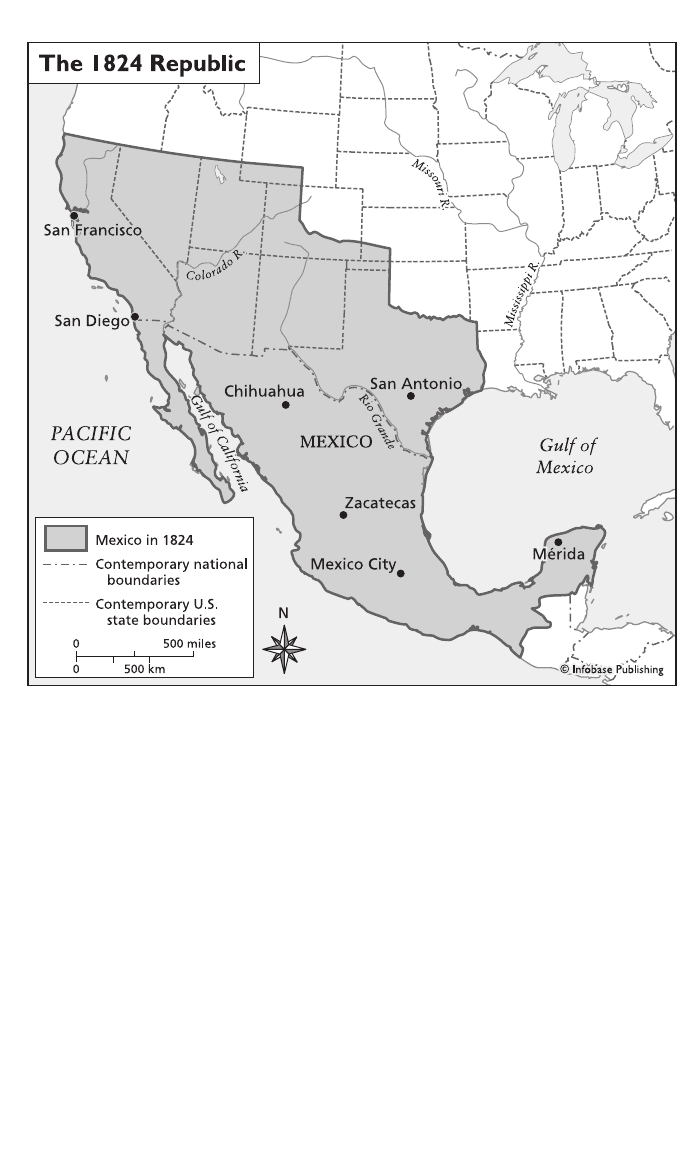
Iturbide was to govern a fledgling but enormous nation, covering
1.73 million square miles from California through Central America to
Panama (
see map on page 103). Its borders with the United States to
the north and Belize to the south were not clearly demarcated, however.
And not all its territories had participated in the War of Independence:
Some Central American governments had to be encouraged with the
threat of invading troops to remain part of Mexico. Ferdinand VII of
Spain had not completely accepted his expulsion and managed to keep
troops on a fortress island in the Veracruz harbor. The United States
was territory hungry, and both Great Britain and France were seeking
special trade concessions.
As his first concern for leading such a vast nation plagued by so
many foreign policy issues, the pompous ruler devoted himself to mak-
ing elaborate plans for his coronation a few months later on July 21,
1822. A French baroness, former couturier to Napoléon, was hired to
design costumes for the new emperor. A court etiquette was issued,
outraging republican factions who deemed it inappropriate to be forced
to kiss Iturbide’s hand. A bankrupt nation issued new coins engraved
with the emperor’s portrait.
Economic Legacy
Iturbide and his Creole supporters had thought that replacing the penin-
sulares in government would automatically rectify the ills of the Mexican
economy. The profits would remain in Mexico, in Creole pockets, and
the taxes would support the new government. They had overlooked
the 75 million peso debt the country had incurred during the War of
Independence. They hadn’t factored in the loss of gold and silver cur-
rency the peninsulares would take with them as they fled the country.
The mines themselves, near the primary battlegrounds for independence,
were flooded and the machinery damaged, requiring considerable capi-
tal to return them to working order. Textile mills were closed because
banditry and bad roads prevented the transport of cotton. Haciendas had

119
been burned and sacked. Returning soldiers could not find jobs: as many
as 20 percent of adult males were without work.
The colonial economy was destroyed. The first Mexican empire none-
theless lavished money on Iturbide, granting him a million-peso bonus.
Congress appropriated 80 percent of its revenues—more than the vice-
royalty had spent during the independence wars—for the emperor’s
cronies, the military. Nothing was invested in restarting the economy:
not even the bloated military made an effort to open the roads for com-
merce. The country was at an economic impasse. When short of funds,
the government attempted to borrow them, incurring more debt. When
even those funds were insufficient, loans were decreed from the church
or money confiscated from citizens.
It didn’t take long for Iturbide to lose support. The devastated country-
side could not properly provision the cities. The congress was outraged by
Iturbide’s arrest of enemies and censorship of the press—so the emperor
dissolved it. Some Creoles, embarrassed by Iturbide’s excesses, wanted a
European prince installed as monarch, but many a confirmed monarchist
joined the republican side. When a military coup forced the emperor to
abdicate his majestic office only eight months after coronation, Mexico’s
debt was as remarkable as the disarray of its government.
General Santa Anna
Mexico learned from the Iturbide interlude to distrust monarchies. A
republic, governed by an elected congress and president, was established
under the Constitution of 1824—a document that would be repealed and
fought over, but returned to over time. Much to the chagrin of the mon-
archists and centralists, this federalist constitution divided the Republic
of Mexico into 19 states and four territories (excluding the provinces
of Central America, which declared their own independence in 1823).
Catholicism was the state religion and the only permitted religion. There
were free press and free speech. Indian tribute was abolished, in law if not
always in deed. By 1829 slavery was officially ended, too. In reality, the
new political order had minimal impact on the majority of Mexicans who
lived in rural isolation and for whom voting rights mattered little because
they were illiterate and, often, did not speak Spanish.
Even under the republican regimes, military heroes of the Wars of
Independence with no administrative experience, were elected to—or
grabbed—the presidency. The first president, for example, was the
rebel leader, Guadalupe Victoria. Uneducated, uncontrollably jealous
of rivals, and unable to inspire the republic, he nonetheless did manage
YEARS OF CHAOS
A BRIEF HISTORY OF MEXICO
120
to continue the bad economic policies of the empire by spending more
money on the military than revenues could sustain. Many of these
military bosses, called caudillos, kept their politics more local, ruling
the countryside with their band of armed adherents and ready to make
trouble when their interests were not served. They would usurp the
power of all but a few presidents.
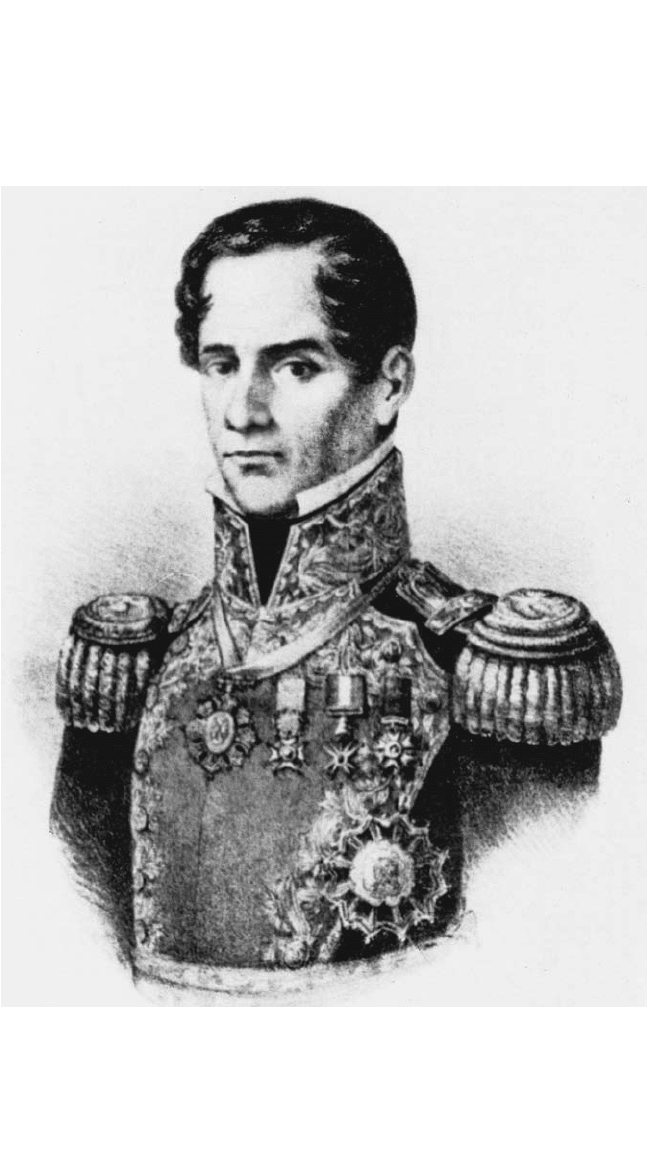
The most remarkable figure in this turbulent period was General
Antonio López de Santa Anna (1794–1876). Repeatedly president of
Mexico, yet disgraced almost as often, exiled, and, in the end, executed
for treason, Santa Anna’s political life spanned the first critical decades
of Mexican Independence. His opportunistic vacillation between liberal
and conservative causes, his constant engagement in military coups and
foreign confrontations (he called himself the liberator of Mexico), his
fine-tuning of political corruption, personified this era of anarchy.
121
Santa Anna first walked onto this historical stage under Iturbide. He
was commander of Veracruz, charged with eliminating the sole remain-
ing Spanish troops on an island fortress in Veracruz harbor. Instead, he
declared against the unpopular Iturbide and formed an alliance with
Antonio López de Santa Anna, a Creole born in the state of Veracruz, quickly found his
niche in the military. Both as president and from behind the scenes, he controlled and dis-
rupted Mexican politics from 1824 to 1855 and in the process made himself a millionaire.
(Courtesy of the Bancroft Library)
YEARS OF CHAOS

A BRIEF HISTORY OF MEXICO
122
the old independence rebels, Guadalupe Victoria and Vicente Guerrero.
After seeing the emperor depart Mexico, he returned to Veracruz to
expel the Spaniards from their fortress in 1825.
Again and again Santa Anna issued pronouncements against various
regimes. In 1829 he defeated 3,000 Spanish soldiers who had landed in
Tampico on the Gulf coast in order to reconquer Mexico for Ferdinand
VII. Finally he himself was elected president in 1833—he would hold
office a total of 11 times—but instead of governing, he retreated to the
sanctuary of his Veracruz hacienda and let his vice president, Valentín
Gómez Farías, take care of the boring day-to-day details.
Church Power Confronted
Gómez Farías typified the more liberal element of the Creoles. An
anticleric, he subordinated the church and seized its properties for
the greater welfare—an action that would repeatedly bring conserva-
tive reaction throughout the century. Like Morelos before him, Gómez
Farías considered the wealth of the Catholic Church wasteful: indeed,
its wealth was estimated at 180 million pesos when the total annual
Mexican budget was only 13 million. The church was powerful, its
clergy numerous, yet most priests resided in the cities, leaving them-
selves open to charges that they inadequately administered to the faith-
ful in smaller towns and rural areas. Since the church was responsible
for educating the populace, their absence from the countryside also
contributed to illiteracy, legitimizing the call of liberals like Gómez
Farías for secular education.
Gómez Farías also tried to bring the military under greater state
control. He attempted to reduce its size and to eliminate its exemption
from civil trials. In doing so he took on at least one too many powerful
groups. President and General Santa Anna bestirred himself from his
hacienda and once again proclaimed. This time he marched against his
own vice president, dismissed the congress, suspended the federalist
constitution, and assumed dictatorial powers in 1834.
A charismatic figure, Santa Anna was able to contemptuously dis-
regard the constitution and desperate needs of his country. While the
conservatives and liberals feuded over matters of substance, the president
assumed the pomp and excessive show of a sultan. Having lost his leg in
battle, he had it ceremoniously interred and enshrined in the presence
of the entire cabinet and diplomatic corps. His greed and graft knew
no limits during his last presidency when, assuming the title “His Most
Serene Highness,” he raided the treasury to finance lavish balls and build

123
an opera theater as ornate as any in Europe. His blatant disregard for the
well-being of the nation culminated in the act that would bring about his
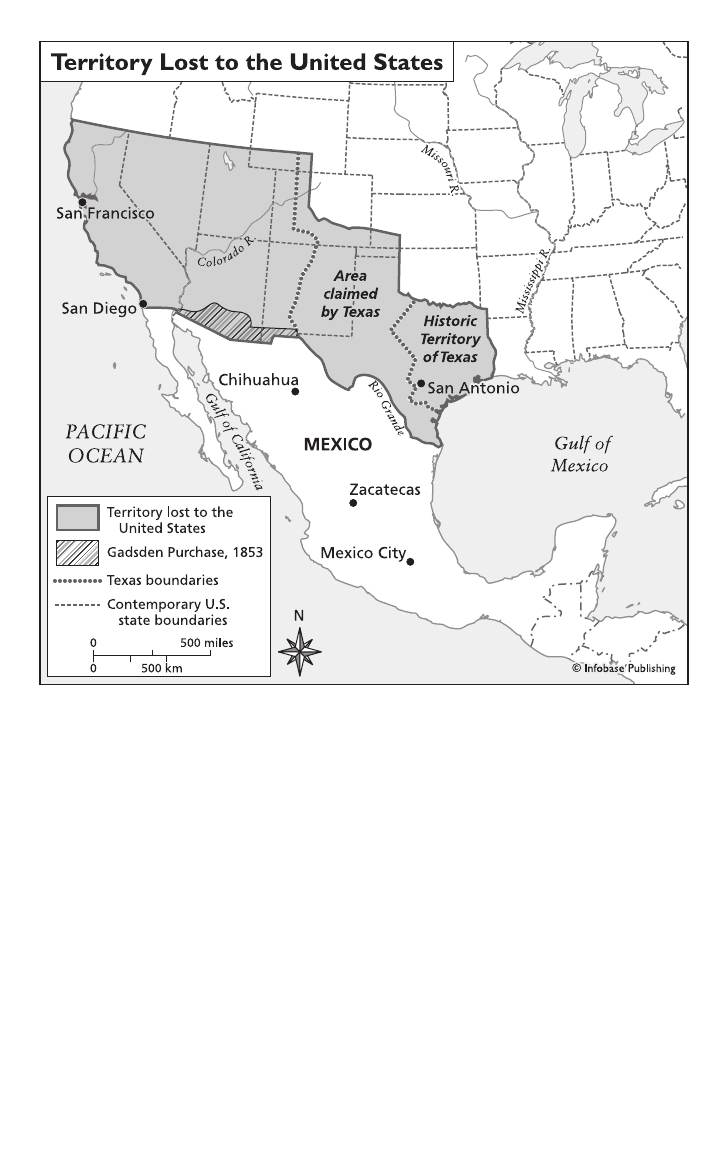
final downfall: he sold the Mesilla Valley, 30,000 square miles in southern
Arizona and New Mexico, to the United States (where it was called the
Gadsden Purchase) in 1853 to pay for his extravagances.
The Alamo
Santa Anna’s legacy to his nation was more than corrupt government.
His role in the battle for Texas resulted in great territorial losses to the
United States. Not only did the president command the troops at the
decisive battle of the Alamo, his policies precipitated the crisis. As a dic-
tator, Santa Anna’s sympathies were most naturally with the centralists.
After the suspension of the federalist constitution in 1834, Mexico was
reorganized into larger territories more directly under the control of the
president. Various parts of the country, including Texas, agitated against
these centralists shifts and had to be pacified by the army.
Mexico City During a
Counterrevolt
F
anny Calderón de la Barca, the English wife of a Spanish diplomat,
visited Mexico during the Santa Anna years and recorded her lively
impressions in a diary. Here is her description of the capital during
Santa Anna’s military coup of 1840:
. . . The chief danger to those who are not actually engaged in
this affair, is from these bullets and shells, which come rattling
into all the houses. We have messages from various people
whom we invited to come here for safety, that they would gladly
accept our offer, but are unwilling to leave their houses exposed
to pillage, and do not dare to pass through the streets. . . . We
were astonished this morning at the general tranquillity, and
concluded that, instead of having attacked . . . the government
was holding a parley . . . Innumerable carriages, drawn by
mules, are passing along, packed inside and out, full of fami-
lies hurrying to the country with their children and moveables.
Those who are poorer, are making their way on foot—men and
women carrying mattresses, and little children following with
baskets and bird-cages (234–236).
YEARS OF CHAOS

A BRIEF HISTORY OF MEXICO
124
In the hope of limiting U.S. expansion into its colonies, Bourbon Spain
had encouraged the settlement of Texas by favorable land-grant policies.
The primary beneficiaries were Anglo-Americans from the United States
who brought their slaves to till the fertile land and cultivate cotton. In
exchange for nearly free land and initial tax exemptions, these settlers
agreed to become Catholics and assume Mexican citizenship.
The land-grant system did at least part of what Spain expected: it
settled Texas. Eventually, the immigrants outnumbered the Mexicans
by more than 20,000 to 4,000. However, assimilation into Hispanic
culture did not occur, and Anglos continued to speak English and
practice the Protestant faith; cultural conflict between the groups were
not uncommon. Centralism, however, incorporated Texas into a much
larger, purely Mexican province, so that Anglo culture and economic
interests were made subservient.
Before the outbreak of open rebellion, Mexico had seen the prob-
lems brewing in Texas. Mexico hoped that a by-product of outlawing
slavery in 1829 would be to make Texas less attractive to U.S. citi-
zens—it did allow Anglo-Texans a temporary exemption, however. In
1830, Mexico closed its borders to new immigrants but like today, the
frontier between Mexico and the United States was extremely porous.
Mexico also increased its customs duties on exports, greatly affecting
Texan trade with the United States. There was also the threat of U.S.
annexation: some private armies had already attempted to invade Texas.
To protect its borders and territorial integrity, Mexico assigned more
military units to the region.
Stephen Austin, son of the founder of the Anglo colony, protested
both centralist policies and new customs regulations. Both liberal
Mexicans and U.S. politicians encouraged him to throw off the dictator-
ship of Santa Anna. When the Mexican government learned Austin was
advocating separation under the name of the Lone Star Republic and
encouraging Texans to arm themselves, President Santa Anna sent army
reinforcements. When Austin forced their surrender and departure
from Texas, the president himself led 6,000 troops to Texas.
. . . zealous in the fulfillment of my duties to my country, [I]
declared that I would maintain the territorial integrity whatever
the cost . . . Stimulated by . . . courageous feelings I took com-
mand of the campaign myself, preferring the uncertainties of
war to the easy and much coveted life of the palace.
President Santa Anna, 1835 (1969, 49–50)

125
The rebel Texans, including Davy Crockett and Jim Bowie, barri-
caded themselves into the old Franciscan mission of the Alamo in San
Antonio. General Santa Anna laid siege for several days. On March 6,
1835, his soldiers attacked the seemingly impassable walls and faced
the heavy artillery of the Texans. Hundreds died while others broke
through the walls. Government forces greatly outnumbered the Texans,
and the government won, leaving not a single survivor.
A few weeks later another Mexican general surrounded the town of
Goliad, forcing the Texan forces of Colonel James Fannin to surrender.
Both sides understood that the Texans’ rights as prisoners of war would
be respected. But upon learning of the incident, Santa Anna ordered
their execution as pirates.
More than the slaughter at the Alamo, the death of 365 prisoners
galvanized public opinion in the United States. Supplies were sent.
Volunteers joined the Texans. Within weeks, Sam Houston was in a
position to strike back. The Mexican army was defeated, and Santa
Anna was taken prisoner.
The peace treaty Santa Anna signed promised that all hostilities
would cease and the Mexican army would withdraw south of the Río
Bravo (as the Rio Grande is known in Mexico). Santa Anna, not at the
moment stimulated to “courageous feelings,” also signed a secret treaty
that promised to arrange recognition of Texas as an independent repub-
lic in exchange for his personal freedom. An outraged Mexico refused
to recognize either treaty.
Mexican-American War
From 1836 to 1845, Texas remained independent. Turbulent domes-
tic politics and military revolts as well as a French invasion and the
bubonic plague made any intervention too difficult. Yucatán, too,
declared its independence, and Mexico concentrated its armies there
from 1839 to 1842. But when President John Tyler introduced a joint
resolution to the U.S. Congress for the annexation of Texas, Mexico
could ignore its northern frontier no longer and was brought to the
brink of war.
More than Texas was at stake. The Lone Star Republic, now the 28th
state, falsely claimed its western border to be the Rio Grande, which dou-
bled its size. The additional territory included the heart of the old colony
of New Mexico around Santa Fe and half of what is now Colorado. The
United States, under President James K. Polk, not only claimed the dis-
puted territory, but also wished to add California and the remainder of
YEARS OF CHAOS
A BRIEF HISTORY OF MEXICO
126
New Mexico to the package; these he was willing to purchase, however:
$5 million for New Mexico, a minimum of $25 million for California. A
total of 1 million square miles of territory was at stake.
When Mexicans learned that Polk’s representative, George Slidell, was
coming to Mexico to negotiate such an offer, they were indignant. Their
national identity was at issue. Vast territories would be lost. Newspapers
threatened rebellion if the government accepted the terms. While the
Mexicans fulminated, Polk considered a declaration of war over the dis-
puted territory. He decided to wait for an incident to justify such an act,
and it came on May 9, 1846. General Zachary Taylor, leading his forces
into the Mexican territory disputed by Texas, encountered resistance
from the Mexican army. Sixteen of Taylor’s soldiers were wounded or
killed. Just enough for Polk to go to Congress for a declaration of war,
disingenuously claiming that Mexico had invaded U.S. territory.

127
Instead of devoting itself to the awesome responsibility it confronted
in the north, the Mexican army engaged in presidential politics. Finally,
after a coup, General Santa Anna was installed again in office. By
then, U.S. forces were already well organized. General Stephen Kearny
marched on Santa Fe where he met no resistance. Leaving forces to
occupy New Mexico, others went south to Chihuahua while Kearny
headed for California. By the time Kearny arrived, California had
already been taken by the navy under John Sloat and John Fremont.
There had been little resistance. In Chihuahua, the Mexicans resisted
but were poorly armed.
At Monterrey, however, General Taylor met the forces of General
Pedro de Ampudia who was able to stall Taylor’s advance by several
days. Then Santa Anna arrived with a hastily assembled army of 20,000.
The initial battle of Buena Vista was a stalemate: the next morning,
fighting should have resumed. Instead, Santa Anna inexplicably began
his return to Mexico City. Mexico’s northern territories were lost.
Invasion of Mexico City
Mexico’s losses were too great for its leaders to simply end the struggle.
While they debated what to do, the United States under General Winfield
Scott led the battle to the capital. Landing at Veracruz, Scott cleverly cut
off the well-armed troops in the old island fortress by landing above the
city and surrounding it from the rear. He then bombarded the helpless
residents and ignored all appeals to let innocent women and children
leave. A total of 6,700 shells bombarded the city. Civilian casualties were
double that of the military. Veracruz finally surrendered.
Scott marched toward Mexico City. Santa Anna tried to cut him off
but was either outmaneuvered or rejected by the citizenry who didn’t
want their cities devastated like Veracruz had been. The capital tried to
prepare itself, but the old conflicts rendered a unified effort impossible.
Some thought the city was impossible to defend and that peace should
be negotiated. Provincial leaders refused to contribute to the corrupt
central government, and congress was reluctant to give the general the
support he requested given his recent failures in battle.
The U.S. forces were well drilled and well supplied, and they outnum-
bered the Mexican troops. But on August 20, 1847, during the Battle of
Churubusco on the outskirts of the capital, the Mexicans fought hard.
Even after intense hand-to-hand combat exhausted them, they refused to
give up. Scott, believing the Mexicans defeated, asked for their surrender.
Santa Anna used the negotiations to buy time and reinforce his position.
YEARS OF CHAOS