
Foster L.V. A Brief History of Mexico
Подождите немного. Документ загружается.


A BRIEF HISTORY OF MEXICO
138
for summary execution of all remaining republican agitators, they were
granted permission by the emperor—who thereby sealed his own fate.
In the capital, the royal couple established their court at Chapultepec
Castle but did not isolate themselves. They received the people weekly
to learn about their concerns and toured the countryside to acquaint
themselves with their realm, which they found quite beautiful. When
it was suggested that a marble arch should be dedicated to Carlota,
Maximilian thought one commemorating Mexican independence
would be better. He outlawed debt peonage, and he granted commu-
nal lands to Indian villages that had lost them under the reforms. Yet
none of these sympathetic acts could redeem the foreigner in the eyes
of most Mexicans.
No sooner did the U.S. Civil War end, than President Abraham
Lincoln threw his support behind Juárez. Having fought its own war of
independence, the United States had declared in the Monroe Doctrine
that the Americas were off limits to European colonization. Juárez was
permitted to purchase arms, and 3,000 Union soldiers joined his army.
The United States advised the French to leave, and Napoléon, also
under pressure in Europe, recalled his troops in late 1866.
With the French army gradually withdrawing, Maximilian found he
had few choices left. The Conservatives no longer approved of him; the
Liberals never had and never would. He considered abdicating the throne.
Carlota convinced him to remain while she traveled to France and then
to Rome to secure support. But neither Napoléon nor Pope Pius IX, who
was disgruntled that church lands had not been restored, was willing to
help. Carlota went insane and was institutionalized in Europe.
By the end of 1867, the Juaristas had recaptured much of northern
Mexico and Oaxaca. Most of the French had withdrawn. Maximilian
still considered abdication. Instead, as a gesture of his Hapsburg pride,
he joined the last French troops in the city of Querétaro. The Juaristas
surrounded them. Maximilian resisted for 100 days. His entourage
arranged for his safe escape; he refused, finding it more dignified to
stand his ground and surrender.
Juárez ordered that Maximilian be tried for violation of Mexico’s
sovereignty and, when found guilty, executed. Mexicans, both men
and women, implored him not to kill the well-meaning emperor.
Presidents and monarchs from around the world appealed to him for
clemency. Juárez, however, could not forget the executions of his own
men ordered by Maximilian nor the 50,000 Mexicans who had died
fighting the French. He followed the letter of the law. Maximilian faced
the firing squad.

139
The Restored Republic, 1867
While the story of Carlota and Maximilian has captured the imagina-
tion of filmmakers and romance writers, the reality for Mexico of this
quixotic interlude was not so inspirational. The nation was saddled with
Maximilian’s war debt, which Juárez refused to pay. The economy was
even more deeply disrupted and local caudillos, or political bosses, had
more power than ever. The foreign debt in 1867 was 375 million pesos
in contrast to 56 million in 1850. There was not a peso in the treasury.
Although the war against the French defined a new sense of nationalism,
the anarchy had intensified regional autonomy at the expense of federal
control. Thirteen years of war had destroyed the Conservative army that
always had been ready to stage a counterrevolt; yet many ambitious cau-
dillos were included in the Liberal army. And the underclasses—Indians,
shop keepers, laborers—had been asked to fight the French, empowering
them in a way that they had not experienced since Hidalgo.
Having temporarily quieted their Conservative opponents and hav-
ing moved the church out of politics and education, the Liberal Party
had to control its own internal divisions. The middle class thought the
large landowners (also members of the party because of the windfall
property obtainable through the reforms) should take their fair burden
of the taxes. Instead, many hacendados paid no more than landless
workers. The poor thought there should be a major redistribution of
the hacendados’ land. The rifts were there, but while Benito Juárez was
alive, the party united behind him.
The Juárez Presidencies, 1867–1876
Until Juárez took control, Mexico never was governed.
Justo Sierra, 1867
Under Benito Juárez, Mexico finally experienced a period of extended
political stability and peace. As a civilian president, he stood in marked
contrast to the military heroes who had dominated politics since inde-
pendence. In 1867 he was elected to his third term as president: the first
one that would not be interrupted by war.
Juárez’s popularity in no small part helped prevent the usual military
coups, but he also had to juggle many competing interests in the Liberal
Party. To keep the hacendados behind him, Juárez granted them absolute
YEARS OF CHAOS

A BRIEF HISTORY OF MEXICO
140
privileges over their domains—no small matter when some, such as the
Terrazas family, owned properties in the north the size of a state and when
the injustices of debt peonage had yet to be eliminated. The middle class
was pleased with the increasing number of positions in the government
bureaucracy and the growing number of public schools in the cities, from
fewer than 2,500 in 1857 to more than 8,000 in 1874.
The Liberals were basically satisfied with Juárez’s public policies as
well. Although the federalist state had become more centralist, the elec-
tions were more open than they had ever been, if not totally free of state
tampering. The press was free, and indeed, intellectuals such as Ignacio
Altamirano (1834–95), an Indian historical novelist, did not hesitate to
criticize the president. The anticlerical reforms remained intact, though
no one contested the church’s quiet procurement of new urban proper-
ties. And the legislature was strengthened as a branch of government.
There were serious problems, however. To control the military and to
save the treasury money, Juárez dismissed 40,000 of the 60,000 soldiers
who had fought the French. Many caudillos were furious, expecting
more spoils from the war; some plotted against Juárez—including the
hero of Cinco de Mayo, Porfirio Díaz. The unemployed soldiers added
their numbers to the bandits already plaguing the countryside, making
all travel unsafe and attacking rural towns and haciendas.
The land problem, exacerbated by the Reform Laws and Juárez’s
favorable policies for hacendados, was an explosive issue for the
Indians—one that would divide the country just as the church had
done. Juárez was sympathetic to certain checks on debt peonage, but
congress overruled him. Indian revolts were increasing, squatters fre-
quently took over hacienda land until federal soldiers arrived. Famine,
such as that in 1869, further inflamed the situation. Some estimate that
one-fifth of the population was dispossessed, scavenging for food in the
countryside or begging in the city streets.
Peace, however, and a conscientious government, enabled some
improvements in the economy, especially in the area of transportation. A
railroad was built between Veracruz and the capital; roads were upgraded
for stagecoach travel. A police force, called the rurales, provided increased
security on the roads, which facilitated commerce. Commerce did
improve. Although cochineal had become inconsequential, hide exports
were 20 times greater than during the viceroyalty, and Yucatán profitably
exported sisal, or henequén, for making rope and cordage. Lumber and
coffee became major exports, too. Yet gold and silver retained their num-
ber one position, especially with the opening of new mines in northern
regions such as Chihuahua.

141
Mexico attempted to attract both foreign settlers and foreign invest-
ment. Given its recent history, however, Mexico was considered a poor
risk. Some capital found its way to the mining and textile industries.
European immigration was encouraged in the hopes of gaining skilled
labor and increasing the population. With so many deaths due to war
and high infant mortality, Mexico’s population remained under 9 million
in 1874—only 2 million more than at the end of the colonial period. Yet
by 1876 a mere 25,000 Mexican residents were foreign born.
Stable Juárez Period Ends
In 1871, Juárez decided to seek a fourth term—against sound Liberal
principle. He appeared an absolutist rather than the constitutional
president he had been. It was a hotly contested election with three can-
didates: Juárez, General Porfirio Díaz, and Sebastián Lerdo de Tejada,
chief justice of the Supreme Court. No one won a majority, so the leg-
islature decided the matter in favor of Juárez. Lerdo came in second.
Díaz, like so many military caudillos before him, proclaimed himself in
revolt. Few joined him and Díaz was defeated—temporarily.
On July 19, 1872, Benito Juárez died of a heart attack. As chief justice,
Lerdo succeeded him as dictated by the Constitution of 1857. In the next
election Lerdo was chosen for president over Díaz by a massive majority
and continued the progressive policies of his party. In a few years he had
further increased the number of primary schools and had contracted for
more railroads. He also connected all the provincial capitals by telegraph
wires. Less popular was his diligent implementation of the Reform Laws,
closing convents and confiscating church properties.
Foundations of the Modern State
Until the French invasion, it would have been hard to discern more than
factionalism and wars and their disruptive effects on the population in
19th-century Mexico. After the French intervention, Mexico became
a more unified nation, and when Juárez died in 1872 the country
had at least experienced a constitutional and democratic government.
Progress had been made in separating religious and civil authority, and
Lerdo had continued upholding the laws of the constitutional republic.
General Porfirio Díaz, however, would reverse the course that had been
so painfully set.
YEARS OF CHAOS

143
8
The Porriato
Dictatorship
(1876–1910)
Don Porfirio’s slogan was “Bread and the Club”: bread for the
army, bread for the bureaucrats, bread for the foreigners, and
even bread for the Church—and the club for the common
people of Mexico and those who differed with him.
Lesley Byrd Simpson (1962, 258)
F
or 34 years Mexico was ruled by a man who fought his way into
power on the slogan of “no reelection”: Porfirio Díaz. This dictator
left an extraordinary legacy. He attracted foreign capital and modernized
the economy. Cities were beautified and the countryside rid of banditry.
His most exceptional legacy, however, was the Revolution of 1910.
Because all he achieved was at the expense of the Mexican people, he is
considered the villain in 20th-century Mexican history. It is not his statue
that graces village squares, but rather that of Francisco Madero, who
stood against him for democracy; it is not Díaz who rides the white horse
in Mexican muralist art, but rather Emiliano Zapata who fought for the
return of peasant lands. These events, the Porfiriato dictatorship and the
Revolution, created a Mexican national identity that survives to this day.
No Reelection
Since independence, the uncompromising factionalism of Mexico had
benefited the military. First, it created Emperor Iturbide. Then His Most
Serene Highness Santa Anna. With Juárez the country took a breather
from generals, if not from war. And finally the political process of
p
r
onouncements and revolt favored yet another caudillo, General Porfirio

A BRIEF HISTORY OF MEXICO
144
Díaz (1830–1915). Díaz, a mestizo born of a Mixtec Indian mother, was
from Juárez’s state of Oaxaca. He went through a similar educational pro-
cess as Juárez but never finished law school. After joining the army, he
became a national hero of the Liberal cause during the battle of Cinco de
Mayo. Later he liberated the capital, as well as Puebla and Oaxaca, from
the French and took up a position in Congress under Juárez.
Initially Díaz tried to get himself elected president legitimately,
arguing that Juárez and Lerdo, by seeking reelection, were despots
not democrats. After losing, in good caudillo fashion, he proclaimed
against the government and led an armed revolt on the principle of
“no reelection.” The idea was quite popular with the middle class,
because—when extended to municipal and state elections—it meant
that a lot more people would have a chance at office. Against Lerdo,
Díaz succeeded in toppling the government. And during his first term
(1876–80) he unified the country behind him when the United States,
under President Hayes, encroached on Mexican territorial sovereignty
by permitting its soldiers, who were in pursuit of Apaches, to cross into
Mexico. Díaz held firm, despite threats of war by the United States, and
gained considerable popularity by standing on principle.
But Díaz would soon be found to hold few principles so strongly as to
defeat his own interests. The Constitution of 1857 stood. Why bother to
create the controversy that would be aroused by repealing it when it could
simply be ignored? So compelling was the principle of no reelection, how-
ever, that Díaz arranged for a stand-in candidate his second term. After his
third, no one dared complain, but to maintain a facade of legality, the law
was changed to permit unlimited terms at every level. All other officials,
local and federal, were handpicked by Díaz and held their positions as
long as they were in favor. And when they were not in favor, they more
often than not were assassinated by Díaz’s personal police called the Bravi.
Elections continued throughout the Porfiriato, but because the outcomes
were always known in advance, few bothered to vote.
Pax Porfiriana
There are no drunken riots . . . little thieving . . . The least disorderly
action, even loud talking in the streets, causes prompt arrest . . .
J. Hendrickson McCarty, 1888
Given the decades of Mexican anarchy, Díaz’s ability to forge a strong
centralized Mexican state is a testament to his political toughness as

145
much as it is to Mexico’s exhaustion. Díaz faced the usual disruptions
in the countryside during his first term. There were peasant uprisings,
Apache raids, and more than one revolt by a regional chief. By expand-
ing the rural police force, the rurales, Díaz quickly put any such trouble
down. And he did so ruthlessly. Under Díaz, the rurales included noto-
rious bandits who were permitted to murder anyone and justify their
acts by the Ley Fugo: “Shot while trying to escape.” Operating outside
the constraints of any due process, the rurales were known for their
fearlessness against presumed enemies of the regime. Well paid by Díaz,
their loyalty was unquestioned. Order was achieved.
Díaz used more than repression in consolidating his power. He was
a political wizard capable of conciliating and co-opting the various
factions of the middle and upper classes. The army, for example, was
appeased by a larger budget and new weapons at the same time it was
decentralized and depoliticized by the simple expedient of assign-
ing soldiers in smaller battalions to different regions on a constant
rotation. In a classic Díaz maneuver of balancing one group against
another, he created several militia groups, such as the rurales, to
compete with the army. The church was satisfied that Díaz did not
actively enforce the Reform Laws, permitting them to build up their
properties and wealth and to reopen their schools. Although the
anticlerical constitution was technically still in effect, Mexico under
Díaz encouraged the clergy to expand in number from the 500 under
Juárez to 5,000.
The middle class, the intelligentsia, the petty caudillos, and the
haughty Creoles supported Díaz because he brought them increased
prosperity. He did so by doing all the right things to attract foreign
capital and know-how. First, his Pax Porfiriana enabled commerce to
resume unimpeded. Second, he stabilized the government by buying off
the various factions. And third, but no less astonishing, he gradually
put the government on a sound financial footing. Continuing Juárez’s
policy of streamlining the government, Díaz brought in professional
financiers such as José Yves Limantour to manage the budget. By 1894
the budget was balanced; by 1910 there was a comfortable surplus.
Modernization
In 1876 Mexico was basically the same feudal society as during the
viceroyalty, and while rigid social stratification had yielded to permit
more people of color into the ranks of power, most of the population
was unskilled and living in peonage. Three-quarters of the society was
THE PORFIRIATO DICTATORSHIP
A BRIEF HISTORY OF MEXICO
146
rural. Only in the cities was there any sophistication. Modernization
was practically nonexistent: oxen, not tractors, plowed the fields, and
most silver was extracted with 16th-century technology. Mexico City,
which was regularly flooded during the rainy season, was less capable
of building dikes and ditches than Aztec Tenochtitlán. The ports, even
Veracruz, were in need of dredging. Instead of trains, burros and human
carriers (used since pre-Columbian times) transported goods.
Díaz believed modernization would come only with foreign capital
and the immigration of skilled Europeans. Government policies, such
as special tax and legal exemptions, were implemented. Laws were
passed not only permitting investors to profit from the products they
extracted, but granting them subsoil rights that had previously been
reserved for the government: a boondoggle for investors in the case of
metals and petroleum.
With domestic peace and a sensible budget, Mexico was deemed
one of the most creditworthy nations in the world. Foreign loans were
readily available and were repaid in a timely fashion. Investors liked
the welcoming attitude and privileges offered to them. Hydroelectric
plants were built. Steam and water power became available for modern
machinery—5,500 textile mills and cement factories, sugar and flour
refineries, and breweries were the result by 1902. Telephones and tele-
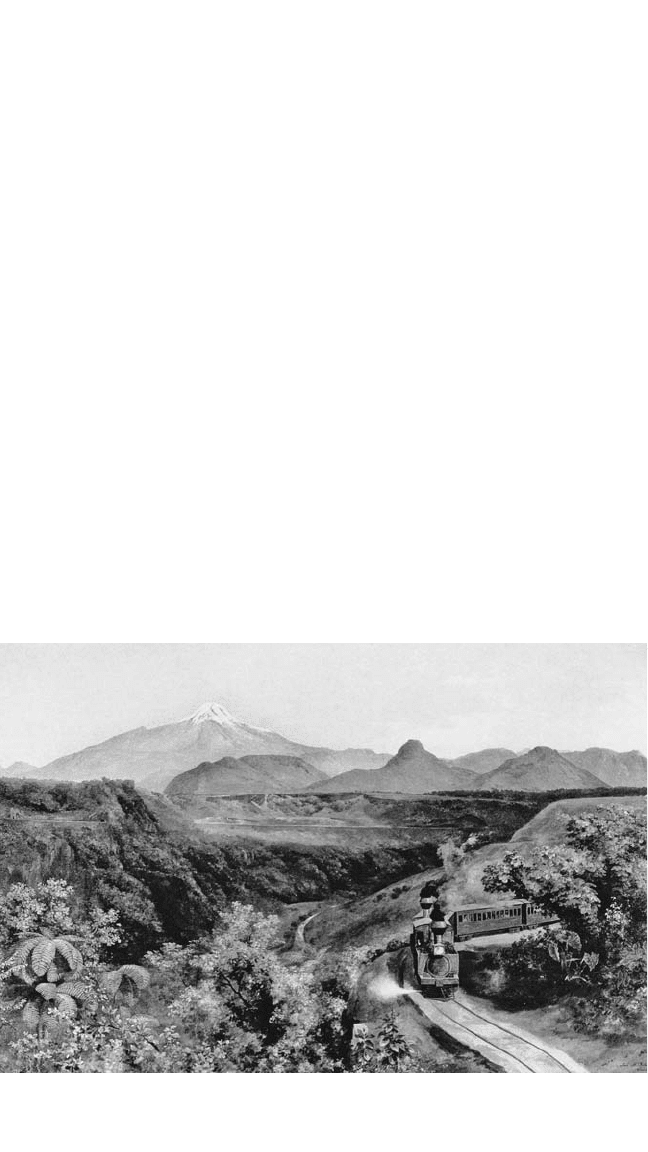
Citlaltépetl (1879), a painting by José María Velasco in the National Museum of Art, Mexico City
147
graphs linked the nation. The first steel mill in Latin America produced
60,000 tons annually from Monterrey, which was fast becoming the
industrial capital of Mexico. The British built a six-mile tunnel through
the mountains that protected the capital from flooding. Foreign mon-
ies and technology dredged the harbor of Veracruz and improved ports
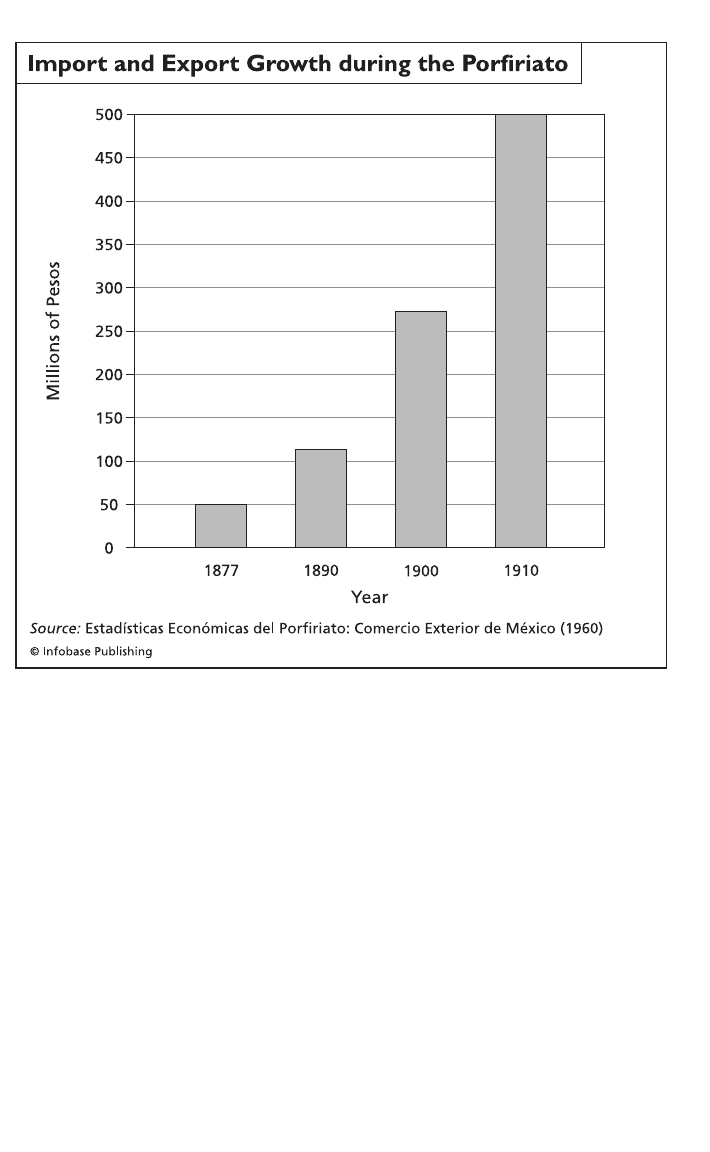
such as Tampico, Manzanillo, and Mazatlán: foreign trade increased
nearly tenfold during the Porfiriato. Silver and other metals were more
easily extracted with new technology: Silver production quadrupled,
gold increased from 1.5 million pesos in 1877 to 40 million 11 years
later; copper became a major export.
The greatest impact on Mexico was the completion of a rail net-
work of more than 15,000 miles by 1910. Subsidized by the Mexican
government, the railroads were constructed by foreign companies and
owned by foreign banks. Around 1908, Mexico took a controlling
THE PORFIRIATO DICTATORSHIP