
Foster L.V. A Brief History of Mexico
Подождите немного. Документ загружается.


A BRIEF HISTORY OF MEXICO
128
Resuming the battle at Molina del Rey, 4,000 Mexicans were killed and
wounded, 1,000 Americans. Scott marched on.
There was only one fortification of the city left: Chapultepec Castle.
The castle, surrounded with land mines, was occupied by a military
academy and defended by 1,000 soldiers and young cadets. Scott
ordered the castle stormed on September 13. The land mines didn’t
explode, and the invaders were able to scale the walls. The cadets
joined in the struggle, choosing death over surrender. It was the last
battle. Santa Anna retreated and went into exile. Under the resultant
treaty of Guadalupe Hidalgo (February 2, 1848), Mexico lost its vast
northern territories (
see map on page 126). As something of a com-
pensation, the loss included less than 2 percent of the population and
no known natural resources (until the San Francisco gold rush only
months later corrected this misimpression). In exchange for its terri-
tory, Mexico received $18 million, less than half its annual budget.
For Mexicans, the U.S. invasion of the “Halls of Montezuma” is
symbolized by the young cadets called the Niños Héroes (heroic chil-
dren), who died fighting at Chapultepec Castle on September 13, 1847.
The cadets are immortalized in the street names of nearly every town.
Statues depict their martyrdom throughout the republic, but none is
more monumental than the one at the foot of Chapultepec Castle where
it is said one cadet hurled himself wrapped in the Mexican flag. These
battles would become a part of the new national consciousness, inevi-
tably tinged with Yankeephobia.
Neocolonialism: Mexico at Mid-Century
By the mid-19th century, Mexico was exhausted and humiliated. More
than half of its territory had been lost to the United States, a country
the liberals had admired and aspired to emulate. Apaches attacked
northern, and rebel Mayas almost took control of the entire Yucatán
peninsula in the Caste Wars (1847–49). In central Mexico, revolts
and counterrevolts had created thousands of army deserters for whom
banditry was the only means of support. The continuous upheaval
had destroyed a considerable amount of property, some belonging to
foreigners whose governments then demanded compensation. This
situation created its own ludicrous results in 1838 when war with
France followed Louis Philippe’s demand for $600,000 in payment to
a French chef for the pastries devoured by hungry Mexican soldiers in
the city of Puebla. Mexico couldn’t pay, so France sent its warships.
(And Santa Anna came to the rescue once again, defeating the French

129
troops in Veracruz.) The chaos made Mexican soil fair game for every
adventurer: a Frenchman tried to create paradise lost in Sonora; an
English pirate claimed Baja California.
With no peace, Mexico had made little progress since gaining inde-
pendence. Foreign investment—British, French, and U.S.—had revived
the mining industry, however; production had increased to the levels of
the late 18th century by 1855. Here and there, especially in the increas-
ing number of foreign-owned mines, more modern technology was
introduced. For the future of Mexico, the problem would be that the
Creoles did not invest their wealth in commerce and industry, leaving
later Mexicans to struggle with the problem of foreign ownership of
national resources.
But mining, the one bright spot in the economy, functioned despite
the obstacles. All commerce was impeded by the lack of transport.
Apart from mule paths, there were only three roads, each in deplorable
condition; in 1860 there were only 15 miles of railroad tracks whereas
the United States had 30,000, and bandits added to the expense of
any commerce. A thriving national economy and unified people could
hardly result from such circumstances. Marketing domestic products
beyond the local level was next to impossible, although the textile mills
in cities rapidly developed. On the international market Mexico contin-
ued to export raw products (92 percent of which were silver and gold)
The Sierra Mixteca and
Cochineal
W
ith independence, the Spanish elite who had exported cochineal
left Oaxaca. During the decades of political turmoil, Oaxaca’s
economy became isolated from the rest of Mexico. By mid-century
chemical dyes had destroyed the European market for cochineal. The
Mixtec in the highlands of Oaxaca, so long favored by circumstances, fell
on more difficult times. The number of aristocratic Mixtec caciques fell
from 45 in 1700 to only eight. Then, noble titles were outlawed after
independence, so that Mixtec caciques officially lost theirs along with
the Creole counts. A few continued to inherit their wealth, but they no
longer were politically powerful. Even the family of the aristocratic caci-
que Gabriel Villagómez, descendant of the great 8 Deer “Tiger Claw,”
sold some of their estates.
YEARS OF CHAOS

A BRIEF HISTORY OF MEXICO
130
for foreign manufactured goods, remaining as industrially undeveloped
as under Spanish rule but even poorer.
In principle, free trade with many nations—the United States, Britain,
France—was an improvement over colonial times. It also provided the
government with one of its few sources of taxable revenues, but custom
duties became so high that smuggling often replaced sanctioned trade.
There are no measures of the trade and production in this period; the
chaos extended to official record keeping. Taxes proliferated—on win-
dows, dogs, pulque cantinas—and still Mexico defaulted on its loans.
There was a tax on every adult male, but even that tax was undermined
by the wars, poverty, and social decay: population levels stagnated.
Despite the language of social equality found in the constitution,
some historians argue that conditions for the poor actually worsened.
At the very least they did not improve. The aristocratic Creoles took on
greater airs in replacing the peninsulares: most Mexicans they considered
worthless rabble. Access to the best positions and to wealth remained
open to very few. Indian lands were increasingly gobbled up by haci-
enda owners. Miners had to work four days in order to earn enough
The Maya Caste Wars,
1847–1849
I
n the Yucatán, near the ancient city of Chichén Itzá, the Maya found
the time had come, as foreseen by their prophets, to reclaim their
land from the dzul (whites). They had been armed by Yucatecan Creoles
in a war for independence from Mexico, and they had been promised
better conditions, which were not forthcoming. At the very moment
Mexico was preoccupied in Texas, numerous villages joined together
under the divine direction of the Maya-Christian cult of the Speaking
Cross. They succeeded in battling the dzul practically into the sea. Those
whites who remained were packing to leave Mérida, their last strong-
hold, when the Maya suddenly abandoned the fight in 1849. Sighting
clouds of winged ants, the traditional sign of the first rain, the Maya
had returned to plant their corn fields so as not to offend the gods of
the milpa. The dzul fought back and by 1855 had regained their lands
and control of central Yucatán. The rebel Maya retreated to the unde-
veloped Caribbean section on the peninsula where they maintained an
independent state under the cult of the Speaking Cross until the begin-
ning of the 20th century.

131
to buy a sack of corn. Entire families, children included, needed work
to survive, yet work was too frequently unavailable. Sometimes the
poor were not properly buried because they could not pay the church
fee. Educational opportunities were as scarce as any route to improve-
ment; at best, one in 10 Mexicans was literate. The society remained
so unchanged—despite years of war and devastation in the name of
human rights—that many called the first century of independence the
“neocolonial” period.
Cultural Life at Mid-Century
The barbaric European overlooks nothing.
He breaks, fells, and annihilates
With an army of fury.
It’s his pleasure to convert
Cities into desert wastes.
(What honorable deeds!)
Ignacio Rodríguez Galván “Profecía de Guatimoc,” 1839
(Read 1939, 59)
The Creole failure to modify the social order was not for want of ideas.
The intelligentsia agitated for change, arguing for the elimination of
debt peonage and for improved schools. In this postindependence
period, romantic poets and writers searched for a uniquely national
identity; they attacked some of the most central tenets of the European-
focused Creoles. Mexican civilization began with its pre-Columbian
heritage, they argued, not with the barbarity of the Spanish conquest:
Mexicans were Americans, not Europeans. Even the spelling of Méjico,
they argued, should be changed to the more Indian México. A literary
society, the Academia de San Juan de Letrán, included the best play-
wright of the time, Fernando Calderón (1809–49), whose works sati-
rized Santa Anna, and the foremost poet of the day, Ignacio Rodríguez
Galván (1816–42). Rodríguez’s most famous poem, “Profecía de
Guatimoc,” is dedicated to the Aztec emperor Cuauhtémoc.
In art, sculptors like Pedro Patiño Ixtolinque found patriotic sub-
jects in pre-Columbian rulers and heroes of independence. These
historical themes were echoed in paintings and woodblock prints,
and in the search for a national identity, the native landscape of vol-
canoes and tropical exuberance, Indian ruins, and Catholic churches.
YEARS OF CHAOS

A BRIEF HISTORY OF MEXICO
132
These beginnings of a national art lost their impetus, temporarily,
when Santa Anna hired all European teachers for the Academy of
San Carlos. Outside the academy, however, provincial artists such as
José María Estrada (active 1830–60), Agustín Arrieta (1802–74), and
Hermeneguildo Bustos (1832–1907) left an enchanting legacy of local
life in their portraits and still lifes.
The Liberals and Benito Juárez
Adversity discourages none but the contemptible.
Benito Juárez, 1867 (Smart 1964, 276)
In 1855, the Liberal Party chased Santa Anna and the Conservatives
out of government. The country, fed up and desiring a government
that might unify the nation, gave an unusually broad base of support to
the Liberals in the armed struggle known as the Revolution of Ayutla.
Based on the principles promulgated in the Constitutional Convention
of Ayutla (March 1, 1854), they were committed to free and honest
elections, free public education, the separation of church and state, and
a federalist republic as delineated in the Constitution of 1824.
The Liberals were members of the younger intelligentsia. Some were
poets, such as Guillermo Prieto. Some were Renaissance men, such as
Melchor Ocampo who was a naturalist as well as the translator of French
political works and a student of Indian languages. All had been active
in politics: Prieto had been jailed by Santa Anna; Ocampo had been
governor of Michoacán. Many were exiled by Santa Anna to Louisiana,
where they formed a revolutionary group. Numerous liberals were mes-
tizos and other peoples of color who had worked their way through the
ranks of the army or had managed to obtain an education.
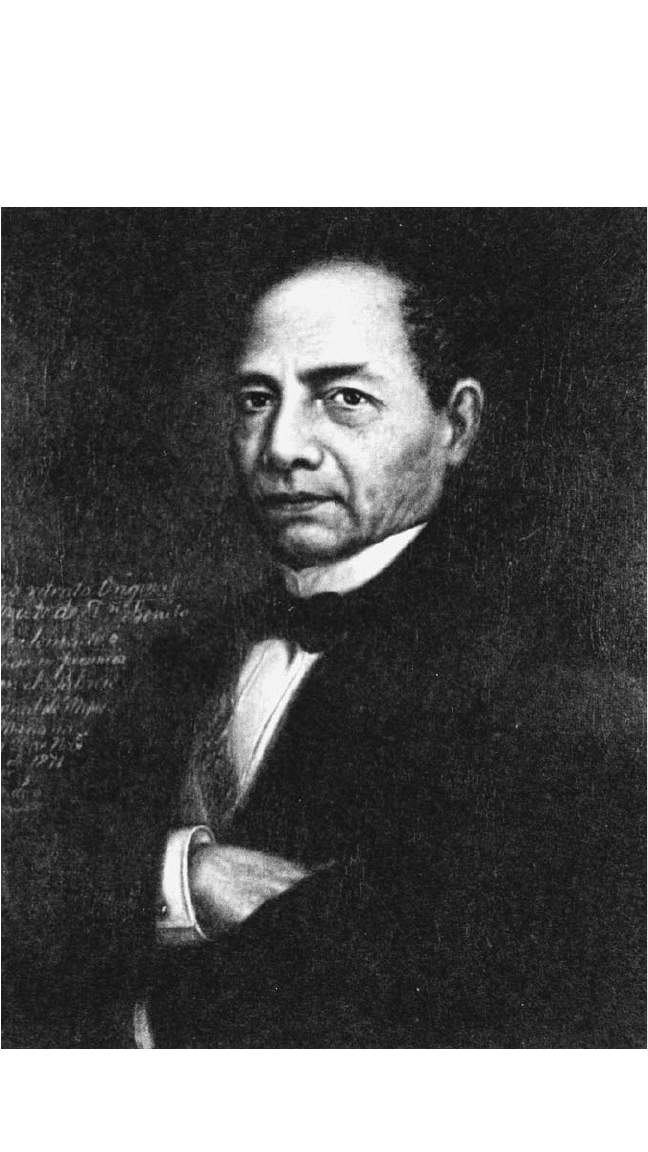
The most famous leader, and certainly the individual most indicative
of a new social order, was Benito Juárez (1806–72). A Zapotec Indian
who is often described as the Abraham Lincoln of Mexico, Juárez was
born in a hamlet in the highlands of Oaxaca. Orphaned at the age of
three, he had the good fortune, when going to the city of Oaxaca at 12
years of age, to work for a Franciscan friar who paid for his education.
Upon graduating from law school, Juárez entered politics and eventu-
ally became governor of Oaxaca where he was recognized for his hon-
est management of the state. Like other Liberals, he was later exiled by
Santa Anna.
133
The Reform Laws
The new Liberal government, with Juárez as secretary of justice, tar-
geted the church and military for its most controversial reforms. The
Ley Juárez eliminated the special exemption the clergy and military
received from standing trial in civil courts—even for crimes such as
Portrait of Benito Juárez (1871), by José Escudero y Espronada in the National Museum of
History, Mexico City
YEARS OF CHAOS

A BRIEF HISTORY OF MEXICO
134
rape and murder. As they had in reaction to previous attempts at
change, Conservative Creoles, clergy, and militia rallied themselves
into a frenzy. Although forced to install a new president, the Liberals
remained in power.
But the new president also antagonized the Conservatives by pro-
mulgating the Ley Lerdo (1856). This law, acceptable to the moder-
ates for the revenues it would generate, required all institutions, both
religious and secular, to divest themselves of property not used in their
normal operations. States would keep the governor’s mansion and office
buildings, for example, but all other properties would be sold at public
auction. For the church, with its vast holdings beyond its churches and
monasteries, the losses would be particularly painful.
The next reform sensibly gave the state the power of registering
births, marriages, deaths, and the like, instead of the church. In the
Ley Iglesias it also deprived the church of the right to set its own fees:
no longer could the poor be forced to pay for receiving the sacraments.
All these reforms were incorporated into the new Constitution of 1857,
along with freedom of speech and press, freedom of education and, for
the first time in Mexico, freedom of religion. Only this last article was
defeated by the Catholic Church.
There were disastrous consequences of the Reform Laws. One was the
effect of the Ley Lerdo on traditional Indian villages. Although the inde-
pendence hero Morelos had argued for something akin to the Ley Lerdo,
he had wanted to redistribute church properties to benefit the poor.
Nothing of the sort occurred under the liberal Reform Laws, because
only the wealthy could afford to buy the properties. And included in the
auctioned properties were ejido lands, the communal farms belonging to
the Indian villages. Under the republic, the separately functioning Indian
communities had been outlawed—after all, free and equal Indians could
vote along with non-Indians for the municipal government. The Indians,
however, rarely gained office even when they constituted the majority.
Communal Indian lands were absorbed by the larger municipality and,
under Ley Lerdo, were sold to pay off state debts. The aristocratic caci-
ques were thereby deprived of the last vestiges of their political power
and Indian communities lost their voice in Mexican affairs. Ley Lerdo
not only created larger estates for the rich, it severely undermined the
autonomy so long enjoyed by indigenous peoples in more remote areas,
such as Oaxaca and Yucatán. For this reason, the Liberal reforms have
been called “the second conquest.”
Another result of the reforms was war. Anticlericalism had been
resisted by the church since the struggle for independence, and the

135
church reacted once again. The wealthy were threatened with excom-
munication for purchasing church property. Those who swore alle-
giance to the constitution also would be excommunicated. Pope Pius
IX entered the fray, declaring the Mexican constitution “null and void”
in regard to the “Most Holy Religion.” The state required an oath of
support from its civic officials, and those who worried about the con-
sequences with the church lost their jobs. In this devoutly Catholic
nation, the church and Mexican state polarized the entire society.
The Reform War: 1858–1861
Once again Mexico found itself incurably divided into two camps: This
time the issue was the proper function of the church in Mexico. The
army declared the Conservative General Félix Zuloaga, president. Many
Liberals escaped north to Querétaro where Benito Juárez was declared
president. A war ensued. The clergy and military supported Zuloaga.
But some Indians did, too, such as the Yaqui in the north, because the
Liberal government’s Ley Lerdo had deprived them of their ejido lands.
Others were convinced that the Zapotec Juárez would have their best
interests at heart.
Mexico was again at war, this time for three years. Many noncomba-
tants were treated brutally. The Conservatives shot doctors who treated
The Sierra Mixteca
A
lthough the glory days of the Mixtec aristocracy passed with
cochineal, geography continued to protect the Mixtec villages
from the ravages experienced by other traditional communities of
Mexico. Despite the Ley Lerdo, the region retained most of its com-
munal lands. Sugarcane had replaced cochineal in Oaxaca as the profit-
able cash crop, but hacendados had little interest in growing it in the
mountainous Sierra Mixteca. As one Mixtec village appealed to the
government in its effort to be exempted from the law:
we lack lands that are called “plough lands” since the places
where it is not steep hillsides are rocky and cut by ravines.
Eusebio López, mayor of Nuyoo, 1856 (Monaghan 1995, 264)
YEARS OF CHAOS

A BRIEF HISTORY OF MEXICO
136
Liberal soldiers; the Liberals abused priests who wouldn’t administer
to them. Thousands of innocents were wounded. Haciendas were
burned, and churches were used as stables. The war continued until
the Liberals defeated the Conservatives, marching into Mexico City on
January 1, 1861.
French Intervention: Cinco de Mayo
Juárez was elected president. The treasury was empty. Juárez declared a
two-year moratorium on payment of foreign debt—some of it outstand-
ing since Iturbide’s time. The Europeans, who had had their citizens
wounded or killed and their silver shipments stolen, were driven to
action. France, England, and Spain, with the pope’s blessing, agreed to
a joint occupation of the customs house at Veracruz. Without interfer-
ing with Mexico’s right to govern itself, they intended to garnishee the
receipts to pay off their loans.
Close to 9,000 foreign troops landed in Veracruz in 1862. It soon
became clear that the French had designs on Mexico that extended
beyond the repayment of loans. In fact, Mexican Conservatives in exile
had been agitating in Europe for the installation of a monarch. France,
under Napoléon III, had agreed. Spain and Britain withdrew their troops
in protest. And 6,500 French soldiers marched toward Puebla with the
intention of occupying Mexico. On May 5 (the famous date Cinco de
Mayo, in Spanish), the Mexicans routed the French in Puebla under the
leadership of General Ignacio Zaragoza and Brigadier General Porfirio
Díaz. It would be a year before the French could resume their march.
More Anticlerical Reforms
Such a long-awaited victory against at least one of Mexico’s many
foreign invaders became a rallying cry for the nation, except for the
Conservatives, who thought that only through the reinstitution of
a European monarchy could authority—and peace—be achieved.
Aristocratic Creoles aided the French troops. Conservative guerrillas
assassinated Liberals in the countryside, including such luminaries
as Melchor Ocampo. Priests used their Sunday pulpits to support the
French and advocated the overthrow of the Juárez government.
The Reform Laws had most affected the clergy, and they had been
sharpened during the Reform War, when new laws were issued that
clearly made the church subservient to the state. All church proper-
ties had been confiscated. Monasteries were closed. Public religious

137
displays were curtailed. Now, in an attempt to end what he perceived
as the traitorous influence of the church, Juárez decreed that the reli-
gious were forbidden to wear their vestments in public and threatened
imprisonment to any priest fostering disrespect for the government and
its laws.
Juárez’s efforts, however, didn’t stop the French government from
creating the second empire in his country. With the United States
embroiled in its own civil war, Napoléon III realized he could proceed
unchallenged. Thirty thousand additional troops were sent to Mexico.
Puebla was taken after a two-month siege that reduced its populace to
eating rats. The Mexican army was decimated. Juárez, realizing he did
not have the troops to defend Mexico City, evacuated the capital and
withdrew the government to the north, establishing it near the U.S.
border in what is now El Paso.
Maximilian and Carlota
In consultation with Napoléon III, arch-conservative Mexicans selected
the Austrian archduke, Ferdinand Maximilian of Hapsburg, as the
vehicle for restoring themselves and the church to power in Mexico.
Maximilian stipulated that he must have the support of the Mexican
people before he took the throne of Mexico, yet the eager conservatives
failed to perceive his liberalism. And the ill-fated Maximilian believed
their cynical assertions that a plebiscite of the Mexican people had
resoundingly approved him as emperor.
Maximilian and his beautiful wife, Carlota, the Belgian princess
born as Marie-Charlotte-Amélie-Léopoldine, were both romantics and
youthful in their innocence—he was 32 and she only 24. Embracing
Mexico and all things Mexican, they disappointed the Europeanized
conservatives. Endorsing the Reform Laws, they scandalized them. As
foreign interlopers, not even their liberalism and idealism could pre-
vent them from being enemies of Juárez; as monarchs, the republican
government in exile could only plot to overthrow them.
The second Mexican empire endured for only a few years. Arriving
in Veracruz on May 28, 1864, Maximilian was forced to surrender three
years later. On June 19, 1867, he was executed by the Juaristas. In those
years, the French constantly were fending off the guerrilla attacks of
the Liberals. They managed to pacify only parts of central Mexico, and
in 1865 they captured Oaxaca from Porfirio Díaz. But the struggle was
unceasing. At one point the army deceived Maximilian by claiming
Juárez had given up and had withdrawn to the United States. Arguing
YEARS OF CHAOS