
Foster L.V. A Brief History of Mexico
Подождите немного. Документ загружается.

A BRIEF HISTORY OF MEXICO
8
level areas are in the lowlands, however. Many highland plateaus, such
as the central basin surrounding today’s Mexico City (a city 7,349 feet in
altitude), are cut off from each other by the various chains of the Sierra
Madre. In this land, altitude determines the climate as much as season:
really only two seasons exist, one with rains and one without. Half the
year most vegetation dies from lack of rain, and the other half it is mirac-
ulously reborn by torrential downpours. There are lakes, rivers, natural
springs, 3,000 miles of coast, and geysers—and deserts.
Mesoamerica
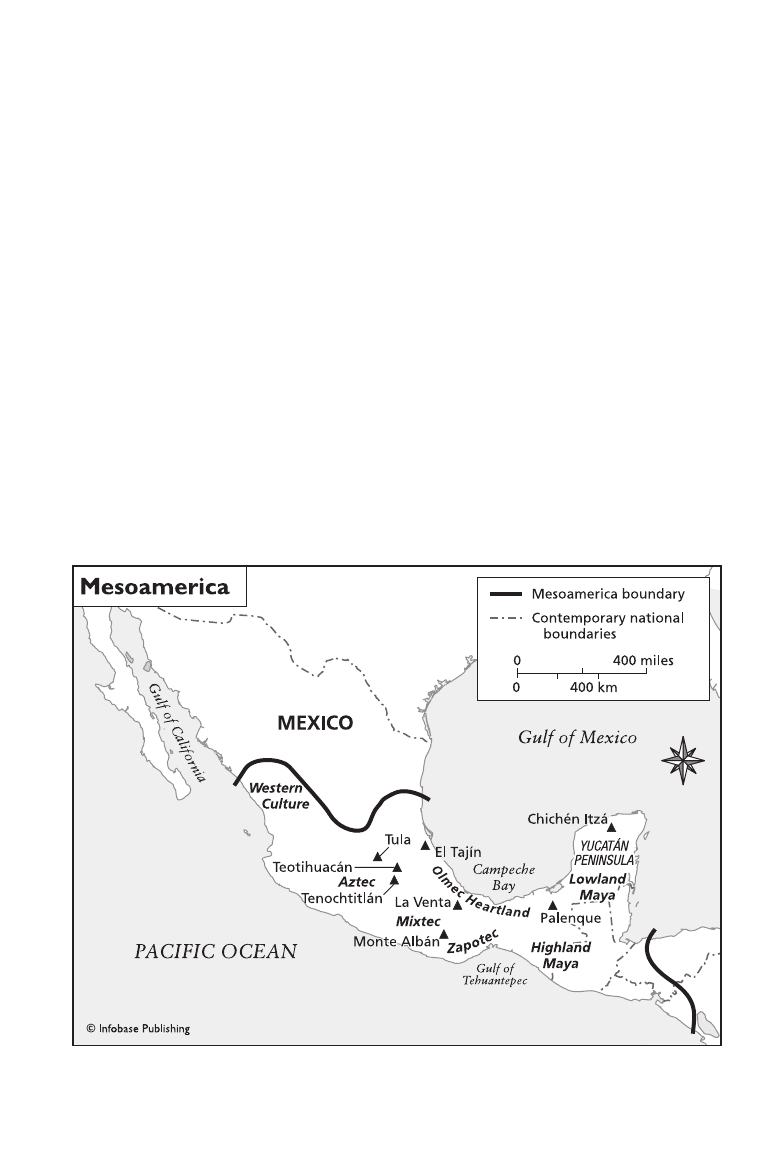
The territory occupied by the great cultures of Mexico did not coincide
with the country’s present political borders. The northern deserts, rarely
hospitable to the agriculture necessary to sustain the settled lifestyle
of urban civilization, formed a natural buffer zone with the cultures in
what is currently the U.S. Southwest. To the south, the Maya civilization
spilled into what are the modern states of Belize, Guatemala, and parts
of Honduras and E1 Salvador. This ancient cultural region, covering
about 400,000 square miles, is called Mesoamerica by archaeologists.
N
The pre-Columbian civilizations covered a somewhat different territory than modern Mexico.
Less northern in its reach, Mesoamerica did extend farther south into Central America.

9
Throughout the millennia the farthest points of Mesoamerica were
in contact, primarily through trade. Although there were no wheeled
vehicles or pack animals, canoes trafficked the rivers and coasts. Sea
trade, in fact, was quite extensive. Christopher Columbus reported
intercepting some canoes off the coast of Honduras that belonged to
Maya traders from Yucatán, a people and land unknown to him. In
1984 archaeologists discovered a port, with massive masonry docks, for
the ancient inland Maya city of Chichén Itzá. The large dugout canoes
must have pulled into port laden with the many objects excavated at
that Yucatec city: gold leaf from as far away as Panama as well as green
obsidian from north of Mexico City and turquoise from near what is
now Cerillos, New Mexico—almost 3,000 miles away. And there is
evidence of pre-Columbian trade along the 2,000 miles of Pacific coast
between Mesoamerica and faraway Peru.
For land transport, human carriers, as onerous as their burdens
must have been, more efficiently maneuvered the mountain passes and
scrub jungles than carts ever could, given the technology. From the
southern cloud forests they carried quetzal bird feathers and from the
tropical ranges, cacao beans for making chocolate—the favorite drink
of Moctezuma when spiked with vanilla, brought from the rainy slopes
of Veracruz. Cacao was so valued it also was used as currency. From
coastal regions like Yucatán came cotton, salt, and honey. From the
highlands was traded much needed obsidian, essential for tools and
weapons as well as shamans’ mirrors, and textiles woven from feathers
and maguey, a cactus-looking plant also used to make alcoholic pulque.
As told by a Spanish conquistador, all these objects, and much more,
could be bought in the great marketplace of the Aztec capital:
. . . gold, silver, and precious stones, feathers, mantles, and
embroidered goods. Then there were other wares consisting of
Indian slaves both men and women . . . in another part there
were skins of tigers and lions, of otters and jackals, deer and
other animals and badgers and mountain cats, some tanned
and others untanned . . . Let us go on and speak of those who
sold beans and sage and other vegetables . . . fowls, cocks with
wattles, rabbits, hares, deer, mallards, young dogs . . . let us
also mention the fruiterers, and the women who sold cooked
food . . . then every sort of pottery made in a thousand differ-
ent forms from water jars to little jugs . . . But why do I waste
so many words in recounting what they sell in that great mar-
ket?—for I shall never finish . . .
Bernal Díaz del Castillo (1928, 215–216)
THE FIRST PEOPLES: PRE-COLUMBIAN MEXICO

A BRIEF HISTORY OF MEXICO
10
Fundamental Traits of Mesoamerica
Mesoamerican cultures were extremely diverse in their political and
artistic attainments. Between the time of the earliest Olmec civiliza-
tion in 1200
b.c.e. and the Spanish conquest in 1521 c.e., the Classic
Maya city-states flourished (250–900
c.e.) in the southern lowlands,
and the great city of Teotihuacán (150
b.c.e.–650 c.e.) dominated the
central highlands. In the tropical valleys and fertile basins of the Sierra
Madre that separated these famous Mesoamerican cultures, many other
groups, such as the Zapotecs, Mixtecs, and Totonacs, built their own
distinctive cities. Such regional diversity continued throughout the
final phase of Mesoamerican civilization, which was dominated by
the Aztecs (1345–1521
c.e.). Before looking at these regional cultures
individually and examining the conditions and remaining mysteries
surrounding their rise to power and collapse, it is important to consider
what unifies them and makes them distinctively Mesoamerican.
Maize
The Aztec emperor chose from among 30 dishes for his dinner each day.
The ordinary citizen, however, was sustained primarily by maize and
beans—a perfect protein complex. Ground on a stone mortar, called a
metate, and mixed with water to make cornmeal, the maize was con-
sumed as a thick gruel called atole or was cooked with various ingre-
dients (such as beans and chile peppers) for tamales (very Mayan), or
patted into flat maize cakes called tortillas (very central Mexican).
Maize was so essential for survival that the Mesoamerican world-
view parallels its recurring agricultural cycle of harvesting (death) and
sprouting (rebirth). In the Maya creation myth from the surviving book
of the Popol Vuh, the maize god is central to the birth of the sun and the
dawning of the world of the Maya where the first humans were shaped
out of cornmeal (
see page 18).
the making the modeling of our first mother-father, with yellow
corn, white corn alone for the flesh, food alone for the human
legs and arms for the first fathers, the four human works.
Popol Vuh (translated by Dennis Tedlock 1985, 164)
For the Aztecs, too, cultivated corn was “precious, our flesh, our bones”
(Sahagún 1950–82, 11:279). Moreover, the world created in the Popol
Vuh myth is a “cosmic corn field” (Taube 1993, 54), measured and

11
dedicated in the same manner as a milpa (cornfield) was prepared cen-
turies ago and just as it is in Yucatán today.
Despite the cultural upheavals experienced by the indigenous
peoples of Mexico, corn remains venerated—there are hundreds of
varieties in Mexico, from blue husked to yellow, white speckled with
black to reddish. The three-stone hearth for cooking cornmeal is the
same as it has been for millennia, and it is held sacred. According to
contemporary Maya of Chiapas, the mistreatment of maize is one of
the greatest offenses against the ancestors and may cause soul loss and,
sometimes, death. The milpa demands such respect that 19th-century
rebel Maya, who had just about driven all Europeans from Yucatán,
abandoned their very successful war because it was time to tend to their
fields. Contemporary poet Homero Aridjis believes that a change in the
quality of tortillas would seriously indicate a deterioration of Mexican
life. From its Mesoamerican beginnings to the present, maize has been
a symbol of life itself.
Calendars, Computations, and Celestial Events
The sciences which they taught were the computations of
the years, months and days, the festivals and ceremonies, the
administration of the sacraments, the fateful days and seasons,
their methods of divination and their prophecies, events and
cures for diseases . . .
Bishop Diego de Landa, 16th century
By measuring the days and years and by studying the seasons and
movement of celestial bodies, the ancient Americans hoped to under-
stand and to influence, if not totally control, the most important events
of their world. The study of the planets and stars, believed to be mani-
festations of the gods, led to the development of calendars for guiding
people through the agricultural and ritual cycles of their lives.
Naked eye astronomy was aided by building alignments and window.
slats. Sometimes entire complexes were constructed for observatories,
such as the Caracol at the Yucatec city of Chichén Itzá. Mesoamerican
skywatchers plotted the movements of the stars in the night skies so
skillfully they could predict the positions of Venus for over 500 years
with only a two-hour margin of error. Entire cities could be aligned
with an astronomical event, such as the heliacal set of Pleiades—known
THE FIRST PEOPLES: PRE-COLUMBIAN MEXICO
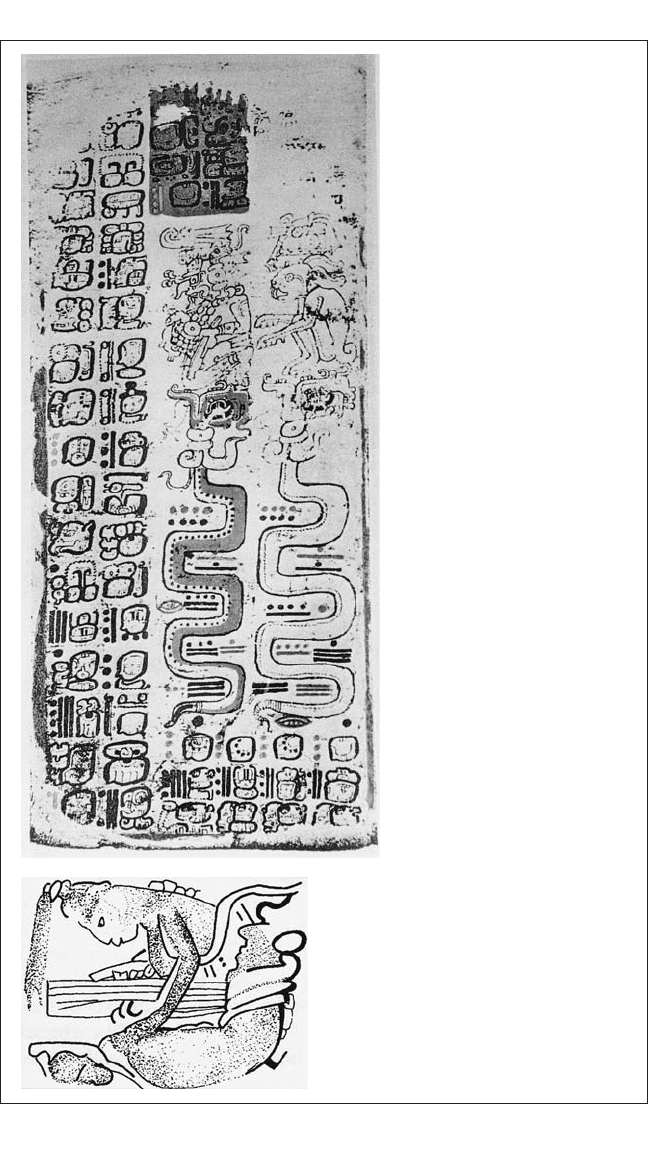
A page from the Dresden
Codex, one of only four
surviving Maya hieroglyphic
books
(Courtesy of the
American Philosophical Society)
A Maya scribe paints a book, pictured on
a late classic-period vase in the National
Museum of the American Indian, New York.
With the decipherment of Maya hieroglyph-
ics, scholars now know that scribes belonged
to the nobility; some were women and some
signed their works. Drawing by Cherra
W
y
llie
(after Persis Clarkson, © Foundation
for Latin American Anthropological Research)
Maya
Books
T
he great Mesoameri-
can civilizations were
the only ones in the Amer-
icas that created writing
and used it to compose
books: books of poetry and
ritual, books of astronomi-
cal cycles (and associated
astrological events), books
of history, and books that
told the legends of world
creation.
A BRIEF HISTORY OF MEXICO
12

13
as “the rattlesnake” by the Mesoamericans—that divided the year into
rainy and dry seasons. Or a sacred building, such as a great ruler’s tomb,
might be designed to glow in the setting sun at solstice, a symbolic
moment when the sun was believed to enter the Underworld, the realm
of the dead.
These astronomers excelled in their mathematics. Neither ancient
Greeks or Romans had the concept of zero. The Maya did, and they
used it in computations that took them thousands of years backward
into mythic time when the original ruler-gods were born and the sun
first dawned. While Europe tried to calculate with unwieldy Roman
numerals, the Mayas used a positional system comparable to our deci-
mal system; theirs had a base of 20, however, not 10.
These sophisticated scientific innovations resulted from a fatalistic
view of the universe. Mesoamericans viewed the world as repeating
cycles, repeating prophecies. What had happened in the past, surely
would happen again—in its right time. For the Yucatec Maya, for
example, every period called “Katun 13 Ahau” was a period when
“things fall to ruin.” Perhaps they felt no surprise in seeing Spanish
ships on the horizon during just such a katun period. Many centuries
before, according to their books of the Chilam Balam, the great city
of Chichén Itzá had been abandoned during the same cycle of time.
All was determined by the “divine mandate” of the ever recurring
calendrical cycles. Whether the ancient Maya had such prognostica-
tions for their 5,000 year “long count” (
see page 15) is unknown.
The long count calendar reaches the end of its mathematical cycle in
2012, more than 1,000 years after the Maya abandoned its use. Today,
however, New Age proponents argue that the Maya ended their cal-
endar on December 21, 2012, because they foresaw a cataclysm on
that day—bringing doom, according to some, or an era of spiritual
renewal, according to others. Unfortunately, ancient Maya are silent
on the matter.
Knowing when to expect the worst and when to perform rituals
and sacrifice to avert calamity was essential. For the learned ones, the
priests, there was no distinction between astronomy and astrology.
They studied the calendars and sky and predicted dangerous times,
like eclipses, and times of war, like Venus stations. They read the
omens and understood when there would be good crops and when not.
Using books as accurate as any astronomer’s chart, as indispensable as
a farmer’s almanac, and as prophetic as an astrologer’s table, the priests
advised rulers and commoners alike. All was based on the calendars
and celestial cycles; all was done to please the gods who could be as
THE FIRST PEOPLES: PRE-COLUMBIAN MEXICO

A BRIEF HISTORY OF MEXICO
14
menacing as they could be beneficent and for whom perfect ritual per-
formance counted. Good intentions were not enough.
They [Yucatec Maya] had a high priest . . . the lords made him
presents and all the priests of the towns brought contributions
to him . . . In him was the key of their learning.
Bishop Diego de Landa, 16th century
There were many cycles and calendrical correlations. The most
important were the following:
Solar Calendar T
he Mesoamericans devised a solar-year calendar as
accurate as our Gregorian calendar, and more accurate than the calendar
used by their contemporaries in Europe. The solar calendar was composed
of 18 months of 20 days each; an additional five-day period occurred at
the end of each year, a period believed to be fraught with danger.
Sacred Round
Another
calendar, used for divinations, was the
260-day sacred round. Archaeologists speculate this calendar may
have been based on the nine-month agricultural cycle and the nine
months of human gestation. Probably the oldest system of measured
time in the New World, the earliest known example of a sacred round
was found in highland Oaxaca and dates from about 500
b.c.e. The
origin of the calendar, however, may very well have been in the Olmec
lowlands because some of the days are named after tropical creatures
such as crocodiles, jaguars, and monkeys. The nature of a king’s rule
was determined by the day he acceded to power, and people’s destinies
were determined by their birthdays in this calendar, the name of the day
becoming part of their own name—the clever could manipulate their
fate, however, by choosing another day for “christening.” In the sacred
round, numbers 1 through 13 rotate consecutively with 20 day names,
then begin at 1 again with a new order of the same day names so that
there is an unrepeating cycle of 260 numbered days.
Calendar Round
Throughout Mesoamerica, religious festivals
and dynastic events were dated by the sacred round combined with
the solar calendar. In this calendar round, any given day had two
names, one in each cycle—something like saying, “January 10th, the
second Tuesday.” It took 52 years before the dual name of any day
would repeat, a period of time in the Mesoamerican system compa-
rable in significance to our century. During the final five days, though,
instead of a blow-out centennial new year’s celebration, the Aztecs
extinguished all fires, broke all their pottery, sacrificed, fasted, and
A BRIEF HISTORY OF MEXICO

15
prayed for the gods to permit the cycle to begin anew and their world
to continue.
The Long Count Mesoamerican
history is difficult to reconstruct
using the 52-year calendar round: the dates yielded are like ’92, with
no distinction made between 1292 and 1992 or any other century. An
additional cycle of time, most often associated with the Maya but used
in the Mesoamerican lowlands from Veracruz in Mexico to Copán,
Honduras, has permitted archaeologists to date Mesoamerican history
with far greater accuracy. Called the “long count,” the system begins
with zero (August 11, 3114
b.c.e. in our calendar) and counts forward
without repeating for over 5,000 years—enough time to cover the
flourishing of Mesoamerican civilization 1,500 years before the arrival
of the first Europeans. While many archaeological techniques, such as
radiocarbon dating, are accurate within only a few hundred years, the
long count dates that were carved into stone monuments from 36
b.c.e.
to 909
c.e. have enabled archaeologists to reconstruct the chronology
of ancient Mesoamerica in unusual detail.
Creation Myths and Worldview
And here is the beginning . . . Whatever might be is simply not
there: only murmurs, ripples, in the dark, in the night.
Popol Vuh (translated by Dennis Tedlock)
There was never a Garden of Eden in the Mesoamerican worldview. The
first people, molded out of ground maize dough, never sinned, they
never fell from grace. They were, instead, the most recent efforts by
the gods to create creatures to speak and pray to them and honor them
through sacrificial offerings. In return, the people of maize would be
fed and, as the Aztecs thought, given the gift of laughter and sleep “so
that [they] would not die of sadness” (Sahagún 1950–82, 6:93).
The gods previously had tried to create appropriate earthly compan-
ions. They had always been disappointed, however, by the inability of
these earlier races to nourish them through prayers and offerings and,
at times, by their overweening arrogance. So the gods had destroyed
their own creations. According to the Aztecs, the very first creatures
were giants that the gods had devoured by fierce jaguars; the most
recent were transformed into fish when floods destroyed the mountains
and the sky crashed to the earth.
THE FIRST PEOPLES: PRE-COLUMBIAN MEXICO
A BRIEF HISTORY OF MEXICO
16
The First Ball Game
M
esoamerica produced the first rubber ball; the rubber came
from the milky sap found in the guayule trees of the tropical zone,
which was occupied by the earliest civilization, that of the Olmecs. The
Aztecs later imported 16,000 rubber balls a year from this Gulf coast
region. The ball was used in any number of games, from a hockey-like
stick ball (seen in the murals of the city of Teotihuacán, near Mexico
City) and a baseball version (seen in ceramic figurines from Western
Mexico) to the more prevalent hipball game in which the ball—solid
and packing a wallop—was bounced off hip protectors, not the hands
or feet. Aztec hipball matches, according to Spanish witnesses, were
accompanied by considerable betting. A team could lose by allowing the
ball to hit the ground or go out of bounds. Scoring in one version of
hipball required the ball to pass through narrow stone rings; this was so
rarely achieved that when it happened spectators showered the scoring
ballplayer with their jewelry. Fascinated by the game, the conquistador
Hernán Cortés took two teams back to Spain on his first trip to report
to Emperor Charles V, thereby introducing ball games to the Old
World. Others simply tried to describe to the uninitiated exactly what
was so remarkable about a rubber ball:
Jumping and bouncing are its qualities, upward and downward,
to and from. It can exhaust the pursuer running after it before
he can catch up.
Friar Diego Durán, 1579
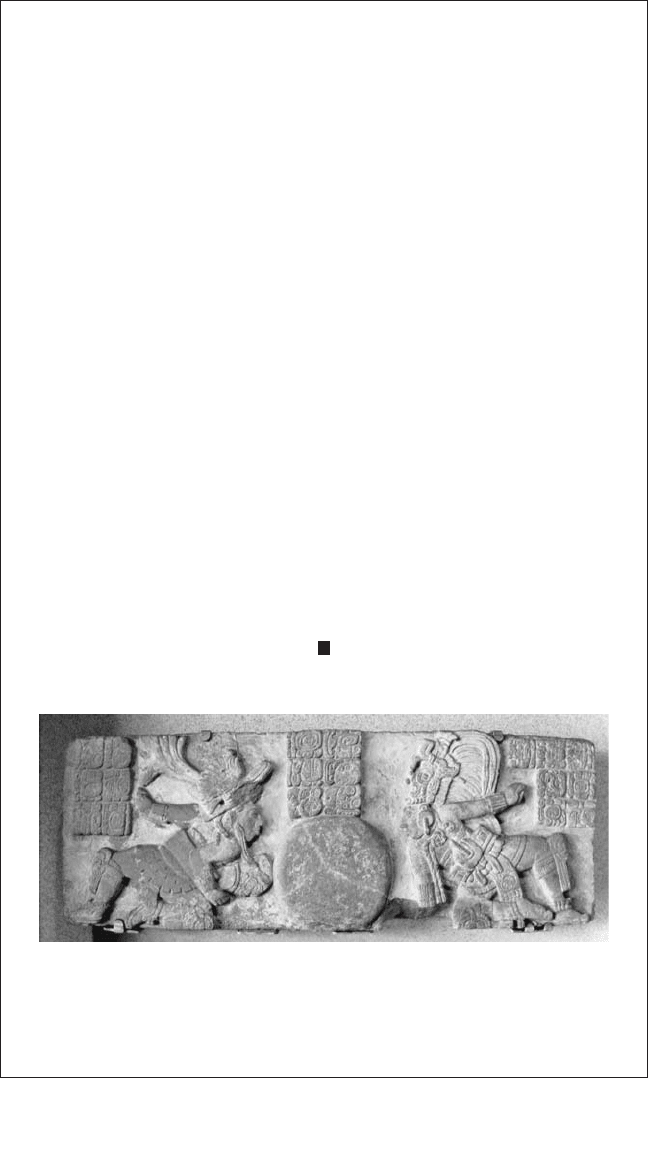
Toniná Stone Monument 171. This Late Classic Maya sculpture, now in the National
Museum of Anthropology, depicts two ballplayers with hip protectors flanking a ball.
The hieroglyphic texts name the players as King K’inich Baaknal Chaak of Toniná (on
the left) and King Yuknon Took’ K’awiil of Calakmul and suggest the sculpture dates to
O
c
tober 30, 727.
(Courtesy Erik Boot)
17
The competitive games played today, however, have none of the cos-
mic significance the ancient Americans attached to ball games. Most of
the great pre-Columbian cities had stone ball courts in their very
center next to the most sacrosanct buildings. In the Aztec origin
myth, the patron god Huitzilopochtli (weet-zee-loh-POACH-tlee)
slays the forces of night in a ball court. The Maya story of creation
as told in the Popol Vuh involved ballplaying hero twins who, through
self-sacrifice and cleverness, defeated the gods of evil and prepared
the world for the birth of the Sun, the dawning of the ancients’ uni-
verse. When rulers took the throne in the seventh century c.e. at
the beautiful Maya city of Palenque, they assumed the title of “ball-
player,” just like the hero twin gods they were believed to embody.
And when the game was played, creation was reenacted: decapita-
tion of the losers paralleled the sacrifice of the creator gods in the
Underworld ball game; the arching ball signified the movement of the
Sun. The game had agricultural significance, too: Central Mexican
kings were said to play the rain god for bountiful crops. Momentous
matters of state—alliances, border disputes, and ruler legitimization
rituals—were decided on the sacred ball court.
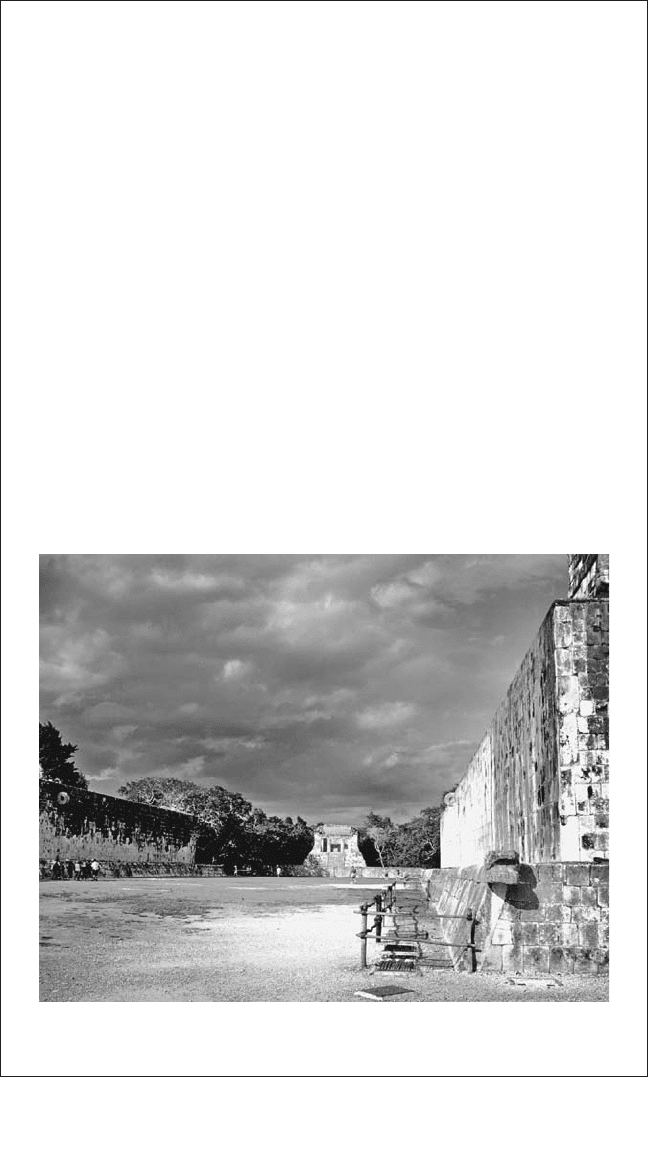
The Great Ball Court at the Maya city of Chichén Itzá. The scoring ring is visible on
the right wall.
(Courtesy Peter Selverstone)