
Foster L.V. A Brief History of Mexico
Подождите немного. Документ загружается.


A BRIEF HISTORY OF MEXICO
38
survived from this time. The conquistadores left eyewitness accounts
of the peoples they conquered, and after the conquest, the Catholic fri-
ars recorded many of the myths and oral histories of the peoples they
converted, such as the Yucatec and highland Guatemalan Maya, the
Mixtecs of Oaxaca, and the Nahuatl-speaking groups of central Mexico,
especially the Aztecs. Ironically, this phase is often poorly known
archaeologically because the Spaniards usually built over the cities they
conquered, including the Aztec capital at Tenochtitlán, which now lies
beneath modern Mexico City.
Preceding the final phase of Mesoamerica, there was a decided
shifting of power and movement of peoples throughout the Mexican
region. From the collapse of the Classic period cultures rose new cities
in Veracruz (El Tajín), northern Yucatán (Chichén Itzá), the northern
basin of Mexico (Tula), as well as other areas. The inhabitants of these
cities borrowed from both their Maya and Teotihuacán predecessors to
create a more eclectic, more pan-Mesoamerican art style: they carved
hieroglyphs on stone monuments, but only short texts; their art was
naturalistic like that of the Maya, but stylistically was more sharp-edged
and rectilinear like that of Teotihuacán. Their political and religious
cults placed special emphasis on the ball game; and their ball-court
art elaborately depicted human sacrifice and was associated with skull
racks. They created a trade route more expansive than that of even the
Classic period, and searched far and wide for turquoise and gold and
cacao beans, which were used for money as well as chocolate. The Aztec
would build on the foundation laid by these earlier cultures.
By 1200
c.e., most of the Early Postclassic cities were either aban-
doned or greatly diminished in power. The Aztecs moved into the
cultural void that ensued—they may even have had something to do
with the collapse. According to their origin myths, they were nomadic
barbarians at this time and only ended their migrations from the north
a century later when they settled in the central Valley of Mexico and
received the veneer of civilization by marrying into more noble groups.
The Aztecs’ historic myths indicate that in 1345 their nomadic
ancestors witnessed an eagle devouring a serpent (a symbol borrowed
for the Mexican flag); the sign, according to their patron deity, meant
their wanderings had ended, their promised land had finally been
reached. Archaeologists, however, believe the Aztecs settled on an iso-
lated island on Lake Texcoco much earlier, forced there by other groups
in the central valley.
It would take the Aztecs more than a century before they even
achieved independence as a city-state. In the meantime they expanded
39
their island by heaping mud from the lake bottom on rafts; plants
anchored their roots to the mud, and the landfill became rich farmland.
Through considerable engineering ingenuity, they built dikes to control
flooding and aqueducts to carry freshwater. In the exact center of this
five-square-mile artificial island was the Templo Mayor (Great Temple),
the double-temple pyramid to Tlaloc, the rain god, and Huitzilopochtli,
the Aztec sun god of war. Slightly askew from true north, the great
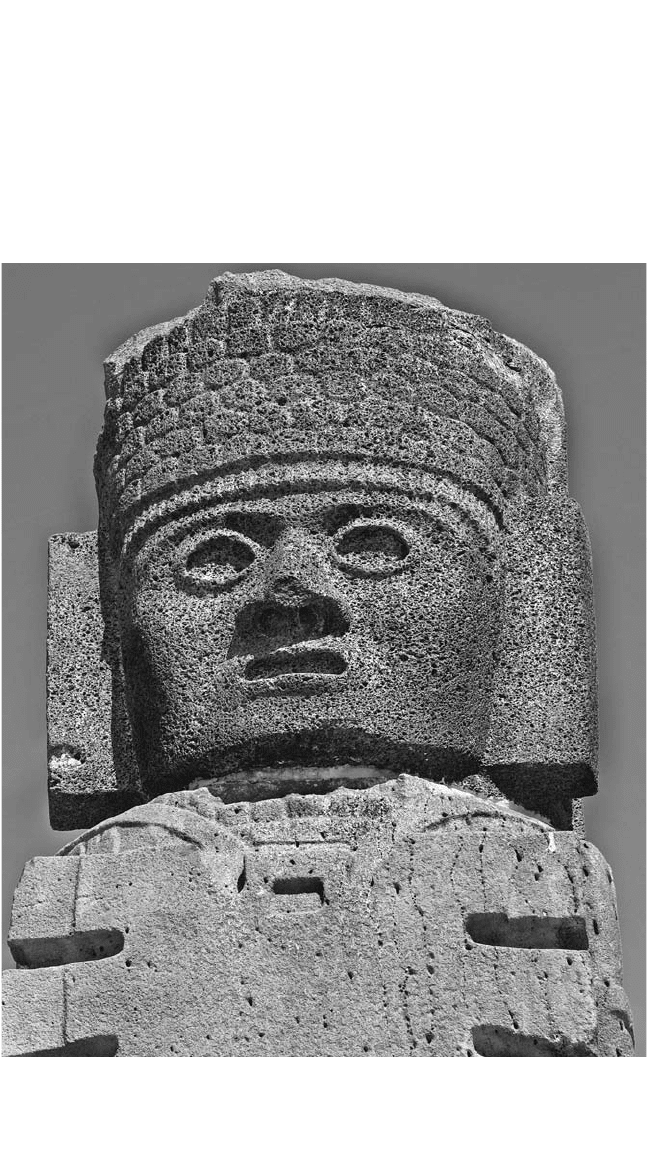
Warrior column (15 feet in height) from the Postclassic city of Tula in central Mexico
(Colman Lerner Gerardo)
DIVERSITY OF MESOAMERICAN CIVILIZATION
A BRIEF HISTORY OF MEXICO
40
temple was instead aligned with sacred mountains on the mainland and
astronomically aligned with the rising Sun at equinox. From this holy
center four avenues divided the city into Mesoamerican divine order.
Despite their humble beginnings, the Aztecs flourished and evolved
into a highly complex state based on rigid class distinctions—
commoners were severely punished for emulating noble dress, for
example—and ruled by a divine king. They created and built
Tenochtitlán, the center of a 19-island lake kingdom, crisscrossed by
canals and reached from the mainland by three monumental cause-
ways. From their islands, the Aztecs forced a triple alliance with their
most powerful neighbors and imposed tribute, not just trade, on
conquered regions as far away as Guatemala. Their commerce was so
great that some estimate nearly 100,000 canoes trafficked the lake and
canals. Eventually, the kingdom of the eagle and serpent became the
capital of Mesoamerica’s strongest empire.
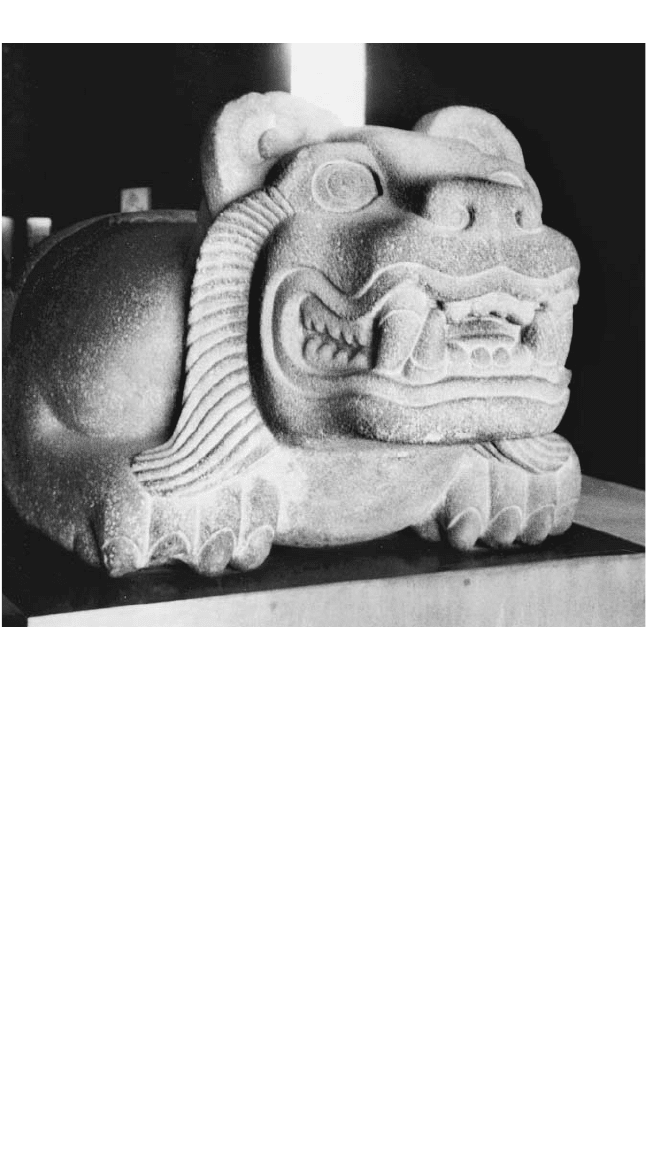
Aztec stone sculpture of a jaguar (National Museum of Anthropology, Mexico City)

41
As archaeologists now know, the Aztecs were not the first militant
culture in Mesoamerica. Nor did they introduce personal bloodlet-
ting and human sacrifice to the pre-Columbian world. Rather, they
incorporated the religious practices of the cultures that had preceded
them—perhaps embellishing them in the process—in order to appease
their gods (and, probably, intimidate their enemies). Ritual wars, called
“flowery wars,” were imposed on their Tlaxcalan neighbors so the
Aztecs could capture sacrificial victims—certainly a gruesome practice
and a grim worldview, but one not unique to the Aztecs.
Aztec art was interregional, particularly so because artists were
brought to Tenochtitlán from all other parts of Mesoamerica, espe-
cially from Oaxaca and Veracruz. Aztecs sculpted in a rectilinear and
often fearsome style that also could be exceptionally realistic, whether
depicting nature or human sacrifice (
see page 20). They produced
NezahualcÓyotl: Poet King
O
ut of the native histories compiled by the early Franciscan friars
emerges a portrait of a king who could rival Lorenzo the
Magnificent of Renaissance Florence in his learning and support for the
arts. Almost 50 years before the Spanish, Nezahualcóyotl (nay-zah-
wahl-KOH-yohtl; meaning Hungry Coyote) ruled Texcoco, part of
the Aztec Triple Alliance. He codified Aztec law, studied astronomy,
engineered elaborate aqueducts, and designed his garden to include
fountains and a zoo. A war captain, he battled for Aztec supremacy
while also setting aside part of his palace for poets, philosophers,
and historians to gather and teach. This most learned man was also a
poet whose name and work has been preserved for us from the pre-
Columbian world. He died in 1472, but is a culture hero in modern
Mexico, with streets and even a neighborhood named after him.
We are not here forever,
But pause only for a moment in time.
Though it be of jade it will shatter,
Though it be of gold it will break,
Though it might be of quetzal feathers it will decay.
Nothing endures for eternity on this earth,
But is here only fleetingly.
Nezahualcóyotl (Davis 1973, 117)
DIVERSITY OF MESOAMERICAN CIVILIZATION
A BRIEF HISTORY OF MEXICO
42
three-dimensional sculptures that were among the greatest artistic
works of Mesoamerica.
The Aztec empire was so powerful it rendered other regions weaker.
After the collapse of Mayapán in 1446
c.e., for example, the Yucatec
Maya no longer built grand cities of stone and plaster, but rather lived in
the older ones of their ancestors or built smaller shrine-like centers, such
as Tulum. Although never conquered by the Aztecs, these Maya seemed
diminished and peripheral to the main course of Mesoamerican events.
The Mixtecs of Oaxaca, however, flourished during the Late
Postclassic period. The longtime occupants of the mountainous
regions of Oaxaca, they had been overshadowed by both Monte Albán
and Teotihuacán in the Classic period. In the Postclassic, however, they
may very well have dominated the Zapotec area. Mixtec pictographic
codices (
see pages 76 and 77) boast of marriage alliances, probably
achieved through military conquest, with the Zapotecs; Mixtec murals
and zigzag fret designs are found on many Oaxacan valley buildings,
such as at Mitla. The Mixtec warlords demanded, and received, tribute
from the Zapotecs.
Just before the conquest, the Mixtecs were subjugated by the Aztecs
and forced to pay tribute themselves. The Aztecs left the region to itself,
however, and so failed to influence the local art style. Mixtec wealth is
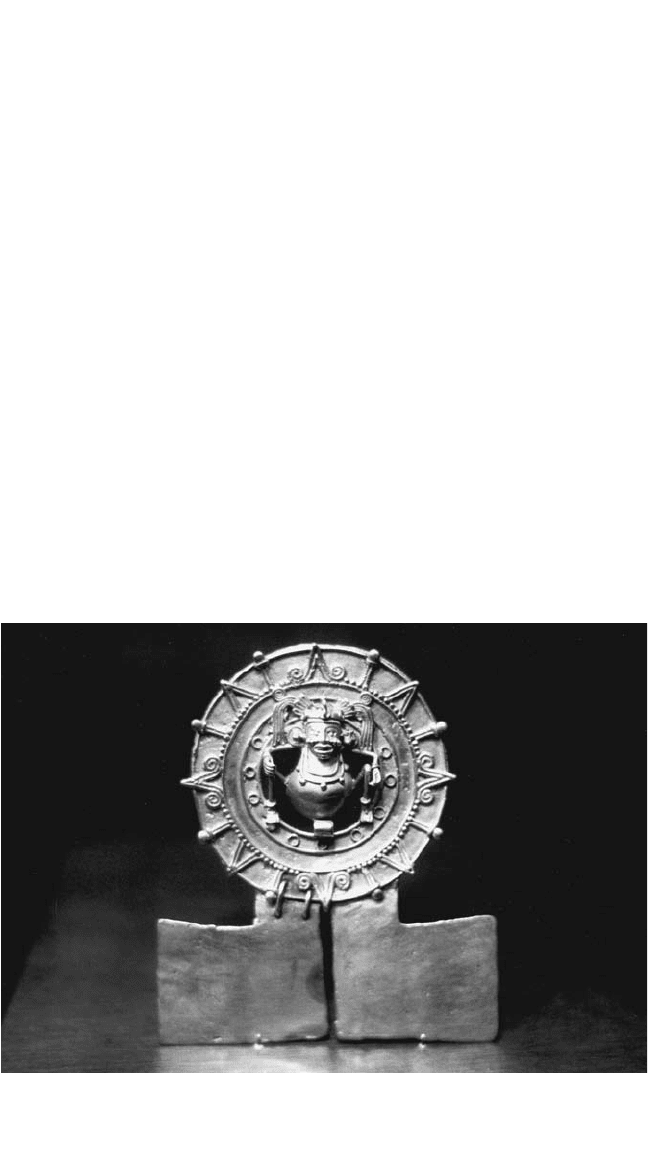
Mixtec gold pendant from a tomb in Zaachila, Oaxaca

43
reflected in the tribute paid to the Aztecs: 40 sacks of cochineal (used to
make purplish red dye), 20 bowls of gold dust, two strings of precious
green stones, 800 bundles of quetzal feathers, and thousands of bundles
of finely woven and decorated mantles and loincloths.
Mixtec polychrome pottery and exquisite gold jewelry were prized
possessions, and often were imitated throughout Mesoamerica in the
Late Postclassic period. Some of the finest examples of Mixtec jewelry
were excavated from tombs at Monte Albán, which the Mixtecs reused
when burying their own lords.
In 1519 Mesoamerica was a checkerboard of cultures, just as it
always had been. Unprecedented, however, was the Aztecs’ domina-
tion of most of the land and their onerous demands for tribute. Their
enemies soon would find an opportunity to fight back.
DIVERSITY OF MESOAMERICAN CIVILIZATION

45
3
The Age of Conquest
They came in battle array, as conquerors, and the dust rose in
whirlwinds on the roads, their spears glinted in the sun, and
their pennons fluttered like bats. They made a loud clamor as
they marched, for their coats of mail and their weapons clashed
and rattled . . . they terrified everyone who saw them
An Aztec account (translated by Miguel León-Portilla)
The greatest thing after the creation of the earth, excepting the
incarnation and death of he who created it, is the discovery of
the Indies.
Francisco López de Gómara, 16th century
O
ne of the most gripping events in world history is the Spanish
conquest of Mexico, that collision of two totally foreign civiliza-
tions, each previously unknown to the other. For Mexico, the conquest
defines the beginning of the modern mestizo nation of mixed indig-
enous and European peoples, a defining event commemorated with a
singularly Mexican twist: not one statue in the land honors the captain
of the conquistadores, Hernán Cortés, yet many recall the heroism of
Cuauhtémoc, the last Aztec emperor. For Spain, the Aztec conquest
would eventually lead to an empire strewn across the two New World
continents and 40 times its own size.
Moctezuma’s Empire
On the eve of the conquest, the Aztec emperor Moctezuma II, grandson
of an Aztec king, ruled an empire the size of modern Italy—and it was
still expanding. The capital of this realm, Tenochtitlán, with a population

A BRIEF HISTORY OF MEXICO
46
approaching 250,000, was one of the largest cities in the world. The
empire dominated central Mexico, which may have had as many as 25
million inhabitants. Spain in its entirety had less than 8 million people.
Tenochtitlán, an independent state since just 1427, had achieved
legitimacy through marriage alliances (Moctezuma had four wives)
into the older, more noble cities of central Mexico. Its expansion from
a small island city to an empire had been achieved through the Triple
Alliance with neighboring city-states and through trade, but above
all through military conquest. The Aztecs’ major concern in expand-
ing beyond Tenochtitlán and the central basin of Mexico was tribute,
tribute that included not only prestige items and wealth for the ruling
classes, but basic foodstuffs for subsistence as well.
The Aztec empire was only loosely held together. Tenochtitlán had
no large standing army to maintain the empire; it often left local,
conquered rulers in office. But it kept itself well informed: long-dis-
tance merchants were known to be state spies, and relay runners were
positioned every few miles throughout the empire for rapid commu-
nication. And the Aztecs were intimidating. Every adult male received
military training and military success was a means to social advance-
ment for both commoners and nobles. From this pool of half a million
trained citizens (the Spaniards found them sophisticated and brave in
battle), the Aztecs frequently mobilized armies of 7,000 or more. When
necessary, Aztec governors were installed in trouble spots, accompanied
by a small Aztec garrison.
During his 16 years of rule, Moctezuma put down numerous rebel-
lions and maneuvered his partners in the Triple Alliance into subordi-
nate positions. In 1515, the death of one of the rulers in the alliance
resulted in a struggle for the Texcoco throne. The loser never forgot
Moctezuma’s role in his defeat; in exile, he remained a constant threat
to Tenochtitlán. The Aztecs had many enemies, and war with remaining
independent states, such as Tlaxcala, intensified in the final years of the
empire as the Aztecs tried to gain more control and more tribute.
Aztec Omens
The last 10 years of Moctezuma’s reign were troubled by a series of
disturbing events, all taken as signs of divine displeasure. A drought
in 1505 created a severe shortage of maize. An unusual lightning bolt,
without thunder, destroyed a temple in Tenochtitlán’s sacred precinct.
In 1517, the very year the Spaniards landed briefly in Yucatán, a comet
flamed over the land and showered it with red hot sparks.

47
For Moctezuma, who was not merely a political and military leader
but also the spokesman for the gods (as for all Aztec rulers, his title
was tlatoani, or speaker), such messages from the gods required careful
translation and consultation with priestly advisers and shamans.
Tell the magicians to say what they believe: whether sickness
is going to strike, or hunger, or locusts, or storms on the lake,
or droughts . . . If war is threatening Mexico, or there will be
sudden deaths . . .
Crónica mexicana (León-Portilla 1962, 14)
One noble sage interpreted the omens as proof the empire was soon
to end in violence. Refusing to believe such an apocalyptic prophecy, the
emperor challenged the sage to a game of ball; the winner—chosen by the
gods, the Aztecs believed—would determine the truth. Moctezuma lost.
Amid such internal stresses and ill omens, the Spaniards appeared
along the Gulf coast of Moctezuma’s empire. Their arrival, like that
of Juan de Grijalva’s expedition the previous year, brought all the evil
portents to a climax.
Spain’s War Machine
Our Spaniards in sixty years of conquest have discovered,
explored, and conquered so much land . . . Blessed be God who
gave them such grace and power.
Francisco López de Gómara, 16th century
The conquistadores off the coast of Moctezuma’s empire were the prod-
uct of a country that had the greatest war machine in all of Europe. For
several centuries Spain had fought to rid itself of the Moorish infidels.
Anarchy had ruled the land until 1492, when the last Islamic outpost sur-
rendered at Granada. In recognition of the defeat of the Muslims, the pope
granted Spain’s rulers the extraordinary privilege of heading the church in
all their dominions. In the very year Christopher Columbus set sail, Spain
was unified as a Christian nation under the Catholic despots, Ferdinand
and Isabella, and soon thereafter under Holy Roman Emperor Charles V.
At the time Christopher Columbus proposed his voyage, Spain was
in an unusually strong position to consider overseas expansion. Isabella
THE AGE OF CONQUEST