
Foster L.V. A Brief History of Mexico
Подождите немного. Документ загружается.

A BRIEF HISTORY OF MEXICO
18
According to the Maya Popol Vuh, the gods continually tried to cre-
ate a more perfect world, looking for a race that could speak in order to
pray, that could remember the gods in order to be thankful. After their
previous attempts (four for the Aztecs; three for the Maya), the gods
finally created this one, the world of the true Sun and Moon, of maize
and humans.
Lifting the sky from the sea, where it had crashed in the floods, and
naming the mountains and caves and places of the land, they created the
middle world of earthlings. The world of the maize people was ordered
into four directions and centered by the world tree that reached into
the earthly Underworld with its roots and raised up to the heavens with
its branches. For all Mesoamericans this world was created through
the ultimate self-sacrifice of the gods. To create the Sun and Moon,
two Aztec gods had thrown themselves onto a raging fire; and Maya
ancestral deities had entered the Underworld where they were defeated
and decapitated in a game of hipball by the gods of death and disease.
Eternal night was banished, and the world was ordered and perfected
for humans only through the blood sacrifices of the central Mexican
god Quetzalcoatl (“feathered serpent”) and the Maya hero twins, all of
whom traveled to the Underworld to find the skulls and bones of their
ancestors in order that they could
be magically reborn in the sky.
It was from these sacrifices that
maize sprouted and the primor-
dial ancestors ground the kernels
to shape the first humans out of
cornmeal.
The creation myths provided
a metaphor for proper human
behavior. The gods had sacrificed
themselves in order to be reborn
as the Sun and Moon; so the Sun
required human sacrifice before it
would dawn again after a night in
the Underworld. The gods went
into the Underworld to defeat the
lords of death and to honor their
ancestors; so all Mesoamericans
must sacrifice in order to honor
their gods and ancestors. To keep
the people of maize from becom-
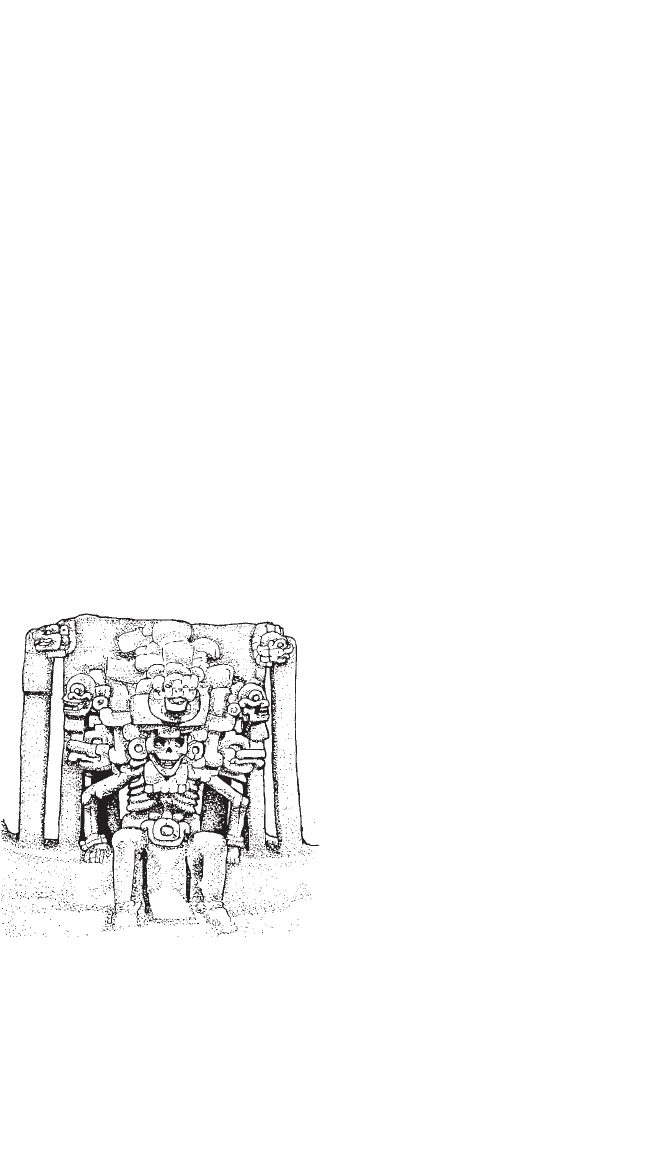
Enthroned Death God presiding over the
Underworld. This life-size terra-cotta sculp-
ture, dating from the Late Classic period, was
entombed inside a pyramid at the Veracruz
site of El Zapotal and surrounded by other
figures representing both death and rebirth.
(Drawing courtesy Cherra Wyllie)

19
ing too arrogant and believing themselves godlike, the gods invented
alcoholic pulque to blur their vision like “breath on a mirror”: Modesty
and a sense of one’s place in the cosmos were imperative.
The myths also infused the world with spiritual meaning. Nature
itself was animate and willful, the winds and rains and storms and
drought were godly expressions. The stars represented an aspect of
the gods, caves were portals to the frightening Underworld, mountains
were home to ancestral deities.
The myths justified the political order. Rulers embodied the creator
gods, their deified ancestors. They wore god emblems on their cos-
tumes and communicated with the ancestors during shamanistic trances
brought on by autosacrifice and hallucinogens. Their cities often were
constructed as cosmograms, or replicas of places of creation—pyramids
represented the sacred ancestral mountains and the place where corn
was born; the small temple interiors represented caves or entrances to
the Underworld, places where rulers communicated with the gods.
Like the Bible, the creation myths of Mesoamerica explained the gen-
esis of the world and prescribed correct social and political behavior.
Irreverence would result, not in hell, but in the destruction of the maize
world, by earthquake according to the Aztecs. Although a few late versions
of these myths have been preserved through the Spaniards’ contact with
the last Mesoamerican civilizations, older ones have recently been deci-
phered in the hieroglyphic texts of the ancient Maya. Even earlier, these
myths can be identified in the art of the Olmec, dating from three millen-
nia ago. And the myths continue to infuse the worldview of many indig-
enous peoples today: From Maya communities in highland Guatemala to
Nahuatl ones near Mexico City, ancestral mountains are still worshiped
and the skies are watched for the activities of the old gods.
Human Sacrifice
…when they sacrifice a wretched Indian they open the chest
with stone knives and hasten to tear out the palpitating heart
and blood, and offer it to their Idols, in whose name the sacrifice
is made.
Bernal Díaz del Castillo (1928, 213)
Grisly tales of human sacrifice permeated the conquistadores’ reports
to Europe. Atop the towering pyramidal platforms, in front of the most
THE FIRST PEOPLES: PRE-COLUMBIAN MEXICO

A BRIEF HISTORY OF MEXICO
20
sacred temples, priests stretched their still-living victims over sacrificial
stones and cut out their hearts. Sometimes they cut out the entrails,
too, and flayed the skin in order to make “cloaks” worn by priests in
honor of Xipe Totec, a god of spring. The remaining corpse would be
rolled down the steps of the Aztec Great Temple where the captors of
the prisoner had the right to take home various parts for a cannibalistic
corn stew.
The Spaniards reported that thousands of victims at a time were dis-
pensed in this manner. Twenty thousand war captives were sacrificed
just to dedicate the temple to the Aztec patron deity, Huitzilopochtli.
Over 100,000 skulls of victims were displayed in the sacred center. Or
so it was said.
Other early civilizations are known to have practiced human
sacrifice—even in the Bible, Abraham vows to sacrifice Isaac, and
the ancient Romans subjected gladiators and slaves to torturous
deaths simply for sport. Likewise, cannibalism has been identified as
ritual behavior in various tribes. The massive scale of ritual sacrifice
reported for the Aztecs, however, has often been considered unique
in world history.
Time-motion computer simulations have cast doubt on the actual
number of sacrificial victims reported by the conquistadores. Scholars
now emphasize that at the time of their reports, the Spaniards were
mistreating the Aztecs and had much to gain by portraying them
as despicable. Careful studies of the reports made by the first mis-
sionaries on the native religion indicate there were really not a great
number of human sacrifices performed for the annual rituals and that
cannibalism was extremely rare, more a kind of religious sacrament.
How many sacrifices were performed remains a matter of controversy.
But they were performed, and with considerable variety, depending
on the feast day.
Until recent decades, archaeologists believed the Aztecs had a bar-
baric streak that made them more bloodthirsty than their predecessors
in ancient Mexico. Now human sacrifice is recognized as a religious
practice in all Mesoamerican cultures. Exactly why their worldview
evolved to demand such behavior remains obscure, but the land itself,
with its stark seasonal contrasts of drought and rain, desiccation and
verdure, deprivation and abundance, surely reinforced any tendency to
believe that from hardship and sacrifice and death came the rebirth of
maize and life itself. Although the details of Mesoamerican resurrec-
tion cosmology are unique, human sacrifice is far from unusual in early

21
civilizations—large numbers of sacrificed individuals have been found
in ancient tombs in both Mesopotamia and China.
The Mesoamerican world was created by sacrifice of the gods, accord-
ing to native myths. For that world to continue, humans had to reenact
the original sacrifice. Nobles sacrificed their own blood, spattered and
burned it on paper and sent the smoke as food for the gods. Men per-
forated their genitals with stingray spines or obsidian in order to let
blood. Both men and women pulled ropes of thorns through their lips;
priests pricked their tongues and lips so often they barely could speak.
Commoners marched into holy wars to capture sacrificial victims, or to
become
victims
themselves. These sacrifices of Mesoamericans provide
compelling evidence of their faith. However, few willingly gave their
lives or those of their loved ones to the temple priests: most sacrificial
victims were, at the time of the Spanish conquest at least, prisoners of
war, orphans, or slaves.
Sacrifice was necessary to keep the sun on its course, to bring on the
rains, to assure order by maintaining the cycles of human existence.
The world was particularly at risk during the completion of a cycle
of time or a transition between seasons or rulerships. At such times,
human sacrifice was especially demanded: Hearts were needed to feed
Carved stone skull rack excavated from the Aztecs’ Great Temple in Mexico City
THE FIRST PEOPLES: PRE-COLUMBIAN MEXICO

A BRIEF HISTORY OF MEXICO
22
the sun and guarantee its cyclical renewal; small children were offered
to bring on the rains—the worse their cries, it was said, the more
Tlaloc, the rain god, was pleased.
For the Mesoamericans, their world could continue only by sacrifice.
Such was the unremitting fate of the New World inhabitants, a tragic
fate that infused every aspect of their lives.

23
2
Diversity of
Mesoamerican
Civilization
M
esoamerican civilization survived 2,500 years. Mesoamerican
trade goods and trade patterns changed over these many cen-
turies, as did the environmental and political setting. And with those
changes, cities achieved moments of greatness, then expired. Vast
regions sometimes were bypassed by new political and economic
arrangements, until they, too, passed away. As a result, the variety in
Mesoamerican art and architecture is extremely rich.
Archaeologists have identified these different cultural and temporal
horizons. The Preclassic period was dominated by the earliest Olmec
culture from 1200 to 400
b.c.e.; and during the Protoclassic period
from 400
b.c.e. to 250 c.e. many cities first made their appearance
throughout Mesoamerica, from the great city of Teotihuacán near
modern Mexico City to the many southern cities, such as Izapa near
the Guatemalan border, Monte Albán in Oaxaca, and the earliest Maya
sites. During the Classic period from 250 to 900
c.e. many of the
Protoclassic cities achieved their greatest heights, from Teotihuacán
and Monte Albán to Maya cities like Palenque in Chiapas and Uxmal
in Yucatán. Then, during the Early Postclassic period from 900 to 1200
c.e. many of the Classic cities were forever abandoned while others,
such as Tula in central Mexico and Chichén Itzá in Yucatán, flourished.
Finally, during the Late Postclassic period much of Mesoamerica was
dominated by the Aztecs. This last Mesoamerican horizon came to a
calamitous end with the Spanish conquest.
The contrasts in geography, not just in time, also influenced the dif-
ferent regional cultures. The art of Mesoamericans of highland central
Mexico tends toward geometric and abstracted figures, hard-cut and

A BRIEF HISTORY OF MEXICO
24
deeply shadowed sculpture (see page 40). The art is powerful and awe-
somely expressive, if often impersonal. By contrast, the lowland areas of
the Gulf coast and the Maya region concentrate far more on portraiture
(
see pages 16 and 35) and Maya art often has the soft, curved forms
and lush foliate designs of the tropical environment that surrounded
those people.
The Preclassic and the Olmec (1200–400 b.c.e.)
Not until the 1950s, when radiocarbon tests were developed to date
excavated materials, did archaeologists realize how old Mesoamerican
civilization was. Equally surprising, at least to some archaeologists, was
that the earlier dates belonged to the Olmec culture (1200–400
b.c.e.),
not to the more famous peoples of the central highlands and not to the
Maya of the southern lowlands. Some had thought the Olmec culture
might be a provincial branch of Maya civilization. Instead it was proven
older, much older.
The Olmec culture had been discovered only in the late 19th cen-
tury, when a farmer clearing his field had found a colossal basalt head
(
see page 27)—the first of 17 that would be uncovered in southeastern
Chronology of Ancient Mexico
Postclassic
Period
Classic
Period
Protoclassic
Period
Preclassic
Period
1520
c.e.-
1200-
900-
600-
250 c.e.-
100 b.c.e.-
500-
900-
1200 b.c.e.-
Central
Mexico
Aztec
Toltec
Xochicalco
Teotihuacán
Cuicuilco
Tlatilco
Oaxaca
Mixtec
Monte
Albán IV
Monte
Albán III
Monte
Albán II
Monte
Albán I
San José
Magote
Gulf
Coast
Zempoala
El
Tajín
Tres
Zapotes
La
Venta
San
Lorenzo
Chiapas
Palenque
Izapa
Yucatán
Maya
Tulum
Mayapán
Chichén Itzá
Uxmal
Edzná
Cobá
Kohunlich
Michoacán/
Mexico
West
Tarascan
Shaft
Tombs
Chupícuaro
Guerrero
Olmec
O
L
M
E
C
D
Z
I
B
I
L
C
H
A
L
T
U
N
C
H
I
A
P
A
D
E
C
O
R
Z
O
25
Veracruz, the most recent one just in 1994. These bodyless basalt heads,
found at many Olmec sites and now thought to be portraits of Olmec
rulers, are 5 to 11 feet high and weigh up to 20 tons.
By the time of their rediscovery, the largest Olmec cities of La Venta
and San Lorenzo Tenochtitlán had been abandoned for 2,500 years. No
subsequent cities had been built over them to link them with later times
and later peoples. The Aztecs, Mayas, and Zapotecs had been encountered
by Spanish conquistadores and written about by evangelizing friars, but
it was unclear if the Mixe-Zoque residents of the region were the Olmec
themselves or later settlers. Too much time had lapsed. The region, no
longer densely populated, seemed rather abandoned—and mysterious.
The first civilization arose in one of the wettest and most bountiful
regions of Mesoamerica. Many rivers, including the Coatzalcoalcos and
Papoloapan, cut through tropical rain forests and mangrove swamps on
their way to the sea. Jaguars, monkeys, crocodiles, wild turkeys, boar, and
deer thrived. Shellfish, turtles, and fish abounded in the estuaries. Heavy
rains and mists made the dry season practically unknown and allowed
crops to grow year-round. Even without cultivated crops, the region was
rich and had evolved into sedentary villages well before 1200
b.c.e. With
the introduction of maize from the highlands, it became a land of plenty,
and the villages grew into important political and religious centers.
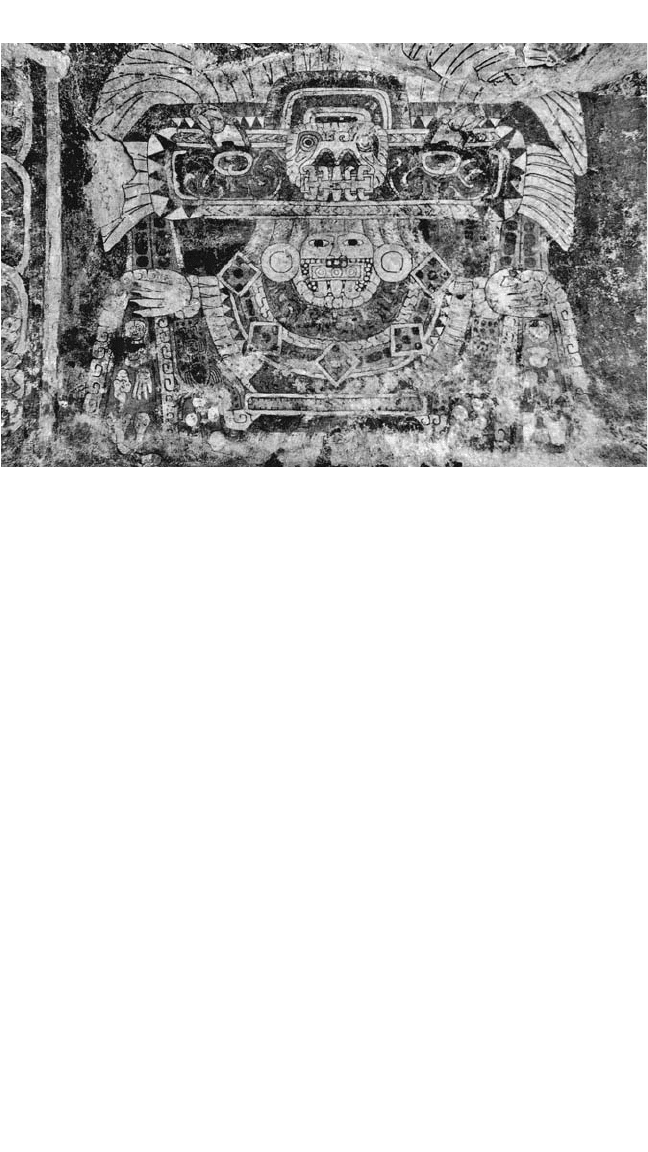
The Great Goddess, one of the three patron deities of Teotihuacán, is frequently depicted in
murals, such as this one, painted on palace walls.
DIVERSITY OF MESOAMERICAN CIVILIZATION

A BRIEF HISTORY OF MEXICO
26
With extra crops and goods, the Olmec set about spending their sur-
pluses. They traded their crops and rubber balls for central highland
obsidian to make tools and southeastern lowland green-blue jade to cre-
ate magnificently polished objects. They exchanged their magnificently
carved ornaments and worked shells for Oaxacan iron-ores in order to
make polished mirrors—mirrors known to be used later in Mesoamerica
by shamans and rulers for communicating with the gods and ancestors.
At home, the Olmecs constructed the first monumental buildings.
The buildings were earthen, not stone like later cities, but while other
areas of Mesoamerica were mere villages of wattle and daub (interwo-
ven poles plastered with clay), the Olmecs of San Lorenzo (1200–900
b.c.e.) reconstructed a natural salt mound into an immense plateau,
3,000 feet long and almost 2,000 feet wide. On top were 200 earthen
mounds for residences and ceremonial buildings and an elaborate drain-
age system connecting artificial ponds. At La Venta (900–400
b.c.e.),
the local population, numbering 18,000, constructed a great pyramid,
100 feet high. Here they buried, perhaps as offerings to the Underworld
gods, immense deity masks (16.5 × 20 feet), stone mosaics, and colored
clays, 3,022 pieces of precious polished jade and, in one burial alone,
1,000 tons of serpentine stone imported from the Pacific coast!
The Olmec built their great centers and carved their delicate bas
reliefs with the stone age kit that would persist until the Spanish con-
quest. What they undertook with such limited technology is often
astonishing. The nearest basalt to San Lorenzo was 30 miles away and
from La Venta, 80 miles. Yet vast quantities of this stone were imported
for carving colossal heads of rulers and 50-ton thrones showing their
divine descent. The stone had to be cut without metal (probably
rope-and-water abrasion assisted by drilling) and transported without
wheeled cart or pack animal. Most likely the basalt was dragged to a
river then floated on rafts to the centers. Some estimate these monu-
mental stones required crews of 1,000 people to move them.
It remains unknown why the Olmec civilization ended. Their hall-
mark art style—jade bas-reliefs of snarling jaguar-human figures (prob-
ably part of a shamanistic cult) and more portrait-like freestanding
sculptures of rulers with slanting eyes, flaring noses, and thick lips—
gradually disappeared. The monolithic sculptures were ritually muti-
lated, then carefully buried. Olmec political centers were abandoned
one by one. The power centers of Mesoamerica shifted elsewhere.
But the Olmecs left a legacy. Their trade into Honduras and across
Mexico to the Pacific coast, and the spread of their art and ideas,
geographically
defined
Mesoamerica. Olmec trade stimulated the devel-
27
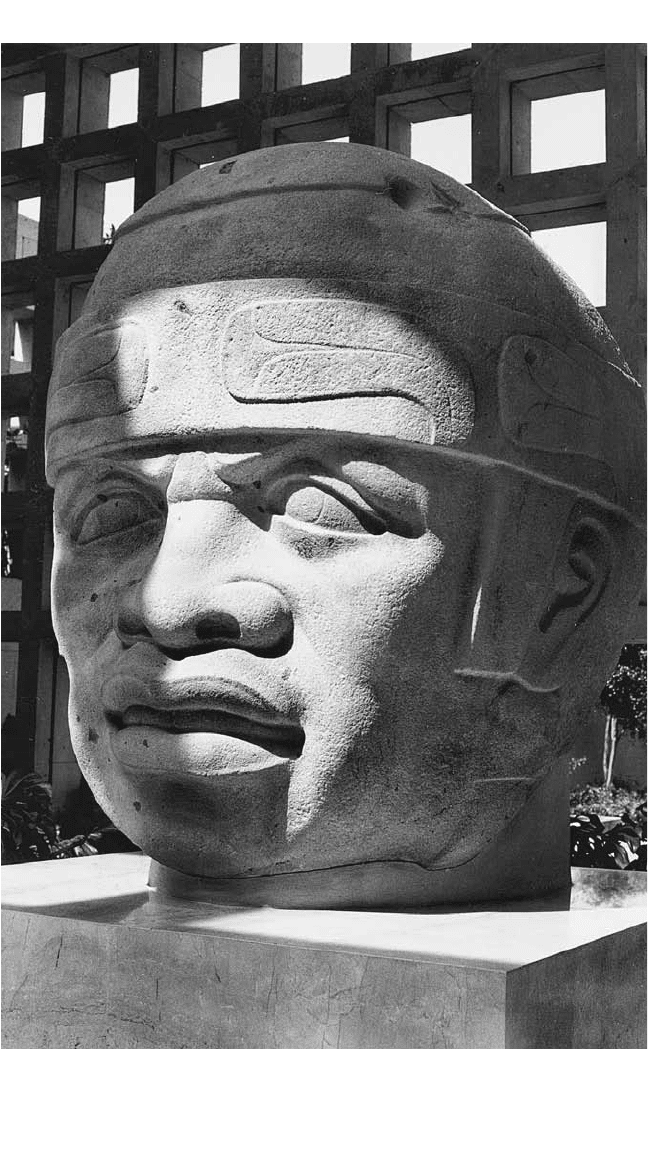
More than seven feet high, this portrait head of an Olmec ruler dates between 1200 and
900
b.c.e. (Photo: Michael Edwards)
DIVERSITY OF MESOAMERICAN CIVILIZATION