
Foster L.V. A Brief History of Mexico
Подождите немного. Документ загружается.


A BRIEF HISTORY OF MEXICO
58
charge, throwing portable bridges over the gaps in the shortest cause-
way. He made it to the mainland, but the weight of those who followed
collapsed the makeshift bridges. With the Aztecs descending on them
in the thousands, the Spaniards jumped into the lake and attempted to
swim ashore, but the gold hoarded in their pockets sunk them in the
hundreds. More than half the Spaniards and 4,000 of their Indian allies
died. Forty-six horses were killed. It is said that Hernán Cortés wept.
The Final Conquest
Cortés survived because his Indian allies steadfastly stood by him. The
Spaniards, reduced to a few hundred in number, were protected from the
Aztecs by the Tlaxcalans. By May 1521 Cortés, strengthened by 50,000
Indian allies including the Texcocans, once part of the Aztec Triple
Alliance, and buoyed by the arrival of new Spanish soldiers-of-fortune
with their horses, cannons, and heavy guns, were ready to fight again.
His strategy was to attack by ship as well as land, and his new fleet of
brigantines, constructed in the intervening months, was carried through
the mountains by 8,000 porters. Once at Texcoco by the lake, Cortés had
the ships reassembled and was ready to lay siege on Tenochtitlán.
Cortés was aided by an unusual weapon: smallpox. “The illness was
so dreadful that no one could walk or move
. . . so they starved to death
in their beds” (León-Portilla 1962, 93). Tens of thousands of Indians,
including Moctezuma’s successor, Cuitlahuac, had died from it by May.
The Aztecs under the leadership of Moctezuma’s 18-year-old nephew
Cuauhtémoc fought ferociously nonetheless. The city was deprived of
freshwater; the only food was lizards, weeds, and dirt. People chewed
leather to stay alive. Sickness was rampant, but the fighting continued
for months.
Once inside the city, Cortés offered a truce to the starving survivors
who replied they would rather die fighting. Cortés decided the only
way to victory was to destroy Tenochtitlán. Cuauhtémoc was taken
prisoner; years later he was executed by Cortés for allegedly conspiring
against him. The city fell on August 13, 1521.
These misfortunes befell us.
We witnessed them in anguish.
We lived through them with suffering.
Broken spears and torn hair lie on the road.
Houses are roofless, their walls now red with blood.
Nahuatl poem, 1528 (Garibay 1953)
59
How Did the Spanish Succeed?
The relative ease of the Spanish conquest of Moctezuma’s empire has
baffled many. The Spaniards themselves claimed they were mistaken for
the god Quetzalcoatl (feathered serpent), a god who opposed human
sacrifice and who had, in the myths, been banished by evil deities, but
who promised to return some day from the east. This captivating story
often is repeated in histories of Mexico, and the Aztecs themselves
championed it during the later colonial period as a symbol of their
eventual resurgence. Yet scholars have recently challenged this theory.
There is no such return myth for Quetzalcoatl in the accounts of Aztec
religion least tainted by contact with the Spaniards. And for the Aztecs,
as for other Mesoamericans, all gods, good or bad, required human
sacrifice to be nourished.
Why, then, was Moctezuma so indecisive when others, such as the
Yucatec Maya and even subsequent Aztec emperors, fearlessly fought,
and defeated, the conquistadores? Aztec accounts repeatedly quote the
emperor as being worried about the harm that resistance would bring
to the elderly and children “who still crawl on all fours” (León-Portilla
1962, 78). However, he clearly could not find a way to avoid war and
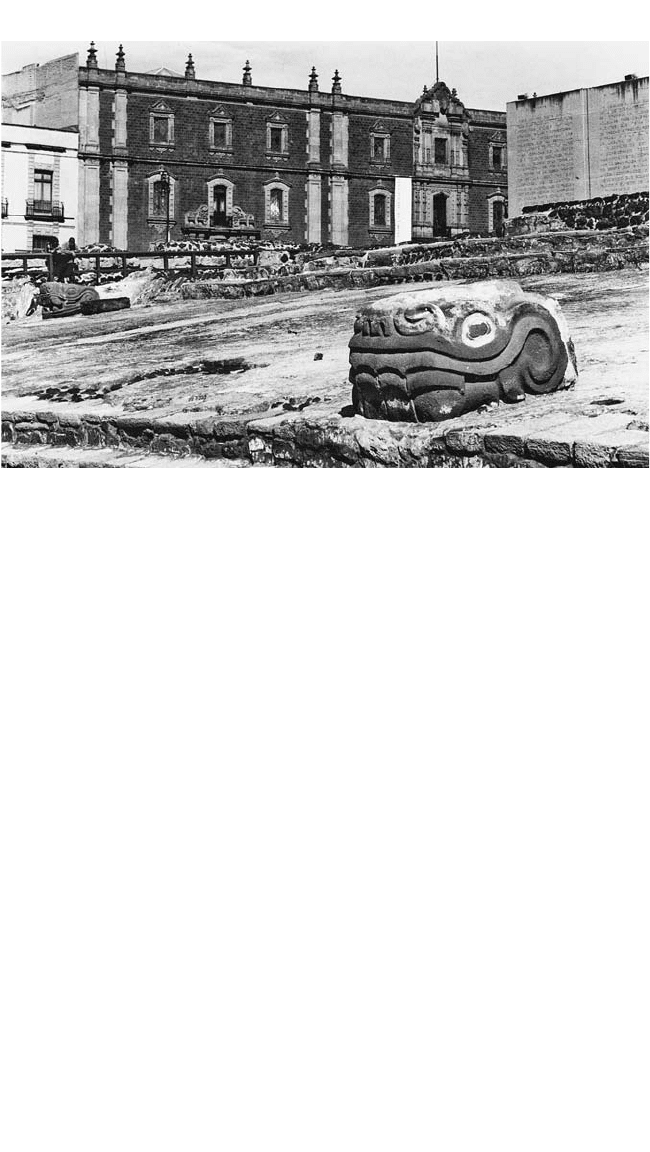
Ruins of the Aztec Great Temple complex surrounded by Spanish buildings in Mexico City. Only
when some of the colonial buildings were destroyed in the 1980s did excavations reveal their
Aztec foundations. Until then, it had been thought Tenochtitlán was totally destroyed.
THE AGE OF CONQUEST

A BRIEF HISTORY OF MEXICO
60
suffering in the heart of his empire. Perhaps he was defeated by circum-
stances, and as the Aztecs said: “He had lost his strength and spirit, and
could do nothing” (León-Portilla 1962, 36).
Another nagging question is how could so few conquistadores defeat
so many Aztecs? The more lethal weapons of the Spaniards are often
cited as the cause. European swords were made of steel, not obsidian;
moreover, the Indian obsidian blades were sharpened to wound (for
gathering captives for sacrifice), rather than to kill. The Spaniards’
guns and cannons, too, were deadly—when not misfired. Despite such
advantages, however, the Spaniards found the Mesoamericans formi-
dable adversaries once they adjusted to the European weapons. They
were nearly overwhelmed by the Tlaxcalans and were lucky to make
their alliance. The Maya sent the first conquistadores scrambling in
defeat from Yucatán. Not until the pre-Columbians divided, adding tens
of thousands of native soldiers to the ranks of the Spaniards, did the
Aztec empire suffer defeat.
Capital of New Spain
Two years after Cortés first marched on Tenochtitlán, the Aztec
world was a smoldering ruin. The victorious Spaniards built their
own capital over the ashes of Tenochtitlán. Aztec labor constructed
it. Aztec-cut stones formed the foundation. The government palace
replaced Moctezuma’s. Construction began on a cathedral next to the
Templo Mayor. The first hospital of the Americas was founded at the
spot where Cortés and Moctezuma first met. The pre-Columbian land
became New Spain. The new city was called Mexico, after Mexica, the
Aztecs’ name for themselves. In 1524 it counted only 30,000 inhabit-
ants; not until the 20th century would its population once again equal
that of Moctezuma’s capital.

61
4
The Founding of
an Empire:
Sixteenth-Century
Mexico
The country we have won is ours. . . .
Hernán Cortés, 1521 (Thomas, 543)
W
hile Cortés was conquering Tenochtitlán, no one in Spain paid
the least attention; at the moment of victory over the Aztec
capital, Cortés remained without official recognition from Charles V.
Two years had already lapsed since the conquistador had sent his let-
ter accompanied by Moctezuma’s first gifts to Spain. But the Catholic
king was too preoccupied with the Protestant Reformation and other
European crises and too mired in local turbulence and petty politics
to address the issues confronting him in the New World. The treasure
from what was called “the new land of gold” did receive notice, how-
ever, as it traveled around Europe with the royal court.
With little preparation, Spain found itself ruler of a wealthy, civilized
land many times larger than itself and far more densely populated.
Spain might conquer such a kingdom as long as it had thousands
of local allies. But how could it control and administer this empire?
Indoctrinate it with Christianity and transform it into a European
society? Yet all of this was accomplished in a matter of decades from a
continent two months away by sea.
Conquest beyond Tenochtitlán
While Spain dithered, Cortés was left to govern. Cortés normally would
not have been the king’s choice: conquistadores were just too independent
A BRIEF HISTORY OF MEXICO
62
to be trusted representatives of the Spanish bureaucracy. Because his popu-
larity made him irreplaceable, however, Cortés received his commission in
1522, nearly a year after the conquest and about the length of time it took
Charles to learn of it. Finally, the “Emperor
.-.-. wrote him a letter, thank-
ing him for the hardships he had undergone in the conquest, and for his
service to God in casting down idols” (López de Gómara 1964, 329).
Cortés might easily have empathized with the Crown’s distrust: he him-
self had trouble controlling his own soldiers-of-fortune. Their demands
for more Aztec gold were nearly mutinous, though sometimes quite
justifiable. After the royal fifth and Cortés’s bounty (some said he stashed
away three million pesos in gold), there was hardly any booty left over for
everyone else. Soldiers received only one-fifth of the cost of their horses,
and some were not paid enough to replace their ammunition. Rather than
rolling in riches after the devastation of the conquest, the victors found
that even food was in short supply. In an attempt to discover more trea-
sure, including the gold lost in the Noche Triste, the conquistadores tor-
tured and maimed Cuauhtémoc and other Indian rulers, but to no avail.
Cortés exploited the restlessness of his men to best advantage. Using
the Aztec tribute lists as a guide, he sent them off to other parts of
Moctezuma’s empire to find food and supplies and, of course, gold.

63
When resistance was encountered, as it was initially in Oaxaca,
Tlaxcalan and Aztec allies helped to settle matters quickly. A port was
built at Veracruz, and other ports were established on the Pacific coast
at places like Acapulco, in order to search for the yet-to-be-discovered
route to the Orient. And trusted captains were charged with the con-
quest of independent regions and the peoples like the Tarascans to the
northwest in Michoacán and the Maya to the south in Yucatán where
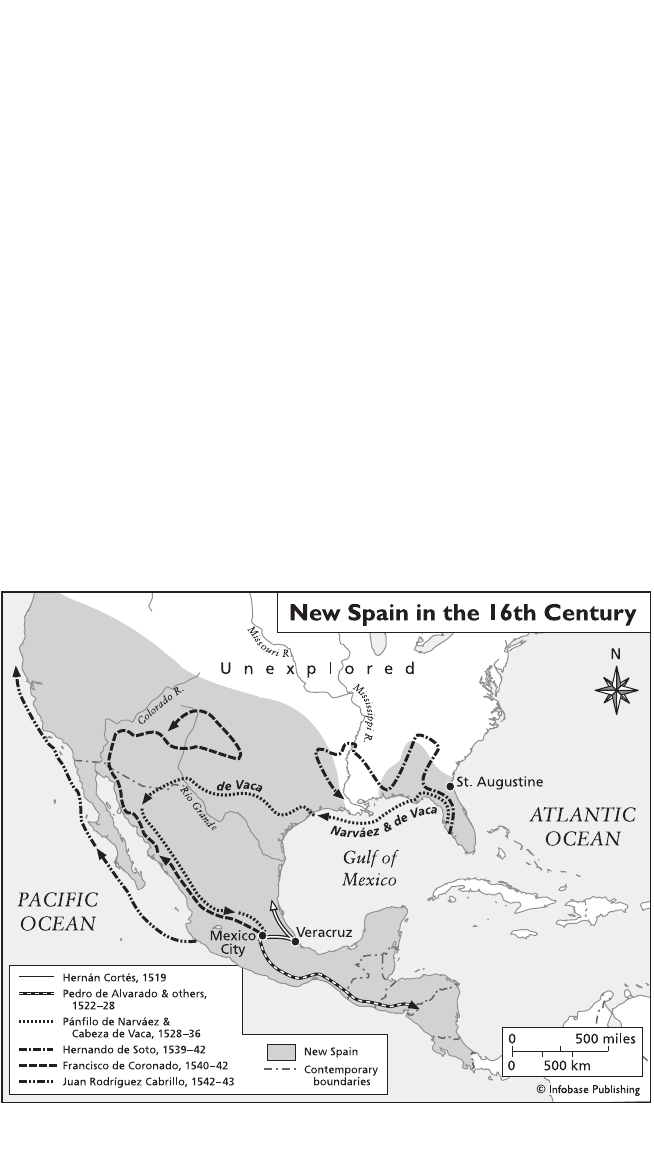
they often battled for years before succeeding. While following the trail
of the Fountain of Youth and other fantastic places, the conquistadores
and their successors made their way to farflung parts of the Americas,
such as what is now the U.S. Southwest. They crossed the Pacific Ocean
to the Philippines and, eventually, created a New Spain that was three
and a half times larger than Mexico is today.
The Mestizo Nation
13 August 1521, Tlatelolco—heroically defended by Cuauhtémoc—
fell under the power of Hernán Cortés. It was neither a triumph
or defeat; it was the painful birth of the mestizo nation that is
Mexico today.
Plaque on Aztec ruins in Mexico City
The task of settlement required a different temperament from con-
quest, yet Cortés initially proved himself able to carry it out. To create
European goods and commerce, he brought in the very first Spanish
brood stocks—cows, sows, sheep, and goats—as well as seeds and
mulberry trees for silk, vine cuttings, and sugar cane. He prevented his
men from returning to Spain with their newfound wealth and, wanting
families rather than just adventurers to settle, he advanced money to
pay the travel costs of the conquistadores’ wives. He encouraged others
to marry indigenous women, and many conquistadores did just that,
beginning the first legitimate mestizo, or mixed Spanish and Indian,
families. Moctezuma’s daughter Tecuichpo, baptized “Isabel,” outlived
her ruler-husband Cuauhtémoc as well as several Spanish captains; her
daughter with Hernán Cortés, Lenor Cortés Moctezuma, more elevated
by the powerful union of two worlds than tarnished by illegitimacy, was
just one of her mestizo offspring. Most of the conquistadores’ children,
however, did not have such a romantic ancestry. Yet they all began what
would become a most distinctive mark of Mexico: its mestizo majority.
THE FOUNDING OF AN EMPIRE: SIXTEENTH-CENTURY MEXICO

A BRIEF HISTORY OF MEXICO
64
The Encomienda
The natives of these parts . . . possess such understanding as is
sufficient for an ordinary citizen to conduct himself in a civilized
country. It seemed to me, therefore, a serious matter at this
time to compel them to serve the Spaniards . . . [yet] I have
been almost forced to deliver the chieftains and other natives of
these parts to the Spaniards in recognition of the services they
have rendered to Your Majesty . . .
Hernán Cortés, 1522 (1986, 281)
Settlement itself required economic incentives. In the New World,
the greatest inducement was gold, but the most reliable one was the
encomienda (land grants). The encomienda system, a thinly disguised
form of slavery, granted entire towns and their Indian populations to
an individual, the encomendero. Sometimes, depending on the grant,
the natives were forced to relocate onto the land. The Indians owed the
encomenderos tribute as well as free labor, and their labors usually sup-
ported the absentee Spaniards in grand style in faraway cities.
The encomenderos were supposed to Christianize and assimilate
the Indians into European culture; exploitation and abuse were more
common. With a few exceptions, the encomiendas reduced all Indians
Alcoholism
M
esoamericans fermented various juices to make mildly alcoholic
drinks. Who could imbibe alcohol (only male adults and elderly
women to warm their blood), how much (a few glasses), and when (in
ritual celebrations) were regulated in Aztec society by severe penalties.
A drunk’s head was shaved in public, his house could be sacked and torn
down. Pulque, made from an agave plant, was popular with the Spaniards,
although Aztec nobles disdained it as plebeian, preferring their chocolate.
After the conquest, when Indians died in alarming numbers, many Aztecs
thought intemperate drinking of pulque, in the Spanish manner, might
be the cause. By the end of the colonial period, Mexico City residents
consumed enough pulque in a year to average 75 gallons each. Pulque
cantinas continue to attract the poor in modern Mexico.

65
to the same level of impoverishment and cultural deprivation. In
central Mexico, where encomiendas were extensive, the price of this
forced acculturation was tragic: Indian homicide rates increased, as
did alcoholism. In the Caribbean Islands, as Cortés himself had com-
plained to the Crown, encomiendas had resulted in the annihilation of
the indigenous peoples.
Charles V, wanting to directly control his new vassals and, as vicar
of the church, wanting to protect them, outlawed the encomienda, but
not before Cortés had distributed the lands among the conquistadores.
Cortés’s professed concern over encomienda did little to restrain his
use of it. Nearly all the Indians in central Mexico had been distributed
among the conquistadores by 1522. Cortés was most generous with
himself: in addition to vast tracts of land and many great cities, he
“deposited” a million natives to his own care. It was said that nothing
could stir up the conquerors more than the size of their grants. And
nothing interfered more with Spain’s control of its provinces since
the encomendero had the right to all tribute and labor, not the Crown.
The encomienda attracted settlers; it also created conflicts—and even
Spanish rebellions—against both church and Crown when reforms
were attempted during the 16th century.
Cortés Sidelined
Cortés was presumed dead while on a daring expedition to Honduras
through uncharted territory in 1524–26. He had abandoned Mexico
City in order to regain control of Honduras from a renegade con-
quistador (much like he himself was in 1519). Attempting to fill the
political vacuum with themselves, enemies of Cortés spread rumors
that the governor had been disloyal to the Crown and had cheated the
royal treasury.
Cortés returned from the dead after almost two years away. The
upstarts were hanged, but the Crown remained suspicious. Charles
V, having wanted to place his own viceroy in Mexico for some time,
accused Cortés of misconduct. Hoping to clear his name, Cortés
returned to Spain in 1528 with an entourage of Mesoamerican nobles,
ballplayers, and dwarfs, with jaguars and armadillos, gold and silver. He
dazzled all of Spain and was elevated to the nobility and made marquis.
He was not reappointed governor of New Spain, however. One of the
wealthiest men in his time, Cortés begrudgingly retired to the periphery
of Mexican politics as Spain imposed its bureaucratic will over its New
World empire.
THE FOUNDING OF AN EMPIRE: SIXTEENTH-CENTURY MEXICO

A BRIEF HISTORY OF MEXICO
66
The Mendicant Friars Arrive
Fray Marín de Valencia, the Pope’s vicar, arrived in Mexico in the
year ’24, with twelve companions. Cortés received him with gifts,
services, and honor. Whenever he spoke to them it was with cap
in hand and one knee to the ground, while he kissed their robes
as an example to the Indians who were to be converted.
Francisco López de Gómara (1964, 331)
In keeping with the conquistadores’ creed of gold and glory but above
all God, Cortés had smashed many idols and his chaplain had baptized
numerous converts. But as Friar Motolinia, one of the first missionar-
ies, put it, the conquistadores “were content to build their houses and
seemed satisfied as long as no human sacrifice occurred in public”
(Thomas). Unlike the conquerors, the emperor could not perform his
duties halfheartedly. Charles V was granted extraordinary privileges
by the papacy to head the Catholic Church in all of Spain’s domains
because the conquest was seen as a sign of God’s favor for the emperor:
he alone was entrusted with all those souls. And Charles V proved
himself a devout monarch.
Perhaps Cortés’s most profound legacy was his recommendation to
the Crown that the mendicant orders—the Franciscans, Dominicans,
and Augustinians—be charged with the responsibility for the Indians’
salvation. These missionaries, as opposed to the secular clergy, were
educated individuals recognized for their devotion and respected for
their vows of poverty. The religious orders and monastic life sustained
them, not the charging of fees for services. Cortés believed their humble
character would speed the conversion of the Mexican people. The
emperor agreed.
The Franciscan volunteers arrived first in 1524. They quickly
impressed the native population by walking barefoot from the Gulf
coast port to Mexico City. Their simple dress and the self-inflicted suf-
fering endured on their 50-day journey could not have contrasted more
with the greed of the conquistadores. Nor could their thinking: rather
than seeking fabled cities of unimaginable wealth, many of the friars
saw the New World as an opportunity to create the monastic kingdom
of pure charity—Thomas More’s Utopia or Augustin’s City of God.
Their zeal was often fueled by the belief that Christianizing the Indians
would create these ideal societies and thus pave the way for the second
coming of Christ. The Crown, too, took its religious obligations seri-
67
ously: when the first bishop, Juan de Zumárraga, arrived in 1527, he
carried the title “Protector of the Indians.”
The Spiritual Conquest
With millions to convert, the friars counted only in the hundreds, yet
they remained undaunted in the task of spiritual conquest. They fanned
out across the country—eventually they, not soldiers, would be the
first to venture into new territories in the north in order to pacify the
native populations. (They were also the first Europeans to see the Grand
Canyon.) In Mexico they built their chapels atop pagan pyramids and
established simple living quarters amid the most ancient cities of the
Americas. Nine million people were baptized in the central region by
1537: Friar Pedro de Gante said it was not unusual to baptize 4,000 peo-
ple in a day; Father Motolinia thought he alone had baptized 300,000.
As the number of neophytes swelled, the friars needed churches, but
the size required was well beyond any immediate building capabilities. So
a uniquely New World architectural form was created: the open chapel,
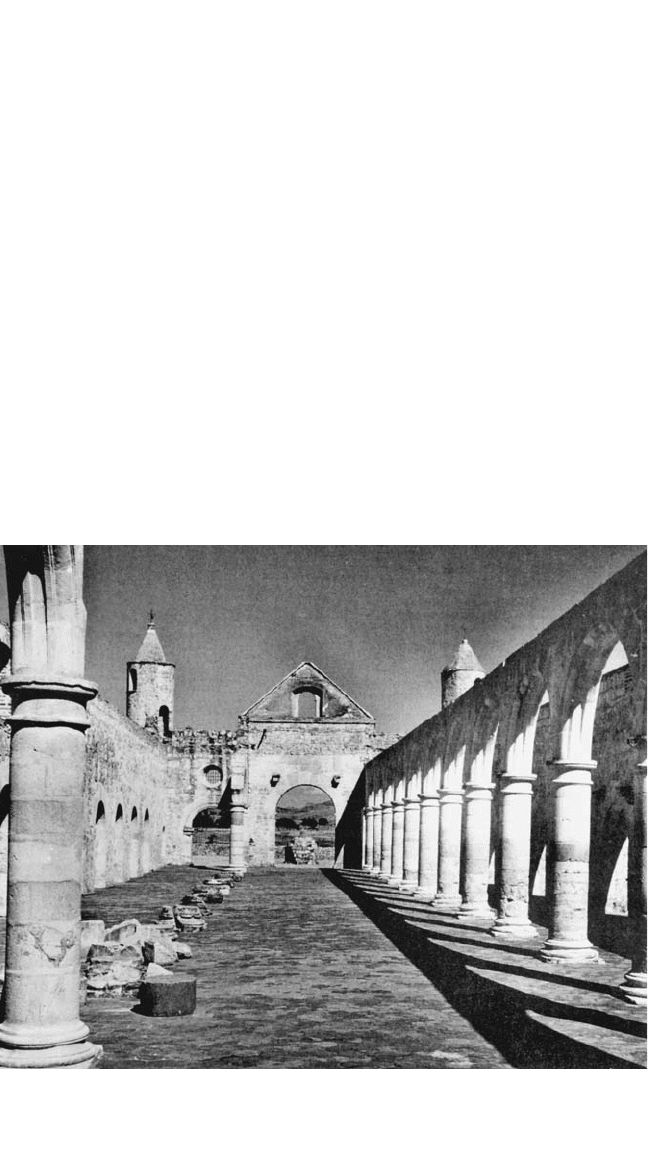
Sixteenth-century Church of Cuilapán in Oaxaca
THE FOUNDING OF AN EMPIRE: SIXTEENTH-CENTURY MEXICO