
Foster L.V. A Brief History of Mexico
Подождите немного. Документ загружается.


A BRIEF HISTORY OF MEXICO
28
opment of other emerging cultures into more complex societies. Their
religious and artistic symbols were borrowed by new elites as badges
of social prestige and authority—burial sites as far away as Honduras
have been found to contain Olmec jades and pottery. And the inherited
shamanistic power of the rulers created a rigid class structure that was
maintained even after the Spanish conquest.
As archaeologists dig deeper into the long-held secrets of the earth,
they may find other civilizations as important or more ancient than
the Olmec. Current evidence suggests, however, that it was the mother
culture of Mesoamerica. Most of the traits that characterize later pre-
Columbian societies can be identified in this earliest period of civili-
zation, from shamanism and rulership to Underworld offerings and
pyramid construction, from the rubber ball game and human sacrifice
to the feathered serpent deities and, of course, the gods of maize, rain,
earth, and fire.
Before the end of the Olmec culture, other cultures flourished
throughout Mesoamerica—calendrical dates were recorded in the
Zapotec highlands of Oaxaca, and the pyramids were built by the Maya
and central Mexicans. During the Protoclassic period (400
b.c.e.–250
c.e.) writing was carved into stone monuments; some of the earliest
examples come from the Olmec heartland. The region shifted into
second-
class status, however, with newer, more urban centers taking
control elsewhere.
The Classic Period: Teotihuacán, Monte Albán,
and Maya Cities
The Classic period was first named for those centuries when cultures
flourished throughout Mesoamerica, from the Maya and Zapotec to the
highland Mexican and Gulf coast cities. This was a period of urbaniza-
tion. And it was a period of widespread literacy; a period when the
Maya used the exact long count system of dating. There was also a great
diversity of city-states—hundreds in the Maya area alone, quite a num-
ber with populations of 50,000 to 100,000. The richness and variety in
art was never greater.
U
n
til recently it was believed these classic cultures were peace-loving,
theocratic states that engaged in neither war nor human sacrifice. Such
notions have been forever dispelled by the work of archaeologists as
recently as the 1980s. At Teotihuacán, archaeologists discovered a ritual
burial of over 200 sacrificed individuals symmetrically arranged inside
the base of the Pyramid of the Feathered Serpent; most of them, includ-
A BRIEF HISTORY OF MEXICO

29
ing the women, were outfitted as warriors. In the Maya area, archaeolo-
gists have uncovered signs of devastating warfare, and epigraphers have
translated hieroglyphs about battles between cities.
The Classic period then, was not an especially stable time. By its end,
entire cities were abandoned, and power and trade alliances had shifted to
new sites on the periphery of the classic regions—such as Chichén Itzá in
northern Yucatán, El Tajín in Veracruz, and Cacaxtla and Xochicalco on
the edges of the basin of Mexico. Some Maya regions were depopulated,
not to recover until the 20th century. The possible causes of these various
collapses have been the subject of considerable archaeological study.
Near the Gulf coast, cities, which may have been very large, have been
rediscovered in the 1990s. At the same time, the Pacific coast is being
more closely examined for sites and cultural affiliation. Excavations
in these areas will surely change archaeologists’ understanding of
Mesoamerica. For now, it is only the better excavated and better under-
stood cities that can be described. As a sample of the diverse settings
and cultures of Mesoamerica, it is worth examining some of the most
important: Teotihuacán, the Maya, and Monte Albán.
Teotihuacán (150 b.c.e.–650 c.e.)
Once the sixth largest city in the world, the ancient city of Teotihuacán
was one of the greatest powers in the 2,500-year span of Mesoamerica.
Located near Lake Texcoco, about 30 miles from modern Mexico City,
Teotihuacán still proclaims its mighty presence with its monumental
Pyramid of the Sun and Pyramid of the Moon. It once controlled a
region about the size of Belgium: Its influence was felt in cities as far
as away as in Honduras; its trade reached to northern Mexico and the
Pacific coast. Its emissaries—warrior merchants, most likely—can still
be seen depicted in the art of foreign cities, such as the Maya site of
Tikal in Guatemala and the Zapotec city of Monte Albán.
So much prestige was invested in Teotihuacán, “the place where the
gods were made,” according to one myth, that the Aztecs venerated it at
the time of the conquest when Emperor Moctezuma made regular pil-
grimages there—900 years after Teotihuacán’s fall. The Aztecs believed
they lived in the age of the Fifth Sun, which was created when the
Sun and Moon were born at Teotihuacán. Teotihuacán’s rise to power
may have been related to just such a religious belief about its cosmic
importance. Archaeologists have discovered a sacred cave, a place
of emergence for Mesoamericans, beneath the Pyramid of the Sun;
astronomers now argue that the alignment not only of the pyramid but
DIVERSITY OF MESOAMERICAN CIVILIZATION
A BRIEF HISTORY OF MEXICO
30
of the entire city may correlate with ancient beliefs about the creation
of the Mesoamerican world.
More than religion propelled Teotihuacán into power. Located
near the highland lake where the Aztecs would eventually build their
island capital, Teotihuacán had access to fish and fowl as well as to
New World Pyramids
P
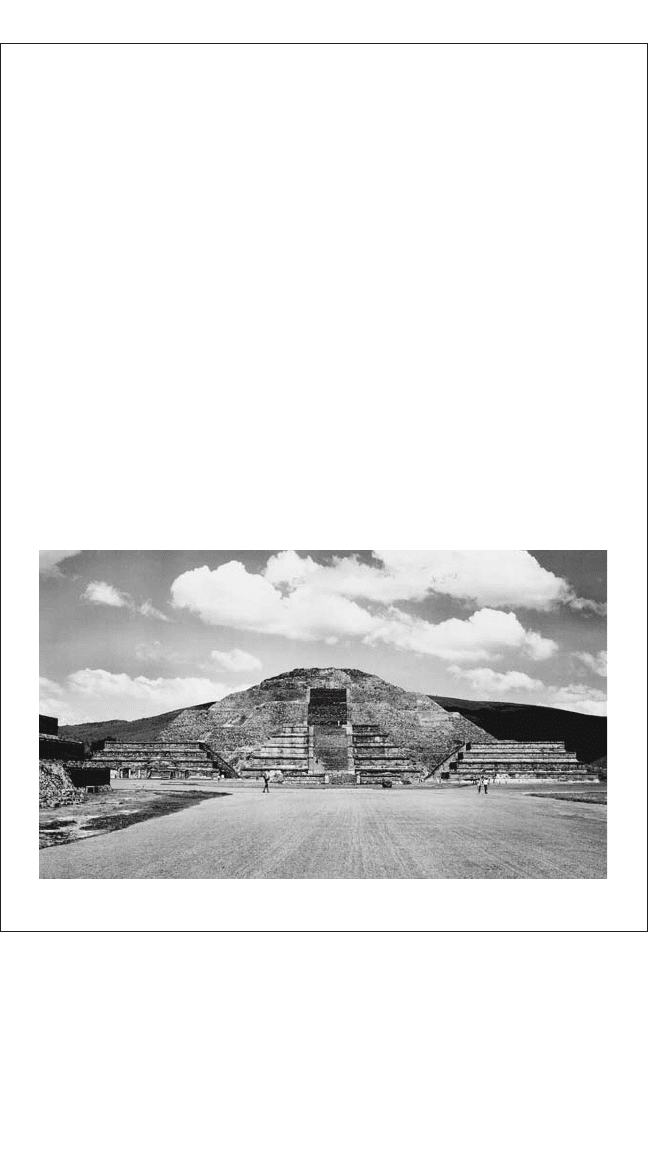
yramids in the New World, such as the Pyramid of the Moon
at Teotihuacán shown below, are unlike those in Egypt in that,
rather than coming to a peak, they are level atop, forming platforms for
temples. American pyramids often achieved their monumental propor-
tions because their builders, rather than starting from scratch, would
envelope old structures as fill. The Cholula pyramid, with a volume of
3 million meters, a base covering 46 acres, and a height of 198 feet, has
been said to be the largest preindustrial building ever erected on earth.
Yet its final bulk was achieved by various building projects over the
centuries that incorporated earlier pyramids—larger than the Pyramid
of the Moon. Like their Egyptian counterparts, however, the pyramids
sometimes contain royal tombs painted with murals and accompanied
with precious jades and, in the Postclassic period, gold ornaments.
Although many have speculated about burials inside Teotihuacán’s Sun
and Moon pyramids, the first evidence suggestive of a royal tomb in the
Pyramid of the Moon was discovered only in 2002.
Pyramid of the Moon, Teotihuacán

31
the agricultural potential of the central basin. Teotihuacanos also
controlled vast quantities of precious obsidian, the glass “iron” from
which Mesoamerican tools were made and their major item of trade.
Teotihuacanos’ wealth paid for the Pyramid of the Sun, completed by
150
c.e., and covering about the same area as the Great Pyramid in
Egypt, but with only half its height. That great effort of human con-
struction was followed by others, including the Pyramid of the Moon
and a 48-acre administrative and market complex, larger than the
Pentagon in Arlington, Virginia (34 acres).
Yet for all of Teotihuacán’s recognized greatness, its rulers remain
anonymous: nowhere in the art of the city are their portraits discov-
ered, and nowhere on the monuments and great buildings were any
writings inscribed about their achievements. Yet their presence is felt
in every element of the city’s design. A rigid grid plan prevails for over
eight square miles. No natural feature was permitted to interfere with
the layout: the San Juan River was canalized to conform to the grid as it
passed through the city. Symmetry was the aesthetic mandate, from the
composition of paintings in palaces to the urban plan for the city.
The urban plan invaded even private homes. The population—who,
based on depopulation studies of the surrounding countryside, were
probably coerced into living in the city—resided in 2,000 apartment
complexes for 60 to 100 individuals each. These complexes could vie
with modern housing projects in the uniformity of their plan: one-story,
windowless buildings with rooms constructed around interlocking,
open courtyards. These complexes included a semipublic space for
worship, especially of the city’s patron, the Great Goddess, from whose
yellow hands flowed streams of jades and shells and other symbols of
fertility and wealth (
see page 25). Of course, the elite classes lived in
grander complexes decorated with bas relief sculptures and murals.
There were warrior enclaves as well as neighborhoods of potters and
obsidian workers. Archaeologists have identified foreign neighbor-
hoods, too: residences with cultural traces from the Zapotec, Gulf
coast, and Maya regions that may have housed traders and artisans.
Many aspects of life in Teotihuacán remain mysterious. Some
Mesoamericanists wonder whether the objects in the precious stream
flowing from the Great Goddess’s fingers are in fact signs that consti-
tute a form of writing. If not, then there is no writing known from this
great city despite the fact that the Teotihuacanos were exposed to the
hieroglyphs of other Mesoamerican cultures, such as the Maya. Could
they have consciously rejected literacy? Many believe records were
kept, but on perishable bark paper rather than stone. Because there is
DIVERSITY OF MESOAMERICAN CIVILIZATION

A BRIEF HISTORY OF MEXICO
32
no written record from this period, the language, and ethnic identity,
of the Teotihuacanos is unknown.
Sometime around 650
c.e. Teotihuacán’s elite lost control. The
sacred center of the city was burned and sacked and never again
occupied. The city never recovered its farflung trade or prestige.
Archaeologists remain uncertain as to whether the populace rose
up in rebellion against oppressive ruling powers or whether other
city-states, competing for the lucrative trade of Teotihuacán, invaded
the city. What is certain is that after 800 years, Teotihuacán ended
cataclysmically.
Southern Lowland Maya (600 b.c.e.–900 c.e.)
In contrast to highland Teotihuacán, the Maya flourished in the south-
ern lowland rain forests of Mexico, Guatemala, and Belize (
see map,
page 8) where colorful bird feathers and jaguar pelts were valued trade
items. They also thrived in the northern scrub jungles of Yucatán where
cotton and salt were items of exchange as well as in the highlands of
Guatemala where obsidian was a resource. Although the Maya built
large cities, quite a number with populations from 50,000 to 100,000,
they built too many of them, perhaps, for any one to achieve the kind
of centralized control that occurred at Teotihuacán.
The aesthetic sensibilities of the southern lowlands and central
Mexican highlands could not be more different. The Maya cities were
never built to a grid plan; more often they conformed to the irregulari-
ties of the natural landscape. Their buildings were constructed with a
corbel arch (the closest Mesoamerica ever came to using the true arch),
permitting greater height. Splendid tombs of rulers and other nobility
have been found incorporated into the pyramidal platforms of temples;
some are connected to the temples by ceramic tubes, or what have been
called “psychoducts”—the Maya may have used them to communicate
with venerated ancestors. Maya art is never anonymous, but full of
portraiture, whether a ruler or ballplayer or tormented captive is the
subject (
see pages 16 and 35). Even Maya gods have faces, and many
of them are deified ancestors and former rulers.
Another major contrast with Teotihuacán is the use of writing on
stone monuments that have preserved their texts till this day. Although
archaeologists have uncovered sizable Maya cities dating back to mid-
dle Olmec times (600
b.c.e.), the earliest known Maya hieroglyphic
text with an exact long count date (
see page 15) occurs in 292 c.e.,
and the last long count date known to archaeologists is 909
c.e.:

33
These dates have been used to define the temporal limits of the Classic
period. Most of the dated Maya monuments are found in the southern
lowlands, called the Maya heartland. Here are the most famous ancient
cities of classic Maya civilization, such as Palenque in Mexico, Tikal in
Guatemala, and Copán in Honduras.
Other Mesoamerican cultures, such as the Zapotecs in Oaxaca and
the Aztecs, recorded brief hieroglyphic statements in stone; many
also had bark-paper books, but few of these survived. Pottery shards
and artifacts are all that can be pieced together to tell us about the
Olmec and Teotihuacán civilizations. The Maya, however, developed
a partially phonetic writing system and left long enough texts for
the hieroglyphic statements to be deciphered by today’s scholars. In
recent decades, epigraphers have made enormous strides in translat-
ing these hieroglyphs. They have revealed the first written history of
the Americas—a very biased history, one based on rulers’ proclama-
tions and boasts, but a brief history nonetheless of the classic period
Maya world. Archaeologists now can enhance their understanding
of the Maya with these deciphered writings. Rulers, a few of them
women, now have names. In addition to the names, a system of gov-
ernance has been revealed through the deciphered texts. The rulers’
inherited right to rule is asserted through dynastic lists; their divine
right to rule is proclaimed by associating the gods with royal ances-
tors. Political and marriage alliances are recorded, wars and noble
captives boasted about, and religious ceremonies with royal bloodlet-
ting described.
Despite the remarkable contrasts between the lowland Maya and
Teotihuacán, there was considerable contact between them. The Maya
presence is clear at Teotihuacán in one of the apartment complexes
and in trade items, such as carved jades. Teotihuacán-style build-
ings, ceramics, and obsidian are found at numerous Maya sites, and
Teotihuacán symbols were adapted by Maya rulers as part of their war
costume. Some archaeologists have argued that Teotihuacán conquered
some Maya cities or even founded them; others believe the evidence
equally supports mere trade and political alliances. Whatever influence
Teotihuacán had, there is major growth in the number and size of Maya
cities after the fall of that central Mexican state.
The collapse of Classic period Maya civilization has been one of the
great Mesoamerican mysteries. Drought, disease, and incessant warfare
have all been suggested as causes. The collapse was most likely caused
by a combination of such factors. But one additional element of the col-
lapse cannot be overlooked, that of the environment.
DIVERSITY OF MESOAMERICAN CIVILIZATION
A BRIEF HISTORY OF MEXICO
34
K’an Xul II, Maya King
T
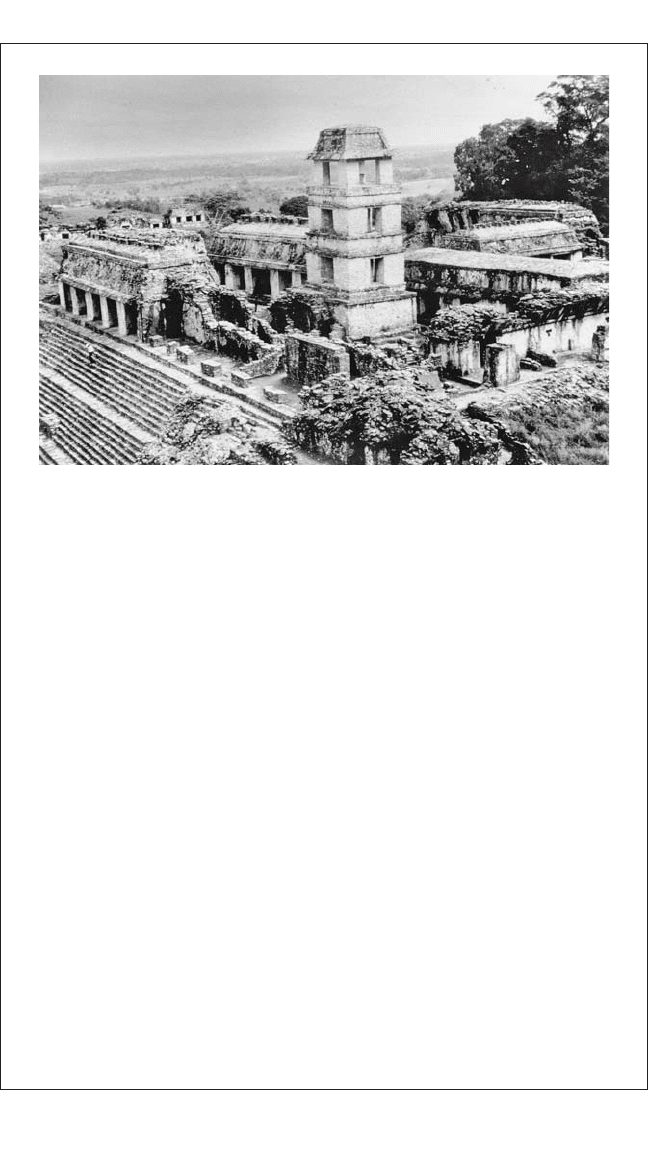
he unusual tower of the palace at the ruined Maya city of Palenque
in Chiapas, Mexico, is believed to have been built by Lord K’an Xul
who ruled the city from June 3, 702 to August 30, 711. Considerable
historical knowledge, such as K’an Xul’s name (now known to be more
accurately spelled phonetically as K’an Hok’ Chitam) and his royal lin-
eage, has resulted from rapid advances in interpreting Maya hieroglyphs.
Scholars have known for the past century how to translate the Maya
long count into our Gregorian calendar, but the rulers’ names, their
births, accession, and other events in their lives have been translated
through phonetic decipherments only in the past few decades.
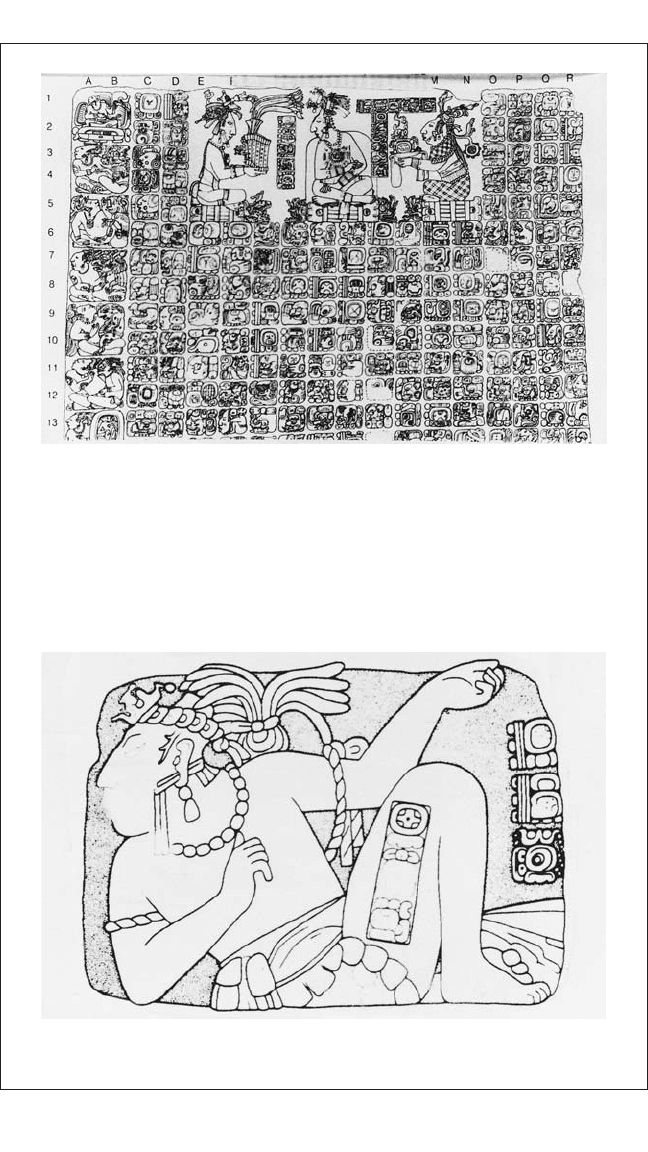
In the Palace Tablet K’an Xul sits between his deceased parents who
legitimize his right to rule Palenque from the otherworld. This scene is
part of a beautiful hieroglyphic panel that begins on the left with a long
count date after which it states the royal ancestry of K’an Xul and tells
of events before his accession to the throne of Palenque. The glyphs in
the top scene name the actors and events.
Even after many of the texts at Palenque had been deciphered, schol-
ars were not able to determine when K’an Xul died. He simply fell out
of the written history of Palenque. The discovery of the carving at the
Eighth-century c.e. palace at the Maya ruins of Palenque
35
nearby site of Toniná revealed the historical truth that Palenque scribes
had avoided telling. The scene depicts a lord, his arms bound, who has
been captured by Toniná. Identified by the hieroglyphs on his thigh, this
victim is none other than K’an Xul of Palenque. The hieroglyphs to the
right state that a war occurred on a certain date.
Toniná Monument 122 (Drawing by lan Graham, courtesy Peabody Museum,
Harvard University)
Palace Tablet, Palenque (Drawing by Merle Greene Robertson; used with permission)
DIVERSITY OF MESOAMERICAN CIVILIZATION

A BRIEF HISTORY OF MEXICO
36
The Classic period Maya radically altered their rain forest environ-
ment. Two hundred cities replaced the forest. Palaces and temples and
ball courts covered the most fertile land. More forest had to be cut for
farming, and trees were needed to burn limestone for the stucco the
Maya used to plaster their buildings both inside and out—20 trees with
all their branches, it is estimated, produce only a small 3-foot-high pile
of stucco. Still more trees had to be felled for wood-fired pottery kilns.
The result, based on pollen studies, was massive deforestation that
caused soil erosion and environmental degradation.
It is not difficult to imagine that the lowland Maya may have out-
stripped the carrying capacity of the lowlands. Some archaeologists
have argued that overpopulation and deforestation caused the collapse
of their civilization. Examination of skeletal remains at some sites sug-
gests malnutrition among the poorer classes and, in some instances,
among the elite as well. The fact that the southern lowlands were
abandoned by the end of the Classic period certainly suggests prob-
lems with the environment. The degradation of the ecosystem, even
if not the sole cause of the collapse of the lowland Maya, could have
rendered them vulnerable to other pressures, including prolonged
warfare and drought.
From 800 to 900
c.e., cities gradually stopped erecting monuments
and an increasing number were abandoned. Some were surrounded
by defensive walls. After the year 909, not a single ruler is proclaimed
anywhere in the long count calendar. The Maya continued to thrive in
northern Yucatán, parts of Belize and highland Guatemala—all regions
where they live today—but not in the southern lowlands. By the time
of the Spanish conquest, the southern lowlands had reverted to tropi-
cal rain forest, and the Classic period cities of stone, once so numer-
ous, were hidden under the jungle growth. Hernán Cortés, marching
through the region in 1525, considered it a wilderness.
Monte Albán (500 b.c.e.–750 c.e.)
The Zapotec city of Monte Albán never was large compared to
Teotihuacán—its entire ceremonial center would fit under the Pyramid of
the Sun. It was not large compared to the great cities of the Maya either.
But Monte Albán, set atop a mountain, required a herculean effort to con-
struct. First the mountain was flattened and the city laid out symmetri-
cally, but not in a Teotihuacán-style grid. Then building materials were
carried up the mountainside—without pack animals or wheeled vehicles.
Stone for columns, the first known in Mesoamerican architecture, were

37
hauled up for the construction of a colonnaded hall. And, finally, the city
of 26,000 people was continually supplied with food and water.
Located in the middle of a series of narrow valleys created by two
converging chains of the Sierra Madre, Monte Albán may have been
chosen for its central, easily defensible position. Archaeologists have
argued that a confederacy of the nobles from the valleys jointly chose
the site as their capital for ruling highland Oaxaca. Although people
continued to populate the valleys (unlike the basin surrounding
Teotihuacán), there is evidence that the elite no longer did. The only
city-state in Oaxaca with any concentration of power (unlike the Maya
region), Monte Albán dominated a vast region, at least according to the
hieroglyphic proclamations of conquest carved into its buildings.
In its earliest history, the Oaxaca valley had close cultural contacts
with the Olmecs with whom they traded magnetite for mirrors, and,
later, with the Maya to the south. Throughout the Classic period, the
Zapotec followed the Maya practices of erecting sculptures carved with
hieroglyphic texts extolling the military exploits of their rulers, and
building stone ball courts in their most sacred centers. Great tombs
were built for their rulers and the nobility, and there is evidence of
ancestor worship, just as there is in the Maya region.
But Monte Albán’s most important contact during the Classic period
was with Teotihuacán. Whether that contact was always peaceful is
unclear, given the defensive position of Monte Albán. Yet there was an
enclave of Oaxaqueños at Teotihuacán, and archaeologists have found
remnants of a Teotihuacano-style palace at Monte Albán from the Early
Classic period. The two cities certainly traded, but whether this trade
was in the form of tribute or exchange remains uncertain. Although
Monte Albán differed from the central Mexican city in its artistic pref-
erence for portraiture and its use of writing on public monuments, the
warrior dress of its rulers and the mural art of its elaborate stone tombs
shows borrowing from that great city.
Monte Albán’s power gradually eroded after the collapse of Teotihuacán.
The grand carvings dedicated to its leaders’ war victories were replaced
with less grandiose ones about marriage alliances and lineages. Numerous,
competing city-states appeared in the Oaxaca valleys. Monte Albán was
abandoned until a new group made its appearance: the Mixtecs.
Postclassic Mixtec and Aztec
The deepest understanding we have of Mesoamerican culture comes
from its final phase. A few of the codices painted on bark paper have
DIVERSITY OF MESOAMERICAN CIVILIZATION