
Foster L.V. A Brief History of Mexico
Подождите немного. Документ загружается.


A BRIEF HISTORY OF MEXICO
48
was captivated by the promise of new souls for the church as much as
Ferdinand was interested in a new trade route for exotic spices and silks
from the Orient. After so many centuries of war, the nation had a ruined
economy and little standing among European trading nations. Fighting
holy wars, however, had become a Spanish specialty. When Columbus
did discover the West Indies for the Crown, it was taken as a sign that
God had chosen Spain over all other nations to civilize the New World.
The pope concurred.
Returning to Spain with proof of his discoveries, Columbus presented
to the court six kidnapped Indians, an iguana, 40 parrots, and a pile of
gold. His announcement excited many Spaniards, who took the divine
mandate as an excuse to enrich themselves. Centuries of crusading
battles had made warriors, not merchants, out of them. Years of plunder-
ing farms and pillaging villages had done much to hurt the economy and
little to promote industriousness. Get-rich-quick dreams associated with
new lands, Indian slaves, and untapped gold mines appealed to impov-
erished aristocrats and unemployed soldiers of fortune alike.
Hernán Cortés
Hernán Cortés, unusual in his cunning and leadership, was otherwise
typical of many Spaniards who joined the ships to the New World. A
member of the bankrupt lesser aristocracy, he could make his fortune
only through the military. He learned soldiering from his father, who
had fought at Granada. At the age of 18 he was on his way to fight in
the Italian wars, but when he heard of Columbus’s discovery, he headed
for Seville instead. Delayed nearly a year by an injury from an amorous
escapade in which he fell from a window, he sailed for the New World
in 1504—along with other penniless nobles, debtors, and criminals.
On reaching the island colonies, Cortés discovered, like so many
others, how meager the prospects really were for wealth. It is said that
he initially refused the offer of land, preferring gold mining to dirtying
his hands like a peasant. Eventually he owned a sugar plantation as
well as some gold mines in Cuba, and he held minor positions in the
local government where he was well known as a convincing speaker.
He remained poor, however, spending the money he gained on finery,
entertainment, and gambling. For someone who had once proclaimed
he wanted either to dine triumphantly to trumpets or die on the scaf-
fold, colonial life must have been disappointing indeed.
There was too little gold to satisfy any of the colonists’ grand dreams.
Their own brutality, whether soldier or settler, eventually exterminated

49
the native population—the very pagans they were supposed to save,
not to mention the only available labor supply. When the Crown sent a
commission to investigate Indian abuses, it found the villages tragically
empty of natives to interview. Around this time in the early 16th cen-
tury, explorations started once again for slaves and gold, for new lands
and, perhaps, a passage to Asia, which was thought to be quite near.
Spaniards Land in Yucatán
In 1517, Hernández de Córdoba landed on the Yucatán peninsula and
reported an entirely new level of civilization; one that had not been
encountered in the previous 25 years of exploration. In Yucatán the
natives wore finely woven textiles and gold ornaments in their noses
and ears. Their cities were larger than Seville, and their homes and
temples were well constructed in stone. And they were fierce. Armed
with bows and arrows and obsidian-pointed spears and clubs, they suc-
cessfully routed Córdoba—more than a quarter of his men were killed,
the rest were wounded, and Córdoba himself suffered 30 wounds from
which he eventually died.
Excited by Córdoba’s report, Diego Velázquez, governor of Cuba, sent
his nephew, Juan de Grijalva, to learn more while he himself applied to
Spain for a license to colonize Yucatán. Grijalva sailed around the tip of
BartolomÉ de Las Casas
I
n 1516, it was reported that the Taino Indians of Hispaniola (the
island comprising the Dominican Republic and Haiti) would soon
be extinct (which came to pass), because their numbers had been
reduced to as “few as grapes after the harvest.” Such statistics on the
native death rate in the New World speak only too plainly about the
exploitation of the Indians. Yet not all Spaniards, or even Spanish policy,
condoned such brutality. No one better exemplified the struggle to
protect the Indians than Father Bartolomé de Las Casas. Himself a
colonist in Cuba, his father a companion of Columbus and a colonist of
Hispaniola, Las Casas witnessed the suffering of the Indians. In order to
protect them, he became a priest. His book, Historia de las Indias, and his
decades of tireless lobbying in Spain, eventually led to the reform laws
of 1542 governing the treatment of Indians in Mexico and all of Spain’s
New World dominions.
THE AGE OF CONQUEST

A BRIEF HISTORY OF MEXICO
50
Yucatán and continued up the Gulf coast to what is now Veracruz. On
his travels he traded glass beads and pins and needles for 20,000 pesos
in gold. At Veracruz, he heard about a great city in the interior of the
land. He did not venture to look for it, however. He claimed that his men
were tired of the year-long journey and had convinced him to turn back
to Cuba. His chaplain thought him simply too timid to attempt a con-
quest. At the very least, if Grijalva had lingered a bit longer, he would
have received the feathered headresses and gold bracelets Moctezuma
was preparing for him. Moctezuma’s messengers had kept him well
informed of the foreign presence.
The Cortés Expedition
With no prior experience commanding soldiers, much less an expedi-
tion, Cortés would nonetheless succeed where his predecessors had
failed. His gambling instincts, his audacity, his intelligence, and his
consuming desire for glory would enable him to defeat a nation of mil-
lions with soldiers numbering in the hundreds.
If Governor Velázquez had suspected the greatness of the land, he
would not have sent so few. On the other hand, if he had realized the
historic importance of the expedition, he would have appointed no
one but himself to conquer “the island” of Yucatán. In fact, Cortés’s
first challenge was to escape Cuba with his ships fully outfitted before
Velázquez could retract his commission; to do so, his men stole the
entire meat supply of the town of Santiago. And because Cortés was
authorized only to trade with, but not colonize, the new land, his
actions throughout the conquest were of questionable legality. Cortés
gambled that Spain’s new king, the Holy Roman Emperor Charles V,
would not be punitive when offered a conquered kingdom, especially if
it turned out to be a rich one.
In the year 1519, the Aztec year of One Reed, Cortés landed on the
Maya island of Cozumel. Accompanying him were 550 Europeans, 16
horses, attack dogs, and some small cannon. The conquistadores were
mostly foot soldiers and sailors, a few were crossbowmen, carpenters,
and artillery officers. There was also a chaplain and four other priests,
a doctor, a few women housekeepers, so it is said, and hundreds of
slaves (a few from Africa, the majority from Cuba). The conquistado-
res were predominantly poor, young, and Spanish—although others
joined, a few Portuguese, African freemen, and Italians among them.
All were hellbent on making their fortune in the name of God and
country.
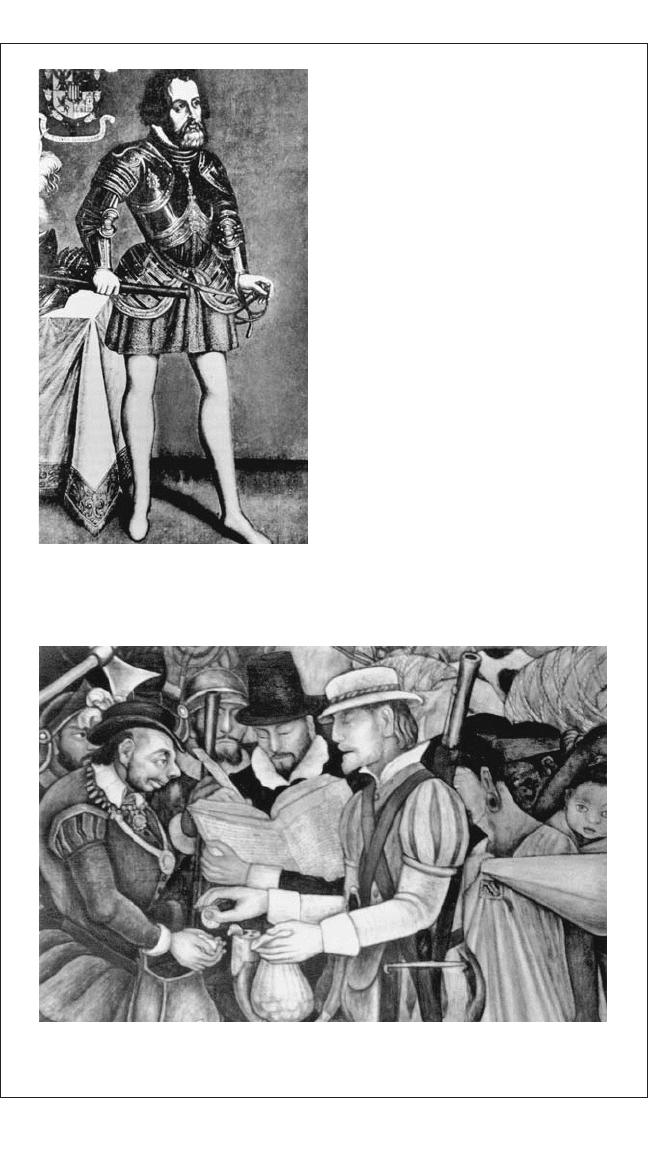
51
HernÁn
CortÉs
(1485–1547)
F
rom the bounty and honors
bestowed on him, Hernán
Cortés became one of richest
men in Spain and married into a
noble family. He was later reviled
in Mexico, however, as a sym-
bol of foreign domination. During
Mexico’s War of Independence,
his remains had to be hidden so
they wouldn’t be destroyed. Diego
Rivera’s malicious portrait of the
conquistador—a notorious wom-
anizer—as the syphilitic destroyer
of native civilization captures the
nationalistic spirit following the
Revolution of 1910.
Hernán Cortés, portrait from the
Hospital de Jesús, which he founded,
in Mexico City
Hernán Cortés (left), from a detail of Diego Rivera’s mural Mexico of Yesterday
(1945) in Mexico City’s National Palace
THE AGE OF CONQUEST

A BRIEF HISTORY OF MEXICO
52
From reports of the previous expeditions, Cortés knew that ship-
wrecked Spaniards were rumored to live on the mainland across from
Cozumel (
see “Gonzalo Guerrero,” page 5). Only one, Jerónimo de
Aguilar, responded to the messengers offering refuge with their coun-
trymen. Aguilar, by then a fluent speaker of Yucatec Mayan and a nine-
year observer of local manners, became a translator for Cortés. Then,
after a skirmish on the Gulf coast, Cortés received a peace offering that
included the slave girl, Malinalli, who was baptized “Marina” by the
conquistadores. Having grown up in a Nahuatl-speaking area of cen-
tral Mexico, but sold by her mother to a Maya cacique (chief), Marina
was bilingual. With Aguilar and Marina able to speak to each other in
Mayan, Cortés could communicate extensively with the native popula-
tions; he could flatter and threaten not only the Nahuatl-speaking Aztec
but their enemies as well.
Cortés rapidly distinguished himself from the preceding expeditions
by actually starting battles—and successfully finishing them. He often
bullied even friendly people with cannon shots and skirmishes. This
created a fearsome aura of indestructibility, especially when his small
force easily won battles against forces 10 times its size.
An astute observer, Cortés noted the native reaction to European
weaponry. Although he found the local cotton armor provided adequate
protection against obsidian-tipped arrows and spears, Cortés realized
the awesome psychological impact steel armor made on the Indians
and so continued to use it. Horses “as tall as a roof” (León-Portilla
1962, 30) and cannon with an odor that “penetrates even to the brain”
(León-Portilla 1962, 30) created understandable confusion in the ranks
of Indian soldiers: mounted horses initially were thought to be strange
centaur-like creatures, and the power of the awful cannon to rip holes
in mountains was “unnatural.” As Cortés sailed along the Gulf coast
toward the central region where Grijalva had heard so much about a
great city in the mountains, Moctezuma’s messengers carried the ter-
rible news to Tenochtitlán: “the strangers brought arms which could
shoot fire, and wild animals on leashes” (from an Aztec account, trans-
lated by León-Portilla).
Moctezuma and Cortés
Believing the conquistadores represented the fulfillment of the ill omens
reported throughout his empire, Moctezuma faltered. Instead of moving
to destroy the strangers with his armies, he sent magicians and shamans
to cast spells. When these failed, he became all the more indecisive.
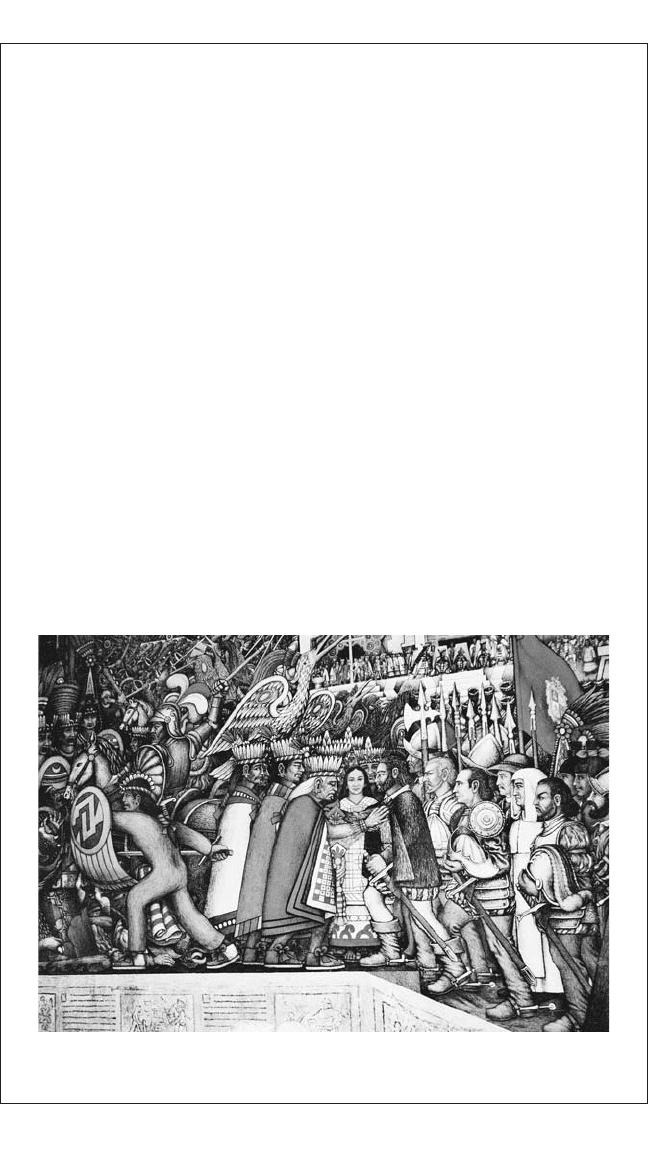
53
Women in
Mesoamerican Society
M
arina was Hernán Cortés’s translator, mistress, and loyal
companion. Without her, he could not have negotiated with
the Tlaxacalans, his allies against the Aztecs. Known as Malinche in
Mexican histories, her very name has come to mean “traitor.” Marina
bore Cortés a son, Martín, but she eventually married another conquis-
tador. About the 19 other female slaves accompanying Marina, noth-
ing is known. That Marina, along with other slaves, would be handed
over to the conquistadores as gifts leaves us with a dispiriting view of
the importance of women in ancient Mesoamerica. In pre-Columbian
society rulers are known to have had many wives and noble mistresses
and to have used such relationships to form political alliances. In just
such a symbolic gesture, Moctezuma later gave Cortés his daughter
Tecuichpo (baptized “Isabel”), with whom Cortés also had a child.
Women were not merely chattels, however. They had essential roles
in religious rituals and were integral to the economy: Textiles were a
valued trade item, for example, and women were the master weavers.
Marina’s own mother was cacique of a small town, and women are
known to have ruled Classic Maya cities, such as Palenque.
A mural by D. H. Xochitiotzin (1967–68) in the Tlaxcalan town hall pictures
Marina as central to the meeting of Tlaxcalan chiefs and Spanish invaders.
THE AGE OF CONQUEST

A BRIEF HISTORY OF MEXICO
54
Then his messengers relayed the news that Cortés, still on the coast,
wanted to meet the great ruler. Moctezuma attempted to buy more
time by sending excuses. He was too ill to travel so far. Moreover, the
Spaniards should not come to Tenochtitlán either; the 200-mile journey
was too rugged and climbed from the tropics up through deserts and
snowy passes, from Moctezuma’s friendly subjects on the coast to dan-
gerous enemy territories in the Tlaxcalan highlands.
Moctezuma sent his discouraging words tempered with gifts of
gold embellished with emeralds from Colombia and turquoise from
northern Mexico, quills of precious feathers filled with gold dust, and
yet more gold—one piece Cortés described as “a large gold wheel
with a design of monsters on it and worked all over with foliage. This
weighed 3,800 pesos de oro” (Cortés 1986, 40). Of course, this gold
dispelled any qualms the conquistadores might have had about their
venture to “Yucatán”; as the Aztecs soon learned, “they hungered like
pigs for gold.” (León-Portilla 1962, 51). These gifts, shipped to Charles
V, emboldened Cortés who included with them his first letter to the
Spanish emperor asking for his sanction.
And, trusting in God’s greatness and in the might of Your
Highness’s Royal name, I decided to go and see [Moctezuma]
wherever he might be . . . I assured Your Highness that I would
take him alive in chains or make him subject to Your Majesty’s
Royal Crown.
Hernán Cortés (1986, 50)
The March to Tenochtitlán
Before marching to Tenochtitlán, Cortés needed to attend to his enemies
within the Spanish camp. A mutiny among his own men, followers of
Governor Velázquez, was quashed and the culprits treated harshly:
Two Spaniards were executed and one had his feet cut off. In addi-
tion, agents of the Cuban governor had secretly landed near Veracruz:
Cortés captured them and incorporated an extra 60 Spanish men and
nine horses into his forces. And in his boldest act, he destroyed his
own ships to banish any thought of retreat among his men. He told the
Spaniards that one ship remained for those who wished to leave; after
noting those who showed interest in escaping, he sunk that one, too.
On August 16, 1519, leaving a contingent behind to build a fortress
in Veracruz, Cortés set out with 15 horsemen, 300 Spanish foot sol-
diers, 1,000 Indian carriers, numerous Indian hostages from among the

55
nobility of Spain’s newest allies, and an undetermined number of native
warriors. Even with local guides to show him the best route, Cortés’s
march to Tenochtitlán was plagued by lack of water and firewood, hail-
storms and bone-chilling cold, just as Moctezuma had warned. He was
attacked by indigenous peoples and nearly routed. But on the whole he
traveled with a certain degree of security. His allies on the coast were
tired of the tyrannical Aztecs who “took their children to sacrifice,” and
they encouraged him to expect that other enemies of the Aztecs would
embrace him in the interior, at Tlaxcala.
Along his route, Cortés was constantly observed by Moctezuma’s
messengers and allies. It took Cortés and his forces three months to
reach Tenochtitlán; it took Moctezuma’s messengers one and a half days
by relay runners. At each advance, Moctezuma sent more gold, more
precious feathers, more gifts, in the hope that the strangers would go
away. He offered to pay tribute to Cortés’s king, if only Cortés would
turn back. When Cortés rested in Tlaxcala with the Aztecs’ enemies,
Moctezuma urged him on to Cholula, a sacred city in his own empire
only 60 miles from the capital city.
At dawn I came upon another large town containing, according
to an inspection I made, more than twenty thousand houses.
As I took them by surprise, they rushed out unarmed, and the
women and children ran naked through the streets, and I began
to do them some harm.
Hernán Cortés (1986, 62)
Cortés marched into Cholula with his new Tlaxcalan allies. He had
the Cholulan lords and their retinue rounded up and locked in the
major temple. He ordered his men to kill them all. According to an
Aztec account, “Then the slaughter began: knife strokes, and sword
strokes, and death” (León-Portilla 1962, 40).
Three thousand were dead in two hours, said Cortés; 5,000 to 10,000,
say historians. Why Cortés committed this massacre remains unclear. He
claimed Moctezuma had set a trap for him and his actions were in self-
defense. Spanish eyewitnesses suggested Cortés wanted to make himself
fearsome before marching into Tenochtitlán. He succeeded. The news
traveled quickly to Tenochtitlán where, as the conquistador Bernal Díaz
del Castillo said, “if we had a reputation for valour before, from now on
they took us for sorcerers” (1928, 181). The people were terrified.
THE AGE OF CONQUEST

A BRIEF HISTORY OF MEXICO
56
Tenochtitlán
. . . we did not know what to say, or whether what appeared
before us was real, for on one side, on the land, there were great
cities, and in the lake ever so many more, and the lake itself was
crowded with canoes, and in the Causeway were many bridges
at intervals, and in front of us stood the great City of Mexico,
and we—we did not even number four hundred soldiers!
Bernal Díaz del Castillo (1928, 192)
The 400 Spaniards marched into Tenochtitlán with 6,000 Indian allies,
but they were still overwhelmed by the numbers of Aztecs who crowded
to see them, covering the pyramids and temples, filling the lake with
their canoes, and squeezing next to the conquistadores in the plazas.
Tenochtitlán was greater than any city the Spaniards had ever seen. It
was not simply large, it was dazzling—the Venice of the New World
with canals for streets. An island metropolis, its great causeways, 30 feet
wide, stretched miles across Lake Texcoco and bridges, wide enough for
“ten horses abreast” (Cortés 1986, 103), spanned city canals. Beautiful
gardens and the royal zoo and aviary adorned the city. The palaces were
so large that a single one could house all the Spaniards, their horses, and
attack dogs. Unlike any European city, Tenochtitlán was glistening clean,
thanks to its good drainage system and nightly garbage collection.
Cortés approached Tenochtitlán at the invitation of Moctezuma, an
invitation proffered against the objections of his advisers, who wished to
attack. But Moctezuma’s word was final. His despotic power was appar-
ent in the pearl-and-feather-covered litter that transported him to meet
Cortés, and in the retinue ritually sweeping the street where he would
stand on gold-soled sandals. Cortés was the divine ruler’s guest, yet he
was understandably wary. Once inside the city, he and his soldiers could
easily be “obliterated from all memory.” So he took Moctezuma hostage.
With Moctezuma as their protector, the conquistadores remained
peacefully in Tenochtitlán for six months. To avoid an uprising,
Moctezuma had told his people not that he was imprisoned, but rather
that he preferred to live with the Spaniards. He continued to rule and
was escorted from the palace to perform official functions. Not deceived,
the Aztec nobility became increasingly angry with the foreigners. The
Aztec treasury had been sacked by the soldiers-of-fortune who melted
down cherished art works into gold ingot—and still demanded more
gold. They also made outrageous requests regarding religious practices,

57
condemning human sacrifice and demanding that an image of the
Virgin Mary replace that of the tribal god, Huitzilopochtli. Moctezuma
warned Cortés he should leave.
Peace ended during the annual celebration in honor of the patron
war deity, Huitzilopochtli. Cortés was absent: in response to the landing
of Governor Velázquez’s troops, he was marching to Veracruz. Pedro de
Alvarado was in charge of the remaining 140 troops in Tenochtitlán.
Alvarado claimed he mistook the dances and festivities in honor of the
god as a prelude to an uprising. To forestall the Aztecs, he led his own
surprise attack on the sacred plaza, sealing off the dancers and unarmed
celebrants and slaughtering them.
“Mexicanos, come running! . . . The strangers have murdered
our warriors!” This cry was answered with a roar of grief and
anger; the people shouted and wailed and beat their palms
against their mouths. The captains assembled at once . . . Then
the battle began.
An Aztec account (León-Portilla 1962, 77)
The Noche Triste
Cortés returned to Tenochtitlán having quashed Velázquez’s attempt to
replace him in Mexico. His own forces and stables were more than dou-
bled by Velázquez’s men who were promised their share of the bounty.
The numbers would do him little good. Permitted to enter the city,
he walked into a trap. The palace had been under siege for a month.
Attacks were frequent; food, scarce; retreat, a necessity.
In a bid for time, Cortés asked Moctezuma to calm his people.
According to the Spaniards, the ruler went to the rooftop and was killed
by rocks hurled by his own people who failed to notice him. According
to the Aztecs, Cortés, no longer finding any use for the emperor, had
him stabbed to death. With Moctezuma dead, so was the calming voice
that had aided the conquistadores in the early months of the conquest.
Cortés asked for a truce and was derisively hooted down. Reported
Bernal Díaz del Castillo, “we were staring death in the face.”
On June 30, 1520, under the cover of darkness and with their horses’
hooves muffled by cloth, the Spaniards tried to escape. Known in
the histories as the Noche Triste (sad night), or the night that “greed
overcame wisdom,” the retreat was a catastrophe for them. The Aztecs
had pulled up the drawbridges in the causeways and built barricades
throughout the city to block their enemies’ escape. Cortés led the
THE AGE OF CONQUEST