
Hunefeldt C., Harris B. A Brief History of Peru
Подождите немного. Документ загружается.


cacique or caudillo (military strongman), and each of these men embod-
ied a different idea of how to govern a country that had no citizens. Some
caciques and caudillos cared only about lining their own pockets. They
usually had absolute control in their respective regions and became the
mediators between the central state and provincial societies. In a refer-
ence to the colonial era, some contemporaries jokingly commented that
a strong king (the king of Spain) had been replaced by several mock
kings. Their power was based on close networks of dependents, black-
mail, and the distribution of favors and rewards often wrung from the
state. Hacendados, powerful merchants, high bureaucrats, officials in the
military, or a combination thereof could become caciques or caudillos.
They consolidated their power throughout the 19th century in spite of
sporadic attempts to centralize power and keep caciquismo under control.
In hindsight caciques and caudillos wer
e generally pro-indigenous and
pro-nationalist local power agents who managed to hold the country
together by guaranteeing if not the ideal form of social order, at least
some kind of order in the transition from colony to republic.
Whatever their intentions or achievements, cacique/caudillo-presi-
dents faced almost insurmountable obstacles. The long, intense wars of
independence had destroyed much of Peru’s economic infrastructure.
Lima’s port city, Callao, was in ruins, and most coastal and highland
agrarian enterprises had been ravaged by foraging armies. The church,
in turn, had lost not only assets but men. Many Spanish priests left the
country, and the church’s grip on people’s lives and consciousness
diminished accordingly. Military caudillism or caciquismo held strong
under these conditions. Most historians today date the end of the first
era of caciquismo at 1872, with the election of Peru’s first civil pr
esident
Manuel Pardo.
Fiscal Issues
Aside from leadership, much of what any government can do depends
on its revenues. Between 1827 and 1845, the Peruvian state expended
between 5 million and 6 million pesos every year. At the time of inde-
pendence the main sources of state income were the taxes on internal
commerce and exports, the Indian tribute, and the state’s production
and distribution monopolies over tobacco, mercury, gunpowder, and
playing cards. In independent Peru, however, state monopolies—with
the exception of the playing cards, a negligible source of state income—
were abolished, following the new principle of nonintervention by the
state in the economic life of the country. But the new state was in des-
A BRIEF HISTORY OF PERU
114
115
THE LONG STRUGGLE FOR STABILITY
perate need of money and had to carefully restructure the income side
of its budget.
Mining remained an important economic state enterprise, albeit
much reduced in scale and productivity from colonial times. Already in
the late colonial period Peru’s silver mining axis had shifted from Potosí
to the central highlands in Cerro de Pasco and Hualgayoc (in the pre-
sent-day departments of Pasco and Cajamarca, respectively). The mer-
cury mines in Huancavelica were no longer productive, and mercury
now had to be imported from Europe. Although Cerro de Pasco had
seen the installation of the first steam engines to pump out rising water
levels in mine tunnels in order to revive faltering mines, these machines
were destroyed during the wars of independence. The mining industry
could no longer count on the strong administrative and financial sup-
port it had enjoyed during colonial times. Mine owners instead had to
depend on new market relationships to solve financial and technologi-
cal hurdles, and the market proved exceptionally fickle. Mercury prices
often doubled or quadrupled in times of scarcity. Mercury production
worldwide was controlled by one company: In 1830, Spain—heavily
indebted—transferred its mercury mines in Almadén to its creditors,
the Rothschilds, who also owned the only other mercury-producing
mines in the world, in Idria, and could thus set the price, at least until
around 1850, when mercury from California became available
(Contreras and Cueto 2000, 83).
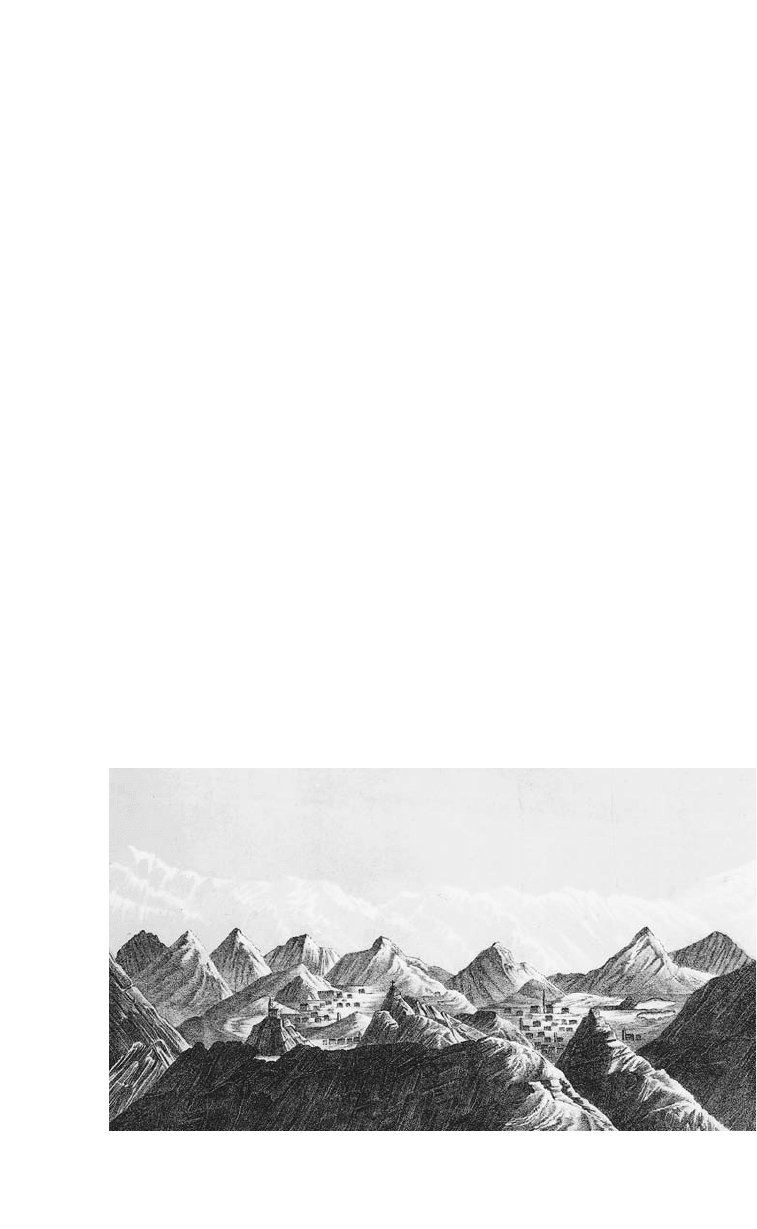
Cerro de Pasco was the name of both a mountain and a major city in the region of the central
highlands that became the center of mining activity after independence.
(Library of Congress)

Under these new market relationships mine owners also had to find
capital to finance costly mining production. In contrast to colonial
times when the state bought silver bars from mine owners and granted
credits on future production, after independence mine owners entirely
depended on merchant capital to finance their enterprises. Often mer-
chants proved to be less cooperative and reliable than the colonial state
had been. More than one mine owner came to understand that free
trade was not always beneficial. Mining, a risky venture, became riskier
during times of political unrest. Many mine owners defaulted on the
repayment of loans and after lengthy legal battles lost their mines to
lenders. Anticipated foreign investments, especially from British entre-
preneurs, failed to materialize in large measure because of inhospitable
political, social, and geographical conditions.
In spite of these problems silver was Peru’s main export product, com-
posing between 82 and 90 percent of total exports, until 1840. The sil-
ver from mining paid for the growing imports from Europe; thus, Peru
kept pace with its balance of trade by exporting silver. An unhappy
counterpart of this process was that the internal market was left with
diminished amounts of circulating money; no money was left to engage
in market transactions inside the country. Slowly, debased coins coming
from Bolivian mints replaced the strong Peruvian peso, and foreign mer-
chants became suspicious of their trade relations with Peru. The debased
coin, called the peso feble or “weak peso,” in contrast to the peso fuerte
or “strong peso,” contained on average 40 percent less silver, replaced by
less valuable metals such as copper or tin. In an economy with no paper
money
, lowering the content of silver in circulating coins was equivalent
to inflation. Prices for imported goods rose accordingly.
The internal customs, or alcabala, was abolished, but the tribute paid
by Indian peasants continued, and in fact the Indian head tax provided
the state with lar
ger sums of money than the internal customs. Both
payments were colonial leftovers that did not fit well into more liberal
and enlightened times; however, fiscal need prevailed. The rationale
behind keeping the indigenous tribute was that Indians, the majority
living in peasant communities and holding communal property in these
communities, could not be taxed on landed property and that by being
essentially self-sufficient they contributed nothing to the state through
the consumption of imported goods. Thus they had to pay a contribu-
ción única, a pseudonym for the colonial tribute.
Until around 1850 the Indian tribute (under its new name) was the
lar
gest single income source of the Peruvian state. The most lucrative
region for tribute payments was the densely populated southern high-
A BRIEF HISTORY OF PERU
116

lands (Cuzco and Puno). The central highlands ( Junín) paid an inter-
mediate amount, and the coastal areas (Lima and Trujillo) provided rel-
atively low amounts. Cuzco and Puno were where the largest numbers
of indigenous peoples lived.
Tribute payments were temporarily abolished between 1854 and
1876, during the guano boom, but were restored between 1876 and
1895, when they were reintroduced in the form of a salt tax by
President Nicolás de Piérola. The salt tax affected the same people who
had been paying tributes before.
Another targeted population as a source of income were castas, or
nonindigenous people fr
om varied racial backgrounds. During the early
19th century the colonial state under Viceroy José Abascal had tried to
impose a tribute on castas, aiming especially at the growing mestizo
population. After independence the government launched a series of
census pr
ojects in 1827, 1836, and 1850 primarily to attempt to
account for the overall population growth but also to count potential
non-Indian tribute payers. In spite of such efforts the contributions
obtained from non-Indians were very limited and subject to continued
questioning from non-Indians and local bureaucrats alike.
Thus, the revenues the early republican state depended on mainly
came from departments with a high concentration of indigenous popu-
lations. The population count in 1827 showed that the southern high-
lands (comprising present-day departments of Ayacucho, Huancavelica,
Cuzco, Apurímac, Puno, Arequipa, Moquegua, Tacna, and Tarapacá)
had 52 percent of Peru’s population and the central highlands (Lima,
Ica, Junín, Pasco, Huánuco, and Ancash) had 28 percent. The northern
region (La Libertad, Lambayeque, Cajamarca, Piura, Tumbes, and
Amazonas), with 22 percent of Peru’s population in 1827, had many
haciendas and plantations, but very few Indian peasants. Regional
development patterns over the following decades were closely con-
nected to this regional population distribution.
Under newly independent Peru and its prevailing free-market ideol-
ogy, a reduction of import taxes should have been expected. But as was
the case with the abolition of the Indian tribute, lowering import taxes
would have resulted in insufficient revenue for the state. The first open-
ing of the international market came in 1821, in the wake of the pro-
tectorate of general José de San Martín. The import tariffs were lowered
to 20 percent of the imported goods’ declared value. Few imports were
barred, and many imported items especially from Great Britain flooded
Peru’s market, soon saturating the market—in contrast to expectations.
In response, in 1826, the Peruvian government increased taxes—to
117
THE LONG STRUGGLE FOR STABILITY
A BRIEF HISTORY OF PERU
118
rates of up to 80 percent—on imported goods that competed with local
production, such as oils and lard, hides, furniture, clothes, tobacco,
candles, and spirits. In spite of increased taxes the revenues obtained
from customs diminished. Such early experiences led to heated debates
on overall economic development strategies. Was the way to success to
open Peru to the international market, as Great Britain had done? Or,
did the nascent industry need—as the United States had decided—
some protection from external competition to gain time to consolidate?
Neither of these economic theories was translated into reality.
Policies governing customs oscillated widely, to the point where unpre-
dictability actually became an efficient form of protectionism. Post-
independence Peru was divided along geographical lines into two
camps on customs issues: a protectionist-minded north (including
Lima) that was heavily engaged in trade with Chile, and a free
trade–minded south that advocated an integration with Bolivia and
increasing interaction with British merchants, who were buying locally
produced wool, saltpeter, and bark. However, not all economic actors
in southern Peru agreed to the free-market policies. Former obraje own-
ers in Cuzco had been completely ruined by the opening of trade with
Britain, and Cuzco had lost its dominant economic position to
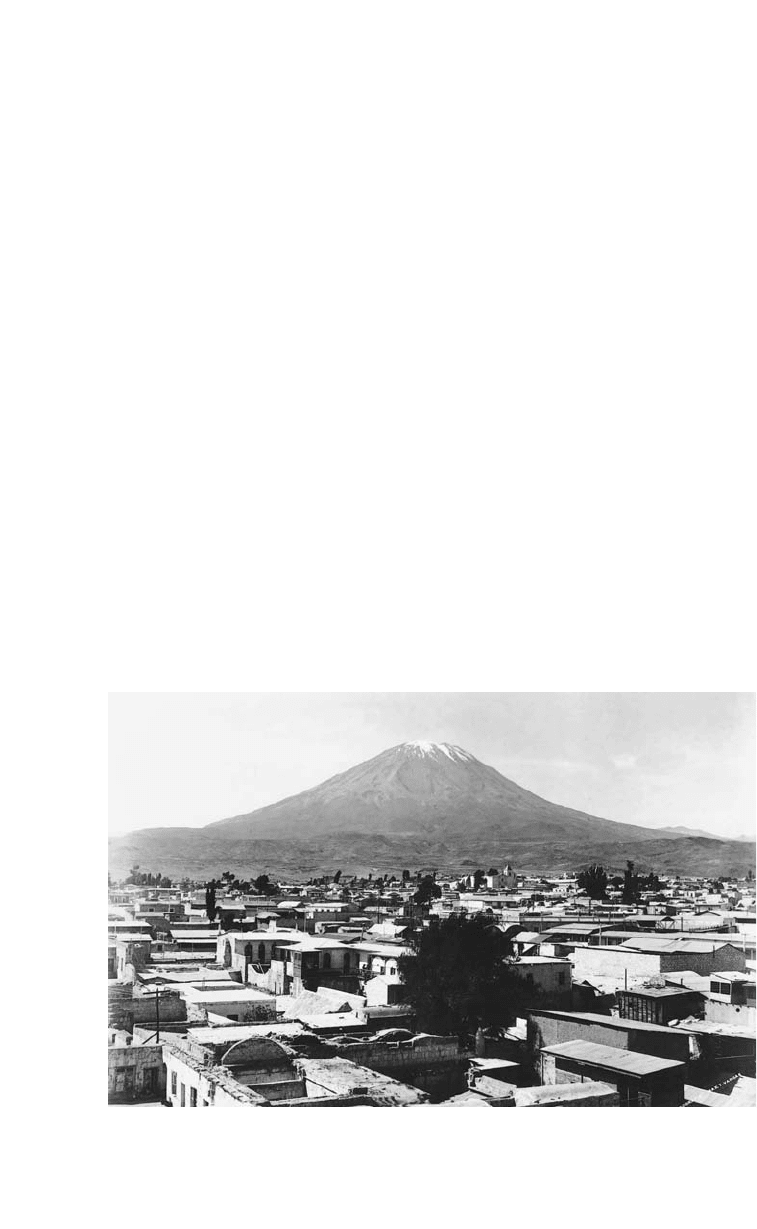
In post-independence Peru, Arequipa, shown here in a later photograph, became the center for
British merchants who traded in raw materials from the southern region. It was also the center
of several separatist movements to break away from Peru.
(Library of Congress)

Arequipa, a city where most British merchant houses had their head-
quarters. Unable to impose a nationwide answer to the protectionism
versus free trade debate, Peru’s south instead adopted separatism and
between 1836 and 1839 tried to establish the Peruvian-Bolivian
Confederation under the guidance of General Andrés de Santa Cruz, a
former independence fighter and then president of Bolivia.
National Identity and National Borders
After their successful revolutions, it was crucial that the newly inde-
pendent Latin American republics establish national boundaries and
their separate territoriality. The new boundaries would determine
issues of military defense and commercial policies, and they would
begin to determine the nature of continuing national interests. The
19th century witnessed many twists and turns that led to the boundary
configuration of present-day South America.
Peru fought regularly throughout the 19th century: war with
Colombia in 1829; war with Bolivia between 1829 and 1834; campaigns
against Chile between 1835 and 1842; skirmishes with Ecuador in
1860; war with Spain in 1866; and a prolonged war (War of the Pacific)
with Chile from 1879 to 1884. These conflicts were part and parcel of
the process of constructing a national identity in a country that had
never thought of itself as a distinct entity. With the exception of the
skirmishes with Ecuador and the maritime battles with Spain, Peru lost
all of these conflicts, and with each military loss came the loss of terri-
tory. The construction of a national identity had territorial costs and,
maybe even more important, psychological costs in terms of national
pride and consciousness.
One important episode in this sequence of wars was the attempt to
create the Peruvian-Bolivian Confederation. Had it been successful, this
effort would have led to the establishment of a new country, integrating
present-day Bolivia and the southern Peruvian departments. At issue
was international trade—free trade versus protectionism—but the real
issues were obscured by a merry-go-round of shifting alliances and
changing presidents.
When General Simón Bolívar left Peru in 1827, the Peruvian congress
selected as president one of his closest collaborators, Ecuadorean gen-
eral José de La Mar, to replace Andrés de Santa Cruz, who had served in
the interim. The new president briefly invaded Bolivia, forcing Bolívar’s
former lieutenant and Bolivian president General Antonio José de Sucre
to flee after the Bolivian troops declined to fight the Peruvian invaders.
119
THE LONG STRUGGLE FOR STABILITY

La Mar then marched north into Gran Colombia, the southern region of
the composite nation presided over by Bolívar, and seized the city of
Guayaquil. However, La Mar and his army were defeated by Colombian
troops in the battle of Portete de Tarqui in 1829, and consequently Peru
lost Guayaquil. (The borders between Ecuador and Peru were not
clearly delineated until well into the 20th century and are still subject to
occasional border skirmishes.)
Following his defeat, La Mar was ousted from the Peruvian presi-
dency by the Cuzco-born general Agustín Gamarra, who had reached an
agreement with General Santa Cruz and General Antonin de la Fuente.
Gamarra became president of Peru, with La Fuente as vice president,
and Santa Cruz took over the presidency of Bolivia. When Gamarra
reached the end of his term in 1833, one of his supporters, Luis José
Orbegoso, was appointed to succeed him. Whereas Gamarra had sup-
ported protectionist measures in an attempt to safeguard Cuzco’s obra-
jes, Orbegoso implemented free trade. This change in economic policy
deepened the existing antagonism between the pr
otectionist northern
coastal plantation owners and the free trade–minded south. A pro-
Gamarra faction deposed Orbegoso, who was then restored briefly to the
presidency after a short, bitter civil war. The situation became even more
complex when the caudillo Felipe de Salaverry became president and
allied himself with Gamarra against Santa Cruz, who hoped to unite
south Peru and Bolivia. Santa Cruz won a series of battles and captured
and executed Salaverry. Santa Cruz proclaimed the Peru-Bolivian
Confederation with himself as protector in 1836. The confederation was
short lived, however, ending three years later with the military defeat of
the Peruvians and Santa Cruz by a Chilean army.
This sort of muddled political and military sequence was, unfortu-
nately, all too typical of the early years of the Peruvian nation. Might
seemed to make right, and few national leaders seemed to have the best
interests of the country at heart—or at least they put national interests
well behind regional interests and self interest. After the defeat at the
hands of the Chileans and the disintegration of the Peru-Bolivian
Confederation, chaos and anarchy took hold. Successive caudillos came
to power, some of them lasting less than a few weeks. In the 19 years
between 1826 and 1845, Peru counted 12 presidents and approved six
constitutions. Executive powers were paramount; at the same time Lima’s
popular classes, tired and disgusted with unrelenting and dreary military
coups, founded the first mass-supported proconstitution movements.
A BRIEF HISTORY OF PERU
120

8
The Age of Guano
(1843–1879)
T
he extraction and export of guano, or seabird droppings that had
been deposited for thousands of years and sedimented on coastal
islands, dominated Peru’s economic life for four decades. Pre-
Columbian societies knew of the fertilizing benefits of guano; however,
it was the German scientist Alexander von Humboldt (1767–1835)
who through his writings alerted European readers to the value of
guano. Demand for guano increased with the industrial revolution in
the United Kingdom, where industrial workers in cities needed to be
fed with higher agrarian yields.
The income from the guano trade was immense and might well have
been spent to develop Peru into a model modern state. Unfortunately
much of the guano wealth went into building a wasteful state bureau-
cracy or was frittered away on grandiose railway projects that were
never completed. Worse still, the Peruvian government chose to borrow
massively in the international financial markets, pledging future guano
production as security.
There were some solid accomplishments, such as the use of guano
income to end slavery through a program of purchasing freedom for the
country’s black slaves and to end the burdensome Indian tribute in
1854. On the whole, however, Peru failed to take full advantage of four
decades of prosperity, from the 1840s through the 1870s, despite posi-
tive developments in wool and agricultural production in the south and
central highlands.
Toward Political Maturity
Peru’s first timid steps toward organizing the business of the state came
between 1843 and 1844, when General Mariano Ignacio Vivanco
attempted to organize a national budget and to implement a judicial
121

and an educational system. Vivanco had lived as an exile in Chile,
where he learned from its example of organizing state issues. Chile,
under the leadership of President Diego Portales, was one of the most
stable areas in a chronically unstable Latin America.
In 1845 a strong caudillo, Ramón Castilla, seized Peru’s presidency.
The Castilla regime, which coincided with a timely European demand
for guano from islands off the Peruvian coast, provided Peru with two
decades of relative economic growth and political stability. Castilla led
Peru through most of the guano age. His social measures, such as the
abolition of Indian tribute and slavery in 1854, as well as his attempts
to control internal corruption provided him with vast popular support,
which allowed him to fight off several challenges, most notably a rebel-
lion led by José Echenique. (Castilla defeated Echenique on the battle-
field in 1855. Castilla died on his horse in Tarapacá in 1867, on his way
to quell yet another uprising.)
A constitution promulgated by Castilla in 1860 that was ideologically
halfway between liberalism and ancien régime resulted in Peru’s first
elections. Under this constitution, all taxpayers, property owners, liter-
ate men, and workshop owners could vote and hold office. It was an
indirect vote; that is, every 500 men chose one member of the Electoral
College, which elected congressmen and the president. In the congress,
senators represented the departments; deputies represented the
provinces, and the number of deputies for each province corresponded
to its population. To become a deputy one had to earn more than 500
pesos a year; to become a senator a candidate had to earn no less than
1,000 pesos annually. Congressional seats were thus reserved for the
economic elites. Elections took place, for the first time, from 1871 to
1872. It took almost a whole year to tidy up the electoral process.
These elections prompted the founding of the Sociedad Independencia
Electoral, which in turn became the Partido Civil in 1872, the political
party through which Peru’s coastal oligarchy remained in command of
Peru until the beginning of the 20th century. In its inception the Partido
Civil was a political counterforce to the military and caudillos. The head
of the Partido Civil was railroad businessman Manuel Pardo. The civilis-
tas, as the party members were called, were supported by big merchants,
large financial interests, and many liberal intellectuals and pr
ofessionals.
Pardo’s main opponent was Nicolás de Piérola and his followers, called
pierolistas (Contreras and Cueto 2000, 143–145).
In contrast to Pardo, Piérola was more oriented toward the provinces
and looked after the inter
ests of medium-sized landowners and small
merchants. He voiced his opposition to foreign interests and those who
A BRIEF HISTORY OF PERU
122

123
THE AGE OF GUANO
supported such interests, such as the coastal plantation owners.
Disputes between civilistas and pierolistas would dominate the Peruvian
political scene (and eventually the militar
y scene) until the late 1910s.
In 1872 Pardo won the elections, but only after a gruesome attempted
coup rocked the nation. During the last days of July 1872 War Minister
Tomás Gutiérrez, backed by his brothers, all of whom were army
colonels, arrested President José Balta and declared himself president.
The so-called rebellion of the colonels failed in large measure because
it lacked popular support in Lima, and the Peruvian navy and key ele-
ments of the army sided with the civilistas. When one of the Gutiérrez
br
others was killed by an angry mob in Lima, the coup leaders mur-
dered President Balta in his cell, which set off a violent public reaction.
A mob seized Tomás Gutiérrez, killed him, and hung his body along
with the beheaded corpse of one of his brothers from the towers of
Lima’s main cathedral. A few days later Pardo became president.
Pardo’s ascendancy to power was followed by several important
reforms: He decentralized state administration, giving more power to
municipalities; he made primary education obligatory for all Peruvians;
he undertook several measures to promote European immigration; and
he organized the first national census in 1876. This census counted 2.7
million Peruvians, of which 58 percent were Indians, a finding that sig-
naled an increase in the nation’s mestizo population. The census also
found that 70 percent of the population were illiterate and that there were
4,400 haciendas, where one-fourth of Peru’s rural population resided.
Manuel Pardo
M
anuel Pardo (1834–98) was a descendant of an aristocratic colo-
nial family. His grandfather had been an official of the audiencias
of both Lima and Cuzco. Pardo was educated in Europe, and entered—
as did many of his peers—a career in commerce and finance. For health
reasons he spent a whole year in the city of Jauja in 1858, and it was
probably in the Mantaro Valley that he conceived his future railroad pro-
ject. There he observed how, for lack of adequate transportation, the
rich produce of Lima’s hinterlands could not reach the urban market.
Railroads and Pardo’s presidency would go together in the Peruvian his-
torical record, and the railroads are considered the main 19th-century
achievement of his Civil Party (Partido Civil) (Contreras and Cueto
2000, 136).