
Hunefeldt C., Harris B. A Brief History of Peru
Подождите немного. Документ загружается.

A BRIEF HISTORY OF PERU
124
Pardo’s presidency was not without serious hurdles. He had inher-
ited both an immense foreign debt, which inevitably prompted seri-
ous financial problems amid decaying guano revenues, and unending
small rebellions in the interior, largely waged by caudillos and the
pierolistas.
Guano
Between 1840 and 1880 Peru exported approximately 10.8 million met-
ric tons of guano at an average price of £10 per ton. Thus, over the
course of these 40 years, Peru earned around £100 million from the
guano trade and became one of the wealthiest countries in Latin
America. Moreover, guano was state owned; in other words, all the
income from exporting guano went to the state coffers. Because these
revenues were state administered, the Peruvian government had a
unique opportunity to develop projects under its own auspices.
What did the Peruvian state do with the money obtained from sell-
ing guano to Europe? The answer to this question is complex and mul-
tilayered. It involves how guano was extracted, who participated in
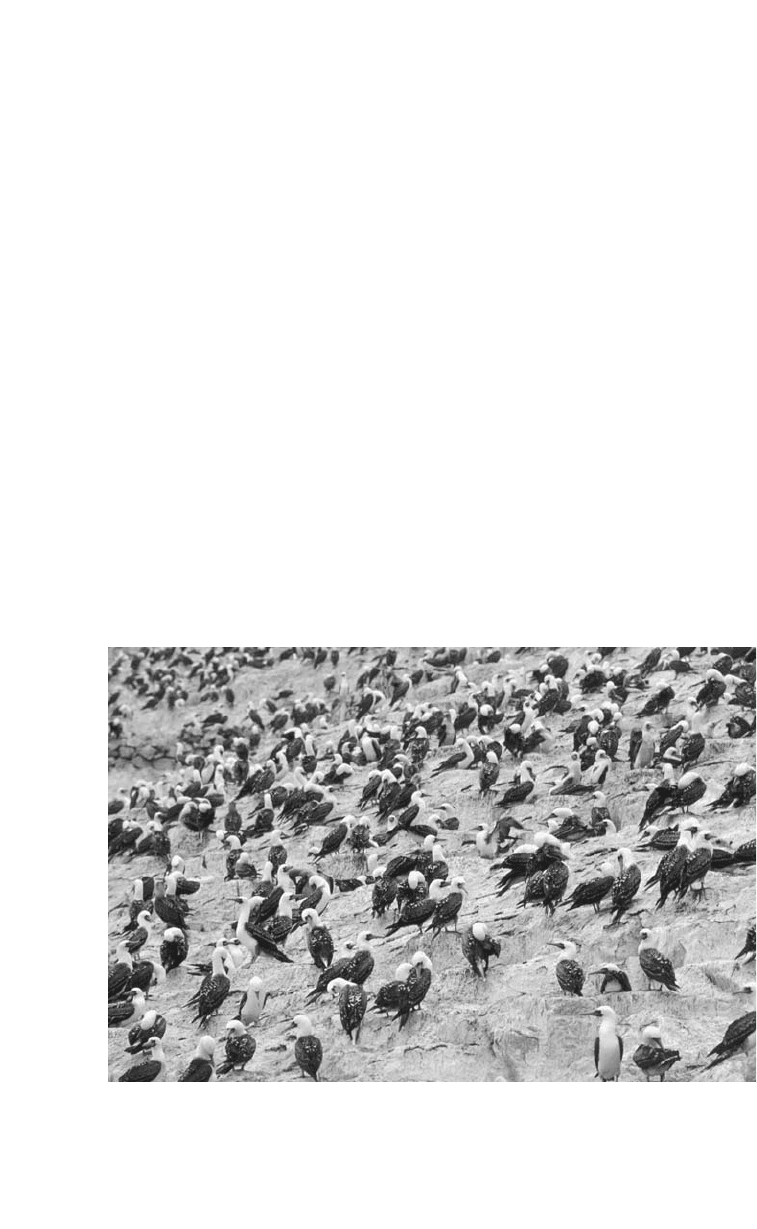
Seabirds, seen here on one of the Chincha Islands off the coast of Peru, have flocked for
hundreds of years on South America’s coastal islands, leaving thick deposits of guano. In the
19th century guano was mined as a hugely lucrative source of agricultural fertilizer.
(Photo by
Alejandro Balaguer/Andes y Mares)

what ways in the guano exports, and how British and Peruvian interests
merged or conflicted in this export venture.
In contrast to ores or agrarian produce, guano was easily accessible
and needed no heavy equipment or high capital investment. Packing
guano and loading it on ships bound for Europe required only men,
bags, shovels, and transportation. The men were mostly convicts or
Chinese immigrants known as coolies, who provided cheap labor that
accounted for about 4 percent of total production costs. Bags were eas-
ily provided by small-scale textile workshops. Shovels were imported
and paid for by money minted in Cerro de Pasco. The ships sailed
under European flags.
Guano exports hugely enlarged the government’s fiscal revenues. In
1846 revenues obtained from guano accounted for less than 10 percent
of state revenues (513,000 soles of 6.113 million soles). (The sol was
established as the national currency in 1863.) Only five years later this
percentage had risen to more than 25 percent (2.194 million of 7.636
million soles), and by 1872, to about 50 percent (34.566 million of
67.987 million soles) (Manrique 1995, 121). Such financial windfalls
made it easy to get loans on the international financial markets and
allowed Peru to borrow against future guano production, although this
practice would eventually lead to a deep financial crisis.
The Impact of Guano Exports
Many Peruvian and non-Peruvian authors have discussed at length why
Peru—having access to the tremendous resources provided by guano
exports—did not achieve economic and political modernization.
Historians previously assumed that the guano revenues benefited mainly
foreigners, but recently it has been convincingly argued that most rev-
enues were retained inside the country. By analyzing state expenditures,
U.S. economist Shane Hunt (1984, 51) has shown that 53.5 percent of
the Peruvian budget was spent on expanding Peru’s civil and military
bureaucracy, 20 percent on the building of railroads, 11.5 percent on
transfer payments to Peruvians and 8 percent to foreigners, and 7 per-
cent to reduce tributary impositions on poor people. The nature of these
expenditures tells the story about the lost economic opportunity.
At the beginning of the guano era the Peruvian governmental appa-
ratus was small, amounting to only three ministries with a few dozen
bureaucrats each. The demands of the guano boom, however, rapidly
expanded almost all branches of the Peruvian government and added
hundreds of state-employed workers. Both police and military forces,
125
THE AGE OF GUANO

for example, were increased in numbers and had their powers extended
to the provinces, which had the side effect of substantially reducing the
autonomy and power of caciques. With money from the guano trade
Peru became one of the strongest military powers in South America and
one of the first nations on the continent to own armored steamships.
The Peruvian navy was strong enough in 1866, for example, to fight to
a standstill a Spanish fleet that had attacked Callao.
In addition to providing such benefits, however, the employment
rolls of the expanding state apparatus were also used as patronage to
recruit and reward followers. Such hiring abuses led to high levels of
inefficiency and corruption. Investing more than 50 percent of state
revenues in an inefficient state administration stifled progress.
Previous loans and the accumulated interest on them further drained
state resources. In 1822 and 1824 the Peruvian state contracted two
loans in London in the amount of £1.81 million. Succeeding govern-
ments were unable to repay them, and by 1848 these loans and the
principal and interest had increased Peru’s debts to £5.38 million—
three times the initial loan. Recognizing Peru’s sudden economic wind-
fall, the British bondholders of the debt exerted great pressure to make
Peru repay the outstanding loans. In 1849 the Peruvian government
signed a treaty by which Peru agreed to repay these loans through new
bond issues backed by future sales of guano. With this treaty Peru was
readmitted to the international financial community and could obtain
new loans. However, new loans soon had to be used to repay old loans
and accumulated interest, and old loans and new loans eventually ate
all available fiscal resources.
In 1869 the minister in charge of Peru’s economics, Nicolás de
Piérola, signed a contract with the French businessman Auguste
Dreyfus by which Dreyfus became the only agent allowed to extract
guano. Until then a large group of Peruvian consignment agents had
been in charge. With the money he gained by exporting guano, Dreyfus
made new loans to the Peruvian government. With £11.92 million
loaned by Dreyfus to the administration of José Balta in 1870, the gov-
ernment began the construction of railroads. In the end guano deposits
were greatly depleted; the railroads were left unfinished; and Peru faced
an external debt of £35 million, an amount that required an annual
interest and principal payment of £2 million, which then was the entire
annual budget.
In addition to the British bondholders many native Peruvians held
long-standing claims on the government. Under pressure from such
claimants the Peruvian government recognized this internal debt. The
A BRIEF HISTORY OF PERU
126

government acknowledged the nation’s obligations to its own citizens,
such as those who had supplied funds for the patriot armies during
the wars of independence. Over time more and more claimants pre-
sented larger and larger claims. In 1851 the state-recognized internal
debt amounted to 4.88 million pesos; by 1858, it had grown to 23.2
million pesos, or five times the annual budget of 1850 (Contreras and
Cueto 2000, 125). Governmental corruption lay at the heart of much
of this drastic increase. The state also acted intentionally to transfer
public savings to private hands in the hope of promoting investments.
The state’s recognition of an internal debt was intended to foster the
development of an entrepreneurial middle class and to forestall suspi-
cions harbored by nationalists about the government’s relations with
foreign capitalists.
Rather than becoming revenue producers, as hoped, Peruvians con-
tinued to receive money from the state. Peruvian historians Carlos
Contreras and Marcos Cueto (2000, 133) have calculated that each
Peruvian cost the state five times more a year than he or she contributed
to the state. During the boom the gap was filled by guano revenues. Who
gained from these state-earned distributions? According to Peruvian his-
torian Alfonso Quiroz in his 1987 book, La deuda defraudada, a total of
2,028 people r
eceived state bonds; however, two-thirds of the total bond
value was held by only 126 people, mostly large land owners and mer-
chants and some state bureaucrats. Money thus obtained from state cof-
fers was only marginally invested in productive ventures, such as a few
banks and small textile and food industries. In large measure the money
was reloaned to the state. For lenders this was a less risky investment
with higher yields than investing in industrial development, at least
until the Peruvian state went bankrupt. In a sense the Peruvian guano
age suffered from what contemporary economists would call the “Dutch
disease.” Abundance of money lowered prices for imported goods and
increased labor costs, whereas the high profitability of guano exports
increased the borrowing price of money (that is, interest rates).
During the boom Lima and other coastal cities benefited most from
guano revenues, sometimes through the internal debt mechanism but
more often simply because more money entered the economy. For
example, real salaries increased on average 3 percent annually.
However, with more money circulating in the cities came inflation, and
inflation further accentuated economic differentiation. Between 1856
and 1869 the accumulated price inflation surpassed 100 percent. As a
result labor conditions and standards of living worsened. Lima’s arti-
sans were the first to react when in 1858 they marched through the
127
THE AGE OF GUANO
A BRIEF HISTORY OF PERU
128
city’s streets protesting against elite consumption patterns. Suddenly
enriched, Lima’s elites resorted to imports. Doors, windows, pianos,
shoes, and clothes came from Europe, leaving Lima’s artisans (most of
them descendants of former slaves) without work and income.
Slavery and Indian Tribute Reassessed
One important expenditure of the Peruvian government during the
guano boom was money spent on effectively abolishing slavery. Seven
percent of guano revenues were set aside, and the government bought
the liberty of 25,505 slaves from slave owners for 300 pesos each. In
theory there were no slaves in Peru, as slavery had been abolished by
General José de San Martín in 1821. Shortly after San Martín’s procla-
mation, however, former slaves were put under the tutelage of their
owners. At first this tutelage lasted until the former slaves reached age
21, but in 1839 it was extended until age 50. Decrees, intentions, and
reality were revealed in the state abolition expenditures. A simple cal-
culation shows that the Peruvian government paid 7.65 million pesos
to slave owners, money that was largely spent after 1854 on expanding
sugar and cotton plantations.
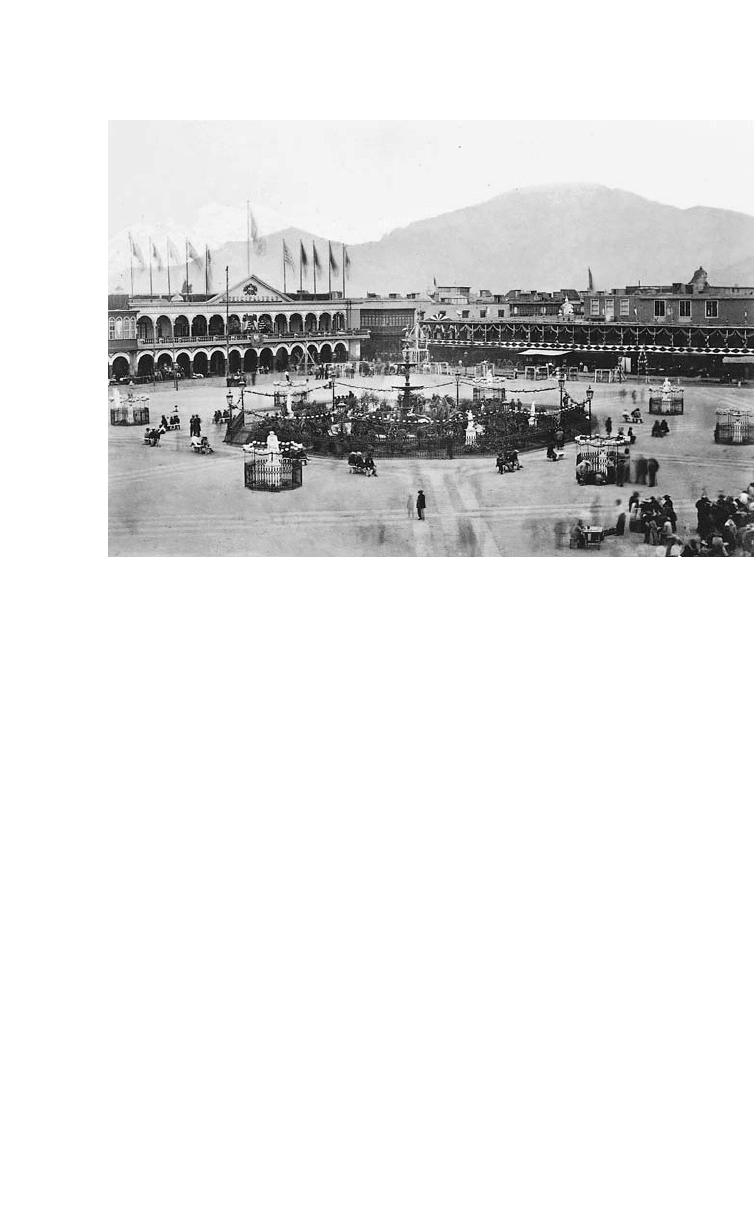
A public square in Lima, decorated for the July 28 celebration of independence day in 1868 at
the height of the guano boom
(Library of Congress)

The other component of social expenditure was the temporary abo-
lition of the Indian tribute, which until around 1840 had represented
25 percent of state revenues. After 1840 the Peruvian state made several
attempts to reform Peru’s tributary system, but each met political resis-
tance. No party or leader wanted to support such unpopular actions.
President Castilla abolished the tribute in 1854. The reform imple-
mented in 1866 by Manuel Pardo, Peru’s minister of economics (and
later its first civil president), was short lived. Pardo wanted to make tax
collection uniform by taxing all Peruvians, not only Indians. According
to his plan all male Peruvians between the ages of 21 and 60 were to
pay the equivalent of 12 days’ labor in a year in taxes. The experiment
lasted less than a year and ended with the ouster of President Mariano
Ignacio Prado.
Despite attempts, the Indian tribute was not replaced with a more
efficient and ethnically neutral taxing system. To the contrary, the same
Indian tribute abolished in 1854 was reintroduced in 1885. Between
1854 and 1885, however, abolishing the tribute had long-term conse-
quences for mining and agriculture in the highlands. It also at least par-
tially explains why coastal plantation owners could not use Indian
labor and resorted to importing Chinese laborers to work on their
fields: Once the Indians had no need for cash to pay their tribute, they
largely could engage in their own endeavors.
One of the peasants’ few monetary needs was money to fulfill com-
munal religious duties, including buying candles, providing dresses for
statues of the local patron saint, and paying the services of a priest.
Many hacienda and mine owners were aware of this cyclical need for
money and visited the peasant communities (or sent a hired intermedi-
ary) knowing when such festivities were scheduled to take place.
Subsequently hacendados or their agents would entice the peasants
involved to accept gifts or money. In exchange the ensnared peasants
would find themselves obligated to work off the value of the gifts or
loans by laboring in a mine or on a hacienda. This form of hiring labor-
ers has been called enganche (meaning a “hook”). Often such practices
were endorsed by or even organized with the help of local political
authorities. Once entrapped by this system, workers saw their debts
constantly increase.
The abolition of both the Indian tribute and slaver
y meant a retreat
of Indians and former slaves from the labor market, leaving plantation
owners on the coast and hacienda owners in the highlands with a labor
shortage, and the state with lower income from internal taxation. As
landowners’ complaints became louder, the Peruvian government
129
THE AGE OF GUANO
A BRIEF HISTORY OF PERU
130
sought to replenish the labor supply. First Peru invited European immi-
grants, who according to contemporary thinking would also improve
Peru’s racial profile. Then—once it became clear that Europeans were a
demanding rather than obedient labor force—Peru organized, in con-
War With Spain
T
he causes of a mostly maritime war with Spain, fought in 1865 and
1866, could be traced to an 1859 policy of the Peruvian govern-
ment to promote the immigration of Spaniards as a way to help
Europeanize the Peruvian population.Among the immigrants were 175
Basques, who were settled in a northern coastal estate to grow cotton
on shares.The estate owner treated them poorly, and tensions eventu-
ally resulted in armed violence in 1863. The Spanish government
protested when the Basque workers were arrested, and the conflict
escalated over the course of the next two years.
In 1865 Spain occupied the guano-rich Chincha Islands, thereby
depriving Peru of its principal source of revenue, and landed a small
force of sailors in Callao, where one Spanish sailor was killed in a
fight with local Peruvians. In May 1866 a Spanish fleet opened fire on
Callao and was subsequently attacked by several modern, well-armed
and well-trained Peruvian warships. The Peruvians disabled the prin-
cipal Spanish ship and forced the Spanish forces to retreat (Manrique
1995, 131).
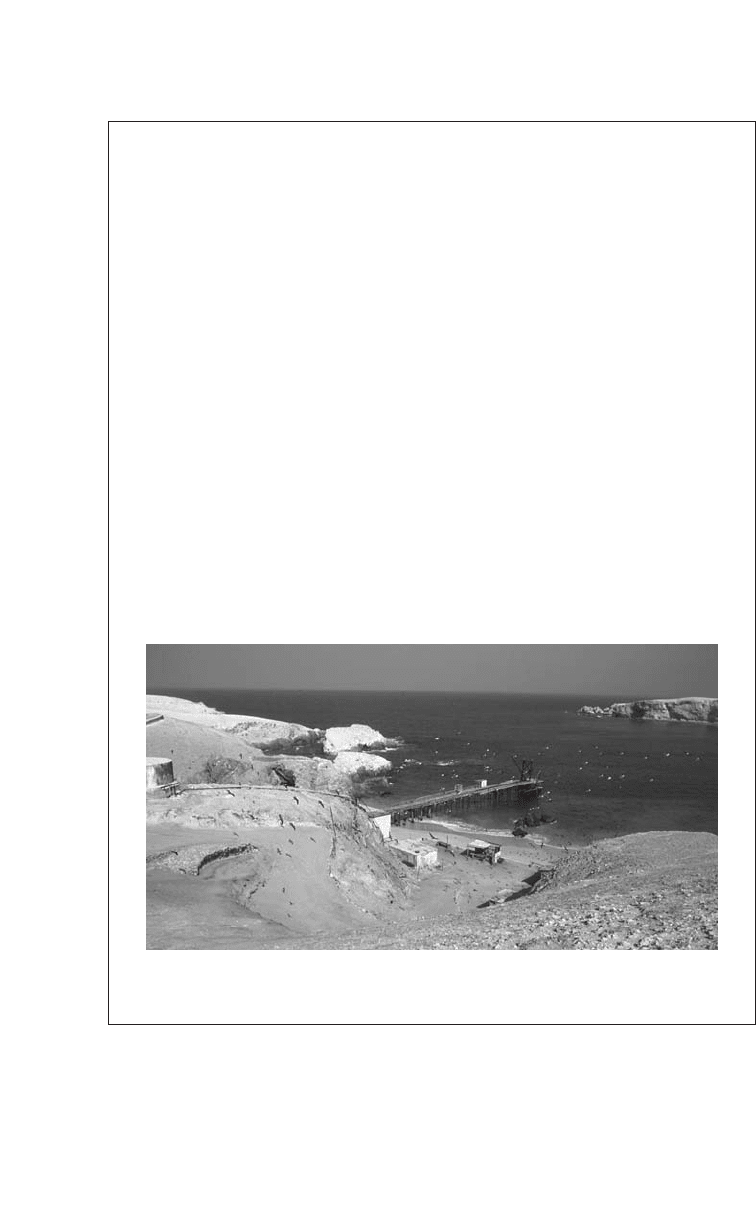
The Chincha Islands, temporarily seized by Spanish forces in 1865 (Photo by
Alejandro Balaguer/Andes y Mares)

junction with Chinese consular representatives, the importation of
unskilled Chinese workers from Macao and Canton (Guangzhou).
Several factors converged to lay the groundwork for the expansion
of coastal plantations in the 1860s: money paid by the state for the
manumission of slaves, fresh labor in the form of Chinese coolies,
high prices in the international market, and capital from merchant
houses and the newly created banks. Sugar production reached
unprecedented heights in the 1870s—growing 495 percent between
1871 and 1878—and by 1879 sugar exports accounted for 32 percent
of all Peruvian exports. In the wake of this expansion many wheat-
producing haciendas in valleys near Lima switched to sugar produc-
tion, and Peru imported wheat from Chile. Coastal valleys between
Lambayeque and La Libertad contained the most important sugar-
producing plantations. Cotton production did not lag far behind,
especially during the years of the U.S. Civil War. Piura contributed 14
percent of all cotton exports, Lima 38 percent, and Ica (south of
Lima) 42 percent (Manrique 1995, 130–131).
Chinese Immigrants
Between 1840 and 1874, 100,000 Chinese immigrants, mainly men,
arrived in Callao. The Pacific passage caused high death tolls.
Estimates indicate that between 10 and 30 percent of people who
embarked in China died during the trip. Once these Chinese laborers
were in Peru, their living conditions resembled those of former
Peruvian slaves. Publicity about the deadly shipboard passage and
labor conditions on the guano islands and on coastal plantations led
to diplomatic protests, followed by an influx of Chinese laborers
between 1870–74 before the looming abandonment of “importing”
this labor supply. Chinese laborers were reportedly subject to harsh
mistreatment, including whipping, incarceration, overwork, and even
forced celibacy. The largest Chinese populations were in Lambayeque
and La Libertad, where historian Humberto Rodríguez Pastor, using
the 1876 census, counted 15 Chinese women and 12,864 Chinese
men (1989, 68).
Since it was the landowners who provided the Chinese immigrants
with the money to pay for the trip from China to Peru, these workers
were indebted to and completely dependent on their employers. Once
settled on the hacienda, Chinese laborers had to repay their travel money
out of their wages in addition to feeding and clothing themselves.
Hacendados would lend workers more money to meet their living
131
THE AGE OF GUANO
A BRIEF HISTORY OF PERU
132
expenses, thus continually extending the initial labor contract. Chinese
laborers were unable to leave their “owners” because of this continued
indebtedness. Very gradually, however, Chinese laborers managed to rid
themselves of their initial labor contracts to become small merchants,
first in provincial cities and then in Lima. The common saying in Lima
el chino de la esquina (“the Chinese on the corner”), which came to mean
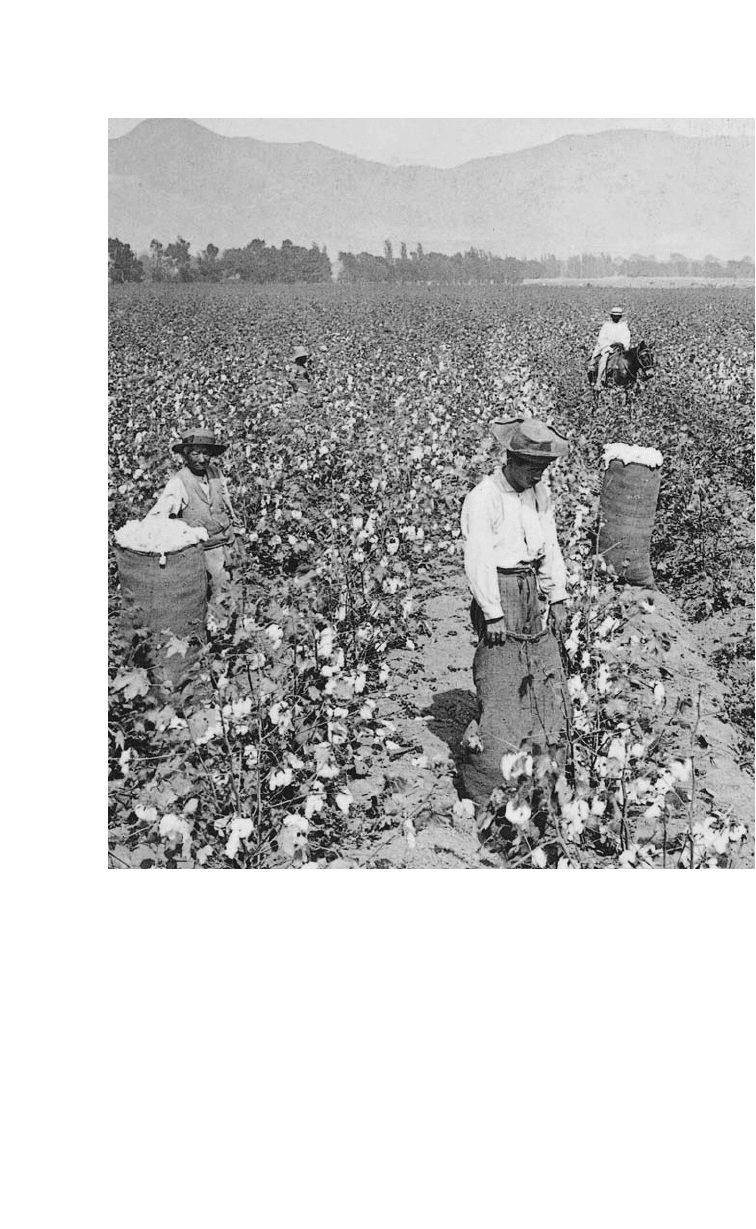
Chinese immigrant workers picking cotton in an irrigated field near Vitarte. Many Chinese
agricultural laborers were brought to Peru in the 1870s and faced harsh conditions and
treatment.
(Library of Congress)

the small neighborhood grocery store, was testament to the role of
Chinese merchants in this period, even after such stores were no longer
in Chinese hands.
The Railroads
The building of Peru’s railroads absorbed about 20 percent of the
guano revenues during the decade between 1868 and 1878. Peru
built its railroads in the hope of promoting development, integrating
the country’s economy, and linking the country to international
trade. In the long run the only goal achieved was joining Peru more
closely to the international market through the export of raw materi-
als: wool, silver, copper, sugar, and cotton. Railroad construction
closely coincided with the location of the main production sites of
these raw materials.
In 1860 Peru only had two railroad lines: One linking Tacna and
Arica in the south, and another (12 miles long) linking Lima to its
port city, Callao and the elite vacation resort of Chorrillos. In 1872,
president Manuel Pardo campaigned for the urgent need to massively
expand the railroad system. He was certain that train whistles would
awaken the country to the benefits of modernity. But dreams of
modernity confronted an almost impossible geophysical landscape.
To reach the highlands locomotives had to climb to 12,000 feet above
sea level, and technological knowledge of this time was not up to the
challenge.
It was an engineer from the United States, Henry Meiggs, who con-
vinced the Peruvian government to launch a railroad-building program.
Between 1869 and 1872 the Peruvian government borrowed £36 mil-
lion to start building railroads. Ten new lines were built, though not all
10 were state initiated. The Lima-Chancay, Pimentel-Chiclayo, and
Pisco-Ica lines were in private hands. Few of these large projects ever
reached their final goal. For example, from 1868 to 1878, about 700
miles of railroad were built; this represented only about 10 percent of
what had initially been planned. An economic crisis in the 1870s
brought railroad construction to a halt. Meiggs died in 1877 leaving
behind muddled and illegible plans and unpaid bills (Contreras and
Cueto 2000, 139). His unfinished railroad network, which ended in iso-
lated peasant communities, was virtually worthless. The evaporation of
state resources with the end of the guano boom and the War of the
Pacific (1879–83) between Peru and Chile postponed all railway
endeavors for several decades.
133
THE AGE OF GUANO