
Hunefeldt C., Harris B. A Brief History of Peru
Подождите немного. Документ загружается.


A BRIEF HISTORY OF PERU
104
had envisioned the success of a liberal reform movement, lost all hope
and realized Peru was on its own.
Bolívar financed the war against royalist forces with Peru’s first inter-
national loan (from the United Kingdom), and without remorse or hes-
itation he expropriated all property, including that of the church, he
could get a hold of. Similarly he imposed recruiting quotas on the lib-
erated territories. The highland provinces of Cajamarca and Chota,
Piura, and Huamachuco were most affected. Bolívar knew that the final
battles had to take place in the Peruvian highlands among a population
that had signaled strong pro-Spanish and even monarchical support.
Thus, the central highlands, one of Peru’s richest regions, bore the
brunt of this war, which involved six military campaigns between the
two biggest armies on the continent, plus the depredations of hundreds
of loosely organized guerrilla groups (Manrique 1995, 64–65).
When he left Lima and advanced into Cerro de Pasco, Bolívar com-
manded 6,000 Colombian and 3,000 Peruvian soldiers. On August 4,
1824, he confronted the royalist army, commanded by General José de
Canterac, at the Battle of Junín, which was fought on the Meseta de
Bombón, 12,000 feet above sea level. The battle ended with a hurried
retreat of Canterac’s army. Although the royalist army had been soundly
defeated, complete victory still eluded Bolívar. In the end Bolívar’s sec-
ond in command, General Antonio José de Sucre, won the final battle
of the war at the Pampa of Ayacucho (which in Quechua means “the
Praise for BolÍvar
D
iego de Choquehuanca, a curaca from the province of Azángaro in
Puno, lauded Simón Bolívar during a visit by the Liberator to Puno.
Once God intended to build an empire with savages and He created
Manco Capac. Manco Capac’s race fell in sin and then God sent
Pizarro.After three centuries of atonement, God had pity with America
and He sent You. You are, then, a man imbued with a godly design.
Nothing that has ever been done before now even comes close to what
You have achieved. If there ever is someone able to follow your path
there has to be another world to liberate. You have founded five
republics that are destined to witness immense development, and
these republics will glorify Your name as none other. With time Your
glory will grow as does the shadow when the sun declines (García
Calderón 1879, 281; translated by Christine Hunef
eldt).

corner of the dead”) on December 9, 1824, and triumphantly entered
the city of Cuzco two weeks later. It was not for another 12 months that
the final bastion of Spanish resistance in Bolivia (then known as Upper
Peru) was subdued, and in January 1826 the few resisting Spaniards
who had taken refuge in Callao surrendered.
After the battle of Ayacucho, Bolívar called elections for a new con-
gress, which was installed on February 10, 1825. Congress proclaimed
Bolívar leader of the nation. He stayed in Lima until September 1826,
when political unrest demanded his presence in his native New
Granada. During his brief command over Peru’s political destiny
Bolívar attempted to introduce several liberal-minded reforms, espe-
cially pertaining to Indians, who represented about 60 percent of the
new nations total population. In particular he strove to eliminate the
still-prevailing colonial institutions and the exploitation of the indige-
nous population. These reforms, however, encountered resistance and,
more often than not, were simply ignored.
Political programs for the new nation-state were abundant. However,
the very proliferation of such programs created uncertainty among polit-
ical leaders and their followers. It also explains why many different ide-
ological factions contended for power. All parties envisioned a better
future for the newly independent Peruvian citizens, but there was no
agreement on the overarching goals or how to implement this future.
To this day Peruvians (and non-Peruvian historians) engage in
heated debate over the meaning of the wars of independence. Did the
wars of independence mark a radical transformation of preexisting
colonial ways? Were the wars carried on the shoulders of Peruvians and
based on a Peruvian willingness to become independent? What does
the participation of Indians and blacks tell us? What were the long-
term effects of these wars?
Whatever the answers to these questions, the wars of independence
did not end internal turmoil and unrest. To the contrary, political inde-
pendence from Spain unleashed new confrontations and ways of
expressing such confrontations. The result was not a more egalitarian
and prosperous society. Indians continued living in peasant communi-
ties, paying tribute, and providing free personal services to individuals
and governmental institutions. Slavery continued. The Catholic
Church held on to its traditional privileges.
In spite of the signs of continuity of Peruvian society after inde-
pendence, changes were visible in the larger economic and political
areas. Commercial networks—linked previously through the Potosí-
Huancavelica-Lima-Seville connection—now became more regionally
105
REVOLTS AND THE WARS FOR INDEPENDENCE

A BRIEF HISTORY OF PERU
106
fragmented. The former Spanish nobility lost its hold on governmen-
tal issues and most of their economic assets, either because they had
been discredited or robbed or they had returned to Spain. The Indian
nobility had been dismantled in the aftermath of the Tupac Amaru II
rebellion. The financial resources of the state were in disarray and
practically nonexistent. Most economic enterprises, such as haciendas,
obrajes, and mines, had been dismantled in the wake of the wars of
independence. This was the scene confr
onting the “new” Peru in 1826.
The Initial Lessons of Independence
Demographically Peru was still a small country. An often cited count of
people based on a register of contributions in 1836 recorded 1.3 million
people living in 10 administrative departments.
The first republican census, in 1876, would show 2.6 million people,
an increase of barely 100,000 from the last colonial census, of 1792.
The densest population concentration was in the southern highland
departments, which also had the highest percentages of Indians. Within
the southern departments, 94 percent of Puno’s population was Indian.
Indians were concentrated not only in the southern highlands but also
Population Distribution by Department, 1836
Department Number of Inhabitants
Amazonas 71,267
La Libertad 162,429
Piura 57,815
Ancash 121,462
Lima and Callao 151,718
Junín 144,243
Ayacucho and Huancavelica 159,608
Cuzco 216,382
Puno 156,000
Arequipa and Moquegua 136,812
Total 1,313,736
Source: Basadre (1983, III:173) and Manrique (1995, 66)
107
REVOLTS AND THE WARS FOR INDEPENDENCE
within peasant communities (sometimes called Indian communities)
and on haciendas as yanaconas. Around one-fourth of Peruvians were
classified as mestizos, and with some minor exceptions (most notably
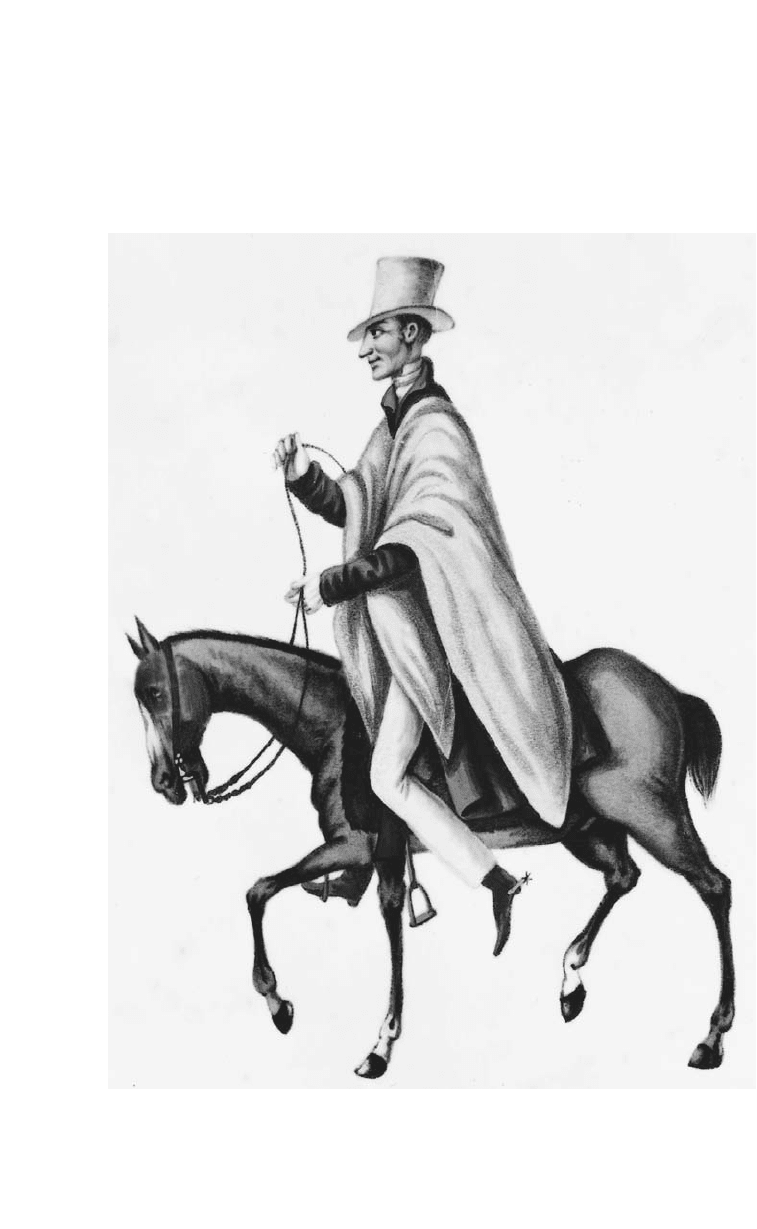
A Peruvian “gentleman” about the time of independence from Spain. Many Spanish-born whites
fled the country during or soon after the wars, but native-born Creoles took control of the
government of the new nation, even though they were a small minority in a population of
Indians and mestizos.
(Library of Congress)

in Cuzco and the Mantaro Valley in Peru’s central highlands), mestizos
lived in Peru’s coastal valleys and cities. A quarter of Peru’s 50,000
slaves and 40,000 free blacks and mulattoes lived on the coastal hacien-
das and the sugar, cotton, and rice plantations. Three-fourths of
Peruvian slaves lived in the department of Lima, most of them in the
city of Lima as artisans and servants.
This was the demography of Peru in the early decades after inde-
pendence. Throughout the 19th century this demographic distribution
would greatly influence economic and political life in the new republic.
Fighting for the King? Rebellion in Iquicha
Independence did not bring the rebellions in the countryside to an end.
A revolt broke out in Iquicha, in the northern part of the department of
Ayacucho, that lasted from 1825 to 1839. It differed from the pre-inde-
pendence rebellions, whose partisans were almost exclusively Indians,
in that its leadership was made up of a mixture of whites, mestizos, and
Indians. Furthermore, this continued unrest showed that peasants and
rural elites wanted to participate in the shaping of the new nation-state
in their own terms.
When the upheaval reached the city of Ayacucho in March 1825, the
prefecto, or political head of the department (a post-independence
administrator), sent a militar
y force that temporarily subdued the
rebels. However, during the next months there were new signs of insub-
ordination. More troops were sent to put down the rebels. This time,
however, a peasant army of approximately 1,200 overwhelmed the gov-
ernment forces, plundered haciendas, and seized the town governor.
Skirmishes continued until May 1826, a year after the wars of indepen-
dence had officially ended. At that point the gobernador of Tambo (now
the head of a district within the lar
ger province) reported to the prefecto
that 50 rebels had been beheaded and many other participants shot.
New uprisings nevertheless followed.
The power of the Iquicha leaders resided in their ability to appr
opri-
ate the tithes. They were able to name their own collectors, especially
in the local coca haciendas. With the tithes they paid for the organiza-
tion and logistics of their rebellion.
General Andrés Santa Cruz, a right-hand man to Bolívar, went to
Ayacucho to meet and negotiate with the rebel leaders. Santa Cruz
eventually reached an agreement and promised to pardon the rebels. A
brief period of peace followed, but in 1826 Spanish officials who had
fought against the patriot army, along with members of the local clergy
A BRIEF HISTORY OF PERU
108

and some of the Iquicha rebels, prepared to strike at the newly created
republic, encouraged by rumors that 22,000 French and Spanish forces
were on their way to help. From headquarters at local haciendas the
rebellion leaders, with the aid of varayocs (traditional Indian commu-
nity leaders), r
ecruited an army of experienced fighters, known as mon-
toner
os. The uprising in Ayacucho was unresolved by the time Bolívar
left Lima. When Marshall José de La Mar became pr
esident, he
promised the people in Iquicha exemption from tribute and military
recruitment. Some Iquicha leaders gave in, but others continued to
resist and on November 12, 1827, took the town of Huanta. A few
weeks later they laid siege to the city of Ayacucho. Domingo Tristán,
prefecto of A
yacucho, organized peasants from neighboring provinces,
especially the Morochucos ethnic group, to fight against the rebel lead-
ers. In this confrontation, hundreds of rebels were killed. Some leaders
escaped but were taken prisoner a few months later after relentless per-
secutions and repressive campaigns. The only leader to escape was
Antonio Huachaca.
Later, in 1833, the remaining rebels in Huanta played another role in
the complex politics of the new republic when they sided with the lib-
eral-minded general Luis José Orbegoso in ousting the conservative
president Agustín Gamarra. By this stage the state needed iquichanos
military aid, a turn of events that allowed the rebels to negotiate with
the republic for the creation of an independent state. Thr
oughout this
period of rapidly shifting confrontation and intrigue, the rebels
remained in control of the local tithe collection on the coca haciendas.
Their ability to manage local resources allowed the iquichanos to
become par
t of the new republic on their own terms. They developed
their own economic and political projects by sometimes resisting and
sometimes accepting the Lima-based programs of conservatives and lib-
erals alike. It was an armed entrance into a new era, and as such this
rebellion demonstrates the competing national agendas existing at the
times of independence. Such conflicting ideas about change and alter-
native visions of the future permeated the following decades.
109
REVOLTS AND THE WARS FOR INDEPENDENCE

7
The Long Struggle for
Stability (1826–1843)
T
he main hurdles in the process of consolidating the new republic
were the lack of physical internal infrastructure; deep-rooted dis-
tances and suspicions between social groups; the complete disorganiza-
tion and disarray of public finances; and, last but not least, the absence
of an accepted and legitimate group of leaders. All of these conditions
made it difficult for the new nation to achieve political, social, or eco-
nomic stability, and it was a long struggle during the first decades after
independence to achieve some sort of balance and order.
The Obstacles
At the time of independence, in the 1820s, Peru suffered from a lack
of basic physical infrastructure. It is an often-cited fact that by the
beginning of the 19th century there were fewer passable roads than
had existed during Inca times. Most inland transport was done on
the back of llamas and mules over small dirt roads. Trains of mules
and llamas carried their loads across the steep Andes from the high-
lands to the coast and back, and from highland town to highland
town. Communication was somewhat easier on the coast, where
most products were transported using vessels and ports on the shores
of the Pacific Ocean. Maritime transport linked Peru’s coastal valleys
to internal and international trade routes. However, the cold water
stream on Peru’s coast, the Humboldt current, made upstream sailing
from north to south very difficult. It was easier to sail from Peru’s
north to Guayaquil, in Ecuador, than to Lima. To solve transport and
communication problems, successive Peruvian governments empha-
sized the need to build railroads, especially to link the highland to
the coast. Not until the last quarter of the 19th century, however, was
a railroad project carried out using revenues obtained from the
110
111
THE LONG STRUGGLE FOR STABILITY
export of guano (bird droppings, used as fertilizer) from Peru’s
coastal islands.
At the time of independence, social structure was clearly defined and
rigid. Population growth was still low due to a low fertility rate, high
infant mortality, military campaigns, the emigration of many Spaniards,
and the separation of Bolivia and Ecuador from what had been the
Viceroyalty of Peru. For several decades after independence Peru had a
racially defined occupational structure. Most artisans were black, most
peasants were Indians, most smaller merchants were mestizos, elites
were predominantly white. As a part of the “colonial heritage,” Peru
began its republican life with a racially defined occupational structure.
Throughout the 1820s several peasant upheavals challenged the
political goals of Lima’s elites. Some of the uprisings had monarchist
undertones or used monarchist language to propose alternative visions
of the new republic. In some cases, such as the fierce resistance by
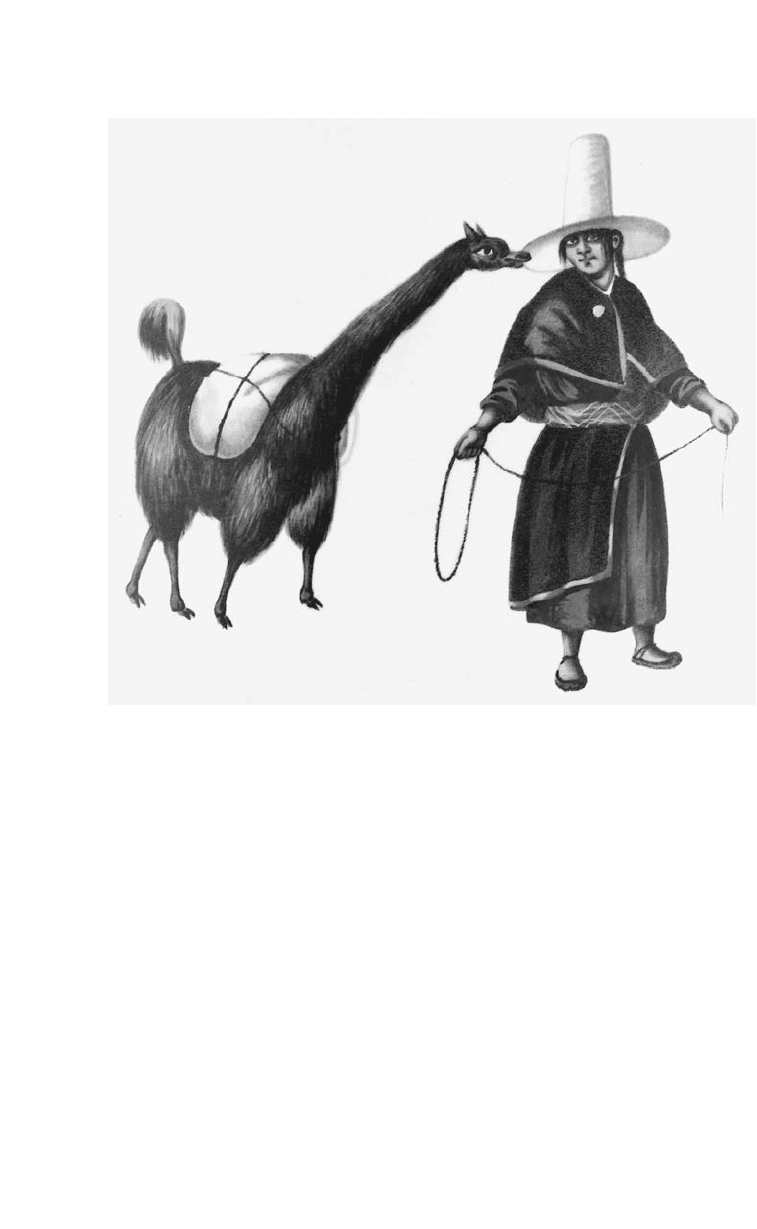
Because of the lack of adequate roads in much of the country, llamas were the principal
beasts of burden in early 19th-century Peru.
(Library of Congress)

Iquicha rebels, an assembly of regional actors (Indian, mestizos, and
whites) kept “liberated” areas out of Lima’s control well into the 1830s.
The fragmentation of the country after the wars of independence was a
reality far removed from republican ideals, which had envisioned a
country for all Peruvian people. Social fragmentation was, in fact,
reflected in the constitution. In the first constitutions only a minority
of literate male property owners had civil rights and could vote or hold
office. This in effect gave all power to the Creole elite and excluded
Indians, most mestizos, and blacks. Civil rights were defined in terms
of race. However, Peru was not alone in its narrowly defined franchise.
Even in England, it took until the end of the 19th century before vot-
ing and eligibility for office became universal for men.
Political Instability
Between 1821 and 1840 Peru had five different constitutions (1823,
1826, 1828, 1834, and 1839), and between 1841 and 1845 six presi-
dents governed Peru. Two basic political models were debated and
fought over with words and weapons by successive contending parties
after independence: a constitutional monarchy versus a liberal republic.
Each form of government had its supporters, and several presidents
defended one model or the other. Partisanship and factionalism were
the result.
Defenders of a constitutional monarchy clashed with liberal republi-
cans over key issues such as incorporating Peru’s indigenous popula-
tions in the electorate. For decades monarchists posited that Indians
were ignorant and subject (as servants and serfs on haciendas) to the
control of third parties; thus they had insufficient free will to be allowed
to vote. Liberals counterargued that most Indians lived in Indian com-
munities where they owned some sort of land and were thus indepen-
dent agrarian producers, and that Indians paid taxes to the state—the
former colonial tribute, now called contribución de indígenas or con-
tribución rural. Between 1849 and 1895, under liberal dominance, illit-
erate men—thus, Indians—were actually allowed to participate in
indir
ect elections.
Another topic of heated discussions and confrontations was the divi-
sion of power between the executive (the president) and the legislative
(congress) branches of government. The five constitutions approved
between 1821 and 1840 contained a clause by which an intermediate
entity between the executive and the legislative was instituted, the
Consejo de Estado, which in a way was an extension of the colonial
A BRIEF HISTORY OF PERU
112

113
THE LONG STRUGGLE FOR STABILITY
audiencia. The Consejo was a consulting rather than legislative entity.
Liberals defended the predominance of the legislative branch to avoid
political centralization and the concentration of power; conservatives
envisioned a strong executive as the only alternative to confront the
prevailing military anarchy, with the goal of establishing a centralized
republic. However, political beliefs and wishes were not set in stone.
More than once some of the most prominent liberal thinkers changed
sides when confronted with social disorder and anarchy (Contreras and
Cueto 2000, 75–79). And social disorder and anarchy were paramount
during the first decades after independence. Some Peruvians even
invoked the colonial era as a better time.
The most visible expression of political dissension and uncertainty and
of social disorder was a form of politics known as caciquismo (derived
fr
om cacique, a local boss). Many contending factions were led by a
Presidential
Musical Chairs
A
s in most other newly independent countries of Latin America,
Peru witnessed a rapidly changing procession of political figures in
the years following the wars against Spanish control. In the four decades
after the departure of Simón Bolívar in 1826, Peru had 34 presidents,
all of whom sought to fasten their personal hold on the country. They
all came from the elite sector of society, and four out of five were mil-
itary officers, most of them veterans of the revolutionary wars. A few
were lawyers, and several were big landowners. A quarter were native
to Lima. Two-fifths of the presidents had previously served in the
important office of prefecto in one of the large departments set up after
independence. Surprisingly, only a minority of the presidents had expe-
rience as legislators or cabinet members before taking executive power.
Succession to the presidential office was hazardous, and several of
those who tried and failed met their ends in front of firing squads. Only
one-fifth of the presidents between 1826 and 1865 came to power by
coups d’état, but the threat of coups and rebellions in the departments
often unseated presidents and added to the record of short executive
tenure. Only a small percentage of Peru’s presidents came to office
through election by the legislature or the electoral college. Most reached
office through constitutional succession or appointment (Dobyns and
Doughty 1976, 158–159).