
Hunefeldt C., Harris B. A Brief History of Peru
Подождите немного. Документ загружается.

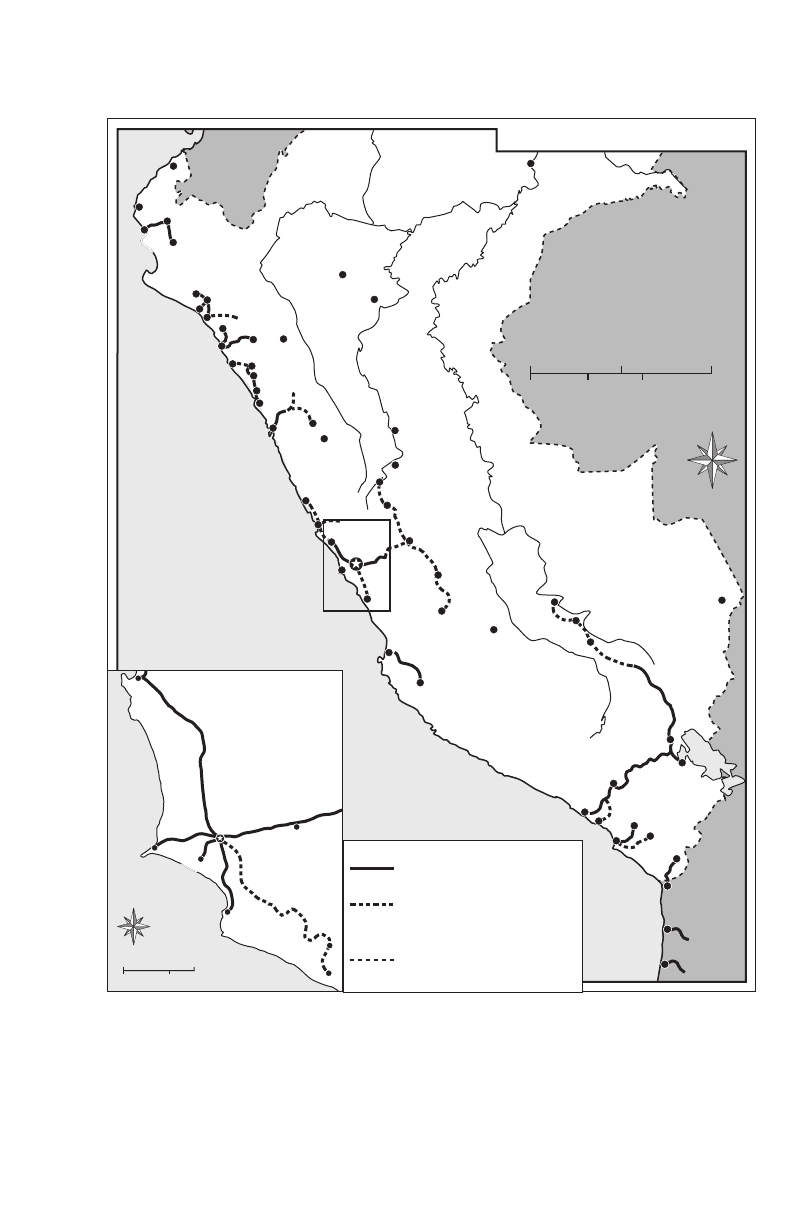
A BRIEF HISTORY OF PERU
134
Historical Processes in the Regions
While historians have devoted much energy to explaining Peruvian
national development during the 19th century, the historical processes
and economic development of the distinct regions have been much less
examined. Much is known about the overarching economic cycles in
250 kilometers
250 miles
0
0
Pacific
Ocean
A
N
D
E
S
Huallanca
1857
A
N
D
E
S
Lima
CallaoCallao
Chancay
Pisco
Ica
Juliaca
Puno
Arica
Pisagua
Iquique
Mollendo
Islay
Tacna
Puerto
Maldonado
Moquegua
Tumbes
TalaraTalara
Sullana
1876
Piura
Paita
Chiclayo
Guadalupe 1874
Cajamarca
Guadalupe 1874
Tarapoto
Iquitos
CuzcoCuzco
Quillabamba
Machu Picchu
Huancavelica
Ayacucho
Lurín
Arequipa
Huacho
Paramonga
Trujillo
Pacasmayo
Puerto Chicama
Chicama
Pimentel
Eten
Chilete
Ascope
Salaverry
1874
Chimbote
Huánuco
Tingo
Cajamarca
Moyobamba
Cerro de Pasco
Goyllarisquizga
Huaráz
Huallanca
HuancayoHuancayo
La Oroya
1871
1874
1871
1920
1892
1904
1875
1857
1872
1870
Lambayeque
1871
Ilo
1877
Lake
Titicaca
Y
a
v
a
r
i
R
.
A
m
a
z
o
n
R
.
P
a
s
t
a
z
a
R
.
U
c
a
y
a
l
i
R
.
H
u
a
l
l
a
g
a
R
.
U
r
u
b
a
m
b
a
R
.
M
a
r
añ
ó
n
R
.
A
p
u
r
í
m
a
c
R
.
CHILE
BRAZIL
ECUADOR
BOLIVIA
PERU
Railroad Construction
N
Railroad lines
constructed before 1879
Railroad lines constructed
after 1890, the majority by
the Peruvian Corporation
Contemporary national
boundary
10 kilometers
10 miles
0
0
AncónAncón
Lima
Callao
Vitarte
Magdalena
Chorrillos
Pachacamac
Lurín
Pachacamac
Lurín
Pachacamac
Lurín
1858
1871–75
1852
1875
N
1870

these regions, but the repercussions of these cycles within the regions
remains relatively obscure.
Three economic regions in Peru are discernible during the 19th cen-
tury. The economy of Peru’s Andean south revolved initially around
sheep and alpaca wool exports but eventually came to include copper
and iron. The central highlands depended first on silver production,
but by mid-century cattle production became important, as did pro-
duction of aguardiente (brandy) by the 1890s. The third region, com-
prising Lima and Peru’
s central and northern coasts, rested on two
pillars: guano exports and sugar and cotton production.
The Andean South
During colonial times before the establishment of the Viceroyalty of Río
de la Plata in 1776, the cycles of the Andean south were closely knit to
the mining industry. The loss of Potosí to the new viceroyalty launched
the southern provinces into several decades of economic depression until
a new product—sheep and alpaca wool—pumped money into the region.
In step with the British industrial revolution, which created demand for
the raw materials, exports of sheep and alpaca wool grew steadily.
Wool exports brought about dramatic changes in the region but did
not benefit everyone. Indian peasants, for example, did not voluntarily
participate in the wool trade. More often than not, a wool merchant’s
agent, called a rescatista, visited a peasant’s hut, left a “loan,” and spec-
ified how much wool he expected to collect during the next shearing
season. When collection day came, these agents, sometimes backed by
armed mestizo guar
ds, returned to the peasant’s hut and confiscated the
wool. The agents often fabricated loans or attached astronomic interest
rates to the amounts of money left with the peasant. Consequently
peasants found themselves unable to repay a loan and often lost their
animals and land. The wool trade, therefore, became a mechanism by
which much peasant-owned land was acquired by aggressively expand-
ing haciendas. Merchants, hacienda owners, and political and ecclesi-
astical authorities were conveniently silent witnesses to these
extortions. Merchant capital obtained high returns, and Peru’s pattern
of servile, forced labor relations was perpetuated. The higher the prices
of wool went on the international market, the hungrier for land hacen-
dados became. This pattern also explains the almost complete absence
of important technological innovations.
As happens with most raw material exports, the benefits derived from
south Andean wool exports did not necessarily return to the region and
135
THE AGE OF GUANO

A BRIEF HISTORY OF PERU
136
the people who produced it. Moreover, single-commodity exports make
regions highly dependent on international price fluctuations. The south-
ern Andes curve of growth and decline depended more on price fluctu-
ations on the international market than on the ups and downs of the
Lima-based economy or events in other Peruvian regions. A telegraph
installed in Arequipa brought price fluctuations into Puno’s hinterlands,
and wool was traded day to day accordingly. A price drop in Liverpool,
therefore, had larger regional repercussions in the Andean south than a
change of presidents in Lima or the flooding of a copper mine.
Until 1854, during Rámon Castilla’s second presidency, Indians con-
tinued paying tribute to the republican state. Tribute payments meant
that Indian peasants had to participate—in one way or another—in mar-
ket relationships to obtain money to pay the tribute. The abolition of trib-
ute payments in 1854 meant that Indian peasants could revert to a
Raw Materials and
Investments
S
tudy of the historical processes in the southern Andes raises an
important question: Can the successful export of raw materials
promote development?
Peasants of the Andean South—a large majority in the production-
commercial cycle (via the wool trade)—earned no benefits and were
unable to accumulate money.With no money in their pockets, peasants
had no purchasing power and, thus, could not participate as buyers in
the internal market. On the other end of the wool cycle were those
who did benefit from international trade: the landowners, merchants,
and British buyers. More often than not, beneficiaries of the wool trade
spent their money on luxury goods and on travel.
Reinvestment of this money in the region could have spurred eco-
nomic growth or development—for instance, by developing a textile
industry.This did not happen.The only textile factory opened, the Nadal
Garmendia, was the single-handed effort of one Cuzco family in 1861.
The imported French machinery to open this factory had to be carried
on mules and llamas from the coast to Cuzco. However, even this “mod-
ern” industry did not have salaried laborers; it used the hacienda’s
servile labor force. Exports alone could not promote development, and
in the end the experiment failed for lack of buyers, a salaried labor
force, roads and transport, and demand.

natural economy—that is, to self-sufficiency. This also meant that hacen-
dados and wool merchants were left with no arguments to coerce Indian
peasants to produce or sell wool. Landowners responded by expanding
their haciendas still further to incorporate entire peasant communities
and then forcing Indian peasants to work on hacienda lands.
Peasant Reaction
Indian peasants, with no salaries, even if they had wanted to, were
unable to buy textiles to clothe themselves. Cuzco, the city that during
colonial times was an important center of textile production, had lost
its preeminence within the southern Andes, and Arequipa became the
new regional center. Between the end of the 18th century and the end
of the 19th century, Cuzco’s population dropped from 40,000 to around
13,000. Thus, the wool trade produced not only a higher level of social
demarcation between the haves and have nots—merchants and
landowners versus Indian peasants—but also stark inequalities within
regions. Cuzco’s large markets (ferias) to which thousands of people
had come fr
om all over the south of Peru as well as Bolivia, Chile, and
Argentina simply disappeared. Prominence had shifted to the city of
Arequipa and to British merchants.
These economic developments had a dramatic social counterpart.
Indian peasants did not sit back and watch when landowners and mer-
chants intensified their attempts to expropriate peasant land. Peasants
responded. During the 1850s and 1860s, rapidly spreading peasant
revolts arose in several communities in the department of Puno. The
center of this revolt was the province of Huancané. Beginning in
October 1866, the revolt spread to the districts and communities in
Taraco, Caminaca, Samán, Achaya, Vilquechico, and Moho. In 1867
Indian peasants fought against state troops in Capachica, leaving 57
soldiers dead. After this initial success, Azángaro’s subprefecto and
Puno’s military commander-in-chief, Andrés Recharte, requested mili-
tar
y help from neighboring Bolivia. The Bolivian troops never arrived,
in large measure because government leaders in Lima soon recognized
the international implications of Recharte’s request. Instead reinforce-
ment troops came from Lima under the command of General Baltazar
Caravedo, who succeeded in avoiding more bloodshed through negoti-
ations. As soon as Caravedo left, however, Puno’s mestizo elites
renewed the conflict in order to punish what they perceived as Indian
insolence. These episodes resonated in Lima when Puno’s three
deputies to congress called for a punitive expedition to Puno to capture
137
THE AGE OF GUANO

A BRIEF HISTORY OF PERU
138
and punish the leaders of the peasant movement and confiscate the
land from those communities involved in the rebellion. The expedition
never left Lima, but the attempt to use state power to repress Indians
and take their lands defined the objectives of landowners and local
power holders and the growing ethnic-racial conflicts in the region.
Colonel Juan Bustamante, an itinerant merchant, became the leader
of Puno’s Indians. He was also the founder in Lima of the Pro-Indian
Society (Sociedad Amiga de los Indios), an organization that sought to
improve Indians’ living conditions. Bustamante was a supporter of the
new president Mariano Ignacio Prado, whose presidency had been chal-
lenged by an Arequipa-based caudillo, General Diez Canseco amid the
Spanish siege of Callao in 1866. Bustamante’s participation in the Puno
peasant upheaval was therefore probably motivated by both national
and local issues. Accused by local power holders of fomenting a caste
war, Bustamante had to face Recharte’s troops in January 1868. His
poorly armed and equipped Indian troops were defeated, and he was
taken prisoner and decapitated. Sixty Indians were executed with him.
The Central Highlands
During colonial times Huancavelica, located in the central highlands,
was the source of mercury and therefore the key to silver production in
Potosí. By 1840 Huancavelica was a ghost town. The mines of Cerro de
Pasco became the economic focus of the central highlands in the 19th
and 20th centuries. Silver in Cerro de Pasco was first discovered in the
17th century, but it was in the 18th century that silver production grad-
ually increased. At the end of the 18th century Cerro de Pasco had
already surpassed silver output in Potosí.
Silver Production in Cerro de Pasco (In Pesos)
Years Amount
1784–1788 531,921
1804–1808 1,472,543
1814–1818 837,716
1839–1843 1,690,328
1879–1883 761,075
Source: Manrique (1995, 104)

139
THE AGE OF GUANO
Between 1820 and 1840 Peru’s economy largely depended on silver
exports from Cerro de Pasco. Without the silver from Cerro de Pasco,
Peru would have been unable to engage in international trade. In con-
trast to the merchant houses in Arequipa, the silver mines belonged to
Peruvian owners, and Cerro de Pasco, in spite of its inaccessible loca-
tion, became by contemporary standards a large city. Outlying areas—
from Huanuco and Tarma to the fertile Mantaro Valley and Lima—were
integrated into Cerro de Pasco’s economic life. Laborers from these
adjacent departments became the permanent and seasonal laborers in
the mines. Tayacaja was the only province in Huancavelica that main-
tained some economic link with the new mining site by selling, toward
the end of the 19th century, large numbers of llamas to Cerro de Pasco
mine owners. When the rail line between Pasco and La Oroya was fin-
ished in 1893 and the minerals could be transported directly from
Cerro de Pasco to Callao, even this small trade between Huancavelica
and Cerro de Pasco was doomed to disappear. Huancavelica and nearby
British Investment
I
n the early 19th century Peru’s image in Europe was one of unlim-
ited wealth based on vast reserves of silver and gold. British
investors were therefore eager to see the dissolution of colonial links
between Spain and its colonies and became aggressive investors in min-
ing shortly after Peru’s independence.
Five British enterprises invested a total of £4.6 million in Peruvian
mining ventures. However, these enterprises failed. British investors
found it difficult to obtain labor for their mining enterprises, and with-
out a labor force the initial investments promptly collapsed.When they
tried to bring in laborers from the United Kingdom, British investors
soon found out that these laborers were very unwilling to work under
the hard conditions and for the low pay Indians usually received.
These investment disasters provoked a financial crises in London
that had international repercussions.These early experiences curtailed
further direct British investment in Peruvian mining until the late 19th
century. Even then, the British were more cautious and decided to
engage in commercial transactions rather than direct investments.The
great and unexpected opportunity to expand commercial activities
came with guano, a natural fertilizer much needed to improve agrarian
output in the United Kingdom and the rest of Europe.

Ayacucho were left out of the surging economy of the central highlands
and forced to revert to self-sufficiency.
Throughout the 19th century mining witnessed only minor techno-
logical improvements and was basically a small-scale activity, each mine
owner working together with four or five workers in thousands of small
sites stretching over hundreds of square miles. Among other things this
dispersal avoided a concentrated destruction during periods of political
unrest. But it also required a complex logistical and transportation sys-
tem to carry the ore to the smelting sites. Thousands of mules crossed
the Andes coming from as far away as Jujuy, Salta, and Tucumán in pre-
sent-day Argentina to solve the transportation problems.
The fertile lands in the Mantaro Valley flourished in tandem with the
expansion of mineral production in Cerro de Pasco and the growth of
Lima. From the Mantaro Valley came the food for an increasing num-
ber of people in both cities. Contrary to what happened in other
regions, this rich 40,000-acre landscape had few haciendas and many
peasant communities. This land tenure pattern was probably a result, of
the initial alliance between Francisco Pizarro and the local ethnic
group, the Huancas, to fight against the Incas. In the wake of this
alliance, curacas obtained privileges and land that they were able to
keep thr
oughout the colonial period. Also unique to the Mantaro Valley
was the high level of market involvement of its indigenous populations.
The Huancayo market began as early as 1572 and promoted a highly
developed labor specialization in the region, including a rich tradition
of artisan textile production. Agrarian and artisan produce from the
Mantaro Valley went to distant places all over the region. Still, agrarian
and manufacturing tools were little developed. Peasants still used the
Incan hoe and, not having irrigation systems, heavily relied on rainfall.
The wars of independence had relatively little damaging effect on
Cerro de Pasco’s mining, in spite of the fact that patriotic and royalist
armies alternatively occupied this region and the final battles for inde-
pendence took place here (precisely because it was where the silver
mines were located). Agrarian production suffered much more from
these military incursions, as communities and haciendas lost cattle and
crops to feed the armies. Many Spanish hacienda owners left the region
following the defeat and withdrawal of royalist soldiers. Land became
cheap and an easy acquisition for those who had the money to buy it:
merchants and mine owners.
Thus, as opposed to land patterns in the southern Andes, haciendas
expanded not at the expense of peasant communities but at the expense
of other haciendas while maintaining an independent and market-ori-
A BRIEF HISTORY OF PERU
140

141
THE AGE OF GUANO
ented peasantry. Such an equilibrium of social forces explains the rela-
tive peace in the central highlands, at least until the end of the 1870s.
When silver prices dropped on the international market, mine
owners shifted their investments toward agriculture, showing a great
flexibility in terms of entrepreneurship and in the ability to manipu-
late capital and investments. This turnaround went hand in hand with
an improvement of stocks and seeds and improved labor productivity
(levels of specialization according to ecological requirements).
Confronted with an independent peasantry, land and cattle owners
had to adjust to labor scarcity. The success of this endeavor went
beyond technological and labor organizational improvements.
Independent of international price fluctuations, the agrarian produce
from the central highlands fed an internal market, especially Lima,
where prices for food kept rising following the guano boom, to the
benefit of food producers.
The region’s economic success was further boosted with the acqui-
sition of land in the Amazons, east of Cerro de Pasco. In 1848
President Ramón Castilla sent a military expedition under the com-
mand of Junín’s prefecto, Mariano Eduardo Rivero y Ustarriz, to “r
econ-
quer” the Chanchamayo Valley and its surroundings. This territory
had been ruled by a local tribe, the Ashaninka, ever since Juan Santos
Atahualpa retreated to this area in the mid-18th century. After mas-
sacring the indigenous inhabitants, Castilla’s government promoted
the settlement of colonists in this area and established a fort in San
Ramón to prevent further incursions by Amazonian Indians. Soon,
tropical products such as coffee, fruit, and sugarcane from the
The Valladares
M
anuel Valladares Pérez was a successful mine owner in Cerro de
Pasco. In the 1830s he migrated to the Mantaro Valley and mar-
ried a local woman. After settling in, he began purchasing land, and his
sons continued to do so well into the 1850s.Valladares managed to con-
centrate 19 haciendas in his hands, covering 121,000 acres, from
Tayacaja to Cerro de Pasco.This pattern was followed by other families
in the region and led to the formation of a new economic elite that
based their fortunes on a combined mining-merchant-landowning
enterprise (Manrique 1995, III).

Chanchamayo Valley enlarged the agrarian regional exports from the
central highlands. Sugarcane production led to the building of distil-
leries that supplied liquor to workers on coastal plantations and to
Peru’s growing urban populations. Based on these diversified regional
exports, central highland elites successfully participated in new, often
Lima-based, economic ventures.
Beyond Guano
It is through the lens of state expenditures that one can view the failure
of the Peruvian government to use to advantage the large revenues
obtained from guano exports, in spite of substantial shifts in govern-
ments. A more stable, more liberal, and more development-oriented gov-
ernment had envisaged Peru’s path toward development, had observed
those developments in other countries (especially in the United States),
and had shown a willingness to engage in large national projects.
A local cultural elite emerged during the guano boom, some of
whom had studied in Europe with scholarships provided by the
Peruvian government. Many of these intellectuals promoted the cre-
ation of a national identity through their various works. For example,
some of them drew the first territorial maps of Peru. Others studied and
wrote about key events in Peru’s history or about Peruvian customs and
landscapes. Enterprising archaeologists uncovered pre-Hispanic ruins.
The knowledge and art of this group reached audiences in Europe and
the United States.
This flourishing of culture was paralleled by the expansion and con-
solidation of universities and the secularization of Peruvian society. In
the wake of the guano boom priests began to receive salaries from the
state, an arrangement that subordinated the Catholic Church to the
state. Overall the visibility of the state increased, laws were debated in
congress and in journals, and more people participated in elections.
Similarly the state expanded its hold on Peruvian territory through
colonization projects into the central Amazon basin. Most colonists
were central European immigrants. The colonies of San Ramón and La
Merced were inaugurated in 1847 and 1869, respectively. Pozuzo, a
German colony, was founded in 1857. By 1876 Peru had increased its
population with 18,078 Europeans (mostly from Italy, France, Spain,
and Germany) and 92,130 Chinese.
In spite of the misuse of guano revenues, these were signs and symp-
toms of progress in a country that had struggled hard to come to grips
with its political, economic, and social future after independence.
A BRIEF HISTORY OF PERU
142

Unfortunately in 1879 once more a war brought all indicators of
progress to a disturbing standstill, if not reversal.
The Collapse
When it finally came, after four decades of prosperity, the collapse of
the guano boom was rapid and devastating to the national economy. In
1872 Peru received loans in the amount of 21.167 million soles; the fol-
lowing year it received only 6.936 million soles. Two reasons explain
this abrupt change: a decline in the overall European need for agricul-
tural fertilizer and the discovery of synthetic fertilizers that began
replacing Peru’s bird droppings. Moreover, guano prices plummeted at
a time when state debts had multiplied by eight. In 1876 the Peruvian
state announced bankruptcy.
However, well before 1876, the Peruvian government had antici-
pated the need to replace guano with exports of nitrate. Nitrate mines
were located in what still was Peruvian territory in the southern
province of Tarapaca. Nitrate was a promising export product as it was
a key ingredient in the production of synthetic fertilizers and gunpow-
der. The nitrate mines were owned by Peruvian, Chilean, and British
citizens. In 1873 President Manuel Pardo created the state nitrate
monopoly (Estanco del Salitre), and signed a mutual defense treaty
with Bolivia. From then on, nitrate producers were forced to sell their
produce to the Peruvian state. The defense treaty with Bolivia was
meant to restrain Chile from interfering with the saltpeter mines in
southern Peru. Two years later Pardo’s government expropriated the
nitrate bureau (oficinas salitreras), and the need to pay for this expro-
priation led to unplanned issuance of paper money and to inflation.
Chile, on the other hand, in association with British and other
Eur
opean enterprises, was unwilling to comply with the new taxes
imposed by the Peruvian state. When the Peruvian government
announced its intention to nationalize the nitrate mines, Chile—prod-
ded by British and Chilean producers and merchants—declared war on
Peru. The War of the Pacific that confronted Peru and Bolivia on one
side, and Chile on the other, lasted for five years and had devastating
effects on Peru.
143
THE AGE OF GUANO