
Hunefeldt C., Harris B. A Brief History of Peru
Подождите немного. Документ загружается.


9
The War of the Pacific
and After (1879–1900)
O
ne of the most destructive events in modern Peruvian history was
the nation’s ill-advised and ultimately catastrophic involvement in
the War of the Pacific from 1879 to 1885. Not only did Peru lose mili-
tarily, it suffered a prolonged and aggressive invasion and occupation by
Chilean forces, which in turn fragmented the Peruvian political leader-
ship and economy even further. When the war finally ended, Peru had
lost its southernmost nitrate-rich provinces, it had given up its guano
income, and its remaining economy was shattered. Yet, in spite of the
devastating consequences of the War of the Pacific, the nation recov-
ered, and the final two decades of the 19th century brought Peru closer
to its goal of modernization by establishing new patterns of trade and
regional economic production.
The War of the Pacific
When Bolivian president Hilarión Daza in 1878 impetuously attempted
to seize Chilean-owned nitrate producing companies in the Antofagasta
region of the Atacama desert, he plunged his nation and Peru into a war
with their powerful neighbor to the south. Bound by a mutual defense
treaty with Bolivia, Peru entered the war. Neither Peru nor Bolivia had
serious armed forces. Most commanders on the Peruvian and Bolivian
side had no rigorous military training, and most soldiers were recently
recruited Quechua-speaking Indians. Peru had what still appeared to be
a strong navy, but advancing technology had made most of her warships
obsolete and ineffective against the Chilean navy’s better-armed and
better-protected ironclads. Moreover, as one historian has written,
Chile was a relatively cohesive country with a strong national tradition,
whereas Peru and Bolivia were “fractured nations” where mountain
barriers divided their people physically “while an almost unspannable
144
145
THE WAR OF THE PACIFIC AND AFTER
cultural chasm separated their Indian and non-Indian citizens”
(Wehrlich 1978, 112).
The military campaign opened with a series of naval engagements,
the most serious of which was the Battle of Iquique Bay in May 1879
when the Chileans defeated the Peruvian flotilla. Though the Peruvian
navy’s most powerful vessel, the Huascar, escaped to fight on for a while
as a raider, this victory allowed Chile to control the sea r
outes along the
Pacific coast. These were vital to fighting the land war, since supplying
or transporting armies on inland roads was nearly impossible. The
Chilean navy could enforce a blockade when and where it wished from
this point forward, and it could land and supply its own armies wher-
ever it desired.
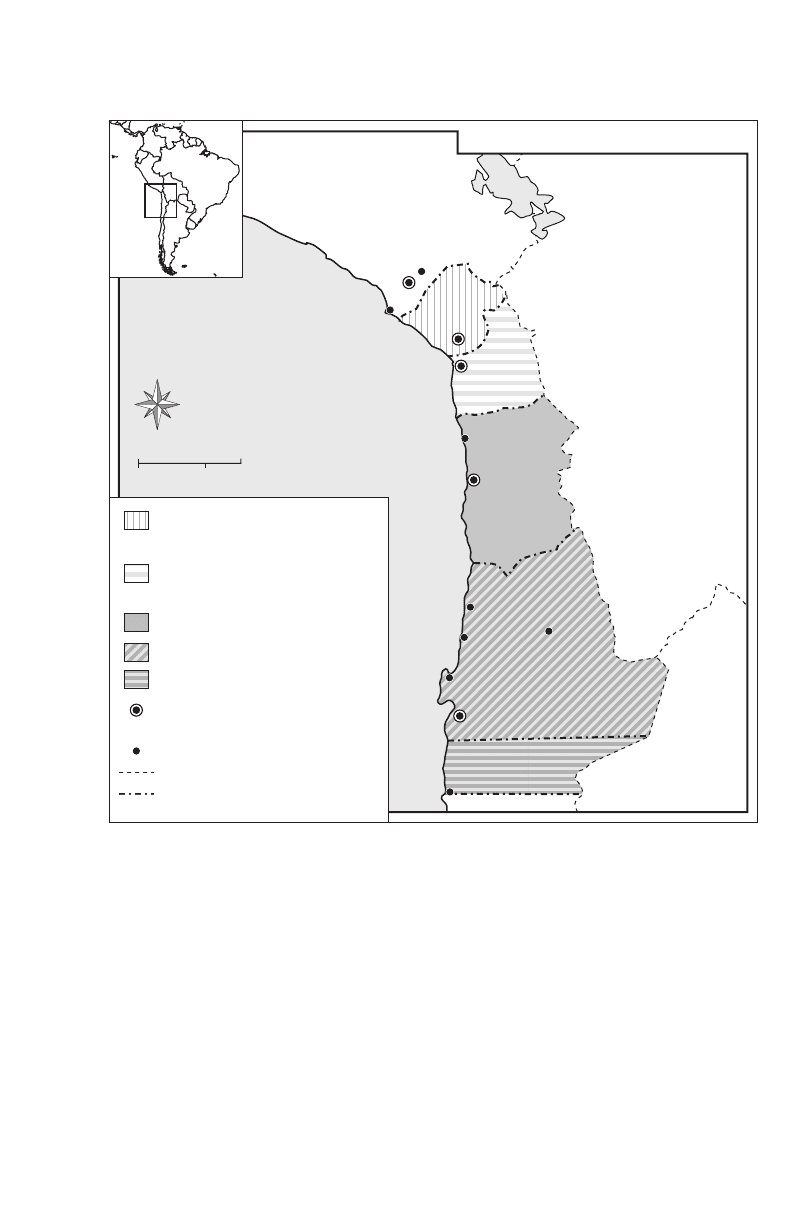
Pacific
Ocean
Lake
Titicaca
100 kilometers
100 miles
0
0
Tacna
Mejillones
Antofagasta
Paposo
TACNA
ARICA
ANTOFAGASTA
Tacna
Arica
Pisagua
Iquique
Tocopilla
Cobija
CalamaCalama
Mejillones
Antofagasta
Paposo
TACNA
ARICA
TARAPACA
ANTOFAGASTA
Moquegua
Torata
Ilo
C H I L EC H I L E
BOLIVIA
PERU
ARGENTINA
Disputed Nitrate Regions
SOUTH
AMERICA
SOUTH
AMERICA
N
Punta
Angamos
Present-day department or
province capital
Populated place
Contemporary national boundary
Disputed area boundary
Peruvian territory administered
by Chile, 1883–1929; awarded
to Peru by Chile, 1929
Peruvian territory administered
by Chile, 1883–1929; awarded
to Chile by Peru, 1929
Awarded to Chile by Peru, 1883
Awarded to Chile by Bolivia, 1883
Awarded to Chile by Bolivia, 1874
A BRIEF HISTORY OF PERU
146
The first battles of the land war also proved disastrous for the
Peruvian and Bolivian armies that attempted to defend the contested
southern nitrate provinces of Arica, Tacna, and Tarapacá. After tem-
porarily checking the Chilean forces in Tarapacá in November 1879,
the Peruvian and Bolivian armies were crushed in a series of losses to
the much better equipped and trained Chileans in Tacna and Arica. The
victors took complete control of what had been Peru’s southern
provinces, and all resistance there collapsed. President Daza of Bolivia
deserted his armies, forfeited his office, and fled the country. Peruvian
president Mariano Ignacio Prado (1826–1901), elected in 1876, fared
scarcely better. After commanding troops in the south, he returned to
Lima, handed over the government to Vice President Antonio de la
Puerta, and left for Europe, claiming he was going to seek help in the
war effort; in fact he deserted, too.
Peruvian national leadership disintegrated with the military defeat at
the hands of the Chileans and, over the following months and years,
became a tangle of competing figures who tried to seize office. Nicolás
Piérola, for example, ousted the vice president and proclaimed himself
president in December 1879. After peace talks arranged by the United
States failed, the Chileans landed a large army south of Lima and
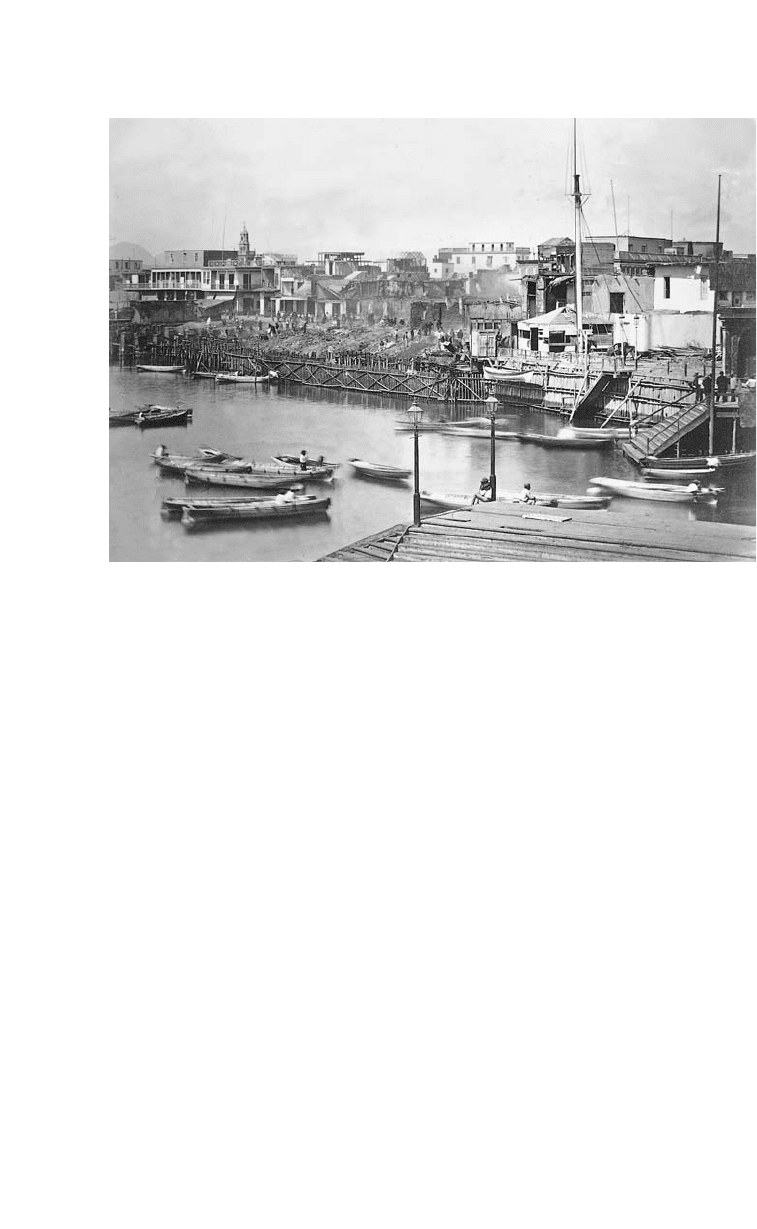
The harbor at Callao, shortly before it was invaded and occupied by Chilean forces (1881)
during the War of the Pacific
(Library of Congress)

147
THE WAR OF THE PACIFIC AND AFTER
advanced on the city, which surrendered in January 1881 after two
bloody Peruvian losses in the suburbs of San Juan and Miraflores.
Piérola fled to the mountains, and the Chileans occupied Lima, bring-
ing havoc and destruction. They looted the national library and even
carted off the animals from the zoo in addition to seizing property and
extorting cash from the residents.
Fragmented Leadership
The degree to which Peru’s popular classes participated, willingly or
unwillingly, in the war is a matter of debate, and so is the role played
by the military and political leaders. Chilean officials received strict
orders not to interfere with Peruvian Indian peasants, letting them
know that this was not their war, thus avoiding that Indians sided with
r
egional and national white elites. How deep-seated racial cleavages still
were after more than a half century of political independence from
Spain is evidenced by the conflicts between racial groups during the
A Political Critic’s
View of War
P
eru’s defeat in the War of the Pacific provoked many reactions
among Peruvian intellectuals, none more somber and scathing than
these comments by Peruvian writer and reformer Manuel González
Prada, published in 1894.
What is bad in the individual we judge to be good in the collectivity,
reducing good and evil to a simple question of numbers.The enormity
of a crime or vice transforms it into a praiseworthy action or into
virtue.We call the robbery of a million “business” and the garroting of
entire nations “a glorious deed.” The scaffold for the assassin;
apotheosis for the soldier. And, nevertheless, the obscure laborer who
kills a fellow worker, whether in revenge for some injury or to take his
money or his wife, does not deserve so much ignominy or punishment
as the “illustrious soldier” who kills twenty or forty thousand men to
gain glory or to win the field marshal’s baton . . .
When man leaves behind his atavistic ferociousness, war will be
remembered as a prehistoric barbarity, and famous and admired
warriors of today will figure in the sinister gallery of the devil’s children,
by the side of assassins, executioners, and butchers (1966, 46–47).

War of the Pacific. The collapse of national order brought on domestic
chaos and violence, most of it motivated by class or racial divisions.
Chinese and black laborers took the opportunity to assault haciendas
and the properties of the rich in protest of the mistreatment they had
suffered in previous years, Lima’s masses attacked Chinese grocery
stores, and Indian peasants took over highland haciendas.
The lack of national cohesiveness was most sharply demonstrated in
the confusion and confrontations among Peru’s would-be wartime lead-
ers. Over the course of the next 10 years (1879–89, approximately),
they often were as much in conflict among themselves as with the
invaders. Piérola, for example, withheld support from some Peruvian
troops and commanders in order to forestall future challenges to his
own power. In some places, however, such as the central highlands,
opposing racial-ethnic groups joined forces to fight for Peru, resisting
Chilean troops with a more united front. As a result, an incipient sense
of nationalism emerged in the wake of the war.
Since they did not want to negotiate with him, the Chilean occupiers
did not recognize Piérola’s claim to the presidency. Instead, with the
assistance of a group of “notables” from the Partido Civil, they desig-
nated the lawyer Francisco García Calderón (1834–1905) as the new
president. The Chilean generals declared the Lima barrio of La
Magdalena as neutral territory and allowed García Calderón to set up a
government there. García Calderón’s nomination deepened civil strife:
Piérola had widespread popular support as well as support from among
the Civilistas. In the following months neither president showed much
interest in facing the enemy. They were more concerned with their own
power struggle, while the Chilean army controlled the capital and most
of the Peruvian coast.
García Calderón failed to win support outside his small enclave, but
he did manage to obtain diplomatic support from the United States,
which offered to help him attain peace without territorial concessions
to Chile. This offer mainly was prompted by the belief of the U.S.
ambassador to Peru that the country might be ripe for U.S. annexation;
furthermore, U.S. Secretary of State James Blaine believed he could ben-
efit financially from a settlement. Both U.S. officials were frustrated in
the end, and U.S. involvement in the negotiations collapsed (Manrique
1995, 167).
García Calderón initiated peace talks with Chile, and he proved to be
a tough negotiator. He was willing to pay for a lost war; however, he
was unwilling to cede any territory to Chile, although Chile claimed by
right of conquest the southern province of Tarapacá, where Peru’s rich-
A BRIEF HISTORY OF PERU
148

est nitrate fields were located. In response to García Calderón’s hard
line, the Chileans in November 1881 dissolved his government and
exiled him to Chile. After much maneuvering from his position in the
highlands, Piérola gave up and left for Europe. In their places Admiral
Lizardo Montero declared himself president from his base in Arequipa.
His authority was challenged, however, by General Andrés Cáceres
(1833–1923), who had organized resistance forces in the highlands.
Emergence of Cáceres
Cáceres had hidden for three months in Lima after the Chilean invasion,
nursing wounds suffered in the Battle of Miraflores. He escaped to the
central highlands in April 1881 to join Piérola. Piérola feared Cáceres as
a rival for power but named him the military chief of the central depart-
ments before fleeing to Europe. Over the next two years Cáceres created
a 5,000-man army and won a sequence of victories against the Chileans
in the Breña Campaign in July 1882 in the Mantaro Valley at Pucará,
Marcavalle, and Concepción. The Chilean army lost 20 percent of its sol-
diers and Chilean troops were forced to retreat to Lima.
Cáceres’s successes in the central highlands had much to do with
how the relationships between haciendas and peasant communities had
developed in earlier decades, and the relative strength of its peasant
population. The Mantaro Valley was ethnically more heterogeneous
than other places in Peru, and it was more commercially advanced, with
long-standing links to urban cities, especially Huancayo and Lima.
Cáceres’s military talents were also a part of his success. He was a skill-
ful strategist, and, perhaps more important he was a landowner and flu-
ent Quechua speaker. Peasants referred to him as tayta (“father” or
“protector” in Quechua).
In spite of his pr
omising start, Cáceres was unable to stand up to new
Chilean offensives, in part because of the emergence of a new claimant
to Peruvian leadership, the northern hacienda owner Miguel Iglesias
(1830–1909) from Cajamarca, who had lost a son in the battles for
Lima. The Chileans recognized Iglesias as president because they
thought he would negotiate with them for peace. This turned out to be
correct, and in October 1883 Iglesias signed the Treaty of Ancón, which
technically ended the War of the Pacific. Under the terms of the treaty
Peru gave up Tarapacá province immediately. Chile was to administer
Tacna and Arica for 10 years, at which point a vote of the people of
these provinces would determine which country they belonged to; the
loser would receive 10 million pesos as compensation. Through the
149
THE WAR OF THE PACIFIC AND AFTER
A BRIEF HISTORY OF PERU
150
treaty the Chileans not only got Peru’s rich nitrate fields but also its
remaining guano reserves.
Iglesias was able to represent himself as the sole negotiator for Peru
because at the time Cáceres was not in a position to contest his claims.
When the central highland provinces had begun to show signs of eco-
nomic exhaustion and it became increasingly difficult to sustain a
standing army, Cáceres had decided to march north to attack Iglesias,
in an attempt to restore a unified political leadership. However, Chile
had mobilized all its available resources to simultaneously defend
Iglesias and attack Cáceres’s remaining troops in the central highlands.
Iglesias had not hesitated to provide the Chilean army with all the
information and resources they needed in order to administer a crush-
ing defeat to his rival Cáceres at the Battle of Huamachuco in July 1883.
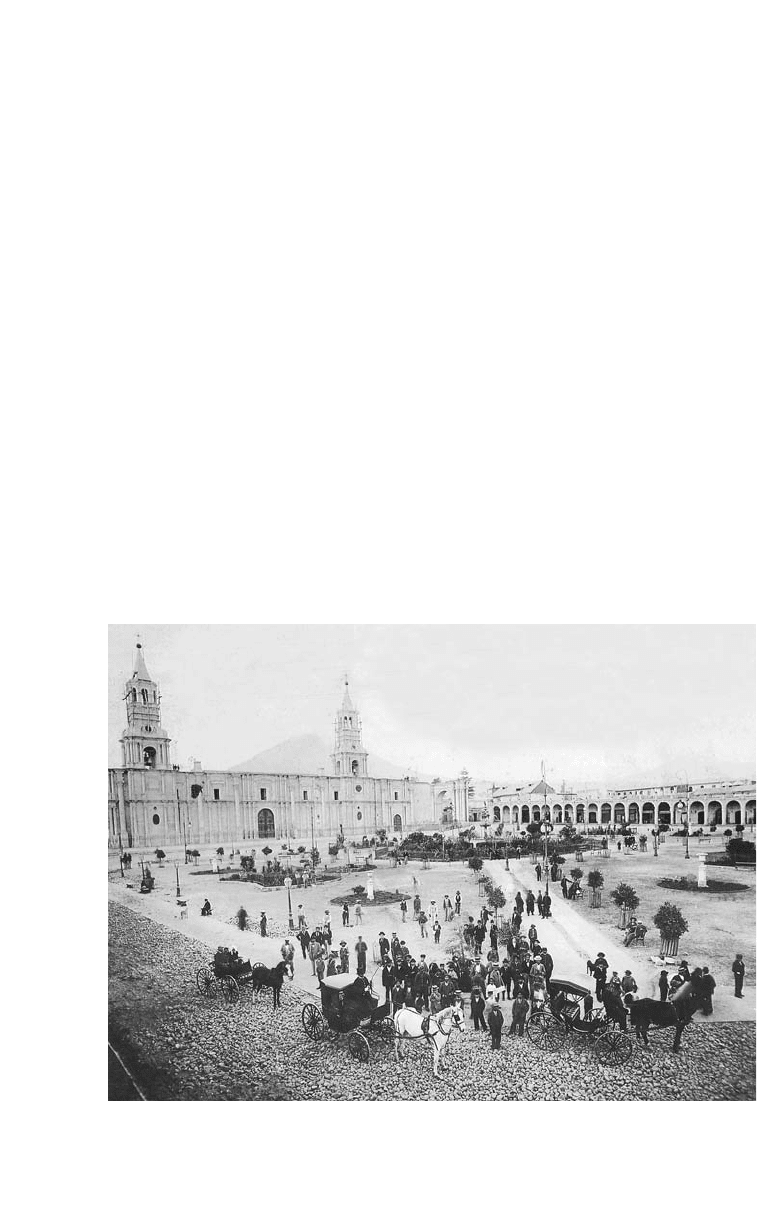
Meanwhile Admiral Montero had installed his government of Peru
first in Cajamarca and then, in August 1882, in Arequipa, where he
stayed until 1883. He refused support to Cáceres, in spite of promises
to do so. In fact, when the victorious Chilean army reached Arequipa
after the Battle of Huamachuco, it found a large cache of arms and other
The main plaza in Arequipa, the city where Admiral Lizardo Montero established his
headquarters and proclaimed himself president of Peru during the Chilean occupation.
(Reproduced with permission of the General Secretariat of the Organization of American States)

military items sent from Bolivia that Montero had withheld from
Cáceres; consequently Cáceres’s men fought the invaders wearing ojo-
tas (Indian sandals) and brandishing obsolete rifles. With the arrival of
the Chilean army Monter
o fled Arequipa across Lake Titicaca, going
first to Argentina and then to Europe. While crossing the lake he
appointed Cáceres president.
In June 1884 Cáceres finally recognized the peace treaty signed by
Iglesias, and this meant new civil strife. Cáceres and Iglesias led their
armies against each other until Iglesias, still the president, was defeated
in December 1885. Cáceres, then, won the elections in June 1886. War
against Chile was no longer feasible. Cáceres demanded that Chilean
troops leave Peru and allow Peruvians to resolve their disputes them-
selves without foreign interference. Chilean occupation had lasted
three years, during which coastal hacienda owners and city-based mer-
chants had had to pay cupos (cash reparations) to the Chilean army
under the thr
eat of destruction of their properties. Chilean generals
drew up a list of the 50 most prominent members of Lima’s society and
forced each to pay 20,000 pesos a month, an amount that was six times
the monthly salary of Peru’s president. The last Chilean troops pulled
out of Peruvian territory in August 1884, leaving the Peruvian state
economically and politically bankrupt.
The Postwar Era
The war against Chile was followed by civil war. Cáceres and Iglesias
continued fighting each other, in spite of the fact that they represented
the same economic interests, namely highland hacendados. Iglesias was
defeated in 1885, and in 1886 a provisional government called for elec-
tions. Cáceres—now transformed in the public mind into the hero of
the resistance against Chilean troops—was elected president. The
Partido Civil supported Cáceres, and the pierolistas, now folded into the
Democratic Par
ty (Partido Demócrata), boycotted the elections.
While pierolistas and supporters of Cáceres were waging their war, a
peasant uprising again shook Peru’s highlands beginning in 1885. Its
leader
, Pedro Pablo Atusparia (1840–87), was a varayoc (ethnic leader)
in Huaraz who protested the arbitrar
y reimposition of the contribución
única—the Indian tribute—amid economic devastation. A “pacifica-
tion” for
ce sent from Lima defeated the rebels and forced Atusparia to
surrender, but some of Atusparia’s more radical followers who advo-
cated the extermination of all whites continued to resist. Colonel José
Iraola, the commander of the suppression forces, obliterated entire
151
THE WAR OF THE PACIFIC AND AFTER

peasant villages. The final death toll was in the thousands. Atusparia
himself was spared, and when he met with Cáceres in 1886, two days
before his election as president, Cáceres promised Atusparia schools,
relief from head taxes, and protection of community lands as well as a
government scholarship for Atusparia’s son. None of these promises,
however, materialized.
After the peasant unrest subsided, Cáceres faced an accumulated
external debt of £51 million. Peru had not made payments on its exter-
nal debt since 1876. The annual interest payments amounted to £2.5 mil-
lion, but Peru’s annual budget had dropped to £1 million, approximately
one-fifth of what it had been prior to the war (Contreras and Cueto 2000,
165). The internal financial situation did not look any better. Beginning
in 1875 the Peruvian government had massively printed money to pay
for the expropriation of the nitrate fields, and during the war itself, more
paper money (now briefly known as “incas”) was printed. As a result,
paper money had completely devalued, and no one wanted to accept it.
Only two private banks had survived the war. The Peruvian government
had to find ways to solve these dire financial problems in order to rein-
troduce Peru into the international financial market.
One of the first steps was to try to reestablish—yet again—the Indian
tribute, in the form of a personal contribution” (contribución personal)
and only in one of Peru’s 18 depar
tments, namely Puno. In other places
the dislocation brought about by the war had greatly diminished the
power of local landholders and had undermined their ability to coerce
local peasants to accept state demands. Confronted with this situation,
the Peruvian state attempted to introduce fiscal decentralization but
with little success. Decentralization depended—in an almost circular
and contradictory way—on the tributes paid by peasants. In the
attempt to reconstruct the country on the local and regional level, the
revenues obtained from the contribución personal were turned over to
the depar
tmental boards (juntas departamentales) to be used to imple-
ment local infrastructure pr
ojects. Access to these fiscal resources pro-
voked often-violent confrontations between local power holders. What
was meant to give provinces a higher level of autonomy in the decision-
making process actually created tenser political relations in the coun-
tryside, where overall poverty provoked widespread banditry.
The Grace Contract
In 1889 President Cáceres signed a remarkable document, the Grace
Contract, the result of three years of hard and intense negotiations. The
A BRIEF HISTORY OF PERU
152

agreement was named after Michael Grace, the appointed representa-
tive of the British bondholders who held most of Peru’s huge debt. The
creditors organized themselves as the Peruvian Corporation, and Grace
claimed that his clients were the actual owners of Peru’s infrastructure.
It had been their loans that had been used to build the nation’s rail-
roads, irrigation systems, and public buildings, for example. Since Peru
lacked liquidity, Grace argued, his clients should be given use for 99
years for their own benefit of Peru’s resources, such as mines, land, rail-
roads, ports, and customs. He left open the questions of what would be
left to Peruvians to pay for their own recovery after the war or how Peru
could be, quite literally, managed from London.
President Cáceres encountered stern congressional opposition to
these propositions, so he dissolved congress and continued his negoti-
ations with Grace. At the end, in return for canceling Peru’s external
debt, the Peruvian Corporation took control of Peru’s railroads for 66
years, became owner of 810,000 acres in the Amazon basin, was
granted free navigational rights on Lake Titicaca, and received an
annual payment of £80,000, which was approximately 10 percent of the
national budget, for 33 years.
In spite of the draconian sound of these terms, the Grace Contract
ended up being quite beneficial to Peru. As a result of the contract the
Peruvian railroads were repaired and expanded from Callao to Cerro
de Pasco in 1904, as was the line from Mollendo to Puno and to Cuzco
in 1908. Moreover, only relatively few acres of Amazonian land were
actually delivered, and the £80,000 was only paid the first year
(Contreras and Cueto 2000, 168) (although later on, in compensation
for Peru’s default on this payment, the ownership of the railroads was
granted in perpetuity).
Overall the aftermath of the War of the Pacific marked a changed
foreign involvement. Whereas before the war foreign presence came
in the form of credits and commercial deals, afterward there were
direct foreign investments in key economic undertakings. After an
initial slowdown of Peru’s economy following the worldwide eco-
nomic crisis in the early 1890s, fresh, direct foreign investments
reached Peru to pay for the modernization of its ports and the expan-
sion of mining production and the refining of ores. Between 1897 and
1903, the world (including Peru) turned to the gold instead of silver
standard, and after 1897, only the state (no longer state-overseen pri-
vate banks) could mint money. The new currency was the libra peru-
ana (Peruvian pound), equal in value to the British pound and valued
at 10 silver soles.
153
THE WAR OF THE PACIFIC AND AFTER