
Hunefeldt C., Harris B. A Brief History of Peru
Подождите немного. Документ загружается.


of constitutional guarantees, and the jailing of 57 union leaders. In
November 1947 Haya de la Torre ordered Major Víctor Villanueva to
organize APRA brigades to bring down Bustamante’s “dictatorship.”
Rumors spread of an impending bloody insurrection. In February
1948 Bustamante appointed an entirely military cabinet, only to find
out later that his ministers had conspired with conservatives to over-
throw his government. In October 1948 APRA civil and military fol-
lowers in Callao began an uprising. Bustamante responded with force
and declared APRA illegal, a step that allowed him to hound aprista
leaders and followers. Bustamante’s uneasy coexistence with his
aprista and oligarchic tormentors was coming to an end.
Political conflicts had r
eached insurmountable hurdles. Peru’s prob-
lems were exacerbated by a U.S. withdrawal of support for democratic
governments because of its cold war fears of communism and by eco-
nomic crisis. Shortly after World War II, the United States cut back its
purchase of Peruvian goods, and revenues from export taxes dropped
sharply. To bring in revenue Bustamante tried to increase oil produc-
tion. Accordingly the government of Peru prepared a contract with the
International Petroleum Company to open for exploration the oil fields
of Sechura, a site that had become a national reserve during the
Benavides administration. APRA warmly supported this project,
whereas in business circles Peru’s wealthiest denounced it as a give-
away to foreigners. The contract was not signed.
Oligarchic voices were heard elsewhere as well. In April 1947 the
Gildemeisters, the owners of the largest sugar plantation on Peru’s
coast, refused to deliver the U.S. dollars earned by their hacienda.
Instead, the plantation attempted to pay its taxes and export revenues
in soles. The owners wanted to force Bustamante’s government to
unfreeze the exchange rate. On September 6, 1947, Bustamante agreed
to allow for a free dollar market conversion of 35 percent of the rev-
enues obtained from exports. Exporters, however, wanted all.
Only a few weeks after the aprista uprising in Callao and closely fol-
lowing the increasing pr
essures from coastal exporters, Odría,
Bustamante’s minister of government, staged a coup in Arequipa. This
new movement was christened the “Restorative Revolution” (revolución
restauradora). Bustamante realized he had to resign when Lima’s com-
mander
, General Zenón Noriega, refused to march to Arequipa, fearing
it would plunge the country into a bloodbath. An uninhibited persecu-
tion of apristas followed, and on January 3, 1949, Haya de la Torre
sought asylum in the Colombian embassy
, where he stayed for the next
five years.
A BRIEF HISTORY OF PERU
214

12
Dictatorships and
Reform (1948–1968)
T
he first years of the second half of the 20th century witnessed some
continuities from the earlier decades. Between 1948 and 1968 suc-
cessive governments expanded the role of the state and its bureaucracy
and attempted to achieve social integration and cohesiveness. The early
decades of the second half of the century also saw some marked differ-
ences. Peru’s population tripled from around 7 million to 22 million
people; massive migration from rural to urban areas began with the first
shantytown settlements around 1945, especially in Lima; and the gov-
ernment engaged in a dramatic expansion of educational efforts.
In the two decades between 1948 and 1968 Peru resumed an export-
oriented economic growth pattern. Initially the economy expanded as
a result of Europe’s reconstruction after World War II and the war in
Korea. During this period, Peru’s exports grew and reached pre-1929
heights. Foreign investment also increased. Acting as bookends to these
20 years were two military dictatorships, one led by Manuel Odría
(1897–1974) from 1948 to 1956 and the other by Juan Velasco
Alvarado (1910–77) from 1968 to 1975.
Eight Years of Odría
Odría, born in Tarma, was 51 years old and a brigadier general when he
became Peru’s dictator. A worldwide economic recession was just com-
ing to an end. During the Korean War (1950–53), prices for Peru’s
exports skyrocketed, and foreign investments had reached $800 million
by the end of Odría’s eight-year presidency—twice as much as at the
beginning of his tenure. Mining production and oil exports, in the hands
of foreign investors, increased state revenues from export taxes. The
drawback was an increased exchange rate: From 9.20 soles per dollar in
1942, at the end of Bustamante’s presidency, to 20.40 soles per dollar in
215

1949. In large measure this hike was the result of financial speculation
by two foreign enterprises, W. Grace and the Cerro de Pasco
Corporation, and of economic recommendations dating from 1931 by
the Kemmerer Mission. The latter an expert group of U.S. economists
invited to assess Peru’s economy, designed a plan that included an
adjustment and reform program for the country’s central financial and
fiscal system. The Kemmerer plan also called for stringent credit and
monetary policies, high central bank reserves, closure of several large
banks, and altered tax and customs codes. In addition it recommended
cancellation of official exchange rate parity, free price fluctuation, and a
modest increase of salaries. All these measures followed the exact wishes
of exporters and were implemented in late 1949. These economic
adjustments—along with strong assertions of control over dissidents by
Odría—resulted in a period of relative national well-being, political sta-
bility, and social peace, and exporters were held in check when they
once again tried to directly control the state.
Odría and his military junta did not see any need to reopen the
adjourned congress. Constitutional guarantees were suspended, and
the 1949 Law of Internal Security gave the government free rein to do
as it pleased. The judicial system was also shut down. By 1950 all apris-
tas and Communists had been forced underground and often when
their hiding places were found, the government did not hesitate to
shoot them. Odría’
s only opponent, General Ernesto Montagne, soon
found himself in prison as well. Having cleared the political grounds
Odría decided to run as sole candidate for election in 1950 to a regular
six-year term. Not surprisingly he gathered 500,000 votes. Protests
from students were bloodily suppressed by the police, and a general
strike in Arequipa in June did not hamper Odría from becoming a duly
installed constitutional president, based on support from Lima’s grow-
ing shantytowns.
Odría’s political theme was “Health, Education, and Work.” His poli-
cies and public statements were much influenced by his contemporary
in Argentina, Juan Domingo Perón. According to historian Frederick
Pike Odría groomed his wife, María Delgado de Odría to play a role in
Peru similar to Evita Perón’s in Argentina by appearing to be a
patroness of the poor. She handed out Christmas gifts to poor children
and provided large amounts of government-financed charity through
the María Delgado de Odría Center of Social Assistance (1967, 291).
Odría also expanded the social security system.
In spite of such public displays of charity a survey at the end of
Odría’s presidency showed that almost half of primary-school children
A BRIEF HISTORY OF PERU
216

in the country did not have a desk in their school building. Such token
bows toward social concerns were nevertheless needed to respond to
growing demands from Peru’s popular classes. Odría, while making
some concessions to these demands, was more interested in building
projects, especially in Lima. Monumental buildings, such as the
Ministries of Education, Commerce, and Labor on the Abancay Avenue
were begun, as were the Employee Hospital on Salaverry Avenue, the
Public Health Cooperative Service, and Lima’s barracks-like large pub-
lic schools. In Peru’s 1949 budget public spending increased by 45 per-
cent from the year before, and between 1950 and 1955 public spending
amounted to 13 percent of Peru’s annual gross national product.
All this cost more money than Odría had in his state coffers, and he
resorted to printing paper money. This brought on inflation, and by
1956 the cost of living was twice as high as in 1948 and per-capita food
consumption declined. Arequipa soon was up in arms again demanding
guarantees for free 1956 elections. Odría’s promises to remove his hated
minister of government, Alejandro Esparza Zañartu, and to suspend the
Law of Internal Security calmed arequipeños.
Former presidents Prado and Bustamante returned to Peru and
aligned under a new party, the National Coalition. APRA was reorga-
nized after Haya de la T
orre won a lawsuit at the Hague International
Court. The coalition gained rapid and widespread support, and Odría
lost ground. Another candidate, Fernando Belaúnde Terry, 44 years old
and an architect trained at the University of Texas, formed the National
Front of Democratic Youth, basing his support on Peru’s predominantly
young population. Belaúnde Terry had been elected to the Chamber of
Deputies in 1945, his first public political office. He was a nephew of
Víctor Andrés Belaúnde and the son of Rafael Belaúnde, the first prime
minister during the short-lived Bustamante regime.
The Odría regime saw Belaúnde Terry as a threat to its continued
hold on power even before his party had been officially registered. To
forestall its registration Odría and his advisers exerted great pressure on
the National Electoral Jury (Jurado Nacional de Elecciones). Belaúnde
Terry hastily returned to Lima and called for a mass rally in the Plaza
San Martín. Thousands of people followed his call, and after delivering
a powerful speech Belaúnde Terry led a procession to the nearby head-
quarters of the National Electoral Jury. The police were ready and fired
tear gas and water from fire hoses into the marching crowd in an
attempt to halt the procession. Even though most of his supporters
were scattered by the attack, Belaúnde Terry seized a Peruvian flag and
marched forward to confront the members of the national jury with an
217
DICTATORSHIPS AND REFORM

ultimatum: If he was not officially inscribed on the electoral list as a
candidate, Odría would have to face the consequences (Pike 1967,
294–295). Soon afterward, the dictator backed off, the National
Electoral Jury followed suit, and Belaúnde’s National Front of
Democratic Youth became a legal political party.
Prado’s Second Presidency
Nonetheless it was Manuel Prado who won the election in 1956, with
support from APRA. The official candidate, Hernando de Lavalle, had
no chance, and Belaúnde Terry could not overcome the popular combi-
nation of APRA and Prado. Those who objected to APRA’s support of
Prado called the alliance “la convivencia” or “super-convivencia,” imply-
ing an illegal and immoral r
elationship. In 1956 three times as many
people voted as in 1950, a result of heightened literacy; still, the num-
bers represented only about one-third of eligible voters. As a result of
the election Prado not only became president again; he was also the
owner of what some have called the “Prado Empire.” He and his family
owned the Banco Popular, the Popular and Porvenir Insurance
Companies, the textile factories Santa Catalina and Manufacturas del
Centro, and large urbanization projects.
Politically Prado opened democratic avenues. His government
allowed for the organization of unions and a return of the Communists
and apristas. In response to the growing demographic pressure in Peru’s
highlands Prado cr
eated the Institute for Agrarian Reform and
Colonization. This institute did not engage directly in agrarian reform,
but it conducted research that was used by later governments to begin
an agrarian reform in the country.
Prado’s minister of the treasury, José Pardo y Barreda, attempted to
peg the sol artificially at the level of 19 to the dollar. Between 1950 and
1955 Peru’s export tonnage had tripled, but the value of exports had
only increased from $200 million to $330 million. Imports had dou-
bled; Peru was importing one-fourth of its consumer goods and half of
its capital goods. As a consequence, dollar reserves at the Central Bank
dwindled. Pedro Beltrán, in the meantime, wrote severe editorial
attacks against the government in his newspaper, La Prensa, and in a
bid to co-opt him, Prado invited Beltrán to become his prime minister
and minister of the tr
easury. Though hesitant, Beltrán accepted.
With Beltrán’s appointment as minister for economic affairs in 1958,
economic policies under Prado became market oriented, marking, per-
haps, Peru’s first attempt at neoliberalism. True to his beliefs Beltrán
A BRIEF HISTORY OF PERU
218

was eager to cancel all consumer food subsidies, adjust Peruvian oil
prices to international prices, and in general diminish the state’s inter-
vention in economic issues. As a result of these policies, Prado did not
pursue the intensive industrialization project he had hoped to under-
take. He still opened a steel factory in Chimbote, however, and together
with increasingly better fishing on Peru’s coast it turned Chimbote from
a fishing village into a city. Despite economic reforms oligarchs contin-
ued to dominate agrarian exports on Peru’s northern coast, and oil, cop-
per, and iron mines remained in foreign hands. During Beltrán’s tenure
at the economic ministry, Peru experienced a 4.5 percent annual
increase in its gross national product, and the state began to replenish
its foreign currency reserves. The rich became richer, the landless still
had no land, and agrarian per-capita production continued to decrease.
By 1950 agrarian exports represented approximately 50 percent of all
Peruvian exports. Although agrarian production kept rising in the fol-
lowing years, it accounted for a decreasing proportion of total exports,
and toward 1960 mining and fishing exports became relatively more
important. In 1969 agrarian exports amounted to 16.3 percent of all
exports, mining made up 55.0 percent, and fish and fishmeal exports
amounted to 25.6 percent. Fishmeal, initially produced as a fertilizer to
replace guano, found a high demand in European and U.S. markets to
feed pigs and chicken. Rising to meet this demand, Peru expanded its
fishing fleet and became ever more profitable. Peru even began to build
its own ships. In the early 1960s the fish industry employed approxi-
mately 30,000 people, and in 1964 Peru was the world’s largest fish
exporter. Growing exports, however, led to overexploitation of fish, and
in 1973, when the Peruvian government nationalized the fishing indus-
try, the industry was in crisis. Thanks to the efficiency of modern fish-
ing technology, there were no more fish left to feed European and U.S.
pigs and chicken.
Peru’s balance of trade was in deep trouble in 1962, when Beltrán
made a run at the presidency. Faced with an open rebuff during a polit-
ical rally, he withdrew and instead watched the electoral process from
the sidelines.
Changing Leadership
The 1962 elections had seven presidential candidates; however, only
three had any chance of winning the elections: Haya de la Torre, polled
558,000 votes; Belaúnde Terry received 544,000 votes; and Odría,
481,000. No single candidate had obtained the absolute majority
219
DICTATORSHIPS AND REFORM

A BRIEF HISTORY OF PERU
220
required, which forced these parties to negotiate agreements among
themselves. Amid accusations of fraud, Haya de la Torre struck a deal
with his former enemy Odría, who had once said that Haya de la Torre
was not morally worthy of Peruvian citizenship and who had shed more
aprista blood than any other Peruvian leader. Beltrán, who had sworn
unrelenting opposition to APRA, soon joined the Odría-Haya alliance.
T
en days before congress had to take a final decision on who would
become president, the military took over and exiled Prado to Paris.
APRA had gained control of the country as a result of their majority in
congress, but Peru’s military was determined not to allow APRA to
command the country, even if this meant unseating Odría, who would
have been the nominated president based on the earlier deal with Haya
de la Torre.
Peruvian Writers:
JosÉ MarÍa Arguedas and
Mario Vargas Llosa
P
olitical changes and social conditions during the 1950s and 1960s
were captured by two of Peru’s most renowned writers, José
María Arguedas (1911–69) and Mario Vargas Llosa (1936– ).
Arguedas was a mestizo from Andahuaylas in Peru’s highlands. During
the Prado (1939–45) and Odría (1948–56) regimes he was working at
the San Marcos University in Lima. In his novel Yawar Fiesta (1941) he
documented the deep-seated antag
onism between modernity and
Andean Indian culture from the perspective of an Indian community. In
Los ríos profundos (1958) Arguedas portrayed people and their social
relations in Peru’s southern Andes. He paralleled his literary endeavors
with anthropological research and published several works on ethnology
and folklore meant to reassess Peru’s indigenous cultures. His last novel
before he committed suicide was El zorro de arriba y el zorro de abajo. This
unfinished novel deals with Chimbote’s migrant workers.
Vargas Llosa was born in Arequipa. His novels, La ciudad y los perros
(1962), La casa verde (1966), and Conversaciones en la catedral (1969),
created a new national literary genre by dealing with nonindigenous
themes.Vargas Llosa was interested in exploring Peru’s cities, the mid-
dle class and the poor in the city, and their moral and religious makeup.
His depiction of the military and life in the barracks is unparalleled.
221
DICTATORSHIPS AND REFORM
The head of the joint chiefs of staff, General Ricardo Pérez Godoy,
became the president of a ruling military junta. New elections were
planned within a year, and Pérez Godoy refrained from pursuing vin-
dictive policies. Apristas and Communists were left unhindered, a free
pr
ess continued, and individual liberties were respected, at least until
January 1963, when the military junta staged a roundup and imprison-
ment of some 1,000 people accused of being Communists or having
communist affiliations. Pérez Godoy believed in the need for deep
changes in Peru, changes he could not see happening either under
Odría’s or Haya de la Torre’s command.
In an article published in the U.S. magazine Life, Haya de la Torre
wr
ote that “democracy and capitalism were the solution to the world’s
problems.” His views were indeed far removed from what he had
thought and said in the 1930s. In response many younger and more
radical apristas left the party, and some even became guerrilla leaders
and joined radical left gr
oups. Such was the case of Luis de la Puente
Uceda, who led the most important guerrilla movement in the 1960s.
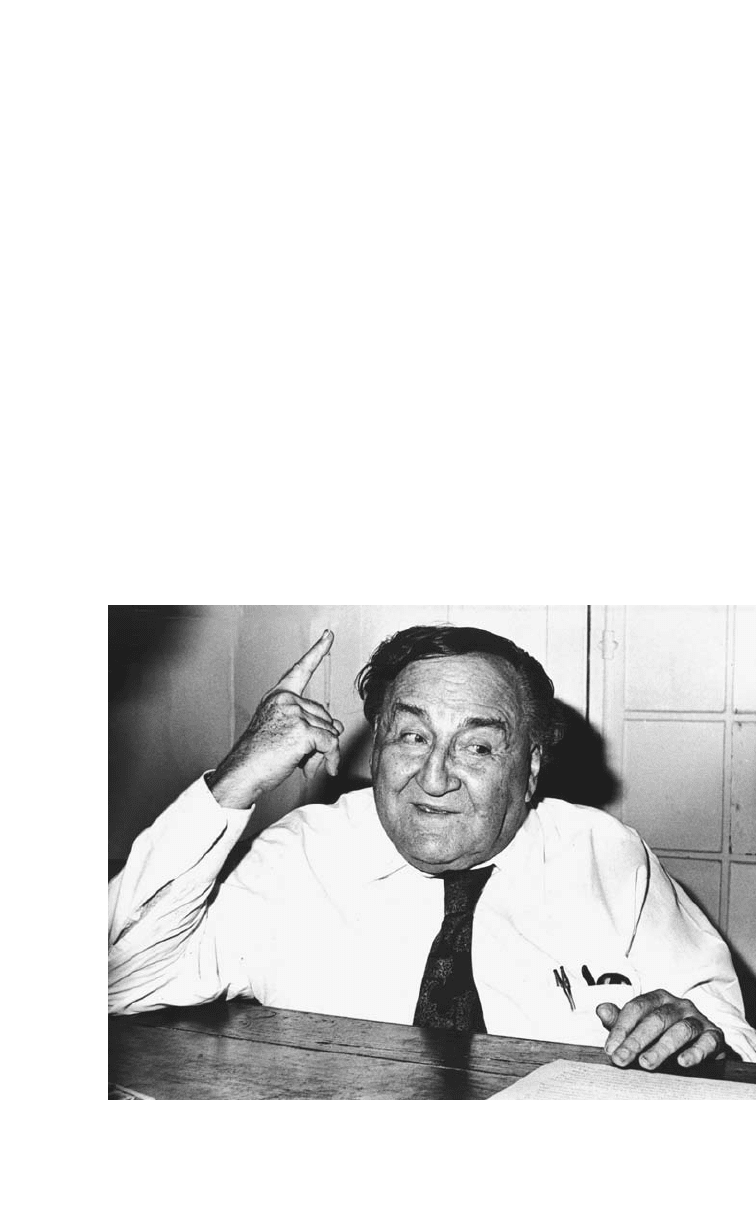
Victor Raúl Haya de la Torre became the leading candidate for the presidency in 1962 after he
forged an alliance with former enemies Manuel Odría and Pedro Beltrán, but a military coup
canceled the election.
(Photo by Caretas/Andes y Mares)

In only one year, Pérez Godoy established an institute to plan devel-
opment (Instituto de Planificación), a bank to extend low-interest cred-
its to purchase inexpensive homes (Banco de la Vivienda), and a
housing agency to carry out slum-clearance projects (Junta Nacional de
la Vivienda). In addition several pilot land-reform projects began, new
regions were opened for colonization, and peasants and colonizers were
given credit facilities.
Belaúnde Terry’s Presidency
For some Pérez Godoy was too reform oriented; for others he exhib-
ited too much ego. Such criticisms led to a reshuffling within the
junta. Pérez Godoy was demoted in 1963, and General Nicolás
Lindley replaced him as president. The new junta abided by the free
election pledge, and in the same year Belaúnde Terry became presi-
dent with 39 percent of the votes. Apristas and supporters of Odría
got 34 and 26 per
cent, respectively, and in parliament, the congres-
sional coalition APRA-UNO (Alliance for Popular Revolution in
America–National Union of Odría) made Belaúnde Terry’s attempts
at reform almost impossible. The constitution Peru had in the 1960s
did not provide a mechanism to reconcile and to mediate between
the executive and legislative branches. The president designated his
ministers, but they could be deposed by the National Assembly.
Thus, opposition in congress could prevent any action for an entire
presidential term of six years.
Belaúnde Terry, however, had big plans and found increasing popu-
lar support. With moderation and compromise, and without respite,
he had campaigned throughout the country between July 1962 and
June 1963. In the wake of his campaign he gained adherents from
members of the lower middle class who were dissatisfied with APRA’s
turn to the right, from apristas who criticized the pact with Odría,
from Peru’
s disenfranchised, and from many of the more enlightened
members of the well-to-do. Last but not least Belaúnde Terry could
also count on a discreet military junta and a willing Catholic clergy.
One of his first steps was to call for municipal elections. Municipal
authorities, following a pattern established by Leguía (1919–30), had
been arbitrarily designated. In the first municipal elections in 1963
and 1966, most mayors came from the ranks of Belaúnde Terry’s
renamed party, the governing Acción Popular (AP), and the
Democracia Cristiana (DC), led by Héctor Cornejo Chávez. To the
chagrin of the APRA-UNO, which had hoped to score a victory with
A BRIEF HISTORY OF PERU
222

María Delgado de Odría as their candidate for Lima’s mayoralty, Luis
Bedoya Reyes, a close friend of Belaúnde Terry, won overwhelmingly.
Neither of the two winning parties had a well-defined government
plan. The DC denounced social injustices and labeled capitalism as cru-
elly exploitative in its very essence. Capitalism, in the party’s view,
should be replaced by a somewhat undefined kind of communitarian-
ism following socialist principles. The AP was more of an assembly of
important personalities following the call of a charismatic leader, or, as
some put it, a dreamer.
Anticipating Alejandro Toledo (who became president in 2001),
Belaúnde Terry announced that his economic policies would follow
those of Pachacútec, and he described such policies as “the conquest
of Peru by Peruvians.” He visited “every corner” of the country on
muleback. To some he sounded much like a socialist indigenista of
the Mariátegui tradition. His most grandiose pr
oject—also following
Incan design—was the construction of the Marginal, a highway along
the edges of the jungle in the eastern Andes, connecting Perú with
Buenos Aires, Argentina, and Asunción, Paraguay, to the south and
Caracas, Venezuela, to the north. Besides improving travel, this move
was also meant to alleviate migrant pressure on Lima by resettling
highland Indians into the eastern slopes of the Andes to produce
food for coastal and city-based laborers. Construction, however, was
never finished.
In the meantime problems attendant upon land distribution and use
had staggering proportions. Less than 2 percent of Peru’s territory was
under cultivation. Only half an acre per capita of land produced domes-
tic food, a number woefully inadequate for a decent diet for a growing
population.
Response to Belaúnde Terry’s attempts at agrarian reform was luke-
warm, and he confronted solid opposition from Peru’s large coastal
landowners. During his presidency coastal plantations were left intact.
Only a little more than 400,000 acres (out of a total of 11 million acres of
cultivable land) were subjected to expropriation, mainly “idle” land of
sierra estates, for which the owners received government-designated com-
pensation. More important perhaps was Belaúnde Terry’s effort to develop
peasant communities. By the end of 1965 more than 2,000 of the esti-
mated 5,000 Indian communities had been surveyed and their leaders
engaged in building roads, clinics, and schools with modest financial sup-
port from the government. Often these development projects were staffed
with volunteers, young and usually urban Peruvians, mostly university
students from medicine, engineering, veterinary, and agronomy programs.
223
DICTATORSHIPS AND REFORM