
Klipp E., Herwig R., Kowald A., Wierling C., Lehrach H. Systems Biology in Practice: Concepts, Implementation and Application
Подождите немного. Документ загружается.


In inducible systems only the R form associates with the operator. Interaction
with the effector (here: inducer) inactivates the repressor and permits transcription.
In repressible systems is the R‘ form is active. Transcription happens in absence of
the effector (here: repressor).
The lac operon is controlled by four processes, which are detailed below: (1) the re-
pression of the operator, (2) the derepression in the presence of lactose, (3) the pro-
moter activation, and (4) the catabolite repression.
1. If the repressor binds to the operator sequence, the RNA polymerase cannot start the
transcription of these neighboring genes. Since the binding of a regulator protein
suppresses the transcription, this kind of genetic control is a negative regulation.
2. In the presence of lactose in the cell, a fraction of lactose is transformed by b-galac-
tosidase into an inducer I (allolactose). The inducer binds to the repressor R and in-
duces an allosteric conformational change; the repressor dissociates from the DNA
and liberates the operator O. The transcription can start, and the genes are said to
be derepressed. Consequently, the cells can produce the enzymes for the degrada-
tion of lactose only in the presence of lactose. The entry of lactose is facilitated by
permease M, which is a positive feedback mechanism. The transport of lactose by
permease is inhibited by glucose, an effect known as inducer exclusion.
3. The promoter of the lac operon is relatively weak and binds the RNA polymerase
loosely. The activity of the polymerase can be enhanced by the action of a gene ac-
tivator protein, which binds to a neighboring DNA sequence, enhances the contact
with the polymerase, and increases the probability of a transcription start. This
phenomenon is a positive regulation, since the presence of the activator leads to
an increase in the transcription rate. Lack of glucose leads to an intracellular in-
crease of cyclic AMP. The cAMP binds to the cAMP receptor protein, CRP, and
causes a conformational change of this protein such that the whole complex can
bind to the DNA near the lac promoter and enhances the transcription of the
neighboring genes.
4. The remainder of the lactose and allolactose are hydrolyzed to galactose and glu-
cose, which enter glycolysis and the Krebs cycle. If the concentration of glucose in
the cell is high enough, then the concentration of cAMP decreases, it dissociates
from CRP, and the transcription of the genes is significantly reduced. Glucose ex-
erts in this way a negative feedback on its own formation.
In the case of the lac operon the lactose repressor protein (negative regulation)
and the CRP (positive regulation) cooperate, yielding the observed gene expression
pattern. This ensures that the cells can react on the nutrient supply without wasting
energy on the expression of currently unnecessary genes.
8.4.2
The Model According to Griffith
This model (Griffith 1968a) considers the activation of the genes, the formation of
mRNA, the synthesis of the enzymes permease and b-galactosidase, and the degra-
280
8 Modeling of Gene Expression
dation of lactose. Permease supports the transport of lactose through the bacterial
membrane. b-galactosidase isomerizes lactose to allolactose and catalyzes the clea-
vage of lactose to glucose and galactose.
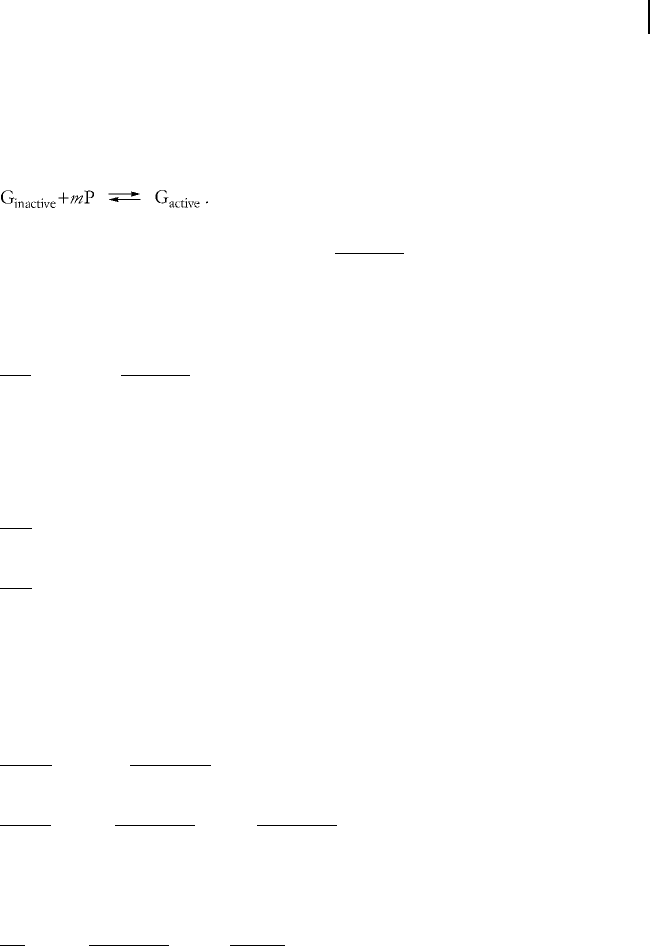
Due to fluctuations, the genes G are rendered active even by trace amounts of allo-
lactose (P).
(8-15)
The portion of active gene is given by p
P
m
k
m
eq
P
m
. The concentration of mRNA
(M) is determined by a basal production rate, M
0
, and a degradation rate, k
2
M,as
well as by the production from activated gene:
dM
dt
M
0
k
1
P
m
k
m
eq
P
m
k
2
M : (8-16)
The concentration changes of the enzymes permease (E
1
) and b-galactosidase (E
2
)
are given by production from mRNA and degradation:
dE
1
dt
c
1
M d
1
E
1
dE
2
dt
c
2
M d
2
E
2
: (8-17)
The uptake of lactose from the external (
ex
) into the internal (
int
) of the bacterial
cell is mediated by permease (E
1
), and the decay of lactose depends on b-galactosi-
dase (E
2
):
dLac
ex
dt
s
0
E
1
Lac
ex
k
0
Lac
ex
dLac
in
dt
s
0
E
1
Lac
ex
k
0
Lac
ex
s
1
E
2
Lac
in
k
S
Lac
in
: (8-18)
Allolactose is produced from lactose and converted to glucose and galactose:
dP
dt
s
1
E
2
Lac
in
k
S
Lac
in
s
2
E
2
P
k
P
P
: (8-19)
The equation system in Eqs. (8-16)–(8-19) has been simplified using the following
assumptions: (1) the quasi-steady-state approximation (Section 5.2.7) applies for the
concentration of mRNA; (2) the concentrations of the enzymes are equal, i. e.,
E
1
= E
2
, as well as their rate constants of degradation, i.e., d
1
= d
2
; and (3) there is no
delay in the conversion of lactose into allolactose, expressed by dLac
in
/dt =0.
281
8.4 Modeling the Regulation of Operons in E. coli
For the sake of simplicity, dimensionless variables are considered, i.e., lac = Lac
ex
/
k
0
, p = P/k
P
, e = E/e
0
, and t = t/t
0
. Taken together, this yields the final system of equa-
tions
de
dt
m
0
p
m
k
m
p
m
e e
dp
dt
m e
lac
1 lac
l
p
1 p
dlac
dt
e
lac
1 lac
; (8-20)
with e
0
c
1
k
0
k
1
s
0
k
2
; t
0
k
0
s
0
e
0
; l
s
2
s
0
; m
k
0
k
p
; k
k
eq
k
p
; m
0
M
0
k
1
; and e t
0
d
1
:
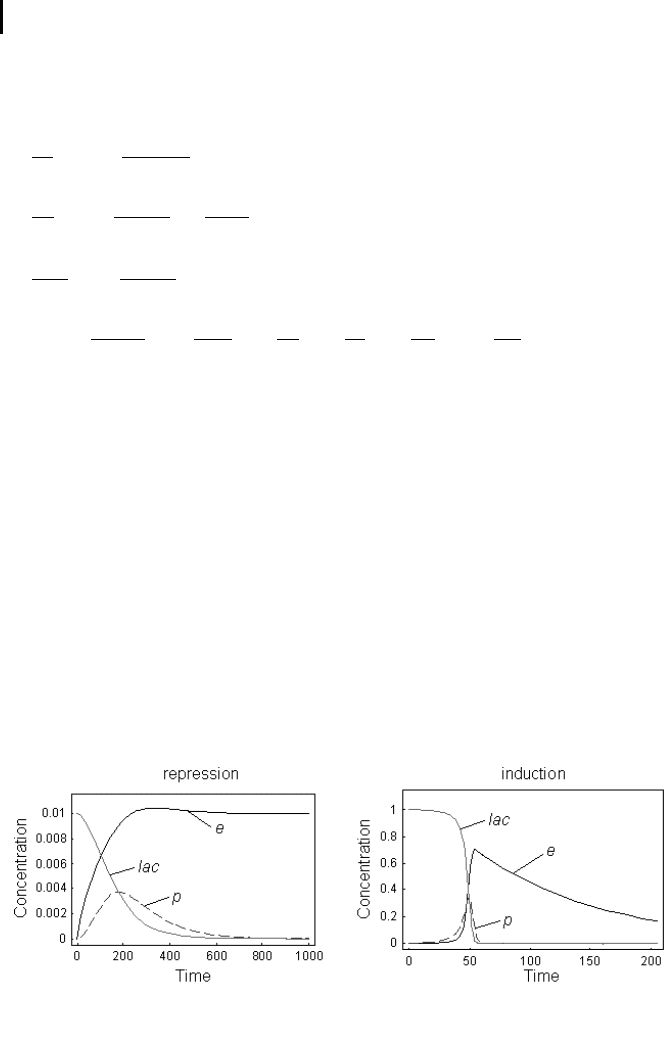
The temporal behavior of this system for low and high external initial concentra-
tion of lactose is represented in Fig. 8.8.
For low initial concentration of lac, there is only a weak activation of gene expres-
sion, resulting in a low enzyme concentration. For high concentration of lac, the pro-
duction of the enzyme is activated as long as its substrate – lac – is available.
8.4.3
The Model According to Nicolis and Prigogine
This model includes more details of the gene expression regulation than the model
of Griffith. It comprises the action of the repressor, the inducer, and the subsequent
enzyme synthesis. The corresponding chemical steps are represented in Fig. 8.9.
Reaction 1 describes the equilibrium between the inactive (R
i
) and the active (R
a
)
form of the repressor. It should be noted that this is a fairly simplified scheme since
282
8 Modeling of Gene Expression
Fig. 8.8 Temporal behavior of compounds in
the operon model of Griffith. Left: Adding of a
low amount of lactose leads to very short activa-
tion of gene and a low amount of structural pro-
teins. Right: A large amount of lactose stimu-
lates gene expression strongly and provokes
pronounced increase of structural proteins,
which decays as soon as lactose is metabolized.
Parameters: m = l = k =1,m
0
=1,e =1,m =1.
Initial conditions: p (0) = 0, e(0) = 0,
lac(0) = 0.01 (A), lac(0) = 1.0 (B). Note different
axes scaling.
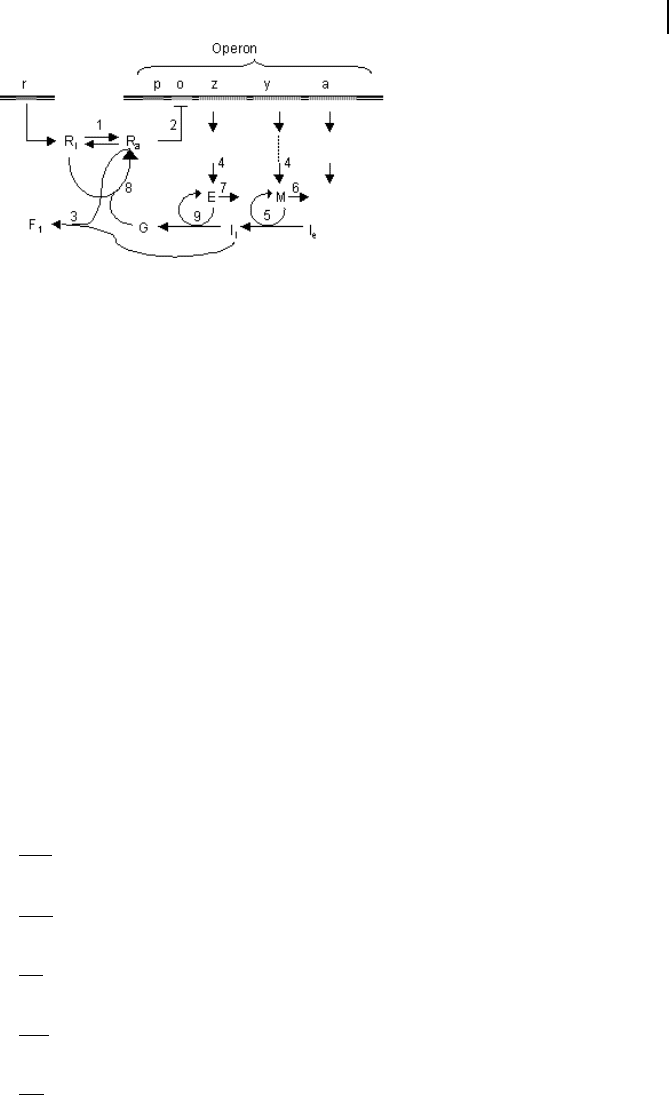
the repressor is, in fact, an allosteric protein with four subunits. In reaction 2 the ac-
tive form of the repressor binds reversibly to the free operator O
f
and forms a complex
O
c
, which prevents the access of the RNA polymerase to the promoter. The presence
of n
I
molecules of the inducer I
i
causes a conformational change of the active repres-
sor to the form F
1
, which dissociates from the operator in reaction 3. If the operator is
free, the RNA polymerase can bind in reaction 4 to the promoter and transcribe the
structural genes; Z represents the amino acid pool. The permease facilitates the entry
of inducer from the external medium (I
e
) into the cell (I
i
). This transport process
(reaction 5) comprises many steps. An accumulation of I
i
in the cell is possible if
k
5
4k
–5
. Reactions 6 and 7 represent the dilution of the enzymes in the cell. Besides
stimulating the derepression of lac operon, the inducer (lactose/allolactose) is also
metabolized to glucose under the action of enzyme E in reaction 9. Reaction 8 de-
scribes the catabolite repression. Glucose (G), which has been formed from lactose,
has a stimulating effect on the formation of an active repressor. This reaction, like re-
action 3, is cooperative. It should be kept in mind that all reactions represent complex
phenomena, which involve several steps and could be described in much more detail.
For the system outlined, a set of ODEs describes the temporal behavior of the reac-
tants. Assuming homogeneity in the extra- and intracellular medium, the influence
of diffusion will be neglected. Inactive repressor R
i
, amino acids Z, and the repressor
form F
1
are assumed to be in excess and are treated as constants.
dR
a
dt
k
1
R
i
k
1
R
a
k
2
R
a
O
f
k
2
O
c
k
3
R
a
I
n
I
i
k
3
F
1
k
8
R
i
G
n
G
k
8
R
a
D
dO
f
dt
k
2
R
a
O
f
k
2
O
c
dE
dt
Zk
4
O
f
k
7
E
dM
dt
Zk
4
O
f
k
6
M
dI
i
dt
n
I
k
3
R
a
I
n
I
i
n
I
k
3
F
1
k
5
I
e
M k
5
I
i
M k
9
I
i
E
283
8.4 Modeling the Regulation of Operons in E. coli
Fig. 8.9 The lac operon model of
Nicolis and Prigogine. The structural
genes z and y code for proteins E and
M, and their expression is regulated by
operon o. The repressor is encoded by
gene r; active repressor R
a
prevents
transcription of the operon. In addition
to the Griffith model, the uptake of in-
ducer I catalyzed by protein M, the reac-
tion of inducer to glucose catalyzed by
protein E, and the catabolite repression
exerted by glucose are considered.

dG
dt
n
G
k
8
R
i
G
n
G
n
G
k
8
R
a
D k
9
I
i
E : (8-21)
The amount of total operator is conserved in the cell, which is why the set of equa-
tions in Eq. (8-21) has to be considered together with
O
f
O
c
w const: (8-22)
In the following, the steady-state characteristics and the time-dependent behavior
of the model will be analyzed. Some of the quantities entering this model are known
from experiments: R
a
, F
1
, w, Z, k
2
, k
–2
, k
3
, k
–3
, k
5
, and k
–5
. The stoichiometric coeffi-
cients in reactions 3 and 9 are chosen as n
I
= n
G
= 2. The remaining constants I
e
, k
1
,
k
–1
, k
4
, k
6
, k
7
, k
8
, k
–8
, and k
9
are used as parameters in the numerical calculations.
The equation system can be simplified a bit by setting
k
8
k
8
D
m k
1
k
8
t k
1
R
i
k
3
F
1
; (8-23)
which leads to the following system of ODEs:
dR
a
dt
t mR
a
k
2
R
a
O
f
k
2
w O
f
k
3
R
a
I
2
i
k
8
R
i
G
2
dO
f
dt
k
2
R
a
O
f
k
2
w O
f
dE
dt
Zk
4
O
f
k
7
E
dM
dt
Zk
4
O
f
k
6
M
dI
i
dt
2 k
3
R
a
I
2
i
2 k
3
F
1
k
5
I
e
M k
5
I
i
M k
9
I
i
E
dG
dt
2 k
8
R
i
G
2
2 k
8
R
a
k
9
I
i
E : (8-24)
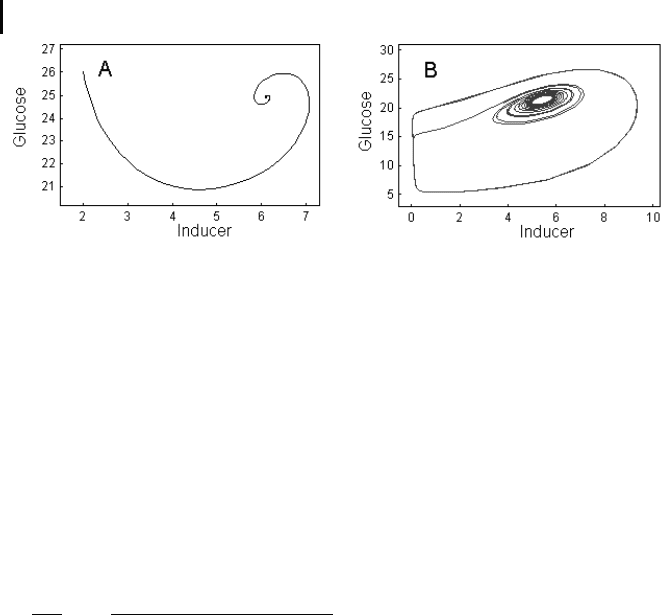
Depending on the values of the parameters, the dynamic behavior of the equation
system in Eq. (8-24) shows several interesting features, including “all-or-none” tran-
sitions and oscillations.
Neglecting the catabolite repression (reactions 8 and 9 or setting k
8
= k
–8
= k
9
= 0),
the steady state shows a sigmoid dependence of the concentration E on the external
inducer I
e
. The lower level is at 10
–6
, the upper level at 3710
–3
, which corresponds to
the experimentally determined value. This sigmoid switch can be interpreted as an
all-or-none transition depending on the inducer concentration.
284
8 Modeling of Gene Expression
Note that the system has multiple steady states. Nicolis and Prigogine saw this in
accordance with the observation that in a medium with a certain inducer concentra-
tion, some cells are induced and other cells are not induced.
In the following, the dynamic behavior under catabolite repression is analyzed. As-
suming a quasi-steady state for the active repressor R
a
, the free operator O
f
, and for
the enzymes E and M, one obtains for the time dependence of the glucose concentra-
tion G and of the internal inducer I
i
:
dI
i
dt
2 k
3
I
2
i
k
8
R
i
G
2
t
k
3
I
2
i
m
2 k
3
F
1
k
5
I
e
k
9
k
5
I
i
k
2
wk
4
Z k
3
I
2
i
m
k
7
k
2
k
8
R
i
G
2
tk
2
k
3
I
2
i
m
dG
dt
2 k
8
R
i
G
2
2 k
8
k
8
R
i
G
2
t
k
3
I
2
i
m
k
9
I
i
k
2
w k
4
Z k
3
I
2
i
m
k
7
k
2
k
8
R
i
G
2
tk
2
k
3
I
2
i
m
: (8-25)
For this equation system, the steady state has been analyzed for fixed parameters
except for varying k
–1
. The parameters are given in the legend of Fig. 8.11. Depend-
ing on the choice of k
–1
the system may exhibit a stable focus only, a stable focus to-
gether with an unstable and a stable limit cycle, an unstable focus with a stable limit
cycle, or an unstable focus and a stable node.
For operons involved in amino acid synthesis (tryptophan, histidine, and phenyla-
lanine operon), an additional control element has been demonstrated, the attenuator.
This is a DNA region between the promoter-operator region and the first structural
gene. At this place the transcription can be stopped, which permits fine-tuning of
the gene expression.
285
8.4 Modeling the Regulation of Operons in E. coli
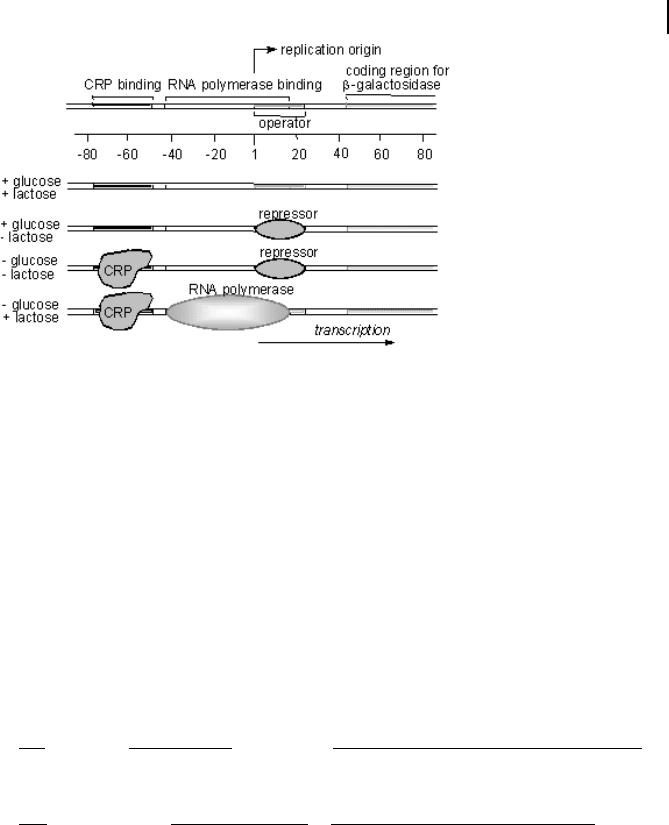
Fig. 8.10 Gene regulation via the lac operon. The upper scale shows
the binding sites for CRP and RNA polymerase as well as the opera-
tor and coding region on the DNA. In the lower part it is shown that
transcription can occur only if glucose is absent and lactose is pre-
sent, since this is the only case when CRP and polymerase can bind
at the same time.
More recent models of the regulation and the dynamics of operons (e.g., Yil-
dirim and Mackey 2003) explicitly consider that different processes such as tran-
scription initiation and translation do not occur immediately but need a certain
amount of time to finish. To include this delay into the mathematical description,
delay differential equations are employed. For example, the dynamics of mRNA is
modeled as
dM
dt
a
M
1 K
1
e
mt
M
At t
M
n
K K
1
e
mt
M
At t
M
n
G
0
g
M
m
M ; (8-26)
where G
0
is the spontaneous mRNA production rate, a
M
is a rate constant, K and K
1
characterize equilibriums between repressor and allolactose or operator, g
M
is the
rate constant of mRNA degradation, m quantifies effective loss of mRNA due to dilu-
tion during growth, and t
M
is the time required to produce the mRNA. t
M
is given
as 0.1 min.
286
8 Modeling of Gene Expression
Fig. 8.11 Dynamics of the lac operon model according to Eq. (8-25)
in phase plane representation. (a) Stable focus. (b) Unstable focus
and stable limit cycle. Parameter values: k
1
= 0.2, k
–1
= 2 (a),
k
–1
= 0.008 (b), k
2
=4710
5
, k
–2
= 0.03, k
3
= 0.2, k
–3
= 60, k
4
=1,
k
5
= 0.6, k
–5
= 0.006, k
6
=3710
–6
, k
7
=3710
–6
, k
8
= 0.03, k
–8
=1710
–5
,
k
9
= 5000, Z = 0.005, w = 0.002002, r
i
= 0.01, F
1
= 0.0001, I
E
= 91100.
References
Alberts, B., Johnson, A., Lewis, J., Raff, M.,
Roberts, K. and Walter, P. Molecular biology
of the cell (2002) 4th Edition Garland Science,
New York.
Allison, L.A., Moyle, M., Shales, M. and
Ingles, C.J. Extensive homology among the
largest subunits of eukaryotic and prokaryotic
RNA polymerases (1985) Cell 42, 599–610.
Berg, O.G. and von Hippel, P.H. Selection of
DNA binding sites by regulatory proteins. Sta-
tistical mechanical theory and application to
operators and promoters (1987) J. Mol. Biol.
193, 723–750.
Burke,T.W. and Kadonga, J.T. The downstream
promoter element, DPE, is conserved from
Drosophila to humans and is recognized by
TAF-II60 of Drosophila (1997) Genes Dev. 11,
3020–3031.
Dandekar,T., Schuster, S., Snel, B.,
Huynen, M. and Bork, P. Pathway alignment:
application to the comparative analysis of gly-
colytic enzymes (1999) Biochem. J. 343 Pt 1,
115–24.

287
References
Davuluri, R.V., Grosse, I. and Zhang, M.Q.
Computational identification of promoters and
first exons in the human genome (2001) Nat.
Genet. 29, 412–7.
Dieterich, C.,Wang, H., Rateitschak, K.,
Luz, H. and Vingron, M. CORG: a database
for COmparative Regulatory Genomics (2003)
Nucleic Acids Res. 31,55–7.
Drew, D.A. A mathematical model for prokaryo-
tic protein synthesis (2001) Bull. Math. Biol.
63, 329–51.
Elkon, R., Linhart, C., Sharan, R., Shamir, R.
and Shiloh,Y. Genome-wide in silico identifi-
cation of transcriptional regulatiors controlling
the cell cycle in human cells (2003) Genome
Res. 13, 773–780.
Fickett, J.W. and Hatzigeorgiou, A.C.
Eukaryotic promoter recognition (1997)
Genome Res. 7, 861–878.
Friedman, N., Linial, M., Nachman, I. and
Pe’er, D. Using Bayesian networks to analyze
expression data (2000) J. Comput. Biol. 7, 601–
20.
Gardiner-Garden, M. and Frommer, M. CpG
islands in vertebrate genomes (1987) J. Mol.
Biol. 196, 261–282.
Gillespie, D.T. Exact stochastic simulation of
coupled chemical chemical reactions (1977) J.
Phys. Chem. 81, 2340–2361.
Goodwin, B.C. Oscillatory behavior in enzy-
matic control processes (1965) Adv. Enzyme
Regul. 3, 425–38.
Griffith, J.S. Mathematics of cellular control
processes. I. Negative feedback to one gene
(1968a) J. Theor. Biol. 20, 202–8.
Griffith, J.S. Mathematics of cellular control
processes. II. Positive feedback to one gene
(1968b) J. Theor. Biol. 20, 209–16.
Heyd, A. and Drew, D.A. A mathematical model
for elongation of a peptide chain (2003) Bull.
Math. Biol. 65, 1095–109.
Hofer,T., Nathansen, H., Lohning, M., Rad-
bruch, A. and Heinrich, R. GATA-3 tran-
scriptional imprinting in Th2 lymphocytes:
a mathematical model (2002) Proc. Natl. Acad.
Sci. USA 99, 9364–8.
Hutchinson, G.B. The prediction of vertebrate
promoter regions using differential hexamer
frequency analysis (1996) CABIOS 12,
391–398.
Jacob, F., Perrin, D., Sanchez, C. and
Monod, J. [Operon: a group of genes with the
expression coordinated by an operator] (1960)
C. R. Hebd. Seances Acad. Sci. 250, 1727–9.
Kauffman, S.A. Antichaos and adaptation
(1991) Sci. Am. 265, 78–84.
Kauffman, S.A. The origins of order: Self-orga-
nization and selection in evolution (1993) Ox-
ford University Press, New York.
Kel, O.V., Romaschenko, A.G., Kel, A.E.,
Wingender, E. and Kolchanov, N.A.
A compilation of composite regulatory ele-
ments affecting gene transcription in verte-
brates (1995) Nucleic Acids Res. 23, 4097–103.
Kel, A., Kel-Margoulis, O., Babenko,V. and
Wingender, E. Recognition of NFATp/AP-1
composite elements within genes induced
upon the activation of immune cells (1999)
J Mol Biol 288, 353–76.
Kel-Margoulis, O.V., Kel, A.E., Reuter, I., Dei-
neko, I.V. and Wingender, E.TRANSCompel:
a database on composite regulatory elements
in eukaryotic genes (2002) Nucleic Acids Res.
30, 332–4.
Kondrakhin,Y., Kel, A., Kolchanov, N.,
Romashenko, A. and Milanesi, L. Eukaryotic
promoter recognition by binding sites for tran-
scription factors (1995) Comp. Appl. Biosc.
111, 477–488.
Liang, S., Fuhrman, S. and Somogyi, R.
REVEAL, a general reverse engineering algo-
rithm for inference of genetic network archi-
tecture (1999) In: R. Altman et al., ed. Proceed-
ings of the Pacific Symposium on Biocomput-
ing 98. Singapore, pp 18–28.
Mackey, M.C., Santillan, M. and Yildirim, N.
Modeling operon dynamics: the tryptophan
and lactose operons as paradigms (2004) C. R.
Biol. 327, 211–24.
Nicolis, G. and Prigogine, I. Self-organization
in non-equilibrium systems (1977) J. Wiley &
Sons, New York.
Novina, C.D. and Roy, A.L. Core promoters and
transcriptional control (1997) Trends Genet.
12, 351–355.
Orphanides, G. and Reinberg, D. Aunified
theory of gene expression (2002) Cell 108,
439–51.
Orphanides, G., LaGrange,T. and Rein-
berg, D. The general initiation factors of RNA
polymerase II (1996) Genes Dev. 10, 2657–
2683.
Pedersen, A.G., Baldi, P., Chauvin,Y. and
Brunak, S. The biology of eukaryotic promoter
prediction – a review (1999) Comput. Chem.
1999 191–207.
Pilpel,Y., Sudarsanam, P. and Church, G.M.
Identifying regulatory networks by combina-

288
8 Modeling of Gene Expression
torial analysis of promoter elements (2001)
Nature Genet. 29, 153–159.
Prestridge, D.S. Prediction of pol II promoter
sequences using transcription factor binding
sites (1995) J. Mol. Biol. 249, 923–932.
Proudfoot, N.J., Furger, A. and Dye, M.J.
Integrating mRNA processing with transcrip-
tion (2002) Cell 108, 501–12.
Ptashne, M. and Gann, A. Transcriptional acti-
vation by recruitment (1997) Nature 386, 569–
577.
Reed, R. and Hurt, E. A conserved mRNA ex-
port machinery coupled to pre-mRNA splicing
(2002) Cell 108, 523–31.
Reese, M.G. Application of a time-delay neural
network to promoter annotation in the Droso-
phila melanogaster genome (2001) Comput.
Chem. 26,51–6.
Santillan, M. and Mackey, M.C. Dynamic be-
havior in mathematical models of the trypto-
phan operon (2001) Chaos 11, 261–268.
Scherf, M., Klingenhoff, A. and Werner,T.
Highly specific localization of promoter re-
gions in large genomic sequences by Promoter-
Inspector: a novel context analysis approach
(2000) J. Mol. Biol. 297, 599–606.
Smale, S.T. Core promoter architecture for
eukaryotic protein-coding genes (1994)
In: R. C. Conaway and J. W. Conaway, eds.
Transcription: mechanisms and regulation.
Raven Press, New York, pp 63–81.
Smolen, P., Baxter, D.A. and Byrne, J.H.
Frequency selectivity, multistability, and oscil-
lations emerge from models of genetic regula-
tory systems (1998) Am. J. Physiol. 274, C531–
42.
Smolen, P., Baxter, D.A. and Byrne, J.H.
Effects of macromolecular transport and sto-
chastic fluctuations on dynamics of genetic
regulatory systems (1999) Am. J. Physiol. 277,
C777–90.
Solovyev,V., and Salamov, A. (1997) The gene
finder computer tools for analysis of human
and model organisms genome sequences. In:
Proceedings of the 5th International Confer-
ence on Intelligent Systems for Molecular Biol-
ogy, pp. 294–302.
Stormo, G.D. DNA binding sites: representa-
tion and discovery (2000) Bioinformatics 16,
16–23.
Stormo, G.D., Schneider,T.D., Gold, L. and
Ehrenfeucht, A. Use of the perceptron algo-
rithm to distinguish translation initiation sites
in E.coli (1982) Nucleic Acids Res. 10, 2997–
3012.
Tavazoie, S., Hughes, J.D., Campbell, M.J.,
Cho, R.J. and Church, G.M. Systematic
determination of genetic network architecture
(1999) Nat. Genet. 22, 281–5.
Thakurta, D.G., Palomar, L., Stormo, G.D.,Te-
desco, P., Johnson,T.E.,Walker, D.W., Lith-
gow, G., Kim, S. and Link, C.D. Identification
of a novel cis-regulatory element involved in
the heat shock response in C.elegans using mi-
croarray gene expression and computational
methods (2002) Genome Res. 12, 701–712.
Tupler, R., Perini, G. and Green, M.R. Expres-
sing the human genome (2001) Nature 409,
832–3.
Uptain, S.M., Kane, C.M. and Chamberlin,
M.J. Basic mechanisms of transcript elonga-
tion and its regulation (1997) Annu. Rev. Bio-
chem. 66, 117–72.
Wassermann,W.W., Palumbo, M.,Thomp-
son,W., Fickett, J.W. and Lawrence, C.E. Hu-
man-mouse genome comparisons to locate
regulatory sites (2000) Nature Genet. 26, 225–
228.
Werner,T. The state of the art of mammalian
promoter recognition (2003) Briefings Bioinf.
4, 22–30.
Woychik, N.A. and Hampsey, M. The RNA poly-
merase II machinery: structure illuminates
function (2002) Cell 108, 453–463.
Yildirim, N. and Mackey, M.C. Feedback regu-
lation in the lactose operon: a mathematical
modeling study and comparison with experi-
mental data (2003) Biophys. J. 84, 2841–51.

9
Analysis of Gene Expression Data
Introduction
The analysis of transcriptome data has become increasingly popular in the last dec-
ade due to the advent of new high-throughput technologies in genome research. In
particular, DNA arrays have become the most prominent experimental technique to
analyze gene expression data. An important component of systems biology is the
analysis of those data and their validation in the context of other data for the identifi-
cation of molecular markers and the development of wiring diagrams and organiza-
tion of these markers into networks of interacting components.
9.1
Data Capture
A DNA array consists of a solid support that carries DNA sequences representing
genes – the probes (cf. Chapter 4). In hybridization experiments with the target sam-
ple of labeled mRNAs and through subsequent data capture, a numerical value, the
signal intensity, is assigned to each probe. It is assumed that this signal intensity is
proportional to the number of molecules of the respective gene in the target sample.
Changes in signal intensities are interpreted as concentration changes. It should be
pointed out that the signal intensities are only crude estimators for the actual con-
centrations and that the interpretation as a concentration change is valid only if the
intensity-concentration correspondence is approximately linear. Microarray measure-
ments often show deviations from this assumption, such as saturation effects if, for
example, the spot signals are above a limit that no longer allows the detection of con-
centration changes or other nonlinearities if the concentration of the gene is below
the detection limit of a microarray.
9.1.1
DNA Array Platforms
DNA array platforms date back to the late 1980s when they were described for the
first time as a tool to screen thousands of DNA sequences in parallel by a single hy-
289