
Masters G.M. Renewable and Efficient Electric Power Systems
Подождите немного. Документ загружается.

78 FUNDAMENTALS OF ELECTRIC POWER
5
4
3
2
1
0
0% 25% 50% 75% 100%
5
4
3
2
1
0
0% 25% 50%
Fraction of rated current (300 mA)
Watts
Watts
Fraction of rated current (300 mA)
(a) (b)
75% 100%
Input
Input
Output
Output
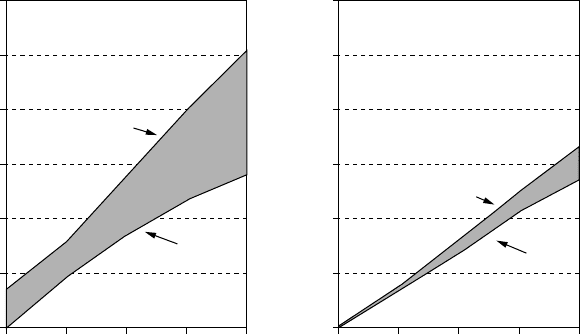
Figure 2.18 Power consumed by 9-V linear (a) and switch-mode power supplies (b) for
a cordless phone. Source: Calwell and Reeder (2002).
drawn. Note, too, that the linear supply continues to consume power even when
the device is delivering no power at all to the load. The wasted energy that occurs
when appliances are apparently turned off, but continue to consume power, or
when the appliance isn’t performing its primary function, is referred to as standby
power. A typical U.S. household has approximately 20 appliances that together
consume about 500 kWh/yr in standby mode. That 5–8% of all residential elec-
tricity costs about $4 billion per year (Meier, 2002).
2.7.1 Linear Power Supplies
A device that converts ac into dc is called a rectifier. When a rectifier is equipped
with a filter to help smooth the output, the combination of rectifier and filter is
usually referred to as a dc power supply. In the opposite direction, a device that
converts dc into ac is called an inverter.
The key component in rectifying an ac voltage into dc is a diode. A diode
is basically a one-way street for current: It allows current to flow unimpeded in
one direction, but it blocks current flow in the opposite direction. In the forward
direction, an ideal diode looks just like a zero-resistance short circuit so that the
voltage at both diode terminals is the same. In the reverse direction, no current
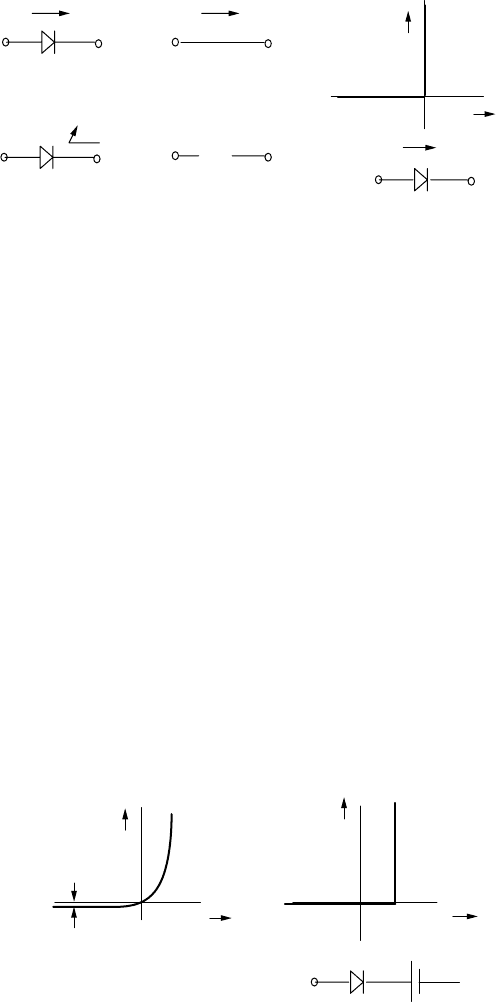
flows and the ideal diode acts like an open circuit. Figure 2.19 summarizes the
characteristics of an ideal diode, including its current versus voltage relationship.
Of course an idealized diode is only an approximation to the real thing. Real
diodes are semiconductor devices, usually made of silicon, with the relationship
POWER SUPPLIES 79
i i
=
Forward direction,
conducting
Short-circuit
voltage drop = 0
Reverse direction,
non-conducting
Open-circuit
current = 0
=
V
ab
i
V
ab
+
−
a
b
i
Figure 2.19 Characteristics of an ideal diode. In the forward direction it acts like a short
circuit; in the reverse direction it appears to be an open circuit.
between current and voltage expressed as follows:
I = I
0
(e
V/E
T
− 1)(2.73)
where I
0
is the reverse saturation current, usually much less than 1 µA; and
E
T
is the energy equivalent of temperature = 0.026 V at r oom temperature.
The exponential in (2.73) indicates a very rapid rise in current for very modest
changes in voltage. In the forward direction, the voltage drop for a silicon diode
is often approximated to be on the order of 0.7 V, which leads to the sometimes
useful diode model shown in Fig. 2.20. When that 0.7-V drop across a diode
is unacceptably high, other, more expensive Shottkey diodes with voltage drops
closer to 0.2 V are often used.
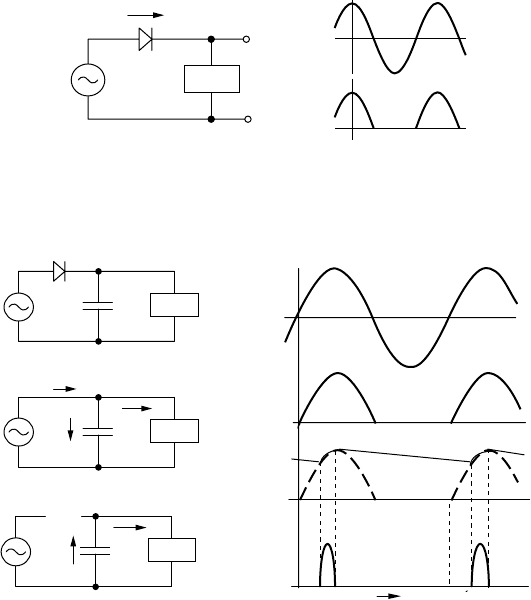
The simplest rectifier is comprised of just a single diode placed between the
ac source voltage and the load as shown in Fig. 2.21. On the positive stroke of
the input voltage, the diode is forward-biased, current flows, and the full voltage
appears across the load. When the input voltage goes negative, however, current
wants to go in the opposite direction, but it is prevented from doing so by the
V
i
Ideal diode
+−
a
b
i
I
0
V
ab
0.7 V
0.7 V
(a) Real diode characteristic curve
(b) An approximate model
Figure 2.20 Real diode I –V curve, and an often-used approximation.
80 FUNDAMENTALS OF ELECTRIC POWER
V
in
V
out
(a) (b)
+
−
−
V
in
V
out
i
Load
+
Figure 2.21 A half-wave rectifier: (a) The circuit. (b) The input and output voltages.
+
−
−
−
−
V
in
V
out
Load
V
in
+
V
out
Rectified
i
(
t
)
Filtered
Input
Current “gulps”
+
V
in
V
out
i
Load
+
−
Charging
+
V
in
V
out
Load
+
−
Discharging
Half-wave rectifier
w
t
0
2p
Figure 2.22 A half-wave rectifier with capacitor filter showing the gulps of current that
occur during the brief periods when the capacitor is charging.
diode. No current flows, so there is no voltage drop across the load, leading to
the output voltage waveform shown in Fig. 2.21b.
While the output voltage waveform in Fig. 2.21b doesn’t look very much like
dc, it does have an average value that isn’t zero. The dc value of a waveform
is defined to be the average value, so the waveform does have a dc component,
but it also has a bunch of wiggles, called ripple, in addition to its dc level. The
purpose of a filter is to smooth out those ripples. The simplest filter is just a big
capacitor attached to the output, as shown in Fig. 2.22. During the last portion
of the upswing of input voltage, current flows through the diode to the load and
capacitor, and it charges the capacitor. Once the input voltage starts to drop, the
diode cuts off and the capacitor then supplies current to the load. The resulting
output voltage is greatly smoothed compared to the rectifier without the capacitor.
Notice how current flows from the input source only for a short while in each
cycle and does so very close to the times when the input voltage peaks. The
circuit “gulps” current in a highly nonlinear way.
POWER SUPPLIES 81
V
in
i
in
Load
V
out
Load
V
out
Input
(a)
(b) (c)
Rectified
Filtered
Current gulps
i
in
(
t
)
V
out
V
in
i
in
V
in
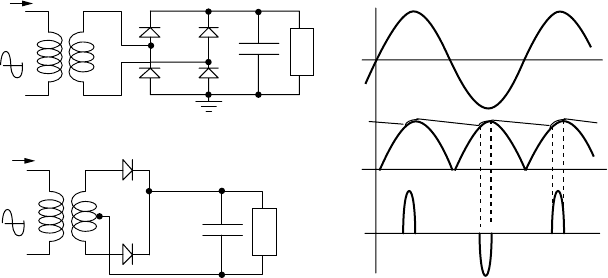
Figure 2.23 Full-wave rectifiers with capacitor filter showing gulps of current drawn
from the supply. (a) A four-diode, bridge rectifier. (b) A two-diode, center-tapped trans-
former rectifier.
The ripple on the output voltage can be further reduced by using a full-wave
rectifier instead of the half-wave version described above. Two versions of power
supplies incorporating full-wave rectifiers are shown in Fig. 2.23: One is shown
using a center-tapped transformer with just two diodes; the other uses a simpler
transformer with a four-diode bridge rectifier. The transformers drop the volt-
age to an appropriate level. The capacitors smooth the full-wave-rectified output
for the load. Numerous small, home electronic devices have transformer-based,
battery-charging power supplies such as these, which plug directly into the wall
outlet. A disadvantage of the transformer is that it is somewhat heavy and bulky
and it continues to soak up power even if the electronic device it is powering
is turned off. Either of these full-wave rectifier approaches results in a voltage
waveform that has two positive humps per cycle as shown. This means that the
capacitor filter is recharged twice per cycle instead of once, which smoothes the
output voltage considerably. Notice that there are now two gulps of current from
the source: one in the positive direction, one in the negative.
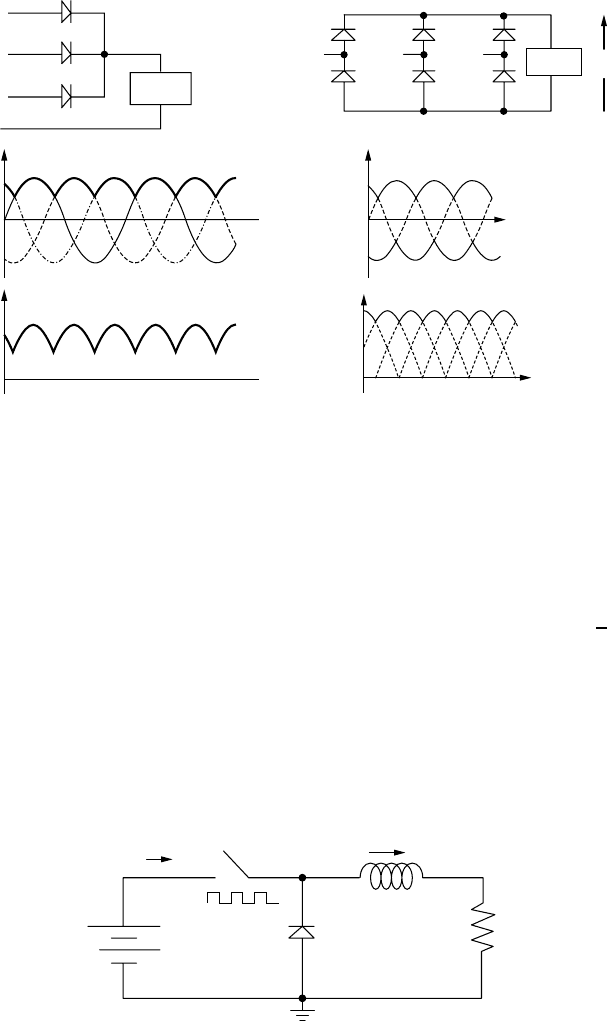
Three-phase circuits also use the basic diode rectification idea to produce a
dc output. Figure 2.24a shows a three-phase, half-wave rectifier. At any instant
the phase with the highest voltage will forward bias its diode, transferring the
input voltage to the output. The result is an output voltage that is considerably
smoother than a single-phase, full-wave rectifier.
The three-phase, full-wave rectifier shown in Fig. 2.24b is better still. The
voltage at any instant that reaches the output is the difference between the highest
of the three input voltages and the lowest of the three phase voltages. It therefore
has a higher average voltage than the three-phase, half-wave rectifier, and it
reaches its peak values with twice the frequency, resulting in relatively low
ripple even without a filter. For very smooth dc outputs, an inductor (sometimes
called a “choke”) is put in series with the load to act as a smoothing filter.
82 FUNDAMENTALS OF ELECTRIC POWER
Load
Load
+
−
+
−
V
B
(
t
)
V
C
(
t
)
V
load
V
highest
(a) (b)
t
t
V
lowest
V
load
V
load
V
A
(
t
)
V
A
(
t
)
V
A
(
t
)
V
B
(
t
)
V
C
(
t
)
V
A
(
t
)
V
B
(
t
)
V
C
(
t
)
V
B
(
t
)
V
C
(
t
)
Figure 2.24 (a) Three-phase, half-wave rectifier. (b) Three-phase, full-wave rectifier.
After Chapman (1999).
2.7.2 Switching Power Supplies
While most dc power supplies in the past were based on circuitry that dropped the
incoming ac voltage with a transformer, f ollowed by rectification and filtering,
that is no longer the case. More often, modern power supplies skip the transformer
altogether and rectify the ac at its incoming relatively high voltage (e.g., 120
√
2 =
170 V peak) and then use a dc-to-dc converter, to adjust the dc output voltage.
Actual dc-to-dc voltage conversion circuits are quite complex (see, for example,
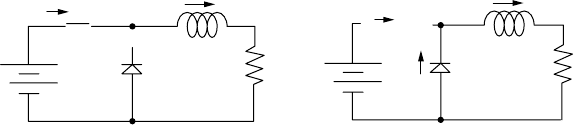
Elements of Power Electronics, P. T. Krein, 1998), but we can get a basic under-
standing of their operation by studying briefly the simple buck converter depicted
in Fig. 2.25.
+
−
+
−
V
in
Switch
Switch
control
signal
L
R
load
i
load
V
out
i
in
Figure 2.25 A dc-to-dc, step-down, voltage converter—sometimes called a buck con-
verter.
POWER SUPPLIES 83
In Fig. 2.25, the rectified, incoming (high) voltage is represented by an
idealized dc source of voltage V
in
. There is also a switch that allows this dc input
voltage to be either (a) connected across the diode so that it can deliver current to
the inductor and load or (b) disconnected from the circuit entirely. The switch is
not something that is opened or closed manually, but is a semiconductor device
that can be rapidly switched on and off with a electrical control signal. The switch
itself is usually an insulated-gate bipolar transistor (IGBT), a silicon-controlled
rectifier (SCR), or a gate-turnoff thyristor (GTO)—devices that you may have
encountered in electronics courses, but which we don’t need to understand here
beyond the fact that they are voltage-controlled, on/off switches. The voltage
control is a signal that we can think of as having a value of either 0 or 1. When
the control signal is 1, the switch is closed (short circuit); when it is 0, the
switch is open. This on/off control can be accomplished with associated digital
(or sometimes analog) circuitry not shown here.
The basic idea behind the buck converter is that by rapidly opening and closing
the switch, short bursts of current are allowed to flow through the inductor to
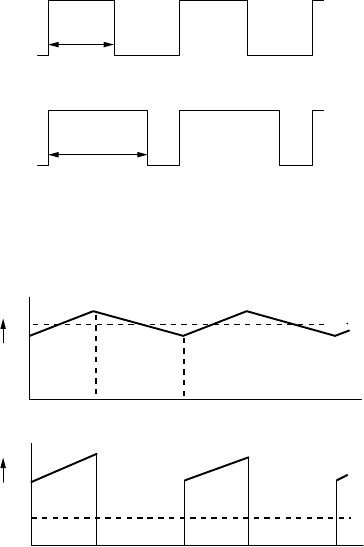
the load (here represented by a resistor). With the switch closed, the diode is
reverse-biased (open circuit) and current flows directly from the source to the
load (Fig. 2.26a). When the switch is opened, as in Fig. 2.26b, the inductor keeps
the current flowing through the load resistor and diode (remember, inductors act
as “current momentum” devices—we can’t instantaneously start or stop current
through one). If the switch is flipped on and off with high enough frequency, the
current to the load doesn’t have much of a chance to build up or decay; that is,
it is fairly constant, producing a dc voltage on the output.
The remaining feature to describe in the buck converter is the relationship
between the dc input-voltage V
in
, and the dc output voltage, V
out
. It turns out that
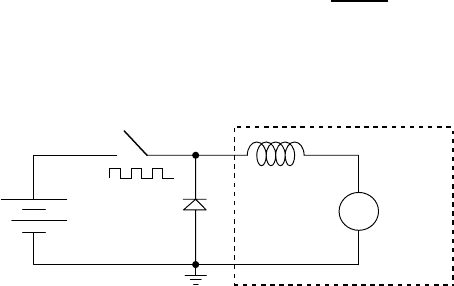
the relationship is a simple function of the duty cycle of the switch. The duty
cycle, D, is defined to be the fraction of the time that the control voltage is a
“1” and the switch is closed. Figure 2.27 illustrates the duty cycle concept.
We can now sketch the current through the load and the current from the
source, as has been done in Fig. 2.28. When the switch is closed, the two currents
are equal and rising. When the switch is open, the input current immediately drops
to zero and the load current begins to sag. If the switching rate is fast enough (and
they are designed that way), the rising and falling of these currents is essentially
+
−
V
in
Switch
closed
i
load
+
−
V
out
i
in
Diode
off
+
−
V
in
Switch
open
i
load
+
−
V
out
Diode
on
i
load
i
in
= 0
(a) (b)
Figure 2.26 The buck converter with (a) switch closed and (b) switch open.
84 FUNDAMENTALS OF ELECTRIC POWER
0
T
T
2
T
0
2
T
D
= 0.5
D
= 0.75
Closed
Open
Closed
Open
0.5
T
0.75
T
Figure 2.27 The fraction of the time that the switch in a dc-to-dc buck converter is
closed is called the duty cycle, D. Two examples are shown.
i
load
i
in
0
T
T
0
DT
DT
(
i
in
)
avg
(
i
load
)
avg
OpenClosed
Switch
open
Switch
closed
Figure 2.28 When the switch is closed, the input and load currents are equal and rising;
when it is open, the input drops to zero and the load current sags.
linear so they appear as straight lines in the figure. With T representing the period
of the switching circuit, then within each cycle the switch is closed DT seconds.
We are now ready to determine the relationship between input voltage and
output voltage in the switching circuit. Start by using Fig. 2.28 to determine the
relationship between average input current and average output current. While
the switch is closed, the areas under the input-current and load-current curves
are equal:
(i
in
)
avg
· T = (i
load
)
avg
· DT so (i
in
)
avg
= D · (i
load
)
avg
(2.74)
We will use an energy argument to determine the voltage relationship. Begin by
writing the average power delivered to the circuit by the input voltage source:
(P
in
)
avg
= (V
in
· i
in
)
avg
= V
in
(i
in
)
avg
= V
in
· D · (i
load
)
avg
(2.75)
The average power into the circuit equals the average power dissipated in the
switch, diode, inductor, and load. If the diode and switch are ideal components,
POWER SUPPLIES 85
they dissipate no energy at all. Also, we know the average power dissipated by
an ideal inductor as it passes through its operating cycle is also zero. That means
the average input power equals the average power dissipated by the load. The
power dissipated by the load is given by
(P
load
)
avg
= (V
out
· i
load
)
avg
= (V
out
)
avg
· (i
load
)
avg
(2.76)
Equating (2.75) and (2.76) gives
V
in
· D · (i
load
)
avg
= (V
out
)
avg
· (i
load
)
avg
(2.77)
which results in the relationship we have been looking for
(V
out
)
avg
= D · V
in
(2.78)
So, the only parameter that determines the dc-to-dc buck converter step-down
voltage is the duty cycle of the switch.
As long as the switching cycle is fast enough, the load will be supplied with
a very precisely controlled dc voltage. The buck converter is essentially, then, a
dc transformer. Since the output voltage is controlled by the width of the control
pulses, this approach is sometimes referred to as pulse-width-modulation (PWM).
When the buck converter is fed by a rectified ac signal, perhaps with capacitor
smoothing, the whole unit becomes a switch-mode power supply.
Buck converters are used in a great many electronic circuit applications besides
switch-mode power supplies, including high-performance dc motor controllers,
as the circuit of Fig. 2.29 suggests.
The dc motor is modeled as an inductor (the motor windings) in series with a
back-emf voltage source. The back emf produced by the motor is proportional to
the speed of the motor, E = kω. The voltage across the back emf of the motor
is the same as that given in (2.78), which lets us solve for the motor speed:
E = D · V
in
= kω so ω =
D · V
in
k
(2.79)
That is, the motor speed is directly proportional to the duty cycle of the switch.
Pretty simple.
+
−
V
in
dc motor
+
−
E
=
k
w
Figure 2.29 A buck converter used as a dc-motor speed controller.
86 FUNDAMENTALS OF ELECTRIC POWER
Later, in Chapter 9, we will see how a somewhat similar circuit, which can
both raise and lower dc voltages from one level to another, is used to enhance
the performance of photovoltaic arrays.
2.8 POWER QUALITY
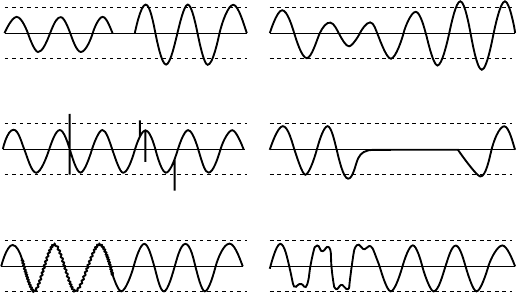
Utilities have long been concerned with a set of current and voltage irregularities,
which are lumped together and referred to as power quality issues. Figure 2.30
illustrates some of these irregularities. Voltages that rise above, or fall below,
acceptable levels, and do so for more than a few seconds, are referred to as
undervoltages and overvoltages. When those abnormally high or low voltages are
momentary occurrences lasting less than a few seconds, such as might be caused
by a lightning strike or a car ramming into a power pole, they are called sag and
swell incidents. Transient surges or spikes lasting from a few microseconds to
milliseconds are often caused by lightning strikes, but can also be caused by the
utility switching power on or off somewhere else in the system. Downed power
lines can blow fuses or trip breakers, resulting in power interruptions or outages.
Power interruptions of even very short duration, sometimes as short as a
few cycles, or voltage sags of 30% or so, can bring the assembly line of a
factory to a standstill when programmable logic controllers reset themselves and
adjustable speed drives on motors malfunction. Restarting such lines can cause
delays and wastage of damaged product, with the potential to cost hundreds of
thousands of dollars per incident. Outages in digital-economy businesses can be
even more devastating.
While most of the power quality problems shown in Fig. 2.30 are caused by
disturbances on the utility side of the meter, two of the problems are caused by
(a) Undervoltage, overvoltage
(c) Surges, spikes, impulses
(e) Electrical noise
(b) Sag, swell
(d) Outage
(f) Harmonic distortion
Figure 2.30 Power quality problems (Lamarre, 1991).

POWER QUALITY 87
the customers themselves. As shown in Fig. 2.30e, when circuits are not well
grounded, a continuous, jittery voltage “noise” appears on top of the sinusoidal
signal. The last problem illustrated in Fig. 2.36f is harmonic distortion, which
shows up as a continuous distortion of the normal sine wave. Solutions to power
quality problems lie on both sides of the meter. Utilities have a number of tech-
nologies including filters, high-energy surge arrestors, fault-current limiters, and
dynamic voltage restorers that can be deployed. Customers can invest in uninter-
ruptible power supplies (UPS), voltage regulators, surge suppressors, filters, and
various line conditioners. Products can be designed to be more tolerant of irreg-
ular power, and they can be designed to produce fewer irregularities themselves.
And, as will be seen in Chapter 4, one of the motivations for distributed genera-
tion technologies, in which customers produce their own electricity, is increasing
the reliability and quality of their electric power.
2.8.1 Introduction to Harmonics
Loads that are modeled using our basic components of resistance, inductance, and
capacitance, when driven by sinusoidal voltage and current sources, respond with
smooth sinusoidal currents and voltages of the same frequency throughout the
circuit. As we have seen in the discussion on power supplies, however, electronic
loads tend to draw currents in large pulses. Those nonlinear “gulps” of current
can cause a surprising number of very serious problems ranging from blown
circuit breakers to computer malfunctions, transformer failures, and even fires
caused by overloaded neutral lines in three-phase wiring systems in buildings.
The harmonic distortion associated with gulps of current is especially impor-
tant in the context of energy efficiency since some of the most commonly used
efficiency technologies, including electronic ballasts for lighting systems and
adjustable speed drives for motors, are significant contributors to the problem.
Ironically, everything digital contributes to the problem, and at the same time it is
those digital devices that are often the most sensitive to the distortion they create.
To understand harmonic distortion and its effects, we need to review the
somewhat messy mathematics of periodic functions. Any periodic function can
be represented by a Fourier series made up of an infinite sum of sines and
cosines with frequencies that are multiples of the fundamental (e.g., 60 Hz) fre-
quency. Frequencies that are multiples of the fundamental are called harmonics;
for example, the third harmonic for a 60-Hz fundamental is 180 Hz.
The definition of a periodic function is that f(t)= f(t + T),whereT is the
period. The Fourier series, or harmonic analysis, of any periodic function can be
represented by
f(t)=
a
0
2
+ a
1
cos ωt + a
2
cos 2ωt + a
3
cos 3ωt +···
+ b
1
sin ωt + b
2
sin 2ωt + b
3
sin 3ωt +··· (2.80)