
Masters G.M. Renewable and Efficient Electric Power Systems
Подождите немного. Документ загружается.

108 THE ELECTRIC POWER INDUSTRY
arena as well. The technological and regulatory systems that underlie the current
electric power industry are the subject of this chapter.
3.1 THE EARLY PIONEERS: EDISON, WESTINGHOUSE, AND INSULL
The path that leads to today’s enormous electric utility industry began in earnest in
the nineteenth century with the scientific descriptions of electricity and magnetism
by giants such as Hans Christian Oersted, Andr
´
eMarieAmp
`
ere, and James Clerk
Maxwell. The development of electromechanical conversion technologies such as
the direct-current dynamos developed in 1831 separately by Maxwell and H. Pixil
of France, followed by Nicola Tesla’s work on alternating-current generation and
distribution along with polyphase, brushless ac induction motors in the 1880s,
made it possible to imagine using electricity as a viable and versatile new source
of power.
The first major electric power market developed around the need for illumi-
nation. Although many others had worked on the concept of electrically heating
a filament to create light, it was Thomas Alva Edison who, in 1879, created
the first workable incandescent lamp. Simultaneously, he launched the Edison
Electric Light Company with the purpose of providing illumination, not just
kilowatt-hours. To do so he provided not only the generation and transmission
of electricity, but also the lamps themselves. In 1882, his company began dis-
tributing power primarily for lights, but also for electric motors, from his Pearl
Street Station in Manhattan. This was to become the first investor-owned utility
in the nation.
Edison’s system was based on direct current, which he preferred in part
because it provided flicker-free light but also because it enables easier speed
control of dc motors. The downside of dc, however, was that in those days it
was very difficult to change voltage from one level to another—something that
became simple to do in ac after the invention of the transformer in 1883. That
flaw in dc was critical since dc was less able to take advantage of the abil-
ity to reduce line losses by increasing the voltage of electricity as it goes onto
transmission lines and then decreasing it back to safe levels at the customer’s
facility. Recall that line losses are proportional to the square of current, while
the power delivered is the product of current and voltage. By doubling the volt-
age, for example, the same power can be delivered using half the current, which
cuts I
2
R line losses by a factor of four. Given dc’s low-voltage transmission
constraint, Edison’s customers had to be located within just a mile or two of a
generating station, which meant that power stations were beginning to be located
every few blocks around the city.
Meanwhile, George Westinghouse recognized the advantages of ac for trans-
mitting power over greater distances and, utilizing ac technologies developed
by Tesla, launched the Westinghouse Electric Company in 1886. Within just a
few years, Westinghouse was making significant inroads into Edison’s electricity
market and a bizarre feud developed between these two industry giants. Rather
THE EARLY PIONEERS: EDISON, WESTINGHOUSE, AND INSULL 109
than hedge his losses by developing a competing ac technology, Edison stuck
with dc and launched a campaign to discredit ac by condemning its high voltages
as a safety hazard. To make the point, Edison and his assistant, Samuel Insull,
began demonstrating its lethality by coaxing animals, including dogs, cats, calves
and eventually even a horse, onto a metal plate wired to a 1000-volt ac generator,
and then electrocuting them in front of the local press (Penrose, 1994). Edison
and other proponents of dc continued the campaign by promoting the idea that
capital punishment by hanging was horrific and could be replaced by a new,
more humane approach based on electrocution. The result was the development
of the electric chair, which claimed its first victim in 1890 in Buffalo, NY (also
home of the nation’s first commercially successful ac transmission system).
The advantages of high-voltage transmission, however, were overwhelming
and Edison’s insistence on dc eventually led to the disintegration of his elec-
tric utility enterprise. Through buyouts and mergers, Edison’s various electricity
interests were incorporated in 1892 into the General Electric Company, which
shifted the focus from being a utility to manufacturing electrical equipment and
end-use devices for utilities and their customers.
One of the first demonstrations of the ability to use ac to deliver power over
large distances occurred in 1891 when a 106-mile, 30,000-V transmission line
began to carry 75 kW of power between Lauffen and Frankfurt, Germany. The
first transmission line in the United States went into operation in 1890 using
3.3-kV lines to connect a hydroelectric station on the Willamette River in Ore-
gon to the city of Portland, 13 miles away. Meanwhile, the flicker problem for
incandescent lamps with ac was resolved by trial and error with various frequen-
cies until it was no longer noticeable. Surprisingly, it wasn’t until the 1930s that
60 Hz finally became the standard in the United States. Some countries had by
then settled on 50 Hz, and even today, some countries, such as Japan, use both.
Another important player in the evolution of electric utilities was Samuel
Insull. Insull is credited with having developed the business side of utilities. It was
his realization that the key to making money was to find ways to spread the high
fixed costs of facilities over as many customers as possible. One way to do that
was to aggressively market the advantages of electric power, especially for use
during the daytime to complement what was then the dominant nighttime lighting
load. In previous practice, separate generators were used for industrial facilities,
street lighting, street cars, and residential loads, but Insull’s idea was to integrate
the loads so that he could use the same expensive generation and transmission
equipment on a more continuous basis to satisfy them all. Since operating costs
were minimal, amortizing high fixed costs over more kilowatt-hour sales results
in lower prices, which creates more demand. With controllable transmission line
losses and attention to financing, Insull promoted rural electrification, further
extending his customer base.
With more customers, more evenly balanced loads, and modest transmis-
sion losses, it made sense to build bigger power stations to take advantage
of economies of scale, which also contributed to decreasing electricity prices
and increasing profits. Large, centralized facilities with long transmission lines

110 THE ELECTRIC POWER INDUSTRY
TA BLE 3.1 Chronology of Major Electricity Milestones
Year Event
1800 First electric battery (A. Volta)
1820 Relationship between electricity and magnetism confirmed (H. C. Oersted)
1821 First electric motor (M. Faraday)
1826 Ohm’s law (G. S. Ohm)
1831 Principles of electromagnetism and induction (M. Faraday)
1832 First dynamo (H. Pixil)
1839 First fuel cell (W. Grove)
1872 Gas turbine patent (F. Stulze)
1879 First practical incandescent lamp (T. A. Edison and J. Swan, independently)
1882 Edison’s Pearl Street Station opens
1883 Transformer invented (L. Gaulard and J. Gibbs)
1884 Steam turbine invented (C. Parsons)
1886 Westinghouse Electric formed
1888 Induction motor and polyphase AC systems (N. Tesla)
1889 Impulse turbine patent (L. Pelton)
1890 First single-phase ac transmission line (Oregon City to Portland)
1891 First three-phase ac transmission line (Germany)
1903 First successful gas turbine (France)
1907 Electric vacuum cleaner and washing machines
1911 Air conditioning (W. Carrier)
1913 Electric refrigerator (A. Goss)
1935 Public Utility Holding Company Act (PUHCA)
1936 Boulder dam completed
1962 First nuclear power station (Canada)
1973 Arab oil embargo, price of oil quadruples
1978 Public Utilities Regulatory Policies Act (PURPA)
1979 Iranian revolution, oil price triples; Three Mile Island nuclear accident
1983 Washington Public Power Supply System (WPPS) $2.25 billion nuclear
reactor bond default
1986 Chernobyl nuclear accident (USSR)
1990 Clean Air Act amendments introduce tradeable SO
2
allowances
1992 National Energy Policy Act (EPAct)
1998 California begins restructuring
2001 Restructuring collapses in California; Enron and Pacific Gas and Electric
bankruptcy
required tremendous capital investments; to raise such large sums, Insull intro-
duced the idea of selling utility common stock to the public.
Insull also recognized the inefficiencies associated with multiple power compa-
nies competing for the same customers, with each building its own power plants
and stringing its own wires up and down the streets. The risk of the monopoly
alternative, of course, was that without customer choice, utilities could charge
whatever they could get away with. To counter that criticism, he helped establish

THE ELECTRIC UTILITY INDUSTRY TODAY 111
the concept of regulated monopolies with established franchise territories and
prices controlled by public utility commissions (PUCs). The era of regulation
had begun.
The story of the evolution of the electric power industry continues in the latter
part of this chapter in which the regulatory side of the industry is presented.
Table 3.1 provides a quick chronological history of this evolution.
3.2 THE ELECTRIC UTILITY INDUSTRY TODAY
Electric utilities, monopoly franchises, large central power stations, and long
transmission lines have been the principal components of the prevailing electric
power paradigm since the days of Insull. Electricity generated at central power
stations is almost always three-phase, ac power at voltages that typically range
from about 14 kV to 24 kV. At the site of generation, transformers step up
the voltage to long-distance transmission-line levels, typically in the range of
138 kV to 765 kV. Those voltages may be reduced for regional distribution using
subtransmission lines that carry voltages in the range of 34.5 kV to 138 kV.
When electric power reaches major load centers, transformers located in
distribution-system substations step down the voltage to levels typically between
4.16 kV and 34.5 kV, with 12.47 kV being the most common. Feeder lines carry
power from distribution substations to the final customers. On power poles or in
concrete-pad-mounted boxes, transformers again drop voltage to levels suitable
for residential, commercial, and industrial uses. A sense of the overall utility
generation, transmission, and distribution system is shown in Fig. 3.1.
3.2.1 Utilities and Nonutilities
Entities that provide electric power can be categorized as utilities or nonutilities
depending on now their business is organized and regulated
Electric utilities traditionally have been given a monopoly franchise over a
fixed geographical area. In exchange for that franchise, they have been subject
to regulation by State and Federal agencies. A few large utilities are vertically
integrated; that is, they own generation, transmission, and distribution infrastruc-
ture. Most, however, are just distribution utilities that purchase wholesale power,
Generation Step-up
transformer
Transmission
138−765 kV
Step-down
transformer
Sub-
transmission
Distribution
substation
Distribution
feeders
Customers
120−600 V
14−24 kV
34.5−138 kV
4.16−34.5 kV
Figure 3.1 Conventional power generation, transmission, and distribution system.
112 THE ELECTRIC POWER INDUSTRY
which they sell to their retail customers using their monopoly distribution sys-
tem. The roughly 3200 utilities in the United States can be subdivided into one
of four categories of ownership: investor-owned, Federally owned, other publicly
owned, and cooperatively owned.
Investor owned utilities (IOUs) are privately owned with stock that is publicly
traded. They are regulated and authorized to receive an allowed rate of return on
their investments. IOUs may sell power at wholesale rates to other utilities or
they may sell directly to retail customers. While they comprise less than 5% of
all U.S. utilities in number, they generate over two-thirds of U.S. electricity.
Federally owned utilities produce power at facilities run by entities such as
the Tennessee Valley Authority (TVA), the U.S. Army Corps of Engineers, and
the Bureau of Reclamation. The Bonneville Power Administration, the West-
ern, Southeastern, and Southwestern Area Power Administrations, and the TVA
market and sell power on a nonprofit basis mostly to Federal facilities, publicly
owned utilities and cooperatives, and certain large industrial customers.
Other publicly owned utilities are State and Local government agencies that
may generate some power, but which are usually just distribution utilities. They
generally sell power at lower cost than IOUs because they are nonprofit and are
often exempt from certain taxes. While two-thirds of U.S. utilities fall into this
category, they sell only about 9% of total electricity.
Rural electric cooperatives were originally established and financed by the
Rural Electric Administration in areas not served by other utilities. They are
owned by groups of residents in rural areas and provide services primarily to
their own members.
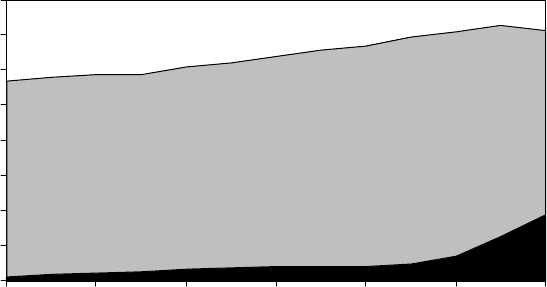
Nonutility generators (NUGs) are privately owned entities that generate
power for their own use and/or for sale to utilities and others. They are dis-
tinct in that they do not operate transmission or distribution systems and are
subject to different regulatory constraints than traditional utilities. Traditionally,
NUGs have been industrial facilities generating on-site power for their own use.
In the 1920s to 1940s, that amounted to roughly 20% of all U.S. generation, but
by the 1970s they were generating an insignificant fraction. NUGs reemerged
in the 1980s and 1990s when regulators began to open the grid to independent
power producers. Then in the late 1990s, as part of the restructuring intended to
create a more competitive industry, some utilities were required to sell off much
of their own generation to private entities, transferring those generators to the
NUG category. By 2001, NUGs were delivering over one-fourth of total U.S.
generation (Fig. 3.2).
3.2.2 Industry Statistics
About 70% of U.S. electricity is generated in power stations that use energy
derived from fossil fuels—coal, natural gas, and some oil. Nuclear and
hydroelectric-power account for almost all of the remaining 30%, though there
is a tiny fraction supplied by nonhydroelectric renewables. The energy going
THE ELECTRIC UTILITY INDUSTRY TODAY 113
2001199919971995199319911989
0
500
1000
1500
2000
2500
3000
3500
4000
Utility
Total
Electricity generated (Billion kWh/yr)
NUG
Figure 3.2 Nonutility generators have become a significant portion of total electricity
generated in the United States. From EIA Annual Energy Review 2001 (EIA, 2003).
into power plants is referred to as primary energy to distinguish it from end-use
energy , which is the energy content of electricity that is actually delivered to
customers. The numerical difference between primary and end-use energy is
made up of losses during the conversion of fuel to electricity, losses in the
transmission and distribution system (T&D), and energy used at the power plant
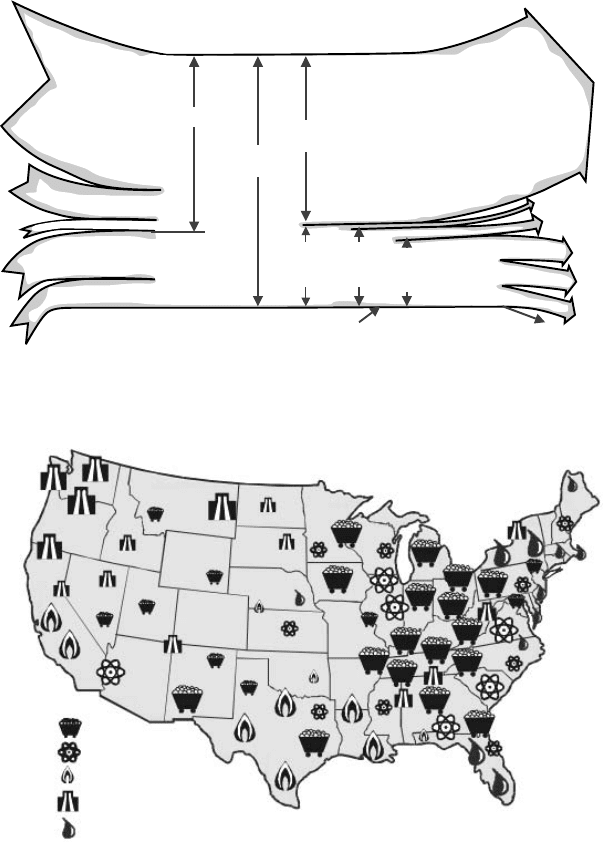
itself for its own needs. Less than one-third of primary energy actually ends up
in the form of electricity delivered to customers. For rough approximations, it is
reasonable to estimate that for every 3 units of fuel into power plants, 2 units
are wasted and 1 unit is delivered to end-users.
As shown in Fig. 3.3, coal is the dominant fuel, accounting for 52% of all
power plant input energy, nuclear is 21%, natural gas 15%, and renewables
(especially hydro and geothermal) 9%. Notice that petroleum is a very minor fuel
in the electricity sector, about 3%, and that is almost all residual fuel oil—literally
the bottom of the barrel—that has little value for anything else. That is, petroleum
and electricity have very little to do with each other.
The distribution of power plant types around the country is very uneven as
Fig. 3.4 suggests. The Pacific Northwest generates most of its power at large
hydroelectric facilities owned by the Federal government. Coal is predominant
in the midwestern and southern states, especially Ohio, West Virginia, Kentucky,
and Tennessee. Texas, Louisiana, Oklahoma, and California derive significant
fractions from natural gas, while what little oil-fired generation there is tends to
be in Florida and New York.
The electricity equation has two sides, the supply side and the demand side,
and both are critically important to understanding the industry. The end-use
side of electricity is usually divided into three sectors, residential, commercial
and industrial. In terms of kilowatt-hour sales (as opposed to electricity that
114 THE ELECTRIC POWER INDUSTRY
Coal
52%
Natural Gas 15%
Petroleum 3%
Nuclear 21%
Renewables 9%
Fossil Fuels 70%
Primary
Energy 100%
Conversion
Losses 65.3%
End Use
Energy
31.8%
Plant Use 1.7%
T&D Loss 3.1%
Gross
Generation
34.7%
Residential 10.6%
Commercial 10.5%
Industrial 8.8%
Net
Generation
32.9%
Direct Use 1.8%
Imports and Unaccounted for 2%
Figure 3.3 Electricity flows as a percentage of primary energy. Based on EIA Annual
Energy Review 2001 (EIA, 2003).
Coal
Nuclear
Natural Gas
Hydroelectric
Petroleum
Figure 3.4 Energy sources for electricity generation by region. Each large icon repre-
sents about 10 GW of capacity, small ones about 5 GW. From The Changing Structure
of the Electric Power Industry 2000 : An Update (EIA, 2000).
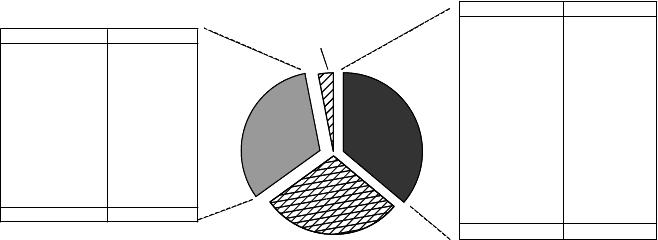
is self-generated on site, which never enters the market), the buildings sector
accounts for over two-thirds (36% is residential and 32% commercial) while
industrial users purchase 29%. As shown in Fig. 3.5, in the residential sector,
usage is spread over many miscellaneous loads, but the single largest ones are air
conditioners and refrigerators. In the commercial sector, lighting is the dominant
THE ELECTRIC UTILITY INDUSTRY TODAY 115
Residential
36%
Commercial
32%
Other 3%
(114TWh)
Industrial 29%
(964 TWh)
COMMERCIAL PERCENTAGE
Lighting 32
Space Cooling 12
Office Equipment 7
Ventilation 5
Refrigeration 5
Space Heating 3
Water Heating 3
Computers 2
Cooking 1
Other Office 9
Non-Building Uses 21
TOTAL (TWh) 1089
RESIDENTIAL PERCENTAGE
Space Cooling 13
Refrigerators 11
Motors 11
Heating 10
Water Heating 10
Electronics 9
Lighting 9
Heating Elements 9
Clothes Dryers 6
Cooking 3
Freezers 3
Televisions 3
Computers 2
Clothes Washers 1
TOTAL (TWh) 1203
Residential
36%
Commercial
32%
Other 3%
(114TWh)
Industrial 29%
(964 TWh)
COMMERCIAL PERCENTAGE
Lighting 32
Space Cooling 12
Office Equipment 7
Ventilation 5
Refrigeration 5
Space Heating 3
Water Heating 3
Computers 2
Cooking 1
Other Office 9
Non-Building Uses 21
TOTAL (TWh) 1089
RESIDENTIAL PERCENTAGE
Space Cooling 13
Refrigerators 11
Motors 11
Heating 10
Water Heating 10
Electronics 9
Lighting 9
Heating Elements 9
Clothes Dryers 6
Cooking 3
Freezers 3
Televisions 3
Computers 2
Clothes Washers 1
TOTAL (TWh) 1203
Figure 3.5 Distribution of retail sales of electricity by end use. Residential and com-
mercial buildings account for over two-thirds of sales. Total amounts in billions of kWh
(TWh) are 2001 data. From EIA (2003).
single load with cooling also being of major importance. If the lighting and air-
conditioning loads of residential and commercial buildings are combined, they
account for almost one-fourth of all electricity sold. More importantly, those
loads are the principal drivers of the peak demand for power, which for many
utilities occurs in the mid-afternoon on hot, sunny days. It is the peak load that
dictates the total generation capacity that must be built and operated.
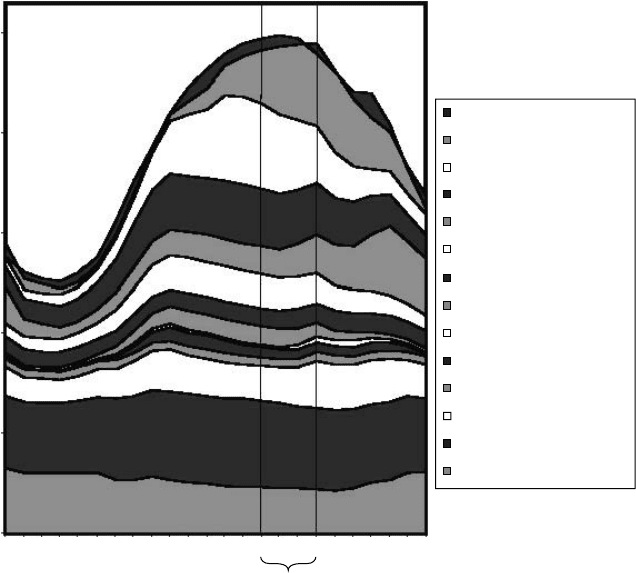
As an example of the impact of lighting and air conditioning on the peak
demand for power, Fig. 3.6 shows the California power demand on a hot, sum-
mer day. As can be seen, the industrial and agricultural loads are relatively
constant, and the diurnal rise and fall of demand is almost entirely driven by the
building sector. In terms of peak demand, buildings account for almost three-
fourths of the load, with air conditioning and lighting alone driving over 40%
of the total peak demand. Better buildings with greater use of natural daylight-
ing, more efficient lamps, increased attention to reducing afternoon solar gains,
greater use of natural-gas-fired absorption air-conditioning systems, load shift-
ing by using ice made at night to cool during the day, and so forth, could
make a significant difference in the number and type of power plants needed to
meet demand.
Not only does the predominant fuel vary widely across the country, so does
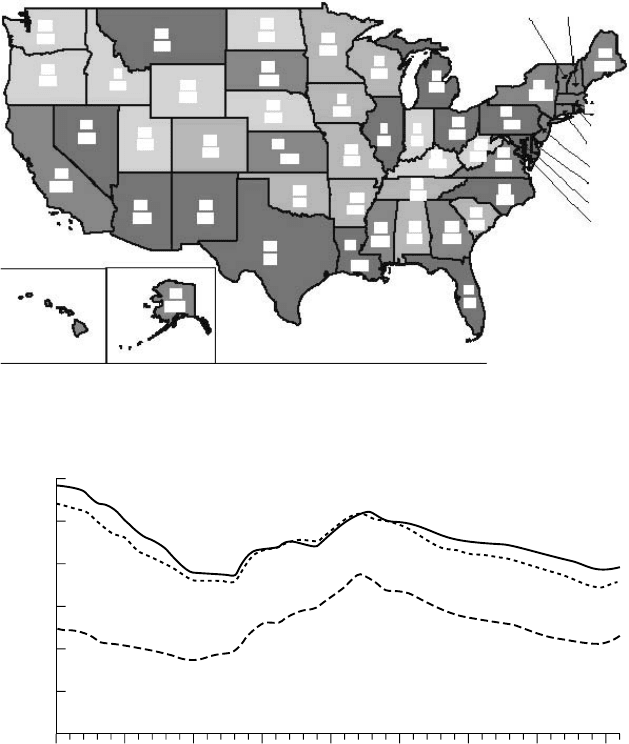
the resulting price of electricity. Figure 3.7 shows the statewide average price
of electricity in 2001 ranged from a low of 4.24¢/kWh in Kentucky to a high
of 14.05¢/kWh in Hawaii, with an overall average price of 7.32¢/kWh. Among
the coterminous states, California’s electricity was the most expensive in 2001 at
11.78¢/kWh, but that was when it was in the midst of its disastrous deregulation
crisis (described later in the chapter); in 1998 it was 25% less, at 9.0 ¢/kWh.
While Fig. 3.7 shows the state-by-state average retail price of electricity, it
greatly masks the large differences in price from one customer class to another.
Industrial facilities are typically charged on the order of 40% less for their
electricity than either residential or commercial customers. Industrial customers
116 THE ELECTRIC POWER INDUSTRY
Demand (GW)
50
40
30
20
10
0
0246810121416
System Peak
Residual ("Other" Area)
Res. - Air Conditioning
Corn'l - Air Conditioning
Corn'l - Interior Lighting
Corn'l - Other
Corn'l - Ventilation
Res. - Miscellaneous
Res. - Refrigerator
Corn'l - Refrigeration
Remainder of Buildings sector
Agriculture & Other Sector
Industrial Sector
Res. - Cooking
Res. - Clothes Dryer
Time of Day (hour starting)
18 20 22
Figure 3.6 The load profile for the a peak summer day in California (1999) shows
maximum demand occurs between 2
P.M. and 4 P.M. Lighting and air conditioning accounts
for over 40% of the peak. End uses are ordered the same in the graph and legend.
From Brown and Koomey (2002).
with more uniform energy demand can be served in large part by less expensive,
base-load plants that run more or less continuously. The distribution systems
serving utilities are more uniformly loaded, reducing costs, and certainly admin-
istrative costs to deal with customer billing and so forth are less. They also have
more political influence.
Figure 3.8 shows the average prices charged for residential, commercial, and
industrial customers, over time. It is interesting to note the sharp increases in
prices that occurred in the 1970s and early 1980s, which can be attributed to
increasing fuel costs associated with the spike in OPEC oil prices in 1973 and
1979, as well as the huge increase in spending for nuclear power plant construc-
tion during that era.
POLYPHASE SYNCHRONOUS GENERATORS 117
WA
OR
ID
NV
CA
AZ
AK
HI
NM
TX
CO
KS
OK
NE
SD
ND
U.S. Total Average Revenue per kWh is 7.32 Cents
MN
LA
MO
AR
LA
MS
AL GA
SC
NC
FL
TN
IN
OH
PA
NY
VT
NH
ME
MA
RI
CT
NJ
DE
MD
DC
WV
VA
KY
IL
MI
WI
6.35
5.48
6.04
6.14
6.9
6.08
6.03
6.05
6.26
5.61
6.39
5.77
6.63
7.7
5.62
5.3
6.65
7.86
11.63
10.8
10.95
11.51
10.79
9.62
9.42
7.01
6.66
7.87
10.73
5.07
6.19
6.98
4.24
6.96
UT
WY
MT
5.26
5.44
4.92
7.86
11.78
7.27
7.16
10.53
14.05
6.02
6.24
6.1
7.4
5.39
5.21
4.46
6.54
Figure 3.7 Average revenue per kilowatt-hour for all sectors by state, 2001. California
in 1998 before restructuring was 9.03 ¢/kWh. Source: Energy Information Administration.
12
10
8
6
4
2
0
1960 1965 1970
Residential
Commercial
Industrial
Cents per Kilowatt hour
1975 1980 1985 1990 1995 2000
Figure 3.8 Average retail prices of electricity, by sector (constant $1996). From EIA
Annual Energy Review 2001 (EIA, 2003).
3.3 POLYPHASE SYNCHRONOUS GENERATORS
With the exception of minor amounts of electricity generated using internal com-
bustion engines, fuel cells, or photovoltaics, the electric power industry is based
on some energy source forcing a fluid (steam, combustion gases, water or air) to