
Masters G.M. Renewable and Efficient Electric Power Systems
Подождите немного. Документ загружается.

88 FUNDAMENTALS OF ELECTRIC POWER
where ω = 2πf = 2π/T . The coefficients can be found from
a
n
=
2
T
T
0
f(t)cos nωt dt, n = 0, 1, 2 ... (2.81)
and
b
n
=
2
T
T
0
f(t)sin nωt dt, n = 1, 2, 3 ... (2.82)
Under special circumstances, the series in (2.80) simplifies. For example, when
there is no dc component to the waveform (average value = 0), the first term,
a
0
, drops out:
a
0
= 0 : when average value, dc = 0 (2.83)
For functions with symmetry about the y-axis, the series contains only cosine
terms. That is,
cosines only: when f(t) = f(−t) (2.84)
For the series to contain only sine terms, it must satisfy the relation
sines only: when f(t) =−f(−t) (2.85)
Finally, when a function has what is called half-wave-symmetry it contains no
even harmonics. That is,
no even harmonics: when f
t +
T
2
=−f(t) (2.86)
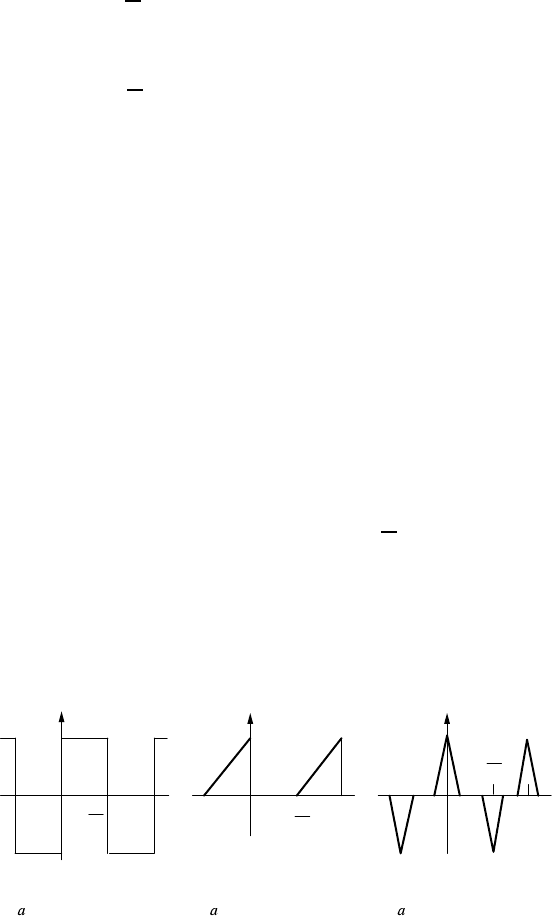
Examples of these properties are illustrated in Fig. 2.31. Notice the waveform
in Fig. 2.31c is very much like the current waveform for a full-wave rectifier,
which says that its Fourier spectrum will have only cosine terms with only
odd harmonics.
T
2
T
2
T
2
T
0
0
0
(a)
0
= 0
sines only
no even harmonics
0
≠ 0
sines & cosines
even & odd harmonics
0
= 0
cosines only
no even harmonics
(b) (c)
T
T
Figure 2.31 Examples of periodic functions, with indications of special properties of
their Fourier series representations.
POWER QUALITY 89
Example 2.11 Harmonic Analysis of a Square Wave. Find the Fourier series
equivalent of the square wave in Fig. 2.31a, assuming that it has a peak value
of 1 V.
Solution We know by inspection, using (2.83) to (2.86), that the series will
have only sines, with no even harmonics. Therefore, all we need are the even
coefficients b
n
from (2.82):
b
n
=
2
T
T
0
f(t)sin nωt dt =
2
T
T/2
0
1 · sin nωt dt +
T
T/2
(−1) · sin nωt dt
Recall that the integral of a sine is the cosine with a sign change, so
b
n
=
2
T
−1
nω
cos nωt
t=T/2
t=0
+
1
nω
cos nωt
t=T
t=T/2
=
2
nωT
(−1)
cos nω
T
2
− cos nω · 0
+ cos nωT − cos nω
T
2
Substituting ω = 2πf = 2π/T gives
=
T
2π
·
2
nT
−cos
2π
T
·
nT
2
+ 1 + cos
2π
T
· nT
− cos
2π
T
·
nT
2
=
1
nπ
[−2cosnπ + 1 +cos 2nπ ]
Since this is half-wave symmetric, there are no even harmonics; that is, n is an
odd number. For odd values of n,
cos nπ = cos π =−1and cos2nπ = cos 0 = 1
That makes for a nice, simple solution:
b
n
=
4
nπ
That is,
b
1
=
4
π
= 1.273,b
3
=
4
3π
= 0.424,b
5
=
4
5π
= 0.255 ...
So the series is
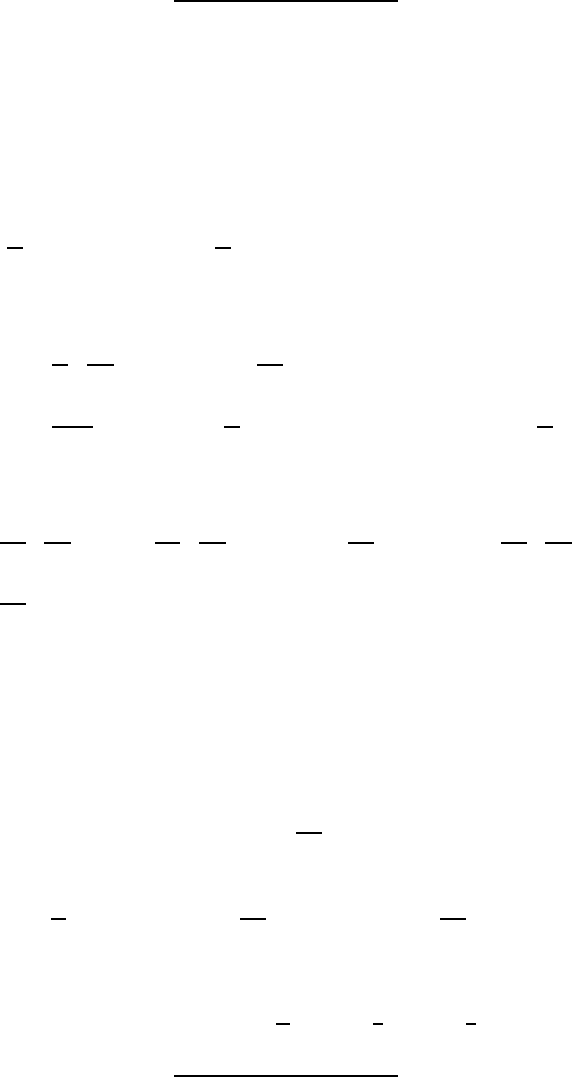
(Square wave with amplitude of 1) =
4
π
sin ωt +
1
3
sin 3ωt +
1
5
sin 5ωt +···
90 FUNDAMENTALS OF ELECTRIC POWER
1
1
0
0
t t
(a) (b)
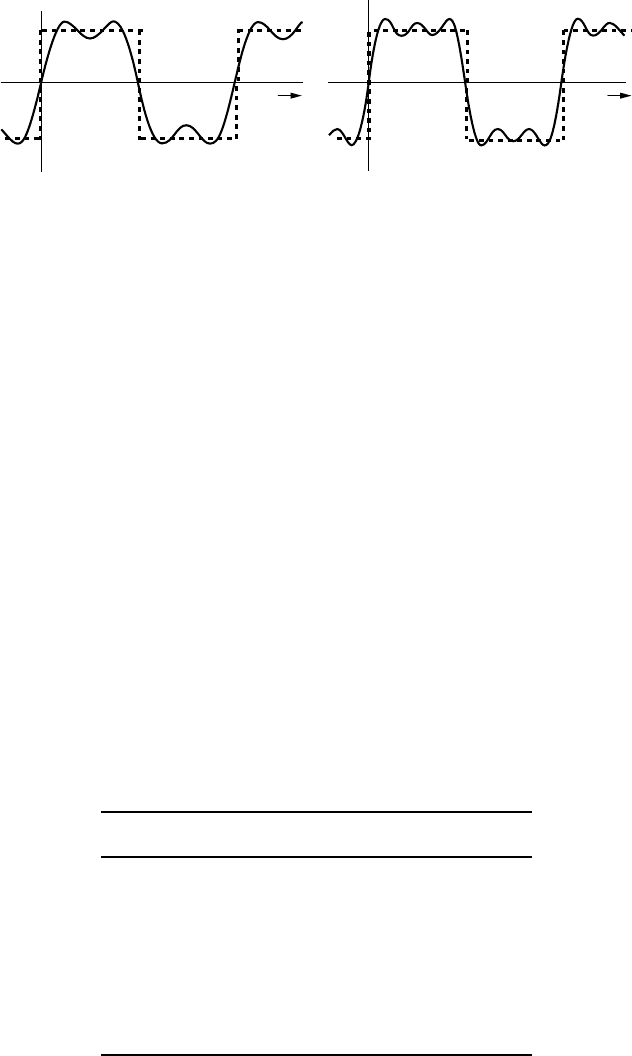
Figure 2.32 Showing the sum of the first two terms (a) and first three terms (b) of the
Fourier series for a square wave along with the square wave that it is approximating.
To show how quickly the Fourier series for the square wave begins to
approximate reality, Fig. 2.32 shows the sum of the first two terms of the
series, and the sum of the first three terms, along with the square wave that
it is approximating. Adding more terms, of course, will make the approximation
more and more accurate.
The first few terms in the harmonic analysis of the square wave derived
in Example 2.11 are presented in tabular form in Table 2.2. Two columns are
shown for the harmonics: one that lists the amplitudes of each harmonic, and the
other listing the harmonics as a percentage of the fundamental amplitude. Both
presentations are commonly used.
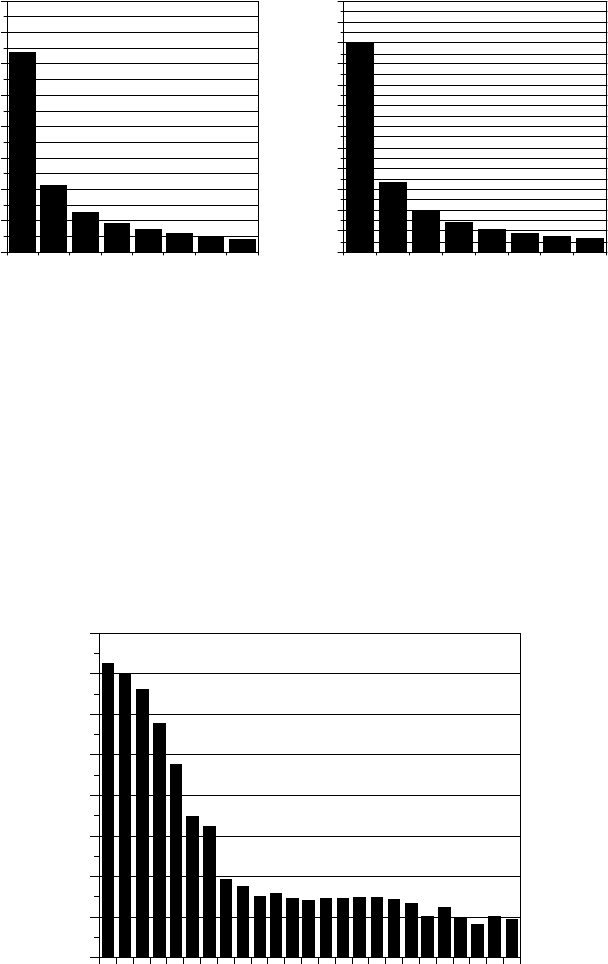
Another convenient way to describe the harmonic analysis that the Fourier
series provides is with bar graphs such as those shown in Fig. 2.33 for a
square wave.
An example harmonic spectrum for the current drawn by an electronically
ballasted compact fluorescent lamp (CFL) is shown in Fig. 2.34. Notice only odd
harmonics are present, which is the case for all periodic half-wave symmetric
TABLE 2.2 Harmonic Analysis of a Square Wave
with Amplitude 1
a
Harmonic Amplitude Percentage of fundamental
1 1.273 100.0%
3 0.424 33.3%
5 0.255 20.0%
7 0.182 14.3%
9 0.141 11.1%
11 0.116 9.1%
13 0.098 7.7%
15 0.085 6.7%
a
Only harmonics through the 15th are shown.
POWER QUALITY 91
13579111315 13579111315
0.0
0.2
0.4
0.6
0.8
1.0
1.2
1.4
1.6
Harmonic
0
10
20
30
40
50
60
70
80
90
100
110
120
Harmonic
(a) (b)
Percentage
Amplitude
Figure 2.33 First few harmonics for a square wave with amplitude 1: (a) By amplitude
of harmonics. (b) By percentage of fundamental.
waveforms. Also notice that the harmonics are still sizable as far out as they are
shown, which is all the way out to the 49th harmonic!
We can reconstruct the waveform for the CFL whose current is shown in
Fig. 2.34. The bulb is run on a 60-Hz (2π · 60 = 377 rad/s) voltage source so,
taking a few values from Fig. 2.34, we can write the first few terms of the
160
140
120
100
80
60
40
Harmonic
Current (mA)
20
0
1
3
5
7
9
11
13
15
17
19
21
23
25
27
29
31
33
35
37
39
41
43
45
47
49
Figure 2.34 Harmonic current spectrum for an 18-W, electronic-ballast compact fluo-
rescent lamp. Currents are rms values.
92 FUNDAMENTALS OF ELECTRIC POWER
current as
i(A)=
√
2(0.145 cos ωt + 0.140 cos 3ωt + 0.132 cos 5ωt
+ 0.115 cos 7ωt +···) (2.87)
where ω = 377 rad/s. Notice the
√
2 converts the rms values of current given in
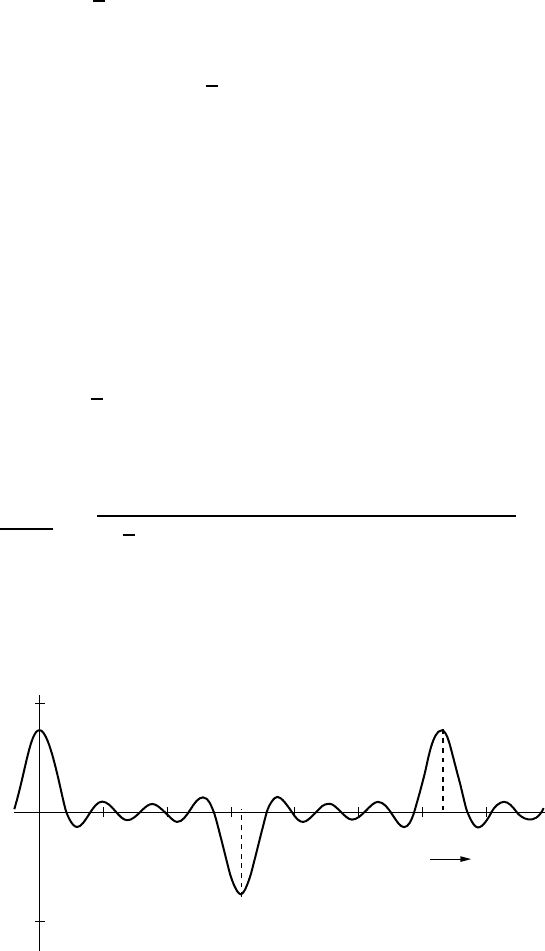
the figure to their full magnitude. A plot of (2.87) is shown in Fig. 2.35.
Even with just a few of the harmonics included, the “gulps” of current similar
to those shown in the full-wave rectifier circuit of Fig. 2.23 are clearly evident.
2.8.2 Total Harmonic Distortion
While the Fourier series description of the harmonics in a periodic waveform
contains all of the original information in the waveform, it is usually awkward to
work with. There are several simpler quantitative measures that can be developed
and more easily used. For example, suppose we start with a series representation
of a current waveform that is symmetric about the y axis:
i =
√
2(I
1
cos ωt + I
2
cos 2ωt + I
3
cos 3ωt +···)(2.88)
where I
n
is the rms value of the current in the nth harmonic. The rms value of
current is therefore
I
rms
=
(i
2
)
avg
=
√
2(I
1
cos ωt + I
2
cos 2ωt + I
3
cos 3ωt +···)
2
avg
(2.89)
While algebraically squaring that infinite series in the parentheses looks menac-
ing, it falls apart when we fool around a bit with the algebra. Starting with the
w
t
p
2p
1
1
−1
2
Current (A)
34567
Figure 2.35 The sum of the first through seventh harmonics of current for the CFL of
Fig. 2.34.
POWER QUALITY 93
square of a sum of terms
(a + b + c +···)
2
= a
2
+ b
2
+ c
2
···+2ab + 2ac + 2bc +··· (2.90)
we see that each term is squared, and then in addition there are combinations of
all possible cross products between terms. Therefore,
I
rms
=
2[(I
1
cos ωt)
2
+ (I
2
cos 2ωt)
2
+···+(2I
1
I
2
cos ωt · cos 2ωt)
+ (2I
1
I
3
cos ωt · cos 3ωt) +···]
avg
(2.91)
Fortunately, the average value of the product of two sinusoids of differing fre-
quency is zero; that is,
[cos nωt · cos mωt]
avg
= 0forn = m(2.92)
Also, we note that
(I
n
2
cos
2
nωt)
avg
=
I
n
2
2
(2.93)
That leaves
I
rms
=
2
I
1
2
2
+
I
2
2
2
+
I
3
2
2
+···
=
I
1
2
+ I
2
2
+ I
3
2
··· (2.94)
So, the rms value of current when there are harmonics is just the square root of
the sum of the squares of the individual rms values for each frequency. While this
was derived for a Fourier series involving just a sum of cosines, it holds for the
general case in which the sum involves cosines and sines.
In the United States, the most commonly used measure of distortion is called
the total harmonic distortion (THD), which is defined as
THD =
I
2
2
+ I
3
2
+ I
4
2
+···
I
1
(2.95)
Notice that since THD is a ratio, it doesn’t matter whether the currents in (2.95)
are expressed as peak values or rms values. When they are rms values, we can
recognize (2.95) to be the ratio of the rms current in all frequencies except the
fundamental divided by the rms current in the fundamental. When no harmonics
are present, the THD is zero. When there are harmonics, there is no particular
limit to THD and it is often above 100%.
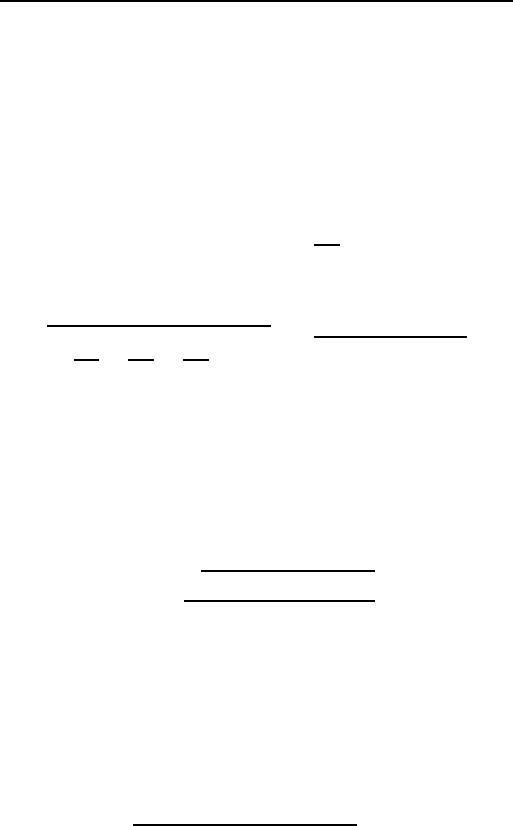
Example 2.12 Harmonic Distortion for a CFL. A harmonic analysis of the
current drawn by a CFL yields the following data. Find the rms value of current
and the total harmonic distortion (THD).
94 FUNDAMENTALS OF ELECTRIC POWER
Harmonics rms Current (A)
10.15
30.12
50.08
70.03
90.02
Solution From (2.94) the rms value of current is
I
rms
= [(0.15)
2
+ (0.12)
2
+ (0.08)
2
+ (0.03)
2
+ (0.02)
2
]
1/2
= 0.211 A
From (2.95) the total harmonic distortion is
THD =
(0.12)
2
+ (0.08)
2
+ (0.03)
2
+ (0.02)
2
0.15
= 0.99 = 99%
so the total rms current in the harmonics is almost exactly the same as the rms
current in the fundamental.
2.8.3 Harmonics and Voltage Notching
As we have seen, diode-rectifiers draw currents in bursts and those bursts can be
described in terms of their THD. One effect of these current surges is that there
will be a voltage drop in the connecting lines during those surges, which results in
momentary drops in the voltage that reaches the load. To illustrate this problem,
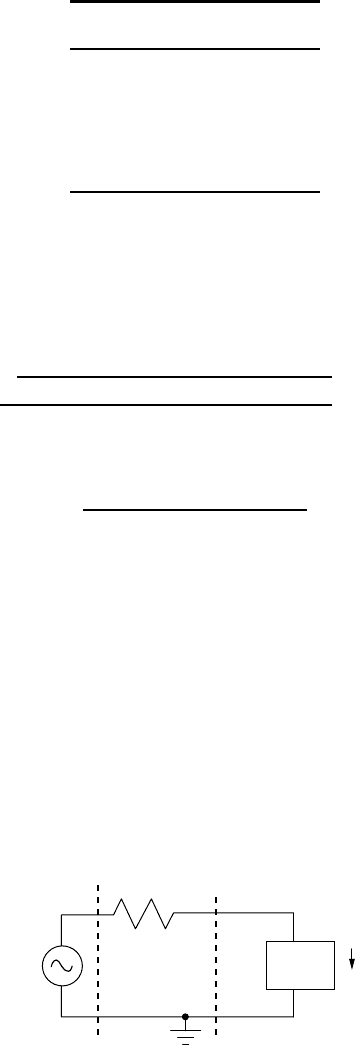
consider the circuit shown in Fig. 2.36 in which a sinusoidal voltage source sends
current through a line to a load. To keep everything as simple as possible, the
line impedance is modeled as just having resistance with no reactive component.
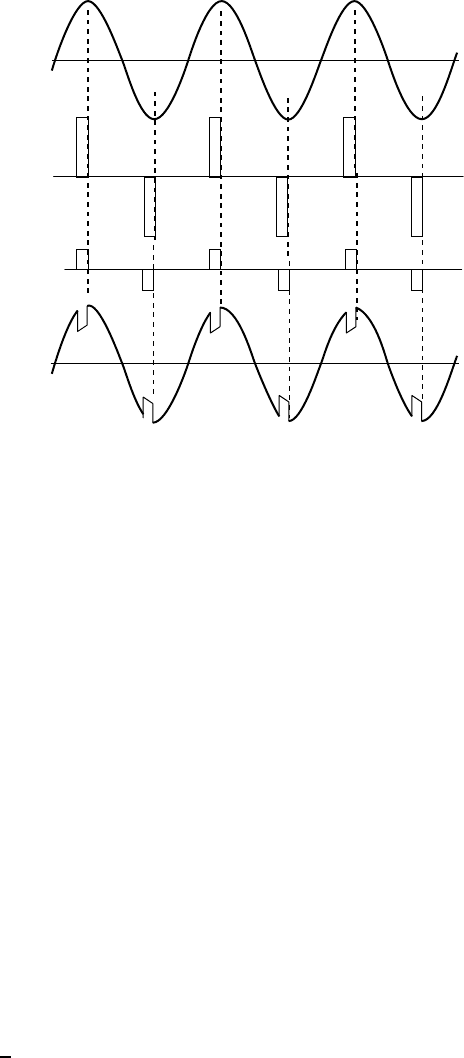
Figure 2.37 shows what we might expect if current surges are modeled as
simple, rectangular pulses. During current pulses, there will be voltage drop in
the line equal to line current times line resistance. The voltage reaching the load
Load
V
s
i
load
Source
voltage
Line
resistance
V
load
R
Figure 2.36 A simple circuit to illustrate voltage notching.
POWER QUALITY 95
v
s
i
v
load
∆
v
line
=
i R
Figure 2.37 Source voltage, line current, voltage drop across the line, and resulting
notched voltage to the load.
will correspondingly be decreased by that line voltage drop. In between pulses,
the full source voltage reaches the load. The result is a “notch” in the load voltage
as shown. Also, there will be harmonic distortion, this time on the voltage signal
rather than the current, that can be analyzed and measured in the same ways we
just dealt with current harmonic distortion.
It is important to note that the nonlinear load causing the notch may also be
affected by the notch. Moreover, other loads that may be on the same circuit
will also be affected. Those current surges could even cause notches in the volt-
age delivered to neighboring facilities. When notching is a potential problem,
capacitors may be added to help smooth the waveform.
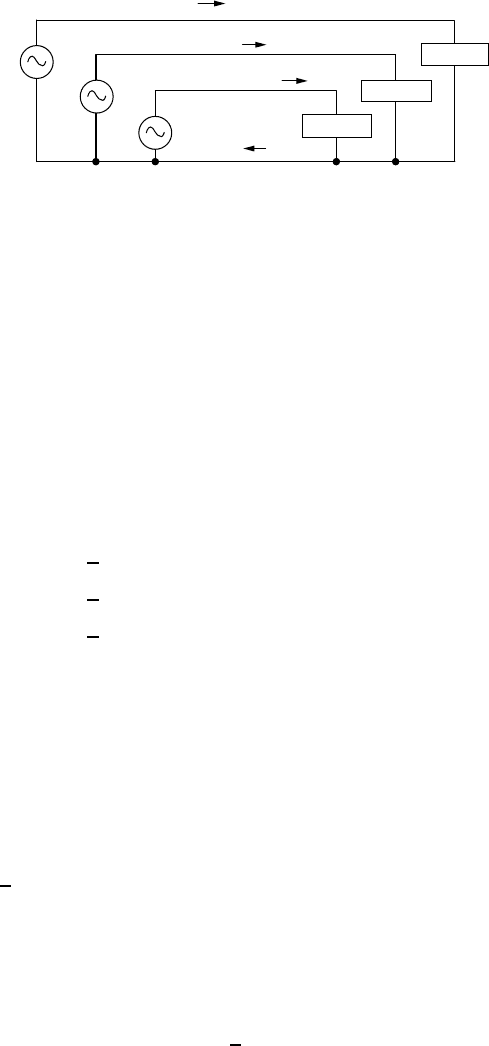
2.8.4 Harmonics and Overloaded Neutrals
One of the most important areas of concern associated with harmonics is the
potential for the neutral wire in four-wire, three-phase, wye-connected systems
to overheat, potentially to a degree sufficient to initiate combustion (Fig. 2.38).
The current in the neutral wire is always given by
i
n
= i
A
+ i
B
+ i
C
(2.96)
For balanced three-phase currents, with no harmonics, we know from (2.56) and
(2.60) that the current in the neutral wire is zero:
i
n
=
√
2I
phase
[cos ωt + cos(ωt + 120
◦
) + cos(ωt − 120
◦
)] = 0 (2.97)
96 FUNDAMENTALS OF ELECTRIC POWER
Load A
Load B
Load C
V
A
V
B
V
C
+
+
+
−
−
−
i
A
i
B
i
C
i
n
=
i
A
+
i
B
+
i
C
Figure 2.38 Showing the neutral line current in a four-wire, three-phase, wye-
connected circuit.
In setting up a building’s electrical system, every effort is made to distribute the
loads so that approximate balance is maintained, with the intention of minimizing
current flow in the neutral. Under the assumption that the neutral carries little
or no current, early building codes allowed smaller neutral wires than the phase
conductors. It has only been since the mid-1980s that the building code has
required the neutral wire to be a full-size conductor.
The question now is, What happens when there are harmonics in the phase
currents? Even if the loads are balanced, harmonic currents cause special prob-
lems for the neutral line. Suppose that each phase carries exactly the same current
(shifted by 120
◦
of course), but now there are third harmonics involved. That is,
i
A
=
√
2[I
1
cos ωt + I
3
cos 3ωt]
i
B
=
√
2{I
1
cos(ωt + 120
◦
) + I
3
cos[3(ωt + 120
◦
)]} (2.98)
i
C
=
√
2{I
1
cos(ωt − 120
◦
) + I
3
cos[3(ωt − 120
◦
)]}
Now, notice what happens to the third harmonics in phases B and C due to
the following:
cos[3(ωt ± 120
◦
)] = cos(3ωt ± 360
◦
) = cos 3ωt (2.99)
This means that the current in the neutral wire, which is the sum of each of the
three phase currents, is
i
n
=
√
2[I
1
cos ωt + I
1
cos(ωt + 120
◦
) + I
1
cos(ωt − 120
◦
) + I
3
cos 3ωt
+ I
3
cos 3ωt + I
3
cos 3ωt] (2.100)
Since the sum of the three cosines of equal magnitude—but each out of phase
with the other by 120
◦
—is zero, the fundamental currents drop out and we are
left with
i
n
= 3
√
2I
3
cos 3ωt (2.101)

POWER QUALITY 97
In terms of rms values,
I
n
= 3I
3
(2.102)
That is, the rms current in the neutral line is three times the rms current in each
line’s third harmonic. There is considerable likelihood, therefore, that harmonic-
generating loads will cause the neutral to carry even more current than the phase
conductors, not less!
The same argument about harmonics adding in the neutral applies to all of
the harmonic numbers that are multiples of 3 (since 3 × n × 120
◦
= n360
◦
= 0
◦
).
That is, the third, sixth, ninth, twelfth, ...harmonics all add to the neutral current
in an amount equal to three times their phase-current harmonics. Notice, by the
way, that harmonics not divisible by 3 cancel out in the same way that the
fundamental cancels—for example, the second harmonic:
i
n−2nd harmonic
=
√
2I
2
{cos(2ωt) + cos[2(ωt + 120
◦
)] + cos[2(ωt − 120
◦
)]}
(2.103)
The terms in the bracket are
cos(2ωt) + cos(2ωt + 240
◦
) + cos(2ωt − 240
◦
) = cos 2ωt + cos(2ωt − 120
◦
)
+ cos(2ωt + 120
◦
) = 0
so the second harmonic currents cancel just as the fundamental did. This will be
the case for all harmonics not divisible by 3.
For currents that show half-wave symmetry, there are no even harmonics, so
the only harmonics that appear on the neutral line for balanced loads of this sort
will be third, 9th, 15th, 21st, ... etc. These odd harmonics, divisible by three,
are called triplen harmonics.
Example 2.13 Neutral-Line Current. A four-wire, wye-connected balanced
load has phase currents described by the following harmonics:
Harmonic rms Current (A)
1 100
350
520
710
98
11 4
13 2
Find the rms current flowing in the neutral wire and compare it to the rms
phase current.