
Masters G.M. Renewable and Efficient Electric Power Systems
Подождите немного. Документ загружается.

98 FUNDAMENTALS OF ELECTRIC POWER
Solution Only the harmonics divisible by three will contribute to neutral line
current, so this means that all we need to consider are the third and ninth har-
monics.
Assuming the fundamental is 60 Hz, the harmonics contribute
Third harmonic: 3 × 50 = 150 A at 180 Hz
Ninth harmonic: 3 × 8 = 24 A at 540 Hz
The rms current is the square root of the sum of the squares of the harmonic
currents, so the neutral wire will carry
I
n
=
150
2
+ 24
2
= 152 A
The rms current in each phase will be
I
n
=
100
2
+ 50
2
+ 20
2
+ 10
2
+ 8
2
+ 4
2
+ 2
2
= 114 A
The neutral current, rather than being smaller than the phase currents, is actually
33% higher!
2.8.5 Harmonics in Transformers
Recall from Chapter 1 that cyclic magnetization of ferromagnetic materials causes
magnetic domains to flip back and forth. With each cycle, there are hysteresis
losses in the magnetic material, which heat the core at a rate that is proportional
to frequency.
Power loss due to hysteresis = k
1
f(2.104)
Also recall that sinusoidal variations in flux within a magnetic core induces
circulating currents within the core material itself. To help minimize these cur-
rents, silicon-alloyed steel cores or powdered ceramics, called ferrites, are used
to increase the resistance to current. Also, by laminating the core, currents have
to flow in smaller spaces, which also increases the path resistance. The impor-
tant point is that those currents are proportional to the rate of change of flux
andthereforetheheatingcausedbythosei
2
R losses is proportional to fre-
quency squared:
Power losses due to eddy currents = k
2
f
2
(2.105)
Since harmonic currents in the windings of a transformer can have rather
high frequencies, and since core losses depend on frequency—especially eddy-
current losses, which are dependent on the square of frequency—harmonics
PROBLEMS 99
can cause transformers to overheat. Even if the overheating does not imme-
diately burn out the transformer, the durability of transformer-winding insulation
is very dependent on temperature so harmonics can shorten transformer life-
time.
Concerns over harmonic distortion—especially when voltage distortion from
one facility (e.g. a building) can affect loads for other customers on the same
feeder—has led to the establishment of a set of THD limits set forth by the Insti-
tute for Electrical and Electronic Engineers (IEEE) known as the IEEE Standard
519–1992. The goal is to control voltage THD at the point where the utility
feeder connects to the step-down transformer of a facility to limit the potential
for one customer to affect another.
REFERENCES
Bosela, T. R. (1997). Introduction to Electrical Power System Technology, Prentice-Hall,
Englewood Cliffs, NJ.
Calwell, C., and T. Reeder (2002). Power Supplies: A Hidden Opportunity for Energy
Savings, Ecos Consulting for NRDC, May.
Chapman, S. J. (1999). Electric Machinery Fundamentals, 3 rd ed., McGraw-Hill, New
York.
Douglas, J. (1993). Solving Problems of Power Quality, EPRI Journal, December.
Krein, P. T. (1998). Elements of Power Electronics, Oxford University Press, New York.
Lamarre, L. (1991). Problems with Power Quality, EPRI Journal, July/August.
Meier, A. (2002). Reducing Standby Power: A Research Report, Lawrence Berkeley
National Labs, April.
Stein, B., and J. S. Reynolds (1992). Mechanical and Electrical Systems for Buildings,
8th ed., John Wiley & Sons, New York.
PROBLEMS
2.1. In some parts of the world, the standard voltage is 50 Hz at 220 V. Write
the voltage in the form
v = V
m
cos(ωt)
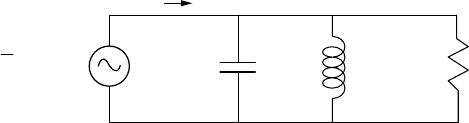
2.2. A 120-V, 60-Hz source supplies current to a 1 µF c apacitor, a 7.036-H
inductor and a 120- resistor, all wired in parallel.
v
=√2
V
cos w
t
1 µF
7.036-H
120-Ω
i
= ?
Figure P2.2
100 FUNDAMENTALS OF ELECTRIC POWER
a. Find the rms value of current through the capacitor, the inductor, and
the resistor.
b. Write the current through each component as a function of time
i = I
√
2cos(ωt + θ)
c. What is the total current delivered by the 120-V source (both rms value
and as a function of time)?
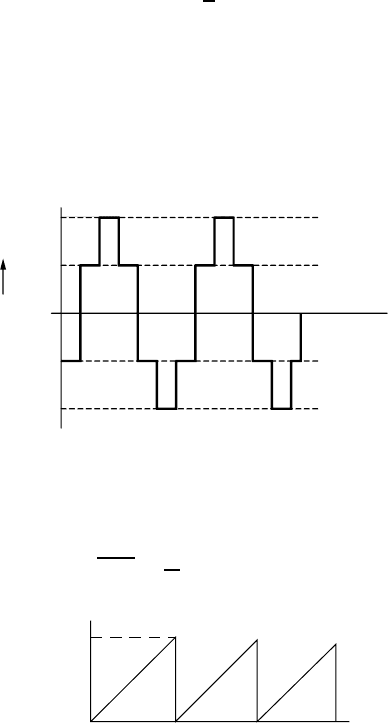
2.3. Inexpensive inverters often use a “modified” square wave approximation
to a sinusoid. For the following voltage waveform, what would be the rms
value of voltage?
2V
1V
0
−1V
−2V
V
Figure P2.3
2.4. Find the rms value of voltage for the sawtooth waveform shown below.
Recall from calculus how you find the average value of a periodic function
f(t)=
1
T
T
0
f(t)dt.
0
2V
1 2 3 sec
voltage
Figure P2.4
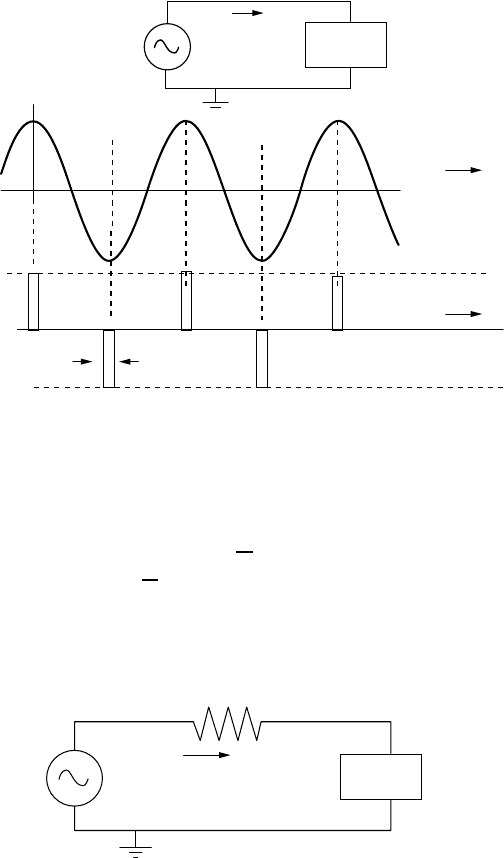
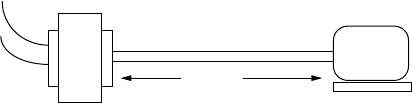
2.5 A load connected to a 120-V ac source draws “gulps” of current approx-
imated by rectangular pulses of amplitude 10 A and duration 0.2 radians
as shown below:
PROBLEMS 101
120V, 60 Hz
V
in
V
out
i
Load
source
10 A
V
in
w
t
w
t
2
0 ππ
−10 A
0.2 radians
Current (amps)
Figure P2.4a
a. What is the rms value of current?
b. Sketch the power delivered by the 120-V source as a function of time
p(t) = v(t) i(t). Assume the currents are drawn at a voltage equal to
the peak voltage of the source.
c. From (b), find the average power
P delivered by the source.
d. Using the relationship
P = V
rms
· I
rms
· PF, find the power factor.
e. Suppose the wires connecting the source to the load have resistance
of 1 ohm.
1 ohm
120 V
V
in
V
out
i
Load
Figure P2.4b
When a gulp of current is drawn there will be a voltage drop (iR)inthewires
causing a notch in the voltage reaching the load. Sketch the resulting voltage
waveform across the load, labeling any significant values.
102 FUNDAMENTALS OF ELECTRIC POWER
2.6. If a 480-V supply delivers 50 A with a power factor of 0.8, find the real
power (kW), the reactive power (kVAR), and the apparent power (kVA).
Draw the power triangle.
2.7. Suppose a utility charges its large industrial customers $0.04/kWh for kWh
of energy plus $7/month per peak kVA (demand charge). Peak kVA means
the highest level drawn by the load during the month. If a customer uses
an average of 750 kVA during a 720-hr month, with a 1000-kVA peak,
what would be their monthly bill if their power factor (PF) is 0.8? How
much money could be saved each month if their real power remains the
same but their PF is corrected to 1.0?
2.8. Suppose a motor with power factor 0.5 draws 3600 watts of real power at
240 V. It is connected to a transformer located 100 ft away.
transformer
100 ft
3600 W
0.5 PF
240 V
motor
? ga wire
Figure P2.8
a. What minimum gage wire could be used to connect transformer to
motor?
b. What power loss will there be in those wires?
c. Draw a power triangle for the wire and motor combination using the
real power of motor plus wires and reactive power of the motor itself.
2.9. A motor with power factor 0.6 draws 4200 W of real power at 240 V from
a 10 kVA transformer. Suppose a second motor is needed and it too draws
4200 W. With both motors on line, the transformer will be overloaded
unless a power factor correction can be made.
a. What power factor would be needed to be able to continue to use the
same 10-kVA transformer?
b. How many kVAR would need to be added to provide the needed power
factor?
c. How much capacitance would be needed to provide the kVAR correc-
tion?
2.10. A transformer rated at 1000 kVA is operating near capacity as it supplies
a load that draws 900-kVA with a power factor of 0.70.
a. How many kW of real power is being delivered to the load?
b. How much additional load (in kW of real power) can be added before
the transformer reaches its full rated kVA (assume the power factor
remains 0.70).
PROBLEMS 103
c. How much additional power (above the amount in a) can the load
draw from this transformer without exceeding its 1000 kVA r ating if
the power factor is corrected to 1.0?
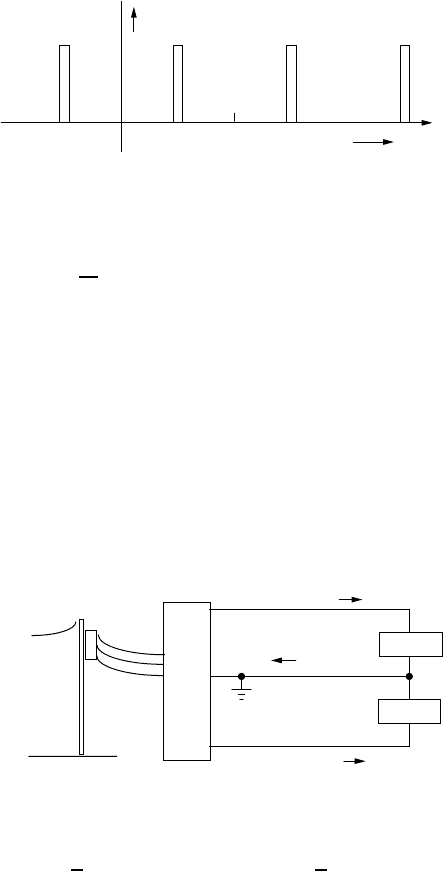
2.11. The current waveform for a half-wave rectifier with a capacitor filter looks
something like the following:
0
time
current
i
T
/2
T
Figure P2.11
Since this is a periodic function, it can be represented by a Fourier series:
i(t) =
a
0
2
+
∞
n=1
a
n
cos(nωt) +
∞
m=1
b
m
sin(mωt)
Which of the following assertions are true and which are false?
a. The value of a
0
is zero.
b. There are no sine terms in the series.
c. There are no cosine terms in the series.
d. There are no even harmonics in the series.
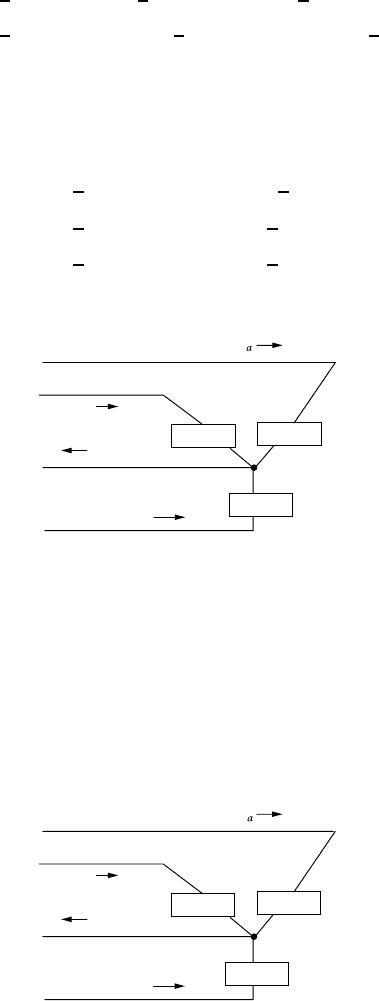
2.12. The power system for a home is usually described as three-wire, single-
phase power. It can however, also be thought of as “two-phase power”
(analogous to three-phase systems).
load
load
i
A
i
B
i
n
+120 V
−120 V
neutral line
breaker box
power
lines
Figure P2.12
a. For balanced loads resulting in the currents
i
A
= 5
√
2cos(377 t) and i
B
= 5
√
2cos(377 t +π) Amps
What is the rms current in the neutral line?
104 FUNDAMENTALS OF ELECTRIC POWER
b. For the following currents with harmonics:
i
A
= 5
√
2cos(377 t) + 4
√
2cos[2(377 t)] + 3
√
2cos[3(377 t)]
i
B
= 5
√
2cos(377 t +π) + 4
√
2cos[2(377 t +π)] + 3
√
2cos[3(377 t +π)]
c. What is the harmonic distortion in each of those currents?
d. What is the rms current in the neutral line?
2.13. Consider a balanced three-phase system with phase currents shown below:
i
a
= 5
√
2cosωt + 4
√
2cos3ωt
i
b
= 5
√
2cos(ωt + 120
◦
) + 4
√
2cos3(ωt + 120
◦
)
i
c
= 5
√
2cos(ωt − 120
◦
) + 4
√
2cos3(ωt − 120
◦
)
load
load
i
i
b
i
c
i
n
load
Figure P2.13
a. What is the rms value of the current in each phase?
b. What is the total harmonic distortion (THD) in each of the phase cur-
rents?
c. What is the current in the neutral as a function of time i
n
(t)?
d. What is the rms value of the current in the neutral line? Compare it to
the individual phase currents.
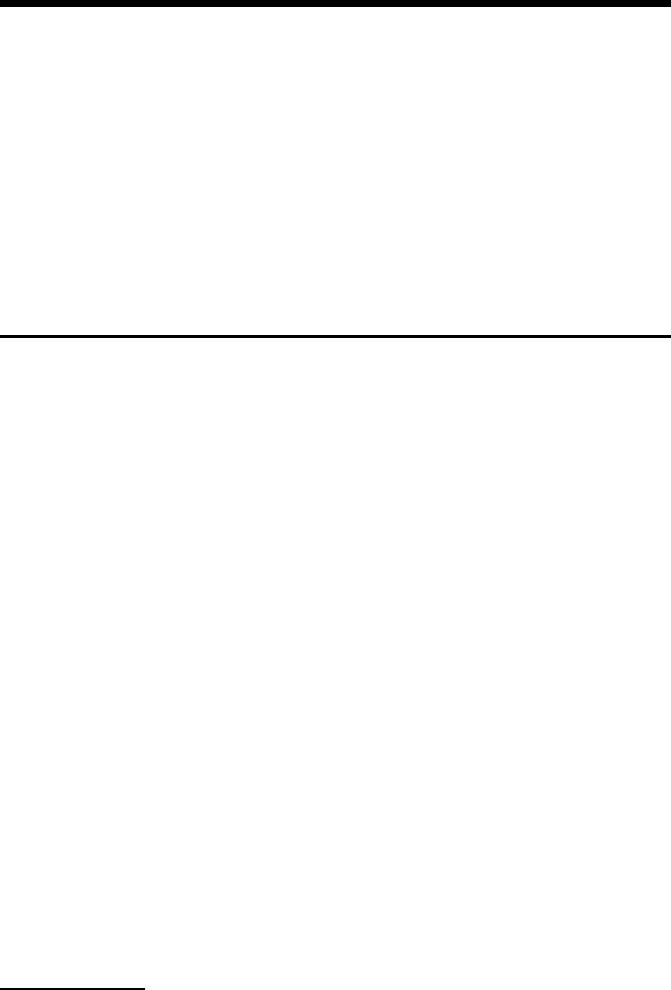
2.14. Consider a balanced three-phase system with phase currents shown below:
load
load
load
i
b
i
c
i
n
i
Figure P2.14

PROBLEMS 105
i
a
= 5
√
2cosωt + 4
√
2cos3ωt + 3
√
2cos9ωt
i
b
= 5
√
2cos(ωt + 120
◦
) + 4
√
2cos3(ωt + 120
◦
) + 3
√
2cos9(ωt + 120
◦
)
i
c
= 5
√
2cos(ωt − 120
◦
) + 4
√
2cos3(ωt − 120
◦
) + 3
√
2cos9(ωt − 120
◦
)
a. What is the rms current in each of the phases?
b. What is the THD in each of the phase currents?
c. What is the current in the neutral as a function of time i
n
(t)?
d. What is the rms value of the current in the neutral line?
CHAPTER 3
THE ELECTRIC POWER INDUSTRY
Little more than a century ago there were no lightbulbs, refrigerators, air con-
ditioners, or any of the other electrical marvels that we think of as being so
essential today. Indeed, nearly 2 billion people around the globe still live without
the benefits of such basic energy services. The electric power industry has since
grown to be one of the largest enterprises on the planet, with annual sales of over
$300 billion in the United States alone. It is also one of the most polluting of all
industries, responsible for three-fourths of U.S. sulfur oxides (SO
X
) emissions,
one-third of our carbon dioxide (CO
2
) and nitrogen oxides (NO
X
) emissions, and
one-fourth of particulate matter and toxic heavy metals emissions.
Twenty years ago, the industry consisted of regulated utilities with monopoly
franchises quietly going about the business of generating power, sending it out
over transmission and distribution lines to their own customers who dutifully
paid their bills. That all began to change in the 1980s when it became apparent
that new, small plants could generate electric power at lower cost than the price
at which electricity was being sold by utilities. When large industrial customers
realized they could save money by generating some, or all, of their own power
on-site, or perhaps buy it directly from nonutility providers, the whole concept
of electricity being a natural monopoly came into question. Just as many states
began to move toward a new, competitive power industry, California’s disas-
trous deregulation experience of 2000-2001 has put the question back on the
table, unanswered.
Technology has provided the impetus for change, but to move an industry
as large and important as this one requires an historic change in the regulatory
Renewable and Efficient Electric Power Systems. By Gilbert M. Masters
ISBN 0-471-28060-7
2004 John W iley & Sons, Inc.
107