
Masters G.M. Renewable and Efficient Electric Power Systems
Подождите немного. Документ загружается.

128 THE ELECTRIC POWER INDUSTRY
Stack
gases
Boiler
Fuel
Air
Boiler
feed pump
Condenser
Water
Turbine
Steam
Generator
Electricity
Cool water in
Cooling water
Warm water out
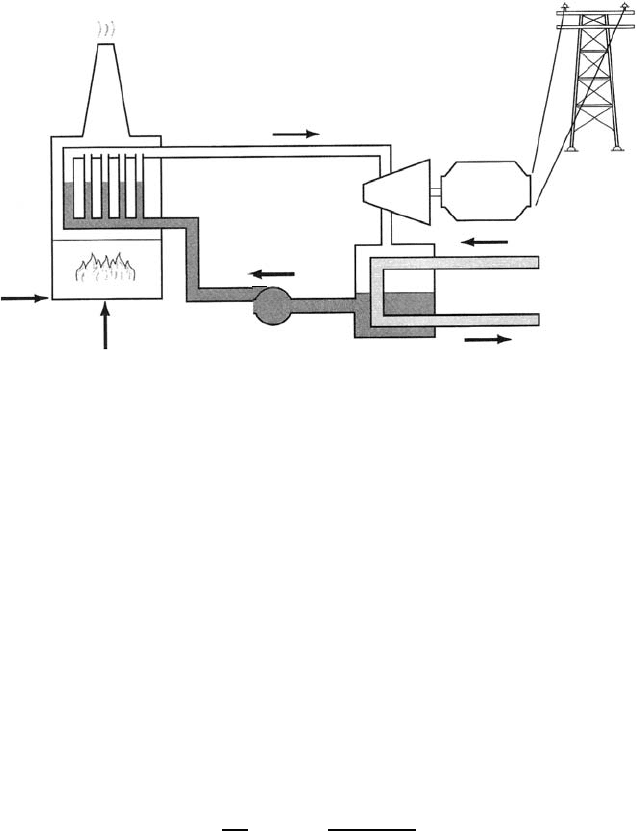
Figure 3.18 A fuel-fired, steam-electric power plant.
river, lake, or sea, heated in the condenser, and returned to that body of water,
in which case the process is called once-through cooling. A more expensive
approach, which has the dual advantages of requiring less water and avoiding
the thermal pollution associated with warming up the receiving body of water,
involves use of cooling towers that transfer the heat directly into the atmosphere.
In either case, if we think of the power plant as a heat engine, it is the environment
that acts as the heat sink so its temperature helps determine the overall efficiency
of the power cycle.
Let us use the Carnot limit to estimate the maximum efficiency that a power
plant such as that shown in Fig. 3.18 can possibly have. A reasonable estimate
of T
H
, the source temperature, might be the temperature of the steam from the
boiler, which is typically around 600
◦
C. For T
C
we might use a typical con-
denser operating temperature of about 30
◦
C. Using these values in (3.14), and
remembering to convert temperatures to the absolute scale, gives
Carnot efficiency = 1 −
T
C
T
H
= 1 −
30 + 273
600 + 273
= 0.65 = 65% (3.15)
We know from Fig. 3.3 that the average efficiency of U.S. power plants is only
about half this amount.
3.5.2 Coal-Fired Steam Power Plants
Coal-fired, Rankine cycle, steam power plants provide more than half of U.S.
electricity and are responsible for three-fourths of the sulfur oxide (SO
x
)
emissions as well as a significant fraction of the country’s carbon dioxide,
particulate matter (PM), mercury, and nitrogen oxides (NO
x
). Up until the 1960s,
STEAM-CYCLE POWER PLANTS 129
coal-fired power plants were notoriously dirty and not much was being done to
control those emissions. That picture has changed dramatically, and now close to
40% of the cost of building a new coal plant is money spent to pay for pollution
controls. Not only have existing levels of control been expensive in monetary
terms, they also use up about 5% of the power generated, reducing the plant’s
overall efficiency.
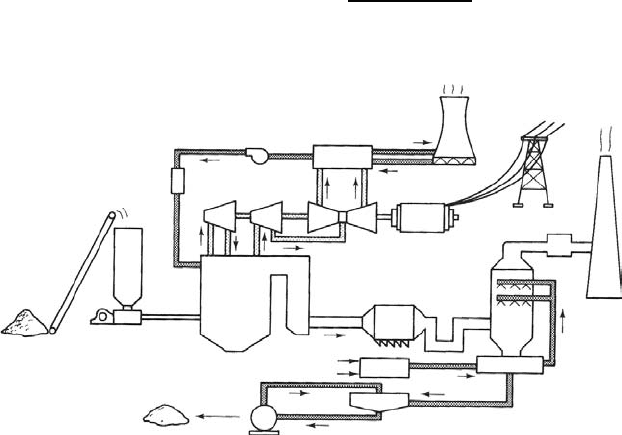
Figure 3.19 shows some of the complexity that emission controls add to coal-
fired steam power plants. In this plant, coal that has been crushed in a pulverizer
is burned to make steam in a boiler for the turbine-generator system. The steam
is then condensed, in this case using a cooling tower to dissipate waste heat
to the atmosphere rather than a local body of water, and the condensate is then
pumped back into the boiler. The flue gas from the boiler is sent to an electrostatic
precipitator, which adds a charge to the particulates in the gas stream so that they
can be attracted to electrodes, which collect them. Next, a wet scrubber sprays
a limestone slurry over the flue gas, precipitating the sulfur and removing it in
a sludge of calcium sulfide or calcium sulfate, which then must be treated and
disposed of.
The thermal efficiency of power plants is often expressed as a heat rate,
which is the thermal input (Btu or kJ) required to deliver 1 kWh of electrical
output (1 Btu/kWh = 1.055 kJ/kWh). The smaller the heat rate, the higher the
efficiency. In the United States, heat rates are usually expressed in Btu/kWh,
which results in the following relationship between it and thermal efficiency, η:
Heat rate (Btu/kWh) =
3412 Btu/kWh
η
(3.16)
FEEDWATER
HEATER
Turbines
Condensate
CONDENSER
COOLING
TOWER
Electrical
power
Stack
EFFLUENT
HOLDING
TANK
THICKENER
Limestone
water
Flue
gas
Steam lines
Slurry
Cool
Sludge
Warm
COAL
PULVERIZER
VACUUM
FILTER
FURNACE
Boiler
ELECTROSTATIC
PRECIPITATOR
SCRUBBER
Reheater
GENERATOR
Calcium sulfide
or sulfate
Coal
silo
Figure 3.19 Typical modern coal-fired power plant using an electrostatic precipitator
for particulate control and a limestone-based SO
2
scrubber. A cooling tower is shown for
thermal pollution control. From Masters (1998).

130 THE ELECTRIC POWER INDUSTRY
Or, in SI units,
Heat rate (kJ/kWh) =
1 (kJ/s)/kW × 3600 s/h
η
=
3600 kJ/kWh
η
(3.17)
While Edison’s first power plants in the 1880s had heat rates of about
70,000 Btu/kWh (≈5% efficient), the average new steam plant is about 34%
efficient and has a heat rate of approximately 10,000 Btu/kWh. The best steam
plants have efficiencies near 40%, but due to cost and technical complexity they
are not widely used in the United States.
Example 3.2 Materials Balance for a Coal-Fired Steam Power Plant.
Consider a power plant with a heat rate of 10,800 kJ/kWh burning bituminous
coal with 75 percent carbon and a heating value (energy released when it is
burned) of 27,300 kJ/kg. About 15% of thermal losses are up the stack, and the
remaining 85% are taken away by cooling water.
a. Find the efficiency of the plant.
b. Find the mass of coal that must be provided per kWh delivered.
c. Find the rate of carbon and CO
2
emissions from the plant in kg/kWh.
d. Find the minimum flow of cooling water per kWh if its temperature is only
allowed to increase by 10
◦
C.
Solution
a. From (3.17), the efficiency of the plant is
η =
3600 kJ/kWh
10, 800 kJ/kWh
= 0.333 = 33.3%
that is, for each 3 units of input heat, the plant delivers 1 unit of electricity and
2 units of waste heat.
b. The rate at which coal needs to be burned is
Coal rate =
10,800 kJ/kWh
27,300 kJ/kg
= 0.396 kg coal/kWh
c. With 75% of the coal being carbon, the carbon emission rate will be
Carbon emissions = 0.75 × 0.396 kg/kWh = 0.297 kgC/kWh
COMBUSTION GAS TURBINES 131
1 kWh
electricity
0.396 kg Coal
146 kg Cooling
Water + 10°C
1.09 kg CO
2
River
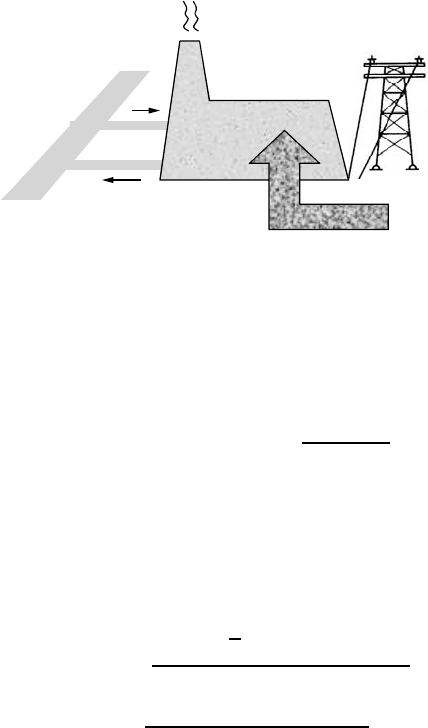
Figure 3.20 Mass flows to generate 1 kWh of electricity in a 33.3% efficient, coal-fired
power plant burning bituminous coal.
Since the molecular weight of CO
2
is 12 + 2 × 16 = 44, there are 12 kg
ofCin44kgofCO
2
. That translates into
CO
2
emissions = 0.297 kgC/kWh ×
44 kg CO
2
12 kg C
= 1.09 kg CO
2
/kWh
d. Two-thirds of the input energy is wasted, and 85% of that is removed by
the cooling water. It takes 4.184 kJ of energy to raise 1 kg of water by 1
◦
C
(the specific heat), so the minimum flow rate for cooling water to increase
by less than 10
◦
C will be
Cooling water =
0.85 ×
2
3
× 10,800 kJ/kWh
4.184 kJ/kg
◦
C × 10
◦
C
= 146.3 kg/kWh
A summary of Example 3.2 is shown in Fig. 3.20. In American units, it takes
about 0.9 pounds of coal and 40 gallons of cooling water to generate 1 kWh of
electricity while releasing about 2.4 pounds of CO
2
emissions.
3.6 COMBUSTION GAS TURBINES
The characteristics of combustion gas turbines for electricity generation are some-
what complementary to those of the steam turbine-generators just discussed.
Steam power plants tend to be large, coal-fired units that operate best with fairly
fixed loads. They tend to have high capital costs, largely driven by required emis-
sion controls, and low operating costs sinc e they so often use low-cost boiler fuels
such as coal. Once they have been purchased, they are cheap to operate so they
132 THE ELECTRIC POWER INDUSTRY
usually are run more or less continuously. In contrast, gas turbines tend to be
natural-gas-fired smaller units, which adjust quickly and easily to changing loads.
They have low capital costs and relatively high fuel costs, which means they are
most cost-effective as peaking power plants that run only intermittently. Histor-
ically, both steam and gas-turbine plants have had similar efficiencies, typically
in the low 30% range.
3.6.1 Basic Gas Turbine
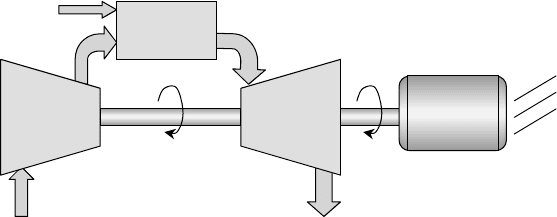
A basic gas turbine driving a generator is shown in Fig. 3.21. In it, fresh air is
drawn into a compressor where spinning rotor blades compress the air, elevating
its temperature and pressure. This hot, compressed air is mixed with fuel, usu-
ally natural gas, though LPG, kerosene, landfill gas, or oil are sometimes used,
and subsequently burned in the combustion chamber. The hot exhaust gases
are expanded in a turbine and released to the atmosphere. The compressor and
turbine share a connecting shaft, so that a portion, typically more than half,
of the rotational energy created by the spinning turbine is used to power the
compressor.
Gas turbines have long been used in industrial applications and as such were
designed strictly for stationary power systems. These industrial gas turbines
tend to be large machines made with heavy, thick materials whose high ther-
mal capacitance and moment of inertia reduces their ability to adjust quickly to
changing loads. They are available in a range of sizes from hundreds of kilo-
watts to hundreds of megawatts. For the smallest units they are only about 20%
efficient, but for turbines over about 10 MW they tend to have efficiencies of
around 30%.
Another style of gas turbine takes advantage of the billions of dollars of
development work that went into designing lightweight, compact engines for
jet aircraft. The thin, light, super-alloy materials used in these aeroderivative
turbines enable fast starts and quick acceleration, so they easily adjust to rapid
load changes and numerous start-up/shut-down events. Their small size makes it
easy to fabricate the complete unit in the factory and ship it to a site, thereby
Compressor
Fuel
100%
Fresh
air
Combustion
chamber
Turbine
Exhaust
gases 67%
AC
power
33%
1150°C
550°C
Generator
Figure 3.21 Basic gas turbine and generator. Temperatures and efficiencies are typical.
COMBINED-CYCLE POWER PLANTS 133
Compressor
Fuel
Fresh
air
Combustion
chamber
Turbine
Exhaust gases
AC
power
Heat recovery steam
generator (HRSG)
Injected
steam
Water
pump
Feedwater
Exhaust
Steam
Generator
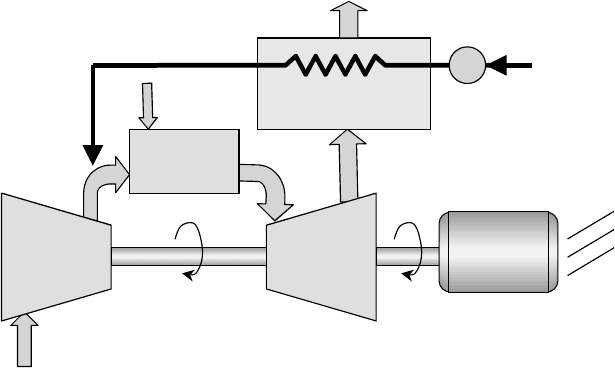
Figure 3.22 Steam-injected gas turbine (STIG) for increased efficiency and reduced
NO
x
emissions. Efficiencies may approach 45%.
reducing field installation time and cost. Aeroderivative turbines are available in
sizes ranging from a few kilowatts up to about 50 MW. In their larger sizes, they
achieve efficiencies exceeding 40%.
3.6.2 Steam-Injected Gas Turbines (STIG)
One way to increase the efficiency of gas turbines is to add a heat exchanger,
called a heat recovery steam generator (HRSG), to capture some of the waste
heat from the turbine. As shown in Fig. 3.22, water pumped through the HRSG
turns to steam, which is injected back into the airstream coming from the com-
pressor. The injected steam displaces a portion of the fuel heat that would
otherwise be needed in the combustion chamber. These units, called steam-
injected gas turbines (STIG), can have efficiencies approaching 45%. Moreover,
the injected steam reduces combustion temperatures, which helps control NO
x
emissions. They are considerably more expensive than simple gas turbines due
to the extra cost of the HRSG, and the care that must be taken to purify incom-
ing feedwater.
3.7 COMBINED-CYCLE POWER PLANTS
From our analysis of the Carnot cycle, we know that the maximum possible
efficiency of a heat engine is limited by a low-temperature sink as well as by
a high-temperature source. With exhaust gases leaving a gas turbine at tem-
peratures frequently above 500
◦
C, it should come at no surprise that overall
134 THE ELECTRIC POWER INDUSTRY
Compressor
Fresh
air
Combustion
chamber
Gas
Turbine
Exhaust
gases
AC
power
Heat recovery steam
generator (HRSG)
Water pump
Exhaust
15%
Steam
Water
Steam
Turbine
Cooling water 36% Condenser
100%
Fuel
31%
18%
Generator
Generator
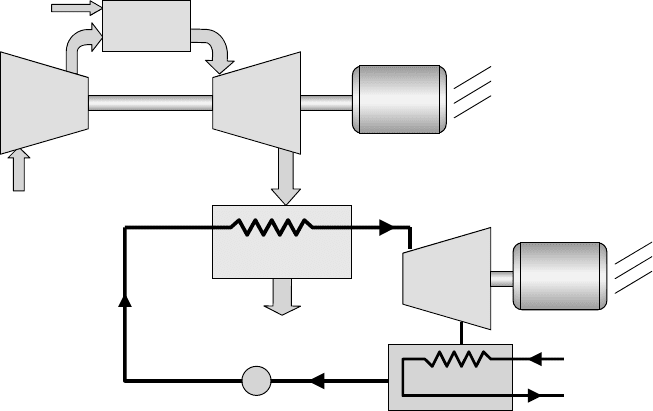
Figure 3.23 Combined-cycle power system with representative energy flows providing
a total efficiency of 49%.
efficiencies are usually modest, in the 30% range, unless some use is made
of that high-quality waste heat. A heat recovery steam generator (HRSG) can
capture some of that waste heat for process steam or other thermal purposes,
but if the goal is to maximize electricity output while treating any thermal
benefits as secondary, the gas turbine waste heat can be used to power a second-
stage steam turbine. When a gas turbine and steam turbine are coupled this
way, the result is called a combined-cycle power plant. Working together, such
combined-cycle plants have achieved fuel-to-electricity efficiencies in excess
of 50%.
Figure 3.23 shows how the two turbines are linked. Exhaust gases from
the gas turbine pass through a heat recovery steam generator (HRSG) before
being allowed to vent to the atmosphere. The HRSG boils water, creating high-
temperature, high-pressure steam that expands in the steam turbine. The rest of
the steam cycle is the normal one: A partial vacuum is created in the condenser,
drawing steam from the turbine, and the resulting condensate is pumped back
through the HSRG to complete the cycle.
3.8 GAS TURBINES AND COMBINED-CYCLE COGENERATION
Exhaust temperatures from gas turbines frequently are above 500
◦
C, which is
high enough to be very useful for a number of applications including industrial
process heating, absorption cooling, space heating, or, as we have seen, generation
of additional electricity with a steam turbine. When a power plant produces useful
BASELOAD, INTERMEDIATE AND PEAKING POWER PLANTS 135
Compressor
Fuel
100%
Fresh
air
Combustion
chamber
Turbine
Exhaust gases
AC
power
33%
Heat recovery steam
generator (HRSG)
Water
pump
Feedwater
Exhaust 14%
Steam 53%
Process heat
Absorption cooling
Space & water heating
Generator
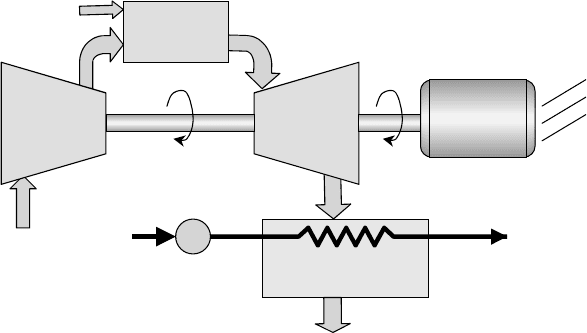
Figure 3.24 Simple-cycle gas turbine with a steam generator for cogeneration showing
typical conversion efficiencies.
thermal energy as well as electrical power in a sequential process using a single
fuel, it is called a cogeneration plant. The usual way to capture the waste heat
in a gas-turbine cogeneration facility is with a heat recovery steam generator
(HRSG), as shown in Fig. 3.24. Example conversion efficiencies of 33% for
electricity and 53% for thermal output are shown.
The steam generated in the HRSG in Fig. 3.24 could, of course, be sent
to a steam turbine to squeeze more electrical output from the fuel. In such a
combined-cycle unit, the electrical efficiency goes up but there is less waste heat
for cogeneration. Moreover, if it is a conventional combined-cycle plant, the
steam turbine has been designed for maximum electrical efficiency, which means
that the condenser operating temperature is as cold as it can be. While there
would still be a lot of heat that could be transferred from condenser to a thermal
load, it would be at such a low temperature that it wouldn’t be of much use.
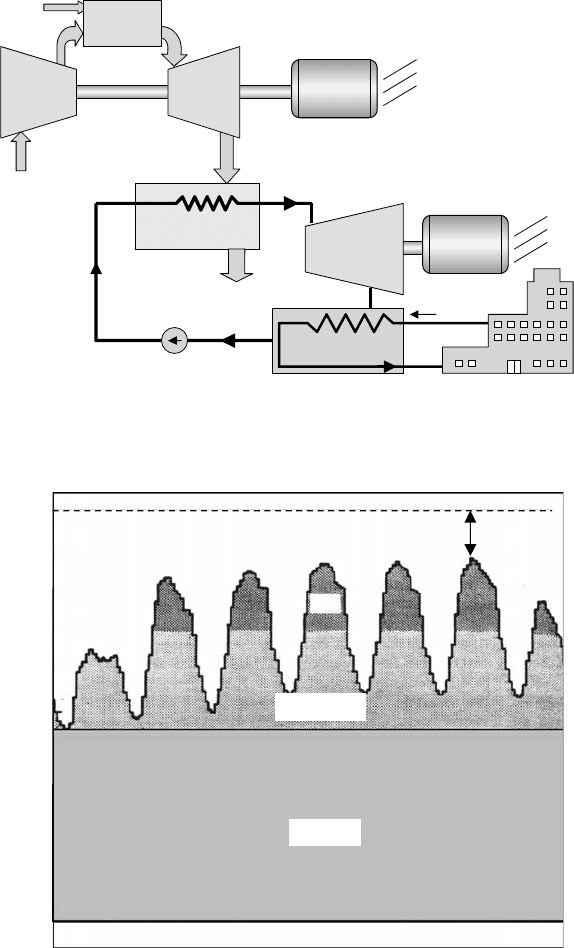
To use a combined-cycle plant for cogeneration often means substituting a
noncondensing heat exchanger for the usual condenser. Without the low pressure
normally created in the condenser, these back-pressure turbines generate more
useful thermal energy at the expense of reduced electrical efficiency. Figure 3.25
shows a schematic of such a combined-cycle, cogeneration plant, including rep-
resentative energy flows.
3.9 BASELOAD, INTERMEDIATE AND PEAKING POWER PLANTS
We saw from the load profile for a hot, summer day in California (Fig. 3.6) that
the demand for electricity can vary considerably from day to night. It also exhibits
weekly patterns, with diminished demands on weekends, as well as seasonally,
136 THE ELECTRIC POWER INDUSTRY
Compressor
Fuel
100%
Fresh
air
Combustion
chamber
Gas
Turbine
Exhaust
gases
Gas turbine
generator 31%
Heat recovery steam
generator (HRSG)
Exhaust
15%
Steam
Non-condensing
Steam Turbine
Heat Recovery Unit
Steam turbine
generator 10%
80°C
55°C
Cogen 44%
Generator
Generator
Figure 3.25 Representative energy flows for a combined-cycle, cogeneration plant with
back-pressure steam turbine, delivering thermal energy to a district heating system.
Total available capacity
Peak
Intermediate
Sunday Monday Wednesday ThursdayTuesday Friday Saturday
Reserve
margin
Demand (Thousand MW)
Baseload
Figure 3.26 Example of weekly load fluctuations and roughly how power plants can be
categorized as baseload, intermediate, or peaking plants.
BASELOAD, INTERMEDIATE AND PEAKING POWER PLANTS 137
with some utilities seeing their annual highest loads on hot summer days and
others on cold winter mornings.
These fluctuations in demand suggest that during the peak demand, most of a
utility’s power plants will be operating, while in the valleys, many are likely to be
idling or shut off entirely. In other words, many power plants don’t operate with
a schedule anything like full output all of the time. It has also been mentioned
that some power plants, especially large coal-fired plants as well as hydroelectric
plants, are expensive to build but relatively cheap to operate, so they should be
run more or less continuously as baseload plants; others, such as simple-cycle
gas turbines, are relatively inexpensive to build but expensive to operate. They
are most appropriately used as peaking power plants, turned on only during
periods of highest demand. Other plants have characteristics that are somewhere
in between; these intermediate load plants are often run for most of the daytime
and then cycled as necessary to follow the evening load. Figure 3.26 suggests
these designations of baseload, intermediate, and peaking power plants applied
to a weeklong demand curve.
An important question for utility planners is what combination of power plants
will most economically meet the hour-by-hour power demands of their customers.
While the details of such generation planning is beyond the scope of this book,
we can get a good feel for the fundamentals with a few simple notions involving
the economic characteristics of different types of power plants and how they
relate to the loads they must serve.
3.9.1 Screening Curves
A very simple model of the economics of a given power plant takes all of the
costs and puts them into two categories: fixed costs and variable costs. Fixed
costs are monies that must be spent even if the power plant is never turned on,
and they include such things as capital costs, taxes, insurance, and any fixed
operations and maintenance costs that will be incurred even when the plant isn’t
operated. Variable costs are the added costs associated with actually running the
plant. These are mostly fuel plus operations and maintenance costs. The first step
in finding the optimum mix of power plants is to develop screening curves that
show annual revenues required to pay fixed and variable costs as a function of
hours per year that the plant is operated.
The capital costs of a power plant can be annualized by multiplying it by a
quantity called the fixed charge rate (FCR). The fixed charge rate accounts for
interest on loans, acceptable returns for investors, fixed operation and mainte-
nance (O&M) charges, taxes, and so forth. The FCR depends primarily on the
cost of capital, so it may vary as interest rates change, but it is a number usually
between 11% and 18% per year. On a per-kilowatt of rated power basis, the
annualized fixed costs are computed from
Fixed ($/yr-kW) = Capital cost ($/kW) × Fixed charge rate (yr
−1
)(3.18)