
Masters G.M. Renewable and Efficient Electric Power Systems
Подождите немного. Документ загружается.

168 THE ELECTRIC POWER INDUSTRY
e. What annual revenue would the utility need to receive from each type
of power plant?
f. What would be the cost of electricity (¢/kWh) from each type of power
plant?
3.11 A 345 kV, three-phase transmission system uses 0.642-in. diameter ACSR
cable to deliver 200 MW to a wye-connected load 100 miles away. Compute
the line losses if the power factor is 0.90.

CHAPTER 4
DISTRIBUTED GENERATION
4.1 ELECTRICITY GENERATION IN TRANSITION
The traditional, vertically integrated utility incorporating generation, transmis-
sion, distribution, and customer energy services is in the beginning stages of
what could prove to be quite revolutionary changes. The era of ever-larger central
power stations seems to have ended. The opening of the transmission and dis-
tribution grid to independent power producers who offer cheaper, more efficient,
smaller-scale plants is well underway. Attempts to restructure the regulatory side
of utilities to help create competition among generators and allow customers to
choose their source of power have been initiated in a number of states, but with
mixed success. And, partly due to California’s deregulation crisis of 2000–2001,
the customer’s side of the meter is being rediscovered and energy efficiency is
enjoying a resurgence of attention.
On the customer side of the meter, the power business is beginning to look
more like it did in the early part of the twentieth century when more than half
of U.S. electricity was self-generated with small, isolated systems for direct use
by industrial firms. Many of those systems were located in the basements of
buildings, which were heated by the waste heat from the power plants. Those
old steam-powered, engine generators used for heat and power have modern
equivalents in the form of microturbines, fuel cells, internal-combustion engines,
and small gas turbines. Using these technologies, customers are rediscovering the
economic advantages of on-site cogeneration of heat and power, or trigeneration
for heating, electric power, and cooling.
Renewable and Efficient Electric Power Systems. By Gilbert M. Masters
ISBN 0-471-28060-7
2004 John W iley & Sons, Inc.
169

170 DISTRIBUTED GENERATION
TA BLE 4.1 Typical Power Plant Power Output and End-Use Power
Demands (kW)
Generation kW End Use kW
Large hydro dam or power-plant cluster 10,000,000 Portable computer 0.02
Nuclear plant 1,100,000
Desktop computer 0.1
Coal plant 600,000
Household average power (U.S.) 1
Combined-cycle turbines 250,000
Commercial customer average power 10
Simple-cycle gas turbine 150,000
Supermarket 100
Aeroderivative gas turbine cogeneration 50,000
Medium-sized office building 1,000
Molten carbonate fuel cell 4,000
Large factory 10,000
Wind turbine 1,500
Peak use of largest buildings 100,000
Fuel-cell powered automobile 60
Microturbine 30
Residential PEM fuel cell 5
Residential photovoltaic system 3
In addition to economic benefits, other motivations helping to drive the transition
toward small-scale, decentralized energy systems include increased concern for
environmental impacts of generation, most especially those related to climate
change, increased concern for the vulnerability of our centralized energy sys-
tems to terrorist attacks, and increased demands for electricity reliability in the
digital economy.
A sense of the dramatic decrease in scale that is underway is provided in
Table 4.1, in which a number of generation technologies are listed along with
typical power outputs. For comparison, some examples of power demands of
typical end uses are also shown. While the power ratings of some of the dis-
tributed generation options may look trivially small, it is the potentially large
numbers of replicated small units that will make their contribution significant.
For example, the U.S. auto industry builds around 6 million cars each year. If
half of those were 60-kW fuel-cell vehicles, the combined generation capacity of
5-year’s worth of automobile production would be greater than the total installed
capacity of all U.S. power plants.
4.2 DISTRIBUTED GENERATION WITH FOSSIL FUELS
Distributed generation (DG) is the term used to describe small-scale power gen-
eration, usually in sizes up to around 50 MW, located on the distribution system
close to the point of consumption. Such generators may be owned by a utility or,
more likely, owned by a customer who may use all of the power on site or who
may sell a portion, or perhaps all of it, to the local utility. When there is waste heat
available from the generator, the customer may be able to use it for such applica-
tions as process heating, space heating, and air conditioning, thereby increasing
the overall efficiency from fuel to electricity and useful thermal energy.

DISTRIBUTED GENERATION WITH FOSSIL FUELS 171
The process of capturing and using waste heat while generating electricity is
sometimes called cogeneration and sometimes combined heat and power (CHP).
There are subtle distinctions between the terms. Some say cogeneration applies
only to qualifying facilities (QFs) as defined by the Public Utilities Regulatory
Policy Act (PURPA), and some say that CHP applies only to low-temperature
heat used for space heating and cooling), but in this text the terms will be used
interchangeably.
4.2.1 HHV and LHV
Before describing some of the emerging technologies for distributed generation,
we need to sort out a subtle distinction having to do with the way power plant effi-
ciencies are often presented. When a f uel is burned, some of the energy released
ends up as latent heat in the water vapor produced (about 1060 Btu per pound
of vapor, or 2465 kJ/kg). Usually that water vapor, along with the latent heat
it contains, exits the stack along with all the other combustion gases, and its
heating value is, in essence, lost. In some cases, however, that is not the case.
For example, the most fuel-efficient, modern furnaces used for space-heating
homes achieve their high efficiencies (over 90%) by causing the combustion
gases to cool enough to condense the water vapor before it leaves the stack.
Whether or not the latent heat in water vapor is included leads to two dif-
ferent values of what is called the heat of combustion for a fuel. The higher
heating value (HHV), also known as the gross heat of combustion, includes the
latent heat, while the lower heating value (LHV), or net heat of combustion,
does not.
Examples of HHV and LHV for various fuels, along with the LHV/HHV
ratios, are presented in Table 4.2. Since natural gas is a combination of methane,
TABLE 4.2 Higher Heating Value (HHV) and Lower Heating Value (LHV) for
Various Fuels
a
Higher Heating Value HHV Lower Heating Value LHV
Fuel Btu/lbm kJ/kg Btu/lbm kJ/kg LHV/HHV
Methane 23,875 55,533 21,495 49,997 0.9003
Propane 21,669 50,402 19,937 46,373 0.9201
Natural gas 22,500 52,335 20,273 47,153 0.9010
Gasoline 19,657 45,722 18,434 42,877 0.9378
No. 4 oil 18,890 43,938 17,804 41,412 0.9425
a
The gases are based on dry, 60
◦
F, 30-in. Hg conditions. Natural gas is a representative value.
Source: Based on Babcock and Wilcox (1992) and Petchers (2002).

172 DISTRIBUTED GENERATION
ethane, and other gases, which varies depending on the source, the values given
for HHV and LHV in the table are meant to be just representative, or typical,
values. For natural gas, the difference between HHV and LHV is about 10%.
Since the efficiency of a power plant is output power divided by fuel-energy
input, the question becomes, Which fuel value should be used, HHV or LHV?
Unfortunately, both will be encountered. For large power stations, efficiency is
almost always based on HHV, but for the most common distributed generation
technologies such as microturbines and reciprocating engines, it is usually based
on LHV. When it is important to reconcile the two, the following relationship
may be used:
Thermal efficiency (HHV) = Thermal efficiency (LHV) ×
LHV
HHV
(4.1)
where the LHV/HHV ratio can be found from Table 4.2.
Example 4.1 Microturbine Efficiency. A microturbine has a natural gas input
of 13,700 Btu (LHV) per kWh of electricity generated. Find its LHV efficiency
and its HHV efficiency.
Solution. In Section 3.5.2 the relationship between efficiency and heat rates (in
American units) is given by (3.16)
Efficiency =
3412 Btu/kWh
Heat rate (Btu input/kWh output)
Using the LHV for fuel gives the LHV efficiency:
Efficiency (LHV) =
3412 Btu/kWh
13,700 Btu/kWh
= 0.2491 = 24.91%
Using the LHV/HHV ratio of 0.9010 for natural gas (Table 4.2) in Eq. (4.1) gives
the HHV efficiency for this turbine:
Efficiency (HHV) = 24.91% × 0.901 = 22.44%
We will revisit the concept of LHV and HHV in the context of fuel cells later
in the chapter.
4.2.2 Microcombustion Turbines
Gas turbines, used either in the simple-cycle mode or in combined-cycle power
plants, were introduced in Chapter 3. Simple-cycle turbines used by utilities
DISTRIBUTED GENERATION WITH FOSSIL FUELS 173
for peaking power plants typically generate anywhere from a few megawatts
to hundreds of megawatts. Industrial facilities often use these same relatively
large turbines to generate some of their own electricity—especially when they
can take advantage of the waste heat.
More recently, a new generation of very small gas turbines has entered the
marketplace. Often referred to as microturbines, these units generate anywhere
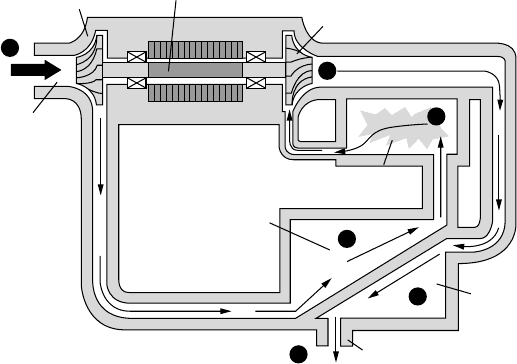
from about 500 watts to several hundred kilowatts. Figure 4.1 illustrates the basic
configuration including compressor, turbine, and permanent-magnet generator, in
this case all mounted on a single shaft. Incoming air is compressed to three or four
atmospheres of pressure and sent through a heat exchanger called a recuperator,
where its temperature is elevated by the hot exhaust gases. By preheating the
compressed incoming air, the recuperator helps boost the efficiency of the unit.
The hot, compressed air is mixed with fuel in the combustion chamber and is
burned. The expansion of hot gases through the turbine spins the compressor and
generator. The exhaust is released to the atmosphere after transferring much of
its heat to the incoming compressed air in the recuperator.
Example specifications of several microturbines are given in Table 4.3. For
example, the Capstone Turbine Corporation manufactures several refrigerator-
size microturbines that generate up to 30 kW and 60 kW. These turbines have
only one moving part—the common shaft with compressor, turbine, and gener-
ator, which spins at up to 96,000 rpm on air bearings that require no lubrication.
There are no gearboxes, lubricants, coolants, or pumps that could require main-
tenance. The generator creates variable frequency ac that is rectified to dc and
Compressor
Permanent-magnet generator
Turbine
Inlet
Combustion chamber
Recuperator
(cool side)
Recuperator
(hot side)
Exhaust
1
4
3
2
5
6
Figure 4.1 Microturbine power plant. Air is compressed (1), preheated in the recuper-
ator (2), combusted with natural gas (3), expanded through the turbine (4), cooled in the
recuperator (5), and exhausted (6). From Cler and Shepard (1996).

TA BLE 4.3 Specifications for Example Microturbines
a
Manufacturer, Model Capstone C30 Capstone C60 Elliott TA 100R
Rated power 30 kW 60 kW 105 kW
Fuel input 390,130 Btu/hr (LHV) 724,000 Btu/h (LHV) 1,235,506 Btu/h (LHV)
Heat rate (LHV) 12,800 kJ (13,100 Btu)/kWh 12,900 kJ (12,200 Btu)/kWh 12,415 kJ (11,770 Btu)/kWh
Efficiency (LHV) 26% 28% 29%
Exhaust gas temp. 275
◦
C (530
◦
F) 305
◦
C (580
◦
F) 279
◦
C (535
◦
F)
NO
x
emissions < 9 ppmV (0.49 lb/MWh) < 9 ppmV (0.49 lb/MWh) < 24 ppmV (1.59 lb/MWh)
CO emissions < 40 ppmV @ 15% O2 < 40 ppmV @ 15% O2 < 41 ppm @ 15% O2
T u rbine rotation 96,000 rpm 96,000 rpm 45,000 rpm
Dimensions H , W , D 1.90 × 0.71 × 1.34 m (75 × 28 × 53
)2.11× 0.76 × 1.96 m (83 × 30 × 77
)2.11× 0.85 × 3.05 m (83 × 34 × 120
)
Weight 478 kg (1052 lb) 758 kg (1671 lb) 1845 kg (4000 lb)
Noise 65 dBA @ 10 m (33 ft) 70 dBA @ 10 m (33 ft) 70 dBA
a
Emissions are for natural gas fuel.
Source: Capstone www.microturbine.com and Elliott www.elliottmicroturbines.com websites.
174
DISTRIBUTED GENERATION WITH FOSSIL FUELS 175
Compressor
Combustor
Turbine
Fuel
Recuperator
Waste-heat
Recovery 47%
Exhaust
24%
Intake air
Generator
AC
29%
100%
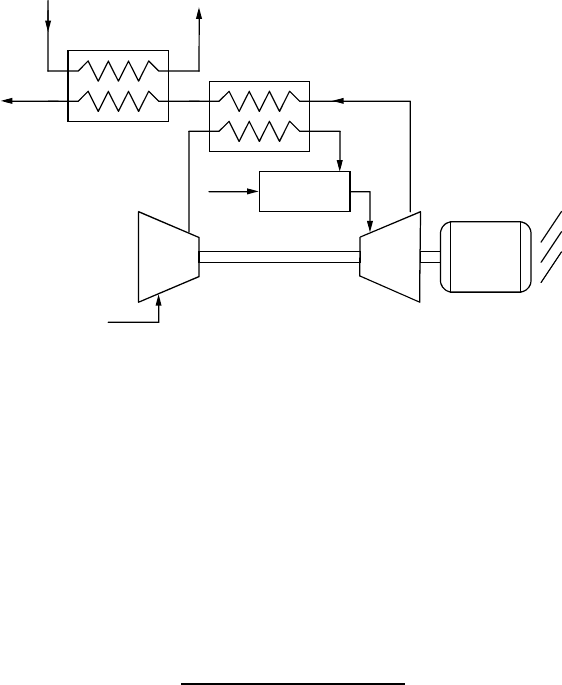
Figure 4.2 Example energy flows for a microturbine with recuperator and waste-heat
recovery. The electric efficiency is based on LHV.
inverted back to 50- or 60-Hz ac electricity ready for use. These are designed
so that 2 to 20 units can easily be stacked in parallel to generate multiples of
30 kW or 60 kW.
The Elliott 100-kW turbine described in Table 4.3 is an oil-cooled, recuperated
unit designed for combined heat and power. It can deliver 105 kW of electri-
cal power plus 172 kW of thermal energy for water heating with an overall
thermal efficiency from fuel to electricity and useful heat of over 75%. An
example of its energy flows in a combined heat and power mode is shown
in Fig. 4.2.
Example 4.2 Combined Heat and Power. The Elliott TA 100A at its full
105-kW output burns 1.24 × 10
6
Btu/hr of natural gas. Its waste heat is used to
supplement a boiler used for water and space heating in an apartment house.
The design calls for water from the boiler at 120
◦
Ftobeheatedto140
◦
F
and returned to the boiler. The system operates in this mode for 8000 hours
per year.
a. If 47% of the fuel energy is transferred to the boiler water, what should
the water flow rate be?
b. If the boiler is 75% efficient, and it is fueled with natural gas costing $6
per million Btu, how much money will the microturbine save in displaced
boiler fuel?
c. If utility electricity costs $0.08/kWh, how much will the microturbine save
in avoided utility electricity?

176 DISTRIBUTED GENERATION
d. If O&M is $1500/yr, what is the net annual savings for the microturbine?
e. If the microturbine costs $220,000, what is the ratio of annual savings to
initial investment (called the initial rate of return)?
Solution
a. The heat Q required to raise a substance with specific heat c and mass flow
rate ˙m by a temperature difference of T is
Q =˙mcT
Since it takes 1 Btu to raise 1 lb of water by 1
◦
F, and one gallon of water
weighs 8.34 lb, we can write
Water flow rate ˙m =
0.47 × 1.24 × 10
6
Btu/h
1 Btu/lb
◦
F × 20
◦
F × 8.34 lb/gal × 60 min /h
= 58 gpm
b. The fuel displaced by not using the 75 percent efficient boiler is worth
Fuel savings =
0.47 × 1.24 × 10
6
Btu/h
0.75
×
$6.00
10
6
Btu
× 8000 hr/yr
= $37,300/yr
c. The utility electricity savings is
Electric utility savings = 105 kW × 8000 hr/yr × $0.08/kWh
= $67,200/yr
d. The cost of fuel for the microturbine is
Microturbine fuel cost = 1.24 × 10
6
Btu/h ×
$6.00
10
6
Btu
× 8000 h/yr
= $59,520/yr
So the net annual savings of the microturbine, including $1500/yr in
O&M, is
Microturbine savings = ($37,300 + $67,200) −$59,520 − $1,500
= $43,480/yr

DISTRIBUTED GENERATION WITH FOSSIL FUELS 177
e. The initial rate of return on this investment would be
Initial rate of return =
Annual savings
Initial investment
=
$43,480/yr
$220,000
= 0.198
= 19.8%/yr
(Chapter 5 presents more sophisticated investment analysis techniques.)
4.2.3 Reciprocating Internal Combustion Engines
Distributed generation today is dominated by installations that utilize recipro-
cating—that is, piston-driven—internal combustion engines (ICEs) connected to
constant-speed ac generators. They are readily available in sizes that range from
0.5 kW to 6.5 MW, with electrical efficiencies in the vicinity of 37–40% (LHV
basis). They can be designed to run on a number of fuels, including gasoline, nat-
ural gas, kerosene, propane, fuel oil, alcohol, waste-treatment plant digester gas,
and hydrogen. They are the least expensive of the currently available DG technolo-
gies, and when burning natural gas they are relatively clean. Reciprocating engines
make up a large fraction of the current market for combined heat and power.
Most of these engines are conventional, four-stroke reciprocating engines very
much like the ones found in automobiles and trucks. The four-stroke cycle, as
illustrated in Fig. 4.3, consists of an intake stroke, a compression stroke, a power
stroke, and an exhaust stroke. During the intake stroke, the piston moves down-
ward. The partial vacuum created draws in air, or a mixture of air and vaporized
fuel, through the open intake valve. During the compression stroke, the piston
moves upward with both the intake and exhaust valves closed. The gases are
compressed and heated, and near the top of the stroke combustion is initiated.
The hot, expanding gases drive the piston downward in the power stroke forcing
the crankshaft to rotate. In the final stroke, the rising piston forces the hot exhaust
gases to exit via the now-open exhaust valve, completing the cycle.
An alternative to the four-stroke engine is one in which every other stroke is
a power stroke. In these two-stroke engines, as the piston approaches its lowest
point in the power stroke, an exhaust port opens, thereby allowing exhaust gases
to escape while the intake port opens to allow fresh fuel and air to enter. Both
close at the start of the compression stroke. Two-stroke engines have greater
power for their size, but because neither intake nor exhaust functions are partic-
ularly effective, their efficiency is not as good as four-stroke engines and they
produce much higher emissions. Since air quality is so often a critical constraint
in siting distributed generation, two-stroke engines have limited potential.
There are two important variations on the four-stroke engine: spark-ignited
(Otto-cycle) and compression-ignition (Diesel-cycle). Spark-ignited engines burn