
Masters G.M. Renewable and Efficient Electric Power Systems
Подождите немного. Документ загружается.

198 DISTRIBUTED GENERATION
well as smaller, less expensive turbines. Home-scale projects with modest flows
and decent heads can lead to quick, simple, cost-effective systems.
The head H given in (4.5) is called the gross head,callitH
G
, because it does
not include pipe losses that decrease the power available for the turbine. The net
head, H
N
, will be the gross head (the actual elevation difference) minus the head
loss in the piping. Those losses are a function of the pipe diameter, the flow rate,
the length of the pipe, how smooth the pipe is, and how many bends, valves,
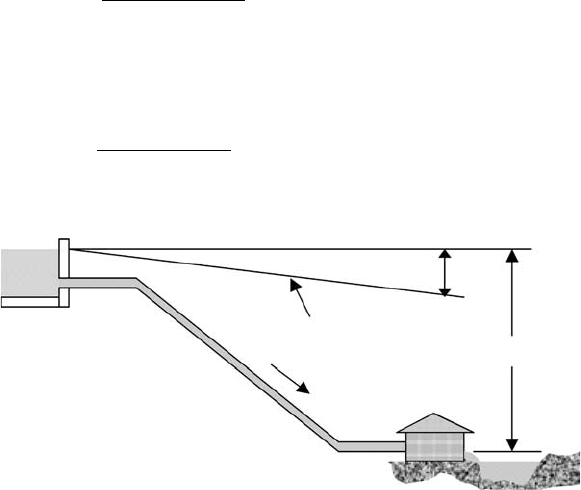
and elbows the water has to pass through on its way to the turbine. Figure 4.18
illustrates the difference between gross and net head.
4.5.2 Pipe Losses
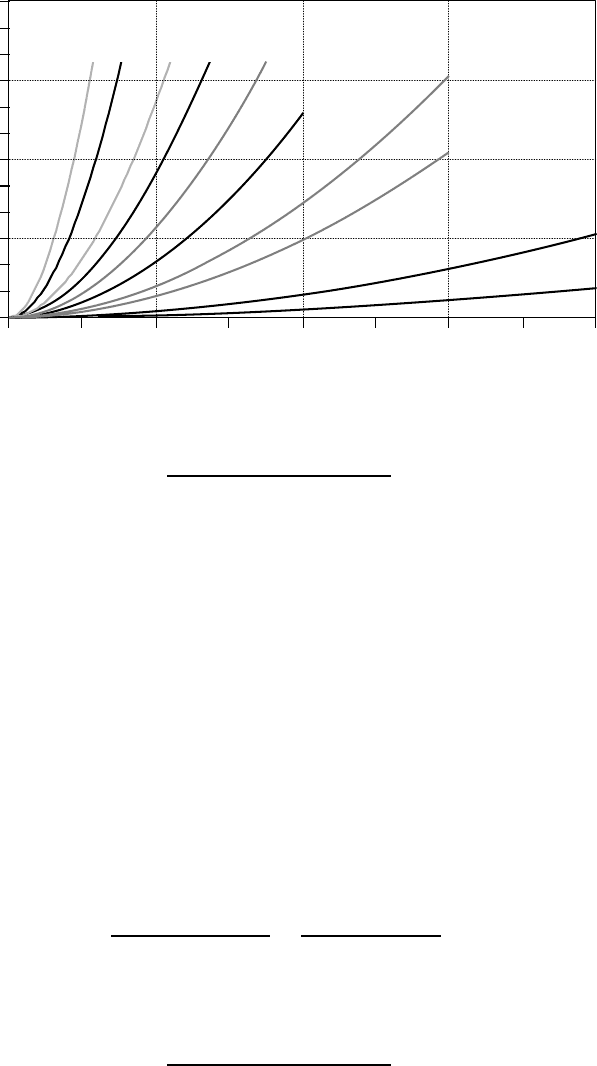
Figure 4.19 shows the friction loss, expressed as feet of head per 100 feet of
pipe, for PVC and for polyethylene (poly) pipe of various diameters. PVC pipe
has lower friction losses and it is also less expensive than poly pipe, but small-
diameter poly may be easier to install since it is somewhat flexible and can
be purchased in rolls from 100 to 300 feet long. Larger-diameter poly comes
in shorter lengths that can be butt-welded on site. Both need to be protected
from sunlight, since ultraviolet exposure makes these materials brittle and easier
to crack.
From (4.5), we can write that the energy delivered by a micro-hydro system
is given by
P(W)
delivered
=
eQ(gpm)H
N
(ft)
5.30
,P(kW) = 9.81eQ(m
3
/s)H
N
(m)(4.6)
where e is the efficiency of the turbine/generator. From (4.6) comes the following
very handy rules-of-thumb for ≈50%-efficient turbine/generator systems (which
is in the right ballpark for a micro-hydro plant):
P(W)≈
Q(gpm)H
N
(ft)
10
,P(kW) ≈ 5Q(m
3
/s)H
N
(m)(4.7)
Head Loss ∆
H
Net (dynamic) Head
H
N
Penstock
Q
Powerhouse
Gross Head
H
G
Figure 4.18 Net head is what remains after pipe losses are accounted for.
MICRO-HYDROPOWER SYSTEMS 199
400350300250200150100500
0
2
4
6
8
10
12
14
16
18
20
22
24
Flow Rate (gpm)
Friction Loss (ft of head per 100 ft of pipe)
PVCPoly
1.5-in 2-in
Poly PVC
2.5-in
Poly
2.5-in
PVC
3-in Poly
3-in PVC
4-in PVC
5-in PVC
Figure 4.19 Friction head loss, in feet of head per 100 ft of pipe, for 160 psi PVC
piping and for polyethylene, SDR pressure-rated pipe.
Example 4.4 Power from a Small Source. Suppose 150 gpm of water is taken
from a creek and delivered through 1000 ft of 3-in.-diameter polyethylene pipe to
a turbine 100 ft lower than the source. Use the rule-of-thumb (4.7) to estimate the
power delivered by the turbine/generator. In a 30-day month, how much electric
energy would be generated?
Solution. From Fig. 4.19, at 150 gpm, 3-in. poly loses about 5 ft of head for
every 100 ft of length. Since we have 1000 ft of pipe, the friction loss is
1000 ft × 5ft/100 ft = 50 ft of head loss
The net head available to the turbine is
Net head = Gross head − Friction head = 100 ft − 50 ft = 50 ft
The rule-of-thumb estimate for electrical power delivered is
P(W)≈
Q(gpm) × H
N
(ft)
10
=
150 gpm × 50 ft
10
= 750 W
The monthly electricity supplied would be about 24 hr × 30 d/mo ×0.75 kW =
540 kWh. This is roughly the average electrical energy used by a typical U.S.
household that does not use electricity for heating, cooling, or water heating.
200 DISTRIBUTED GENERATION
Example 4.4 would be a poor design since half of the power potentially
available is lost in the piping. Larger-diameter pipe will always reduce losses
and increase power delivered, so bigger is definitely better from an energy per-
spective. But, large pipe costs more, especially when the cost of larger valves and
other fittings is included, and it is more difficult to work with. Since the cost of
the piping is often a significant fraction of the total cost of a micro-hydro project,
an economic analysis should be used to decide upon the optimum pipe diameter.
Suppose, however, that the pipe size has already been determined for one rea-
son or another. Perhaps it is already the largest diameter conveniently available,
perhaps it is as much as can be afforded, or perhaps it has already been pur-
chased. The question arises as to whether there is an optimum flow rate through
the pipe. If flow is too high, friction eats up too much of the power and output
drops. By slowing down the flow rate, friction losses are reduced but so is the
power delivered. So, there must be some ideal flow rate that balances these two
competing phenomena and produces the maximum power for a given pipe size.
A derivation of the theoretical maximum power delivered by a pipeline is
quite straightforward. The curves given in Fig. 4.19 can be approximated quite
accurately by the following relationship:
H = kQ
2
(4.8)
where k is just an arbitrary constant. The power delivered by the pipeline will
be the net head times the flow, with an appropriate constant of proportionality c
that depends on the units used:
P = cH
N
Q = c(H
G
− H )Q = c(H
G
− kQ
2
)Q (4.9)
For maximum power, we can take the derivative with respect to Q and set it
equal to zero:
dP
dQ
= 0 = H
G
− 3kQ
2
= H
G
− 3H (4.10)
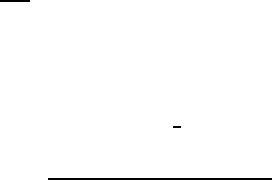
That leads to the conclusion that the theoretical maximum power delivered by a
pipeline occurs when pipe losses are one-third of the gross head:
H =
1
3
H
G
(4.11)
Example 4.5 Optimum Flow Rate. Find the optimum flow rate for the 1000 ft
of 3-in. poly pipe in Example 4.4. Gross head is 100 ft.
Solution. Applying (4.11), for friction to be one-third of 100 ft of gross head
means 33.3 ft of pipe losses in 1000 ft of pipe. That translates to 3.33 ft of loss
per 100 ft of pipe. For 3-in. poly, Fig. 4.19 indicates that a flow rate of about
120 gpm will be optimum.
MICRO-HYDROPOWER SYSTEMS 201
200180160140120100806040200
0
100
200
300
400
500
600
700
800
900
Flow Rate
Q
(gpm)
Power (Watts)
∆
H
=
1
3
H
G
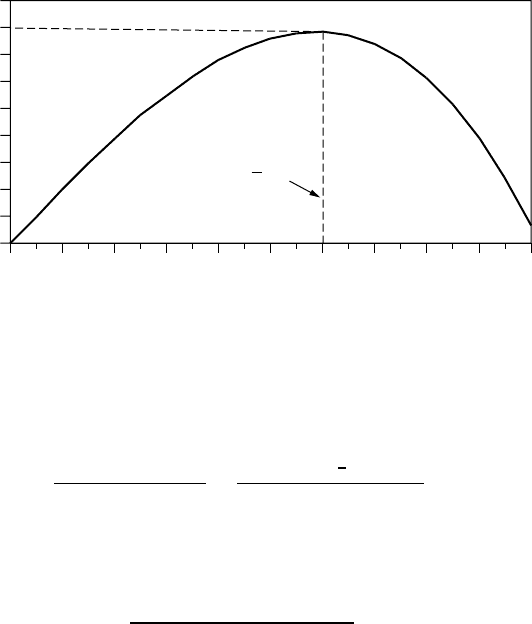
Figure 4.20 Showing the influence of flow rate on power delivered from a penstock
(values correspond to Example 4.4).
At 120 gpm and with net head equal to two-thirds of the gross head, power
delivered will be
P(W)≈
Q(gpm) × H
N
(ft)
10
=
120 gpm ×
2
3
× 100 ft
10
= 800 W
For comparison, in Example 4.3, with 150 gpm of flow only 750 W were gen-
erated. The relationship between flow and power for this pipeline is shown in
Fig. 4.20.
While the above illustrates how slowing the flow may increase power delivered
by the pipeline, that doesn’t mean it would help to simply put a valve in line that
is then partially shut off. That would waste more power than would have been
gained. Instead, it is the function of a properly designed nozzle to control that
flow without much power loss. And, once again, it should be pointed out that the
first approach to increasing power delivered is always to consider a larger pipe.
Keeping flow rates less than about 5 ft per second and friction losses less than
20% seem to be good design guidelines.
4.5.3 Measuring Flow
Obviously, a determination of the available water flow is essential to planning
and designing a system. In some circumstances, the source may be so abundant
and the demand so low that a very crude assessment may be all that is necessary.
If, however, the source is a modest creek, or perhaps just a spring, especially if it
is one whose flow is seasonal, much more careful observations and measurements
may be required before making a hydropower investment. In those circumstances,
regular measurements taken over at least a full year should be made.
202 DISTRIBUTED GENERATION
h
W > 3 h> 2 h > 2 h
h
> 2 h
> 4 h
Ruler
v < 0.15 m/s
< 0.5 ft/s
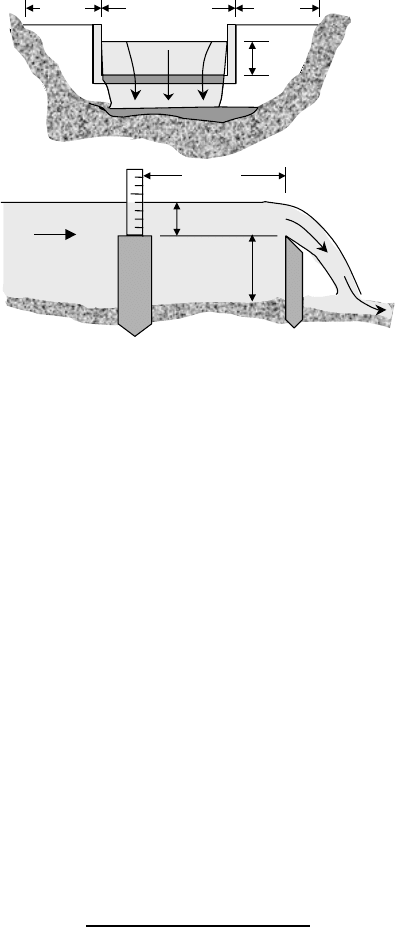
Figure 4.21 A rectangular weir used to measure flows. Based on Inversin (1986).
Methods of estimating stream flow vary from the very simplest bucket-and-
stopwatch approach to more sophisticated approaches, including one in which
stream velocity measurements are made across the entire cross section of the
creek using a propeller-or-cup-driven current meter. For micro-hydro systems,
oftentimes the best approach involves building a temporary plywood, concrete,
or metal wall, called a weir, across the creek. The height of the water as it flows
through a notch in the weir can be used to determine flow.
The notch in the weir may have a number of different shapes, including
rectangular, triangular, and trapezoidal. It needs to have a sharp edge to it so
that the water drops off immediately as it crosses the weir. For accuracy, it
must create a very slow moving pool of water behind it so that the surface is
completely smooth as it approaches the weir, and a ruler of some sort needs to
be set up so that the height of the water upstream can be measured. When the
geometric relationships for the rectangular weir shown in Fig. 4.21 are followed,
and height h is more than about 5 cm, or 2 in., the flow can be estimated from
the following:
Q = 1.8(W − 0.2 h)h
3/2
with Q(m
3
/s), h(m), W (m) (4.12)
Q = 2.9(W − 0.2 h)h
3/2
with Q(gpm), h(in.), W (in.) (4.13)
Example 4.6 Designing a Weir. Design a weir to be able to measure flows
expected to be at least 100 gpm following the constraints given in Fig. 4.21.

MICRO-HYDROPOWER SYSTEMS 203
Solution. At the 100-gpm low-flow rate, we’ll use the suggested minimum water
surface height above the notch of 2 in. From (4.13),
W ≤
Q
2.9 h
3/2
+ 0.2 h =
100
2.9 × 2
3/2
+ 0.2 × 2 = 12.6in
To give the weir the greatest measurement range under the constraint that h ≤
W/3, suggests making W = 12.6 in. The maximum water height above the weir
can then be h = 12.6/3 = 4.2in.
From (4.13), the greatest flow that could be measured with the 12.6in. ×
4.2 in. notch would be
Q = 2.9(W − 0.2 h)h
3/2
= 2.9(12.6 −0.2 × 4.2)4.2
3/2
= 294 gpm
4.5.4 Turbines
Just as energy in water manifests itself in three forms—potential, pressure, and
kinetic head—there are also three different approaches to transforming that
waterpower into the mechanical energy needed to rotate the shaft of an elec-
trical generator. Impulse turbines capture the kinetic energy of high-speed jets
of water squirting onto buckets along the circumference of a wheel. In contrast,
water velocity in a reaction turbine plays only a modest role, and instead it is
mostly the pressure difference across the runners, or blades, of these turbines
that creates the desired torque. Generally speaking, impulse turbines are most
appropriate in high-head, low-flow circumstances, while the opposite is the case
for reaction turbines. And, finally, the slow-moving, but powerful, traditional
overshot waterwheel converts potential energy into mechanical energy. The slow
rotational rates of waterwheels are a poor match to the high speeds needed by
generators, so they are not used for electric power.
Impulse turbines are the most commonly used turbines in micro-hydro systems.
The original impulse turbine was developed and patented by Lester Pelton in
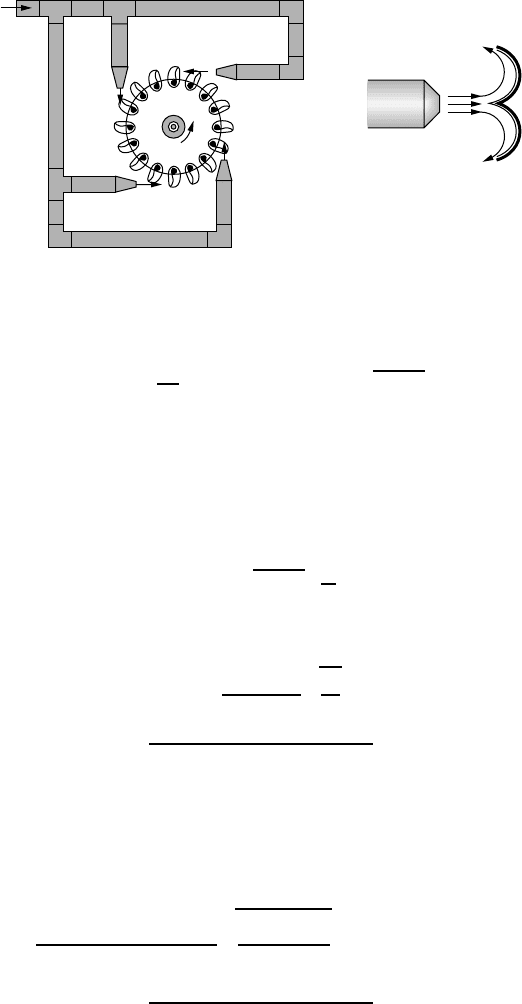
1880, and its modern counterparts continue to carry his name. In a Pelton wheel,
water squirts out of nozzles onto sets of twin buckets attached to the rotating
wheel. The buckets are carefully designed to extract as much of the water’s
kinetic energy as possible while leaving enough energy in the water to enable it
to leave the buckets without interfering with the incoming water. A diagram of a
four-nozzle Pelton wheel is shown in Fig. 4.22. These turbines have efficiencies
typically in the range of 70–90%.
The flow rate to a Pelton wheel is controlled by nozzles, which for simple
residential systems are much like those found on ordinary irrigation sprinklers.
When water exits a nozzle, its pressure head is converted to kinetic energy, which
204 DISTRIBUTED GENERATION
Twin
Buckets
Jet
Nozzle
Figure 4.22 A four-nozzle Pelton turbine.
means that we can use (4.3) to determine the flow velocity.
H
N
=
v
2
2g
so that v =
2gH
N
(4.14)
From flow velocity v and flow rate Q we can determine an appropriate diameter
for the water jets. For nozzles with needle valves, the jet diameter is on the order
of 10–20% smaller than the nozzle, but for simple, home-scale systems, the jet
and nozzle diameters are nearly equal. Using Q = vA along with (4.14), we can
determine the jet diameter d for a turbine with n nozzles:
Q = vA =
2gH
N
π
4
nd
2
(4.15)
Solving for jet diameter gives
d =
0.949
(gH
N
)
1/4
Q
n
(4.16)
Example 4.7 Nozzles for a Pelton Turbine. A penstock provides 150 gpm
(0.334 cfs) with 50 ft of head to a Pelton turbine with 4 nozzles. Assuming jet
and nozzle diameters are the same, pick a nozzle diameter.
Solution. From (4.16)
d =
0.949
(32.2 ft/s
2
× 50 ft)
1/4
0.334 ft
3
/s
4
= 0.0433 ft = 0.52 in.
The efficiency of the original Pelton design suffers somewhat at higher flow
rates because water trying to leave the buckets tends to interfere with the incoming
MICRO-HYDROPOWER SYSTEMS 205
jet. Another impulse turbine, called a Turgo wheel, is similar to a Pelton, but
the runner has a different shape and the incoming jet of water hits the blades
somewhat from one side, allowing exiting water to leave from the other, which
greatly reduces the interference problem. The Turgo design also allows the jet
to spray several buckets at once; this spins the turbine at a higher speed than a
Pelton, which makes it somewhat more compatible with generator speeds.
There is another impulse turbine, called a cross-flow turbine, which is espe-
cially useful in low-to-medium head situations (5–20 m). This turbine is also
known as a Banki, Mitchell, or Ossberger turbine—names that reflect its inven-
tor, principal developer, and current manufacturer. These turbines are especially
simple to fabricate, which makes them popular in developing countries where
they can be built locally.
For low head installations with large flow rates, reaction turbines are the ones
most commonly used. Rather than having the runner be shot at by a stream
of water, as is the case with impulse turbines, reaction turbine runners are com-
pletely immersed in water and derive their power from the mass of water moving
through them rather than the velocity. Most reaction turbines used in micro-hydro
installations have runners that look like an outboard motor propeller. The pro-
peller may have anywhere from three to six blades, which for small systems
are usually fixed pitch. Larger units that include variable-pitch blades and other
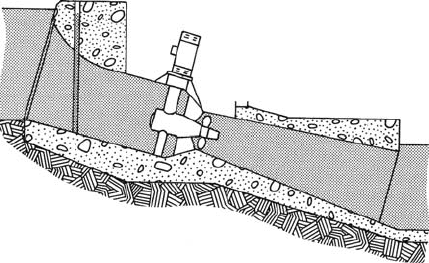
adjustable features are referred to as Kaplan turbines. An example of a right-
angle-drive system in which a bulb contains the gearing between the turbine and
an externally mounted generator is shown in Fig. 4.23.
4.5.5 Electrical Aspects of Micro-Hydro
Larger micro-hydro systems may be used as a source of ac power that is fed
directly into utility lines using conventional synchronous generators and grid
interfaces. Since the output frequency is determined by the rpm of the genera-
tor, very precise speed controls are necessary. While mechanical governors and
hand-operated control valves have been traditionally used, modern systems have
electronic governors controlled by microprocessors.
Figure 4.23 A right-angle-drive propeller turbine. Inversin (1986).
206 DISTRIBUTED GENERATION
Charge
Controller
Shunt
Load
Generator
Turbine
DC
Batteries
DC to AC
Inverter
DC
Loads
AC
Loads
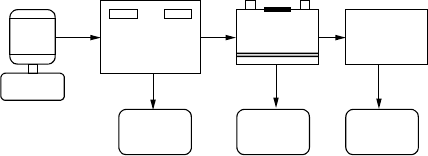
Figure 4.24 Electrical block diagram of a battery-based micro-hydro system.
On the other end of the scale, home-size micro-hydro systems usually generate
dc, which is used to charge batteries. An exception would be the case in which
utility power is conveniently available, in which case a grid-connected system in
which the meter spins in one direction when demand is less than the hydro system
provides, and the other way when it doesn’t, would be simpler and cheaper than
the battery-storage approach. The electrical details of grid-connected systems as
well as stand-alone systems with battery storage are covered in some detail in
the Photovoltaic Systems chapter of this text (Chapter 9).
The battery bank in a stand-alone micro-hydro system allows the hydro sys-
tem, including pipes, valves, turbine, and generator, to be designed to meet just
the average daily power demand, rather than the peak, which means that every-
thing can be smaller and cheaper. Loads vary throughout the day, of course, as
appliances are turned on and off, but the real peaks in demand are associated with
the surges of current needed to start the motors in major appliances and power
tools. Batteries handle that with ease. Since daily variations in water flow are
modest, micro-hydro battery storage systems can be sized to cover much shorter
outages than weather-dependent PV systems must handle. Two days of storage
is considered reasonable.
A diagram of the principal electrical components in a typical battery-based
micro-hydro system is given in Fig. 4.24. To keep the batteries from being dam-
aged by overcharging, the system shown includes a charge controller that diverts
excess power from the generator to a shunt load, which could be, for example, the
heating element in an electric water heater tank. Other control schemes are pos-
sible, including use of regulators that either (a) adjust the flow of water through
the turbine or (b) modulate the generator output by adjusting the current to its
field windings. As shown, batteries can provide dc power directly to some loads,
while other loads receive ac from an inverter.
4.6 FUEL CELLS
I believe that water will one day be employed as a fuel, that hydrogen and oxygen
which constitute it, used singly or together, will furnish an inexhaustible source of
heat and light.
—Jules Verne, Mysterious Island, 1874
FUEL CELLS 207
The portion of the above quote in which Jules Verne describes the joining
of hydrogen and oxygen to provide a source of heat and light is a remarkably
accurate description of one of the most promising new technologies now nearing
commercial reality—the fuel cell. However, he didn’t get it quite right since
more energy is needed to dissociate water into hydrogen and oxygen than can be
recovered so water itself cannot be considered a fuel.
Fuel cells convert chemical energy contained in a fuel (hydrogen, natural
gas, methanol, gasoline, etc.) directly into electrical power. By avoiding the
intermediate step of converting fuel energy first into heat, which is then used
to create mechanical motion and finally electrical power, fuel cell efficiency is
not constrained by the Carnot limits of heat engines (Fig. 4.25). Fuel-to-electric
power efficiencies as high as 65% are likely, which gives fuel cells the potential to
be roughly twice as efficient as the average central power station operating today.
Fuel cells have other properties besides high efficiency that make them espe-
cially appealing. The usual combustion products (SO
x
, particulates, CO, and
various unburned or partially burned hydrocarbons) are not emitted, although
there may be some thermal NO
x
when fuel cells operate at high temperatures.
They are vibration-free and almost silent, which, when coupled with their lack
of emissions, means they can be located very close to their loads—for example,
in the basement of a building. Being close to their loads, they not only avoid
transmission and distribution system losses, but their waste heat can be used
to cogenerate electricity and useful heat for applications such as space heating,
air-conditioning, and hot water. Fuel-cell cogeneration systems can have overall
efficiencies from fuel to electricity and heat of over 80%. High overall efficiency
not only saves fuel but also, if that fuel is a hydrocarbon such as natural gas,
emissions of the principal greenhouse gas, CO
2
, are reduced as well. In fact,
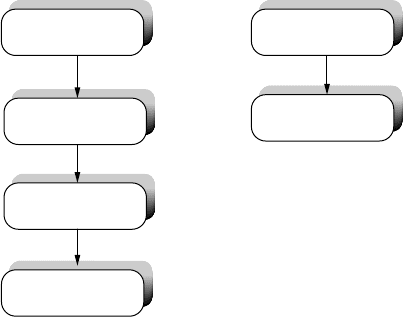
CHEMICAL
ENERGY
HEAT
MECHANICAL
MOTION
ELECTRICITY
ELECTRICITY
CHEMICAL
ENERGY
CONVENTIONAL
COMBUSTION
FUEL
CELL
Figure 4.25 Conversion of chemical energy to electricity in a fuel cell is not limited by
the Carnot efficiency constraints of heat engines.