
Masters G.M. Renewable and Efficient Electric Power Systems
Подождите немного. Документ загружается.

178 DISTRIBUTED GENERATION
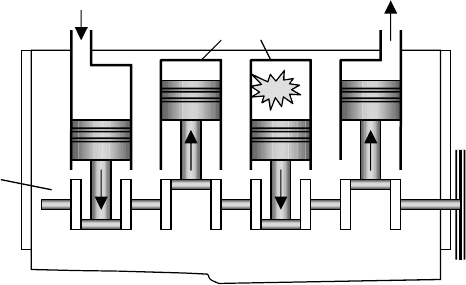
Intake valve
open
Rotating
crankshaft
Intake and exhaust
valves closed
Exhaust
valve open
Intake Power ExhaustCompression
Figure 4.3 Basic four-stroke, internal combustion engine.
gasoline or other easily ignitable fuels such as natural gas or propane. Combustion
is initiated by an externally timed spark, which ignites the air–fuel mixture that
entered the cylinder during the intake stroke and which has been compressed
during the subsequent compression stroke.
In contrast, compression-ignition engines burn heavier petroleum distillates
such as diesel or fuel oil. These fuels are not premixed with air, but instead
are injected under high pressure directly into the cylinder toward the end of the
compression cycle. Self-ignited diesel engines have much higher compression
ratios than do spark-ignited engines, which means that during the compression
stroke the air is heated to much higher temperatures. As the pressure increases,
so does the temperature until a point is reached at which spontaneous combus-
tion causes the fuel to explode, initiating the power stroke. In addition to having
higher compression ratios, diesel engines also experience much more sudden
fuel ignition—more of an explosive “bang” than occurs in the slower-burning
air–fuel mixture of a spark-ignited engine. Both of these factors mean that diesel
engines must be built to be stronger and heavier than their spark-ignited counter-
parts. In spite of these more severe materials requirements, diesel engines tend to
have higher efficiencies, which means for the same output they can be physically
smaller in size and somewhat less expensive. Generally speaking, they require
more maintenance than spark-ignition engines and their emissions are more prob-
lematic, making them more difficult to site in areas where air quality is an issue.
The efficiency of internal combustion engines can be increased by pressurizing
the air, or air–fuel mixture, before it is enters the cylinder (called charged aspi-
ration). This can be done with a turbocharger, which is a small turbine driven by
the exhaust gases, or a supercharger, which is mechanically driven by an auxiliary
shaft from the engine. Thermal efficiencies (from fuel to horsepower) of as high as
41% LHV (38% HHV) for spark-ignited engines and 46% LHV (44% HHV) for
Diesel-cycle engines have been achieved. An added benefit of charged aspiration
is that it allows the engine to run with a leaner air–fuel mixture, which helps
lower combustion temperature and hence lowers NO
x
emissions.
DISTRIBUTED GENERATION WITH FOSSIL FUELS 179
Since emissions are a major constraint, most of the interest in reciprocating
engines for distributed generation is focused on engines that burn the cleanest
fuel—natural gas. The U.S. Department of Energy (DOE), along with Caterpillar,
Cummins, and Waukesha Engines and a number of universities, has initiated
an Advanced Reciprocating Engines Systems (ARES) program to help improve
natural-gas engine efficiency while lowering emissions, with a goal of reaching
50% electrical efficiency and 80+% CHP efficiency, with NO
x
emissions below
0.1 g NO
x
per brake-horsepower-hour, at a capital cost of $400 to $450 per kW.
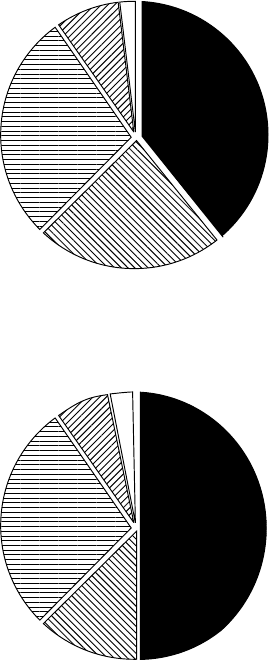
Figure 4.4 shows a typical heat balance for today’s 39.1% efficient engine along
Friction
7.7%
Unburned
Fuel 2%
Net Power
39.1%
Exhaust Gas
Losses 23.4%
Current Heat Balance
Thermal
Losses 27.8%
Friction
4.6%
Unburned
Fuel 2%
Net Power
50.7%
Exhaust Gas
Losses 14.6%
Targeted Heat Balance
Thermal
Losses 28.1%
Figure 4.4 Heat balance for conventional high-efficiency reciprocating engines, along
with the goals of the ARES program for next-generation engines. Based on McNeely
(2003).
180 DISTRIBUTED GENERATION
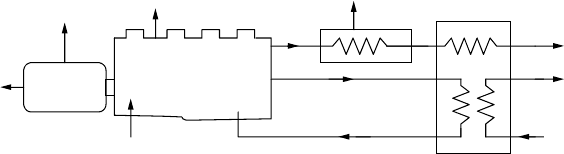
Electric
power 36%
Generator
losses 2%
Engine radiative
losses 5%
Steam 15%
Exhaust gas
losses 8%
Jacket water
Exhaust
gas
HRSG
Heat
exchangers
Thermal loads:
hot water, A/C,
boiler heat 34%
Generator
Engine
Natural gas fuel 100%
Figure 4.5 Heat balance for an example reciprocating-engine cogeneration system with
overall efficiency of 85%. Based on data from Petchers.
with the targeted heat balance for the next generation, 50% efficient, natural-gas
fueled, reciprocating engines.
For combined heat and power applications, waste heat from reciprocating
engines can be tapped mainly from exhaust gases and cooling water that circulates
around cylinders in the engine jacket, with additional potential from oil and turbo
coolers. While engine exhaust and cooling water each provide about half of the
useful thermal energy in a reciprocating-engine cogeneration system, the exhaust
is at much higher temperature (around 450
◦
C versus 100
◦
C) and hence is more
versatile. Figure 4.5 shows an example heat balance for a reciprocating-engine
cogeneration system utilizing a heat-recovery steam generator (HRSG) for steam
along with other heat exchangers to provide lower temperature energy for such
loads as absorption air-conditioning, hot water, and boiler heat. The conversion
efficiency from fuel to electricity (36%) and usable heat (49%) gives an overall
thermal efficiency of 85%.
4.2.4 Stirling Engines
The spark-ignition and Diesel-cycle reciprocating engines just described are
examples of internal combustion engines. That is, combustion takes place inside
the engine itself. An alternative approach is external combustion, in which energy
is supplied to the working fluid from a source outside of the engine. A steam-cycle
power plant is one example of an external combustion engine. A Stirling-cycle
engine is an example of a piston-driven reciprocating engine that relies on exter-
nal rather than internal combustion. As such, it can run on any virtually any fuel
or other source of high temperatures such as concentrated sunlight shining onto
a black absorber plate.
Stirling-cycle engines were patented in 1816 by a minister in the Church of
Scotland, Robert Stirling. He was apparently motivated, in part, by concern for the
safety of his parishioners who were at some risk from poor-quality steam engines
that had a tendency, in those days, to violently and unexpectedly explode. His
engine had no such problem since they were designed to operate at relatively
low pressures. The first known application of a Stirling engine was in 1872 by
John Ericsson, a British/American inventor. Thereafter, Stirling engines were
DISTRIBUTED GENERATION WITH FOSSIL FUELS 181
used quite extensively until the early 1900s, at which point advances in steam
and spark-ignition engines, with higher efficiencies and greater versatility, pretty
much eliminated them from the marketplace. They are now enjoying somewhat
of a comeback, however, especially as an efficient technology for converting
concentrated sunlight into electricity.
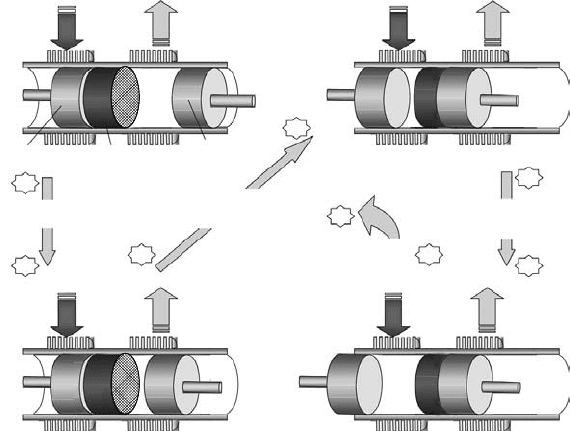
The basic operation of a Stirling engine is explained in Fig. 4.6. In this case,
the engine consists of two pistons in the same cylinder—one on the hot side of the
engine, the other on the cold side—separated by a “short-term” thermal energy
storage device called a regenerator. Unlike an internal-combustion engine, the
gas, which may be just air, but is more likely to be nitrogen, helium, or hydrogen,
is permanently contained in the cylinder. The regenerator may be just a wire or
ceramic mesh or some other kind of porous plug with sufficient mass to allow
it to maintain a good thermal gradient from one face to the other. It also needs
to be porous enough to allow gas in the cylinder to be pushed through it first in
one direction, then the other. As the gas passes through the regenerator, it either
picks up heat or drops it off, depending on which way the gas is moving.
As shown, the space on the left-hand side of the regenerator is kept hot with
some source of heat, which might be a continuously burning flame or perhaps
concentrated sunlight. On the right-hand side the space is kept cold by radiative
cooling or active cooling with a circulating heat-exchange fluid. If it is actively
cooled, that becomes a source of heat for cogeneration. In other words, this is a
heat engine operating between a hot source and a cold sink. As such, its efficiency
is constrained by the Carnot-cycle limit (interestingly, Carnot did not develop his
famous relationship until well after Stirling’s patent).
STATE 1
Cool gas
Maximum volume
Minimum pressure
STATE 1
Compressed gas
rejects heat to the
cold sink.
Minimum volume
STATE 4
Hot gas
Maximum volume
STATE 3
Hot gas
Minimum volume
Maximum pressure
Hot
source
Hot
source
Hot
source
Cold
sink
Cold
sink
Hot
gas
Hot
source
Cold
sink
Cold
sink
Hot piston
Cold piston
Regenerator
3
3
4
4
Cool
gas
1
2
2
1
Cold piston begins to move
in, compressing the gas.
Both pistons move simultaneously
to the left. Gas flows through
regenerator and warms up.
Both pistons move simultaneously
to the right. Gas flows through
regenerator and cools off.
Gas collects heat, driving
hot piston to left in the
power stroke.
Figure 4.6 The four states and transitions of the Stirling cycle.
182 DISTRIBUTED GENERATION
The Stirling cycle consists of four states and four transitions between those
states. As shown in Fig. 4.6, the cycle starts with the hot piston up against the
hot face of the regenerator, while the cold piston is fully extended away from the
cold face of the regenerator. In State 1, essentially all of the gas is cool (there
is an insignificant amount within the pores of the regenerator), the pressure is at
its lowest, and the gas volume is the highest it will get. The following describes
the transitions from one state to another:
1
to
2
. The hot piston remains stationary while the cold one moves to the
left, compressing the gas while transferring heat to the cold sink. Ideally, this is
an isothermal process; that is, the temperature of the gas remains constant at T
C
.
2
to
3
. Both pistons now move simultaneously to the left at the same rate
and by the same amount. The gas passing through the regenerator into the hot
space picks up heat in the regenerator and increases in temperature and pressure
while the volume remains constant.
3
to
4
. The gas in the hot space absorbs energy from the hot source and
isothermally expands, pushing the hot piston to the left. This is the power stroke.
4
to
1
. Both pistons now move simultaneously to the right while main-
taining a constant volume. The gas passing through the regenerator into the cold
space transfers heat to the regenerator and drops in temperature and pressure.
Piston movement in the above machine can be controlled by a rotating
crankshaft to which the pistons are connected. And, of course, a generator could
be attached to that rotating shaft to produce electricity.
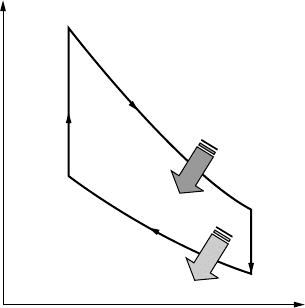
The idealized pressure–volume diagram shown in Fig. 4.7 may make it easier
to understand the states and transitions in the Stirling cycle. In thermodynamics,
P –v diagrams, such as this one, greatly enhance intuition, especially since the
area contained within the process curves represents the net work produced during
the cycle.
Stirling engines in sizes ranging from less than 1 kW up to about 25 kW are
beginning to be made commercially available. While their efficiency is still rela-
tively low, typically less than 30%, rapid progress is being made toward boosting
that into the range in which they would be competitive with internal-combustion
engines. Since fuel is burned slowly and constantly, with no explosions, these
engines are inherently quiet, which could make them especially attractive for
automobiles, boats, recreational vehicles, and even small aircraft. In fact, that
quietness has been used to advantage in Stirling engine propulsion systems
for submarines.
Potential markets include small-scale portable power systems for battery charg-
ing and other off-grid applications. They could be especially useful in developing
countries since they will run on any fuel, including biomass; or when incorporated
in parabolic dish systems, they can use solar energy. Cogeneration is possible
using the cooling water that maintains the cold sink, so heat-and-power systems
for homes are likely. With higher efficiencies, their quiet, vibration-free operation,
CONCENTRATING SOLAR POWER (CSP) TECHNOLOGIES 183
3
2
q
IN
q
OUT
4
1
Pressure
Volume
Area =
Net work
T
H
= constant
T
C
= constant
Figure 4.7 Pressure–volume diagram for an ideal Stirling cycle.
very low emissions when burning natural gas, simplicity, and potentially high
reliability could make them an attractive alternative in the near future.
4.3 CONCENTRATING SOLAR POWER (CSP) TECHNOLOGIES
While the already mentioned combustion turbines, reciprocating engines, and
conventional Stirling-cycle engines have many desirable attributes, including the
ability to take advantage of cogeneration, they do still rely on fossil fuels, which
means they pollute, making them hard to site, and they are vulnerable to the eco-
nomic uncertainties associated with fuel-price volatility. An alternative approach
is based on capturing sunlight. That can be done with photovoltaics, which are
covered extensively later in this book, or with concentrating solar power (CSP)
technologies.
CSP technologies convert sunlight into thermal energy to run a heat engine
to power a generator. With the environment providing the cold temperature sink,
the maximum efficiency of a heat engine is directly related to how hot the high-
temperature source can be made. Without concentration, sunlight can’t provide
high enough temperatures to make the thermodynamic efficiency of a heat engine
worth pursuing. But with concentration, it is an entirely different story. There are
three successfully demonstrated approaches to concentrating sunlight that have
been pursued with some vigor: parabolic dish systems with Stirling engines,
linear solar-trough systems, and heliostats (mirrors) reflecting sunlight onto a
power tower.
4.3.1 Solar Dish/Stirling Power Systems
Dish/Stirling systems use a concentrator made up of multiple mirrors that approx-
imate a parabolic dish. The dish tracks the sun and focuses it onto a thermal
184 DISTRIBUTED GENERATION
receiver. The thermal receiver absorbs the solar energy and converts it to heat
that is delivered to a Stirling engine. The receiver can be made up of a bank
of tubes containing a heat transfer medium, usually helium or hydrogen, which
also serves as the working fluid for the engine. Another approach is based on
heat pipes in which the boiling and condensing of an intermediate fluid is used to
transfer heat from the receiver to the Stirling engine. The cold side of the Stirling
engine is maintained using a water-cooled, fan-augmented radiator system simi-
lar to that in an ordinary automobile. Being a closed system, very little make-up
water is required, which can be a major advantage over other CSP technologies.
Some of the existing units have been designed to operate in a hybrid mode in
which fuel is burned to heat the engine when solar is inadequate. As a hybrid, the
output becomes a reliable source of power with no backup needed for inclement
weather or nighttime loads.
With average efficiencies of over 20% and the record measured peak efficiency
of nearly 30%, dish/Stirling systems currently exceed the efficiency of any other
solar conversion technology.
Two competing dish/Stirling system technologies have been successfully de-
monstrated. In one, the dish is built by Science Applications International Corpo-
ration (SAIC) and the engine by Sterling Thermal Motors (STM). The other is a
Boeing/Stirling Energy Systems (SES) power plant. Both provide on the order of
25 kW per system with conversion efficiencies from direct-beam solar radiation
to electrical power of over 20%.
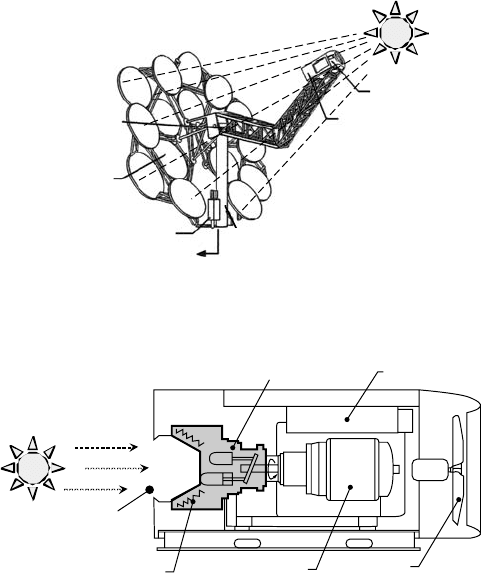
The SAIC dish/Stirling system is illustrated in Fig. 4.8. The dish itself is made
up of an array of 16 stretched-membrane, mirrored facets. Each facet consists of
a steel ring approximately 3.2 m in diameter, with thin stainless steel membranes
stretched over both sides of the ring to form a structure that resembles a drum.
The top membrane is made highly reflective by laminating either a thin glass
mirror or a silverized polymer reflective film onto the membrane. By partially
evacuating the space between the membranes, the shape of the mirrored surface
can be made slightly concave, allowing each facet to be focused appropriately
onto the receiver.
Sunlight, concentrated by the SAIC dish, is absorbed in the receiver to provide
725
◦
C heat to the Stirling engine. The STM engine is made up of four cylinders,
each with a double-acting piston, arranged in a square pattern. The connecting
rods for the pistons cause a swashplate to convert their motion to the rotary
motion needed by the generator. The efficiency of these engines from heat to
mechanical power is over 36%.
Table 4.4 shows the efficiencies and power outputs for the SAIC/STM system
from sunlight to net power delivered. Even though the Stirling engine itself
is 36.1% efficient, by the time losses at the reflector, receiver, gear box, and
generator are added to parasitic power needed to operate the system, the overall
efficiency is just under 21%. In good locations, with these efficiencies, the land
area required is about four acres per megawatt of power.
Dish/Stirling systems can be stand-alone power plants that don’t need access
to fuel lines or sources of cooling water. Not needing water except to wash the
CONCENTRATING SOLAR POWER (CSP) TECHNOLOGIES 185
(a) The complete SAIC/STM system
Receiver
Stirling
engine
Tracking
motors
Mirror
facets
Controls
Power out
Auxiliary
fuel
(b) The STM Stirling engine.
Stirling engine
Electronic
controls
Cooling
fan
Generator
Auxiliary
fuel combustion
Aperture
Figure 4.8 The SAIC/STM dish/Stirling system.
mirrors once in a while, they are ideal for power generation in sunny desert
areas where lack of cooling water is a major constraint. Many load centers,
including those in southern California, Arizona, and Nevada, are located close
to such sunny deserts so transmission distances could be short. Unless they are
hybridized with fuel augmentation, there are no air emissions, which means that
the lengthy process of obtaining air permits can be eliminated. With short con-
struction times, easy permitting, and relatively small 25-kW modular sizes, which
simplifies financing, the time from project design to delivered power can be very
short—on the order of just a year or so. Short lead times means that capacity can
be added incrementally as needed to follow load growth, avoiding the periods of
oversupply that characterize large-scale generation facilities (see Section 5.7.1).
4.3.2 Parabolic Troughs
As of 2003, the world’s largest solar power plant is a 354-MW parabolic-trough
facility located in the Mojave Desert near Barstow, California called the Solar
186 DISTRIBUTED GENERATION
TA BLE 4.4 Second-Generation SAIC/STM Dish/Stirling System
Efficiencies
a
Step Description
Step
Efficiency (%)
Cumulative
Efficiency (%)
Power
(kW)
Solar insolation 100.0 100 113.5
Reflected by mirrors 93.1 93.1 105.7
Intercepted at aperture 90.3 84.1 95.4
Absorbed by receiver 85.0 71.5 81.1
Receiver heat loss 98.0 70.0 79.5
Engine mechanical efficiency 36.1 25.3 28.7
Gear box efficiency 98.0 24.8 28.1
Gross generator output 92.0 22.8 25.9
Electrical parasites −2.2 kW 20.9 23.7
a
Insolation is direct normal solar radiation at 1000 W/m
2
.
Source: Davenport et al. (2002).
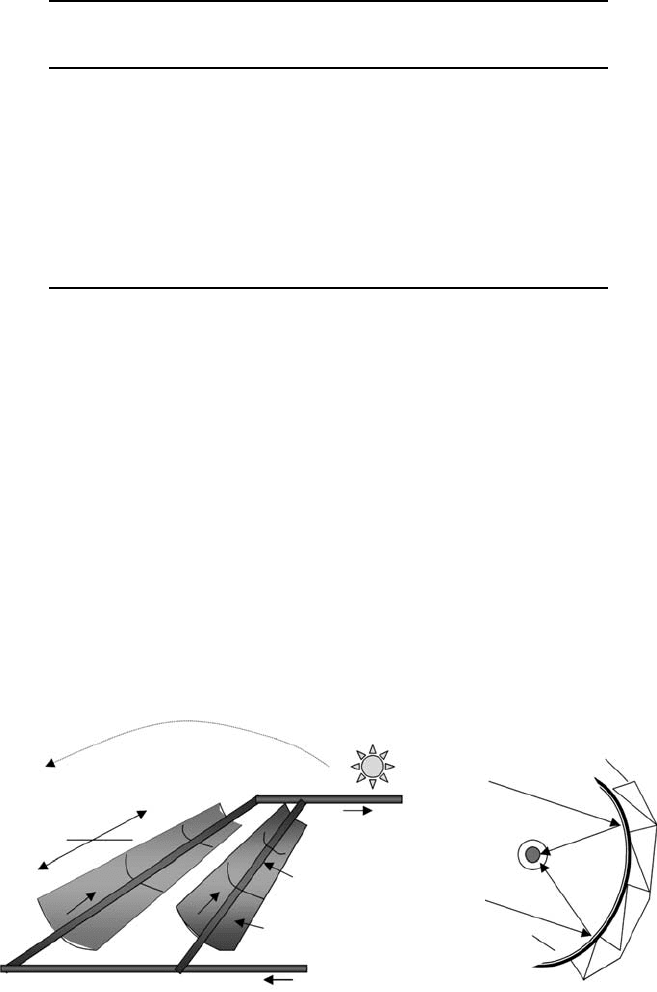
Electric Generation System (SEGS). SEGS consists of nine large arrays made
up of rows of parabolic-shaped mirrors that reflect and concentrate sunlight onto
linear receivers located along the foci of the parabolas. The receivers, or heat
collection elements (HCE), consist of a stainless steel absorber tube surrounded
by a glass envelope with the vacuum drawn between the two to reduce heat losses.
A heat transfer fluid circulates through the receivers, delivering the collected
solar energy to a somewhat conventional steam turbine/generator to produce
electricity. The SEGS collectors, with over 2 million m
2
of surface area, run
along a north–south axis, and they rotate from east to west to track the sun
throughout the day. Figure 4.9 illustrates the parabolic trough concept.
The first plant, SEGS I, is a 13.4-MW facility built in 1985, while the
final plant, SEGS IX, produces 80 MW and was completed in 1991. SEGS I
p.m
a.m
N
S
Glass,
Vacuum,
Steel tubing
HCE
Steel strucuture
Reflector
Parabolic reflector
Heat transfer fluid (HTF)
Receiver,
Heat collection element
(HCE)
Figure 4.9 Parabolic trough solar collector system.
CONCENTRATING SOLAR POWER (CSP) TECHNOLOGIES 187
was designed with thermal storage to enable it to operate several extra hours
each day after the sun had gone down. Storage was based on elevating the
temperature of a highly flammable mineral oil, called Caloria. Unfortunately,
an accident in 1999 set the storage unit on fire and it was destroyed. Later
SEGS plants do not include storage, but have been designed to operate as
hybrids with back-up energy supplied by fossil fuels to run the steam/turbine
when solar is not available. Future designs may once again include heat stor-
age, but the medium will likely be based on molten salts rather than min-
eral oil.
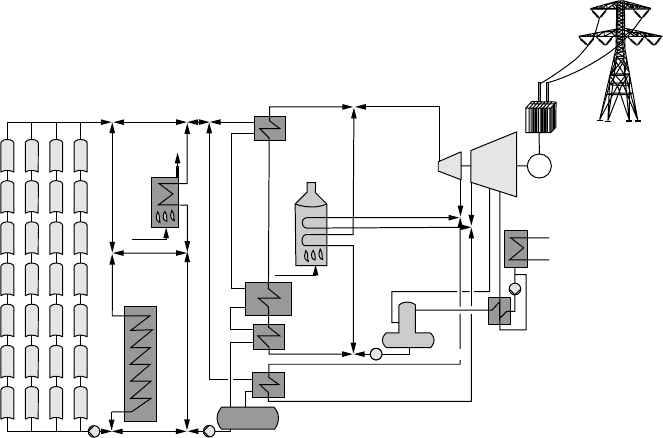
Figure 4.10 presents an overall system diagram for a typical parabolic trough
power plant. The heat transfer fluid (HTF) is heated to approximately 400
◦
Cin
the receiver tubes along the parabola foci. The HTF passes through a series of
heat exchangers to generate high-pressure superheated steam for the turbine. The
system shown includes the possibility for thermal storage as well as fossil-fuel-
based auxiliary heat to run the plant when solar is insufficient. Two options for
hybrid operation are indicated. One is based on a natural-gas-fired HTF heater in
parallel with the solar array. The other is an optional gas boiler to generate steam
for the turbine, which makes it virtually the same as a complete, conventional
steam-cycle power plant with an auxiliary solar unit.
Solar trough systems have thus far been coupled with conventional steam-cycle
power plants, which means that cooling water is needed for their condensers.
Once-through cooling requires enormous amounts of water; and even when
Solar Field
HTF
Heater
(
optional
)
Fuel
Fuel
Thermal
Energy
Storage
(
optional
)
Solar
Superheater
Boiler
(
optional
)
Steam
Generator
Solar
Preheater
Solar
Reheater
Expansion
Vessel
Substation
Steam Turbine
Condenser
Low Pressure
Preheater
Deaerator
~
Figure 4.10 Solar trough system coupled with a steam turbine/generator, including
optional heat storage and two approaches to fossil-fuel hybridization. From NREL website.