
Masters G.M. Renewable and Efficient Electric Power Systems
Подождите немного. Документ загружается.

188 DISTRIBUTED GENERATION
Solar field
Hot
tank
Cold
tank
Pump
Pump
Heater
Air-cooled
condenser
Inlet manifold Inlet manifold
Turbine
Generator
Boiler
Cooling towers
Gear
Gear
Motor
Motor
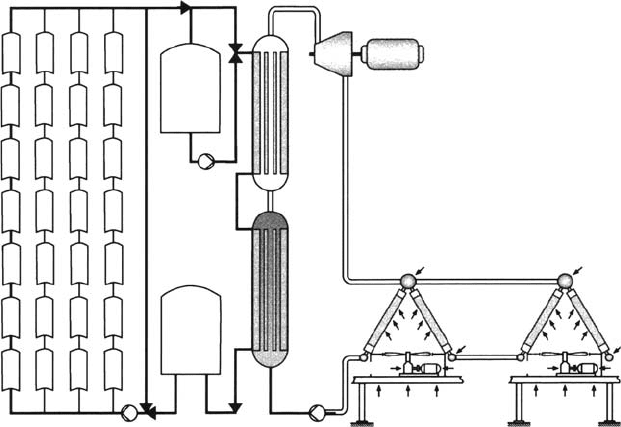
Figure 4.11 An organic Rankine-cycle, solar-trough system that eliminates the need for
cooling water. From NREL, in Price et al. (2002).
cooling towers are used, the water demand is still high. Since these plants are
likely to be located in desert areas, where water is precious, it would be highly
advantageous to develop a trough technology that might eliminate this constraint.
One approach, shown in Fig. 4.11, is based on a modified, organic fluid, Rankine-
cycle technology currently used in geothermal power plants. The key is the use
of an organic fluid that can be condensed at above-atmospheric pressures using
air-cooled, fan-driven, cooling towers. This technology is being evaluated for
relatively small plants, on the order of 100 kW to 10 MW, which could make
them attractive for remote or distributed generation applications.
The SEGS experience has demonstrated that solar trough systems can be
reliable and reasonably cost effective. Operating experience with the later 80-
MW SEGS plants show overall annual solar-to-electricity efficiencies of around
10% with generation costs of about 12¢/kWh (in 2001 dollars), which makes
them the least expensive source of solar electricity today. Advanced, 200-MW
plants with more efficient thermal storage units and refinements in receivers
coupled with general cost reductions associated with gained experience suggest
that electricity from future solar-trough systems could be close to 5¢/kWh (Price
et al., 2002). While this technology was first demonstrated on a large scale in the
United States, much of the current development is taking place in other countries,
including Spain, Greece, Italy, India, and Mexico.
CONCENTRATING SOLAR POWER (CSP) TECHNOLOGIES 189
4.3.3 Solar Central Receiver Systems
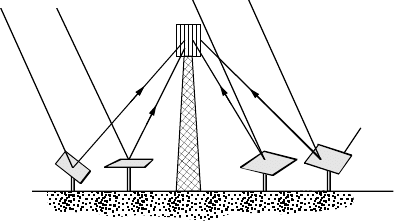
Another approach to achieving the concentrated sunlight needed for solar thermal
power plants is based on a system of computer-controlled mirrors, called
heliostats, which bounce sunlight onto a receiver mounted on top of a tower
(Fig. 4.12).
The evolution of power towers began in 1976 with the establishment of the
National Solar Thermal Test Facility at Sandia National Laboratories in Albu-
querque, New Mexico. That soon led to the construction of number of test
facilities around the world, the largest of which was a 90-m-tall, 10-MW power
tower, called Solar One, built near Barstow, California. In Solar One, water was
pumped up to the receiver where it was turned into steam that was brought back
down to a steam turbine/generator. Steam could also be diverted to a large, ther-
mal storage tank filled with oil, rock, and sand to test the potential for continued
power generation during marginal solar conditions or after the sun had set. While
thermal storage as a concept was successfully demonstrated, there was a sizable
mismatch between the storage tank temperature and the temperature needed by
the turbine for maximum efficiency.
Solar One operated from 1982 to 1988, after which time it was dismantled;
parts of it, including the 1818 heliostats and the tower itself, were reused in
another 10-MW test facility called Solar Two. While Solar One used water as
the heat exchange medium, Solar Two used molten nitrate salts (60% sodium
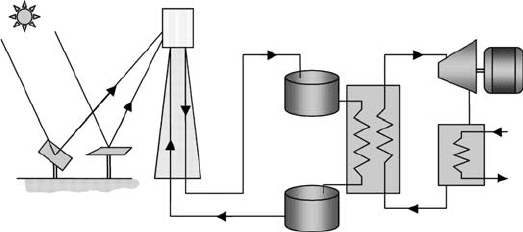
nitrate and 40% potassium nitrate). A two-tank, molten-salt thermal storage sys-
tem replaced the original oil/rock storage tank in the configuration shown in
Fig. 4.13. The molten-salt system has proven to be a great success. Its temper-
ature of 565
◦
C well matches the needs of the steam turbine, and its round-trip
efficiency (the ratio of thermal energy out to thermal energy in) was greater than
97%. It was designed to provide enough storage to deliver the full 10-MW output
of the plant for an extra three hours past sunset. With reduced output, it could
deliver power for much longer periods from stored solar energy.
Central
receiver
Heliostats
Figure 4.12 Central receiver system (CRS) with heliostats to reflect sunlight onto a
central receiver.
190 DISTRIBUTED GENERATION
Central
receiver
Hot salt
565°C
Hot salt
storage
tank
Heliostats
Cold salt 285°C
Turbine
Generator
Cooling
water
Condenser
Cold salt
storage tank
Steam generator
Figure 4.13 Schematic of a molten-salt central receiver system.
After operating for three years, Solar Two was decommissioned in 1999. Since
then, a design team from the United States and Spain has proposed construction
of a 15-MW Solar Tres, to be located somewhere in Spain. This system will
have a much higher ratio of heliostat area to rated generator power and a much
larger molten-salt thermal storage tank, which will enable it to operate at full
capacity for over 12 h on stored energy alone. Systems with more collector area
than is needed to run the turbines while the sun is out, augmented with more
thermal storage to save that extra solar energy until it is needed later, could
become reliable sources of power, ready when needed to meet typical afternoon
and evening peak demands. This dispatchability advantage of power towers with
thermal storage would add considerably to their value.
The future of central receiver systems is promising, but somewhat uncertain.
Molten-salt power towers are the most well understood technology, but to be cost
effective they need to be made much larger—probably on the order of 100 MW,
which means that the first ones will cost hundreds of millions of dollars. The
financial risk for the first plants will likely be a significant deterrent. There are
also emerging power tower technologies that use air as the working fluid rather
than molten salt. Solar-heated air could be used directly in a steam generator
for a conventional Rankine-cycle power plant, or it might be used to preheat
air leaving the compressor on its way to the combustor of a gas turbine in a
combined-cycle hybrid power plant.
4.3.4 Some Comparisons of Concentrating Solar Power Systems
The three approaches to concentrating solar thermal power systems—dish Stir-
ling, parabolic trough, and central receiver—can be compared from a variety of
perspectives. Although they share the same fundamental approach of using mir-
rored surfaces to reflect and concentrate sunlight onto a receiver creating high
enough temperatures to run a heat engine with reasonable efficiency, they are in
many ways quite different from one another.
CONCENTRATING SOLAR POWER (CSP) TECHNOLOGIES 191
With regard to efficiency, all three of these technologies incorporate heat
engines, which means the higher the temperature of the heat source, the greater the
potential efficiency. The key to high temperatures is the intensity of solar radiation
focused onto the receiver, which is usually expressed in dimensionless “suns” of
concentration where the reference point of 1 sun means no concentration. Dish
Stirling systems achieve concentration ratios of about 3000 suns, power towers
about 1000 suns, and parabolic trough systems about 100 suns. Not surprisingly,
the corresponding efficiencies of these technologies follow the same ranking,
with dish Stirling the highest and parabolic trough the lowest.
There are a number of measures of efficiency, including peak efficiency under
design conditions, annual efficiency as measured in the field, and land area
required per unit of electrical output. The current annual efficiency from sun-
light hitting collectors to electrical energy delivered to the grid for these systems
is approximately: Dish Stirling 21%, power towers 16%, and parabolic troughs
14%. In terms of land area required, however, power towers suffer because of
the empty space between tower and mirrors, so the rankings shift some. Dish
Stirling requires about 4 acres per MW, parabolic troughs about 5 a cres/MW,
and power towers about 8 acres/MW.
Another important concern for solar systems in general is whether they can
deliver electricity whenever it is needed. All three of these CSP technologies
can be hybridized using fossil fuel auxiliary heat sources, so they are the some-
what the same in that regard. Another way to achieve reliability, however, is
with thermal storage; in that regard, parabolic troughs and power towers have
an advantage over dish Stirling engines. When thermal storage is the backup
rather than fuel combustion, systems are easier to permit since they can be
100% solar.
Since all CSP technologies need to be able to focus the suns rays, they will
most likely be used in areas with very clear skies. If those are desert areas,
minimizing the need for cooling water can be a significant concern. In that
regard, Dish Stirling engines, which need no cooling water have the advan-
tage over current designs for troughs and towers. They also make very little
noise and have a r elatively low profile so they may be easier to site close to
residential loads.
During the early stages of development, and as technologies begin to be
deployed, economic risks are incurred and the scale of the investments required
can be an important determinant of the speed with which markets expand. Small-
scale systems cost less per modular unit so the financial risks associated with the
first few units are similarly small. Dish Stirling systems appear to be appropri-
ately sized at about 25 kW each, but economies of scale play a bigger role for
troughs and towers and they may be most economical in unit sizes of about
100 MW. It seems likely to be easier to find investors willing to help develop
$100,000 dish systems, working out the bugs and improving the technology as
they go along, than to assemble the hundreds of millions of dollars needed for a
single trough or tower system. Wind turbines, with their explosive growth, have
certainly benefited from the fact that they too are small in scale.
192 DISTRIBUTED GENERATION
4.4 BIOMASS FOR ELECTRICITY
Biomass energy systems utilize solar energy that has been captured and stored in
plant material during photosynthesis. While the overall efficiency of conversion
of sunlight to stored chemical energy is low, plants have already solved the
two key problems associated with all solar energy technologies—that is, how
to collect the energy when it is available, and how to store it for use when the
sun isn’t shining. Plants have also very nicely dealt with the greenhouse problem
since the carbon released when they use that stored energy for respiration is the
same carbon they extracted in the first place during photosynthesis. That is, they
get energy with no net carbon emissions.
While there is already a sizable agricultural industry devoted to growing crops
specifically for their energy content, it is almost entirely devoted to converting
plant material into alcohol fuels for motor vehicles. On the other hand, biomass
for electricity production is essentially all waste residues from agricultural and
forestry industries and, to some extent, municipal solid wastes. Since it is based
on wastes that must be disposed of anyway, biomass feedstocks for electricity
production may have low-cost, no-cost, or even negative-cost advantages.
Currently there are about 14 GW of installed generation capacity powered
by biomass in the world, with about half of that being in the United States.
About two-thirds of the biomass power plants in the United States cogenerate
both electricity and useful heat. Virtually all biomass power plants operate on a
conventional steam–Rankine cycle. Since transporting their rather disbursed fuel
sources over any great distances could be prohibitively expensive, biomass power
plants tend to be small and located near their fuel source, so they aren’t able to
take advantage of the economies of scale that go with large steam plants. To
offset the higher cost of smaller plants, lower-grade steel and other materials are
often used, which requires lower operating temperatures and pressures and hence
lower efficiencies. Moreover, biomass fuels tend to have high water content and
are often wet when burned, which means that wasted energy goes up the stack
as water vapor. The net result is that existing biomass plants tend to have rather
low efficiencies—typically less than 20%. Even though the fuel may be very
inexpensive, those low efficiencies translate to reasonably expensive electricity,
which is currently around 9¢/kWh.
An alternative approach to building small, inefficient plants dedicated to
biomass power production is to burn biomass along with coal in slightly modified,
conventional steam-cycle power plants. Called co-firing, this method is an
economical way to utilize biomass fuels in relatively efficient plants. And, since
biomass burns cleaner than coal, overall emissions are correspondingly reduced
in co-fired facilities.
New combined-cycle power plants don’t need to be large to be efficient, so it is
interesting to contemplate a new generation of biomass power plants based on gas
turbines rather than steam. The problem is, however, that gas turbines cannot run
directly on biomass fuels since the resulting combustion products would damage
the turbine blades, so an intermediate step would have to be introduced. By gasify-
ing the fuel first and then cleaning the gas before combustion, it would be possible
BIOMASS FOR ELECTRICITY 193
to use biomass with gas turbines. Indeed, considerable work has already been
done on coal-integrated gasifier/gas turbine CIG/GT systems. CIG/GT systems
have not been commercialized, however, in part due to gas-cleaning problems
caused by the high sulfur content of coal. Biomass, however, tends to have very
little sulfur, so this problem is minimized. Moreover, biomass tends to gasify eas-
ier than coal, so it may well be that it will be easier to develop biomass-integrated
gasifier/gas turbine (BIG/GT) systems than to develop CIG/GTs. Biomass fuels
do, however, have rather high nitrogen content, and control of NO
X
would have
to be addressed. It is projected that BIG/GT plants could generate electricity at
about 5¢/kWh.
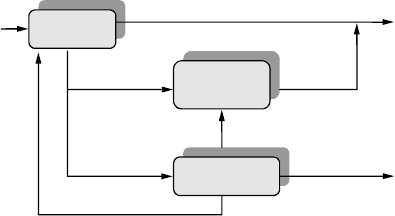
A two-step process for gasifying biomass fuels is illustrated in Fig. 4.14. In the
first step, the raw biomass fuel is heated, causing it to undergo a process called
pyrolysis in which the volatile components of the biomass are vaporized. As the
fuel is heated, moisture is first driven off; then at a temperature of about 400
◦
C
the biomass begins to break down, yielding a product gas, or syngas, consisting
mostly of hydrogen (H
2
), carbon monoxide (CO), methane (CH
4
), carbon dioxide
(CO
2
), and nitrogen (N
2
) as well as tar. The solid byproducts of pyrolysis are
char (fixed carbon) and ash. In the second step, char heated to about 700
◦
C reacts
with oxygen, steam, and hydrogen to provide additional syngas. The heat needed
to drive both steps comes from the combustion of some of the char.
The relative percentages of each gas vary considerably, depending on the tech-
nology used in the gasifier, and so does the heating value of the mix. High heating
values (HHV) of syngas ranges from about 5.4 to 17.4 MJ/m
3
. For comparison,
natural gas typically has an HHV of anywhere from 36 to 42 MJ/m
3
.
Pyrolysis reactions can also be used to convert biomass to liquid, as dia-
grammed in Fig. 4.15. Different temperatures and reaction rates produce energy-
rich vapors that can be condensed into a liquid “biocrude” oil with a heating
value about 60% that of diesel fuel.
Another technology for converting biomass to energy is based on the anaero-
bic (without oxygen) decomposition of organic materials by microorganisms to
produce a biogas consisting primarily of methane and carbon dioxide. The bio-
chemical reactions taking place are extremely complex, but in simplified terms
Pyrolysis
Biomass
Char
Conversion
Combustion
Char
Char & Ash
Heat
Vapors
(Syngas)
Ash &
Exhaust Gases
Heat
Vapors (Syngas)
Syngas
Figure 4.14 Biomass gasification process.
194 DISTRIBUTED GENERATION
Pyrolysis
Biomass
Combustion
Char & Ash
Exhaust Gases
Heat
Vapors
Condenser
Non-condensible Vapors
Biocrude Oils
Figure 4.15 Biomass pyrolysis used to create liquid biocrude oil.
they can be summarized as
C
n
H
a
O
b
N
c
S
d
+ H
2
O + bacteria → CH
4
+ CO
2
+ NH
3
+ H
2
S + new cells
(4.2)
where C
n
H
a
O
b
N
c
S
d
is meant to represent organic matter, and the equation is
obviously not chemically balanced. The technology is conceptually simple, con-
sisting primarily of a closed tank, called a digester, in which the reactions can
take place in the absence of oxygen. The desired end product is methane, CH
4
and the relative amount of methane in the digester gas is typically between 55%
and 75%.
Anaerobic digesters are fairly common in municipal wastewater treatment
plants where their main purpose is to transform sewage sludge into innocuous,
stabilized end products that can be easily disposed of in landfills or, sometimes,
recycled as soil conditioners. Anaerobic digesters can be used with other biomass
feedstocks including food processing wastes, various agricultural wastes, munic-
ipal solid wastes, bagasse, and aquatic plants such as kelp and water hyacinth.
When the biogas is treated to remove its sulfur, the resulting gas can be burned
in reciprocating engines to produce electricity and usable waste heat.
4.5 MICRO-HYDROPOWER SYSTEMS
Hydroelectric power is a very significant source, accounting for 19% of the global
production of electricity. In a number of countries in Africa and South America,
it is the source of more than 90% of their electric power. Hydropower generates
9% of U.S. electricity, which may sound modest, but it is still almost an order of
magnitude more than the combined output of all of the other renewables. Almost
all of that hydropower is generated in large-scale projects, which are sometimes
defined to be those larger than 30 MW in capacity. Small-scale hydropower
systems are considered to be those that generate between 100 kW and 30 MW,
while micro-hydro plants are smaller than 100 kW. Our interest here is in micro-
hydropower.
The simplest micro-hydro plants are run-of-the-river systems, which means
that they don’t include a dam. As such, they don’t cause nearly the ecosystem dis-
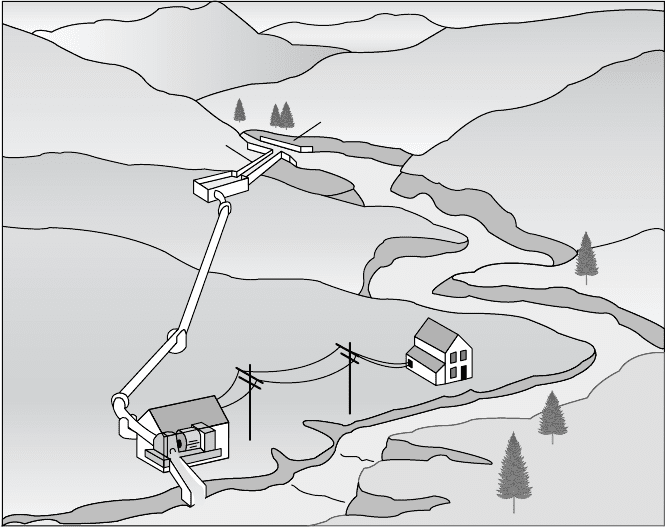
ruption of their dams and reservoir counterparts. An example of a run-of-the-river
MICRO-HYDROPOWER SYSTEMS 195
Canal
Intake
Forebay
Penstock
Powerhouse
Figure 4.16 A micro-hydropower system in which water is diverted into a penstock and
delivered to a powerhouse below. Source: Small Hydropower Systems, DOE/GO-102001-
1173, July 2001.
system is shown in Fig. 4.16. A portion of the river is diverted into a pipeline,
called a penstock, that delivers water under pressure to a hydraulic turbine/
generator located in a powerhouse located at some elevation below the intake.
Depending on how the system has been designed, the powerhouse may also con-
tain a battery bank to help provide for peak demands that exceed the average
generator output.
4.5.1 Power From a Micro-Hydro Plant
The energy associated with water manifests itself in three ways: as potential
energy, pressure energy, and kinetic energy. The energy in a hydroelectric sys-
tem starts out as potential energy by virtue of its height above some reference
level—in this case, the height above the powerhouse. Water under pressure in
the penstock is able to do work when released, so there is energy associated with
that pressure as well. Finally, as water flows there is the kinetic energy that is
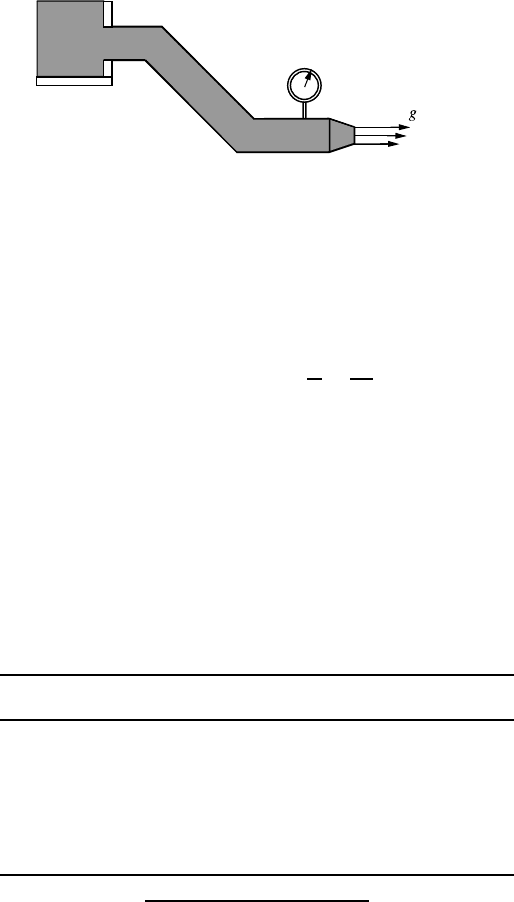
associated with any mass that is moving. Figure 4.17 suggests the transforma-
tions between these forms of energy as water flows from the forebay, through
the penstock, and out of a nozzle.
196 DISTRIBUTED GENERATION
Kinetic energy
u
2
/ 2
Pressure energy
p
/g
Potential energy
z
Figure 4.17 Transformations of energy from potential, to pressure, to kinetic.
It is convenient to express each of these three forms of energy on a per unit
of weight basis, in which case energy is referred to as head and has dimensions
of length, with units such as “feet of head” or “meters of head.” The total energy
is the sum of the potential, pressure, and kinetic head and is given by
Energy head = z +
p
γ
+
v
2
2g
(4.3)
where z is the elevation above a reference height (m) or (ft), p is the pressure
(N/m
2
)or(lb/ft
2
), γ is the specific weight (N/m
3
)or(lb/ft
3
), v is the aver-
age velocity (m/s) or (ft/s), and g is gravitational acceleration (9.81 m/s
2
)or
(32.2 ft/s
2
).
In working with micro-hydropower systems, especially in the United States,
mixed units are likely to be incurred, so Table 4.5 is presented to help sort
them out.
TA BLE 4.5 Useful Conversions for Water
American SI
1 cubic foot = 7.4805 gal 0.02832 m
3
1 foot per second = 0.6818 mph 0.3048 m/s
1 cubic foot per second = 448.8 gal/min (gpm) 0.02832 m
3
/s
Water density = 62.428 lb/ft
3
1000 kg/m
3
1 pound per square inch = 2.307 ft of water 6896 N/m
2
1kW= 737.56 ft-lb/s 1000 N-m/s
Example 4.3 Mixed Units in the American System. Suppose a 4-in.-diameter
penstock delivers 150 gpm of water through an elevation change of 100 feet.
The pressure in the pipe is 27 psi when it reaches the powerhouse. What frac-
tion of the available head is lost in the pipe? What power is available for the
turbine?

MICRO-HYDROPOWER SYSTEMS 197
Solution. From (4.3)
Pressure head =
p
γ
=
27 lb/in.
2
× 144 in.
2
/ft
2
62.428 lb/ft
3
= 62.28 ft
To find velocity head, we need to use Q = vA,whereQ is flow rate, v is velocity,
and A is cross-sectional area:
v =
Q
A
=
150 gal/ min
(π/4)(4/12 ft)
2
× 60 s/ min ×7.4805 gal/ft
3
= 3.830 ft/s
So, from (4.3) the velocity head is
Velocity head =
v
2
2g
=
(3.830 ft/s)
2
2 × 32.2 ft/s
2
= 0.228 ft
The total head left at the bottom of the penstock is the sum of the pressure
and velocity head, or 62.28 ft + 0.228 ft = 62.51 ft. Notice the velocity head is
negligible. Since we started with 100 ft of head, pipe losses are 100 − 62.51 =
37.49 ft, or 37.49%.
Using conversions from Table 4.5, while carefully checking to see that units
properly cancel, the power represented by a flow of 150 gpm at a head of
62.51 ft is
P =
150 gal/ min ×62.428 lb/ft
3
× 62.51 ft
60 s/ min ×7.4805 gal/ft
3
× 737.56 ft-lb/s-kW
= 1.77 kW
The power theoretically available from a site is proportional to the difference
in elevation between the source and the turbine, called the head H, times the
rate at which water flows from one to the other, Q. Using a simple dimensional
analysis, we can write that
Power =
Energy
Time
=
Weight
Vo l u m e
×
Vo l u m e
Time
×
Energy
Weight
= γ QH (4.4)
Substituting appropriate units in both the SI and American systems results in the
following key relationships for water:
P(W)= 9810 Q(m
3
/s)H(m) =
Q(gpm)H(ft)
5.3
(4.5)
While (4.5) makes no distinction between a site with high head and low flow
versus one with the opposite characteristics, the differences in physical facilities
are considerable. With a high-head site, lower flow rates translate into smaller-
diameter piping, which is more readily available and a lot easier to work with, as