
Masters G.M. Renewable and Efficient Electric Power Systems
Подождите немного. Документ загружается.

208 DISTRIBUTED GENERATION
if fuel cells are powered by hydrogen obtained by electrolysis of water using
renewable energy sources such as wind, hydroelectric, or photovoltaics, they
have no greenhouse gas emissions at all. Fuel cells are easily modulated to track
short-term changes in electrical demand, and they do so with modest compro-
mises in efficiency. Finally, they are inherently modular in nature, so that small
amounts of generation capacity can be added as loads grow rather than the con-
ventional approach of building large, central power stations in anticipation of
load growth.
4.6.1 Historical Development
While fuel cells are now seen as a potentially dominant distributed generation
technology for the twenty-first century, it is worth noting that they were first
developed more than 160 years ago. Sir William Grove, the English scientist cred-
ited with the invention of the original galvanic cell battery, published his original
experiments on what he called a “gaseous voltaic battery” in 1839 (Grove, 1839).
He described the effects caused by his battery as follows: “A shock was given
which could be felt by five persons joining hands, and which when taken by a sin-
gle person was painful.” Interestingly, this same phenomenon is responsible for
the way that the organs and muscles of an electric eel supply their electric shock.
Grove’s battery depended upon a continuous supply of rare and expensive
gases, and corrosion problems were expected to result in a short cell lifetime,
so the concept was not pursued. Fifty years later, Mond and Langer picked
up on Grove’s work and developed a 1.5-W cell with 50% efficiency, which
they named a “fuel cell” (Mond and Langer, 1890). After another half century of
little progress, Francis T. Bacon, a descendent of the famous seventeenth-century
scientist, began work in 1932 that eventually resulted in what is usually thought
to be the first practical fuel cell. By 1952, Bacon was able to demonstrate a 5-
kW alkaline fuel cell (AFC) that powered, among other things, a 2-ton capacity
fork-lift truck. In the same year, Allis Chalmers demonstrated a 20-horsepower
fuel-cell-powered tractor.
Fuel cell development was greatly stimulated by NASA’s need for on-board
electrical power for spacecraft. The Gemini series of earth-orbiting missions
used fuel cells that relied on permeable membrane technology, while the later
Apollo manned lunar explorations and subsequent Space Shuttle flights have used
advanced versions of the alkaline fuel cells originally developed by Bacon. Fuel
cells not only provide electrical power, their byproduct is pure water, which is
used by astronauts as a drinking water supply. For longer missions, however,
photovoltaic arrays, which convert sunlight into electric power, have become the
preferred technology.
Fuel cells for cars, buildings, central power stations, and spacecraft were
the subject of intense development efforts in the last part of the twentieth
century. Companies with major efforts in these applications include: Ballard
Power Systems, Inc. (Canada), General Electric Company, the International
Fuel Cells division of United Technologies Corp. and its ONSI subsidiary,
FUEL CELLS 209
Plug Power, Analytic Power, General Motors, H-Power, Allison Chalmers,
Siemens, ELENCO (Belgium), Union Carbide, Exxon/Ashthom, Toyota, Mazda,
Honda, Toshiba, Hitachi Ltd., Ishikawajima-Harima Heavy Industries, Deutsche
Aerospace, Fuji Electric, Mitsubishi Electric Corp. (MELCO), Daimler Chrysler,
Ford, Energy Research Corporation, M-C Power Corp., Siemens-Westinghouse,
CGE, DenNora, and Ansaldo. Clearly, there is an explosion of activity on the
fuel cell front.
4.6.2 Basic Operation of Fuel Cells
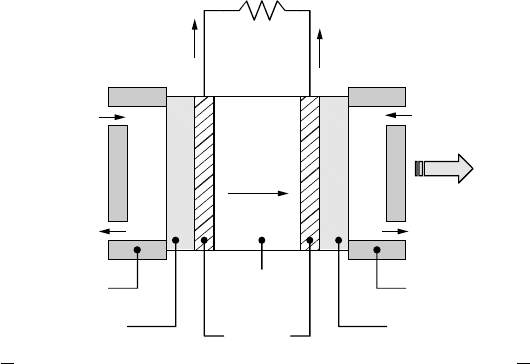
There are many variations on the basic fuel cell concept, but a common config-
uration looks something like Fig. 4.26. As shown there, a single cell consists of
two porous gas diffusion electrodes separated by an electrolyte. It is the choice
of electrolyte that distinguishes one fuel cell type from another.
The electrolyte in Fig. 4.26 consists of a thin membrane that is capable of
conducting positive ions but not electrons or neutral gases. Guided by the flow
field plates, fuel (hydrogen) is introduced on one side of the cell while an oxidizer
(oxygen) enters from the opposite side. The entering hydrogen gas has a slight
tendency to dissociate into protons and electrons as follows:
H
2
↔ 2H
+
+ 2e
−
(4.17)
This dissociation can be encouraged by coating the electrodes or membrane with
catalysts to help drive the reaction to the right. Since the hydrogen gas releases
Proton
Transport
2 H
+
H
2
Fuel H
2
Unused Fuel
Recirculates
O
2
from Air
H
2
O Air + Water Vapor
O
2
Electrons 2e
−
Current
I
Electrical Load
(40% - 60% Efficiency)
Electrolyte
(PEM)
Gas Diffusion Electrode
(Anode)
H
2
> 2H
+
+ 2e
−
Catalyst
Gas Diffusion Electrode
(Cathode)
1/2 O
2
+ 2H
+
+ 2e
−
> H
2
O
+
−
Heat (≈ 85°C)
Flow Field Plate
Flow Field Plate
Figure 4.26 Basic configuration of a proton-exchange membrane (PEM) fuel cell.
210 DISTRIBUTED GENERATION
protons in the vicinity of the electrode on the left (the anode), there will be a
concentration gradient across the membrane between the two electrodes. This
gradient will cause protons to diffuse through the membrane leaving electrons
behind. As a result, the cathode takes on a positive charge with respect to the
anode. Those electrons that had been left behind are drawn toward the positively
charged cathode; but since they can’t pass through the membrane, they must
find some other route. If an external circuit is created between the electrodes,
the electrons will take that path to get to the cathode. The resulting flow of
electrons through the external circuit delivers energy to the load (remember that
conventional current flow is opposite to the direction that electrons move, so
current I “flows” from cathode to anode).
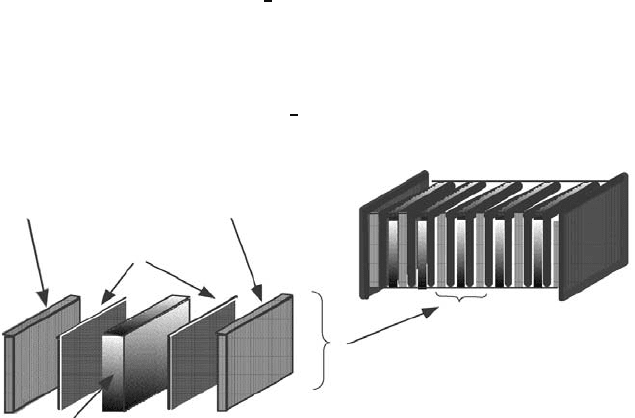
A single cell, such as that shown in Fig. 4.26, typically produces on the order
of 1 V or less under open circuit conditions and produces about 0.5 V under
normal operating conditions. To build up the voltage, cells can be stacked in
series. To do so, the gas flow plates inside the stack are designed to be bipolar;
that is, they carry both the oxygen and hydrogen used by adjacent cells as is
suggested in Fig. 4.27.
4.6.3 Fuel Cell Thermodynamics: Enthalpy
The fuel cell shown in Fig. 4.26 is described by the following pair of half-
cell reactions:
Anode: H
2
→ 2H
+
+ 2e
−
(4.18)
Cathode:
1
2
O
2
+ 2H
+
+ 2e
−
→ H
2
O (4.19)
When combined, (4.18) and (4.19) result in the same equation that we would
write for ordinary combustion of hydrogen:
H
2
+
1
2
O
2
→ H
2
O (4.20)
Gas Flow Bipolar Plates
Electrodes/Catalysts
Single Cell
Multi-Cell Stack
Electrolyte
Figure 4.27 A multicell stack made up of multiple cells increases the voltage. After
Srinivasan et al. (1999).
FUEL CELLS 211
The reaction described in (4.20) is exothermic; that is, it liberates heat (as
opposed to endothermic reactions, which need heat to be added to make them
occur). Since (4.20) is exothermic, it will occur spontaneously—the hydrogen
and oxygen want to combine to form water. Their eagerness to do so provides
the energy that the fuel cell uses to deliver electrical energy to its load. The
questions, of course, are how much energy is liberated in reaction (4.20) and how
much of that can be converted to electrical energy. To answer those questions,
we need to describe three quantities from thermodynamics: enthalpy, free energy,
and entropy. Unfortunately, the precise definitions of each of these quantities tend
not to lend themselves to easy, intuitive interpretation. Moreover, they have very
subtle properties that are beyond our scope here, and there are risks in trying to
present a simplified introduction.
The enthalpy of a substance is defined as the sum of its internal energy U and
the product of its volume V and pressure P :
Enthalpy H = U + PV (4.21)
The internal energy U of a substance refers to its microscopic properties, includ-
ing the kinetic energies of molecules and the energies associated with the forces
acting between molecules, between atoms within molecules, and within atoms.
The total energy of that substance is the sum of its internal energy plus the
observable, macroscopic forms such as its kinetic and potential energies. The
units of enthalpy are usually kJ of energy per mole of substance.
Molecules in a system possess energy in various forms such as sensible and
latent energy, which depends on temperature and state (solid, liquid, gaseous),
chemical energy (associated with the molecular structure), and nuclear energy
(associated with the atomic structure). For a discussion of fuel cells, it is changes
in chemical energy that are of interest, and those changes are best described in
terms of enthalpy changes. For example, we can talk about the potential energy of
an object as being its weight times its height above some reference elevation. Our
choice of reference elevation does not matter as long as we are only interested
in the change in potential energy as an object is raised against gravity from one
elevation to another. The same concept applies for enthalpy. We need to describe
it with respect to some arbitrary reference conditions.
In the case of enthalpy a reference temperature of 25
◦
C and a reference pres-
sure of 1 atmosphere (standard temperature and pressure, STP) are assumed. It
is also assumed that the reference condition for the chemically stable form of
an element at 1 atmosphere and 25
◦
C is zero. For example, the stable form of
oxygen at STP is gaseous O
2
, so the enthalpy for O
2
(g)iszero,where(g)just
means it is in the gaseous state. On the other hand, since atomic oxygen (O) is
not stable, its enthalpy is not zero (it is, in fact, 247.5 kJ/mol). Notice that the
state of a substance at STP matters. Mercury, for example, at 1 atmosphere and
25
◦
C is a liquid, so the standard enthalpy for Hg(l) is zero, where (l)meansthe
liquid state.
One way to think about enthalpy is that it is a measure of the energy that
it takes to form that substance out of its constituent elements. The difference

212 DISTRIBUTED GENERATION
between the enthalpy of the substance and the enthalpies of its elements is called
the enthalpy of formation. It is in essence the energy stored in that substance
due to its chemical composition. A short list of enthalpies of formation at STP
conditions appears in Table 4.6. To remind us that a particular value of enthalpy
(or other thermodynamic properties such as entropy and free energy) is at STP
conditions, a superscript “
◦
”isused(e.g.H
◦
).
Table 4.6 also includes two other quantities, the absolute entropy S
◦
and the
Gibbs free energy G
◦
, which will be useful when we try to determine the maxi-
mum possible fuel cell efficiency. Notice when a substance has negative enthalpy
of formation, it means that the chemical energy in that substance is less than that
of the constituents from which it was formed. That is, during its formation,
some of the energy in the reactants didn’t end up as chemical energy in the
final substance.
In chemical reactions, the difference between the enthalpy of the products and
the enthalpy of the reactants tells us how much energy is released or absorbed
in the reaction. When there is less enthalpy in the final products than in the
reactants, heat is liberated—that is, the reaction is exothermic. When it is the
other way around, heat is absorbed and the reaction is endothermic.
If we analyze the reaction in (4.20), the enthalpies of H
2
and O
2
are zero so
the enthalpy of formation is simply the enthalpy of the resulting H
2
O. Notice
in Table 4.6 that the enthalpy of H
2
O depends on whether it is liquid water or
gaseous water vapor. When the result is liquid water:
H
2
+
1
2
O
2
→ H
2
O(l) H =−285.8kJ (4.22)
When the resulting product is water vapor:
H
2
+
1
2
O
2
→ H
2
O(g) H =−241.8kJ (4.23)
TA BLE 4.6 Enthalpy of Formation H
◦
, Absolute Entropy S
◦
,
and Gibbs Free Energy G
◦
at 1 atm, 25
◦
Cfor
Selected Substances
Substance State H
◦
(kJ./mol) S
◦
(kJ/mol-K) G
◦
(kJ/mol)
H Gas 217.9 0.114 203.3
H
2
Gas 0 0.130 0
O Gas 247.5 0.161 231.8
O
2
Gas 0 0.205 0
H
2
O Liquid −285.8 0.0699 −237.2
H
2
OGas−241.8 0.1888 −228.6
C Solid 0 0.006 0
CH
4
Gas −74.9 0.186 −50.8
CO Gas −110.5 0.197 −137.2
CO
2
Gas −393.5 0.213 −394.4
CH
3
OH Liquid −238.7 0.1268 −166.4

FUEL CELLS 213
The negative signs for the enthalpy changes in (4.22) and (4.23) tell us these
reactions are exothermic; that is, heat is released. The difference between the
enthalpy of liquid water and gaseous water vapor is 44.0 kJ/mol. Therefore, that
amount is the familiar latent heat of vaporization of water. Recall that latent heat
is what distinguishes the higher heating valuez (HHV) of a hydrogen-containing
fuel and the lower heating value LHV. The HHV includes the 44.0 kJ/mol of
latent heat in the water vapor formed during combustion, while the LHV does not.
Example 4.8 The High Heating Value (HHV) for Methane. Find the HHV
of methane CH
4
in kJ/mol and kJ/kg when it is oxidized to CO
2
and liquid H
2
O.
Solution. The reaction is written below, and beneath it are enthalpies taken from
Table 4.6. Notice that we must balance the equation so that we know how many
moles of each constituent are involved.
CH
4
(g) + 2O
2
(g) → CO
2
(g) + 2H
2
O(l)
(−74.9) 2 × (0)(−393.5) 2 × (−285.8)
Notice, too, that we have used the enthalpy of liquid water to find the HHV.
The difference between the total enthalpy of the reaction products and the
reactants is
H = [(−393.5) + 2 × (−285.8)] −[(−74.9) + 2 × (0)]
=−890.2kJ/mol of CH
4
Since the result is negative, heat is released during combustion; that is, it is
exothermic. The HHV is the absolute value of H , which is 890.2 kJ/mol.
Since there are 12.011 + 4 × 1.008 = 16.043 g/mol of CH
4
, the HHV can
also be written as
HHV =
890.2kJ/mol
16.043 g/mol
× 1000 g/kg = 55,490 kJ/kg
4.6.4 Entropy and the Theoretical Efficiency of Fuel Cells
While the enthalpy change tells us how much energy is released in a fuel cell,
it doesn’t tell us how much of that energy can be converted directly into elec-
tricity. To figure that out, we need to review another thermodynamic quantity,
entropy. Entropy has already been introduced in the context of heat engines in
Section 3.4.2, where it was used to help develop the Carnot efficiency limit. In
a similar fashion, the concept of entropy will help us develop the maximum
efficiency of a fuel cell.
214 DISTRIBUTED GENERATION
To begin, let us note that all energy is not created equal. That is, for example,
1 joule of energy in the form of electricity or mechanical work is much more
useful than a joule of heat. We can convert that joule of electricity or work
into heat with 100% conversion efficiency, but we cannot get back the joule
of electricity or work from just a single joule of heat. What this suggests is
that there is a hierarchy of energy forms, with some being “better” than others.
Electricity and mechanical energy (doing work) are of the highest quality. In
theory we could go back and forth between electricity and mechanical work with
100% conversion efficiency. Heat energy is of much lower quality, with low-
temperature heat being of lower quality than high-temperature heat. So, where
does chemical energy fit in this scheme? It is better than thermal, but worse than
mechanical and electrical. Entropy will help us figure out just where it stands.
Recall that when an amount of heat Q is removed from a thermal reservoir
large enough that its temperature T does not change during the process (i.e., the
process is isothermal), the loss of entropy S from the reservoir is defined to be
S =
Q
T
(4.24)
With Q measured in kilojoules (kJ) and T in kelvins (K =
◦
C + 273.15), the
units of entropy are kJ/K. Recall, too, that entropy is only associated with heat
transfer and that electrical or mechanical work is perfect so that these forms have
zero entropy. And, finally, remember that in any real system, if we carefully
add up all of the entropy changes, the second law of thermodynamics requires
that there be an overall increase in entropy. Now let us apply these ideas to a
fuel cell.
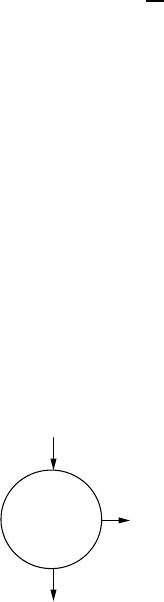
Consider Fig. 4.28, which shows a fuel cell converting chemical energy into
electricity and waste heat. The fuel cell reactions (4.22) and (4.23) are exother-
mic, which means that their enthalpy changes H are negative. Working with
negative quantities leads to awkward nomenclature, which we can avoid by say-
ing that those reactions act as a source of enthalpy H that can be converted to
heat and work as Fig. 4.28 implies.
Fuel
Cell
Enthalpy in
H
Enthalpy output
W
e
Rejected heat
Q
Figure 4.28 The energy balance for a fuel cell.

FUEL CELLS 215
The cell generates an amount of electricity W
e
and rejects an amount of thermal
energy Q to its environment. Since there is heat transfer and it is a real system,
there must be an increase in entropy. We can use that requirement to determine
the minimum amount of rejected heat and therefore the maximum amount of
electric power that the fuel cell will generate. To do so, we need to carefully
tabulate the entropy changes occurring in the cell:
H
2
+
1
2
O
2
→ H
2
O + Q(4.25)
where we have included the fact that heat Q will be released. The entropy of the
reactants H
2
and O
2
will disappear, but new entropy will appear in the H
2
Othat
is formed plus the entropy that appears in the form of heat Q. As long as the
process is isothermal, which is a reasonable assumption for a fuel cell, we can
write the entropy appearing in the rejected heat as
S =
Q
T
(4.26)
What about the entropy associated with the work done, W
e
? Since there is no
heat transfer in electrical (or mechanical) work, that entropy is zero.
To make the necessary tabulation, we need values of the entropy of the reac-
tants and products. And, as usual, we need to define reference conditions. It is
conventional practice to declare that the entropy of a pure crystalline substance
at zero absolute temperature is zero (the “third law of thermodynamics”). The
entropy of a substance under other conditions, referenced to the zero base con-
ditions, is called the absolute entropy of that substance, and those values are
tabulated in a number of places. Table 4.6 gives absolute entropy values, S
◦
,for
several substances under STP conditions (25
◦
C, 1 atm).
The second law of thermodynamics requires that in a real fuel cell there be a
net increase in entropy (an ideal cell will release just enough heat to make the
increase in entropy be zero). Therefore, we can write that the entropy that shows
up in the rejected heat and the product water (liquid water) must be greater than
the entropy contained in the reactants (H
2
and O
2
):
Entropy gain ≥ Entropy loss (4.27)
Q
T
+
S
products
≥
S
reactants
(4.28)
which leads to
Q ≥ T
S
reactants
−
S
products
(4.29)
Equation (4.29) tells us the minimum amount of heat that must appear in the
fuel cell. That is, we cannot convert all of the fuel’s energy into electricity—we
are stuck with some thermal losses. At least our thermal losses are going to be
less than if we tried to generate electricity with a heat engine.

216 DISTRIBUTED GENERATION
We can now easily determine the maximum efficiency of the fuel cell. From
Fig. 4.28, the enthalpy supplied by the chemical reaction H equals the electricity
produced W
e
plus the heat rejected Q:
H = W
e
+ Q(4.30)
Since it is the electrical output that we want, we can write the fuel cell’s effi-
ciency as
η =
W
e
H
=
H − Q
H
= 1 −
Q
H
(4.31)
To find the maximum efficiency, all we need to do is plug in the theoretical
minimum amount of heat Q from (4.29).
Example 4.9 Minimum Heat Released from a Fuel Cell. Suppose a fuel cell
that operates at 25
◦
C (298 K) and 1 atm forms liquid water (that is, we are
working with the HHV of the hydrogen fuel):
H
2
+
1
2
O
2
→ H
2
O(l) H =−285.8kJ/mol of H
2
a. Find the minimum amount of heat rejected per mole of H
2
.
b. What is the maximum efficiency of the fuel cell?
Solution
a. From the reaction, 1 mole of H
2
reacts with 1/2 mole of O
2
to produce
1 mole of liquid H
2
O. The loss of entropy by the reactants per mole of H
2
is found using values given in Table 4.6:
S
reactants
= 0.130 kJ/mol-K × 1molH
2
+ 0.205 kJ/mol-K × 0.5molO
2
= 0.2325 kJ/K
The gain in entropy in the product water is
S
product
= 0.0699 kJ/mol-K ×1molH
2
O(l) = 0.0699 kJ/K
From (4.29), the minimum amount of heat released during the reaction
is therefore
Q
min
= T
S
reactants
−
S
products
= 298 K (0.2325 − 0.0699) kJ/K = 48.45 kJ per mole H
2

FUEL CELLS 217
b. From (4.22), the enthalpy made available during the formation of liquid
water from H
2
and O
2
is H = 285.8kJ/molofH
2
.
The maximum efficiency possible occurs when Q is a minimum; thus
from (4.31)
η
max
= 1 −
Q
min
H
= 1 −
48.45
285.8
= 0.830 = 83.0%
4.6.5 Gibbs Free Energy and Fuel Cell Efficiency
The chemical energy released in a reaction can be thought of as consisting of two
parts: an entropy-free part, called free energy G, that can be converted directly
into electrical or mechanical work, plus a part that must appear as heat Q.The
“G” in free energy is in honor of Josiah Willard Gibbs (1839–1903), who first
described its usefulness, and the quantity is usually referred to as Gibbs free
energy. The free energy G is the enthalpy H created by the chemical reaction,
minus the heat that must be liberated, Q = TS, to satisfy the second law.
The Gibbs free energy G corresponds to the maximum possible, entropy-
free, electrical (or mechanical) output from a chemical reaction. It can be found
at STP using Table 4.6 by taking the difference between the sum of the Gibbs
energies of the reactants and the products:
G =
G
products
−
G
reactants
(4.32)
This means that the maximum possible efficiency is just the ratio of the Gibbs
free energy to the enthalpy change H in the chemical reaction
η
max
=
G
H
(4.33)
Example 4.10 Maximum Fuel Cell Efficiency Using Gibbs Free Energy.
What is the maximum efficiency at STP of a proton-exchange-membrane (PEM)
fuel cell based on the higher heating value (HHV) of hydrogen?
Solution. The HHV corresponds to liberated water in the liquid state so that the
appropriate reaction is
H
2
+
1
2
O
2
→ H
2
O(l) H =−285.8kJ/mol of H
2
From Table 4.6 the Gibbs free energy of the reactants H
2
and of O
2
are both
zero, and that of the product, liquid water, is −237.2 kJ. Therefore, from 4.32)
G =−237.2 − (0 + 0) =−237.2kJ/mol