
Masters G.M. Renewable and Efficient Electric Power Systems
Подождите немного. Документ загружается.

228 DISTRIBUTED GENERATION
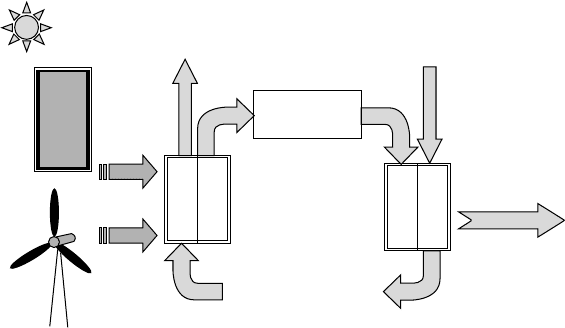
Photovoltaics
Oxygen
Oxygen
Wind
Water Water
Fuel Cell
Electrolyzer
H
2
Storage
Electric
Power
Figure 4.32 Renewable energy sources coupled with fuel cells can provide electric
power where and when it is required, cleanly, and sustainably.
the ultimate goals of carbon-free electricity, available whenever it is needed,
whether or not the sun is shining or the wind is blowing, without depleting
scarce nonrenewable resources, can become an achievable reality.
REFERENCES
Babcock and Wilcox (1992). Steam, 40th ed., Babcock & Wilcox, Barberton, OH.
Cler, G. I., and M. Shepard (1996). Distributed Generation: Good Things Are Coming in
Small Packages, Esource Tech Update, TU-96-12, Esource, Boulder, CO.
Davenport, R. L., B. Butler, R. Taylor, R. Forristall, S. Johansson, J. Ulrich,
C. VanAusdal, and J. Mayette (2002). Operation of Second-Generation Dish/Stirling
Power Systems, Proceedings of the 31st ASES Annual Conference, June 15–20.
Grove, W. R. (1839). On Voltaic Series in Combinations of Gases by Platinum, Philo-
sophical Magazine, vol. 14, pp. 127–130.
Inversin, A. R. (1986). Micro-Hydropower Sourcebook, National Rural Electrification Co-
operative Association, Arlington, VA.
McNeely, M. (2003). ARES—Gas Engines for Today and Beyond, Diesel and Gas Tur-
bine Worldwide, May, pp. 1–6.
Mond, L. L., and C. Langer (1890). Proceedings of the Royal Society (London), Services,
A, vol. 46, pp. 296–304.
Petchers, N. (2002). Combined Heating, Cooling and Power: Technologies and Applica-
tions, The Fairmont Press, Lilburn, GA.
Price, H., E. Lupfert, D. Kearney, E. Zarra, G. Cohen, R. Gee, and R. Mahoney (2002).
Advances in Parabolic Trough Solar Power Technology, Journal of Solar Engineering,
May, pp. 109–125.
PROBLEMS 229
Srinivasan, S., R. Mosdale, P. Stevens, and C. Yang (1999). Fuel Cells: Reaching the Era
of Clean and Efficient Power Generation in the Twenty-First Century. Annual Review
of Energy and Environment, pp. 281–328.
PROBLEMS
4.1 A natural-gas-fired microturbine has an overall efficiency of 26% when
expressed on an LHV basis. Using data from Table 4.2, find the efficiency
expressed on an HHV basis.
4.2 On an HHV basis, a 600-MW coal-fired power plant has a heat rate of
9700 Btu/kWh. The particular coal being burned has an LHV of 5957 Btu/
lbm and an HHV of 6440 Btu/lbm.
a. What is its HHV efficiency?
b. What is its LHV efficiency?
c. At what rate will coal have to be supplied to the plant (tons/hr)?
4.3 A natural-gas fueled, 250-kW, solid-oxide fuel cell with a heat rate of
7260 Btu/kWh costs $1.5 million. In its cogeneration mode, 300,000 Btu/hr
of exhaust heat is recovered, displacing the need for heat that would have
been provided from a 75% efficient gas-fired boiler. Natural gas costs $5
per million Btu and electricity purchased from the utility costs $0.10/kWh.
The system operates with a capacity factor of 80%.
a. What is the value of the fuel saved by the waste heat ($/yr)?
b. What is the savings associated with not having to purchase utility elec-
tricity ($/yr)?
c. What is the annual cost of natural gas for the CHP system?
d. With annual O&M costs equal to 2% of the capital cost, what is the net
annual savings of the CHP system?
e. What is the simple payback (ratio of initial investment to annual savings)?
4.4 Suppose 200 gpm of water is taken from a creek and delivered through
800 ft of 3-inch diameter PVC pipe to a turbine100 ft lower than the
source. If the turbine/generator has an efficiency of 40%, find the elec-
trical power that would be delivered. In a 30-day month, how much energy
would be provided?
4.5 The site in Problem 4.4 has a flow rate of 200 gpm, 100-ft elevation change,
and 800-ft length of pipe, but there is excessive friction loss in the pipe.
a. What internal pipe diameter would keep flow to less than a recommended
speed of 5 ft/sec.
b. Assuming locally available PVC pipe comes in 1-in diameter increments
(2-in, 3-in, etc), pick a pipe size closest to the recommended diameter.
c. Find the kWh/month delivered by the 40% efficient turbine/generator.
d. With a 4-nozzle pelton wheel, what diameter jets would be appropriate?
230 DISTRIBUTED GENERATION
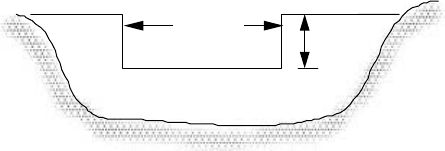
4.6 The rectangular weir flow equation is based on water height h above the
notch being at least 2 inches while the notch width must be at least 3 h.
Design a notch (width and height) that will be able to measure the maximum
flow when the minimum flow is estimated to be 200 gpm. What maximum
flow rate could be accommodated?
W > 3 h
h > 2 in .
Figure P4.6
4.7 Use enthalpies from Table 4.6 to compute the following heating values
(kJ/kg) when they are oxidized to CO
2
and H
2
O:
a. LHV of H
2
(molecular weight (MW) = 2.016)
b. HHV of H
2
c. LHV of methane, CH
4
(MW = 16.043)
d. LHV of liquid methanol CH
3
OH (MW = 32.043)
e. HHV of methanol, CH
3
OH (l)
4.8 Suppose a methanol fuel cell forms liquid water during its operation. Assum-
ing everything is at STP conditions:
a. What minimum amount of heat must be rejected in order to satisfy
entropy constraints (kJ/mol)?
b. What maximum efficiency could the fuel cell have using the calculation
in (b)?
c. What maximum efficiency could the fuel cell have using the Gibbs free
energy approach?
4.9 Equation (4.38) indicates that an ideal PEM cell needs 30.35 g H
2
to pro-
duce one kWh of electrical output. Suppose an electric car can travel 10
miles per kWh. How much hydrogen would be needed to give the car a
range of 300 miles if the source of electricity is an on-board fuel cell with
an efficiency that is 50% of the ideal?
4.10 An ideal PEM fuel cell with an efficiency of 83% needs 30.35 g of hydrogen
to generate 1 kWh. For a real cell with half that efficiency, how much
hydrogen per day would be needed to power a house that uses 25 kWh
per day?

CHAPTER 5
ECONOMICS OF DISTRIBUTED
RESOURCES
In this chapter, the techniques needed to evaluate the economics of both sides
of the electric meter—the demand side and the supply side—will be explored.
Some of this is simply applied engineering economy, but the energy systems that
we need to evaluate, especially those involving cogeneration, sometimes require
special perspectives to adequately describe their economic advantages.
5.1 DISTRIBUTED RESOURCES (DR)
The traditional focus in electric power planning has been on generation
resources—forecasting demand, perhaps by extrapolating existing trends, and
then trying to select the most cost-effective combination of new power plants
to meet that forecast. In the final decades of the twentieth century, however,
there was an important shift in which it was recognized that the real need was
for energy services—illumination, for example—not raw kilowatt-hours, and a
least-cost approach to providing those energy services should include programs
to help customers use energy more efficiently. Out of that recognition a process
called integrated resource planning (IRP) emerged in which both supply-side and
demand-side resources were evaluated, including environmental and social costs,
to come up with a least-cost plan to meet the wants and needs of customers
for energy services. Building new power plants had to compete with helping
customers install more efficient lamps and motors.
Renewable and Efficient Electric Power Systems. By Gilbert M. Masters
ISBN 0-471-28060-7
2004 John W iley & Sons, Inc.
231
232 ECONOMICS OF DISTRIBUTED RESOURCES
More recently, with increased attention to the electricity grid and the emer-
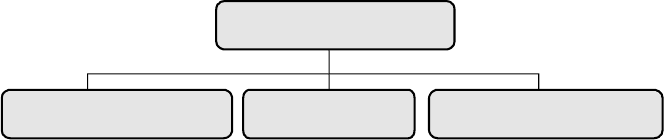
gence of efficient, cost-effective cogeneration, IRP now recognizes three kinds
of electricity resources: generation resources, especially the distributed genera-
tion (DG) technologies explored in the last chapter; grid resources, which move
electricity from generators to customers; and demand-side resources, which link
electricity to energy services. These three distributed resources (DR) are all
equally valid, comparable resources that need to be evaluated as part of a least-
cost planning process. In this chapter, the focus is on distributed resources that
are relatively small in scale and located somewhat near the end-user. Examples
of such distributed resources are shown in Fig. 5.1. In an astonishing book by
Amory Lovins et al. Small is Profitable: The Hidden Economic Benefits of Mak-
ing Electrical Resources the Right Size (2002), over 200 benefits of distributed
resources are explored and explained.
Improving efficiency is an important energy resource in every electric power
system. On the generation side, efficiency in the context of renewable energy
technologies is important because it helps reduce the size and cost of the systems.
Other important new technologies, including combined-cycle turbines, microtur-
bines, Stirling engines, and, to some extent, fuel cells, rely on fossil fuels, so
efficiency has added importance because it helps extend the lifetime of nonre-
newable resources while reducing the political and environmental consequences
associated with their mining, processing, and use.
For many renewable and nonrenewable generation systems, their efficiency is
greatly enhanced when the cogeneration of electricity and usable waste heat is
incorporated into the energy conversion processes. The usability of waste heat,
of course, depends on what task is to be accomplished. Low-temperature heat
(≈50–80
◦
C) can be used for water heating and perhaps space heating; medium
temperatures (≈80–100
◦
C) can be used for space heating and air conditioning;
and with temperatures over 100
◦
C, steam can be generated for process heating and
other industrial purposes. In some circumstances, cogeneration not only reduces
total energy consumption, but can also cut the demand for electric power itself
DISTRIBUTED RESOURCES
DISTRIBUTED GENERATION GRID RESOURCES DEMAND-SIDE RESOURCES
• Fuel cells
• Internal combustion engines
• Combustion turbines
• Biomass cogeneration
• Wind turbines
• Photovoltaics
• Mini-hydro
• Increased grid capacity
• Decreased grid losses
• Grid-sited storage
• Improved power factor
• Reduced connection losses
• Unaccounted for losses
• Heat pumps
• Solar architecture
• Motor controls
• Efficient lighting
• Load shifting
• Appliance efficiency
• Absorption cooling
Figure 5.1 Examples of distributed resources. (Based on Lovins et al. (2002).
ELECTRIC UTILITY RATE STRUCTURES 233
by allowing fuel rather than electricity to provide the desired energy service.
An example is air conditioning that can be shifted from electrically powered,
vapor-compression chillers to absorption chillers that run on waste heat.
On the demand side, technologies that use electricity more efficiently—better
lamps and fixtures, more efficient motors and controls, heat pumps for water and
space heating, and more efficient appliances—are the major energy resource, but
finding ways to totally eliminate the need for power is also a resource. When
we focus on what we want energy for, rather than how many kilowatt hours are
usually needed, important perspectives emerge. Illumination, for example, can
be provided by burning coal in a power plant, sending the generated electricity
through a transmission and distribution system to the filament of a lightbulb
where it is converted mostly into heat plus a little bit of light. In a big building,
this heat may have to be removed from the conditioned space, which means
burning more coal to generate electricity for the air conditioner. The process can
be made more efficient by using fluorescent rather than incandescent lighting; or,
better still, the need for artificial light, and the cooling that often accompanies
it, can be minimized, or even eliminated entirely, by proper manipulation of
natural daylight through well-designed fenestration (windows). Natural daylight,
for example, may do more than just reduce the electricity demand for illumination,
it may also increase worker productivity the value of which may far exceed the
reduction in utility bills.
5.2 ELECTRIC UTILITY RATE STRUCTURES
An essential step in any economic calculation for a distributed resource (DR)
project is a careful analysis of the cost of electricity and/or fuel that will be
displaced by the proposed system. Our focus in this section is on electric utility
rate structures, which are critical factors for customers evaluating a DR project
intended to reduce electricity purchases.
Electric rates vary considerably, depending not only on the utility itself, but
also on the electrical characteristics of the specific customer purchasing the
power. The rate structure for a residential customer will typically include a basic
fee to cover costs of billing, meters, and other equipment, plus an energy charge
based on the number of kilowatt-hours of energy used. Commercial and indus-
trial customers are usually billed not only for energy (kilowatt-hours) but also
for the peak amount of power that they use (kilowatts). That demand charge for
power ($/mo per kW) is the most important difference between the rate structures
designed for small customers versus large ones. Large industrial customers may
also pay additional fees if their power factor—that is, the phase angle between
the voltage supplied and the current drawn—is outside of certain bounds.
5.2.1 Standard Residential Rates
Consider the example rate structure for a residential customer shown in Table 5.1.
Notice that it includes three tiers based on monthly kWh consumed, and notice

234 ECONOMICS OF DISTRIBUTED RESOURCES
TA BLE 5.1 Example Standard Residential Electric Rate Schedule for a
California Utility
Tier Level Winter: November–April Summer: May–October
Tier I First 620kWh 7.378¢/kWh First 700kWh 8.058¢/kWh
Tier II 621–825 12.995¢/kWh 701–1000 13.965¢/kWh
Tier III Over 825 14.231¢/kWh Over 1000 15.688¢/kWh
that the rates increase with increasing demand. This is an example of what is
called an inverted block rate structure, designed to discourage excessive con-
sumption. Not that long ago, the most common structures were based on declining
block rates, which made electricity cheaper as the customer’s demand increased,
which of course discouraged conservation. This particular rate structure is for a
summer peaking utility (the Sacramento Municipal Utility District, 2003), so the
rates increase somewhat in summer to encourage customers to conserve during
the peak season.
Example 5.1 Calculating a Simple Residential Utility Bill. Suppose that a
customer subject to the rate structure in Table 5.1 uses 1200 kWh/mo during
the summer.
a. What would be the total cost of electricity ($/mo, ignoring the monthly
service charge)?
b. What would be the value (¢/kWh) of an efficiency project that cuts the
demand to 900 kWh/mo?
Solution:
a. The total monthly bill includes 700 kWh @ 8.058¢, 300 kWh @ 13.965¢,
and 200 kWh @ 15.688¢, for a total of
700 × $0.08058 + 300 × $0.13965 + 200 × $0.15688 = $129.68/mo
b. If the demand is reduced to 900 kWh/mo, the bill would be
700 × $0.08058 + 200 ×$0.13965 = $84.34/mo
The savings per kWh is ($129.68 − $84.34)/300 kWh = $0.1511/kWh

ELECTRIC UTILITY RATE STRUCTURES 235
TA BLE 5.2 Example Residential Time-of-Use (TOU) Rate Schedule
November–April May–October
On-peak 7–10 A.M., 5–8 P.M. 8.335 ¢/kWh 2–8 P.M. 19.793 ¢/kWh
Off-peak All other times 7.491 ¢/kWh All other times 8.514 ¢/kWh
5.2.2 Residential Time-of-Use (TOU) Rates
In an effort to encourage customers to shift their loads away from the peak
demand times, some utilities are beginning to offer residential time-of-use (TOU)
rates. For many utilities the peak demand occurs on hot, summer afternoons when
air conditioners are humming (see, for example, Fig. 3.6), so TOU rates in such
circumstances charge more for electricity during summer afternoons. Conversely,
at night when there is idle capacity, rates may be significantly lower.
Table 5.2 presents an example of a residential TOU rate schedule for a
summer-peaking utility. While there is not much time/price differential in the
winter, in the summer the TOU rate schedule is very costly during the on-peak
times. In this case, however, the off-peak summer rate is still rather high so a
careful calculation would need to be made to determine whether the TOU rate
or the regular residential rate schedule in Table 5.1 would be most cost-effective
for an individual homeowner.
An especially interesting calculation is one for a TOU customer with pho-
tovoltaics (PVs) on the roof displacing the need for expensive on-peak utility
electricity. Some utilities allow true net-metering with TOU rates, in which case
monthly net energy consumed or generated is billed or credited to the customer at
the applicable TOU rate. The following example shows how this incentive works.
Example 5.2 PVs, TOU Rates, and Net Metering. During the summer
a rooftop PV system generates 10 kWh/day during the off-peak hours and
10 kWh/day during the on-peak hours. Suppose too, that the customer uses
2 kWh/day on-peak and 18 kWh/day off-peak. That is, the PVs generate
20 kWh/day and the household consumes 20 kWh/day.
PV supply Demand
On-peak 10kWh 2kWh
Off-peak 10kWh 18kWh
Total 20kWh/day 20kWh/day
For a 30-day month in the summer, find the electric bill for this customer if the
TOU rates of Table 5.2 apply.

236 ECONOMICS OF DISTRIBUTED RESOURCES
Solution During the on-peak hours, the customer generates 10 kWh and uses
2 kWh, so there would be a credit of
On-peak credits = 8kWh/day× $0.19793/kWh ×30 day/mo = $47.50
During the off-peak hours, the customer generates 10 kWh and uses 18 kWh,
so the bill for those hours would be
Off-peak bill = 8kWh/day× $0.08514/kWh ×30 day/mo = $20.43/mo
So the net bill for the month would be
Net bill = $20.43 − $47.50 =−$27.07mo
That is, the utility would owe the customer $27.07 for this month. Most likely
in other months there will be actual bills against which this amount would
be credited.
Notice that the bill would have been zero, instead of the $27.07 credit, had this
customer elected the standard rate schedule of Table 5.1 instead of the TOU rates.
5.2.3 Demand Charges
The rate structures that apply to commercial and industrial customers usually
include a monthly demand charge based on the highest amount of power drawn
by the facility. That demand charge may be especially severe if the customer’s
peak corresponds to the time during which the utility has its maximum demand
since at those times the utility is running its most expensive peaking power plants.
In the simplest case, the demand charge is based on the peak demand in a
given month, usually averaged over a 15-minute period, no matter what time of
day it occurs. An example of a typical rate structure with such a demand charge
is given in Table 5.3.
Example 5.3 Impact of Demand Charges. During the summer, a small com-
mercial building that uses 20,000 kWh per month has a peak demand of 100 kW.
a. Compute the monthly bill (ignoring fixed customer charges).
b. How much does the electricity cost for a 100-W computer that is used 6 h
a day for 22 days in the month? The computer is turned on during the
period when the peak demand is reached for the building. How much is
that in ¢/kWh?

ELECTRIC UTILITY RATE STRUCTURES 237
TABLE 5.3 Electricity Rate Structure Including
Monthly Demand Charges
Winter
Oct–May
Summer
June–Sept
Energy charges $0.0625/kWh $0.0732/kWh
Demand charges $7/mo-kW $9/mo-kW
Solution
a. The monthly bill is made up of energy and demand charges:
Energy charge = 20,000 kWh × $0.0732/kWh = $1464/mo
Demand charge = 100 kW ×$9/mo-kW = $900/mo
For a total of $1464 + $900 = $2364/mo (38% of which is demand)
b. The computer uses 0.10 kW × 6h/d × 22 day/mo = 13.2kWh/mo
Energy charge = 13.2kWh/mo× $0.0732/kWh = $0.97/mo
Demand charge = 0.10 kW ×$9/mo-kW = $0.90/mo
Total cost = $0.97 + $0.90 = $1.87/mo
On a per kilowatt-hour basis, the computer costs
Electricity =
$1.87/mo
13.2kWh/mo
= $0.142/kWh
Notice how the demand charge makes the apparent cost of electricity for the
computer (14.2¢/kWh) nearly double the 7.32 ¢/kWh price of electric energy.
5.2.4 Demand Charges with a Ratchet Adjustment
The demand charge in the rate schedule shown in Table 5.3 applies to the peak
demand for each particular month in the year. The revenue derived from demand
charges that may only be monetarily significant for just one month of the year,
however, may not be sufficient for the utility to pay for the peaking power
plant they had to build to supply that load. To address that problem, it is com-
mon to have a ratchet adjustment built into the demand charges. For example,
the monthly demand charges may be ratcheted to a level of perhaps 80% of the
annual peak demand. That is, if a customer reaches a highest annual peak demand
of 1000 kW, then for every month of the year the demand charge will be based