
Masters G.M. Renewable and Efficient Electric Power Systems
Подождите немного. Документ загружается.

248 ECONOMICS OF DISTRIBUTED RESOURCES
where A is the annual savings at t = 0. The quantity d
can be found by trial-
and-error or interpolation using Table 5.4 or Fig. 5.2 as a guide, or with a special
calculator. Comparing (5.12) with (5.17), we can see that d
will be the same as
the internal rate of return that is found without fuel escalation, which we will
call IRR
0
. Replacing d
with IRR
0
in (5.15) gives
IRR
0
=
d − e
1 + e
(5.18)
Since d in (5.18) is the buyer’s discount rate that results in a NPV of zero, it
is the same as the internal rate of return with fuel escalation, which we will
call IRR
e
:
IRR
e
= IRR
0
(1 + e) + e(5.19)
Example 5.8 IRR for an HVAC Retrofit Project with Fuel Escalation.
Suppose the energy-efficiency retrofit of a large building reduces the annual elec-
tricity demand for heating and cooling from 2.3 × 10
6
kWhto0.8 × 10
6
kWh
and the peak demand for power from by 150 kW. Electricity costs $0.06/kWh
and demand charges are $7/kW-mo, both of which are projected to rise at an
annual rate of 5%. If the project costs $500,000, what is the internal rate of
return over a project lifetime of 15 years?
Solution. The initial annual savings will be
Energy savings = (2.3 − 0.8) ×10
6
kWh/yr × $0.06/kWh = $90,000/yr
Demand savings = 150 kW × $7/kW-mo × 12 mo/yr = $12,600/yr
Total annual savings = A = $90,000 + $12,600 = $102,600/yr
The simple payback will be
Simple payback period =
P
A
=
$500,000
$102,600/yr
= 4.87 yr
From Table (5.4), the internal rate of return without fuel escalation IRR
0
is very
close to 19%.
From (5.19) the internal rate of return with fuel escalation is
IRR
e
= IRR
0
(1 + e) + e = 0.19(1 + 0.05) + 0.05 = 0.2495≈25%/yr
5.3.6 Annualizing the Investment
In many circumstances the extra capital required for an energy investment will
be borrowed from a lending company, obtained from investors who require a

ENERGY ECONOMICS 249
TABLE 5.5 Capital Recovery Factors as a Function of Interest Rate and Loan
Term
Years 3% 4% 5% 6% 7% 8% 9% 10% 11% 12% 13%
5 0.2184 0.2246 0.2310 0.2374 0.2439 0.2505 0.2571 0.2638 0.2706 0.2774 0.2843
10 0.1172 0.1233 0.1295 0.1359 0.1424 0.1490 0.1558 0.1627 0.1698 0.1770 0.1843
15 0.0838 0.0899 0.0963 0.1030 0.1098 0.1168 0.1241 0.1315 0.1391 0.1468 0.1547
20 0.0672 0.0736 0.0802 0.0872 0.0944 0.1019 0.1095 0.1175 0.1256 0.1339 0.1424
25 0.0574 0.0640 0.0710 0.0782 0.0858 0.0937 0.1018 0.1102 0.1187 0.1275 0.1364
30 0.0510 0.0578 0.0651 0.0726 0.0806 0.0888 0.0973 0.1061 0.1150 0.1241 0.1334
return on their investments, or taken from one’s own accounts. In all of these
circumstances, the economic analysis can be thought of as a loan that converts
the extra capital cost into a series of equal annual payments that eventually pay
off the loan with interest. Even if the money is not actually borrowed, the same
approach can be used to annualize the cost of the energy investment, which has
many useful applications. The key equation is
A = P × CRF(i, n) (5.20)
where A represents annual loan payments ($/yr), P is the principal borrowed ($),
i is the interest rate (e.g. 10% corresponds to i = 0.10/yr), and n is the loan
term (yrs), and
CRF(i, n) = Capital recovery factor(yr
−1
) =
i(1 + i)
n
(1 + i)
n
− 1
(5.21)
Notice that the capital recovery factor (CRF) is just the inverse of the present
value function (PVF). Since we are treating the first cost of the investment as a
loan, we have gone back to using an interest rate i rather than a discount rate d.
A short table of values for the CRF is given in Table 5.5.
Equations (5.20) and (5.21) were written as if the loan payments are made
only once each year. They are easily adjusted to find monthly payments by
dividing the annual interest rate i by 12 and multiplying the loan term n by 12,
leading to the following:
CRF(i, n) =
(i/12)[1 + (i/12)]
12n
[1 + (i/12)]
12n
− 1
per month (5.22)
Example 5.9 Comparing Annual Costs to Annual Savings. An efficient air
conditioner that costs an extra $1000 and saves $200 per year is to be paid for
with a 7% interest, 10-year loan.
a. Find the annual monetary savings.
b. Find the ratio of annual benefits to annual costs.

250 ECONOMICS OF DISTRIBUTED RESOURCES
Solution. From (5.21), the capital recovery factor will be
CRF(0.07, 10) =
0.07(1 + 0.07)
10
(1 + 0.07)
10
− 1
= 0.14238/yr
The annual payments will be A = $1000 × 0.14238/yr = $142.38/yr.
a. The annual savings will be $200 − $142.38 = $57.62/yr. Notice that by
annualizing the costs the buyer makes money every year so the notion
that a 5-year payback period might be considered unattractive becomes
irrelevant.
b. The benefit/cost ratio would be
Benefit/Cost =
$200/yr
$142.38/yr
= 1.4
The annualized cost method is also applicable to investments in generation
capacity, as the following example illustrates.
Example 5.10 Cost of Electricity from a Photovoltaic System. A 3-kW pho-
tovoltaic system, which operates with a capacity factor (CF) of 0.25, costs
$10,000 to install. There are no annual costs associated with the system other
than the payments on a 6%, 20-year loan. Find the cost of electricity generated
by the system (¢/kWh).
Solution. From either (5.21) or Table 5.5, the capital recovery factor is 0.0872/yr.
From (5.20) the annual payments will be
A = P × CRF(0.06, 20) = $10,000 × 0.0872/yr = $872/yr
To find the annual electricity generated, recall the definition of capacity factor
(CF) from (3.20):
Annual energy (kWh/yr) = Rated power (kW) × 8760 hr/yr × CF
In this case
kWh/yr = 3kW× 8760 h/yr × 0.25 = 6570 kWh/yr
The cost of electricity from the PV system is therefore
Cost of PV electricity =
$872/yr
6570 kWh/yr
= $0.133/kWh = 13.3¢/kWh
ENERGY ECONOMICS 251
5.3.7 Levelized Bus-Bar Costs
To do an adequate comparison of cost per kilowatt-hour from a renewable energy
system versus that for a fossil-fuel-fired power plant, the potential for escalating
future fuel costs must be accounted for. To ignore that key factor is to ignore one
of the key advantages of renewable energy systems; that is, their independence
from the uncertainties associated with future fuel costs.
The cost of electricity per kilowatt-hour for a power plant has two key com-
ponents—an up-front fixed cost to build the plant plus an assortment of costs
that will be incurred in the future. In the usual approach to cost estimation, a
present value calculation is first performed to find an equivalent initial cost, and
then that amount is spread out into a uniform series of annual costs. The ratio of
the equivalent annual cost ($/yr) to the annual electricity generated (kWh/year)
is called the levelized, bus-bar cost of power (the “bus-bar” refers to the wires
as they leave the plant boundaries).
In the first step, the present value of all future costs must be found, including
the impacts of inflation. To keep things simple, we’ll assume that the annual
costs today are A
0
, and that they escalate due to inflation (and other factors) at
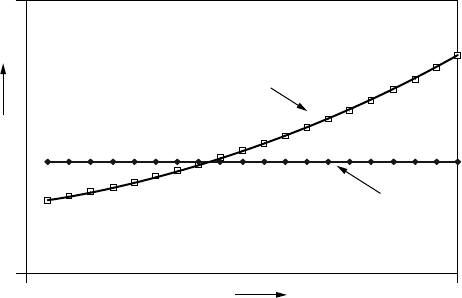
the rate e. Figure 5.3 illustrates the concept.
The present value of these escalating annual costs over a period of n years is
given by
PV(annual costs) = A
0
· PVF(d
,n) (5.23)
where d
is the equivalent discount rate including inflation introduced in (5.15).
Having found the present value of those future costs, we now want to find an
equivalent annual cost using the capital recovery factor:
Levelized annual costs = A
0
[PVF(d
,n)· CRF(d, n)] (5.24)
0
0
Levelized Annual Costs = A
0
⋅ LF
Actual Annual Costs = A
0
(1 + e)
t
Annual Cost
Year
Figure 5.3 Levelizing annual costs when there is fuel escalation.
252 ECONOMICS OF DISTRIBUTED RESOURCES
The product in the brackets, called the levelizing factor, is a multiplier that
converts the escalating annual fuel and O&M costs into a series of equal annual
amounts:
Levelizing factor (LF) =
(1 + d
)
n
− 1
d
(1 + d
)
n
·
d(1 + d)
n
(1 + d)
n
− 1
(5.25)
Notice that when there is no escalation (e = 0),thend
= d and the levelizing
factor is just unity.
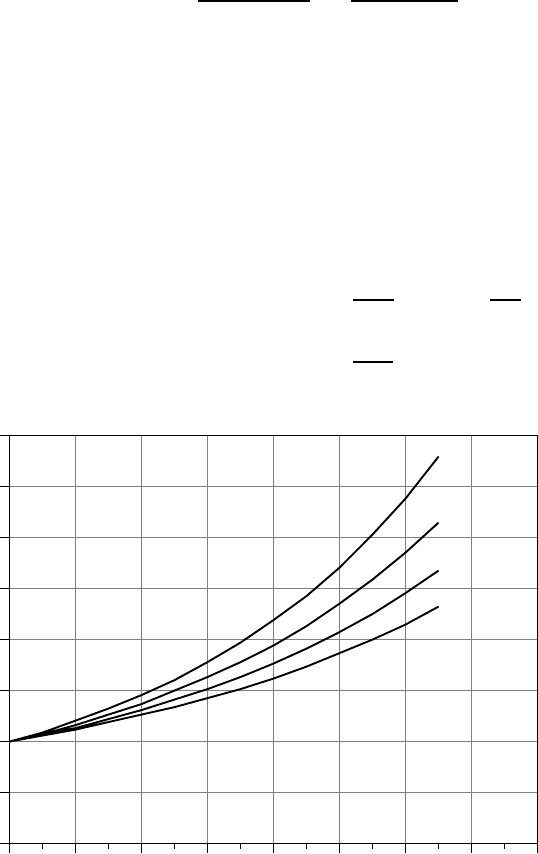
The impact of the levelizing factor can be very high, as is illustrated in Fig. 5.4.
For example, if fuel prices increase at 5%/yr for an owner with a 10% discount
rate, the levelizing factor is 1.5. If they increase at 8.3%/yr, the impact is equiv-
alent to an annualized cost of fuel that is double the initial cost.
Normalizing the levelized annual costs to a per kWh basis can be done using
the heat rate of the plant (Btu/kWh), the initial fuel cost ($/Btu), the per kWh
O&M costs and the levelizing factor:
Levelized annual costs($/kWh) =
Heat rate
Btu
kWh
× Fuel
$
Btu
+ O&M
$
kWh
0
× LF (5.26)
1614121086420
0.0
0.5
1.0
1.5
2.0
2.5
3.0
3.5
4.0
Annual Cost Escalation Rate (%/yr)
Levelizing Factor
n = 20 Years
d = 5%/yr
d = 10%/yr
d = 15%/yr
d = 20%/yr
Figure 5.4 Levelizing Factor for a 20-year term as a function of the escalation rate of
annual costs, with the owner’s discount rate as a parameter. With a discount rate of 10%/yr
and fuel escalation rate of 5%/yr, the levelized cost of fuel is 1.5 times the initial cost.

ENERGY ECONOMICS 253
Just as the future cost of fuel and O&M needs to be levelized, so does the
capital cost of the plant. To do so, it is handy to combine the CRF with other
costs that depend on the capital cost of the plant into a quantity called the fixed
charge rate (FCR). The fixed charge rate covers costs that are incurred even if the
plant doesn’t operate, including depreciation, return on investment, insurance, and
taxes. Fixed charge rates vary depending on plant ownership and current costs of
capital, but tend to be in the range of 10–18% per year. The governing equation
that annualizes capital costs is then
Levelized fixed cost($/kWh) =
Capital cost($/kW) × FCR(1/yr)
8760 h/yr × CF
(5.27)
where CF is the capacity factor of the plant.
Table 3.3 in Chapter 3 provides estimates for some of the key variables in
(5.26) and (5.27).
Example 5.11 Cost of Electricity from a Microturbine. A microturbine has
the following characteristics:
Plant cost = $850/kW
Heat rate = 12,500 Btu/kWh
Capacity factor = 0.70
Initial fuel cost = $4.00/10
6
Btu
Variab le O &M co st = $0.002/kWh
Fixed charge rate = 0.12/yr
Owner discount rate = 0.10/yr
Annual cost escalation rate = 0.06/yr
Find its levelized ($/kWh) cost of electricity over a 20-year lifetime.
Solution. From (5.27), the levelized fixed cost is
Levelized fixed cost =
$850/kW × 0.12/yr
8760 h/yr × 0.70
= $0.0166/kWh
Using (5.26), the initial annual cost for fuel and O&M is
A
0
= 12,500 Btu/kWh × $4.00/10
6
Btu + $0.002/kWh = $0.052/kWh
This needs to be levelized to account for inflation. From (5.15), the inflation
adjusted discount rate d
would be
d
=
d − e
1 + e
=
0.10 − 0.06
1 + 0.06
= 0.037736

254 ECONOMICS OF DISTRIBUTED RESOURCES
From (5.25), the levelizing factor for annual costs is
Levelizing factor (LF) =
(1.037736)
20
− 1
0.037736(1.037736)
20
·
0.10(1.10)
20
(1.10)
20
− 1
= 1.628
The levelized annual cost is therefore
Levelized annual cost = A
0
LF = $0.052/kWh × 1.628 = $0.0847/kWh
The levelized fixed plus annual cost is
Levelized bus-bar cost = $0.0166/kWh + $0.0847/kWh = $0.1013/kWh
5.3.8 Cash-Flow Analysis
One of the most flexible and powerful ways to analyze an energy investment is
with a cash-flow analysis. This technique easily accounts for complicating factors
such as fuel escalation, tax-deductible interest, depreciation, periodic maintenance
costs, and disposal or salvage value of the equipment at the end of its lifetime.
In a cash-flow analysis, rather than using increasingly complex formulas to char-
acterize these factors, the results are computed numerically using a spreadsheet.
Each row of the resulting table corresponds to one year of operation, and each
column accounts for a contributing factor. Simple formulas in each cell of the
table enable detailed information to be computed for each year along with very
useful summations.
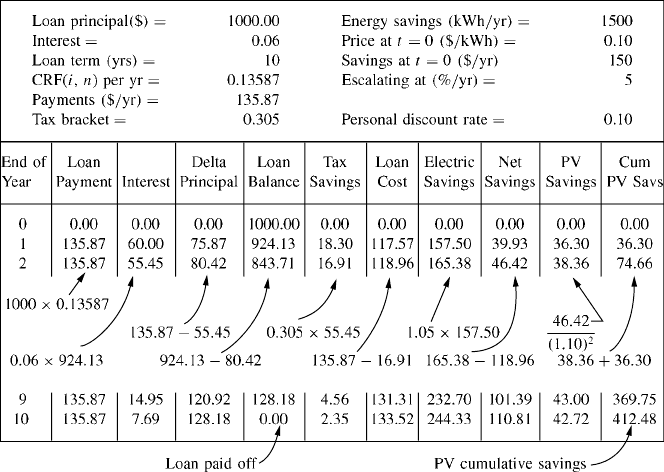
Table 5.6 shows an example cash-flow analysis for a $1000, 6%, 10-year loan
used to pay for a conservation measure that, at the time of loan initiation, saves
a homeowner $150/yr in electricity. This savings in the electric bill is expected
to increase 5% per year. The homeowner has a personal discount factor of 10%.
Since this is a home loan, any interest paid on the loan will qualify as a tax
deduction and the homeowner’s federal (and perhaps state) income taxes will go
down accordingly. Let’s work our way through the spreadsheet.
Begin with the loan payments. From (5.21), the capital recovery factor
CRF(0.06, 10) can easily be found to be 0.13587/yr. Since the loan is for $1000,
this means 10 annual payments of $135.87 must be made. At time t = 0, the
$1000 loan begins and the borrower has use of that money for a full year before
making the first payment. This means, with 6% interest, 0.06 × $1000 = $60 in
interest is owed at the end of the first, which comes out of the first $135.87
payment. The difference $135.87 − $60 = $75.87 is applied to the loan balance,
bringing it down from $1000 to $924.13 at time t = 1 year. In the next year,
0.06 × $924.13 = $55.45 pays the interest, and $135.87 − $55.45 = $80.42 is
applied to the principal. As expected, when the tenth payment is made, the loan
is completely paid off.
ENERGY ECONOMICS 255
TABLE 5.6 Cash-Flow Analysis for a $1000, 6%, 10-yr Loan, Showing Fuel
Escalation and Income Tax Savings on Loan Interest
a
a
The cash flow is always positive even though this energy saving investment has an uninspiring
simple payback of 6.67 years.
In most circumstances, interest on home loans is tax deductible, which means
it reduces the income that is taxed by the I.R.S. To determine the tax benefit
associated with the interest portion of the loan payments, we need to learn some-
thing about how income taxes are calculated. Table 5.7 shows the 2002 federal
personal income tax brackets for married couples filing jointly. Similar tables
are available for individuals with different filing status. For a family earning
between $109,250 and $166,500, for example, every additional dollar of income
has 30.5¢ of taxes taken out of it. On the other hand, if the income that has to
be reported to the I.R.S. can be reduced by one dollar, that will save 30.5¢ in
taxes. The 30.5% number is called the marginal tax bracket (MTB). Most (but
not all) states also have their own income taxes, which increases an individual’s
total MTB. For example, in California, a married couple in the 30.5% federal
bracket will have a combined state and federal MTB of about 37%.
Having teased out the interest in each year’s payments for the example loan
in Table 5.6, we can now determine the income-tax advantages associated with
that interest. When the first payment of $135.87 was made on the loan, $60
was tax-deductible interest. That means the taxpayer’s net income (net income =
gross income − tax deductions) will be reduced by that $60 deduction. With the
taxpayer in the 30.5% tax bracket, that buyer’s income taxes in the first year will
be reduced by $60 × 0.305 = $18.30. Therefore, the loan in that first year really
only costs the homeowner $135.87 − $18.30 = $117.57.

256 ECONOMICS OF DISTRIBUTED RESOURCES
TA BLE 5.7 Federal Income Tax Brackets for Married Couples Filing Jointly,
2002
Income Over... But Not Over... Federal Tax Is... Of the Amount Over
$0 $45,200 15% $0
45,200 109,250 $6, 780 + 27.5% 45,200
109,250 166,500 24, 394 + 30.5% 109,250
166,500 297,350 41, 855 + 35.5% 166,500
297,350 — 88, 307 + 39.1% 297,350
The spreadsheet shown in Table 5.6 also includes an electricity savings asso-
ciated with the efficiency measure worth $150 per year at t = 0. This rises by
5% each year, so by the time the first payment is made the fuel savings is
1.05 × $150 = $157.50. The total savings at the time of that first annual payment
is therefore
First-year savings = $157.50(electricity) + $18.30(taxes) − $135.87(loan)
= $39.93
This homeowner has a personal discount rate of 10%, so the first year’s savings
has a present value of $39.93/(1.10) = $36.30. Continuing through the 10 years
and adding up the cumulative present-values of each year’s savings results in
a total present value of $412.48. That is, if this family goes ahead with the
energy efficiency project, it is financially the same as getting a free system, with
the same annual bills as would have been received without the system, plus a
check for $412.48. If the system lasts longer than 10 years, the benefits would
be even greater.
5.4 ENERGY CONSERVATION SUPPLY CURVES
By converting all of the costs of an energy efficiency measure into a uniform
series of annual costs, and dividing that by the annual energy saved, a convenient
and persuasive measure of the value of saved energy can be found. The resulting
cost of conserved energy (CCE) has units of $/kWh, which makes it directly
comparable to the $/kWh cost of generation.
CCE =
Annualized cost of conservation($/yr)
Annual energy saved (kWh/yr)
(5.28)
When the only cost of the conservation measure is the extra initial capital
cost, the annualized cost of conservation in the numerator is easy to obtain using
an appropriate capital recovery factor (CRF). In more complicated situations, it

ENERGY CONSERVATION SUPPLY CURVES 257
may be necessary to do a levelized cost analysis in which the present value of all
future costs is obtained, and then that is annualized using CRF and a fuel-savings
levelizing factor.
Example 5.12 CCE for a Lighting Retrofit Project. It typically costs about
$50 in parts and labor to put in new lamps and replace burned out ballasts in a
conventional four-lamp fluorescent fixture. For $65, more efficient ballasts and
lamps can be used in the replacement, which will maintain the same illumination
but will decrease the power needed by the fixture from 170 W to 120 W. For an
office in which the lamps are on 3000 h/yr, what is the cost of conserved energy
for the better system if it is financed with a 15-yr, 8% loan, assuming that the
new components last at least that long? Electricity from the utility costs 8¢/kWh.
Solution. The extra cost is $65 − $50 = $15. From Table 5.5, CRF(0.08, 15) is
0.1168/yr so the annualized cost of the improvement is
A = P × CRF(i, n) = $15 ×0.1168/yr = $1.75/yr
The annual energy saved is
Saved energy = (170 − 120)W ×3000 h/yr ÷ (1000 W/kW ) = 150 kWh/yr
The cost of conserved energy is
CCE =
$1.75/yr
150 kWh/yr
= $0.0117/kWh = 1.17¢/kWh
The choice is therefore to spend 8¢ to purchase 1 kWh for illumination or spend
1.17¢ to avoid the need for that kWh. In either case, the amount of illumination
is the same. Notice, too, that there will also be a r eduction in demand charges
with the more efficient system.
While CCE provides another measure of the economic benefits of a single
efficiency measure for an individual or corporation, it has greater application as
a policy tool for energy forecasters. By analyzing a number of efficiency measures
and then graphing their potential cumulative savings, policy makers can estimate
the total energy reduction that might be achievable at a cost less than that of
purchased electricity.
To illustrate the procedure, consider four hypothetical conservation measures
A, B, C, and D. Suppose they have individual costs of conserved energy and
individual annual energy savings values as shown in Table 5.8. If we do Mea-
sure A, 300 kWh/yr will be saved at a cost of 1¢/kWh. If we do A and B, another