
Masters G.M. Renewable and Efficient Electric Power Systems
Подождите немного. Документ загружается.

258 ECONOMICS OF DISTRIBUTED RESOURCES
TA BLE 5.8 Hypothetical Example of Four Independent Conservation Measures
Conservation
Measure
CCE
(¢/kWh)
Saved Energy
(kWh/yr)
Cumulative
Energy Saved
(kWh/yr)
Cumulative Cost
(¢/yr)
A 1 300 300 300
B 2 200 500 700
C 3 500 1000 2200
D 10 200 1200 4200
15001000500
0
0
2
4
6
8
10
12
Cumulative Energy Saved (kWh/yr)
Cost of Conserved Energy CCE (¢/kWh)
A
B
C
D
Average Price of U.S. Electricity, 7.3¢/kWh
Figure 5.5 Energy conservation supply curve for the example in Table 5.8.
200 kWh/yr will be saved (assuming these are independent measures for which
the energy savings of one doesn’t affect the savings of the other), for a total of
500 kWh/yr saved. Similarly, total costs can be added up; so, for example, doing
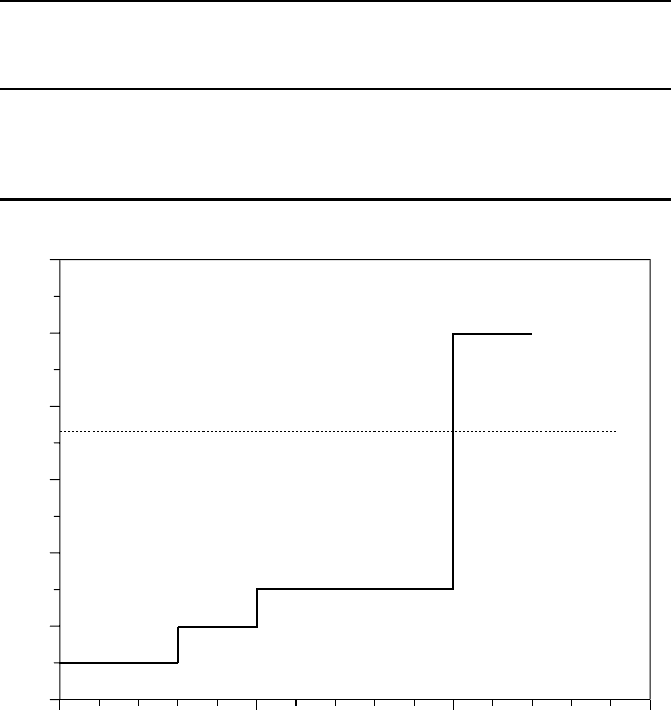
all four measures will save 1200 kWh/yr at a total cost of 4200¢/yr. A plot of the
marginal cost of conserved energy (¢/kWh) versus the cumulative energy saved
(kWh/yr) is called an energy conservation supply curve. Such a curve for this
example is presented in Fig. 5.5.
Continuing the example, the average retail price of U.S. electricity at 7.3¢/kWh
is also shown on Fig. 5.5. Measures A, B, and C each save energy at less than

ENERGY CONSERVATION SUPPLY CURVES 259
that price, and so they would be cost effective to implement, saving a total of
1000 kWh/yr. Measure D, which costs 10¢/kWh, is not cost effective since it
would be cheaper to purchase utility electricity at 7.3¢. But, what if we did
all four measures at the same time? A total of 1200 kWh/yr would be saved
at a total cost of 4200¢/yr, for an average CCE of 2.85¢/kWh. An economist
would argue that when the marginal cost of an efficiency measure is above
the price of electricity, it shouldn’t be implemented. An environmentalist, how-
ever, might argue that the full package of measures saves more energy while
still saving society money and should be done. The point is that both argu-
ments will be encountered, so it is important to be clear about whether assertions
about cumulative energy efficiency potential are based on marginal CCE or aver-
age CCE.
An example of data derived for a real conservation supply curve by the
National Academy of Sciences (1992) for U.S. buildings is given in Table 5.9. As
shown there, 12 electricity efficiency measures were analyzed ranging from paint-
ing rooftops white and planting more trees to reduce air-conditioning loads, to
increased efficiency in residential and commercial lighting, water heating, space
heating, cooling, and ventilation systems. As is customary for such studies, the
CCEisbasedonareal (net of inflation), rather than nominal (includes inflation),
discount rate in order to exclude the uncertainties of inflation. In this case, a real
discount rate of 6% has been used.
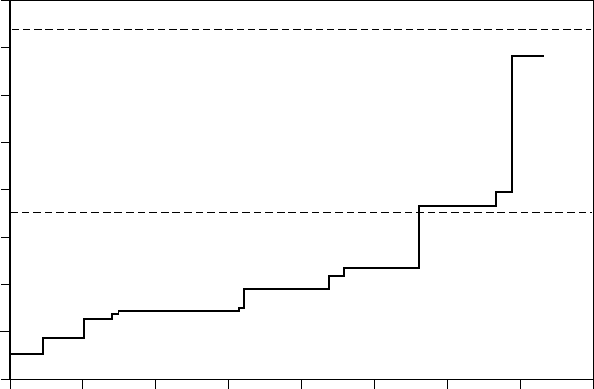
The data from Table 5.9 have been plotted in the conservation supply curve
shown in Fig. 5.6. All 12 measures are cost effective when compared to the
7.3¢/kWh average price of electricity in the United States, yielding a total potential
TA BLE 5.9 Data for an Energy Conservation Supply Curve for U.S. Residential
Buildings Calculated Using a Discount Rate of 6% (Real)
Conservation Measure
CCE
d = 0.06
(¢/kWh)
Energy
Savings
(TWh/yr)
Cumulative
Savings
(TWh/yr)
1 White surfaces and urban trees 0.53 45 45
2 Residential lighting 0.88 56 101
3 Residential water heating 1.26 38 139
4 Commercial water heating 1.37 9 148
5 Commercial lighting 1.45 167 315
6 Commercial cooking 1.50 6 321
7 Commercial cooling 1.91 116 437
8 Commercial refrigeration 2.18 21 458
9 Residential appliances 3.34 103 561
10 Residential space heating 3.65 105 666
11 Commercial and Industrial space heating 3.96 22 688
12 Commercial ventilation 6.83 45 733
Source: National Academy of Sciences (1992).
260 ECONOMICS OF DISTRIBUTED RESOURCES
8007006005004003002001000
0
1
2
3
4
5
6
7
8
Cumulative Electricity Savings (TWh/yr)
1
2
3
4
5
6
7
8
9
10
11
12
U.S. Electricity 7.3 ¢/kWh
Avg. Operating Cost of Existing Power Plants 3.5¢/kWh
Cost of Conserved Energy (¢/kWh)
Figure 5.6 Electricity conservation supply curve for U.S. buildings (National Academy
of Sciences, 1992).
savings of 733 billion kWh. If all 12 were implemented, they would reduce build-
ing electricity consumption by one-third at an average cost of just over 2.4¢/kWh,
which is less than the average running cost of U.S. power plants.
5.5 COMBINED HEAT AND POWER (CHP)
Distributed generation (DG) technologies include some that produce usable waste
heat as well as electricity (e.g. combustion turbines and fuel cells), and some
that don’t (e.g., photovoltaics and wind turbines). For those that do, the added
monetary value of the waste heat can greatly enhance the economics of the
DG technology. The value of waste heat is related to its temperature, distance
from generation to where it will be used, the relative timing and magnitude of
electricity demand and thermal demand, and cost of the fuel that the cogenera-
tion displaces.
Higher-temperature heat is more versatile since it can be used in a variety
of applications such as process steam, absorption cooling, and space heating,
while simple water heating may be the only application of low-temperature heat.
Distance from generator to load is important since transporting heat over long
distances can be costly and wasteful. Finding applications where the timing

COMBINED HEAT AND POWER (CHP) 261
and magnitude of electric and thermal demands are aligned can greatly affect
the economics of cogeneration. For example, if the thermal application is for
space heating alone, then the heat may have no value all summer long, whereas
if it is used for space heating and cooling, it may be useful all year round.
And finally, if the waste heat is displacing the need to purchase an expen-
sive fuel, such as propane or electricity, the overall economics are obviously
enhanced.
5.5.1 Energy-efficiency Measures of Combined Heat and Power
(Cogeneration)
With combined heat and power (CHP), it is a little tricky to allocate the costs and
benefits of the plant since the value of a unit of electricity is so much higher than
a unit of thermal energy, yet both will be produced with the same fuel source.
This dilemma requires some creative accounting.
The simplest approach to describing the efficiency of a cogeneration plant
is to simply divide the total output energy (electrical plus thermal) by the total
thermal input, remembering to use the same units for each quantity:
Overall thermal efficiency =
Electrical + Thermal ouput
Thermal input
× 100% (5.29)
While this measure is often used, it doesn’t distinguish between the value of
recovered heat and electrical output. For example, a simple 75% efficient boiler
that generates no electricity would have an overall thermal efficiency of 75%,
while cogeneration that delivers 35% of its fuel energy as electricity and 40% of
it as recovered heat would also have the same overall efficiency of 75%. Clearly,
the true cogeneration plant is producing a much more valuable output that isn’t
recognized by the simple relationship given in (5.29).
A better way to evaluate CHP is by comparing the cogeneration of heat and
power, in the same unit, to generation of electricity in one unit plus a separate
boiler to provide the equivalent amount of heat. This method, however, requires
an estimate of the efficiency of the separate boiler.
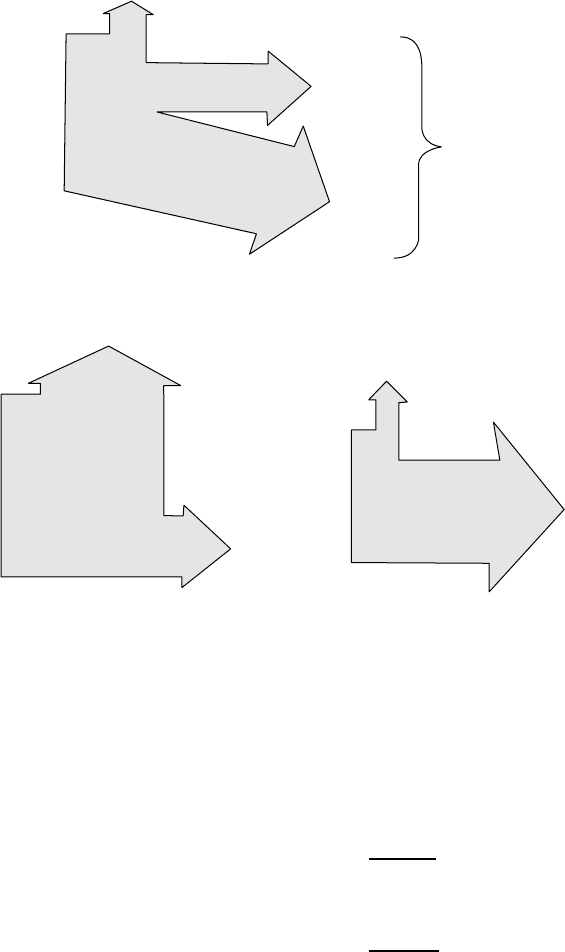
For example, consider Fig. 5.7 in which a CHP plant converts 30% of its fuel
into electricity while capturing 48% of the input energy as thermally useful heat,
for an overall thermal efficiency of 78%. Suppose we compare this plant with
33.3%-efficient grid electricity plus an 80% efficient boiler for heat, as shown in
Fig. 5.8. To generate the 30 units of electricity from the grid, at 33.3% efficiency,
requires 90 units of thermal energy. And, to produce 48 units of heat from the
80% efficient boiler, another 60 units of thermal energy are required. That is,
with separate electrical and thermal generation a total of 60 + 90 = 150 units of
input energy are required, but with cogeneration only 100 units were needed—a
savings of one-third.
262 ECONOMICS OF DISTRIBUTED RESOURCES
22 units
Waste heat
100 units
Input heat
30 units
Electricity
48 units
Thermal
recovery
Overall
thermal
efficiency
= 78%
Figure 5.7 A cogeneration plant with an overall thermal efficiency of 78%.
90 units
Input heat
60 units
Waste heat
60 units
Input heat
30 units
Electricity
12 units
Waste heat
48 units
Thermal
Boiler for heatGrid electricity
+
33.3%-efficient
Utility grid
80%-efficient
Boiler
Figure 5.8 Separate generation of heat in an 80%-efficient boiler, and electricity from
the grid at 33.3% efficiency, requires 150 units of thermal input compared to the 100
needed by the CHP plant of Fig. 5.7.
There are several ways to capture the essence of Figs. 5.7 and 5.8. One
approach is to compare the overall thermal efficiency (5.29) with and without
cogeneration. For example, using the data given in those figures,
Overall thermal efficiency (with CHP) =
30 + 48
100
× 100%
= 78% (5.30)
Overall thermal efficiency (without CHP) =
30 + 48
90 + 60
× 100%
= 52% (5.31)
By comparing the overall thermal efficiencies, the improvement caused by
CHP is easy to determine. The improvement is called the overall energy savings,

COMBINED HEAT AND POWER (CHP) 263
which is defined as
Overall energy savings =
1 −
Thermal input with CHP
Thermal input without CHP
× 100% (5.32)
where, of course, the two approaches (with and without CHP) must deliver the
same electrical and thermal outputs.
For the data in Figs. 5.7 and 5.8,
Overall energy savings =
1 −
100
90 + 60
× 100% = 33.3% (5.33)
While the previous example illustrates the overall energy (or fuel) savings for
society gained by cogeneration, a slightly different perspective might be taken
by an industrial facility when it considers CHP. Under the assumption that the
facility needs heat anyway, say for process steam, the extra thermal input needed
to generate electricity using cogeneration can be described using a quantity called
the Energy-Chargeable-to-Power (ECP)
ECP =
Total thermal input − Displaced thermal input
Electrical output
(5.34)
where the displaced thermal input is based on the efficiency of the boiler if one
had been used. The units of ECP are the same as would be found for the heat
rate of a conventional power plant, that is Btu/kWh or kJ/kWh.
Example 5.13 Cost of Electricity from a CHP Microturbine An industrial
facility that needs a continuous supply of process heat is considering a 30 kW
microturbine to help fill that demand. Waste heat recovery will offset fuel needed
by its existing 75-percent efficient boiler. The microturbine has a 29% electrical
efficiency and it recovers 47% of the fuel energy as usable heat. Find the Energy-
Chargeable-to-Power (ECP)
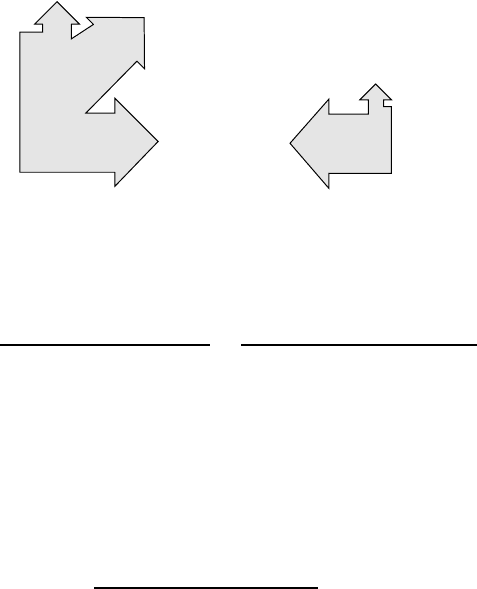
Solution. Using the energy conversion factor of 3412 Btu/kWh, we can find the
thermal input to the 29 percent efficient, 30 kW microturbine:
Microturbine input =
30 kW
0.29
× 3412 Btu/kWh = 352,966 Btu/hr
Since 47 percent of that is delivered as usable heat,
Microturbine usable heat = 0.47 × 352,966 Btu/hr = 165,894 Btu/hr
The displaced fuel for the 75 percent efficient boiler will be
Displaced boiler fuel =
165,894 Btu/hr
0.75
= 221,192 Btu/hr
264 ECONOMICS OF DISTRIBUTED RESOURCES
The calculations thus far obtained are shown below:
30 kW
Electricity
165,894 Btu/h
Usable Heat
84,712 Btu/h
Waste heat
55,298 Btu/h
352,966 Btu/h
75%
Microturbine Displaced Boiler
29%
47%
221,192 Btu/h
Substituting these values into (5.34) gives the Energy Chargeable to Power
ECP =
Extra CHP thermal input
Electrical output
=
(352,966 − 221,192) Btu/hr
30 kW
= 4393 Btu/kWh
This 4393 Btu/kWh can be compared with the heat rate of conventional power
plants, which is typically around 10,300 Btu/kWh. That is, given the need for
process heat anyway, it can be argued that the bonus from CHP is the ability
to generate electricity with less than half as much fuel as must be burned at an
average thermal power plant.
5.5.2 Impact of Usable Thermal Energy on CHP Economics
The energy chargeable to power (ECP) depends on the amount of usable heat
recovered as well as the efficiency of the boiler or furnace that would have
generated the heat had it been provided separately. Heat recovery is important to
the economics since, in a sense, it helps subsidize the cost of the more important
output—electricity—so we should look more carefully at the role it plays.
When the ECP is modified to account for the cost of fuel, a simple mea-
sure of the added cost of electricity with cogeneration, called the operating cost
chargeable to power (CCP), can be found from
Cost chargeable to power (CCP) = ECP × Unit cost of energy (5.35)
CCP will have units of $/kWh.

COMBINED HEAT AND POWER (CHP) 265
Example 5.14 Cost Chargeable to Power for a CHP Microturbine. Suppose
the 30-kW microturbine in Example 5.13 costs $50,000 and has an annual O&M
cost of $1200 per year. It operates 8000 hours per year and the owner uses a
fixed charge rate of 12%/yr. Natural gas for the microturbine and existing boiler
costs $4 per million Btu.
a. Find the operating cost chargeable to power (CCP)
b. What is the cost of electricity from the microturbine?
c. If the facility currently pays 6.0¢/kWh for energy, plus demand charges of
$7/kW-mo, what would be the annual monetary savings of the microtur-
bine?
Solution.
a. In Example 5.13, the energy cost chargeable to power for this microtur-
bine was found to be 4393 Btu/kWh. From (5.35), the cost chargeable to
power is
CCP = 4393 Btu/kWh × $4/10
6
Btu = $0.0145/kWh
That is, choosing to generate on-site power will cost 1.45¢/kWh for fuel.
b. The amortized cost of the microturbine is $50, 000 × 0.12/yr = $6, 000/yr.
Annual operations and maintenance = $1200/yr
Annual fuel cost for electricity = 30 kW ×8000 hr/yr ×$0.0145/kWh
= $3480/yr
Electricity cost =
($6000 + $1200 + $3480)/yr
30 kW × 8000 h/yr
= $0.0445/kWh
c. The value of the energy saved would be
Energy savings = 30 kW ×8000 hr/yr ×($0.06 − $0.0445)/kWh
= $3720/yr
Assuming the peak demand is reduced by the full 30 kW saves
Demand savings = 30 kW × $7/mo-kW ×12 mo/yr = $2520/yr
Notice the value of the demand reduction is a significant fraction of the
total value.
266 ECONOMICS OF DISTRIBUTED RESOURCES
The total savings would be
Total annual savings = $3720 + $2520 = $6240/yr
This is net profit since the capital cost of the turbine was included in the
fixed charge rate.
The ECP defined in (5.34) can be expressed more generally in terms of elec-
trical and boiler efficiency. Referring to Fig. 5.9 and using American units, we
can write for 1 Btu of fuel input to the system:
Electrical output (kWh) =
1 (Btu) × η
P
3412 (Btu/kWh)
(5.36)
Displaced thermal input (Btu) =
1 (Btu) × η
H
η
B
(5.37)
where η
P
is the efficiency with which 1 unit of CHP fuel is converted into
electricity, η
H
is the efficiency with which 1 unit of CHP fuel is converted into
useful heat, and η
B
is the efficiency of the boiler/heater that isn’t used because
of the CHP. The energy chargeable to power (ECP) is
ECP =
Total thermal input − Displaced thermal input
Electrical output
=
1 −
η
H
η
B
η
P
× 3412 Btu/kWh (5.38)
Fuel
1 unit
h
P
units of power
h
H
units
useful heat
h
B
“boiler”
efficiency
h
H
/h
B
units
displaced
fuel input
COGENERATION DISPLACED “BOILER”
Waste heat
Waste heat
Figure 5.9 The economics of cogeneration are affected by the efficiency with which
CHP fuel is converted into power and useful heat, as well as the efficiency of the boiler
(or furnace or steam generator) that CHP heat displaces.

COMBINED HEAT AND POWER (CHP) 267
which simplifies to
ECP =
3412
η
P
1 −
η
H
η
B
Btu/kWh =
3600
η
P
1 −
η
H
η
B
kJ/kWh (5.39)
Example 5.15 Cost of Electricity from a Fuel Cell. A fuel cell with an inte-
gral reformer generates heat and electricity for an apartment house from natural
gas fuel. The heat is used for domestic water heating, displacing gas needed by
the apartment house boiler. The following data describe the system:
Fuel cell rated output = 10 kW
Capacity factor CF = 0.90
Fuel cell/reformer electrical efficiency η
P
= 0.40 (40%)
Fuel to useful heat efficiency η
H
= 0.42
Boiler efficiency η
B
= 0.85
Capital cost of the system = $30,000
Paid for with an 8%, 20-year loan
Price of natural gas $0.80/therm ($8/10
6
Btu)
a. Find the energy, and cost of fuel, chargeable to power.
b. Find the cost of electricity (ignore inflation and tax benefits).
c. How many gallons of water per day could be heated from 60
◦
F to 140
◦
F?
Solution
a. From (5.39), the energy chargeable to power is
ECP =
3412
η
P
1 −
η
H
η
B
Btu/kWh =
3412
0.40
1 −
0.42
0.85
= 4315 Btu/kWh
The fuel cost chargeable to power is
CCP = 4315 Btu/kWh × $8/10
6
Btu = $0.0345/kWh
b. With a 90% capacity factor, the annual electricity delivered will be
Electricity = 10 kW × 8760 h/yr ×0.90 = 78,840 kWh/yr
(sufficient for about 10 homes, or maybe 20 apartments)
From (5.21) or Table 5.5, the capital recovery factor is CRF(0.08, 20) =
0.1019/yr, so the annualized capital cost of the system is
A = P × CRF(i, n) = $30,000 × 0.1019/yr = $3057/yr