
Masters G.M. Renewable and Efficient Electric Power Systems
Подождите немного. Документ загружается.

278 ECONOMICS OF DISTRIBUTED RESOURCES
Expansion
Valve
Condenser
Evaporator
Absorber
Generator
Strong water-
LiBr solution
Weak water-
LiBr solution
Water vapor
Water vapor
Heat
Source
Q
gen
Heat rejection
to environment
Q
H
Q
L
Cold
Refrigerated space
Liquid
water
Waste heat
Q
abs
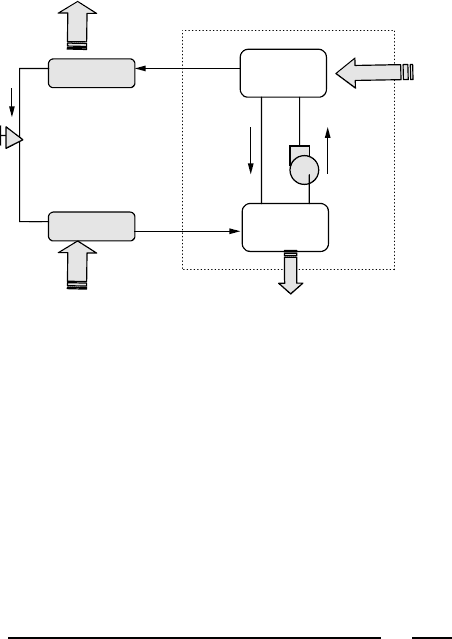
Figure 5.18 Lithium bromide absorption chiller schematic. The compressor in a standard
compressive refrigeration system has been replaced with a generator and absorber that
perform the same function but do so with heat instead of mechanical power.
generator is ready to pass through the condenser and the rest of the conventional
refrigeration system. Meanwhile, the lithium bromide returns to the absorber,
never having left the system. The absorption of refrigerant into the absorbent is
an exothermic reaction, so waste heat is released from the absorber as well as
the condenser.
The COP of an absorption refrigeration system is given by
COP
R
=
Desired output (cooling)
Required input (heat + very little electricity)
≈
Q
L
Q
gen
(5.47)
For a good LiBr system, the COP is currently about 1.0 to 1.1, but new “triple
effect” absorption units promise COPs better than 1.5.
A competing absorption cycle chiller uses water as the absorbent and uses
ammonia as the refrigerant. These NH
3
–H
2
O chillers date back to the mid-1850s
and were originally popular as ice makers. While their COPs are not as good as
those based on LiBr, they do create lower temperatures and, because they operate
with higher pressures, the piping and equipment can be physically smaller.
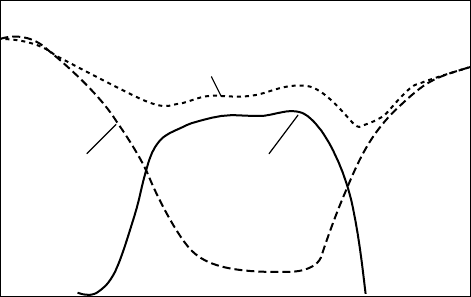
As is suggested in Fig. 5.19, the advantage of absorption cooling coupled with
cogeneration is the smoothing of the demand for thermal energy throughout the
year, which significantly improves the economics of CHP electricity.
5.6.4 Desiccant Dehumidification
Another technology that can take advantage of thermal energy to provide cool-
ing is based on the ability of some materials, called desiccants, to dehumidify air
COOLING, HEATING, AND COGENERATION 279
Total thermal load
Heating load
Absorption
cooling load
Jan Mar Jun Sep Dec
Monthly Thermal Load
Figure 5.19 Absorption cooling helps smooth the annual thermal demand for a building.
by adsorbing water vapor onto their surfaces. The cooling load associated with
cooling outside air, or recirculated indoor air, is a combination of (a) sensible
cooling, in which the temperature of air is lowered, and (b) latent cooling, in
which water vapor is removed. Especially in humid climates, the latent cooling
load is by far the most important. In the usual compressive refrigeration sys-
tem, air is dehumidified by cooling it well below its dew point to condense out
some of the water vapor, and then it is reheated to a comfortable supply tem-
perature. All of that takes considerable compressor power. When an inexpensive
source of relatively low-temperature heat is available, however, desiccants offer
an alternative, less electricity-intensive approach.
Desiccants, such as natural or synthetic zeolites, powdered silica gels, and
certain solid polymers, have a strong affinity for moisture, which means that
when contact is made, water vapor readily condenses, or adsorbs, onto their
surfaces. The resulting release of latent heat raises the desiccant temperature, so
the overall result of an air stream passing through a desiccant is dehumidification
with an increase in air temperature. The accumulating moisture in the desiccant
must of course be removed, or desorbed, and that is accomplished by driving a
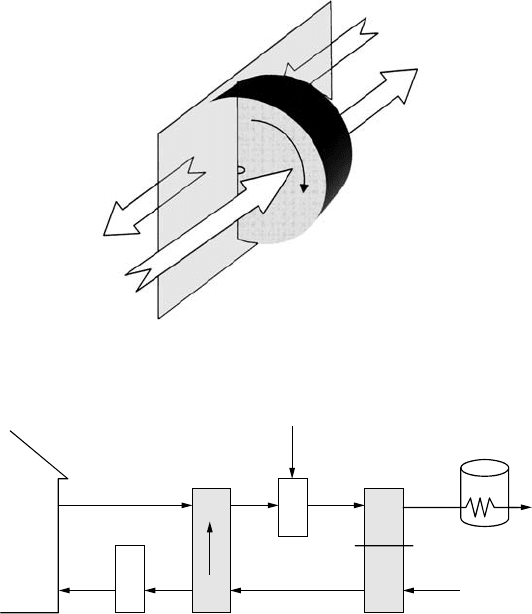
very hot air stream through the desiccant in a process called regeneration. The
sorption and desorption of moisture is often done with a rotating wheel, as shown
in Fig. 5.20.
The remaining components in a desiccant air-conditioning system are there
to provide sensible cooling to the now hot, dry supply air and to provide the
heat needed to regenerate the desiccant. It is this latter step that dominates the
energy requirement of a desiccant system, and that is why the availability of an
inexpensive source of heat becomes so important for these systems. Waste heat
from an industrial process, thermal energy from a cogeneration facility, or heat
from a solar collector system all could provide the necessary thermal input to
these systems. An example of a desiccant cooling system is shown in Fig. 5.21.
280 ECONOMICS OF DISTRIBUTED RESOURCES
Desorption
Exhaust
air 120°F
Warm, 80°F
humid, outside air
Sorption
Rotationg
desiccant
wheel
Hot, dry air
ready to be
cooled
120°F
250°F Heated
regeneration air
Figure 5.20 Desiccant wheel as part of a dehumidification and cooling system.
Desiccant
wheel
Heat
exchanger
Sensible
cooling
Thermal
input
Hot water heater
65°F
75°F
95°F
90°F
120°F
250°F 120°F
80°F
Figure 5.21 A desiccant refrigeration system for space cooling and domestic hot water.
Temperatures are illustrative.
5.7 DISTRIBUTED BENEFITS
There are a number of subtle but important benefits associated with distributed
generation, which have only recently begun to be appreciated and assessed
(Swisher, 2002). In addition to direct energy savings, increased fuel efficiency
with cogeneration, and reduced demand charges for larger customers, there are a
number of other DG attributes that can significantly add value, including
ž
Option Value: Small increments in generation can track load growth more
closely, reducing the costs of unused capacity.
ž
Deferral Value: Easing bottlenecks in distribution networks can save utili-
ties costs.
DISTRIBUTED BENEFITS 281
ž
Engineering Cost savings: Voltage and power factor improvements and
other ancillary benefits provide grid value.
ž
Customer Reliability Value: Reduced risk of power outages and better power
quality can provide major benefits to some customers.
ž
Environmental Value: Reduced carbon emissions for CHP systems will
have value if/when carbon taxes are imposed; for fuel cells, since they
are emission-free, ease of permitting has value.
5.7.1 Option Values
In the context of distributed generation, the option part of option value refers to
the choice of the incremental size of new generation capacity; that is, the buyer
has the option to purchase a large power plant that will satisfy future growth for
many years, or a series of small ones that will each, perhaps, only satisfy growth
for a year or two. The value part refers to the economic advantages that go with
small increments, which are better able to track load growth.
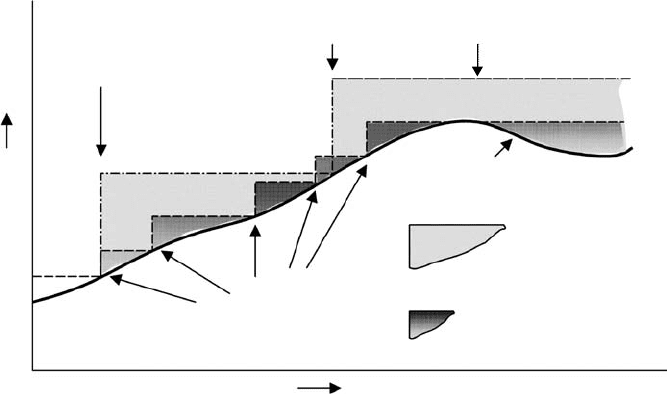
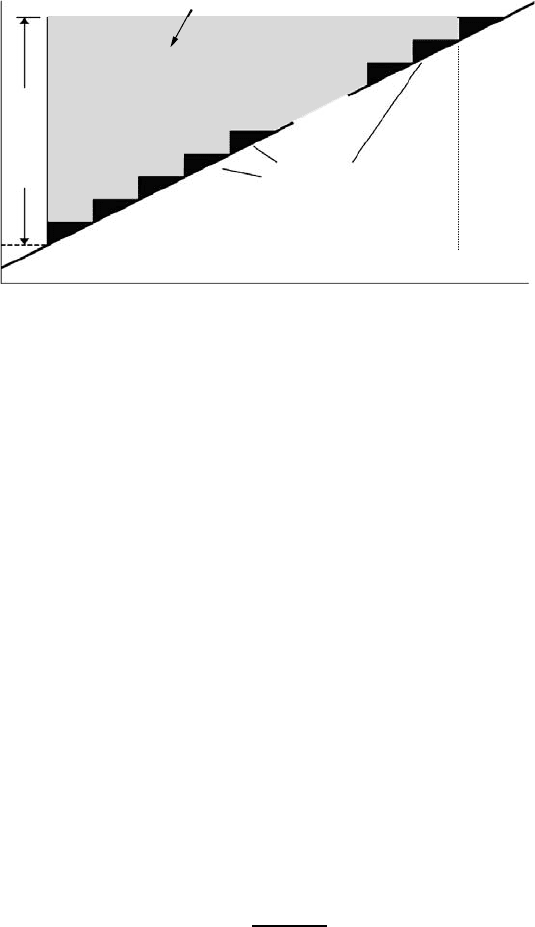
Figure 5.22 illustrates the comparison between adding fewer, larger increments
of capacity versus smaller, but more frequent, increments. Smaller increments,
such as distributed generation, better track the changing load and result in less idle
capacity on line over time. The advantage is especially apparent when forecasted
load growth doesn’t materialize and a large incremental power plant may result
in long-term overbuilt capacity that remains idle but still incurs costs.
Install large
resoure
Install large
resource
MW Capacity
Install DG resource
Time
Idle capacity of large resource
Idle capacity of DG resource
Overbuilt capacity
Electric Load
Figure 5.22 Smaller distributed generation increments better track the changing electric
load with less idle capacity than fewer, larger plants. Less idle capacity translates into
decreased costs. Based on Swisher (2002).
282 ECONOMICS OF DISTRIBUTED RESOURCES
Idle capacity
Generation Capacity
1 Large plant
N
Small, plants, 1 per yr
Order new plant at
t
= 0, pay for it at
t
= 1 when it comes on line..
0 1 2 3 4 5 .....
N
Time (yrs)
•
•
•
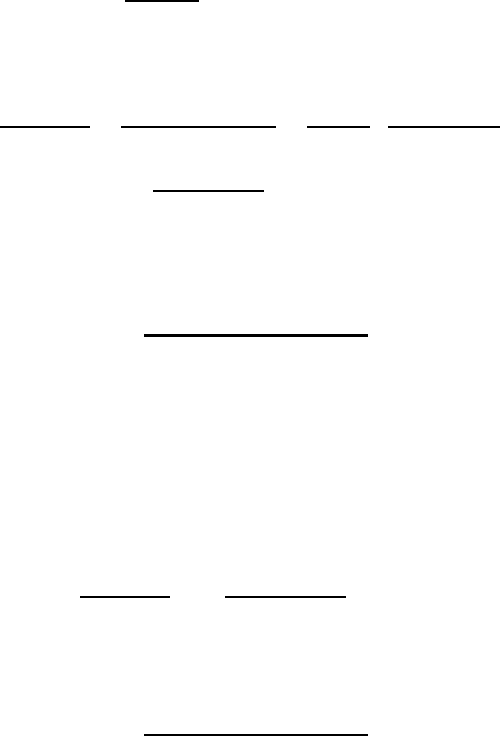
Figure 5.23 Comparing the present worth of a single large plant capable of supplying
N years of growth with N plants, each satisfying 1 year of growth. For simplicity, both
are assumed to have 1-year construction lead times.
One way to quantify the cost advantage of the option value is to do a present
worth analysis of the capital cost of a single large plant compared with a series
of small ones. Figure 5.23 shows a comparison of one large power plant, which
can supply N years of load growth, with N small plants, each able to supply
one year’s worth of growth. Let us begin by assuming that it only takes 1 year
between the time a plant is ordered and the time it comes on line, so at time
t = 0, either a large plant or a small plant must be ordered. Finally, assume that
full payment for a plant is due when it comes on line.
Let
Annual growth in demand = P (kW)
Cost of a small plant = P
S
($/kW) × P (kW)
Cost of a large plant = P
L
($/kW) × NP (kW)
Discount rate = d(yr
−1
)
The present value of the single large plant (P V
L
) is its initial cost discounted
back 1 year to t = 0:
PV
L
=
P
L
NP
(1 + d)
(5.48)
For the sequence of N small plants, the present value of N payments of
P
S
P , w ith the first one at t = 1 year, is given by
PV
S
= P
S
P PVF(d, N ) (5.49)
DISTRIBUTED BENEFITS 283
where PVF(d, N ) is the present value function used to find the present value of
aseriesofN equal annual payments starting at t = 1. If we equate the present
values of the large plant and the N small ones, we get
P
L
NP
(1 + d)
= P
S
P PVF(d, N ) (5.50)
and, using (5.9) for PVF(d,N)gives
P
S
($/kW)
P
L
($/kW)
=
N
(1 + d)PVF(d, N )
=
N
(1 + d)
d(1 + d)
N
(1 + d)
N
− 1
= N
d(1 + d)
N−1
(1 + d)
N
− 1
(5.51)
Equation (5.51) is the ratio of the small-plant-to-large-plant capital costs ($/kW)
that makes them equivalent on a present worth basis.
Example 5.16 Present Value Benefit of Small Increments of Capacity. Use
(5.51) to find the present value advantage of eight small plants, each supplying
1 year’s worth of growth, over one large plant satisfying 8 years of growth. Use
a discount rate of 10%/yr. Each plant takes 1 year to build. If the large one costs
$1000/kW, how much can the small ones cost to be equivalent?
Solution. Using (5.51), we obtain
P
S
($/kW)
P
L
($/kW)
= 8
0.1(1 + 0.1)
7
(1 + 0.1)
8
− 1
= 1.363
This means the small DG plants can cost $1363/kW and they still would be
equivalent to the single large one at $1000/kW.
Even though the calculation in Example 5.16 is impressive enough as it stands,
it omits another important advantage of smaller plants. Large plants tie up capital
for a longer period of time before the plant can be designed, permitted, built,
and turned on. That longer lead time costs money, so let’s modify our analysis
to include it.
Imagine the initial cost of the large plant being spread over years 1 through L,
where L is the lead time. Also, suppose payments on the N small plants begin
in year L, as shown in Fig. 5.24. We continue to assume the small plants can
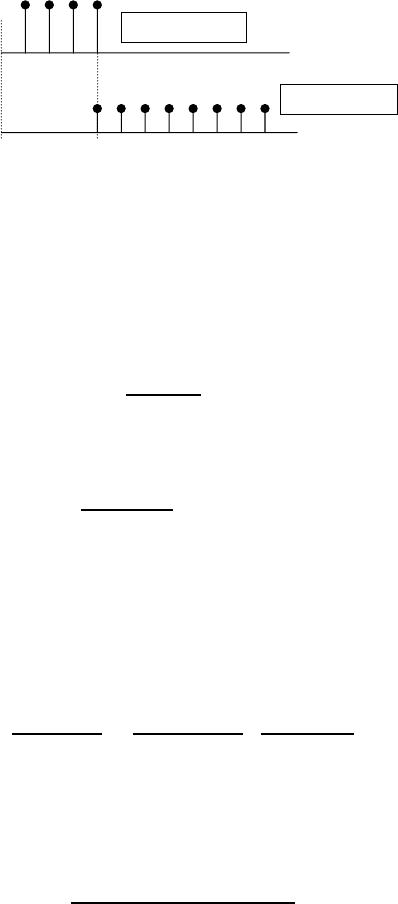
284 ECONOMICS OF DISTRIBUTED RESOURCES
t
= 0 …
L
$/yr
$/yr
L payments of
P
L
∆
P N/L
N
payments of P
S
∆P
One Large Plant
N
Small Plants
1 2 (years) (L + N − 1)
Figure 5.24 The payments made on one large plant spread over the L years of lead
time that it takes to bring it on line, and annual payments made on N small plants. The
first of each type comes on line in year L.
be built in one year. The present value of the payments made on the large plant
costing P
L
NP spread out over L years is given by
PV
L
=
P
L
NP
L
· PVF(d, L) (5.52)
And, for the N small plants, each costing P
S
P over years L to L +N − 1,
we have
PV
S
=
1
(1 + d)
L−1
[P
S
P · PVF(d, N )] (5.53)
where the term in the brackets finds the present value of the series of payments,
discounted back to year L − 1, and the initial term discounts that back to t = 0.
Setting the present value of the large plant (5.52) equal to the present value of
the series of small ones (5.53) results in the following ratio of capital costs for
small and large plants, including the extra lead time for the large one:
P
S
($/kW)
P
L
($/kW)
=
N(1 + d)
L−1
L
·
PVF(d, L)
PVF(d, N)
(5.54)
where N is the number of small plants, each taking 1 year to build and satisfying
1yrofgrowth;L represents the years of lead time for the single large plant; and
d is the discount rate (yr
−1
).
Example 5.17 Option Value of Small Plants Including Short Lead-Time
Advantage. Find the capital cost that could be paid for eight small plants, each
sized to supply one year of load growth and each taking 1 year to build, com-
pared with one large plant that supplies 8 years of growth. The large plant costs
$1000/ kW and has a lead time of 4 years to build. Use a discount rate of 10%/yr.
DISTRIBUTED BENEFITS 285
Solution. To use(5.54) we need
PVF(d, L) =
(1 + d)
L
− 1
d(1 + d)
L
=
(1 + 0.1)
4
− 1
0.1(1 + 0.1)
4
= 3.1698
and
PVF(d, N) =
(1 + 0.1)
8
− 1
0.1(1 + 0.1)
8
= 5.3349
so
P
S
($/kW)
P
L
($/kW)
=
N(1 + d)
L−1
L
·
PVF(d, L)
PVF(d, N)
=
8(1 + 0.1)
4−1
4
×
3.1698
5.3349
= 1.582
The capital cost of the small plants can be $1582/kW, and they would still be
equivalent to one large plant costing $1000/kW.
Table 5.10 has been derived from (5.54) to show the cost premium that smaller
plants can enjoy and still have the same present value as a single larger one. An
additional advantage of the small plants is that they will have less unused capacity
if load doesn’t grow as fast as forecast.
Another advantage of meeting projected demand with incremental capacity
additions is the reduced need for working capital to build the plants. Putting
enormous amounts of capital into a huge, billion-dollar power plant and then
TA BLE 5.10 Capital Cost Premium that N Smaller
Plants Can Have Versus One Larger One and Still
Have the Same Present Value
a
NL= 1yr 2yr 3yr 4yr 5yr
1 0% 5% 10% 16% 22%
2 5% 10% 16% 22% 28%
3 10% 15% 21% 27% 34%
4 15% 20% 27% 33% 40%
5 20% 26% 32% 39% 46%
6 25% 32% 38% 45% 53%
7 31% 37% 44% 52% 60%
8 36% 43% 50% 58% 66%
9 42% 49% 57% 65% 73%
10 48% 55% 63% 72% 81%
a
L is years of lead time to build the larger plant. Assumes dis-
count rate of 10%/yr and a 1-year lead time for small plants.
Source: Swisher (2002).
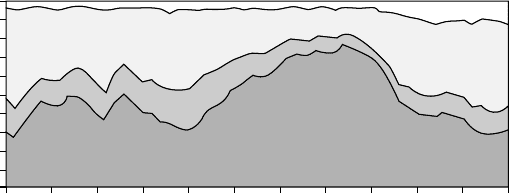
286 ECONOMICS OF DISTRIBUTED RESOURCES
waiting 5 or so years to start earning revenue could be perceived by the capital
markets to be a riskier investment than would be the case for a series of short-
lead-time, modular units. The reduced risk in the modular approach can translate
into lower cost of capital, providing another financial advantage to distributed
generation.
5.7.2 Distribution Cost Deferral
The utility distribution system, which sends power to every house and store in
town, is a very expensive asset that is typically greatly underutilized except in
certain critical locations during certain times of the day and year. As Fig. 5.25
attests, distribution systems constitute a significant fraction—on the order of
half in recent years—of annual utility construction cost. Running power lines
up and down every street to serve residential customers is expensive, and it
is one reason why residential electric rates are so much higher than those for
large, industrial facilities with dedicated feeders. In terms of the overall cost of
running a utility, including construction costs, fuel, administrative costs, billing,
and operations and maintenance, the distribution system accounts for about 20%
of the total.
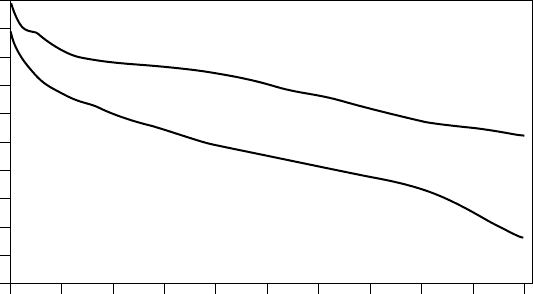
As Fig. 5.26 indicates, distribution system assets are not only expensive, but
they are often utilized far less than is the case for generation. For example,
only one-third of the time is this particular feeder operating above 50% of its
capacity—or conversely, two-thirds of the time there is more than twice as much
distribution capacity as is needed. Compare this with generation, where that level
of underutilization never occurs.
Distribution systems are plagued by bottlenecks. When a new housing devel-
opment or shopping center gets built, distribution feeders and the local substation
may have to be upgraded even though their current capacity may be exceeded
for only a few hours each day during certain months of the year. The effect of
that localized growth can ripple from feeder to substation to transmission lines
to power plants.
General/Misc
100%
80%
60%
40%
20%
0%
Distribution
Transmission
Generation
1945 1950 1955 1960 1965 1970 1975 1980 1985 1990 1995 2000
Figure 5.25 Allocation of U.S. investor-owned utilities’ construction expenditures. From
Lovins et al. (2002).
DISTRIBUTED BENEFITS 287
100
90
80
70
60
50
40
30
20
10
0
0 102030405060708090100
Percentage of the Year (%)
Load Factor
Percentage (%)
Distribution Asset Utilization
Electric Generation Asset Utilization
Figure 5.26 Comparing the load–duration curve for a typical feeder in the distribution
system of a large utility with a curve for generation assets. The distribution system assets
are utilized far less than the generation system. From Ianucci (1992).
Studies of area-and-time (ATS) costs can pinpoint those portions of a distri-
bution network where the marginal cost of delivering another kilowatt makes
distributed generation and demand-side management particularly cost effective.
Figure 5.27, for example, shows an extreme case in which an ATS study iden-
tified a particular feeder in which the marginal cost of peak power rose to over
$3.50/kWh during a few hours a day over just a few weeks each year. At such a
site, almost any distributed generation or energy conservation system would be
cost effective.
On-site generation by utility customers can help avoid or delay the need for
distribution system upgrades, leading to more efficient use of existing facili-
ties. Customers in portions of the distribution grid where capacity constraints
are imminent could in the future be provided with incentives to generate some
of their own power (or shed some of their load), especially at times of peak
power demand. Area-and-time-based differential pricing of grid services could
well become an important driver of distributed generation.
5.7.3 Electrical Engineering Cost Benefits
Besides capacity deferrals, distributed generation can also decrease costs in the
distribution network by helping to improve the efficiency of the grid. Power
injected into the grid by local distributed generation resources helps to reduce
losses in several ways.
Without DG, the current supplied to a distribution network by the transmission
system must be sufficient to satisfy all of the loads, from one end to the other.
When current flows through conductors, there is voltage drop due to Ohm’s law,