
Masters G.M. Renewable and Efficient Electric Power Systems
Подождите немного. Документ загружается.


268 ECONOMICS OF DISTRIBUTED RESOURCES
On a per kilowatt-hour basis, the annualized capital cost is
Annualized capital cost =
$3057/yr
78,840 kWh/yr
= $0.0388/kWh
The fuel plus capital cost of electricity is therefore
Electricity = 3.45¢/kWh + 3.88¢/kWh = 7.33¢/kWh
This is about the same as the average U.S. price for electricity, and con-
siderably less than the average residential price.
The gas cost for the fuel cell will increase over time due to inflation, but
so will the competing price of electricity, so these factors tend to cancel
each other.
c. Since the system is 40% efficient at converting fuel to 10 kW of electricity,
the thermal input for the fuel cell is
Fuel cell input =
10 kW
e
0.40
× 3412 Btu/kWh = 85,300 Btu/h
Since 42% of the fuel input is converted to usable heat, the energy delivered
to hot water while the unit is running at full power is
Hot water =
85,300 × 0.42 Btu/h
8.34 lb/gal × 1 Btu/lb
◦
F × (140 − 60)
◦
F
= 53.7 gal/h
At a 90% capacity factor the daily hot water delivered would be
Hot water = 53.7 gal/h × 24 h/d ×0.90 = 1160 gal/day
(Domestic consumption of hot water averages around 20 gal/person-day,
so this is enough for almost 60 people.)
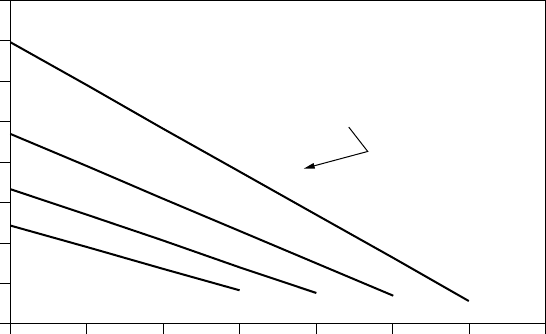
The calculation in Example 5.15 is based on reasonable near-term estimates
for fuel cell costs and efficiencies, and the resulting cost of electricity, at 7.3
¢/kWh, look quite attractive. A key reason for it looking so good is that the
thermal output is helping to pay for the electricity from the fuel cell. To illustrate
the importance of the cogenerated heat, Fig. 5.10 shows a sensitivity analysis in
COMBINED HEAT AND POWER (CHP) 269
706050403020100
6
7
8
9
10
11
12
13
14
Fuel-to-Heat Efficiency (%)
Cost of Electricity (¢/kWh)
Fuel-to-Electricity Efficiency
30%
40%
50%
60%
Figure 5.10 Cost of electricity from a fuel cell depends on the amount of waste heat
utilized. Assumptions: CF = 0.9, η
B
= 0.85, fuel = $8/MMbtu, plant cost = $3/W, loan
8%, 20 yr.
which electricity cost is plotted against the fraction of input energy that ends up
as useful heat.
5.5.3 Design Strategies for CHP
The design of CHP systems is inherently complex since it involves a balancing
act between the amount of power and usable heat that the cogenerator delivers
and the amount of heat and power needed by the end use for that energy. While
the power-to-heat ratio (P/H) of the cogeneration equipment may be reasonably
constant, that is often not the case for the end-user for whom the demand for
heat and for power often varies with the seasons. It may also vary throughout
the day.
An industrial plant may have a relatively constant demand for heat and power,
but that is not at all the case for a typical residential building. Imagine, for
example, a residence with a relatively constant thermal demand for hot water,
while its need for space heating is high in the winter and nonexistent in the
summer. Moreover, its electrical demand may peak in the summer if it cools
with a conventional, electricity-driven air conditioner, dip in the spring and fall
when there is no heating or air conditioning, and rise somewhat again in the
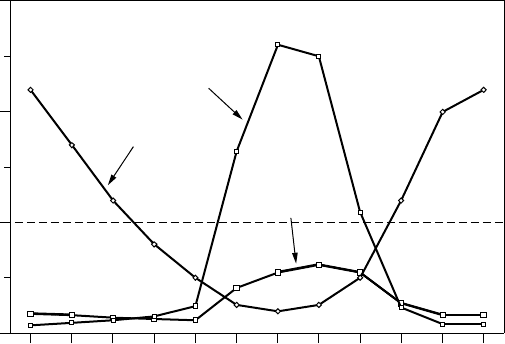
winter when more time is spent indoors. Figure 5.11 illustrates these not unusual
circumstances.
Imagine trying to design a cogeneration system, say a fuel cell, with a P/H
ratio of about 1/1, to deliver heat and electricity for the building in Fig. 5.11. The
270 ECONOMICS OF DISTRIBUTED RESOURCES
JMMJ SN
Month
Thermal Demand
P/H
P/H = 1
Energy Units
FA AJO
Electrical
Demand
D
0
Figure 5.11 Thermal and electrical demand for a hypothetical residential building with
summer air conditioning and winter space heating, expressed in equivalent units of energy.
The ratio of power to heat for this load varies greatly from month to month.
building has an annual P/H ratio of about 1/3, but on a monthly basis it varies
over a tremendous range from roughly 2.5 in the summer to 0.1 in the winter.
If, for example, the fuel cell is sized to deliver all of the electricity needed at
the peak time of summer, and it continuously runs at that peak, then there will be
extra power during most of the year. That extra power probably won’t be wasted
since it would likely be sold to the utility grid. With this sizing and operating
protocol, almost all of the thermal output could be used with the exception of
some excess heat from June to September and, assuming sales to the grid, all of
the power would be of value.
If, on the other hand, the fuel cell is sized to deliver all of the thermal demand
in the middle of winter, then it needs to have roughly four times the capacity of
a system sized to meet the peak electrical load. If this much larger machine runs
at full output all year long, then a very high fraction of the thermal output will be
wasted and most of the electricity will have to be sold to the grid. As Fig. 5.10
demonstrates, the economics using this strategy will be severely compromised
since there isn’t much thermal output to subsidize the electrical output.
Another strategy would be to design for the thermal peak in winter, but mod-
ulate the fuel cell output so that it follows the thermal or electrical load. This
isn’t a very good idea either since the system will work with a very poor annual
capacity factor, which increases the annualized capital cost. Both strategies based
on sizing for the peak thermal load would not seem to be as cost effective as
sizing for the peak electrical load.
A further complication results from the hour-to-hour variation in the heat
and power demands for loads. For industrial facilities and office buildings, heat
COOLING, HEATING, AND COGENERATION 271
and power needs may vary somewhat in unison, being high together during
the workday and lower at night. But for residential loads, especially in sum-
mer, the electrical and thermal demands may be completely unsynchronized with
each other, in which case some sort of diurnal thermal storage system may be
appropriate.
Even from this simple example, it should be apparent that designing the most
cost-effective cogeneration system, one that takes maximum advantage of the
waste heat, is a challenging exercise.
5.6 COOLING, HEATING, AND COGENERATION
The cost effectiveness of fuel-cell and other cogeneration technologies is quite
dependent on the ability to utilize the available thermal energy as well as the
electric power generated. However, as Fig. 5.11 suggested, the summer power
demand for cooling and the winter thermal demand for heating cause the ratio
of power-to-heat for many buildings to vary widely through the seasons, which
complicates greatly the design of an economically viable CHP system. And since
the buildings sector is almost three-fourths of the grid’s total peak demand, and
much of the rise in peak during the summer is associated with air conditioning,
it is a load worth special attention.
There are several ways to smooth the power-to-heat ratio in buildings by
using alternative methods for heating and cooling. Heat pumps, for example, can
smooth the ratio by substituting electricity for heat in the winter, while absorption
cooling systems can smooth if by substituting thermal for electrical power during
the summer.
5.6.1 Compressive Refrigeration
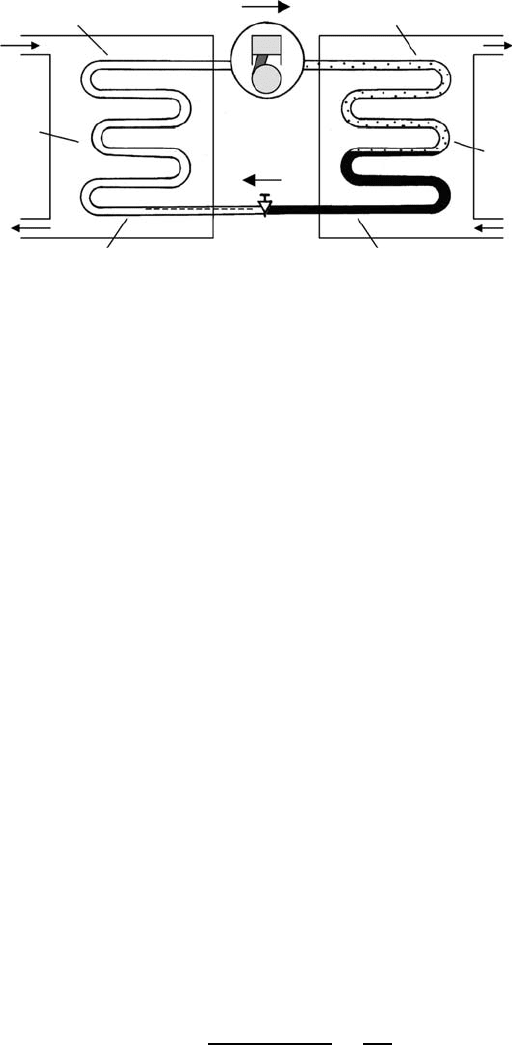
A conventional vapor-compression chiller is shown in Fig. 5.12. It consists of a
refrigerant that cycles through four major system components: compressor, con-
denser, expansion valve, and evaporator. In the compressor, the refrigerant, which
enters as a cold, low-pressure vapor, is pumped up to a high pressure. When a
gas is compressed, its temperature and pressure increase, so the refrigerant enters
the condenser at a relatively high temperature. In the condenser, the refrigerant
transfers heat to warm outside air (or perhaps to water from a cooling tower),
causing the refrigerant to release its latent heat as it changes state from vapor
to liquid. The high-pressure liquid refrigerant then passes through an expansion
valve, where the pressure is suddenly released, causing the liquid to flash to vapor
and it emerges as a very cold, low-pressure mixture of liquid and vapor. As it
passes through the evaporator, the refrigerant continues to vaporize, absorbing
heat from its environment as it changes state from liquid to a vapor.
The amount of heat the refrigerant absorbs and releases as it changes phase,
and the temperature at which those transitions occur depend on the particu-
lar refrigerant being used. Traditionally, the refrigerants of choice have been
272 ECONOMICS OF DISTRIBUTED RESOURCES
Cold
Low Pressure Vapor
50°F
45°F
38°F
50°F
120°F
100°F
85°F
95°F
Evaporator
Coil
Chilled
Water
Expansion
Valve
Warm
High Pressure Liquid
Hot
High Pressure Vapor
Compressor
Heat
Rejection
Condenser
Coil
Cold
Low Pressure Liquid/Vapor
Figure 5.12 Conventional vapor compression chiller. Temperatures are representative
for a building cooling system.
chlorofluorocarbons (CFCs), which are inert chemicals containing just chlorine,
fluorine, and carbon. CFCs were developed to satisfy the need for a nontoxic,
nonflammable, efficient refrigerant for home refrigerators. Before that time, the
most common refrigerants were either toxic, noxious, or highly flammable or
required high operating pressures, which necessitated heavy, bulky equipment.
When they were first introduced in the 1930s, CFCs were hailed as wonder
chemicals since they have none of those undesirable attributes. In 1974, how-
ever, it was discovered that CFCs were destroying the stratospheric ozone layer
that shields us from lethal doses of ultraviolet radiation. That discovery, and sub-
sequent international efforts to ban CFCs, has led to a scramble in the cooling
industry to find suitable replacements.
CFCs were also used in the manufacture of various rigid and flexible plastic
foams, including rigid foam insulation used in refrigerators and buildings. The
simultaneous need to replace CFC refrigerants as well as CFC-containing foam
insulation raised concerns that the electricity demand of refrigerators, which are
the largest source of consumption in many households, would increase. In fact,
the opposite occurred. With increasingly stringent California, and then Federal,
refrigerator efficiency standards, along with a modest amount of government
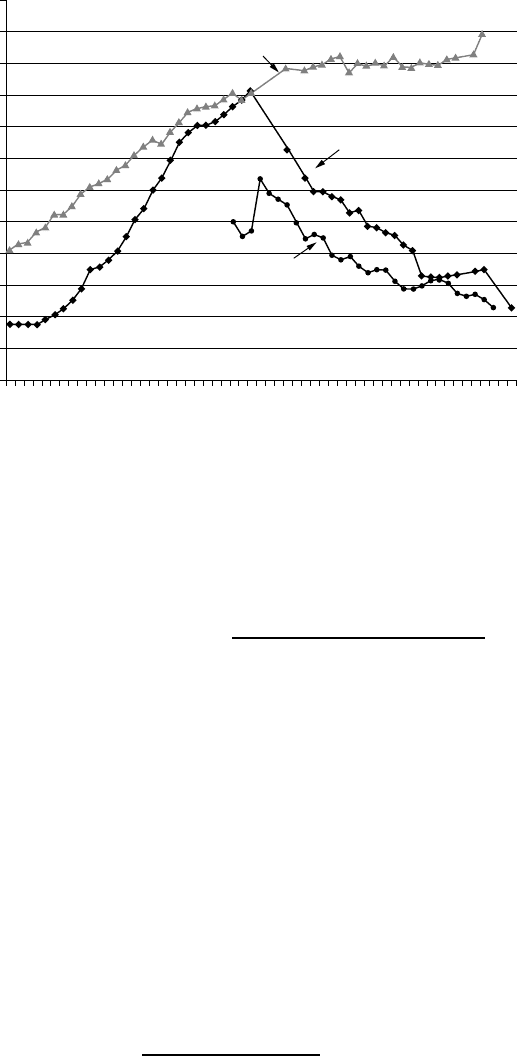
R&D stimulation, the refrigerator industry has accomplished a remarkable tech-
nological achievement. A modern refrigerator now uses one-third the electricity
of the typical 1974 model, while its size and features have increased, and all of its
ozone-depleting substances have been removed. Figure 5.13 shows this amazing
improvement.
The efficiency of the basic refrigeration cycle can be expressed in dimension-
less terms as a coefficient of performance (COP
R
):
COP
R
=
Desired output
Work input
=
Q
L
W
(5.40)
COOLING, HEATING, AND COGENERATION 273
0
1947
1951
1955
1959
1963
1967
1971
1975
1979
1983
1987
1991
1995
1999
2003
200
400
600
800
Real Price ($2002)
Energy (kWh/yr) and Price ($)
Adjusted Volume (ft
3
)
(ft
3
)
Sales Weighted Average
Energy Use (kWh/yr)
2
6
10
14
18
22
1000
1200
1400
1600
1800
2000
2200
2400
Figure 5.13 Energy use, size, and real price ($2002) of U.S. refrigerators updated from
Goldstein and Geller (1999).
where W is the work put into the compressor and Q
L
is the heat extracted from
the refrigerated space. In the United States, the efficiency is often expressed in
terms of an energy efficiency rating (EER), which is defined as
Energy efficiency rating (EER) =
Heat removal rate Q
L
(Btu/h)
Input power W(watts)
(5.41)
Typical air conditioners have values of EER that range from about 9 Btu/Wh to
17 Btu/Wh. Note that EER and COP
R
are related by
EER (Btu/Wh) = COP
R
× 3.412 Btu/Wh (5.42)
Another measure of air conditioner efficiency is the seasonal energy efficiency
rating (SEER), which has the same Btu/Wh units. While the EER is an instan-
taneous measure, the SEER is intended to provide an average rating accounting
for varying outdoor temperatures and losses due to cycling effects.
The traditional unit of cooling capacity for U.S. air conditioners originated in
the days when the only source of cooling was melting ice. By definition, one
“ton” of cooling is the rate at which heat is absorbed when a one-ton block of
ice melts in 24 hours. Since it takes 144 Btu to melt one pound of ice, and there
are 2000 pounds in one (short) ton,
1 ton of cooling =
2000 lb × 144 Btu/lb
24 h
= 12,000 Btu/h (5.43)
274 ECONOMICS OF DISTRIBUTED RESOURCES
This leads to another measure of the efficiency of an air conditioning chiller,
which is the tons of cooling it produces per kW of electrical power into the
compressor:
kW/ton =
12,000 Btu/h-ton
EER (Btu/h-W) × 1000 W/kW
=
12
EER
(5.44)
An average, home-size, 3-ton air conditioner uses roughly 3 kW, but the best
ones will only need 2 kW to do the same job. For comparison, a 100-ton rooftop
chiller for commercial buildings draws on the order of 100 kW and, depending
on climate, cools about 30,000 square feet of office space.
The heart of a cooling system is the chiller, which for a vapor compression sys-
tem is the unit described in Fig. 5.12. How the coldness created in the evaporator
heat exchanger reaches the desired destination is very dependent on the particular
application. In a simple room air conditioner, a fan mixes warm return air from
the conditioned space, with some fresh ambient air, and blows it directly across
the cold evaporator coil for cooling. In larger buildings, chilled water lines may
be used to carry cold water from the chiller to cooling coils located in forced
air ducts around the building. For district heating and cooling systems there
may be underground steam and chilled water lines running from a cogeneration
plant to nearby buildings. Figure 5.14 shows the Stanford University campus
energy facility, which includes a 50-MW combined cycle CHP plant, multiple
vapor-compression and absorption chillers, and a 96,000 ton-hour underground
water-and-ice storage vault. At night, when electricity is cheap, chillers make ice
that can be melted the next day to supplement the cooling capacity of the plant.
5.6.2 Heat Pumps
Notice that the basic vapor-compression refrigeration cycle can be used to do
heating as well as cooling by, in essence, turning the machine around as shown
TO CAMPUS BUILDINGS
Steam lines
Chilled water lines
CARDINAL
COGEN
SRSR
50 MWe electric
power
CHILLED-WATER
PLANT
3 2250-hp
2-kton chillers
2 MWe each
ammonia
Chilled
water
38°F
95°F
80°F
33°F
25°F
54°F
50 MWe
combined-cycle
≈24 MW to campus
≈24 MW to PG&E
Chillers:
5 ktons absorption
6 ktons electric
Heat rejection
to atmosphere
Cooling
towers
Heat rejection to cooling towers
Glycol
loop
UNDERGROUND
ICE-STORAGE
96,000 ton-h
≈ 15 ktons × 6 h
360 miles of heat
exchange tubing
125' × 125' × 23'
Glycol
Ice
Water
Tubing
Ice storage cross-section
Figure 5.14 The Stanford University combined-cycle CHP plant with ice storage.
COOLING, HEATING, AND COGENERATION 275
WARM
Environment
COLD
Environment
Q
H
=
Q
L
+
W
Q
L
WW
Q
L
Q
L
+
W
C
C
(a) As an air conditioner (b) As a heater
Figure 5.15 A h eat pump acts as an air conditioner or a heater depending on which
direction the evaporator and condenser coils face.
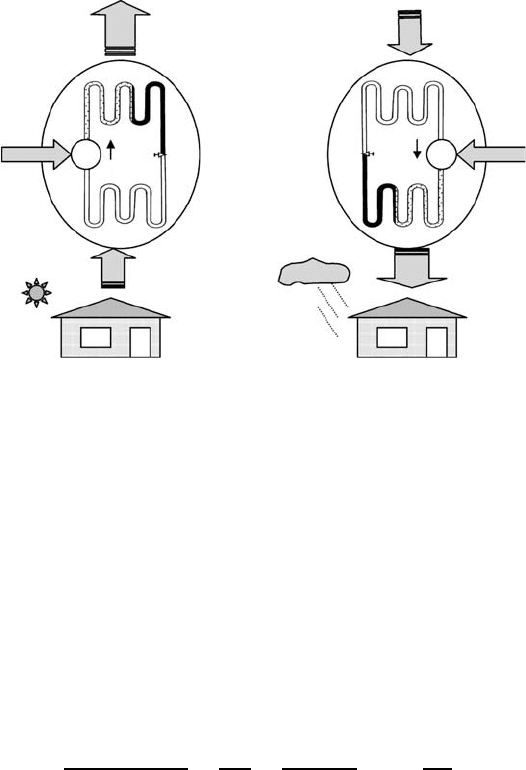
in Fig. 5.15. Heat pumps have this ability to be reversed, so they can serve as
an air conditioner in the summer and a heater in the winter. Heat pumps may
seem to defy some law of thermodynamics, since they take heat out of a cold
space and pump it to a hot one, but of course they don’t. When used as heaters,
they are nothing more than a refrigerator with its door wide open to the ambient
and its condenser coils facing into the kitchen, trying to cool the whole outside
world just the way it tries to cool the warm beer on the shelf.
As a heater, a heat pump theoretically delivers the sum of the heat removed
from the environment plus the compressor energy, which leads to the following
expression for the COP for heat pumps:
COP
HP
=
Desired output
Work input
=
Q
H
W
=
Q
L
+ W
W
= 1 +
Q
L
W
> 1 (5.45)
Notice, by comparison with (5.40), there is a simple relationship between the
coefficient of performance as a refrigerator or air conditioner (COP
R
)andasa
heat pump (COP
HP
):
COP
HP
= COP
R
+ 1 (5.46)
Equation (5.45) tells us that a heat pump, in its heating mode, has a COP
HP
greater than unity, which means that more heat goes into the conditioned space
than the energy content of the electricity running the compressor. The actual COP
will depend on the ambient temperature, dropping as the outside temperature
276 ECONOMICS OF DISTRIBUTED RESOURCES
706050403020100
1
2
3
4
5
Source Temperature (°F)
COP
Heating Capacity
(×10
4
Btu/h)
Power (kW)
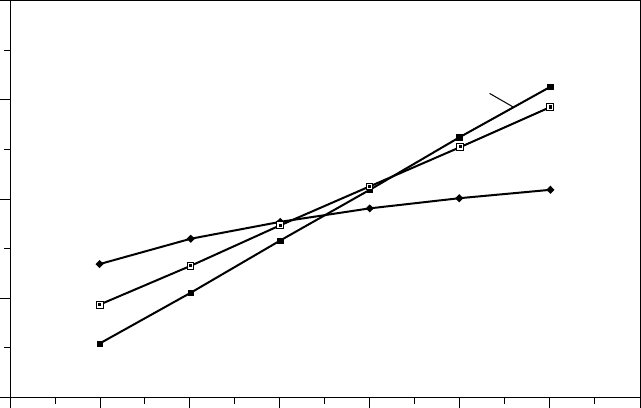
Figure 5.16 Temperature dependence of COP, power demand, and heating capacity for
a home-size, 3-ton heat pump.
drops. An example of the temperature dependence of the COP, power demand,
and heating capacity of a 3-ton heat pump is shown in Fig. 5.16. Notice that as
it gets colder outside, the heater output drops at the same time that the demand
for heat rises. What this means is that at some ambient temperature, called the
balance point temperature, the heat pump can no longer deliver enough heat to
satisfy the demand and supplementary heating must be provided. This supplement
is typically built-in strip resistance heaters, which, when they are turned on, cuts
the overall COP of the heat pump dramatically. It is not unusual for the overall
COP to approach unity as ambient drops below freezing. One way, however, to
imagine maintaining the high efficiency of a heat pump in cold weather is to
couple it with a source of waste heat, such as a CHP fuel cell.
In mild climates where electricity is relatively inexpensive, many homes are
heated with straight electric resistance heating. A simple air-source heat pump in
those circumstances can usually reduce the electricity demand by at least half. In
climates characterized by very cold winters and very hot summers, heat pumps
that use a local body of water, or the ground itself, as the source and sink for
heating and cooling can be even more efficient. Since the ground temperature
ten-to-twenty feet below the surface often hovers around 50
◦
F, a heat pump with
its source at that temperature delivers heat with very high COP. Moreover, in the
summer, rejecting heat into the cool ground rather than into hot ambient air also
improves its efficiency as an air conditioner. Such ground-source heat pumps are
COOLING, HEATING, AND COGENERATION 277
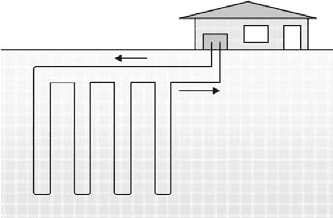
Figure 5.17 Ground source heat pump for high heating and cooling efficiency.
expensive, but can be the most efficient of all methods currently available to heat
and cool a home. A simple schematic of such a system, with vertical closed heat
exchange loops buried in the ground, is shown in Fig. 5.17.
5.6.3 Absorption Cooling
As was shown in Fig. 3.6, one of the biggest contributors to the peak demand
for power in a utility system is space cooling. For residential and commercial
customers, the cost of air conditioning is often a major fraction of their electricity
bills—especially when the tariff includes demand charges. While most cooling
systems in use today are based on electricity-powered, vapor-compression-cycle
technologies, there are heat-driven alternatives that make especially good sense
as part of a cogeneration system. The most developed of these systems is based
on the absorption refrigeration cycle shown in Fig. 5.18.
In an absorption cooling system, the mechanical compressor in a conventional
vapor compression system is replaced with components that perform the same
function, but do so thermochemically. In Fig. 5.18, everything outside of the dot-
ted box is conventional; that is, it has the same components as would be found
in a compressive refrigeration system. A refrigerant, in this case water vapor,
leaves the thermochemical compressor under pressure. As it passes through the
condenser, it changes state, releasing heat to the environment, and emerges as
pressurized liquid water. When its pressure is released in the expansion valve, it
flashes back to the vapor state in the evaporator, drawing heat from the refriger-
ated space. The refrigerant then must be compressed to start another pass around
the loop.
The key to the dotted box on the right of the figure is the method by which the
vaporized refrigerant leaving the evaporator is re-pressurized using heat rather
than a compressor. The system shown in Fig. 5.18 uses water vapor as the refrig-
erant and uses lithium bromide (LiBr) as the absorbent into which the water vapor
dissolves. A very small pump shuttles the water–LiBr solution from the absorber
to the generator. In the generator, heat is added, which pressurizes the dissolved
water vapor and drives it out of solution. The pressurized water vapor leaving the