
Masters G.M. Renewable and Efficient Electric Power Systems
Подождите немного. Документ загружается.

288 ECONOMICS OF DISTRIBUTED RESOURCES
3.75
3
2.25
1.5
0.75
0
Week
Hour
24
1
Marginal cost ($/kWh)
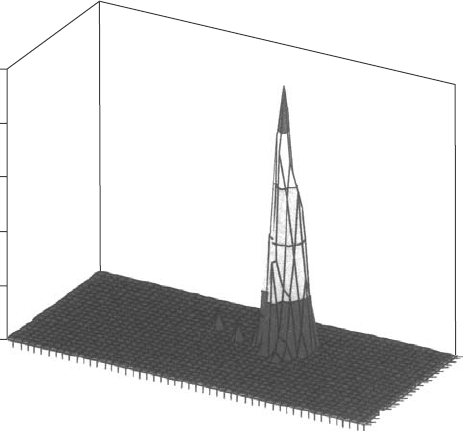
Figure 5.27 Area-and-time (ATS) studies can identify feeders where distributed gener-
ation and demand-side management programs can be particularly cost effective. This is a
particular PG&E feeder in the early 1990s. From Swisher and Orans (1996).
V = iR, and there is power loss due to i
2
R heating of the wires. The longer
the distance and the greater the current, the more there will be voltage drop and
power loss in the wires. If, however, a distributed generation source provides
some of its own power, or if loads can be reduced through customer efficiency,
the current and power that the grid needs to supply will drop and so will grid
losses. Moreover, if the DG source actually delivers power to the grid, line losses
will be reduced even more.
Injecting power onto the grid not only provides voltage support to offset iR
drops and reduce i
2
R losses, it can also raise the power factor of the lines. Recall
that when voltage and current are out of phase with each other, more current must
be provided to deliver the same amount of true power (watts) capable of doing
work. Improving the power factor is usually accomplished by adding banks of
capacitors to the line, but it can also be helped if DG systems are designed to
inject appropriately phased reactive power. Improved power factor reduces line
current, which reduces voltage sag and line losses. On top of that, a better power
factor also helps distribution transformers waste less energy, supply more power,
and extend their lifetime.
5.7.4 Reliability Benefits
Most power outages are caused by faults in the transmission and distribution
system—wind and lightning, vehicular accidents, animals shorting out the
DISTRIBUTED BENEFITS 289
wires—not generation failures. To the extent that a customer can provide some
fraction of their own power during those outages, especially to critical loads such
as computers and other digital equipment, the value of the added reliability can
easily surpass the cost of generation by orders of magnitude. Such emergency
standby power is now often provided with back-up generators, but such systems
are usually not designed to be operated continuously, nor are they permitted
to do so given their propensity to pollute. This means that they don’t provide
any energy payback under normal circumstances. Battery systems and other
uninterruptible power supplies (UPS) can’t cover sustained outages on their own
without additional backup generators, so they have the same disadvantages of
not being able to help pay for themselves by routinely delivering kilowatt-hours.
Fuel cells, on the other hand, can operate in parallel with the grid. With
natural gas reformers, or sufficient stored hydrogen, they can cover extended
power outages. With no emissions or noise they be housed within a building
and can be permitted to run continuously so they are an investment with annual
returns in addition to providing protection against utility outages.
5.7.5 Emissions Benefits
As concerns about climate change grow, there is increasing attention to the role
of carbon emissions from power plants. The shift from large, coal-fired power
plants to smaller, more efficient gas turbines and combined-cycle plants fueled
by natural gas can greatly reduce those emissions. Reductions result from both
the increased efficiency that many of these plants have and the lower carbon
intensity (kgC/GJ) of natural gas. As Table 5.11 indicates, natural gas emits only
about half the carbon per unit of energy when it is burned as does coal.
Calculating the reduction in emissions in conventional power plants that would
be gained by fuel switching from coal to gas is straightforward. To do so for
cogeneration is less well defined. One approach to calculating carbon emissions
from CHP plants is to use the energy chargeable-to-power (ECP) measure. Recall
that ECP subtracts the displaced boiler fuel no longer needed from the total input
energy, which, in essence, attributes all of the fuel (and carbon) savings to the
electric power output. The following example illustrates this approach.
TABLE 5.11 Carbon Intensity of Fossil Fuels Based on High-Heating Values
(HHV)
a
Energy Density
(kJ/kg)
Carbon Content
(%)
Carbon Intensity
(kgC/GJ)
Anthracite coal 34,900 92 26.4
Bituminous coal 27,330 75 27.4
Crude oil 42,100 80 19.0
Natural gas 55,240 77 13.9
a
HHV includes latent heat in exhaust water vapor.
Source: IPCC (1996) and Culp (1979).
290 ECONOMICS OF DISTRIBUTED RESOURCES
Example 5.18 Carbon Emission Reductions with CHP. Use the ECP method
to determine the reduction in carbon emissions associated with a natural-gas-fired,
combined-cycle CHP having 41% electrical efficiency and 44% thermal effi-
ciency. Assume that the thermal output would have come from an 83% efficient
boiler. Compare it to that of a 33.3% efficient conventional bituminous-coal-fired
power plant.
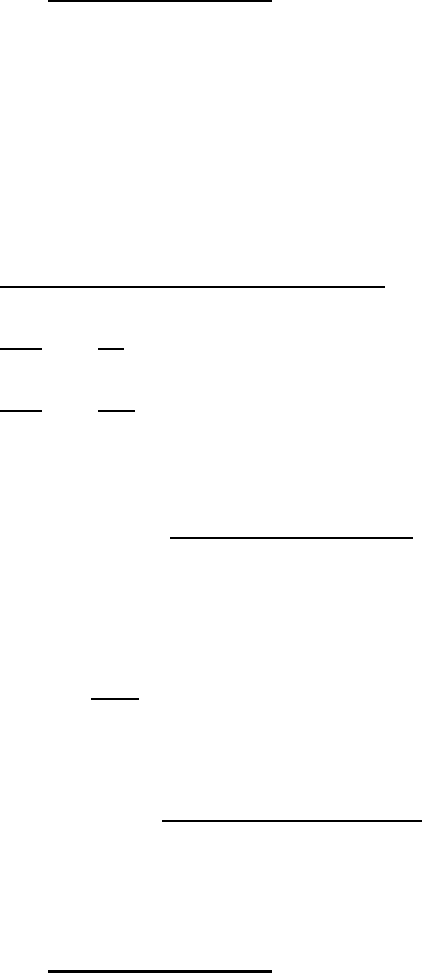
Solution. The energy chargeable to power is given by (5.39)
ECP =
Total thermal input − Displaced thermal input
Electrical output
=
3600
η
P
1 −
η
H
η
B
kJ/kWh
ECP =
3600
0.41
1 −
0.44
0.83
= 4126 kJ/kWh
Using the 13.9-kgC/GJ carbon intensity of natural gas provided in Table 5.11 gives
Carbon chargeable to power =
4126 kJ/kWh × 13.9 kgC/GJ
10
6
kJ/GJ
= 0.0573 kgC/kWh
The coal plant has no displaced thermal input, so its ECP is the full
ECP =
3600
0.333
= 10,811 kJ/kWh
Using 27.4 kgC/GJ as its carbon intensity from Table 5.11, we obtain
Carbon chargeable to power =
10,811 kJ/kWh × 27.4 kgC/GJ
10
6
kJ/GJ
= 0.296 kgC/kWh
The efficient CHP combined-cycle plant reduces carbon emissions by 81%.
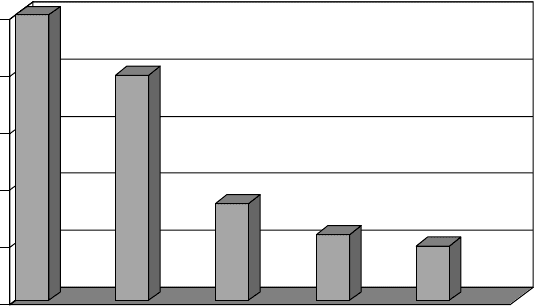
Application of the above method for evaluating carbon emissions to a number of
power plants results in the bar chart shown in Fig. 5.28. The bar heights represent
emissions compared to those from the 33.3%-efficient coal plant just evaluated.
INTEGRATED RESOURCE PLANNING (IRP) AND DEMAND-SIDE MANAGEMENT (DSM) 291
0
20
40
60
80
100
Relative Carbon Emissions (%)
100
AVERAGE
COAL
33%Eff
BEST
COAL
42%Eff
N. GAS
COMB-CYCLE
49% Eff
N. GAS, CHP
SIMPLE-CYCLE
30% Elect Eff
49% Thermal Eff
N. GAS, CHP
COMB-CYCLE
41% Elect Eff
44% Thermal Eff
79
34
23
19
Figure 5.28 Relative carbon emissions for various power plants compared to the average
coal plant. CHP units assume thermal output replaces an 83% efficient gas boiler.
5.8 INTEGRATED RESOURCE PLANNING (IRP) AND DEMAND-SIDE
MANAGEMENT (DSM)
In the 1980s, regulators began to recognize that energy conservation could be
treated as a “source” of energy that could be directly compared with traditional
supply sources. If utilities could help customers be more efficient in their use of
electricity, delivering the same energy service with fewer kilowatt-hours, and if
they could do so at lower cost than supplying energy, then it would be in the
public’s interest to encourage that to occur. What emerged is a process called
integrated resource planning (IRP) or, as it is sometimes referred to, least-cost
planning (LCP).
The new and defining element of IRP was the incorporation of utility pro-
grams that were designed to control energy consumption on the customer’s side
of the electric meter. These are known as demand-side management (DSM) pro-
grams. While DSM most often refers to programs designed to save energy, it has
been defined in a broader sense to refer to any program that attempts to modify
customer energy use. As such it includes:
1. Conservation/energy efficiency programs that have the effect of reducing
consumption during most or all hours of customer demand.
2. Load management programs that have the effect of reducing peak demand
or shifting electric demand from the hours of peak demand to non-peak-
time periods.
292 ECONOMICS OF DISTRIBUTED RESOURCES
3. Fuel substitution programs that influence a customer’s choice between elec-
tric or natural gas service from utilities. For example, the electricity needed
for air conditioning can be virtually eliminated by replacing a compressive
refrigeration system with one based on absorption cooling.
DSM programs have included a wide range of strategies, such as (1) energy
information programs, including energy audits; (2) rebates on energy-efficient
appliances and other devices; (3) incentives to help energy service companies
(ESCOs) reduce commercial and industrial customer demand for their clients;
(4) load control programs to remotely control customer appliances such as water
heaters and air conditioners; (5) tariffs designed to shift or reduce loads (time-
of-use rates, demand charges, real-time pricing, interruptible rates).
5.8.1 Disincentives Caused by Traditional Rate-Making
Electric utilities have traditionally made their money by selling kilowatts of power
and kilowatt-hours of energy, so the question arises as to how they could possibly
find it in their best interests to sell less, rather than more, electricity. To understand
that challenge, we need to explore the role of state-run public utility commissions
(PUCs) in determining the rates and profits that investor-owned utilities (IOUs)
have traditionally been allowed to earn.
A fairly common rate-making process is based on utilities providing evidence
for costs, and expected demand, to their PUC in what is usually referred to as a
general rate case (GRC). General rate cases often focus only on the non-fuel com-
ponent of utility costs (depreciation of equipment, taxes, non-fuel operation and
maintenance costs, return on investment, and general administrative expenses).
Dividing these revenue requirements by expected energy sales results in a base-
case ratepayer cost per kWh. Fuel costs, which may change more rapidly than
the usual schedule of general rate case hearings, may be treated in separate pro-
ceedings. In general, changes in fuel costs are simply passed on to the ratepayers
as a separate charge in their bills.
To understand how this process encourages sales of kWh and discourages
DSM, consider the simple graph of revenue requirements versus expected energy
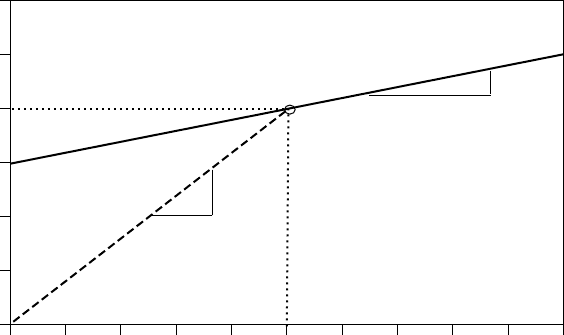
sales shown in Fig. 5.29. In this example, the utility has a fixed annual revenue
requirement of $300 million needed to recover capital costs of equipment along
with other fixed costs, plus an additional amount that depends on how many
kilowatt-hours are generated. In this example, each additional kilowatt-hour of
electricity generated costs an additional amount of one cent. This 1¢/kWh is
called the short-run marginal cost, which means that it is based on operating
existing capacity longer. There is also long-run marginal cost, which applies
when the additional power needed triggers an expansion of the existing power
plants, transmission lines, or distribution system.
If the utility in Fig. 5.29 projects that it will sell 10 billion kWh/yr, then annual
revenues of $400 million would be needed. The ratio of the two is an average
base rate of 4¢/kWh, which is what the utility would be allowed to charge until
the next general rate case is heard.
INTEGRATED RESOURCE PLANNING (IRP) AND DEMAND-SIDE MANAGEMENT (DSM) 293
20181614121086420
0
100
200
300
400
500
600
Estimated Sales (Billion kWh/yr)
Revenue Required (Million $/yr)
Average cost
4 ¢/kWh
Marginal cost
1 ¢/kWh
Figure 5.29 Estimated sales of 10 billion kWh would require $400 million in revenue,
so the (non-fuel) base rate would be 4¢/kWh.
Consider now the perverse incentives that would encourage this utility to sell
more kWh than the 10 billion estimated in Fig. 5.29. Having established a price of
4¢/kWh, any sales beyond the estimated 10 billion kWh/yr would yield revenues
of 4¢ for each extra kWh sold. Since each extra kWh generated has a marginal
cost of only 1¢, and it is being sold at 4¢, there will be a net 3¢ profit for each
extra kWh that can be sold.
Notice, too, that the example utility loses money if it sells less than 10 billion
kWh. Generating one fewer kWh reduces costs by 1¢, but reduces revenue by 4¢.
In other words, this rather standard practice of rate-making not only encourages
utilities to want to sell more energy, it also strongly discourages conservation
that would reduce those sales.
5.8.2 Necessary Conditions for Successful DSM Programs
As the above example illustrates, traditional rate-making has tended to reward
energy sales and penalize energy conservation, no matter what the relative costs
of supply-side and demand-side options might be. During the 1980s and early
1990s, energy planners and utility commissions grappled with the problem of
finding fair and equitable rate-making procedures that would reverse these ten-
dencies, allowing cost-effective energy-efficiency to compete. Three conditions
were found to be necessary for DSM to be successful:
1. Decoupling utility sales from utility profits.
2. Recovery of DSM program costs to allow utilities to earn profits on DSM.
3. DSM incentives to encourage utilities to prefer DSM over generation.

294 ECONOMICS OF DISTRIBUTED RESOURCES
While there are several approaches that regulators have taken to decouple
utility profits from sales, the electric rate adjustment mechanism (ERAM) is a
good example of one that works quite effectively. ERAM simply incorporates any
revenue collected, above or below 1 year’s forecasted amount, into the following
year’s authorized base-rate revenue, thereby eliminating incentives to sell more
kWh and removing disincentives to reduce kWh sales. Clearly, decoupling is a
necessary condition for DSM to work, but it is not sufficient.
The second condition allows utilities to earn profits on demand-side programs
just as they do on supply-side investments. Recovery of DSM program costs
can be accomplished by including them in the rate base alongside capital costs
of power plants and other utility infrastructure. In this way, supply-side and
demand-side investments would both earn whatever rate of return the regulators
would allow. Alternatively, DSM costs might be included as an expense that is
simply passed along to the ratepayer.
Experience has shown that just decoupling sales and profits, along with rate-
basing or expensing DSM costs, does not provide sufficient encouragement for
utilities to actively pursue customer energy efficiency. Additional incentives for
the utilities and their stockholders seems to be needed. Shared savings programs
have emerged in which shareholders are allowed to keep some fraction of the net
savings that DSM programs provide. The following example illustrates this idea.
Example 5.19 A Shared-Savings Program. Suppose that a utility offers a $2
rebate on 18-W, 10,000-h, compact fluorescent lamps (CFLs) that produce as
much light as the 75-W incandescents they are intended to replace. Suppose
that it costs the utility an additional $1 per CFL to administer the program. The
utility has a marginal cost of electricity of 3¢/kWh, and 1 million customers are
expected to take advantage of the rebate program.
If a shared savings program allocates 15% of the net utility savings to share-
holders and 85% to ratepayers, what would be the DSM benefit to each?
Solution
Energy savings = (75 − 18) W/CFL × 10 kh × $0.03/kWh × 10
6
CFL
= $17.1 million
Program cost = ($2 + $1)/CFL × 10
6
CFL = $3 million
Net savings to utility = $17.1 million − $3 million = $14.1 million
Shareholder benefit = 15% ×$14.1 million = $2.12 million
Ratepayer savings = 85% ×$14.1 million = $11.99 million
INTEGRATED RESOURCE PLANNING (IRP) AND DEMAND-SIDE MANAGEMENT (DSM) 295
In the above example, it was quite easy to calculate the energy savings asso-
ciated with replacing 75-W incandescents with 18-W CFLs, assuming that their
rated 10,000-h lifetime is realized. For many other efficiency measures, how-
ever, the savings are less easy to calculate with such confidence. Exactly how
much energy will be saved by upgrading the insulation in someone’s home, for
example, is not at all easy to predict.
Further complicating load reduction estimates are the problems of free rid-
ers and take-backs. Free riders are customers who would have purchased their
energy efficiency devices even if the utility did not offer an incentive. In the
above example, it was assumed that all 1 million rebates went to customers
who would not have purchased CFLs without them. Take-backs refer to cus-
tomers who change their behavior after installing energy-efficiency devices. For
example, after insulating a home a user may be tempted to turn up the thermostat,
thereby negating some fraction of the energy savings.
While free riders, take-backs, and uncertainties in estimating energy savings
may result in less DSM value to the utility than anticipated, one can argue that
these are more than offset by the environmental advantages of not generating
unneeded electricity. Some utilities have, in fact, tried to incorporate environ-
mental externalities into the avoided cost benefits of DSM.
5.8.3 Cost Effectiveness Measures of DSM
The goal of integrated resource planning is to minimize the cost to customers of
reliable energy services by suitably incorporating supply-side and demand-side
resources. A proper measure of cost-effectiveness on the demand side, unfortu-
nately, is largely in the eyes of the beholder; that is, the most cost-effective DSM
strategy for stockholders may be different from the best strategy as seen by util-
ity customers. In fact, utility customers can also see things differently depending
on whether the customer is someone who takes advantage of the conservation
incentives, or whether it is a customer who either cannot, or will not, take advan-
tage of the benefit (e.g., they already purchased the most efficient refrigerator on
their own before an incentive was offered). To account for such differences of
perspective, a number of standardized DSM cost-effectiveness measures have
been devised.
The evaluation of DSM cost-effectiveness measures is complicated by such
factors as what type of DSM it is (e.g. appliance efficiency, commercial peak-
power reduction, fuel switching) and what assumptions are appropriate to deter-
mine future costs and savings. The following descriptions are vastly simplified
for clarity; for greater detail, see, for example, CPUC (1987).
Ratepayer Impact Measure (RIM) Test. The RIM test is primarily a measure
of what happens to utility rates as a result of the DSM program. For a DSM
program to be cost effective using the RIM test, utility rates must not increase.
296 ECONOMICS OF DISTRIBUTED RESOURCES
(a)
(b)
Revenue required
kWh sales
Revenue required
kWh sales
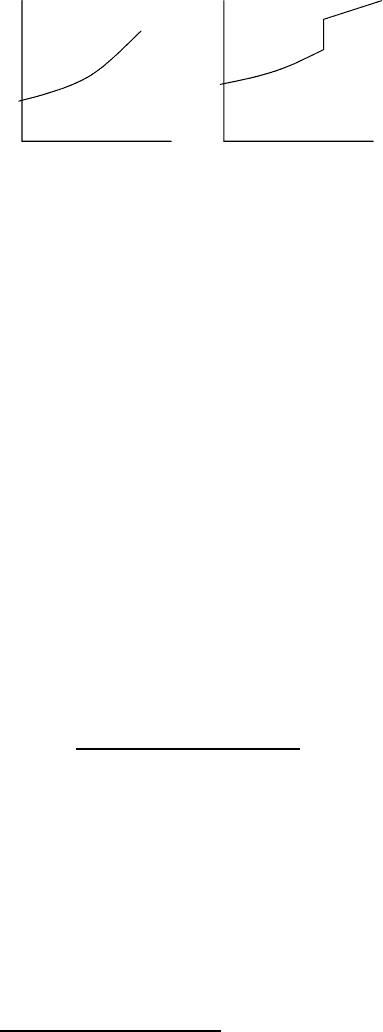
Figure 5.30 Marginal cost can be higher than average cost when the cost curve is
nonlinear. (a) Smoothly increasing costs. (b) Jumps caused by capacity expansion.
That is, even nonparticipants must not see an increase in their electric bills (or at
least a lower increase than they would have seen without DSM), which is why
this is sometimes referred to as the no-losers test. Clearly, this is a difficult test to
pass. For example, any reduction in demand for the utility modeled in Fig. 5.29
will result in an increase in the average cost of electricity. But, this example
utility has a simple, linear relationship between demand and price, which may
not always be the case. Increasing demand may mean that less efficient, more
expensive power plants get used more often (Fig. 5.30a) or it may trigger the
need for new generation, transmission, and distribution capacity (Fig. 5.30b).
Avoiding or delaying new capacity expansions is often a major driver motivating
DSM programs.
A necessary condition for a measure to pass the RIM test is that the marginal
cost of electricity (including fuel costs) must be greater than the average cost.
Moreover, the only way to keep rates from increasing is to have the DSM program
cost less than the difference between the marginal cost of electricity and the
average cost. For example, if the average cost of a kWh of electricity is 5¢ and
the marginal cost is 6¢, then a DSM program has to cost less than 1¢ to save a
kWhtopasstheRIMtest.
Example 5.20 The RIM Test for a CFL Program. Suppose that the util-
ity offering the CFL rebate program in Example 5.18 has an average cost of
electricity of 2¢/kWh. Will the program pass the RIM test?
Solution. Since the marginal cost of electricity (3¢/kWh) is more than the aver-
age cost (2¢/kWh), the DSM program might pass the RIM test. To check,
however, we need to find the per kWh cost of the CFL program. With a $2 rebate
and a $1 administrative cost, DSM costs $3 per CFL so the cost of conserved
energy is
DSM cost =
$3/CFL
(75 − 18)W/CFL × 10 kh
= $0.0052/kWh = 0.52¢/kWh

INTEGRATED RESOURCE PLANNING (IRP) AND DEMAND-SIDE MANAGEMENT (DSM) 297
To pass the RIM test, the DSM cost must be less than the difference between the
marginal and average cost to the utility:
Marginal cost − Average cost = 3¢/kWh − 2¢/kWh
= 1¢/kWh > 0.52 ¢/kWh
So the RIM test is satisfied and electric rates will decrease with this program.
Total Resource Cost (TRC) Test. The TRC test asks whether society as a
whole is better off with DSM. It is again a cost–benefit calculation in which
benefits result from reduced costs of fuel, operation, maintenance, and trans-
mission losses, as well as potential reduction in needed power plant capacity,
as before. Total costs are somewhat different since they not only include DSM
administrative costs incurred by the utility, but also add any extra cost the cus-
tomer pays when purchasing the more efficient product. Since the utility pays the
rebate and the customer collects it, the net impact of the rebate itself on societal
cost is zero, so it is simply not included in the TRC test on either side of the
benefit–cost calculation. For measures passing the TRC test, utility rates may
go up or down, but average utility bills will decrease. Nonparticipants may see
an increase in their bills. The TRC test is the most commonly used measure of
DSM cost effectiveness.
Example 5.21 The TRC Test for a CFL Program. Suppose 75-W incan-
descents costing $0.50 each have an expected lifetime of 1000 h. The utility is
offering a $2 rebate to encourage customers to replace those with 10,000-h, 18-W
CFLs that normally cost $7. The utility has a marginal cost of $0.03/kWh. It will
cost the utility $1 per CFL to administer the program. Does this measure satisfy
the TRC test?
Solution. Since the TRC test excludes the cost of the rebate, the utility cost per
CFL is just $1 per CFL.
Ignoring the rebate, the customer spends $7 for a 10,000-h CFL. To obtain
the same light would require purchasing ten 1000-h incandescents at 50¢ each,
for a total of $5. The extra cost to the consumer is therefore $7 − $5 = $2 for
each CFL.
Total cost to society of the conservation measure (regardless of the amount
of rebate) is the sum of the utility cost and consumer cost, or $1 + $2 = $3 for
each CFL.
The avoided cost benefit seen by the utility is
Avoided cost benefit = (75 − 18) W × 10 kh × $0.03/kWh
= $17.10 per CFL