
Masters G.M. Renewable and Efficient Electric Power Systems
Подождите немного. Документ загружается.

308 WIND POWER SYSTEMS
Subsequent interest in wind systems declined as the utility grid expanded and
became more reliable and electricity prices declined. The oil shocks of the 1970s,
which heightened awareness of our energy problems, coupled with substantial
financial and regulatory incentives for alternative energy systems, stimulated a
renewal of interest in windpower. Within a decade or so, dozens of manufac-
turers installed thousands of new wind turbines (mostly in California). While
many of those machines performed below expectations, the tax credits and other
incentives deserve credit for shortening the time required to sort out the best
technologies. The wind boom in California was short-lived, and when the tax
credits were terminated in the mid-1980s, installation of new machines in the
United States stopped almost completely for a decade. Since most of the world’s
wind-power sales, up until about 1985, were in the United States, this sud-
den drop in the market practically wiped out the industry worldwide until the
early 1990s.
Meanwhiley, wind turbine technology development continued—especially in
Denmark, Germany, and Spain—and those countries were ready when sales
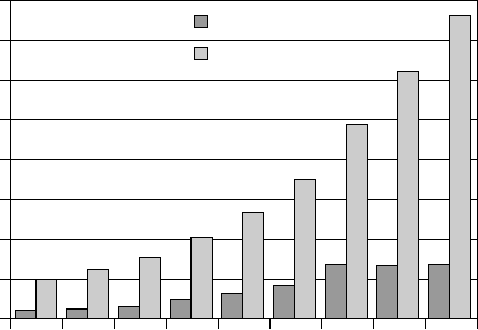
began to boom in the mid-1990s. As shown in Fig. 6.1, the global installed
capacity of wind turbines has been growing at over 25% per year.
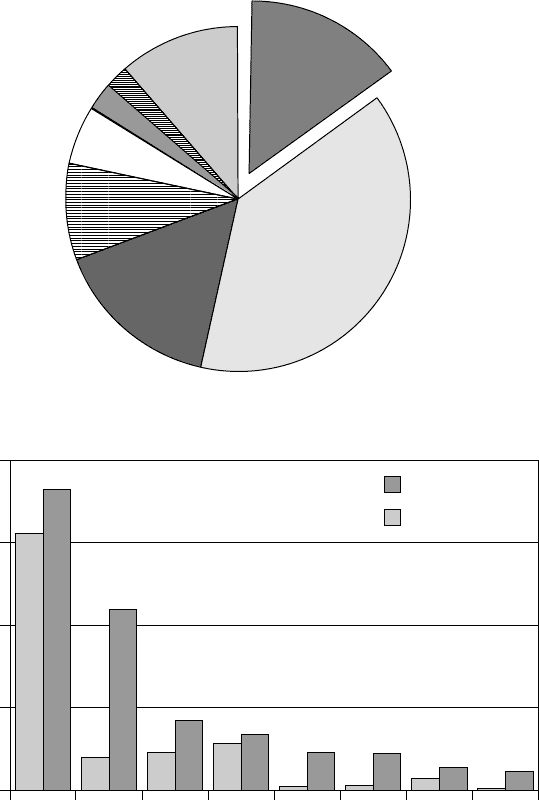
Globally, the countries with the most installed wind capacity are shown in
Fig. 6.2. As of 2003, the world leader is Germany, followed by Spain, the United
States, Denmark, and India. In the United States, California continues to have the
most installed capacity, but as shown in Fig. 6.3, Texas is rapidly closing the gap.
Large numbers of turbines have been installed along the Columbia River Gorge in
the Pacific Northwest, and the windy Great Plains states are experiencing major
growth as well.
1995 1996 1997 1998 1999 2000 2001 2002 2003
0
5000
10,000
15,000
20,000
25,000
30,000
35,000
40,000
Net Additions
Installed Capacity
Capacity (MW)
Figure 6.1 Worldwide installed wind-power capacity and net annual additions to capac-
ity have grown by over 25% per year since the mid-1990s. Data from AWEA.
TYPES OF WIND TURBINES 309
USA
4,685
Germany
12,001
Spain
4,830
Denmark
2,880
India
1,702
Italy, 785
Netherlands, 688
Other
3,557
Figure 6.2 Total installed capacity in 2002, by country. AWEA data.
California
Texas
Iowa
Minnesota
Washington
Oregon
Wyoming
Kansas
0
500
1000
1500
2000
1999
2002
Installed Capacity (MW)
Figure 6.3 Installed wind capacity in the United States in 1999 and 2002.
6.2 TYPES OF WIND TURBINES
Most early wind turbines were used to grind grain into flour, hence the name
“windmill.” Strictly speaking, therefore, calling a machine that pumps water or
generates electricity a windmill is somewhat of a misnomer. Instead, people are
310 WIND POWER SYSTEMS
using more accurate, but generally clumsier, terminology: “Wind-driven gener-
ator,” “wind generator,” “wind turbine,” “wind-turbine generator” (WTG), and
“wind energy conversion system” (WECS) all are in use. For our purposes,
“wind turbine” will suffice even though often we will be talking about system
components (e.g., towers, generators, etc.) that clearly are not part of a “turbine.”
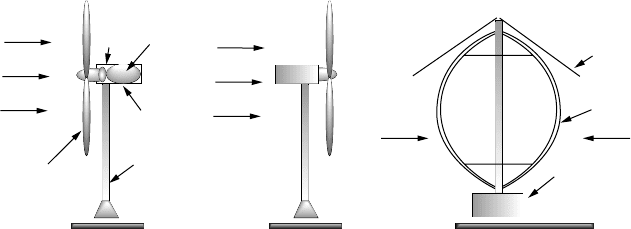
One way to classify wind turbines is in terms of the axis around which the
turbine blades rotate. Most are horizontal axis wind turbines (HAWT), but there
are some with blades that spin around a vertical axis (VAWT). Examples of the
two types are shown in Fig. 6.4.
The only vertical axis machine that has had any commercial success is the
Darrieus rotor, named after its inventor the French engineer G. M. Darrieus,
who first developed the turbines in the 1920s. The shape of the blades is that
which would result from holding a rope at both ends and spinning it around a
vertical axis, giving it a look that is not unlike a giant eggbeater. Considerable
development of these turbines, including a 500-kW, 34-m diameter machine, was
undertaken in the 1980s by Sandia National Laboratories in the United States.
An American company, FloWind, manufactured and installed a number of these
wind turbines before leaving the business in 1997.
The principal advantage of vertical axis machines, such as the Darrieus rotor,
is that they don’t need any kind of yaw control to keep them facing into the
wind. A second advantage is that the heavy machinery contained in the nacelle
(the housing around the generator, gear box, and other mechanical components)
can be located down on the ground, where it can be serviced easily. Since the
heavy equipment is not perched on top of a tower, the tower itself need not
be structurally as strong as that for a HAWT. The tower can be lightened even
further when guy wires are used, which is fine for towers located on land but not
for offshore installations. The blades on a Darrieus rotor, as they spin around, are
almost always in pure tension, which means that they can be relatively lightweight
Wind
Wind
Wind Wind
Gear
box
Generator
Guy wires
Rotor blades
Generator,
Gear Box
Upwind
HAWT
Downwind
HAWT
Darrieus
VAWT
(a) (b) (c)
Rotor
blades
Tower
Nacelle
Figure 6.4 Horizontal axis wind turbines (HAWT) are either upwind machines (a) or
downwind machines (b). Vertical axis wind turbines (VAWT) accept the wind from any
direction (c).
TYPES OF WIND TURBINES 311
and inexpensive since they don’t have to handle the constant flexing associated
with blades on horizontal axis machines.
There are several disadvantages of vertical axis turbines, the principal one
being that the blades are relatively close to the ground where windspeeds are
lower. As we will see later, power in the wind increases as the cube of velocity
so there is considerable incentive to get the blades up into the faster windspeeds
that exist higher up. Winds near the surface of the earth are not only slower but
also more turbulent, which increases stresses on VAWTs. Finally, in low-speed
winds, Darrieus rotors have very little starting torque; in higher winds, when
output power must be controlled to protect the generator, they can’t be made to
spill the wind as easily as pitch-controlled blades on a HAWT.
While almost all wind turbines are of the horizontal axis type, there is still
some controversy over whether an upwind machine or a downwind machine is
best. A downwind machine has the advantage of letting the wind itself control the
yaw (the left–right motion) so it naturally orients itself correctly with respect to
wind direction. They do have a problem, however, with wind shadowing effects
of the tower. Every time a blade swings behind the tower, it encounters a brief
period of reduced wind, which causes the blade to flex. This flexing not only has
the potential to lead to blade failure due to fatigue, but also increases blade noise
and reduces power output.
Upwind turbines, on the other hand, require somewhat complex yaw control
systems to keep the blades facing into the wind. In exchange for that added
complexity, however, upwind machines operate more smoothly and deliver more
power. Most modern wind turbines are of the upwind type.
Another fundamental design decision for wind turbines relates to the number
of rotating blades. Perhaps the most familiar wind turbine for most people is the
multibladed, water-pumping windmill so often seen on farms. These machines are
radically different from those designed to generate electricity. For water pumping,
the windmill must provide high starting torque to overcome the weight and
friction of the pumping rod that moves up and down in the well. They must also
operate in low windspeeds in order to provide nearly continuous water pumping
throughout the year. Their multibladed design presents a large area of rotor facing
into the wind, which enables both high-torque and low-speed operation.
Wind turbines with many blades operate with much lower rotational speed
than those with fewer blades. As the rpm of the turbine increases, the turbulence
caused by one blade affects the efficiency of the blade that follows. With fewer
blades, the turbine can spin faster before this interference becomes excessive. And
a faster spinning shaft means that generators can be physically smaller in size.
Most modern European wind turbines have three rotor blades, while American
machines have tended to have just two. Three-bladed turbines show smoother
operation since impacts of tower interference and variation of windspeed with
height are more evenly transferred from rotors to drive shaft. They also tend to
be quieter. The third blade, however, does add considerably to the weight and
cost of the turbine. A three-bladed rotor also is somewhat more difficult to hoist
up to the nacelle during construction or blade replacement. It is interesting to
312 WIND POWER SYSTEMS
note that one-bladed turbines (with a counterweight) have been tried, but never
deemed worth pursuing.
6.3 POWER IN THE WIND
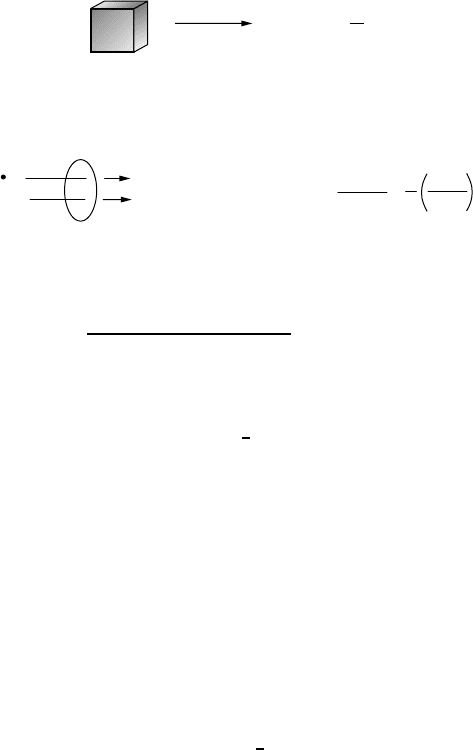
Consider a “packet” of air with mass m moving at a speed v. Its kinetic energy
K.E., is given by the familiar relationship:
K.E.
v
m
mv
2
1
2
=
(6.1)
Since power is energy per unit time, the power represented by a mass of air
moving at velocity v through area A will be
A
=
Energy
Time
=
1
2
Mass
Time
v
2
m
v
Power through area
A
(6.2)
The mass flow rate ˙m, through area A, is the product of air density ρ,speedv,
and cross-sectional area A:
Mass passing through A
Time
=˙m = ρAv (6.3)
Combining (6.3) with (6.2) gives us an important relationship:
P
w
=
1
2
ρAv
3
(6.4)
In S.I. units; P
w
is the power in the wind (watts); ρ is the air density (kg/m
3
)(at
15
◦
Cand1atm,ρ = 1.225 kg/m
3
); A is the cross-sectional area through which
the wind passes (m
2
); and v = windspeed normal to A (m/s) (a useful conversion:
1m/s= 2.237 mph).
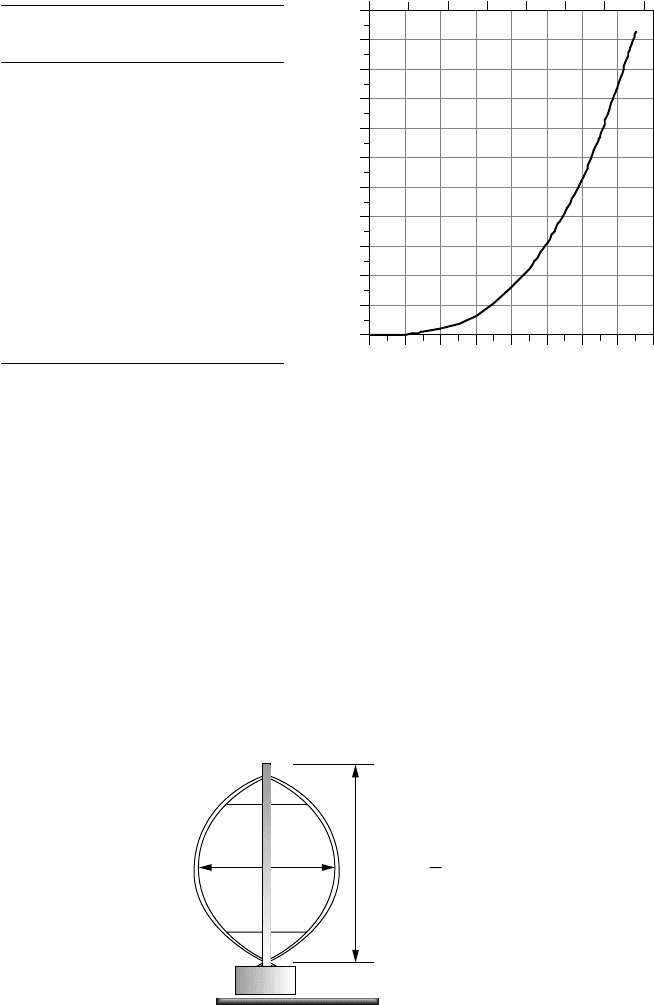
A plot of (6.4) and a table of values are shown in Fig. 6.5. Notice that the
power shown there is per square meter of cross section, a quantity that is called
the specific power or power density.
Notice that the power in the wind increases as the cube of windspeed. This
means, for example, that doubling the windspeed increases the power by eight-
fold. Another way to look at it is that the energy contained in 1 hour of 20 mph
winds is the same as that contained in 8 hours at 10 mph, which is the same as
that contained in 64 hours (more than 2
1
2
days) of 5 mph wind. Later we will
see that most wind turbines aren’t even turned on in low-speed winds, and (6.4)
reminds us that the lost energy can be negligible.
Equation (6.4) also indicates that wind power is proportional to the swept
area of the turbine rotor. For a conventional horizontal axis turbine, the area
POWER IN THE WIND 313
1614121086420
0
200
400
600
800
1000
1200
1400
1600
1800
2000
2200
WINDSPEED (m/s)
WINDSPEED (mph)
POWER (watts/m
2
)
0 5 10 15 20 25 30 35
0
1
2
3
4
5
6
7
8
9
10
11
12
13
14
15
0
2.24
4.47
6.71
8.95
11.19
13.42
15.66
17.90
20.13
22.37
24.61
26.84
29.08
31.32
33.56
0
1
5
17
39
77
132
210
314
447
613
815
1058
1346
1681
2067
Windspeed
(mph)
Windspeed
(m/s)
Power
(W/m
2
)
Figure 6.5 Power in the wind, per square meter of cross section, at 15
◦
Cand1atm.
A is obviously just A = (π/4)D
2
, so windpower is proportional to the square
of the blade diameter. Doubling the diameter increases the power available by
a factor of four. That simple observation helps explain the economies of scale
that go with larger wind turbines. The cost of a turbine increases roughly in
proportion to blade diameter, but power is proportional to diameter squared, so
bigger machines have proven to be more cost effective.
The swept area of a vertical axis Darrieus rotor is a bit more complicated to
figure out. One approximation to the area is that it is about two-thirds the area
of a rectangle with width equal to the maximum rotor width and height equal to
the vertical extent of the blades, as shown in Fig. 6.6.
H
D
A
≅
D⋅H
2
3
Figure 6.6 Showing the approximate area of a Darrieus rotor.

314 WIND POWER SYSTEMS
Of obvious interest is the energy in a combination of windspeeds. Given
the nonlinear relationship between power and wind, we can’t just use average
windspeed in (6.4) to predict total energy available, as the following example
illustrates.
Example 6.1 Don’t Use Average Windspeed. Compare the energy at 15
◦
C,
1 atm pressure, contained in 1 m
2
of the following wind regimes:
a. 100 hours of 6-m/s winds (13.4 mph),
b. 50 hours at 3 m/s plus 50 hours at 9 m/s (i.e., an average windspeed
of 6 m/s)
Solution
a. With steady 6 m/s winds, all we have to do is multiply power given by (6.4)
times hours:
Energy (6m/s) =
1
2
ρAv
3
t =
1
2
· 1.225 kg/m
3
· 1m
2
· (6m/s)
3
· 100 h
= 13,230 Wh
b. With 50 h at 3 m/s
Energy (3m/s) =
1
2
· 1.225 kg/m
3
· 1m
2
· (3m/s)
3
· 50 h = 827 Wh
And50hat9m/scontain
Energy (9m/s) =
1
2
· 1.225 kg/m
3
· 1m
2
· (9m/s)
3
· 50 h = 22,326 Wh
for a total of 827 +22,326 = 23,152 Wh
Example 6.1 dramatically illustrates the inaccuracy associated with using aver-
age windspeeds in (6.4). While both of the wind regimes had the same average
windspeed, the combination of 9-m/s and 3-m/s winds (average 6 m/s) produces
75% more energy than winds blowing a steady 6 m/s. Later we will see that,
under certain common assumptions about windspeed probability distributions,
energy in the wind is typically almost twice the amount that would be found by
using the average windspeed in (6.4).
6.3.1 Temperature Correction for Air Density
When wind power data are presented, it is often assumed that the air density
is 1.225 kg/m
3
; that is, it is assumed that air temperature is 15
◦
C(59
◦
F) and
POWER IN THE WIND 315
pressure is 1 atmosphere. Using the ideal gas law, we can easily determine the
air density under other conditions.
PV = nRT (6.5)
where P is the absolute pressure (atm), V is the volume (m
3
), n is the mass
(mol), R is the ideal gas constant = 8.2056 × 10
−5
m
3
· atm · K
−1
· mol
−1
,and
T is the absolute temperature (K), where K =
◦
C + 273.15. One atmosphere of
pressure equals 101.325 kPa (Pa is the abbreviation for pascals, where 1 Pa = 1
newton/m
2
). One atmosphere is also equal to 14.7 pounds per square inch (psi),
so 1 psi = 6.89 kPa. Finally, 100 kPa is called a bar and 100 Pa is a millibar,
which is the unit of pressure often used in meteorology work.
If we let M.W. stand for the molecular weight of the gas (g/mol), we can
write the following expression for air density, ρ:
ρ(kg/m
3
) =
n(mol) · M.W.(g/mol) · 10
−3
(kg/g)
V(m
3
)
(6.6)
Combining (6.5) and (6.6) gives us the following expression:
ρ =
P × M.W. × 10
−3
RT
(6.7)
All we need is the molecular weight of air. Air, of course, is a mix of molecules,
mostly nitrogen (78.08%) and oxygen (20.95%), with a little bit of argon (0.93%),
carbon dioxide (0.035%), neon (0.0018%), and so forth. Using the constituent
molecular weights (N
2
= 28.02, O
2
= 32.00, Ar = 39.95, CO
2
= 44.01, Ne =
20.18), we find the equivalent molecular weight of air to be 28.97 (0.7808 ×
28.02 + 0.2095 × 32.00 + 0.0093 × 39.95 + 0.00035 × 44.01 + 0.000018 ×
20.18 = 28.97).
Example 6.2 Density of Warmer Air. Find the density of air at 1 atm and
30
◦
C(86
◦
F)
Solution. From (6.7),
ρ =
1atm× 28.97 g/mol × 10
−3
kg/g
8.2056 × 10
−5
m
3
· atm/(K · mol) × (273.15 + 30) K
= 1.165 kg/m
3
which is a 5% decrease in density compared to the reference 1.225 kg/m
3
;since
power is proportional to density, it is also a 5% decrease in power in the wind.
316 WIND POWER SYSTEMS
TABLE 6.1 Density of Dry Air at a Pressure of 1
Atmosphere
a
Temperature
(
◦
C)
Temperature
(
◦
F)
Density
(kg/m
3
)
Density Ratio
(K
T
)
−15 5.0 1.368 1.12
−10 14.0 1.342 1.10
−5 23.0 1.317 1.07
0 32.0 1.293 1.05
5 41.0 1.269 1.04
10 50.0 1.247 1.02
15 59.0 1.225 1.00
20 68.0 1.204 0.98
25 77.0 1.184 0.97
30 86.0 1.165 0.95
35 95.0 1.146 0.94
40 104.0 1.127 0.92
a
The density ratio K
T
is the ratio of density at T to the density
at the standard (boldfaced) 15
◦
C.
For convenience, Table 6.1 shows air density for a range of temperatures.
6.3.2 Altitude Correction for Air Density
Air density, and hence power in the wind, depends on atmospheric pressure as
well as temperature. Since air pressure is a function of altitude, it is useful to
have a correction factor to help estimate wind power at sites above sea level.
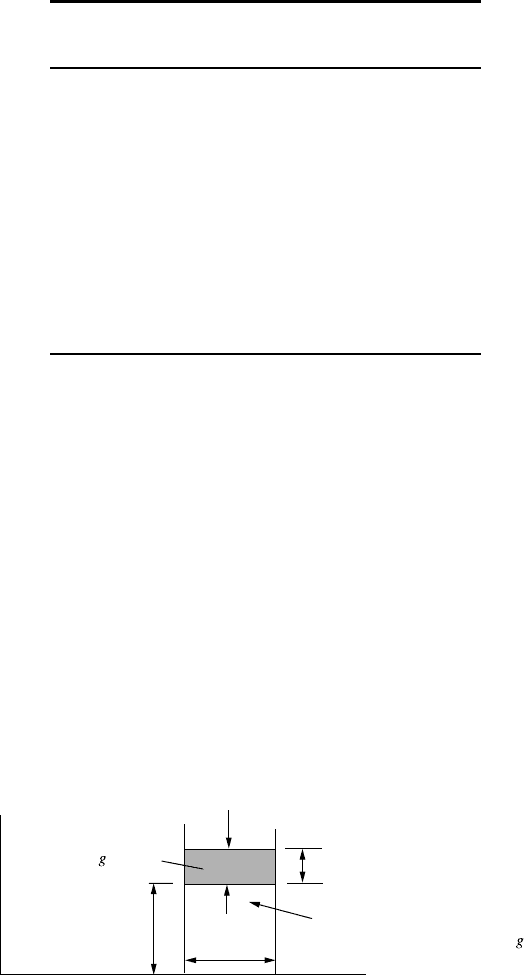
Consider a static column of air with cross section A,asshowninFig.6.7.
A horizontal slice of air in that column of thickness dz and density ρ will have
mass ρA dz. If the pressure at the top of the slice due to the weight of the air
above it is P(z+ dz), then the pressure at the bottom of the slice, P(z), will be
Area
A
Pressure on
bottom =
P
(
z
) =
P
(
z
+
dz
) + r
dz
dz
Pressure on top =
P
(
z
+
dz
)
Altitude
Weight of slice
of air = r
Adz
z
Figure 6.7 A column of air in static equilibrium used to determine the relationship
between air pressure and altitude.
POWER IN THE WIND 317
P(z+ dz) plus the added weight per unit area of the slice itself:
P(z) = P(z+ dz) +
gρAd z
A
(6.8)
where g is the gravitational constant, 9.806 m/s
2
. Thus we can write the incre-
mental pressure dP for an incremental change in elevation, dz as
dP = P(z+ dz) − P(z) =−gρdz (6.9)
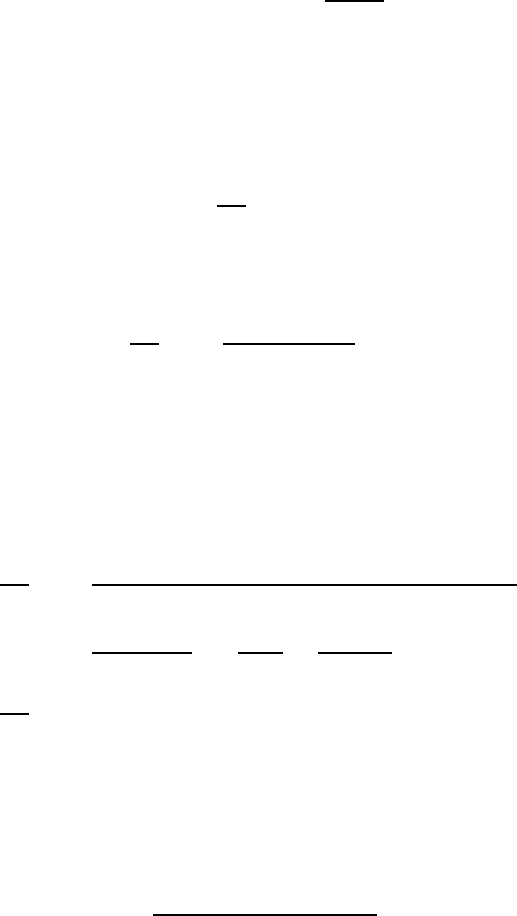
That is,
dP
dz
=−ρg (6.10)
The air density ρ given in (6.10) is itself a function of pressure as described
in (6.7), so we can now write
dP
dz
=−
g M.W. × 10
−3
R · T
· P(6.11)
To further complicate things, temperature throughout the air column is itself
changing with altitude, typically at the rate of about 6.5
◦
C drop per kilometer
of increasing elevation. If, however, we make the simplifying assumption that
T is a constant throughout the air column, we can easily solve (6.11) while
introducing only a slight error. Plugging in the constants and conversion factors,
while assuming 15
◦
C, gives
dP
dz
=−
9.806(m/s
2
) × 28.97(g/mol) × 10
−3
(kg/g)
8.2056 × 10
−5
(m
3
· atm · K
−1
· mol
−1
) × 288.15 K
×
atm
101, 325 Pa
·
1Pa
N/m
2
1N
kg · m/s
2
· P
dP
dz
=−1.185 × 10
−4
P (6.12)
which has solution,
P = P
0
e
−1.185×10
−4
H
= 1(atm) · e
−1.185×10
−4
H
(6.13)
where P
0
is the reference pressure of 1 atm and H is in meters.
Example 6.3 Density at Higher Elevations. Find the air density (a), at 15
◦
C
(288.15 K), at an elevation of 2000 m (6562 ft). Then (b) find it assuming an air
temperature of 5
◦
C at 2000 m.