
Masters G.M. Renewable and Efficient Electric Power Systems
Подождите немного. Документ загружается.

498 PHOTOVOLTAIC MATERIALS AND ELECTRICAL CHARACTERISTICS
8.9.2 Gallium Arsenide and Indium Phosphide
While silicon dominates the photovoltaic industry, there is emerging competition
from thin films made of compounds of two or more elements. Referring back
to the portion of the Periodic Table of the elements shown in Table 8.1, recall
that silicon is in the fourth column, and it is referred to as a Group IV element.
These other compounds are often made up of pairs of elements from the third
and fifth columns (called III–V materials), or pairs from the second and sixth
columns (II–VI materials). For example, gallium, which is a Group III element,
paired with arsenic, which is Group V, can be used to make gallium arsenide
(GaAs) photovoltaics. Similarly, indium (Group III) and phosphorus (Group V)
can be made into indium phosphide (InP) cells. Later we will consider II–VI
materials such as cadmium (Group II) and tellurium (Group VI) in CdTe (“cad-
telluride”) cells.
Compounds such as GaAs can be grown as crystals and doped with acceptor
(p-type) and donor (n-type) impurities. Common donors include Group VI ele-
ments such as Se and Te, while Group II elements such as Zn and Cd can be used
as acceptors. It is even possible for elements from Group IV such as C, Si, Ge,
and Sn to act as donors or acceptors, depending on which element they displace.
For example, when Ge substitutes for Ga on a particular site in the lattice, it acts
as a donor, but when it substitutes for As it acts as an acceptor.
As shown in Fig. 8.11, the GaAs band gap of 1.43 eV is very near the optimum
value of 1.4 eV. It should not be surprising, therefore, to discover that GaAs
cells are among the most efficient single-junction solar cells around. In fact,
the theoretical maximum efficiency of single-junction GaAs solar cells, without
solar concentration, is a very high 29%, a nd with concentration it is all the
way up to 39% (Bube, 1998). GaAs cells with efficiencies exceeding 20% have
been reported since the mid-1970s; and when used in concentrator systems in
which solar energy is focused onto the cells, efficiencies approaching 30% have
been realized.
In contrast to silicon cells, the efficiency of GaAs is relatively insensitive to
increasing temperature, which helps them perform better than x-Si under con-
centrated sunlight. They are also less affected by cosmic radiation, and as thin
films they are lightweight, which gives them an advantage in space applica-
tions. On the other hand, gallium is much less abundant in the earth’s crust
and it is a very expensive material. When coupled with the much more dif-
ficult processing required to fabricate GaAs cells, they have been too expen-
sive for all but space applications and, potentially, for concentrator systems in
which expensive cells are offset by cheap optical concentrators. Ongoing work
with alloys and multijunction cells may, however, change that prognosis. Of
particular interest are cells in which GaAs is coupled with other photovoltaic
materials. A multijunction cell consisting of layers of GaAs and GaInP has
achieved efficiencies of 29.5% for nonconcentrating AM1.5 conditions, while
a hybrid, multijunction, solar concentrating cell of GaAs and Si has reached 31%
efficiency.
THIN-FILM PHOTOVOLTAICS 499
8.9.3 Cadmium Telluride
Cadmium telluride (CdTe) is the most successful example of a II–VI photo-
voltaic compound. Although it can be doped in both p-type and n-type forms,
it is most often used as the p-layer in heterojunction solar cells. Recall the dis-
tinction between homojunctions (the same material on each side of the junction)
and heterojunctions (different materials). One difficulty associated with hetero-
junctions is the mismatch between the size of the crystalline lattice of the two
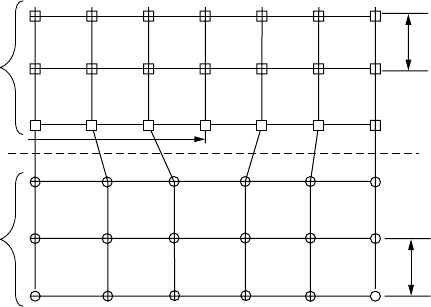
materials, which leads to dangling bonds as shown in Fig. 8.58.
One way to sort out the best materials to use for the n-layer of CdTe cells is
based on the mismatch of their lattice dimensions as expressed by their lattice
constants (the a
1
, a
2
dimensions shown in Fig. 8.58). One compound that is often
used for the n-layer is cadmium sulfide CdS, which has a lattice mismatch of
9.7% with CdTe.
The band gap for CdTe is 1.44 eV, which puts it very close to the optimum for
terrestrial cells. Thin-film laboratory cells using the n-CdS/p-CdTe heterojunction
have efficiencies approaching 16% and prototype modules are reaching efficien-
cies beyond 9%. The equipment needed to manufacture these cells is orders
of magnitude cheaper than that required for x-Si, and their relatively high effi-
ciency makes them attractive candidates for mass production. While CdTe cells
were used for years on pocket calculators made by Texas Instruments, full-scale
modules have not yet successfully entered the marketplace.
One aspect of CdS/CdTe cells that needs to be considered carefully is the
potential hazard to human health and the environment associated with cadmium.
Cadmium is a very toxic substance, and it is categorized as a probable human
carcinogen. Use of cadmium during the manufacture of CdTe cells needs to be
carefully monitored and controlled to protect worker health, but apparently nec-
essary safety precautions are relatively straightforward. Waste cadmium produced
during the manufacturing process needs to be kept out of the environment and
Material #1
e.g., Cds
Material #2
e.g., CdTe
Dangling bond
a
2
a
1
Heterojunction
Lattice
constant
Figure 8.58 The mismatch between heterojunction materials leads to dangling bonds
as shown.
500 PHOTOVOLTAIC MATERIALS AND ELECTRICAL CHARACTERISTICS
should be recycled. The question then arises as to what precautions are necessary
once modules have been manufactured and installed. CdS/CdTe modules contain
about 6 g of cadmium per square meter of surface area, but it is completely sealed
inside of the module so it should pose no risk under normal circumstances. If
all of the cadmium in a rooftop PV system were to vaporize in a fire, however,
and be inhaled by an individual, it would be pose a very serious health risk. But
the likelihood of someone inhaling enough cadmium to cause harm without also
having inhaled a lethal dose of smoke is considered to be insignificantly small.
8.9.4 Copper Indium Diselenide (CIS)
The goal in exploring compounds made up of a number of elements is to find
combinations with band gaps that approach the optimum value while minimiz-
ing inefficiencies associated with lattice mismatch. Copper indium diselenide,
CuInSe
2
, better known as “CIS,” is a ternary compound consisting of one ele-
ment, copper, from the first column of the Periodic Table, another from the
third column, indium, along with selenium from the sixth column. It is there-
fore referred to as a I–III–VI material. A simplistic way to think about this
complexity is to imagine that the average properties of Cu (Group I) and In
(Group III) are somewhat like those of an element from the second column
(Group II), so the whole molecule might be similar to a II–VI compound such
as CdTe (Bube, 1998).
While the crystal structure of silicon is a simple tetrahedral that is easy to
understand and visualize, crystalline CuInSe
2
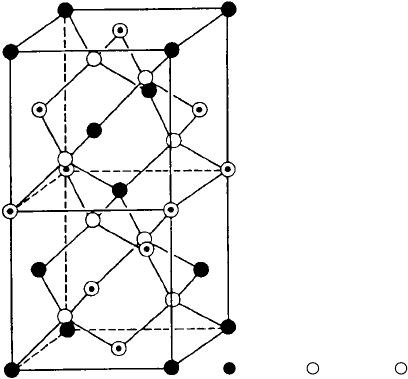
is much more complicated. As
shown in Fig. 8.59, each selenium atom serves as the center of a tetrahedron of
.
( ) = Cu, ( ) = In, ( ) = Se
Figure 8.59 The crystalline structure of CuInSe
2
or “CIS.” From Bube (1998) based
on Kazmerski and Wagner (1985).
REFERENCES 501
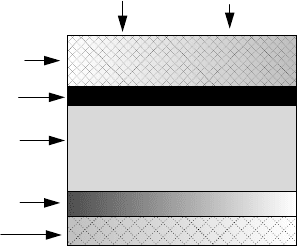
Transparent conductor
n
-type (CdZn)S (≈50 nm)
p
-type Cu In Se
2
(≈2000 nm)
Back metal conductor (200 nm)
Glass substrate
Sunlight
Figure 8.60 Structure of a simple, thin-film copper indium diselenide (CIS) cell.
two Cu and two In atoms, and each Cu atom is the center of a tetrahedron of
selenium atoms.
CIS cells often use a thin layer of cadmium and zinc sulfide (CdZn)S for the
n-layer as shown in Fig. 8.60.
With the substitution of gallium for some of the indium in the CIS material, the
relatively low 1.04-eV band gap of CIS is increased and efficiency is improved.
This is consistent with our interpretation of the Periodic Table in which band gap
increases for elements in higher rows of the table (Ga is above In). The resulting
CuIn
1−x
Ga
x
Se
2
alloy is called “CIGS” for short. By 2003, laboratory CIGS cells
had achieved efficiencies of almost 20% and production modules had efficiencies
in the range of 8 to 10%.
REFERENCES
Adams, W. G., and R. E. Day (15 June 1876). The Action of Light on Selenium, Pro-
ceedings of the Royal Society, vol. A25, pp. 113–117.
Becquerel, E. (4 November 1839). Memoire sur les effets electriques produits sous
l’influence des rayons solaires, Comptes Rendus, vol. 9, pp. 561–564.
Bube, R. H. (1998). Photovoltaic Materials, Imperial College Press, London.
Carlson, D. E., and C. R. Wronski (1976). Amorphous Silicon Solar Cell, Applied Physics
Letters, vol. 28:11: 671–773.
Chittick, R. C., J. H. Alexander, and H. F. Sterling (1969). The Preparation and Proper-
ties of Amorphous Silicon, Journal of the Electrochemical Society, vol. 116; pp. 77–81.
ERDA/NASA (1977). Terrestrial Photovoltaic Measurement Procedures. ERDA/NASA
NASA/1022-77/16, NASA TM 73702, Cleveland, Ohio.
Green, M. (1993). Crystalline-and-Polycrystalline Solar Cells, Renewable Energy:
Sources for Fuels and Electricity, T. B. Johansson, H. Kelly, A. K. N. Reddy, and
R. H. Williams (eds.), Island Press, Washington, D.C.
Hersel, P., and K. Zweibel (1982). Basic Photovoltaic Principles and Methods,Solar
Energy Research Institute, Golden, CO.
502 PHOTOVOLTAIC MATERIALS AND ELECTRICAL CHARACTERISTICS
Kazmerski, L., and S. Wagner (1985). Current Topics in Photovoltaics,T.J.Couttsand
J. D. Meakin (eds.), Academic Press, London, p. 41.
Kuehn, T. H., J. W. Ramsey, and J. L. Threlkeld (1998). Thermal Environmental Engi-
neering, 3rd ed., Prentice-Hall, Englewood Cliffs, NJ.
Maycock, P. (2004). The State of the PV Market, Solar Today, Jan/Feb pp 32–35.
Schmela, M. (2000). Do You Remember S-Web?, Photon International, The Photovoltaic
Magazine, September.
SERI (1985). Photovoltaics Technical Information Guide, Solar Energy Research Institute,
SERI/SP-271-2452, U.S. Department of Energy, Washington, D.C.
PROBLEMS
8.1 For the following materials, determine the maximum wavelength of solar
energy capable of creating hole-electron pairs:
a. Gallium arsenide, GaAs, band gap 1.42 eV.
b. Copper indium diselenide, CuInSe
2
, band gap 1.01 eV
c. Cadmium sulfide, CdS, band gap 2.42 eV.
8.2 A p-n junction diode at 25
◦
C carries a current of 100 mA when the diode
voltage is 0.5 V. What is the reverse saturation current, I
0
?
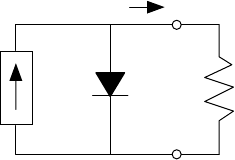
8.3 For the simple equivalent circuit for a 0.005 m
2
photovoltaic cell shown
below, the reverse saturation current is I
0
= 10
−9
A and at an insolation of
1-sun the short-circuit current is I
SC
= 1A,.At25
◦
C, find the following:
I
SC
I
d
Load
I
V
+
−
Figure P8.3
a. The open-circuit voltage.
b. The load current when the output voltage is V = 0.5V.
c. The power delivered to the load when the output voltage is 0.5 V.
d. The efficiency of the cell at V = 0.5V.
8.4 The equivalent circuit for a PV cell includes a parallel resistance of R
P
=
10 . The cell has area 0.005 m
2
, reverse saturation current of I
0
= 10
−9
A
and at an insolation of 1-sun the short-circuit current is I
SC
= 1A,At25
◦
C,
with an output voltage of 0.5 V, find the following:
PROBLEMS 503
I
SC
I
d
R
P
I
V
Load
+
−
Figure P8.4
a. The load current.
b. The power delivered to the load.
c. The efficiency of the cell.
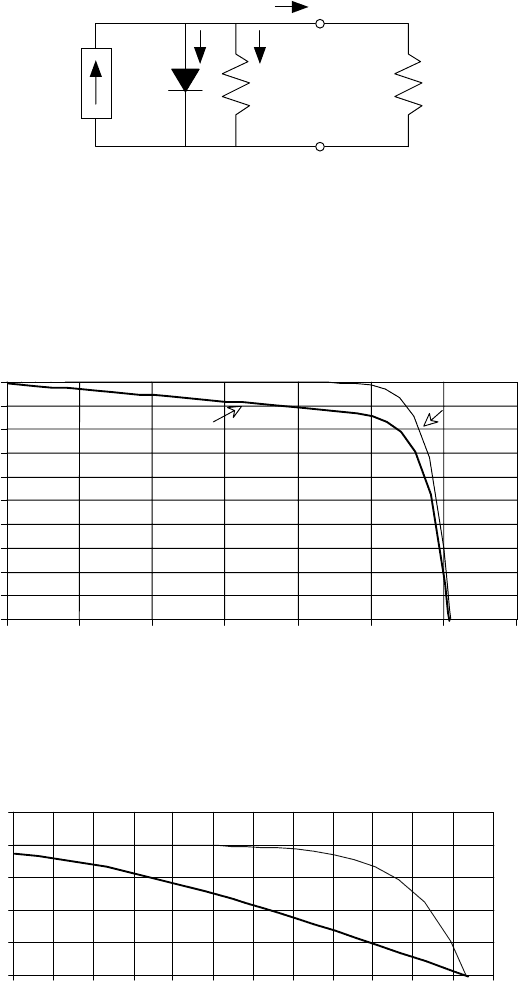
8.5 The following figure shows two I-V curves. One is for a PV cell with an equiv-
alent circuit having an infinite parallel resistance (and no series resistance).
What is the parallel resistance in the equivalent circuit of the other cell?
0.70.60.50.40.30.20.10.0
2.0
2.2
2.4
2.6
2.8
3.0
3.2
3.4
3.6
3.8
4.0
Voltage (V)
Current (A)
Infinite
Rp
Rp
= ?
Figure P8.5
8.6 The following figure shows two I-V curves. One is for a PV cell with an
equivalent circuit having no series resistance (and infinite parallel resistance).
What is the series resistance in the equivalent circuit of the other cell?
0.640.620.600.580.560.540.520.500.480.460.440.420.40
0
1
2
3
4
5
Voltage (V)
Current (A)
Rs
= 0
Rs
= ?
Figure P8.6
504 PHOTOVOLTAIC MATERIALS AND ELECTRICAL CHARACTERISTICS
8.7 Estimate the cell temperature and power delivered by a 100-W PV module
with the following conditions. Assume 0.5%/
◦
C power loss.
a. NOCT = 50
◦
C, ambient temperature of 25
◦
C, insolation of 1-sun.
b. NOCT = 45
◦
C, ambient temperature of 0
◦
C, insolation of 500 W/m
2
.
c. NOCT = 45
◦
C, ambient temperature of 30
◦
C, insolation of 800 W/m
2
.
8.8 A module with 40 cells has an idealized, rectangular I-V curve with I
SC
=
4AandV
OC
= 20 V. If a single cell has a parallel resistance of 5 and
negligible series resistance, draw the I-V curve if one cell is completely
shaded. What current would it deliver to a 12-V battery (vertical I-V load
at 12 V)?
I
V
20 V
4A
40 cells in series
Figure P8.8
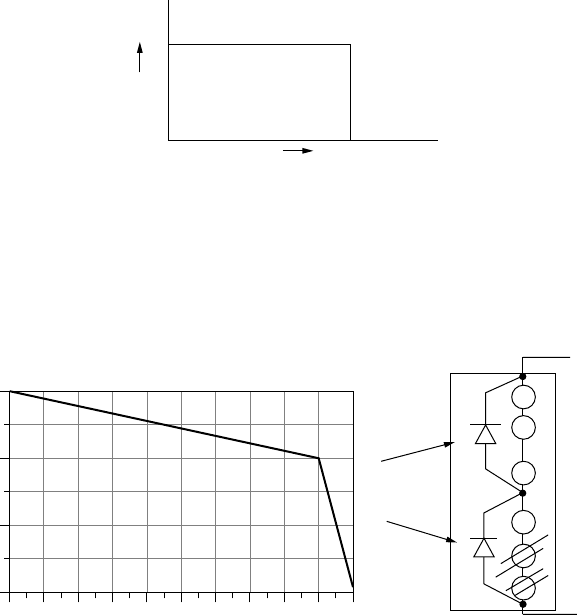
8.9 Suppose a PV module has the 1-sun I-V curve shown below. Within the
module itself, the manufacturer has provided a pair of bypass diodes to help
the panel deliver some power even when many of the cells are shaded. Each
diode bypasses half of the cells, as shown. You may consider the diodes to
be “ideal;” that is, they have no voltage drop across them when conducting.
20181614121086420
0
1
2
3
Volts
Amps
1-sun
Shaded
cells
By-pass
diodes
Figure P8.9
Suppose there is enough shading on the bottom cells to cause the lower diode
to start conducting. Draw the new “shaded” I-V curve for the module.

CHAPTER 9
PHOTOVOLTAIC SYSTEMS
9.1 INTRODUCTION TO THE MAJOR PHOTOVOLTAIC SYSTEM
TYPES
The focus of this chapter is on the analysis and design of photovoltaic (PV)
systems in their three most commonly encountered configurations: systems that
feed power directly into the utility grid, stand-alone systems that charge batteries,
perhaps with generator back-up, and applications in which the load is directly
connected to the PVs as is the case for most water-pumping systems.
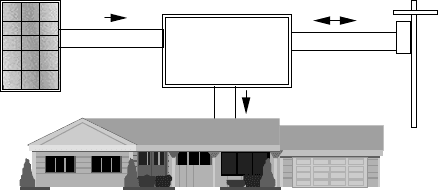
Figure 9.1 shows a simplified diagram of the first of these systems—a grid-
connected or utility interactive (UI) system in which PVs are supplying power
to a building. The PV array may be pole-mounted, or attached externally to
the roof, or it may become an integral part of the skin of the building itself.
PV roofing shingles and thin-film PVs applied to glazing serve dual purposes,
power, and building structure, and when that is the case the system is referred
to as building-integrated photovoltaics (BIPV).
The photovoltaics in a grid-connected system deliver dc power to a power
conditioning unit (PCU) that converts dc to ac and sends power to the building.
If the PVs supply less than the immediate demand of the building, the PCU draws
supplementary power from the utility grid, so demand is always satisfied. If, at
any moment, the PVs supply more power than is needed, the excess is sent back
onto the grid, potentially spinning the electric meter backwards. The system is
relatively simple since failure-prone batteries are not needed for back-up power,
although sometimes they may be included if utility outages are problematic. The
Renewable and Efficient Electric Power Systems. By Gilbert M. Masters
ISBN 0-471-28060-7
2004 John W iley & Sons, Inc.
505
506 PHOTOVOLTAIC SYSTEMS
Power
Conditioning
Unit
dc
ac
ac
PVs
Utility
Grid
Figure 9.1 Simplified grid-connected PV system.
power-conditioning unit also helps keep the PVs operating at the most efficient
point on their I –V curves as conditions change.
Grid-connected PV systems have a number of desirable attributes. Their rela-
tive simplicity can result in high reliability; their maximum-power-tracking unit
assures high PV efficiency; their potential to be integrated into the structure of
the building means that there are no additional costs for land and, in some cases,
materials displaced by PVs in such systems may offset some of their costs; and
finally, their ability to deliver power during the middle of the day, when utility
rates are highest, increases the economic value of their kilowatt-hours. All of
these attributes contribute to the cost effectiveness of these systems. On the other
hand, they have to compete with the relatively low price of utility power.
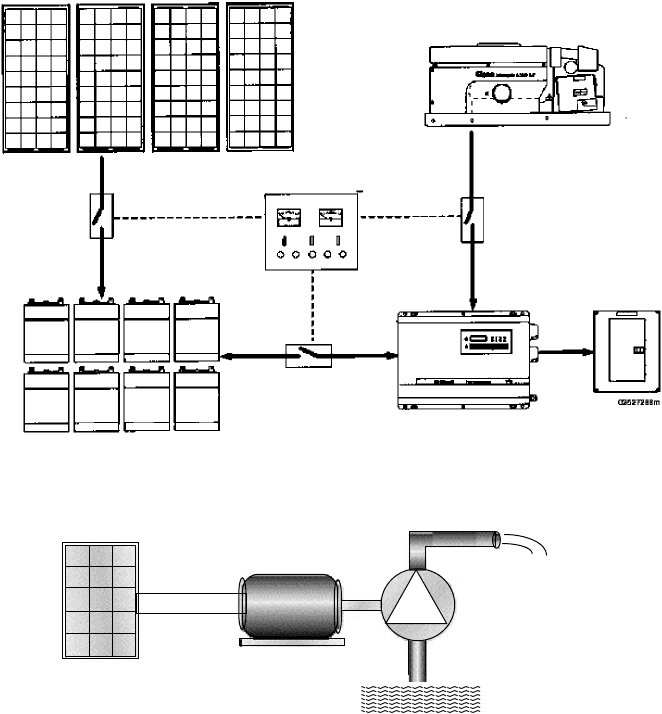
Figure 9.2 shows the second system, which is an off-grid, stand-alone system
with battery storage and a generator for back-up power. In this particular system,
an inverter converts battery dc voltages into ac for conventional household elec-
tricity, but in very simple systems everything may be run on dc and no inverter
may be necessary. The charging function of the inverter allows the generator to
top up the batteries when solar is insufficient.
Stand-alone PV systems can be very cost effective in remote locations where
the only alternatives may be noisy, high-maintenance generators burning rela-
tively expensive fuel, or extending the existing utility grid to the site, which can
cost thousands of dollars per mile. These systems suffer from several inefficien-
cies, however, including battery losses and the fact that the PVs usually operate
well off of the their most efficient operating point. Moreover, inefficiencies are
often increased by mounting the array at an overly steep tilt angle to supply
relatively uniform amounts of energy through the seasons, rather than picking an
angle that results in the maximum possible annual energy delivery. These sys-
tems also require much more attention and care than stand-alone systems; and if
generator usage is to be minimized (or eliminated), those using the energy may
need to modify their lifestyles to accommodate the uneven availability of power
as the seasons change or the weather deteriorates.
The third system type that we will pay close attention to has photovoltaics
directly coupled to their loads, without any batteries or major power conditioning
equipment. The most common example is PV water pumping in which the wires
from the array are connected directly to the motor running a pump (Fig. 9.3).
INTRODUCTION TO THE MAJOR PHOTOVOLTAIC SYSTEM TYPES 507
PV Array
Control Panel/Charge Controller
Generator (optional)
Batteries
AC
Distribution
Panel
Inverter/charger
Figure 9.2 Example of a stand-alone PV system with optional generator for back-up.
dc
PVs
dc Motor
Pump
Source
water
Supply
water
Figure 9.3 Conceptual diagram of a photovoltaic-powered water pumping system.
When the sun shines, water is pumped. There is no electric energy storage, but
potential energy may be stored in a tank of water up the hill for use whenever
it is needed. These systems are the ultimate in simplicity and reliability and are
the least costly as well. But they need to be carefully designed to be efficient.
Our goal in this chapter is to try to learn how to properly size photovoltaic
systems to provide for these various types of loads. Power delivered by a pho-
tovoltaic system will be a function of not only ambient conditions—especially
solar intensity, spectral variations associated with overcast conditions, ambient
temperature, and windspeed—but also what type of load the photovoltaics are
supplying. As we shall see, very different analysis procedures apply to grid-
connected systems, battery-charging stand-alone systems, and directly coupled
water pumping systems.