
Masters G.M. Renewable and Efficient Electric Power Systems
Подождите немного. Документ загружается.


528 PHOTOVOLTAIC SYSTEMS
PVs perform better, the PTC would underestimate energy delivered, and in hot
climates the opposite would occur.
9.3.3 The ‘‘Peak-Hours’’ Approach to Estimating PV Performance
Predicting performance is a matter of combining the characteristics of the major
components—the PV array and the inverter—with local insolation and temper-
ature data. After having adjusted dc power under STC to expected ac from the
inverter, the second key factor is the amount of sun available at the site. Chapter 7
was devoted to developing equations for clear sky insolation, and tables of values
are given in Appendices C and D. In Appendix E there are tables of estimated
average insolations for a number of locations in the United States and Appendix
F presents seasonal averages around the globe.
When the units for daily, monthly, or annual average insolation are specifically
kWh/m
2
-day, then there is a very convenient way to interpret that number. Since
1-sun of insolation is defined as 1 kW/m
2
, we can think of an insolation of say
5.6 kWh/m
2
-day as being the same as 5.6 h/day of 1-sun, or 5.6 h of “peak sun.”
So, if we know the ac power delivered by an array under 1-sun insolation (P
ac
),
we can just multiply that rated power by the number of hours of peak sun to get
daily kWh delivered.
To see whether this simple approach is reasonable, consider the following
analysis. We can write the energy delivered in a day’s time as
Energy (kWh/day) = Insolation
kWh/m
2
day
· A(m
2
) · η(9.11)
where A is the area of the PV array and
η is the average system efficiency over
the day.
When exposed to 1-sun of insolation, we can write for ac power from the system
P
ac
(kW) =
1kW
m
2
· A(m
2
) · η
1−sun
(9.12)
where η
1−sun
is the system efficiency at 1-sun. Combining (9.11) and (9.12) gives
Energy (kWh/day) = P
ac
(kW) ·
Insolation (kWh/m
2
/day)
1kW/m
2
.
η
η
1−sun
(9.13)
If we assume that the average efficiency of the system over a day’s time is the
same as the efficiency when it is exposed to 1-sun, then the energy collected is
what we hoped it would be
Energy (kWh/day) = P
ac
(kW) · (h/day of “peak sun”)(9.14)

GRID-CONNECTED SYSTEMS 529
The key assumption in (9.14) is that system efficiency remains pretty much
constant throughout the day. The main justification is that these grid-connected
systems have maximum power point trackers that keep the operating point near
the knee of the I –V curve all day long. Since power at the maximum point is
nearly directly proportional to insolation, system efficiency should be reasonably
constant. Cell temperature also plays a role, but it is less important. Efficiency
might be a bit higher than average in the morning, when it is cooler and there is
less insolation, but all that will do is make (9.14) slightly conservative.
The value of something like the ac PTC rating system is now quite apparent.
Using it to indicate system ac power at 1-sun, coupled with the interpreta-
tion of kWh/m
2
-day as hours of peak sun, gives us an easy way to estimate
energy production.
Example 9.4 Annual Energy Using the Peak-Sun Approach. Estimate the
annual energy delivered by the 1-kW (dc, STC) array described in Example 9.3
if it located in Madison, WI, is south-facing, and has a tilt angle equal to its
latitude minus 15
◦
. Use the PTC ac rating.
Solution. Appendix E shows the annual insolation in Madison at L-15 is
4.5 kWh/m
2
-day. Using the de-rated ac output of 0.72 kW (ac, PTC) that was
found in Example 9.3, along with 4.5 h/day of peak sun, gives
Energy = 0.72 kW ×4.5h/day × 365 day/yr = 1183 kWh/yr
The PTC rating assumes a nominal ambient of 20
◦
C, which is a pretty good
average estimate for many locations in the United States. We could expect it to
overpredict performance when it is hotter than that, and underpredict when it is
cooler. To test this, let us rework Example 9.4 on a monthly basis using Madison
ambient temperature instead of the assumed 20
◦
C.
Example 9.5 Correcting Predicted Performance for Temperature Effects.
Estimate the energy that the 1-kW (dc, STC) array described in Example 9.3
would deliver in Madison in January. Assume south-facing with tilt = L-15 and
use the average daily maximum temperature instead of the 20
◦
C assumed by
PTC. The nominal operating cell temperature (NOCT) was given as 47
◦
Cfor
this array.

530 PHOTOVOLTAIC SYSTEMS
Solution. In Appendix E, the average daily maximum temperature for Madison in
January is given as −4.0
◦
C. When it is that cold, (8.24) estimates cell temperature
at 1-sun to be
T
cell
= T
amb
+
NOCT − 20
0.8
· S
=−4.0 +
47 − 20
0.8
· 1 = 29.8
◦
C
With power loss at 0.5% per degree above 25
◦
C, the dc rated power of the array
without dirt and mismatched modules would be
P
dc
= 1kW[1− 0.005(29.8 − 25)] = 0.98 kW
For comparison, in Example 9.3 the cell temperature at PTC was a much warmer
53.8
◦
C and the dc power was
P
dc(PT C)
= 1kW[1− 0.005(53.8 − 25)] = 0.856 kW
In other words, the array will perform considerably better than PTC would have
predicted because it is so cold in Madison.
Including mismatch, dirt and inverter efficiencies given in Example 9.3, yields
an estimated ac rated power at of
P
ac
= 0.98 kW × 0.97 × 0.96 × 0.90 = 0.82 kW
Appendix E gives January insolation at L-15 in Madison as 3.0 kWh/m
2
or
3.0 h/day of 1-sun. So we estimate this 1 kW array will deliver
Energy = 0.82 kW × 3.0h/day × 31 day/mo = 76 kWh/mo
It is easy to systematize calculations of the sort demonstrated in Example 9.5
so that actual site temperature data can be used instead of the 20
◦
C assumed
in PTC. A spreadsheet for the 1-kW (dc) Madison system using the same dirt,
mismatch, and inverter assumptions is demonstrated in Table 9.2. Notice that the
PTC estimate for annual energy found in Example 9.4 was 1183 kWh/yr, and this
more carefully done spreadsheet gives 1202 kWh. The difference is negligible.
A similar comparison for Phoenix, which is a much hotter place than Madison,
results in a 7% overestimate using PTC. These differences are so small that it

GRID-CONNECTED SYSTEMS 531
TA BLE 9.2 Estimated Energy Delivered by a 1-kW (dc, STC) PV Array in
Madison, WI, Using Average Maximum Monthly Temperatures to Compute
Performance Degradation
a
Madison, WI, South L-15
dc Power 1 kW at STC
Temp. coef. 0.5%/
◦
C
Mismatch 0.03
Dirt 0.04
Inverter 0.90
NOCT 47
◦
C
Month
Insolation
(kWh/m
2
-day)
Avg Max
Temp. (
◦
C)
Cell
Temp.
(
◦
C)
Array dc
Power
(kW)
Array ac
Power
(kW)
Energy
(kWh/mo)
Jan 3.0 −4.0 29.8 0.98 0.82 76
Feb 3.9 −1.1 32.7 0.96 0.81 88
Mar 4.5 5.3 39.1 0.93 0.78 109
Apr 5.1 13.7 47.5 0.89 0.74 114
May 5.8 20.5 54.3 0.85 0.72 129
Jun 6.2 25.7 59.5 0.83 0.69 129
July 6.2 28.0 61.8 0.82 0.68 131
Aug 5.7 26.4 60.2 0.82 0.69 122
Sept 4.8 21.9 55.7 0.85 0.71 102
Oct 3.8 15.5 49.3 0.88 0.74 87
Nov 2.5 6.7 40.5 0.92 0.77 58
Dec 2.3 −1.2 32.6 0.96 0.81 57
Avg: 4.5 13.2 kWh/yr = 1202
a
Inverter, mismatch, and dirt losses from Example 9.3 are included.
would appear that using the simpler PTC approach is quite reasonable under a
wide range of temperature conditions.
One of the most useful ways to describe energy production from a PV array
is in terms of kWh/yr delivered per kW of STC rated power. Table 9.3 presents
such data for a number of U.S. cities. The table has been derived following the
methods presented in Example 9.5. Temperature and insolation data are from
Appendix E. A 90% efficient inverter, a long with 3% module mismatch and
4% dirt depreciation were assumed. Annual energy delivered for south-facing
modules tilted at the latitude −15
◦
ranges from about 1000 kWh per kW (dc,
STC) in Seattle, to over 1600 kWh/kW in Albuquerque. When a single-axis E–W
tracker with polar tilt angle is used, annual production increases by 24–36%.
Table 9.3 suggests a very crude rule-of-thumb for annual performance of a
grid-connected system in a pretty good location:
Each 1 kW of dc, STC-rated PV will deliver an average of roughly
1400 kWh per year.
532 PHOTOVOLTAIC SYSTEMS
TA BLE 9.3 Annual Energy Production in Various Cities per kW (dc, STC) of
Installed PV Capacity
a
South Facing, L-15 Fixed 1-Axis, Polar Mount
Location
Average
High Temp.
(
◦
C)
Insolation
(kWh/
m
2
-d)
Annual
kWh/kW
Insolation
(kWh/
m
2
-d)
Annual
kWh/kW
Ratio
1-axis/
Fixed
Seattle, WA 15.3 3.8 1006 4.7 1247 1.24
New York, NY 16.8 4.5 1195 5.6 1479 1.24
Madison, WI 13.2 4.5 1202 5.7 1519 1.26
Boston, MA 15.0 4.5 1209 5.7 1529 1.26
Atlanta, GA 21.8 5.0 1294 6.4 1639 1.27
Honolulu, HI 29.1 5.5 1373 7.4 1834 1.34
Boulder, CO 17.9 5.3 1404 7.2 1885 1.34
Los Angeles, CA 21.3 5.5 1420 7.0 1808 1.27
El Paso, TX 25.3 6.3 1583 8.6 2159 1.36
Albuquerque, NM 21.2 6.3 1618 8.5 2199 1.36
a
Assumed inverter efficiency 90%, mismatching loss 3%, dirt loss 4%
0
Jan Feb Mar Apr May Jun Jly Aug Sep Oct Nov Dec
40
80
120
160
200
Los Angeles
Seattle
Boston
Albuquerque
MONTHLY ENERGY (kWh/kWdc)
TILT = L − 15
Albuquerque
Los Angeles
Boston
Seattle
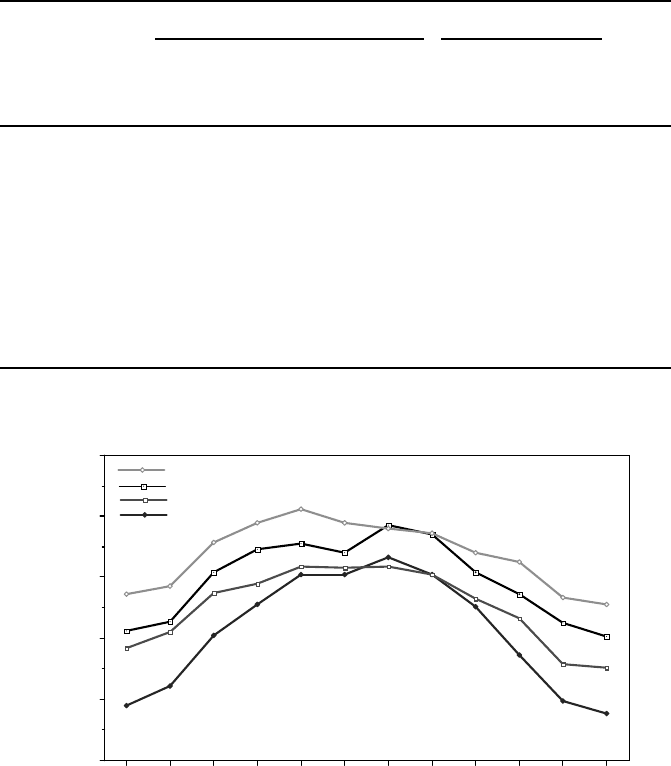
Figure 9.26 Monthly energy production for four cities in kWh per kW (dc, STC) for
fixed south-facing, L-15 tilt. Assumed inverter efficiency 90%, mismatch loss 3%, dirt
loss 4%. Includes local temperature impacts.
Figure 9.26 shows monthly values of kWh/kW for four U.S. cities that pretty
much represent the range of likely performance across the coterminous states. A
couple of features are worth pointing out. In Albuquerque, the decline in output
after it peaks in May is due in large part to the high summer temperatures. At the
other extreme, Seattle, with latitude about as high as it gets in the coterminous
GRID-CONNECTED SYSTEMS 533
0
JFMAMJJASOND
40
80
120
160
200
240
ALBUQUERQUE
kWh/kWdc
L-15
1-axis
JFMAMJJASOND
0
40
80
120
160
200
LOS ANGELES
kWh/kWdc
1-axis
L-15
0
40
80
120
160
200
JFMAMJJASOND
BOSTON
kWh/kWdc
1-axis
L-15
JFMAMJJASOND
0
40
80
120
160
200
SEATTLE
kWh/kWdc
1-axis
L-15
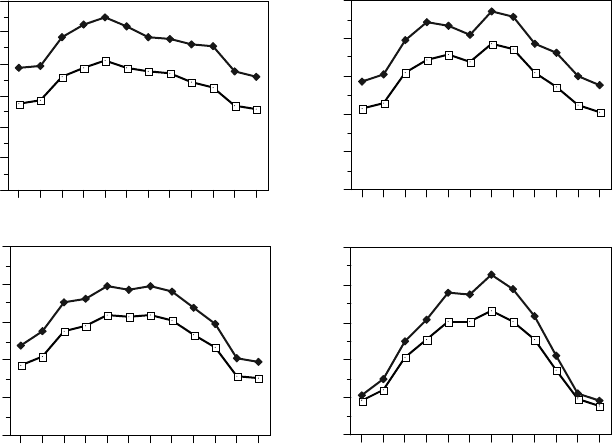
Figure 9.27 Comparing energy delivered from fixed L-15 tilt with single-axis polar
tracking.
states, does quite well in the summer due to long, clear, relatively cool days.
Figure 9.27 shows the improvement in monthly performance for those four cities
when a single-axis polar mount tracker is incorporated into the system.
9.3.4 Capacity Factors for PV Grid-Connected Systems
A simple way to present the energy delivered by any electric power generation
system is in terms of its rated ac power and its capacity factor (CF). If the system
delivered full, rated power continuously, the CF would be unity. A CF of 0.4, for
example, could mean that the system delivers full-rated power 40% of the time
and no power at all the rest of the time, but that is not the only interpretation. It
could also deliver 40% of rated power all of the time and still have CF = 0.4,
or any of a number of other combinations.
The governing equation for annual performance in terms of CF is simply
Energy (kWh/yr) = P
ac
(kW) · CF · 8760(h/yr)(9.15)
where 8760 is the product of 24 hours per day times 365 days per year. Monthly
or daily capacity factors are similarly defined.
534 PHOTOVOLTAIC SYSTEMS
Combining (9.14) and (9.15) leads to the simple interpretation of capacity
factor for grid-connected PV systems:
Capacity factor (CF) =
(h/day of “peak sun”)
24 h/day
(9.16)
Notice that the complication associated with temperature is included in the defini-
tion of P
ac
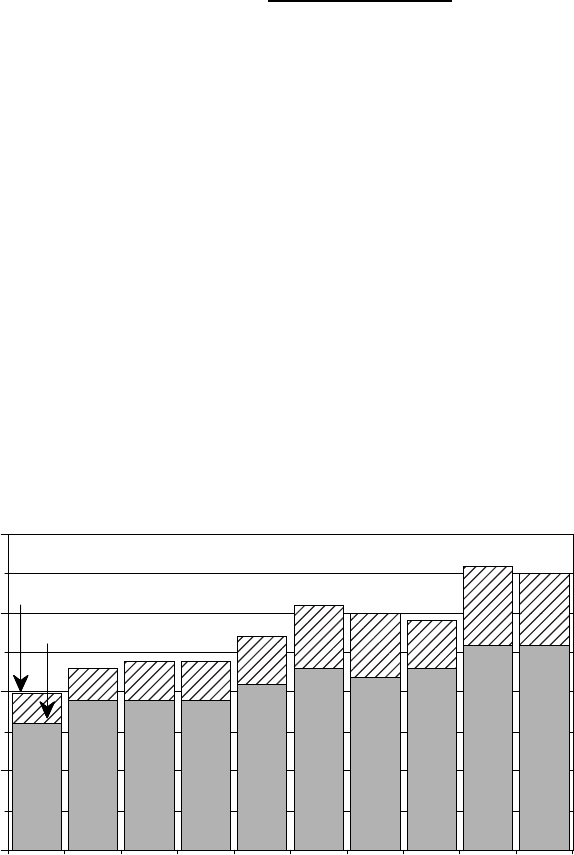
so it doesn’t affect CF. Capacity factors for a number of U.S. cities are
shown in Fig. 9.28. They range from 0.16 to 0.26 for fixed, south-facing panels
at tilt L-15 and range from 0.20 to 0.36 for single-axis polar-mount trackers.
9.3.5 Grid-Connected System Sizing
With the utility there to provide energy storage and back-up power, sizing grid-
connected systems is not nearly as critical as it is for stand-alone systems.
Moreover, there are few economies of scale with these systems—it costs roughly
twice as much to install a system that will deliver twice as much energy. Sizing
grid-connected systems therefore is more a matter of how much area is conve-
niently available on the building, and the budget of the buyer, than it is trying to
match supply to demand. It is, nonetheless, very important to be able to predict
as accurately as possible the annual energy delivered by the system in order to
decide whether it makes economic sense. Certain components will dictate some
of the details, but what has already been developed on rated ac power and “peak
hours” of insolation provides a good start to system design.
Seattle
New York
Madison
Boston
Atlanta
Honolulu
Boulder
Los Angeles
El Paso
Albuquerque
0.0
0.1
0.2
0.3
0.4
1-Axis Polar
CAPACITY FACTOR
Fixed L-15
Figure 9.28 AC photovoltaic capacity factors for a number of U.S. cities.

GRID-CONNECTED SYSTEMS 535
As an academic exercise, system sizing is straightforward. How many kWh/yr
are required? How many peak watts of dc PV power are needed to provide
that amount? How much area will that system require? The realities of design,
however, revolve around real components, which are available only in certain
sizes and which have their own design constraints. It is hard to find a collector
that is rated at 103.45 W. Available rooftop areas and orientations, whether a
pole-mount is physically and aesthetically acceptable, is a collector rack in the
yard viable, all affect system sizing. Some decisions require not only technical
data but cost data as well, such as whether a tracking system is more cost effective
than a fixed array. And certainly budget constraints dominate every decision.
Example 9.6 System Sizing in Fresno, CA: A First Cut. An energy efficient
house in Fresno is to be fitted with a rooftop PV array that will annually displace
all of the 3600 kWh/yr of electricity that the home uses. How many kW (dc,
STC) of panels will be required and what area will be needed? Make assumptions
as needed.
Solution. We’ll assume the roof is south-facing with a moderate tilt angle. Aes-
thetically, the array will look best if it is mounted at the same angle as the roof,
which means a shallow pitch. Data in Appendix E indicate 5.7 kWh/m
2
-day of
annual insolation for L-15, which at Fresno’s latitude of 37
◦
means a tilt of 22
◦
.
That’s probably a good estimate for the roof insolation.
Using the peak hour approach, we can write
Energy (kWh/yr) = P
ac
(kW) · (h/day @1-sun) · 365 days/yr
Solving
P
ac
=
3600 kWh/yr
5.7h/day × 365 days/yr
= 1.73 kW
Previous examples have shown how to individually estimate the impacts of
temperature, inverter efficiency, module mismatch, and dirt to come up with
conversion efficiency from dc to ac. Those results suggests that a de-rating of
about 25%, or an efficiency of 75%, is in the ballpark, so we’ll use that to
estimate the STC rated dc power of the array:
P
dc,ST C
=
P
ac
Conversion efficiency
=
1.73 kW
0.75
= 2.3kW
If we can estimate collector efficiency, we can find collector area from the following:
P
dc,ST C
= 1kW/m
2
insolation · A(m
2
) · η
536 PHOTOVOLTAIC SYSTEMS
Assuming crystalline silicon modules, Table 8.3 suggests that an efficiency of
about 12.5% is reasonable, resulting in an area estimate of
A =
2.3kW
1kW/m
2
· 0.125
= 18.4m
2
(198 ft
2
)
The procedure outlined in Example 9.6 illustrates the first step in grid-connected
system design, which is to estimate the rated power and area required for the PV
array. Local insolation in kWh/m
2
-day was a key site parameter, and the resulting
calculations included rough estimates for a de-rating from dc to ac power along
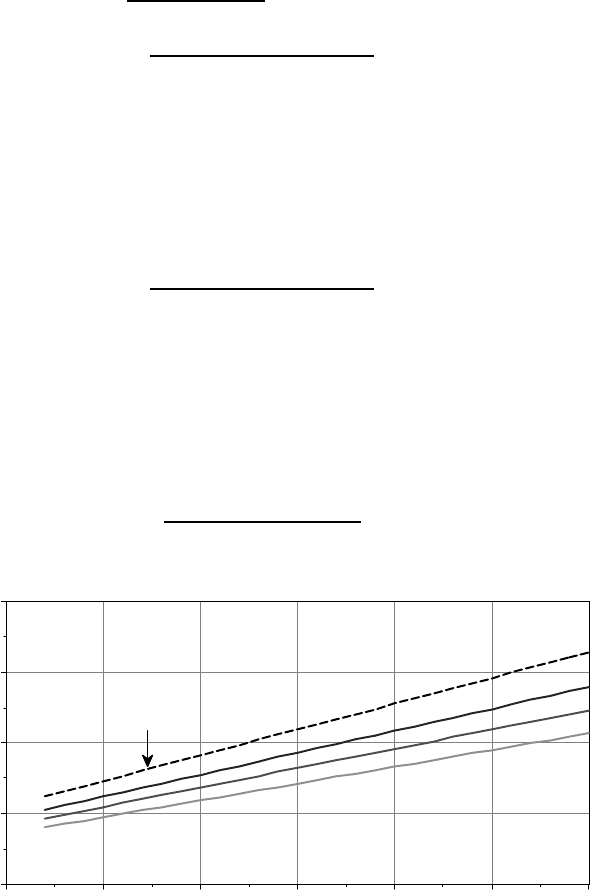
with the module efficiency. Figure 9.29 shows how the estimate of annual energy
production depends on the de-rating and local insolation, while Fig. 9.30 shows
how area required depends on module efficiency.
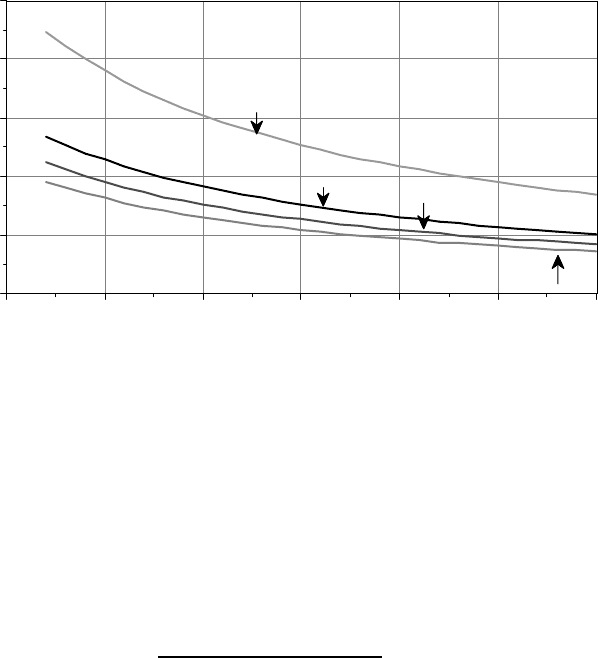
Example 9.7 Fresno House with a 1-Axis Polar Tracker. Use Figs. 9.29 and
9.30 to estimate the module rated power and area needed to deliver 3600 kWh/yr
in Fresno if a single-axis, polar mount tracker is used.
Solution. From Appendix E, annual insolation on a 1-axis tracker in Fresno is
7.6 kWh/m
2
-day. From Fig. 9.29 with the 75% dc-to-ac efficiency, the energy
delivered per kW (dc, STC) is about 2100 kWh/yr. This suggests that we need
P
dc,ST C
=
3600 kWh/yr
2100 kWh/yr/kW
dc,ST C
= 1.7kW
9876543
0
1000
2000
3000
4000
INSOLATION (kWh/m
2
-day)
ANNUAL ENERGY (kWh/yr/kW
dc
)
No Derating
0.85
0.75
0.65
1.0
Figure 9.29 Annual energy delivered by a 1 kW(dc, STC) PV array, with dc to ac
conversion efficiency as a parameter.
GRID-CONNECTED SYSTEMS 537
9876543
0
4
8
12
16
20
INSOLATION (kWh/m
2
-day)
AREA REQUIRED (m
2
per thousand kWh/yr)
Module efficiency 6%
10%
12%
14%
Figure 9.30 Area required to deliver 1000 kWh/yr with module efficiency as a param-
eter. Assumes a conversion efficiency from dc to ac of 75%.
This is considerably less than the 2.3 kW needed for the nontracking array in
Example 9.6. The extra cost of the tracker will need to be compared to the
reduction in cost of both the modules and the inverter.
From Fig. 9.30, the area of collectors at the assumed efficiency of 12.5% looks
like about 3.9 m
2
per 1000 kWh/yr. That is, the area would be about
Area = 3600 kWh/yr × 3.9m
2
/(1000 kWh/yr) = 14 m
2
Examples 9.6 and 9.7 illustrate the first step in grid-connected system design,
which is to estimate the rated power and area required for the PV array. The next
step is to explore the interactions between the choice of PV modules and inverters
and how those impact the layout of the PV array. Finally, we need to consider
details about voltage and current ratings for fuses, switches, and conductors.
Most traditional collectors on the market have 36 or 72 series cells in order to
satisfy 12- or 24-V battery charging applications. Higher-voltage, higher-power
modules are now becoming popular in grid-connected systems, for which battery-
voltage constraints no longer apply. The key characteristics for a number of
high-power modules intended for grid connections are given in Table 9.4.
Similarly, inverters for grid-connected systems are also different from those
designed for battery-charging applications. Grid-connected inverters, for example,
accept much higher input voltages and, as we shall see, those voltage constraints
very much affect how the PV array is configured. The most important parameters
for a number of inverters intended for grid-connected applications are given in
Table 9.5.