
Masters G.M. Renewable and Efficient Electric Power Systems
Подождите немного. Документ загружается.


518 PHOTOVOLTAIC SYSTEMS
An actual MPP tracker needs some way for the dc-to-dc converter to know
the proper duty cycle to provide at any given instant. This can be done with a
microprocessor that periodically varies the duty cycle up and down a bit while
monitoring the output power to see whether any improvement can be achieved.
Example 9.2 Duty Cycle for a MPPT. Under certain ambient conditions, a
PV module has its maximum power point at V
m
= 17 volts and I
m
= 6A.
What duty cycle should an MPPT have if the module is delivering power to
a 10 ohm resistance?
Solution. The maximum power delivered by the PVs is P = 17 V × 6A=
102 W. To deliver all of that 102 W to the 10 resistor means that the resistor
needs a voltage of
P =
V
R
2
R
= 102 =
V
R
2
10
V
R
=
√
102 · 10 = 31.9V
The MPPT must bump the 17-V PV voltage to the desired 31.9-V resistor voltage.
Using (9.9) and ignoring the sign change (it doesn’t matter), we obtain
31.9
17
=
D
1 − D
= 1.88
solving
D = 1.88 − 1.88D
D =
1.88
2.88
= 0.65
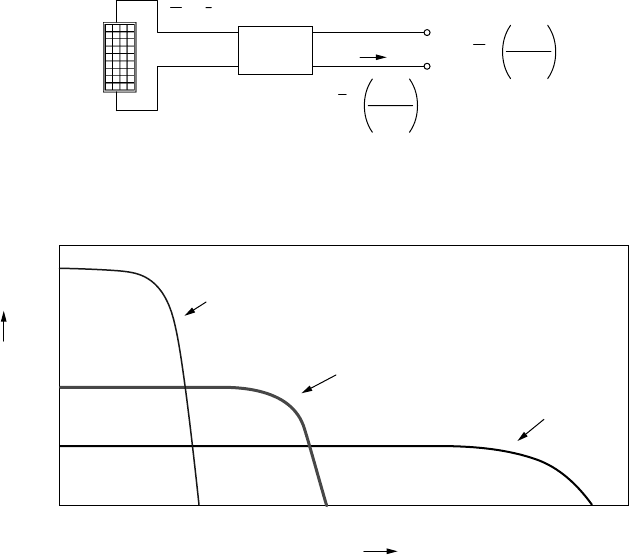
For a 100% efficient MPPT, the product of current and voltage (power) from
the PVs is the same as the current-voltage product delivered by the MPPT to
the load (Fig. 9.16). One way to visualize the impact of the MPPT is to redraw
the PV I –V curves using D as a parameter. For the MPPT’s output voltage and
current, one goes up and the other goes down compared with the original PV
I –V curve as shown in Fig. 9.17.
9.2.5 Hourly I–V Curves
As a typical solar day progresses, ambient temperature and available insolation
are constantly changing. That means, of course, that the I –V curveforaPV
array is constantly shifting and the operating point for any given load is constantly
CURRENT–VOLTAGE CURVES FOR LOADS 519
PVs
+
−
+
−
MPPT
V
=
V
PV
D
1 −
D
V
PV
,
I
PV
I
=
I
PV
D
1 −
D
Figure 9.16 The MPPT bumps the PV voltages and currents to appropriate values for
the load (one goes up, the other down).
CURRENT
Original
I
−
V
curve (
D
= 1/2)
D
= 1/3
D
= 2/3
I
SC
2
I
SC
V
OC
/2
V
OC
2
V
OC
I
SC
/2
VOLTAGE
Figure 9.17 Redrawing the PV I –V curves with an MPPT.
moving around as well. Manufacturers provide I –V curves for various tempera-
tures and solar intensity (e.g., Fig. 8.36), but there are times when hour-by-hour
curves are helpful.
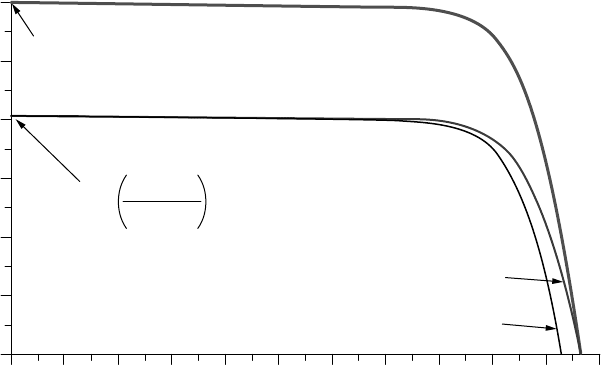
Over most of a PV I –V curve, current at any voltage is directly propor-
tional to insolation. That suggests we can simply scale the 1-sun (1000 W/m
2
)
I –V curve by moving it up or down in proportion to the anticipated insolation.
This generalization is completely true for short-circuit current I
SC
(i.e., V = 0).
Recall, however, that open-circuit voltage V
OC
decreases somewhat as insolation
decreases, so the simple assumption of current being proportional to insolation
breaks down near V
OC
. Under most circumstances, however, the operating volt-
age of a system is around the knee, or even lower, where current is very close to
being proportional to insolation. Figure 9.18 illustrates this point. In it, a 1-sun
I –V curve having I
SC
= 6 A has been drawn along with two I –V curves that
would be expected if insolation happened to be 677 W/m
2
. One of the curves
uses the assumption that current is proportional to insolation, the other properly
accounts for the drop in V
OC
as insolation decreases. As can be seen, there is
very little difference between the 677-W/m
2
curves as long as the module doesn’t
operate below the knee.
520 PHOTOVOLTAIC SYSTEMS
2220181614121086420
VOLTAGE (V)
CURRENT (A)
1-SUN (1000 W/m
2
)
9 a.m. 677 W/m
2
6
5
4
3
2
1
0
6.0
A ×
677 W/m
2
1000 W/m
2
= 4.1 A
6 A
Assuming
I
proportional
to insolation
Correct
I
Figure 9.18 The 1-sun I –V curve with two I –V curves when insolation is 677 W/m
2
:
One is drawn under the simplifying assumption that I is proportional to insolation; the
other accounts for the drop in V
OC
as insolation decreases. For voltages below the knee,
there is very little difference.
The simple assumption that current is proportional to insolation makes it easy
to draw hour-by-hour I –V curves for clear days. Techniques for estimating
hourly insolation on clear days were presented in Chapter 7, and Appendix C
has tables of values as well, so all we need to do is scale the 1-sun (1 kW/m
2
)
I –V curve in direct proportion to those estimated hourly solar intensities. Since
the 1-sun I –V curve itself depends on cell temperature, and cell temperature
depends on insolation and ambient temperature, we could imagine adjusting the
1-sun reference curve on an hour-by-hour basis as well. But since our purpose
is to illustrate certain principles, that degree of refinement will be ignored here.
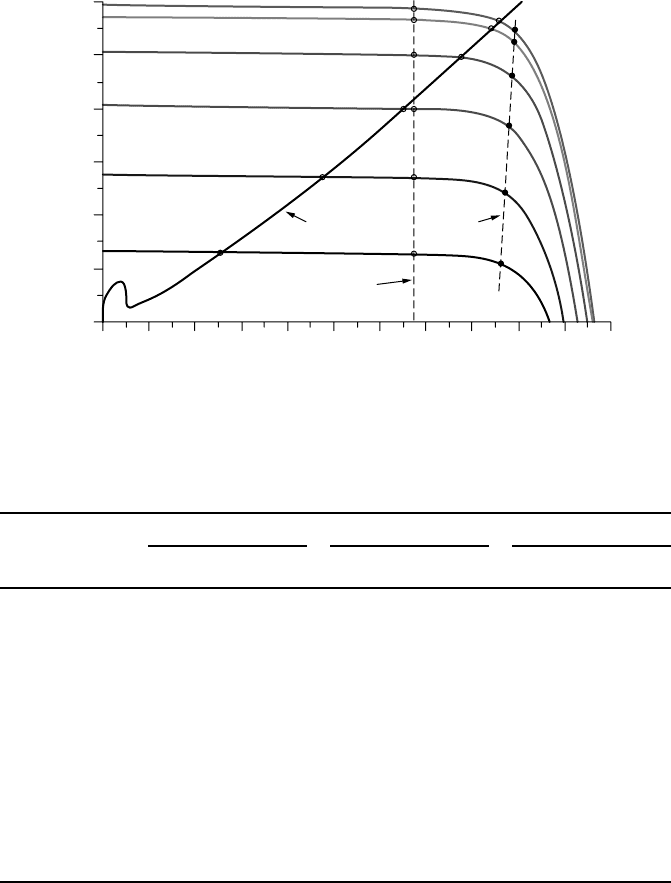
In Fig. 9.19, hourly PV I –V curves have been drawn using insolations cor-
responding to a south-facing collector in April at 40
◦
latitude with tilt angle
of 40
◦
using clear-sky values given in Appendix C. The module is the same
one used in the example in Fig. 9.18. Superimposed onto these I –V curves are
example I –V curves for three different kinds of loads: a dc motor, a 12-V battery
with a constant charging voltage of 13.5 V, and a maximum power point tracker
(MPPT). As can be seen, the dc motor has been well matched to the 1-sun I –V
curve, but does poorly in the early morning and late afternoon. The 12-V battery
is consistently somewhat below the maximum power point. Table 9.1 provides
a compilation of the hourly performance of each of these loads. The dc motor
loses about 15% of the available daily energy because it doesn’t operate at the
maximum power point while the 12-V battery loses 17%.
GRID-CONNECTED SYSTEMS 521
7, 5:
224 W/m
2
8, 4: 461 W/m
2
9, 3: 677 W/m
2
10, 2: 846 W/m
2
11, 1: 954 W/m
2
Noon: 991 W/m
2
2220181614121086420
VOLTAGE (V)
CURRENT (A)
6
5
4
3
2
1
0
dc motor
12-V
battery
MPPT
Figure 9.19 Hour-by-hour PV I –V curves with examples of three different load types:
dc motor, 12-V battery, MPPT.
TA BLE 9.1 Daily Energy Delivered to Three Loads
a
dc Motor 12-V Battery MPPT
Insolation
Time (W/m
2
) Amps Volts Watts Amps Volts Watts Amps Volts Watts
7 224 1.3 5.0 6.5 1.3 13.5 17.6 1.1 17.3 19.0
8 461 2.7 9.6 25.9 2.7 13.5 36.5 2.5 17.4 43.5
9 677 4.0 13.0 52.0 4.0 13.5 54.0 3.7 17.5 64.8
10 846 5.0 15.6 78.0 5.0 13.5 67.5 4.7 17.6 82.7
11 954 5.3 16.9 89.6 5.6 13.5 75.6 5.2 17.7 92.0
12 991 5.5 17.1 94.1 5.9 13.5 79.7 5.4 17.8 96.1
1 954 5.3 16.9 89.6 5.6 13.5 75.6 5.2 17.7 92.0
2 846 5.0 15.6 78.0 5.0 13.5 67.5 4.7 17.6 82.7
3 677 4.0 13.0 52.0 4.0 13.5 54.0 3.7 17.5 64.8
4 461 2.7 9.6 25.9 2.7 13.5 36.5 2.5 17.4 43.5
5 224 1.3 5.0 6.5 1.3 13.5 17.6 1.1 17.3 19.0
W-h: 7315 598 582 700
Eff. vs. MPPT: 85% 83% 100%
a
Without an MPPT, the dc motor is unable to collect 15% of the available energy and the 12-V battery loses 17%
9.3 GRID-CONNECTED SYSTEMS
Photovoltaic systems mounted on buildings are becoming increasingly popular as
prices decrease and the installation infrastructure becomes increasingly mature.
522 PHOTOVOLTAIC SYSTEMS
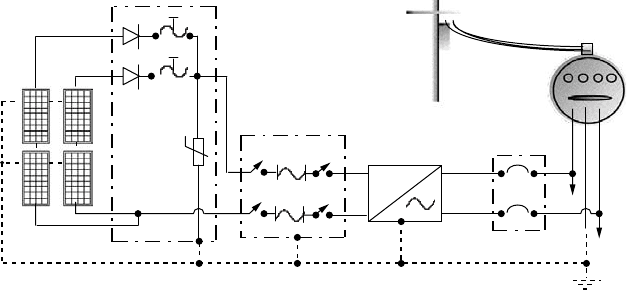
As shown in Fig. 9.20, the principal components in a grid-connected, home-
size PV system consists of the array itself with the two leads from each string
sent to a combiner box that includes blocking diodes, individual fuses for each
string, and usually a lightning surge arrestor. Two heavy-gauge wires from the
combiner box deliver dc power to a fused array disconnect switch, which allows
the PVs to be completely isolated from the system. The inverter sends ac power,
usually at 240 V, through a breaker to the utility service panel. By tying each
end of the inverter output to opposite sides of the service panel, 120-V power is
delivered to each household circuit. Additional components not shown include
the maximum power point tracker (MPPT), a ground-fault circuit interrupter
(GFCI) that shuts the system down if any currents flow to ground, and circuitry
to disconnect the PV system from the grid if the utility loses power. The system
may also include a small battery bank to provide back-up power in case the
grid is down. The inverter, some of the fuses and switches, the MPPT, GFCI,
and other power management devices are usually integrated into a single power
conditioning unit (PCU).
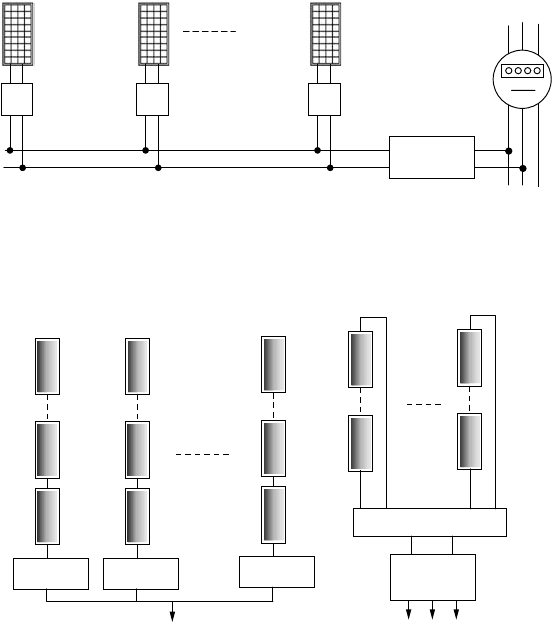
An alternative approach to the single inverter system shown in Fig. 9.20 is
based on each PV module having its own small inverter mounted directly onto the
backside of the panel. These ac modules allow simple expansion of the system,
one module at a time, as the needs or budget dictate. Another advantage is that
the connections from modules to the house distribution panel can all be done
with relatively inexpensive, conventional 120- or 240-V ac switches, breakers,
and wiring. Currently available module-mounted inverters are designed to work
with individual 24-V modules, or with pairs of 12-V modules wired in series.
Figure 9.21 suggests how simple this approach can be.
For large grid-connected systems, strings of PV modules may be tied into
inverters in a manner analogous to the individual inverter/module concept
(Fig. 9.22a). By doing so, the system is modularized, making it easier to service
portions of the system without taking the full array off line. Expensive dc cabling
Inverter
+
−
gnd
Utility
meter
dc
Fuse
Lightning
surge
arrestor
Series strings
of PVs
Combiner box
Breaker
+
−
+
−
Grounded PV frames
=
240-V
ac
Array
disconnect
House
loads
Figure 9.20 Principal components in a grid-connected PV system using a single inverter.
GRID-CONNECTED SYSTEMS 523
24-V
module
dc
120-V ac
Inverter
dc
120-V ac
Inverter
24-V
module
24-V
module
dc
120-V ac
Inverter
Neutral -white
Hot - black
120-V ac
Disconnect
Utility grid
House Loads
Meter
Figure 9.21 AC modules each have their own inverters mounted on the backside of the
collector, allowing simple system expansion at any time.
(a)
(b)
Inverter Inverter
Inverter
To Grid
Combiner
+
−
+
+−
−
3-phase
Inverter
f
a
f
b
f
c
Figure 9.22 Large grid-connected systems may use an individual inverter for each string
(a) or may incorporate a large, central inverter system to provide three-phase power (b).
is also minimized making the installation potentially cheaper than a large, central
inverter. Large, central inverter systems providing three-phase power to the grid
are also an option (Fig. 9.22b).
9.3.1 Interfacing with the Utility
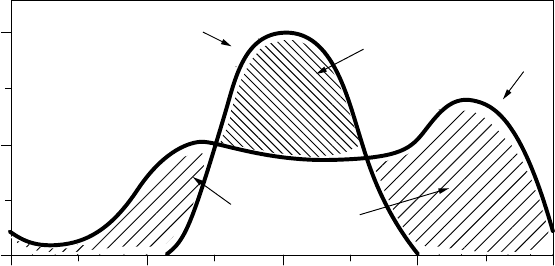
The ac output of a grid-connected PV system is fed into the main electrical
distribution panel of the house, from which it can provide power to the house
or put power back onto the grid as shown in Fig. 9.23. In most cases, whenever
the PV system delivers more power than the home needs at that moment, the
electric meter runs backwards, building up a credit with the utility. At other times,
when demand exceeds that supplied by the PVs, the grid provides supplementary
power. This arrangement, in which a single electric meter runs in both directions,
524 PHOTOVOLTAIC SYSTEMS
0.0
MN 6 am Noon 6 pm MN
1.0
2.0
POWER (kW)
Energy
sold to
utility
Energy bought
from utility
PV Power
Power
used in
home
Figure 9.23 During the day, excess power from the array is sold to the utility; at night,
the deficit is purchased from the utility.
is called net metering since the customer’s monthly electric bill is only for that
net amount of energy that the PV system is unable to supply. For an example
of one version of net metering, refer back to Example 5.2 in Chapter 5. It is
also possible to use two ratcheted meters, one to measure power you sell to the
grid and the other to measure power you buy back from the grid. The two-meter
arrangement is not only more cumbersome, it also can mean that the customer
may have to sell electricity at a wholesale price and buy it back at the utility’s
more expensive retail price. From a PV owner’s perspective, the net metering
approach is usually preferred.
The power conditioning unit absolutely must be designed to quickly and auto-
matically drop the PV system from the grid in the event of a utility power
outage. When there is an outage, breakers automatically isolate a section of the
utility lines in which the fault has occurred, creating what is referred to as an
“island.” A number of very serious problems may occur if, during such an out-
age, a self-generator, such as a grid-connected PV system, supplies power to
that island.
Most faults are transient in nature, such as a tree branch brushing against the
lines, and so utilities have automatic procedures that are designed to limit the
amount of time the outage lasts. When there is a fault, breakers trip to isolate
the affected lines, and then they are automatically reclosed a few tenths of a
second later. It is hoped that in the interim the fault clears and customers are
without power for just a brief moment. If that doesn’t work, the procedure is
repeated with somewhat longer intervals until finally, if the fault doesn’t clear,
workers are dispatched to the site to take care of the problem. If a self-generator
is still on the line during such an incident, even for less than one second, it
may interfere with the automatic reclosing procedure, leading to a longer-than-
necessary outage. And if a worker attempts to fix a line that has supposedly been
disconnected from all energy sources, but it is not, then a serious hazard has
been created.
GRID-CONNECTED SYSTEMS 525
When a grid-connected system must provide power to its owners during a
power outage, a small battery back-up system may be included. If the users
really need uninterruptible power for longer periods of time, the battery system
can be augmented with a generator such as has been suggested in Fig. 9.2.
9.3.2 DC and AC Rated Power
Grid-connected systems consist of an array of modules and a power conditioning
unit that includes an inverter to convert dc from the PVs into ac required by the
grid. A good starting point to estimate system performance is the rated dc power
output of an individual module under standard test conditions (STC)—that is,
1-sun, AM 1.5 and 25
◦
C cell temperature. Then we can try to estimate the actual
ac power output under varying conditions.
When a PV system is put into the field, the actual ac power delivered at 1-sun,
call it P
ac
, can be represented as the following product:
P
ac
= P
dc,ST C
× (Conversion Efficiency) (9.10)
where P
dc(ST C)
is the dc power of the array obtained by simply adding the indi-
vidual module ratings under standard test conditions. The conversion efficiency
accounts for inverter efficiency, dirty collectors, mismatched modules, and dif-
ferences in ambient conditions. Even in full sun, the impact of these losses can
easily derate the power output by 20–40%.
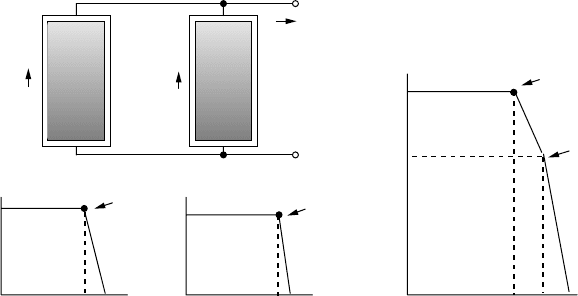
Consider first the impact of slight variations in I –V curves for modules in
an array. Figure 9.24 shows a simple example consisting of two mismatched
6
4230
Current (A)
Voltage (V)
5
4236
Current (A)
Voltage (V)
P
= 180 W
P
= 180 W
11
30 36 420
8
0
Voltage (V)
Current (A)
P
= 330 W
P
= 288 W
+
=
I
1
I
2
I
1
+
I
2
V
Figure 9.24 Illustrating the loss due to mismatched modules. Each module is rated at
180 W, but the parallel combination yields only 330 W at the maximum power point.
526 PHOTOVOLTAIC SYSTEMS
180-W modules wired in parallel. Their somewhat idealized I –V curves have
been drawn so that one produces 180 W at 30 V and the other does so at 36 V.
As shown, the sum of their I –V curves shows that the maximum power of the
combined modules is only 330 W instead of the 360 W that would be expected
if their I –V curves were identical. In addition, not all modules coming off
the very same production line will have exactly the same rated output. Some
100-W modules may really be 103 W and others 97 W, for example. In other
words, production tolerances can reduce array output as well. These two module
mismatch factors can easily drop the array output by several percent.
An even more important factor that reduces module power below the rated
value is cell temperature. In the field, the cells are likely to be much hotter than the
25
◦
C at which they are rated and we know that as temperature increases, power
decreases. To help account for the change in module power caused by elevated
cell temperatures, another rating system has been evolving that is based on field
tests performed as part of an extensive monitoring program called PVUSA. The
PVUSA test conditions (PTC) are defined as 1-sun irradiance in the plane of the
array, 20
◦
C ambient temperature, and a wind-speed of 1 m/s. The ac output of
an array under PTC conditions P
ac(P T C)
is a much better indicator of the actual
power delivered to the building in full sun than is the more commonly used
P
dc(ST C)
. For its PV rebate programs, California, for example, has chosen to use
the PTC rating of collectors.
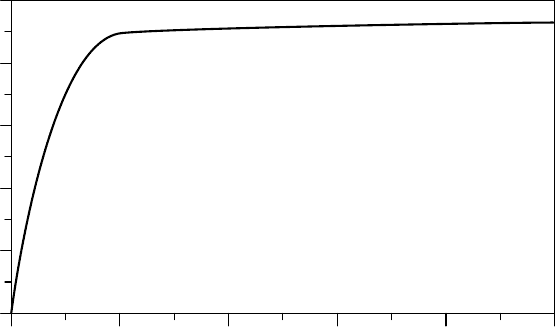
Finally there is the efficiency of the inverter itself, which varies depending on
the load, as is suggested in Fig. 9.25. Good grid-connect inverters have efficiencies
above 90% when operating at all but very low loads.
100806040200
0
20
40
60
80
100
PERCENT OF FULL LOAD
EFFICIENCY (%)
Figure 9.25 The efficiency of an inverter depends on the fraction of its rated power at
which it operates.

GRID-CONNECTED SYSTEMS 527
Example 9.3 Derating a PV Array to a PTC, AC Rating. Consider a PV
array rated at 1 kW under standard test conditions. Module nominal operating
cell temperature (NOCT) is 47
◦
C (see Section 8.6). DC power output at the MPP
drops by 0.5%/
◦
C above the STC temperature of 25
◦
C.
Estimate its ac output under PTC conditions if there is a 3% array loss due to
mismatched modules, dirt loss is 4%, and the inverter has an efficiency of 90%.
Solution. Inserting PTC conditions (ambient 20
◦
C, insolation S = 1kW(m
2
)
into (8.24) gives us an estimated cell temperature of
T
cell
= T
amb
+
NOCT − 20
0.8
· S
= 20 +
47 − 20
0.8
· 1 = 53.8
◦
C
With power loss at 0.5% per degree above 25
◦
C, the dc rated power of the array
would be
P
dc(PT C)
= 1kW[1− 0.005(53.8 − 25)] = 0.856 kW
Including mismatch, dirt, and inverter efficiencies will result in an estimated ac
rated power at PTC of
P
ac(P T C)
= 0.856 kW ×0.97 × 0.96 × 0.90 = 0.72 kW
That’s a pretty sizably reduced indicator of rated power, but it is much more
realistic in terms of actual field experience than the 1-kW dc STC rating that
would often be quoted.
PV systems have been traditionally described in terms of their dc output under
standard test conditions. In the above example, the system would likely be sold
as a “ 1-kW system.” But in that example the array will deliver only 72% of that
as ac power to the load under the much more realistic PTC conditions. It should
probably be called a 0.72-kW(ac) system. And in fact studies of real systems in
the field under PTC conditions suggest that the ratio of P
ac(P T C)
to P
dc(ST C)
may
be lower still. Scheuermann et al. (2002) measured 19 PV systems in California
and found the ratio to be between 53% and 70%.
Whether the ac PTC rating system will be adopted as the standard remains
to be seen. It is much more realistic than the usual STC rating, but it has the
disadvantage of being less easy to define since it depends on the specific inverter
that has been chosen. In the meantime, it should be clear that describing a system
based on its dc performance under STC without also including corrections for
temperature and inverter is misleading. Even the PTC system is crude since it too
is based on arbitrary ambient conditions. In cold climates, for example, where