
Moulson A.J., Herbert J.M. Electroceramics: Materials, Properties, Applications
Подождите немного. Документ загружается.

may be formed together by tape-casting and stacking, or by calendering, and the
stack co-fired. Similarly, the interconnect ceramic may be tape-cast or hot-
pressed. Whichever the approach, the elements of the assembled stack must
make good electrical contact one with the other.
The most challenging technology is concerned with effecting, with the aid of
metals, glasses and glass-ceramics, gas-tight seals at the edges of the stack.
Whichever the sealing technology, serious problems arise because of the
inevitable thermal expansion mismatches and the resulting mechanical stresses
developed during cooling. Apart from immediate failure such stresses can lead to
‘fatigue’ effects (slow crack-growth) and therefore to in-service unreliability over
required working lifetimes of order 10
4
hours. During this lifetime the cell may be
temperature-cycled (from an operating temperature of 700 8C to room
temperature) making further severe demands on reliability, and failure induced
through chemical and electrochemical reactions between the sealants and the
stack ceramics are an additional hazard.
Reliability could be improved by a reduction in working temperature,
maintaining adequate cell conductance. This demands decreasing the electrolyte
membrane thickness, consistent with impermeability to gas molecules and
mechanical soundness, or by using more conductive electrolytes such as
Ce
0.9
Gd
0.1
O
1.95
(see Fig. 4.31). Unfortunately ceria exhibits some electronic
conductivity under the low oxygen potentials encountered in a fuel cell, the
resulting internal partial short-circuiting leading to a small reduction in cell
voltage.
Tubular geometry The following discussion draws specifically on the Siemens–
Westinghouse [13] programme. The arrangement of the cell components is
illustrated in Fig. 4.32(a).
The fabrication of the long (1.5 m) tubular structure starts with the cathode
which is extruded (20 mm dia. and 2 mm wall thickness) with additions to the
lanthanum manganate powder of organics (e.g. starch and cellulose: see Section
3.9) in order to develop the necessary porosity. The tube is sintered in air at
1500 8C. The structure must be chemically stable with respect to the subsequent
processing of the electrolyte, anode and interconnect layers and have compatible
thermal expansivity. It must, of course, have adequate strength to be self-
supporting and also to support the electrolyte and cathode.
The electrolyte (YSZ) layer (40 mm thick) is applied to the cathode by EVD
(see Section 3.6.9). Because this is an expensive route efforts are made to use
more cost-effective methods, for example plasma-spraying and electrophoretic
deposition followed by sintering.
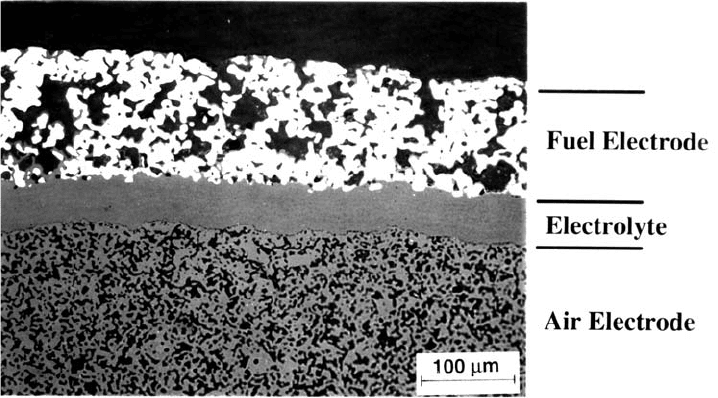
The anode (fuel electrode) consists of an approximately 120 mm thick Ni/YSZ
cermet layer. This is achieved simply by applying a slurry of nickel and YSZ
powders to the electrolyte and sintering. A cross-section of the 3-layer
microstructure is shown in Fig. 4.33.
192 CERAMIC CONDUCTORS
TEAMFLY
Team-Fly
®
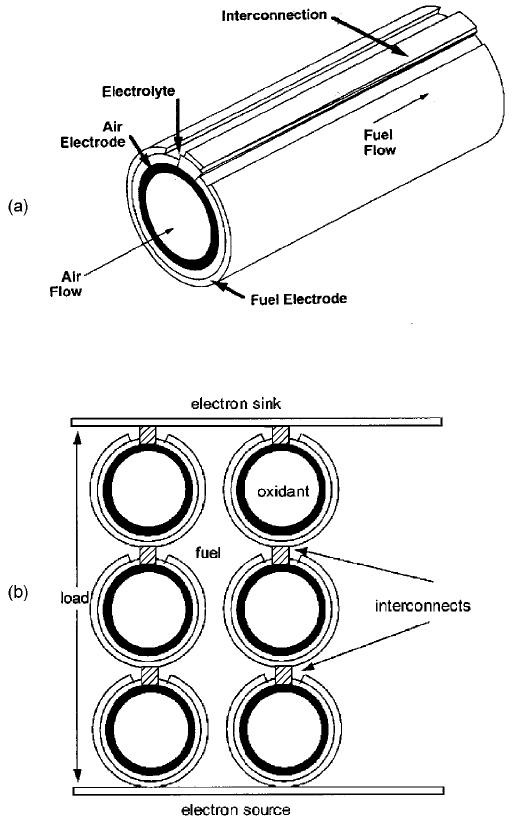
The lanthanum chromite interconnect strip is applied along the length of the
tube by plasma-spraying. Since this is required to pass through the electrolyte
and anode it is necessary to use appropriate masking during their deposition.
The connection between cells is made via a soft nickel felt so that no dangerous
mechanical stresses are placed on the tubes.
The manner in which the separate cells are connected, along their lengths, in a
series/parallel array is shown schematically in Fig. 4.32(b).
FUEL CELLS AND BATTERIES 193
Fig. 4.32 (a) The arrangement of the electrodes in a tubular SOFC [13]. (b) Schematic of a
stack of series/parallel fuel cells. The diagram should be viewed in conjunction with (a).
Operational considerations and forecasts The significant advantage offered
by the Siemens–Westinghouse tubular design is the absence of critical gas-tight
seals. The oxidant (air) is fed into a closed-ended cell tube via a long feed tube
after which it flows in the reverse direction in the annular space between the feed
and cell tubes. The fuel flows in the spaces between the stacked cells towards
their open ends. The 1.5 m long tubes, which are active along almost their entire
lengths, run at a temperature of approximately 900 8C. Some of the emergent
unused oxidant and fuel gases are combusted to pre-heat the incoming air and
fuel, and a part of the unburnt fuel is recirculated. ‘Waste’ heat can be used for
other purposes, for example, district heating, the precise operating conditions
being determined by the specific objectives. Typically the cell voltage is 0.7 V,
depending upon the current drawn. Such systems have been built and operate
successfully delivering about 100 kW of electrical power with negligible
degradation problems.
Recently a 200 kW high pressure (3 atm.) system has been constructed by the
same collaborators and tubular cells have been tested at pressures as high as
15 atm. Operating the system at higher pressures increases the efficiency because
the free energy change, DG, for the oxidation reaction is increased and therefore
so too is the cell voltage (see Eq. 4.33).
The additional advantage is that it allows the hot emergent gases to drive a
turbine and the 200 kW, 3 atm. system is coupled to a small gas turbine
generating 50 kW. The predictions are that such combined cell and gas
turbine systems can achieve overall efficiencies as high as 70% and it seems
194 CERAMIC CONDUCTORS
Fig. 4.33 Microstructure of a cross-section of a Siemens–Westinghouse SOFC. (Reproduced
with the kind permission of S.C. Singhal.)
that the future of the tubular design lies with systems having outputs greater than
1 MW.
A major disadvantage associated with the tubular design is the low power
density (0.3 MW m
3
). There are two main reasons for this. One is the inherent
low stacking density of the individual fuel cells; the other is the high internal
resistance of the cell arising because of the long circumferential paths the current
has to take in the cell tubes to reach the interconnects. A further disadvantage is
cost arising from the rather sophisticated fabrication technologies (EVD)
involved.
The planar format presents many fabrication challenges, as mentioned above,
but the bonus is an estimated power density of approximately 2 MW m
3
and
flexibility for constructing power sources to a required rating. A present objective
is to build a relatively small power (up to 10 kW) module which could be mass-
produced and then integrated with similar modules to meet power requirements
ranging from on-board transport to static, large scale distribution. All the
technologies for fabricating the cell are cheap and suited to mass production. The
electrolyte and interconnect can be tape-cast, calendered or pressed and the
porous electrodes formed by slurry-coating. The major challenge is to achieve a
reliable high temperature edge-sealing technology. However, as is usually the
case, once the problem has been clearly defined a solution will be found, and even
if this is an expensive solution widespread adoption soon lowers the price (the
initially very costly, fully dense alumina tube, later universally exploited in high
pressure public lighting, is a classic example). If it proves possible to successfully
exploit the more highly conducting Gd-doped ceria for the electrolyte then the
lower operating temperatures (500 8C) will very significantly ease the sealing
challenge.
In conclusion, fuel cell technology has to be seen ‘in the round’. The PEM cell
is certainly favoured for automotive power. Its serious drawback has nothing to
do with the cell technology per se, rather with the fact that it runs on hydrogen
and the infrastructure to supply the gas does not exist, at least not to any
significant extent. It can be combined with a fuel reforming plant to produce
hydrogen from a hydrocarbon but then, because the system is ‘cold’, the
incorporation of such a reformer carries with it its own penalties regarding
efficiency. The cell is regarded as a power source for far more than the motor car;
for example it is seen as the candidate for powering lap-top computers, torches
and for any equipment presently powered by batteries. Some projections
envisage the domestic home powered totally from PEM cells.
The intermediate temperature SOFC offers an advantage over the PEM cell of
a predicted higher efficiency, 45–50% compared to 30%. It can also be integrated
with a reformer which, utilizing some of the ‘waste’ heat, produces useable fuels,
(H
2
and CO) from a hydrocarbon fuel.
The tubular technology as described above is suited only to static power-
generation. In contrast the planar format is far more versatile and, especially if it
FUEL CELLS AND BATTERIES 195
could be coupled with a lower operating temperature of approximately 500 8C,
would be a strong candidate for auxiliary power supplies for motor vehicles, for
example to provide air-conditioning when the internal combustion engine is not
running, and for the supply of domestic electricity and heating. For such
applications the stack would be required to reliably withstand many cycles from
room temperature to the operating temperature.
Na/S and Na/NiCl batteries
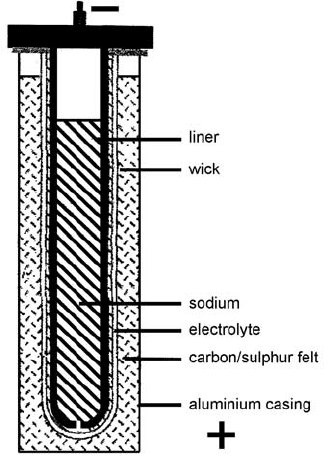
Na/S cell There are various cell designs and details can be found elsewhere [7].
The principle of operation is illustrated in Fig. 4.28 and a schematic of one
design of cell shown in Fig. 4.34. The cell contains just the amount of sodium for
it all to be combined with the sulphur for complete discharge. The small space
between the stainless steel liner and the electrolyte contains a fine stainless steel
mesh which, by capillarity, can raise the height of the liquid sodium which enters
the gap through the small hole at the bottom of the liner. The sodium can be
pulled to a height of at least 200 mm at 300 8C.
196 CERAMIC CONDUCTORS
Fig. 4.34 Schematic of Na/S cell.
Na/NiCl
2
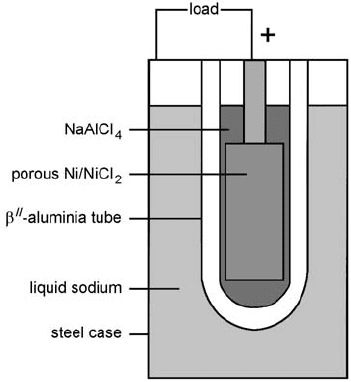
(‘ZEBRA’ cell) To illustrate the principle a schematic of one design
of cell is shown in Fig. 4.35. Cell design and technology have evolved very
considerably and the reader is referred for details to [7] and to the paper by R.C.
Galloway and S. Haslam [14].
One innovative aspect of the ZEBRA technology is that the cell is constructed
with the reaction ‘products’, metallic nickel and sodium chloride in situ; that is
the cell is in the discharged state, greatly facilitating fabrication. The liquid
sodium and nickel chloride are formed by charging the cell.
The NaAlCl
4
is a liquid electrolyte at the normal operating temperature of
270 8C (maximum of 350 8C) of the cell, interfacing both with the porous Ni/
NaCl electrode and the b@-alumina. After assembly the cell is charged, liquid
sodium (melting point 98 8C) being formed. Excess NaCl in the liquid
electrolyte ensures that Na ions are not removed from the solid electrolyte which
would otherwise cause an increase in internal resistance.
In order to increase the active area of the electrolyte and so increase drawn
current capability, the circular section tube has evolved to a convoluted form in
which the cross section has four lobes.
The future for batteries based upon b@-alumina As far as the ‘zero emission
vehicle’ is concerned the foreseeable future depends upon the battery, and there
are competing technologies. In its 1998 report the United States Advanced
Battery Consortium (USABC) identified the following four battery technolo-
gies – the nickel/metal hydride(NiMH), the lithium ion (Li-Ion) and the high
temperature sodium ion batteries (Na/S and the Na/NiCl
2
-ZEBRA) as most
promising as far as meeting the post 2000 performance objectives. Electric
FUEL CELLS AND BATTERIES 197
Fig. 4.35 Schematic of the Na/NiCl
2
‘ZEBRA’ cell (charged state).
vehicles powered by all technologies are running but, of the two based on b@-
alumina, the ZEBRA battery is the most promising.
There are many technical matters to be taken into account in considering the
viability of a particular technology. The specific energy and specific power which,
on a single charging determine respectively travelling range and acceleration and
hill-climbing capabilities, are critical. Another important technical characteristic
is energy density on a volume basis since this, of course, determines the space
occupied by the battery pack. Most importantly for a motive power source there
are ‘safety’ considerations and the sodium-based batteries are posing no
problems in this respect.
Thermal management is also a critical matter. At first sight a comparison
between the high temperature (300 8C) sodium cells and the ambient
temperature NiMH and Li-Ion cells would seem to favour the latter. The
ZEBRA cell must be maintained at the operating temperature even when the
battery is resting. If the battery is out of use for such a time that it cools to
ambient temperature, then recharging has to be a carefully controlled process,
taking a day or more as the battery is raised to its operating temperature.
However there are very significant advantages. The sodium battery is unaffected
by extremes in ambient whereas, in contrast, the near room temperature cells
require elaborate thermal management. As an additional bonus the stored heat is
immediately available for car interior heating or window defrosting.
The battery poses no ‘safety’ problems and is ideally suited to the totally
electric car, van and bus. Batteries can be manufactured with voltages as high as
the 600 V which is standard for many electric buses and trains, and therefore
motors and drive systems are already available. The battery and fuel cell can
work together, the fuel cell being ideally suited to providing a steady power
output and the battery providing the boost necessary for climbing hills and
acceleration. The battery can also provide the power for regenerative braking.
In the ‘series hybrid vehicle’ a ZEBRA battery would complement the internal
combustion engine. This combination could offer pollution-free motoring within
cities, with the more powerful but ‘dirty’ petrol/diesel motive power used for
longer journeys. In the 100 kW h to 10 MW h energy range the batteries would be
suited to load-levelling. The ZEBRA battery is now being mass-produced (MES-
DEA, Stabio, Italy).
4.6 Ceramics-based Chemical Sensors
Ceramic chemical sensors fall into two broad categories, namely those that
exploit solid electrolytes and those that exploit electronic conductors. In all cases
the sensors respond to changes in the chemical environment. The operational
principles and typical applications are described below.
198 CERAMIC CONDUCTORS
4.6.1 Sensors based on solid electrolytes
Sensing oxygen with cubic stabilized zirconia
Potentiometric mode There is no essentially different principle involved from
that on which the fuel cell is based. The distinction is that in the case of the fuel
cell the required output is power whereas with the sensor it is either a small
voltage or small current that monitors some chemical characteristic of the
ambient.
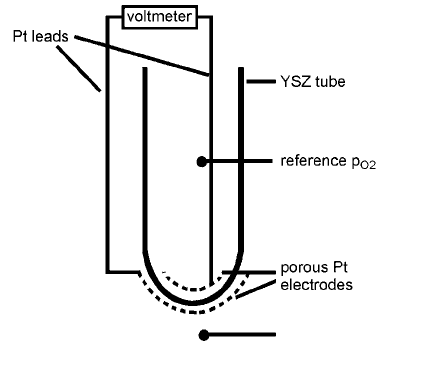
A common type of oxygen sensor takes the form of an yttria stabilized zirconia
(YSZ, see earlier) tube electroded on the inner and outer surfaces with a porous
catalytic platinum electrode. The electrode allows rapid equilibrium to be
established between the ambient, the electrode and the tube. Such a system is
shown schematically in Fig. 4.36.
It is usual to write the electrochemical cell in the form
p
0
O
2
ð‘test’), PtjYSZj Pt, p@
O
2
ðreferenceÞ
in which p
0
O
2
and p@
O
2
are partial pressures.
Platinum catalyses the dissociation and recombination of the oxygen
molecules so that O
2
ions can be formed at one electrode and converted to
O
2
molecules at the other. The e.m.f. developed by such a cell is given by the
Nernst equation (see Eq. (4.33)). In the present case z ¼4 because an oxygen
molecule consists of two atoms each acquiring two electrons on being ionized.
Hence, the equation becomes
E ¼ RT=4F flnðp@
O
2
=p
0
O
2
Þg (4:38Þ
CERAMICS-BASED CHEMICAL SENSORS 199
Fig. 4.36 Schematic diagram of a solid electrolyte probe for the measurement of oxygen
partial pressures (or chemical activities).
‘test’ p
O
2
or, more correctly
E ¼ RT=4F flnða@
O
2
=a
0
O
2
Þg (4:39Þ
where a@
O
2
and a
0
O
2
are the chemical ‘activities’. (In writing the partial pressures
the assumption is being made that the gases are behaving as ideal.)
YSZ oxygen sensors are used to monitor automobile exhaust gas emissions so
that the fuel-to-air ratio can be kept at the optimum from the point of view of
both pollution and engine efficiency. Pollutant gases generated by the internal
combustion engine include CO, hydrocarbons and oxides of nitrogen (NO
x
).
Catalytic converters in the engine exhaust line are able to oxidize the CO and
hydrocarbons to CO
2
and H
2
O, and reduce the NO
x
gases to N
2
provided the
catalytic unit is operated close to the l* (lambda) ¼1 point, defined as the
condition when precisely the correct amount of air (the ‘stoichiometric’ amount)
is involved in the combustion to completely oxidize the fuel.
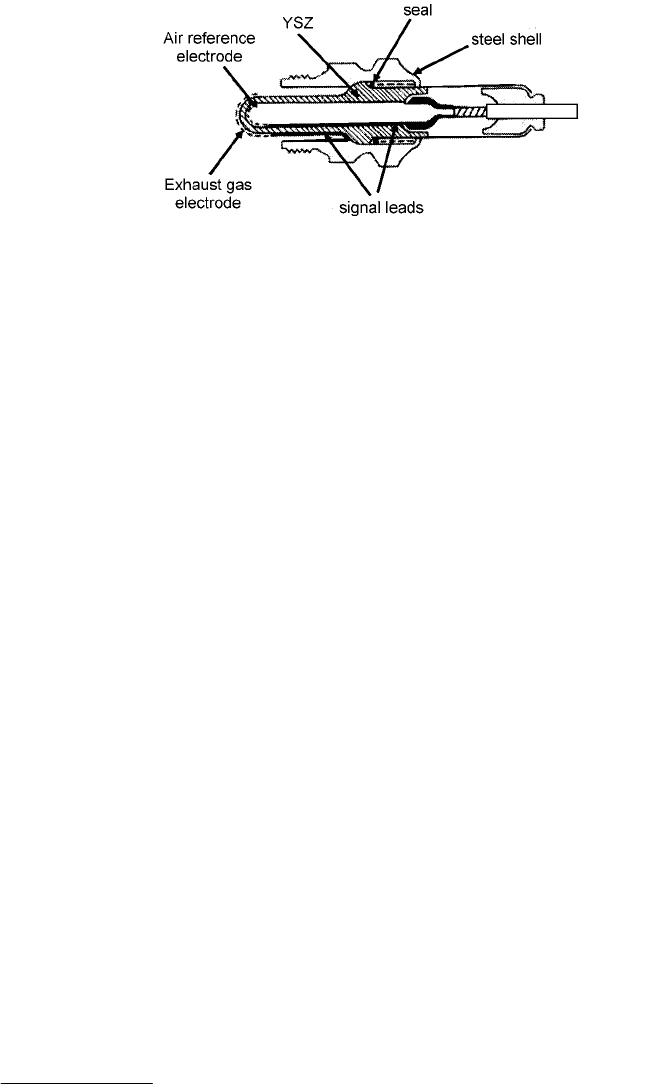
The general form of a ‘lambda’ sensor is illustrated in Fig. 4.37. The closed end
projects into the hot exhaust gas stream heating the sensor to a temperature at
which it is sufficiently conductive for the e.m.f. to be measured by a high
impedance meter. The input impedance of the meter must be 100 times that of
the cell for 1% precision. Corrections for changes in cell temperature (Eq. (4.38))
can be made by monitoring the cell resistance.
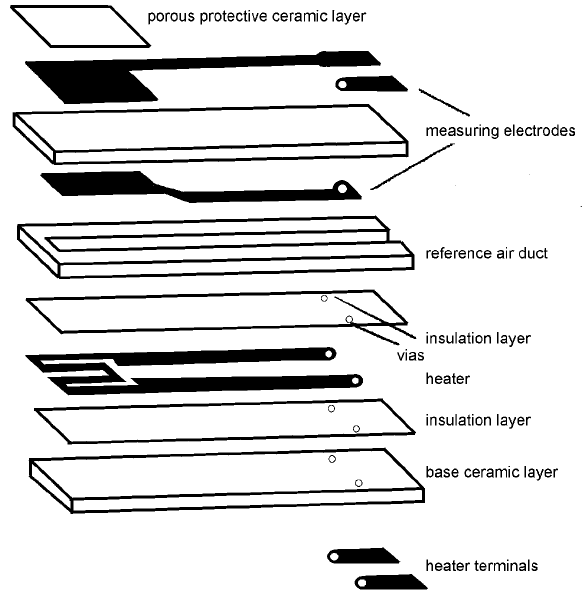
A planar format lambda sensor offers significant economic advantages over
the tubular design. An exploded schematic of such a sensor for monitoring
exhaust gases is shown in Fig. 4.38. It is manufactured by essentially the same
ceramic fabrication technology as developed for multilayer circuits (see Section
5.4.3). The various metallic parts are printed onto tape-cast ‘green’ ceramic-
loaded sheets, the interconnections being made through vias. The assembly is
laminated and finally co-fired. The completed sensor is housed in a manner
similar in its essentials to that illustrated in Fig. 4.37.
200 CERAMIC CONDUCTORS
Fig. 4.37 Form of a ‘lambda’ automobile exhaust sensor (the forms may vary from model to
model but the essentials are the same).
* l ¼the ‘operating’ air : fuel ratio/the ‘stoichiometric’ air : fuel ratio.
In the case of the lambda sensor the YSZ needs to have adequate mechanical
strength to withstand vibrations etc. Partially stabilised zirconia (PSZ) ceramic is
a mix of tetragonal and monoclinic crystals and exhibits exceptionally high
fracture-toughness. For this reason a compromise is reached at approximately
4 mol.% yttria addition which produces the high toughness PSZ at the same time
offering adequate ionic conductivity.
Another important application is in the refining of steels when the oxygen
content must be controlled at the parts per million level and monitored
continuously ‘on line’ and many oxygen sensors are currently used in the steel
industry for this purpose. The principle of operation is as described for the
lambda sensor and one form is shown schematically in Fig. 4.39. In this case the
reference activity is established by a chromium metal/chromium oxide mix rather
than being defined by air.
Essentially the sensor comprises an YSZ element one side of which is in
contact with the steel melt and the other with the metal–metal oxide reference
mixture. The steel serves as one electrical contact to the zirconia and the
CERAMICS-BASED CHEMICAL SENSORS 201
Fig. 4.38 Planar sensor format (adapted from the Automotive Electronics Handbook, 1994).