
Moulson A.J., Herbert J.M. Electroceramics: Materials, Properties, Applications
Подождите немного. Документ загружается.

It is necessary to maintain close control over temperature because of its effect
upon the base resistance of the semiconductor. With a platinum heater this can
be effected to 0.1 8C through monitoring the resistance of the heater itself
using a Wheatstone bridge. The relatively high temperature coefficient of
resistivity of RuO
2
complicates the control system.
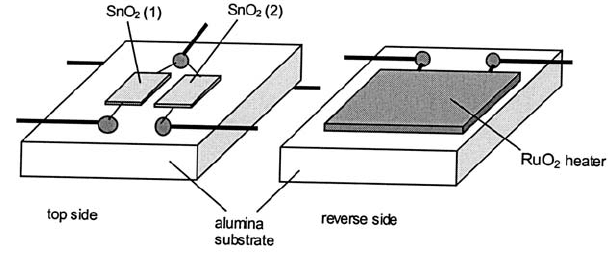
A sensor (Fig. 4.49) under development for monitoring and activating control
over the air quality in automobile cabins well illustrates the status of present-day
technology, and how thick-film circuit fabrication technology is exploited. The
target gases are CO and NO
2
emitted from petrol and diesel engines respectively.
The SnO
2
is doped with Fe
2
O
3
to increase NO
2
sensitivity and with V
2
O
5
and Pd
to enhance sensitivity to CO. The heater pad is RuO
2
. The two sensing areas have
a covering of porous silica to maintain cleanliness. The measured sensitivity to
NO
2
is 0.5 p.p.m. and to CO 30 p.p.m., and the long-term stability is good.
212 CERAMIC CONDUCTORS
(a)
(b)
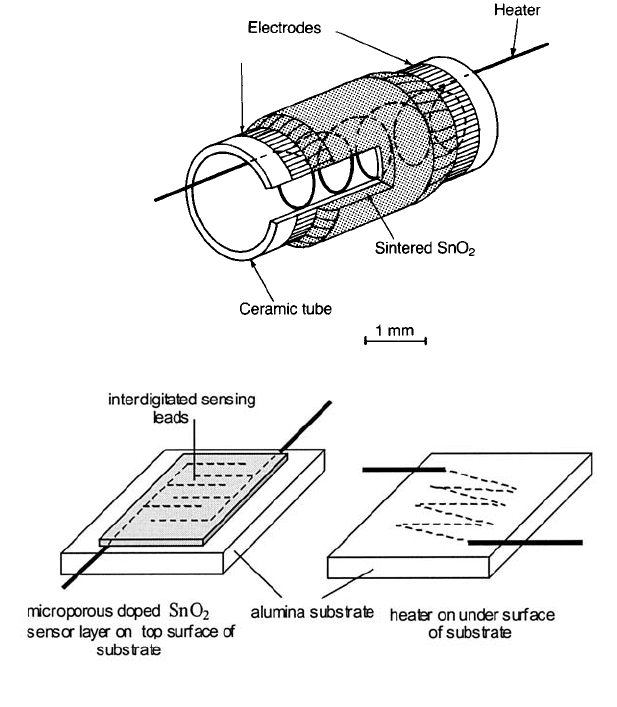
Fig. 4.48 (a) The classic ‘Taguchi sensor’; (b) the typical screen-printed planar format.
TEAMFLY
Team-Fly
®
There is a wide variety of chemical sensor systems developed for specificity
to certain gases and vapours. For example WO
3
-based sensors for O
3
and
NH
3
,In
2
O
3
/SnO
3
for NO and SnO
2
/Al
2
O
3
for H
2
S. A comprehensive list is
given in [28].
Apart from chemical factors, the detailed physical form of the sensor can have
an important influence on selectivity. It is apparent from Fig. 4.48(b) that the
target gas has to diffuse through the microporous sensor material towards the
sensing electrodes. The gas flow will depend upon the mean free path of the gas
molecules in relation to the diameter of the channels in the solid. The mean free
path of gas molecules usually present in a functioning sensor will be of the same
size order as the channel sizes making the gas interdiffusion process a difficult
one to model mathematically. There will certainly be gas concentration gradients
across the sensor thickness, and different gradients for different gases. A graded
microporosity, readily accomplished via screen-printing is a route to influencing
selectivity.
The effective thickness of sensing material overlying the electrodes will depend
upon the electrode spacing, the electric field between the electrodes penetrating
more deeply into the sensor layer the more widely spaced the electrodes. Electrode
spacing is, therefore, an important design parameter which can influence
selectivity. Indeed, varying the electrode spacing can be used as a research tool
to probe the processes ongoing through the depth of the sensor layer.
Water vapour is an inadvertent and very variable ‘contaminant’ in most
sensing situations. The operating temperature of the sensor eliminates the risk of
the involvement of water molecules at the semiconductor surface but not that of
hydroxyl groups. In the case of the SnO
2
-based sensor it seems that OH
behaves
in much the same way as O
so that the effect of the presence of water vapour
can be large. The effects in the case of the Cr
2
O
3
/TiO
2
(p-type) sensor system are
far less marked, for reasons yet to be elucidated [30].
CERAMICS-BASED CHEMICAL SENSORS 213
Fig. 4.49 Twin tin oxide-based sensors for monitoring NO
2
and CO in automobile passenger
compartments. NB: alumina substrate size approximately 22.60.254 mm. (Adapted from
Oto, K. et al. (2001), Sensors and Actuators, B77 , 525–8.)
It is apparent that with so many variables the approach to designing effective
sensors has to be essentially empirical but, nevertheless, one founded on a
working understanding of the underlying basic sciences.
At the research level there is interest in thin film sensors. Thin films, typically
100 nm thick, of doped tin oxide can be deposited by sputtering, evaporation,
sol–gel, etc. when subsequent annealing leads to the development of a
nanocrystalline porous structure. Although ‘thin’ film technology, in comparison
with thick film technology, would appear to offer the advantage of relatively
lower production costs because of the avoidance of powder and screen-printing
paste processing steps, there are drawbacks. Thin films offer a much smaller
reactive area than sintered thick film ceramics and so the sensitivity of sensors
fabricated from them is correspondingly lower; for the same reason they are
more susceptible to surface contamination.
The established and potential applications of ceramic gas sensors are many
and varied. Principal among them is CO sensing because of the highly toxic
nature of the gas. It is also the gas given off in the early stages of a fire and so its
detection can give warning of an impending fire in, for example, computer areas
and television sets, and of smouldering cables in electrical equipment generally.
The installation of gas sensors to warn of gas leaks and the attendant risk of
explosion is increasing in the developed world, especially in situations where
bottled gas is stored, for example in caravans, trailers and boats. In the UK it is
becoming commonplace to install them in homes along with smoke alarms.
By responding to fumes in cooking areas, car parks, laboratories and similar
places, gas sensors can be used to control ventilation fans. In industrial situations
the sensor can monitor concentrations of carbon monoxide, ammonia, solvent
vapours, hydrocarbon gases, ozone etc., and because of the growing conscious-
ness of environmental pollution and the safety aspects of industrial processes the
applications will multiply.
Gas sensors are being employed to characterise the ‘noses’ of perfumes, fruits,
wines and other foodstuffs and to measure the effectiveness of deodorants. The
range of sensor types and applications is expanding at a remarkable rate with the
term ‘electronic noses’ introduced to describe the technology.
Semiconducting lambda-sensors based on titania have been developed and
used for car engine management. However for a variety of reasons, one being
sensitivity to surface contamination, the electrolytic sensor dominates.
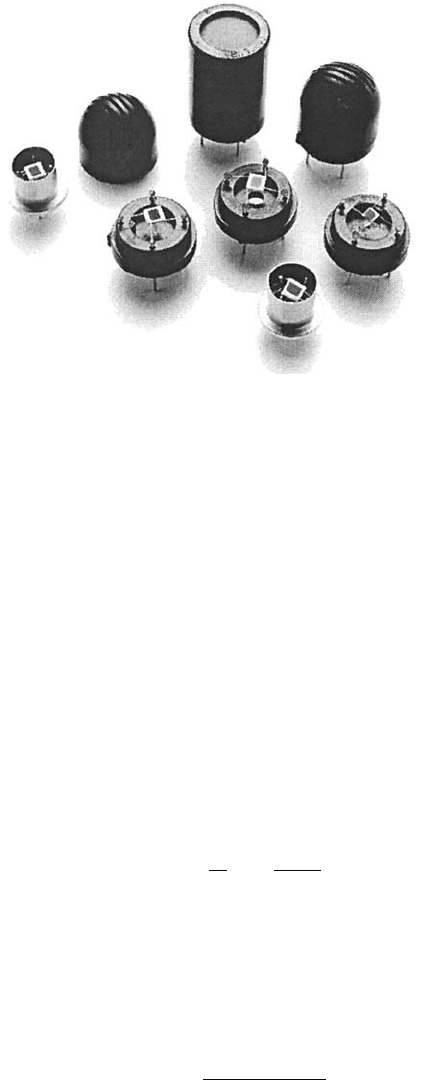
A variety of commercial gas sensors is illustrated in Fig. 4.50.
4.6.3 Humidity sensors
Almost all ceramics that contain interconnected porosity exhibit a fall in resistivity
when exposed to humid atmospheres at normal ambient temperatures. Water is
adsorbed from low-humidity atmospheres by most oxide surfaces when it
214 CERAMIC CONDUCTORS
dissociates, with OH
attaching itself to a surface cation and the hydroxonium ion
H
3
O
þ
attaching itself to a surface O
2
ion. Movement of the ions to alternative
sites under the influence of a field gives an initial reduction in resistivity. With
increased humidity further layers of water are adsorbed and the high electrostatic
fields resulting from the surface states lead to a far greater degree of dissociation
than in liquid water and therefore to a further reduction in resistivity. At high
humidities liquid water may condense in the pores as a result of the curvature of
the liquid surface induced in the confined space by surface tension.
The formation of liquid depends on pore diameter, surface tension and the
contact angle between the solid, liquid and gas phases. The last factor is difficult to
estimate in general but is likely to be close to zero between water, humid air and a
surface consisting of adsorbed water. It can be deduced that, when the contact
angle is zero, the vapour pressure p in equilibrium with a concave liquid meniscus
relative to the vapour pressure p
0
in equilibrium with a flat surface is given by
ln
p
0
p
¼
2gV
m
R
0
Tr
ð4:51Þ
where g is the surface tension, V
m
is the molar volume of the liquid, R
0
is the gas
constant, T is the temperature and r is the radius of curvature of the meniscus.
Since the humidity h is 100p=p
0
and the diameter d of a pore in which water will
condense is given by d ¼ 2r, the relation between pore diameter and humidity
leading to condensation is
d ¼
4gV
m
R
0
T lnð100=hÞ
ð4:52Þ
CERAMICS-BASED CHEMICAL SENSORS 215
Fig. 4.50 A selection of commercial gas sensors. The alumina tile carrying the sensor is
approximately 33mm
2
. An activated charcoal filter may be mounted inside the top of the
housing. (Courtesy of City Technology Ltd.)
If g ¼ 0:073 N m
1
, V
m
¼ 0:018 10
3
m
3
, T ¼ 293 K and R ¼ 8:315 J K
1
mol
1
,
d is approximately 3 nm when h ¼ 50% and approximately 42 nm when h ¼ 95%.
It is therefore evident that condensation will occur only at the narrowest points in
the microstructure, i.e. in the ‘neck’ regions.
The speed of response of a humidity element will depend on the rate of
diffusion of the ambient atmosphere into the pores of the sensing element. The
element must therefore be thin in section and may contain a system of larger
pores to reduce the length of the finer pore pathways into which gas must
penetrate. Electrodes covering major surfaces must be porous.
The response of the surfaces of the element to moisture must remain constant,
and in practice this is one of the most difficult conditions to meet. Over a period
of time the adsorbed molecules are thermally activated to the lowest-energy sites
and the response to a change in humidity may then be either sluggish or
permanently altered. Furthermore, molecules other than water may be adsorbed
increasingly with the passage of time, modifying the response to moisture. One of
the most effective solutions to this problem is periodically to heat the sensor to a
temperature of 500 8C so that the surface is restored to a reproducible state.
One of the advantages of ceramic over organic elements is that they can be
repeatedly reconditioned in this way.
A sensor developed to detect the moisture content of the atmosphere in a
microwave oven and so indicate the onset of the cooking process serves to
illustrate the principles. The sensing element consists of a solid solution of TiO
2
in MgCr
2
O
4
with a minor phase of MgTi
2
O
5
. It is formed by mixing the
constituent oxides, pressing them into compacts 0.25 mm thick at the relatively
low pressure of about 70 MPa (about 10
4
p.s.i.) and firing for several hours at
about 1350 8C to yield a sintered body with, typically, 35% porosity. The
electrodes are RuO
2
with the minimum amount of added glaze for adhesion so
that the layer is porous.
MgCr
2
O
4
is a normal spinel with Mg
2þ
ions on tetrahedral sites and Cr
3þ
ions
on octahedral sites. 30 mol.% TiO
2
can be incorporated without losing the spinel
structure. It is thought that Ti
4þ
and Mg
2þ
ions occupy neighbouring octahedral
sites, and the excess charge is compensated by the formation of Cr
2þ
ions which
occupy tetrahedral sites. It is a p-type semiconductor, although this does not
appear to be relevant to its behaviour as a humidity sensor, in contrast with its
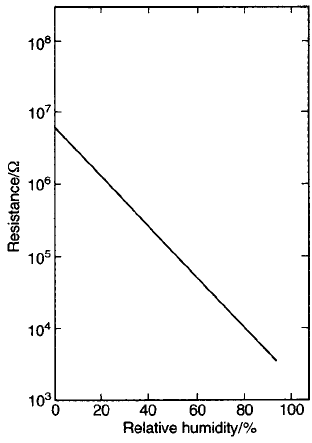
behaviour as a gas sensor discussed above. Typical resistance–humidity
characteristics are shown in Fig. 4.51. It is believed that the high charge on
the Cr
3þ
ions exposed in the pore surfaces promotes the adsorption and
dissociation of water molecules according to
2H
2
O Ð H
3
O
þ
þ OH
ð4:53Þ
leading to the conduction mechanism outlined above. The resistance increases
irreversibly when the element is exposed to high humidities for prolonged
216 CERAMIC CONDUCTORS
periods. This may be due to reduced dissociation in the adsorbed layer as the
ions reach lower energy sites.
In practice the sensor is a plate 4-mm square mounted within a heater coil, and
its characteristic is periodically restored to the standard state by heating to
450 8C for a few seconds.
4.7 High Transition Temperature Superconductors
4.7.1 Overview
The following extract from a paper [31] published in 1968 makes interesting
reading in the light of subsequent developments.
Industrial interest in a physical phenomenon lies in a ‘quality’ or ‘outstanding
feature’ of that phenomenon. And in fact, the absence of electrical resistance
unlocks a wealth of new possibilities. Although the highest transition temperature
so far found is still as low as 20.05 K, the possibility of using underground cooled
superconducting cables for electricity supply in certain densely populated areas
such as London is already being seriously examined to see what advantages it
might offer. There is also interest in the use of superconducting elements for logic
circuits (‘cryotrons’). Some very interesting possible uses include superconducting
magnet coils which can be used to give very high magnetic fields, sometimes with
flux densities greater than 10 Wb/m
2
(100 000 gauss) over volumes large enough to
HIGH TRANSITION TEMPERATURE SUPERCONDUCTORS 217
Fig. 4.51 Resistance versus humidity for MgCr
2
O
4
þ 30 mol.% TiO
2
.
be of interest in technical applications. One wonders how many other even more
impressive changes in electrical technology are to be expected if superconducting
materials with a transition temperature of 50 or 100 K are ever produced . . .
Nevertheless, it is to be expected that, even if superconductors with transition
temperatures well above 20 K are never found, superconductivity will still find its
applications in technology.
Since then there has been the totally unexpected breakthrough with the
superconducting ceramics operating comfortably at liquid nitrogen temperature
(77 K), and stimulating intensive R&D efforts in the US, Japan and Europe.
Probably the most obvious application for superconductors is in the
transmission of electrical power and it seems that that this is close to being a
reality. There are many other potential applications in the power electrical
engineering field, for example power generators, motors, transformers, leads and
fault current-limiters.
An important and established application is for electromagnets for nuclear
magnetic resonance (NMR) widely exploited as a research tool, and for its
medical counterpart, magnetic resonance imaging (MRI), a powerful medical
diagnostic tool. Strong magnetic fields are also essential for high-energy particle
accelerators for nuclear research.
Until superconducting magnets became available the generation of magnetic
fields of 10 MA m
1
(approximately 12 T in air) involved power dissipation of
order 1 MW in the windings. Not only did such a magnet require a large power
source (a large power station generator delivers about 600 MW) but most is
dissipated as heat which had to be removed by coolants. Superconducting
magnets exploiting Nb–Ti and other intermetallic compounds have been used for
many years, and it is now commonplace to produce fields of 12 T in quite
compact and easy to run electromagnets.
Exploiting the magnetic fields generated by superconducting coils, and also
those resulting from trapped magnetic induction within a superconducting bulk
material, is a very active R&D field. Frictionless bearings and magnetic levitation
for transport systems are among the many objectives.
For ‘superconducting electronics’ interest is focussed on materials in thin film
form, the major objectives being to achieve faster computers and improved
communications systems. Signal transit times are reduced by using super-
conducting interconnects, and the Josephson junction is the basis of a bistable
logic device. In communications technology superconducting filters and
antennae offer significantly improved selectivity and sensitivity.
4.7.2 The phenomenon of superconductivity
The following summary of the essentials of the phenomenon and theory of
superconductivity serves to introduce terminology and permits the ‘high
transition temperatures (T
c
) superconductors’ (HTSs) to be seen in a historical
218 CERAMIC CONDUCTORS
perspective. The texts by G. Vidali [32] and V.Z. Kresin and S.A. Wolf [33] are
recommended for supplementary reading.
The history of superconductivity has its origins in the experiments of H.
Kamerlingh Onnes who in 1908 at the University of Leiden succeeded in
liquefying helium and reaching temperatures down to 1 K. In 1911, while
pursuing the study of the electrical resistivity of metals at these very low
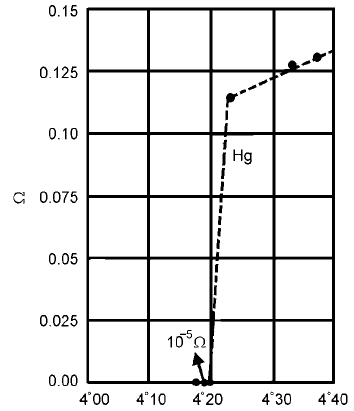
temperatures, he discovered superconductivity in mercury. As the temperature
was reduced the resistivity fell sharply at about 4 K and at the T
c
, fell to zero as
shown in Fig. 4.52. A current induced in a superconducting loop circuit has been
observed to persist without decay for over 2 years, setting an upper limit on the
resistivity of 10
28
O m; for practical purposes this is zero resistivity.
Since 1911 superconductivity has been observed in many metallic elements and
intermetallics, principal among them being tin (3.7 K), tantalum (4.5 K), lead
(7.2 K), niobium (9.3 K), Nb
3
Sn (18 K) and Nb
3
Ge (20.9 K).
There are two types of superconductor, Type I and Type II, characterized by
the way in which they respond to an applied magnetic field.
If a Type I superconductor such as lead is placed in a small magnetic field (e.g.
a few mT) and cooled, then at T
c
the magnetic field is expelled from the interior
of the specimen. This is the Meissner effect, which is fundamental to the
superconducting state; it is not simply characteristic of a material which happens
to be a (fictitious) perfect conductor. The total absence of an electric field in a
HIGH TRANSITION TEMPERATURE SUPERCONDUCTORS 219
Fig. 4.52 Resistance of mercury versus temperature. (After H. Kammerlingh Onnes (1911)
Akad. van Wetenschappen, Amsterdam, 14, 113, 818. Taken from Introduction to Solid State
Physics, C. Kittel, John Wiley, Chichester, 1986, p. 318.)
material having zero resistivity only demands that the magnetic induction (B)is
constant, not necessarily zero.
Because in the presence of an applied magnetic field the interior of the
superconductor has zero magnetic induction it can formally be described as a
perfect diamagnet (see Section 9.1.5). The ‘diamagnetic effect’ is of course not
due to a distribution of diamagnetism throughout the volume, but arises because
of ‘screening currents’ which flow in the very near surface region of the
superconductor. The externally applied magnetic field penetrates the super-
conductor to a small depth l, characteristic of the particular superconductor.
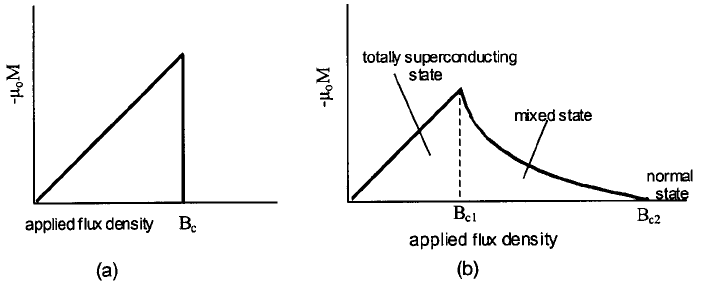
Below T
c
the applied magnetic field can be increased up to a critical value B
c
,
when the superconductor changes to the normal state. This behaviour is
characteristic of a Type I superconductor.
In the case of a Type II superconductor below its T
c
, the applied magnetic
induction is totally excluded until a critical value B
c1
is reached when some
flux penetration occurs through filaments known as flux vortices. The filaments
are of normal, that is non-superconducting material, and carry a magnetic
flux. The flux is quantized, the single quantum, a fluxon, being of magnitude
h/2e ¼2.067810
15
Tm
2
. The filament itself is surrounded by screening currents
as a magnetic field along the axis of a solenoid is surrounded by circular currents
(see Section 9.1.2). The material is therefore in a ‘mixed’, superconducting/
normal state. As the applied flux density is increased so the penetration increases
until at an applied flux density B
c2
the material as a whole becomes normal.
The different behaviours are illustrated in Fig. 4.53(a) and (b). Some of the
alloys, for example Nb
3
Sn (18 K), and all the high temperature superconductors
are Type II.
Because useful currents carried by a Type I superconductor generate magnetic
fields it follows that there are also critical current densities J
c
, corresponding
to the critical applied magnetic fields. In a Type II superconductor the
220 CERAMIC CONDUCTORS
Fig. 4.53 The induced magnetic moment (m
0
M) as a function of applied field for (a) a Type I
superconductor and (b) a Type II superconductor.
situation is complicated by the extent of flux ‘pinning’ discussed in Section 4.7.4
below.
These are the essential phenomenological characteristics of superconductivity.
The first significant step in a theoretical interpretation was taken in 1950 when H.
Fro
¨
hlich and J. Bardeen showed that electron–phonon interactions are capable
of coupling two electrons together as if there is a direct attractive force between
them.
In 1956 L.N. Cooper published a theoretical analysis describing the addition
of a single electron pair to a normal metal at 0 K. This showed that if there is an
attraction between the two electrons, however weak, their combined energy is
always less than that of normal conduction electrons in their highest energy state,
the Fermi energy. In 1957 J. Bardeen, L.N. Cooper and J.R. Schrieffer extended
Cooper’s treatment to a large population of interacting electrons and showed
that they would form an assembly of so-called ‘Cooper pairs’. This has become
known as the ‘BCS theory’.
Cooper pairs move in the ‘classic’ superconductors in such a way that at
equilibrium their combined momenta is unchanged; whatever momentum change
one of the pair suffers due to interaction with a phonon, the change produced in
the partner is equal and opposite. Therefore phonon scattering has no net effect
on the forward momentum of the electron population accelerating in an electric
field. Because electron–phonon interactions are also responsible for electrical
resistance at normal temperatures, it is not surprising that relatively stable
Cooper pairs are found in poorly conducting metals with corresponding
relatively high values of T
c
. The energy required to split up a Cooper pair at
0 K is of the order of kT
c
(actually 1.8 kT
c
).
Fro
¨
hlich also predicted the so-called ‘isotope effect’ which associates a higher
T
c
with light isotopes of a metal than with heavier isotopes. This seems
reasonable since the lighter the atom the more easily it is moved and therefore
able to couple to the electron motions. The BCS theory explains the isotope effect
in terms of phonon frequencies.
Although the BCS theory offers an explanation for the behaviour of
superconductors known prior to 1986 it is generally not applicable to the high
temperature ceramic superconductors. In fact the BCS theory predicts a
maximum T
c
of approximately 30 K and this has now been comfortably passed.
It is surprising that, despite intensive efforts over more than 15 years, there is still
no generally accepted theory to explain the mechanism of high-temperature
superconductivity. However, it is believed that whatever theory is finally
accepted it will involve paired electrons, although the pairing mechanism may
well differ from that invoked in the BCS theory.
W.L. Ginzburg and L. Landau developed a phenomenological theory, the ‘GL
theory’, which makes no assumptions concerning the basic mechanism
responsible for superconductivity. In this respect the approach is similar to the
Devonshire phenomenological theory as applied to ferroelectrics (see Section
HIGH TRANSITION TEMPERATURE SUPERCONDUCTORS 221